A Thing Remembered from Teaching

I had occasion to write recently something that brought to mind for me some of the better days of my teaching, back when I had hope that I would have a secure teaching job and still had reason to think that I did a good job of it. It reminded me of a couple of things, actually, and I might write about the other one later–but the thing that came to mind first was the idea of students–of people, really–saying that they “don’t care.”

This is the kind of thing I was talking about. Dig in!
Image from Niteowlneils on Wikipedia, used for commentary and in what I believe is alignment with a Creative Commons license.

Now, the simple fact of making such a remark carries some certainty of care; it is an expenditure of time and effort to make such a statement, and expending them is not something done without some regard for the thing on which they are expended. The performance is itself an indication of caring; it is an instantiation of it, however small a thing it is. And it is a statement that tends to prove false quickly after being challenged, as I suspected and found when I was teaching at a technical school in Midtown Manhattan, back when I did such things in such places.

One session among the several I taught–and I did a lot of teaching, covering six or more sections of two or three courses in each of three fifteen-week terms at the institution, for which I was well compensated thanks to a strong and heavily integrated union–I fell back on an idea I had had the good fortune to learn early on in graduate school. Namely, I aligned my writing exercises–yes, following the not-too-apt generic model of composition classes because of institutional policies (because I did rather appreciate my paychecks) with problems I have spoken to, and others besides–along a single theme. One session, it was music; another, citizenship (I did try to be socially aware and engaged).

The first session I did it, though, I did it with food. I figured that all of my students ate, so they would all have material with which to work–and it was New York in which I was teaching, so there was no shortage of food to get and comment about. Given my own love of eating, and my then-budding enjoyment of cooking–my family uses it as bonding, among other things; cooking together helps us be together–I had some passion for the subject, and I figured that my students would have something similar.

Of course, there was the one student that is in every course at every school, it seems: the contrarian. And the one that session told me that he didn’t care what he ate; for him, he said, food was fuel and nothing else, not to be enjoyed or savored, but to be consumed and forgotten. (I am paraphrasing, of course; it’s been ten years or so, after all.) But I was still quick on the uptake then, as I am not so much anymore, and ready to reply with a riposte to a thrust of wit I was confident I could turn aside.

I asked the student if, since he did not care what he ate, why he spent money on food instead of fishing restaurants’ leavings out of dumpsters, where they could be gotten for free. After all, if it was not to be enjoyed or savored, but only to be consumed and forgotten, and the food still sound, why not? Or even if it was not quite sound, because, hey, he didn’t care, right?

He didn’t have an answer for me then. He did, however, have a paper for me when it was due, and I don’t recall that it was a bad one.

Did I bring you as much pleasure as a slice of pizza? Could you kick in the cost of one for me so that I can keep doing this? Click here, then, and thanks!

A Robin Hobb Rereading Series: Entry 112: Ship of Magic, Chapter 11

Read the previous entry in the series here.
Read the next entry in the series here.


The following chapter, “Consequences and Reflections,” opens with Althea consulting the Bingtown equivalent of an attorney regarding the terms of her father’s will. They are, unfortunately, clear, and clearly not in her favor. She also asks about Kyle’s oath about ceding the Vivacia to her if she could present proof of her honest sailor’s skills; her interlocutor notes that it would likely work, but counsels her against pursuing the action.

Disconcerting?
-Amber- by AngellaMireille on DeviantArt, used for commentary

After Althea leaves, she fumes, musing on her situation, and determines that she will not live on her sister’s charity. She also calls upon the Vivacia at the docks, reminiscing on the status of women among sailors as she does so. As she begins to confer with the ship, she realizes that she can feel Wintrow at work aboard her–and that his suffering marks the ship, to its potential future peril. When she is interrupted by Torg, she sits upon her anger and counsels the ship to set it aside; the ship does not, but acts against the mate.

As Althea leaves, promising to return to the ship, she wonders about the ship’s intentions and harbors dark thoughts of her own. She also has an uncomfortable encounter with Amber, though the two exchange no words, and there is no hostility made manifest between the two. After, she eats and gives thought to how she will proceed afterward, being unwilling to accept more of her family’s charity, and she begins to realize how dire her family’s situation is. She also gives more thought to the Vivacia and her nascent development, comparing her to other notable liveships–including the Paragon, whose history she rehearses in part; the part is tragic enough.

After the meal, she sends a note to Ronica and walks out amid the shops selling goods from up the Rain Wild River. She sees Amber again, at her shop this time, and considers her situation again before making her way towards the beached Paragon.

The story of the Paragon that Althea rehearses is, as noted, a tragic one, the more so given that it depicts the ship as having come into consciousness amid fear and pain. Death has already been established as necessary to quicken a liveship–three generations of a single bloodline–with implications that the Liveship Traders novels do begin to investigate, but there is a patent difference between lives ending of old age and its often-associated infirmities and the calamities that befell those whose lives quickened the Paragon. It is hardly to be wondered at that a consciousness that forms amid such trauma would have problems, as ascertained by the standards generally applied. (How apt the application is is something with which the books concern themselves later.) The repeated traumas clearly do not help, either.

Help me recover from the weekend’s holiday?


A Robin Hobb Rereading Series: Entry 111: Ship of Magic, Chapter 10

Read the previous entry in the series here.
Read the next entry in the series here.


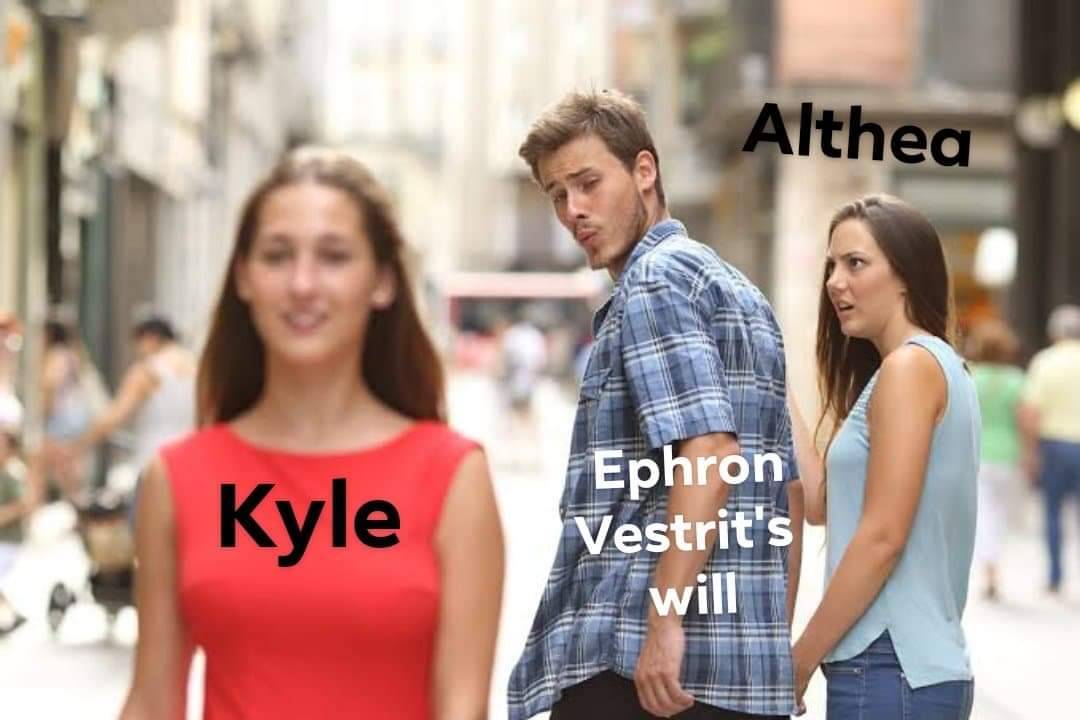
The following chapter, “Confrontations,” opens with Althea waking to the sound of Ronica berating Kyle for punching his adolescent son. Kyle responds harshly before backing off of a position he realizes is perilous for him. Althea enters abruptly and confronts him, but she is soon distracted by tending to Wintrow. She rages against her nephew’s situation for a moment as he continues to try to remove himself from that situation, and, in a rage, Kyle vows that he will cede the Vivacia to Althea if any captain vouches for her seamanship. He also rages against his own son, sending him packing off to the ship under duress before rebuking Althea. Ronica quashes the argument. She accepts the blame for Althea’s disinheritance, explaining her reasons for it and noting the terms of Keffria’s enfranchisement. Althea cannot but continue to inveigh against the situation, and, in the face of the continued insistence upon it, she leaves.

image
This rather speaks for itself.
Meme from FitzChivalryFarseer on tumblr, used for commentary

Kyle resumes inveighing against Althea, and when Ronica rebukes him for his behavior, he turns his anger upon her–not physically, but still coercively, and partly through exploiting Keffria’s indecision. Ronica reassesses her elder daughter, not favorably, and she is shocked yet again when Kyle announces his intent to trade in slaves. When he is met with objections to that plan, he demands charts to the Rain Wild River, only to be told that they had been destroyed. He disbelieves and continues to rage, and Ronica takes herself and Keffira away from him.

Kyle’s patriarchal tendencies are on full display in the present chapter. He demands Wintrow’s obedience physically, notes that things are done well “for a woman,” and rages at the Vestrit women because they “have no sons to protect” them or “men to take over the running of the holdings.” He repeatedly asserts that he is “the man of this family” and therefore its rightful head, owed obedience by all in it. It is an all too common attitude even now, that the presence of a penis is the primary determiner of ability, and it is still an all too common attitude that command means the imposition of will despite the knowledge and expertise of others. I must confess to being guilty of some of the same follies, and I am trying to sit with the discomfort that being reminded of them produces in me. But perhaps I am overly affective a reader in doing so.

I note as I reread the ways in which Kyle approaches Kennit. Both of them appear amid the trappings of bourgeoisie success; Kyle stands in a house built by settlers over generations and staffed by servants, commander of a vessel owned by the family descended from those settlers, concerned more with money than anything else. He is not heir to that family, as such, but married into it and is imposing his own views upon it rather than even attempting to understand the people he seeks to rule. Might he, himself, be taken as a metaphor for colonialist discourse, especially given his physical description in the text? Might he point towards intersectionalities of oppressive structures? Might someone still vested in academe make such arguments?

Help me mark tomorrow’s holiday?

A Letter

Dear Friends,

I know I have not been as good at keeping in contact with you, individually, as I ought. And there are many excuses I could plead, some of which might even be acceptable ones, but they are only that: excuses. Guilty as my conscience is, I might offer such even if I had not done wrongly not to write to you or otherwise get into some kind of contact, but I did do wrongly, as I well know. So I offer my apology for letting it be so long since I have reached out to you; I hope you will accept it and that we can keep in touch, moving forward, but I will understand if you do not, if we cannot.

I have been working on several blogging projects, including this one; I still post poems at my personal blog, and I still post something that seems like scholarship or moves that way for the Tales after Tolkien Society. Here, of course, I have been working on my Hobb Reread–and I have been neglecting too many other things. Having left academe almost completely behind–I no longer teach, I only rarely tutor, and I have not been doing much in the way of research, having limited access to any apparatus–I should have a much more open schedule for things than I seem to do. But I do not do them.

Again, I make no excuses for it. I do note, though, that I am still working through my experiences, trying to make sense of them, trying to construct something like a cohesive narrative of how I fell away from my intent yet again–I was going to be a band director when I grew up, then an English teacher, then an English professor, and none of those seems to have happened and stuck–and arrived in my current situation. I do decently enough that I ought not to complain, as I well know. I have a decent job that lets me help people, I am engaged in my community (to some extent), and I have a good family; each is worth enjoying. But I cannot let go of some bitterness and hurt. I should, but I am not sure how–or I am not sure I will land well when I finally fall completely away.

There are senses in which I have let go of too much. For all the problems academe has–and there are many, many problems, not least of which are the systemic racism, sexism, and classism embedded within it, despite the lip-service paid to equality and parity by many–it did have transformative effects upon me, effects which depend in large part on continued involvement within it. I do not have access to information as I did before, or at least not as ready, and I do not have as much time to sit and take in that information as I once did, as much time to turn it over in my mind and make it fit into structures that only barely suggested themselves before. And I can feel my mind stultify from the lack.

But I have prattled on long enough by now. I hope you and yours are well and will remain so, and I hope that I will hear from you again.

Sincerely,

Geoffrey B. Elliott