A Robin Hobb Rereading Series: Entry 299: Fool’s Fate, Chapter 22

Read the previous entry in the series here.
Read the next entry in the series
here.


“Reunion,” the following chapter, begins with an excerpt from a letter from Queen Desire detailing her reaction to the introduction of Fitz to Buckkeep at Shrewd’s behest. It moves on to follow Fitz’s progress from the Pale Woman’s caverns to Dutiful’s encampment, beleagured by the cold and guided briefly by the Black Man. He is brought back in and treated as he is debriefed, and he learns how Thick had been found–both by Dutiful’s company and by Burrich, whose own arrival is detailed.
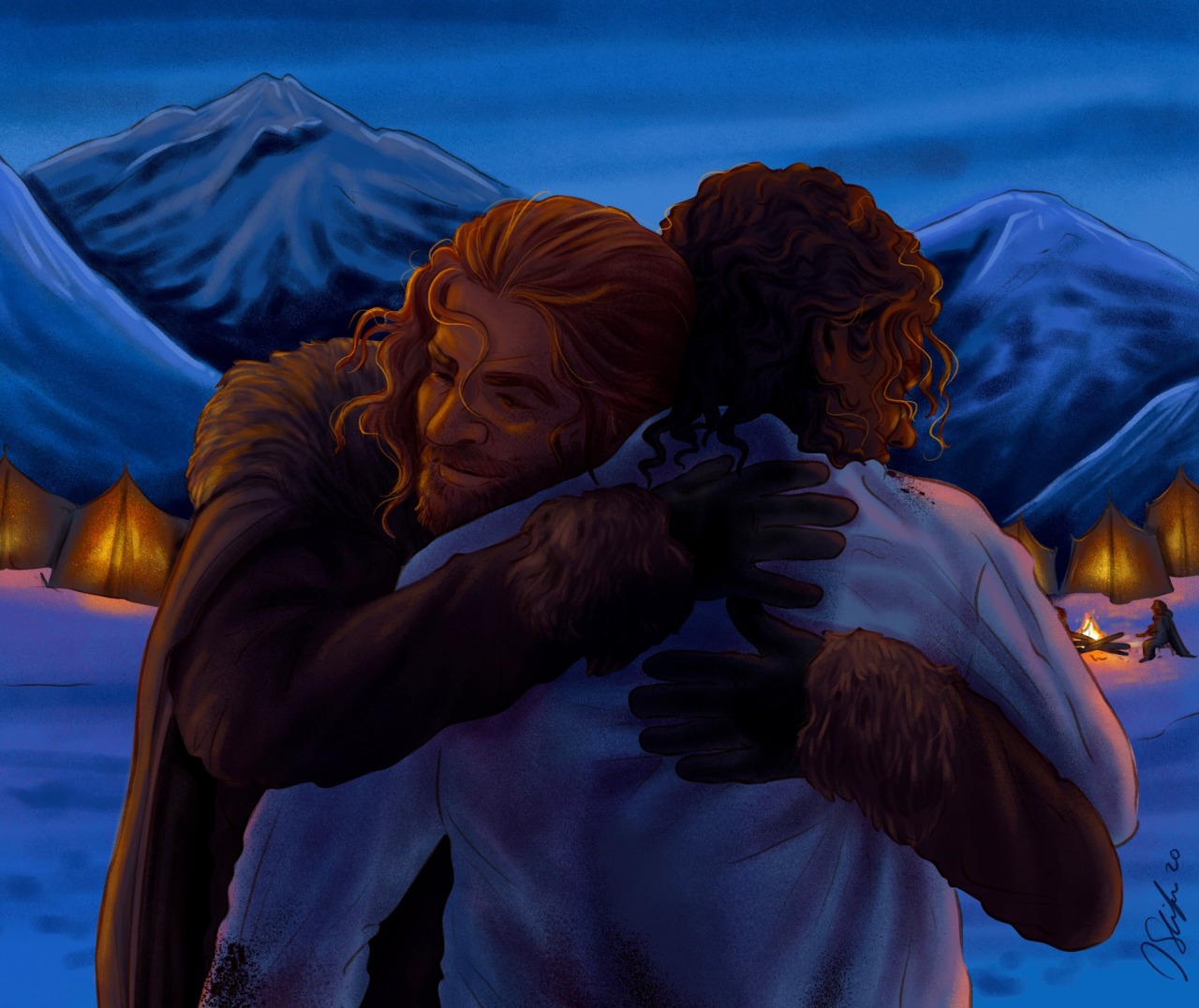
Another image from Faceless Frey, used here for commentary.

The Witted coterie joins the throng with food and further aid, and Web marvels at Burrich’s use of the Wit to help treat Fitz; his comments provoke the other man, and Web leaves. Conference about what has been learned and its implications commences, and Dutiful summons Peottre and Elliania. When they arrive, Peottre flatly begs for aid, joined by Elliania, and more of the Pale Woman’s perfidy is laid bare. Plans for how to proceed with killing Icefyre and destroying the Pale Woman are noted, involving Chade’s blasting powder, Fitz volunteering to spare Dutiful and despite Burrich’s protests. And as Fitz goes about his work, Burrich takes him aside and says words to him that he has long needed to say, that Fitz has needed to hear–with a promise of more to come.

The rush I noted earlier seems to be accelerating, pieces being slotted into place in evident haste because they need to be in place. I continue to be somewhat put off by it, even all these years later–because I have been reading this novel for years, since it was published, and hungrily though I did so and do so, this morsel is not necessarily to my taste.

And I am not sure how to regard the content of the chapter in light of what has happened in the world recently. I know that it is not “fair” to assess a given work by the standards of times other than its own, and even eighteen years (the book was published in 2004, and I reread it for the present writing in 2022) occasions quite a bit of change. But I also know that one of the ways in which a work’s quality is borne out is that it continues to speak to audiences well after it emerges into the world, and while it may be the case that I read the work with nostalgic longing–my later undergraduate years were not bad ones, though they were not as good for me as grad school was–I cannot help but think that it would still show up well even had I not the prior experience with it. I am a different reader now than I was then, though, and not only because I have much, much more in the way of formal training; the eighteen years of lived experience has a lot to do with it, as well, and the reading now…I do not know.

How much longer the world in which I live will allow for such things is unclear. I fear it will be less long than might be liked.
I continue to appreciate your kind support!

A Hymn against the Stupid God: 186

A pick-up note is sounding in the screeching symphony
The Stupid God composes as a new movement will begin,
And the discordant jangling it promises already hurts the ears
And shakes the hearts of those who cannot leave the audience.
What song can be lifted up against so damned much noise?

Not even so harmonious as this…
Image via Discogs, linked here, used for commentary

A Robin Hobb Rereading Series: Entry 298: Fool’s Fate, Chapter 21

Read the previous entry in the series here.
Read the next entry in the series
here.


The next chapter, “In the Realm of the Pale Woman,” begins with commentary about the White Prophets before turning to Fitz regaining consciousness in captivity, bound and brought before the Pale Woman. She is described as Fitz and the Fool are presented to her amid her gathered servants, a dragon in the midst of being carved, and the feral figure of Kebal Rawbread. The Pale Woman laughingly explicates his situation and theirs to Fitz before having them separated and taken to individual cells.

“I am so very sorry. So very sorry.”
Image is from facelessfrey on Tumblr, used for commentary.

Fitz surveys his cell as he is thrown into it, but he is not held there long. Instead, he is conducted to the Pale Woman’s chambers, where she is attended to as he looks on. Reluctantly, he washes and is shaved before sitting to table with her at her bidding, and after the meal, the Pale Woman expounds upon her ideas to him, interleaving her plans with no little inveighing against the Fool. Fitz feels his Skill begin to return among the discourse, and the Pale Woman moves to work her own Skill upon him to seduce him. He resists, however, and attacks her–ineffectively, in the event–when he sees what has been done to the Fool.

Enraged, the Pale Woman has Fitz and the Fool brought to her throne room again, where she sacrifices one of her prisoners to the nascent dragon and to Kebal Rawbread’s hunger. She has the Fool bound for his own sacrifice and tasks Fitz with the killing of Icefyre–to which he agrees, even as the Fool is tortured before him. Fitz is turned out into the snows on Aslevjal and left to find his way again.

There is more than a bit of fanservice in the present chapter, and as I reread it again, I found myself wondering why it was there, why it was so overt. I mean, I get why the Pale Woman would want to seduce Fitz into doing her bidding; a willing participant is better than an unwilling one, the later being likely to look for ways to subvert and suborn even amid coerced compliance. But having the heavy-handed attempt seems…out of keeping for a prophetic figure who would normally be expected to be both long-lived and long-seeing; it doesn’t seem very thought out or thought ahead, and that seems to be at odds with the whole thing of the White Prophets. Perhaps it is a part of what I’ve seen as the primary point where Hobb’s writing falters–the rush to the end, about which I have commented on occasion (April 2013 and August 2015). It’s as if Hobb has an “Oh, shit, I have to finish the novel!” moment, and it still sits less than well with me, a decade later (and more, really). And that’s a shame, because I clearly like how Hobb writes–well enough to write my MA thesis on her work and to return to it after giving up on being a “real” academic.

Loving something doesn’t mean being blind to its problems, though. But at least the problems are as they are and not worse ones…

I do always appreciate your support!