Schools have started up again, and that means assignments are starting again, too. Even down into elementary school, students are being asked to write–and writing is hard. It takes work. It takes attention to detail. And it takes time to do well.
This is the kind of thing I can help you overcome… Photo by Jessica Lewis Creative on Pexels.com
Classroom teachers do their best, of course, but with twenty to forty students in a room, there is only so much time they can give to any one student–and when there’s one or two acting out, it’s clear where the teachers’ attention will go. The quiet student who sits and tries to get things done gets left out–not because of anything they did or anything their teachers have done, but because there’s only so much time in the class, and there’re so many other things that teachers have to do.
That’s where I come in.
I’ve been writing for years, and I’ve taught writing in the classroom and in individual settings for almost as long. My students have ranged from middle- and high-schoolers through graduate students; my clients have ranged from high-schoolers through PhD candidates and established scholars. Each has seen a marked improvement in performance after working with me–and you and yours can have the same success!
I’d be thrilled to put my time and talents to work for you. Let me know what you need help writing, and we’ll talk about what we can do together!
I have written before about Labor Day, here and here in this webspace, and as the observance comes around once again, I find myself in much less secure a position to write anything than in previous years. It’s my own fault, really; I shifted jobs without thinking things through, and I was hindered in the latter by not having joined the union. But that’s not why I’m returning to the topic now.
Solidarity! Image is the Freelancers Union emblem, from their website, used for commentary
Recently, approval of unions reached some 71% of those polled, per Gallup. It’s not an unequivocal thing, as the report makes clear, but it is of some note–and some importance. My own experience as a union man–less presently than previously, when I was in a heavily unionized and union-integrated workplace and a member of UAW Local 2110–bears out the good of unions. Yes, it was the case that some members of the union were skating by, trusting in their collective contracts to cover their own inadequacies and stagnation. And it was the case that the specifics of the contract did not do as much to encourage innovation and development as could or should have been the case. But it was also the case that demonstrated expertise was explicitly and meaningfully rewarded; I got a 10% hourly raise upon completing my doctorate, for one thing, and guaranteed cost-of-living increases. I also had fully covered medical, dental, and vision, and I had access to retirement plans. (I did not invest in them, which worked out for the best, in the event, but that’s a different matter.) And it wasn’t just me; it was all of the working folk at the school, from department- and program-chair faculty through teaching staff and administrative support to the janitors and maintenance technicians.
I recognize that unionization is not something that everybody wants for themselves. I also recognize that there are some occupations where it ought not to happen–even some where it has. I also certainly understand why those who are driven to find profit–not earn, because “earn” does not really apply with them–oppose unionization. For me, though, it was a good and it is a good, and I delight in the increasing solidarity to be seen.
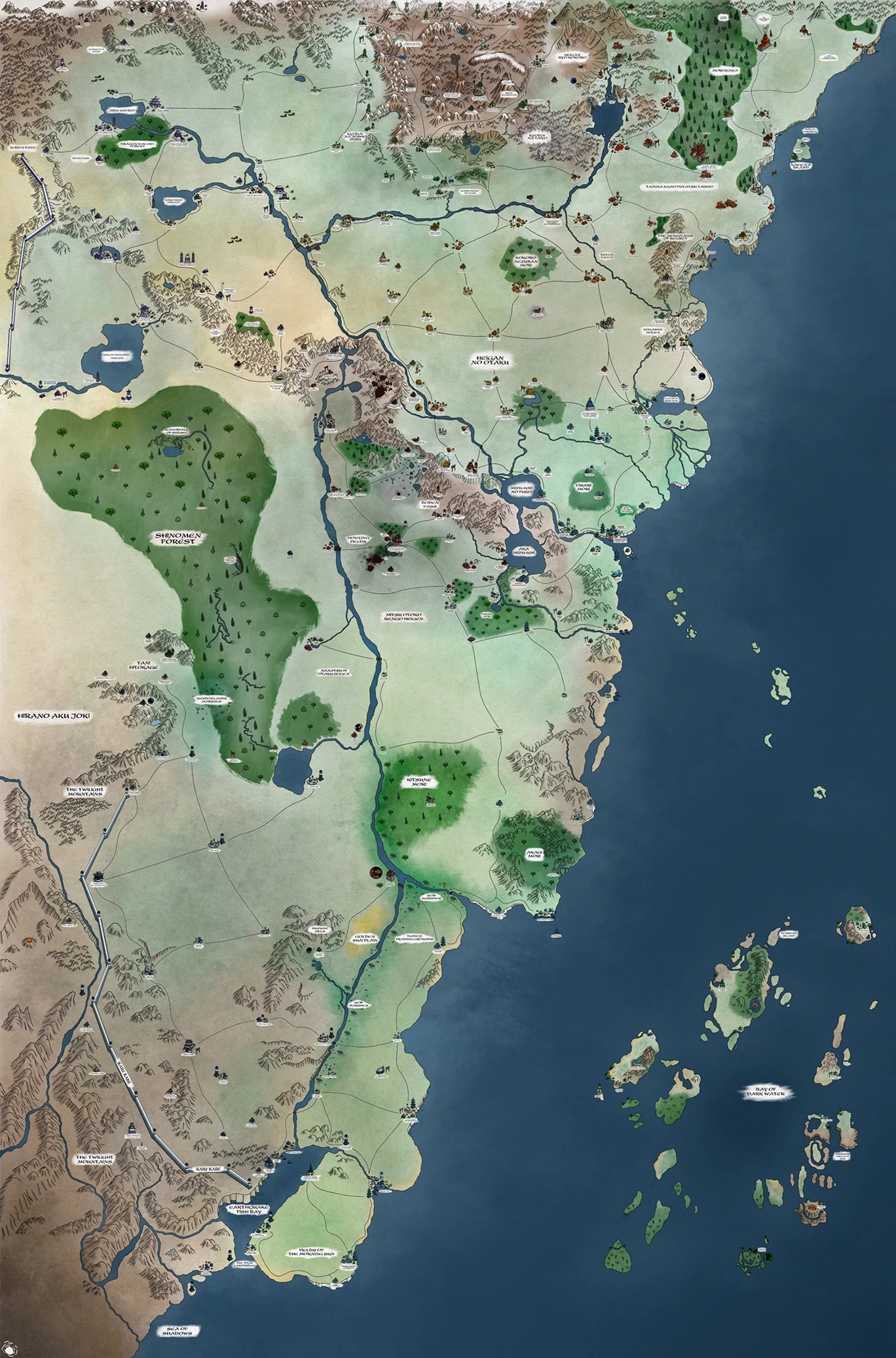
I noted in my previous post to this webspace that I am working on a Legend of the Five Rings (L5R) roleplaying game (RPG) campaign. Development continues on it, as might be imagined; I work on money-making jobs, after all, which take up time, and generating materials requires its own efforts and does not always go quickly. I expected as much, certainly, as I undertook to work on it. What I did not so much expect, however, was running into how much I have lost in the years since I last thought to do this kind of thing. I am running into…gaps in my knowledge, but I remember knowing a lot, and the…gaps are frustrating.
There’s a lot to work with… Image is from the Atlas of Rokugan, used here for commentary.
Admittedly, I’ve noted this kind of thing before, about having been able to immerse myself in things that I can no longer, given the different demands upon my time and attention and the many, many rewards that associate therewith. And I am not saying I would trade what I have to gain back what I had. It’s not like I actually sold it away, anyway; it’s less produce vended at the stand than fields that have been left alone, and while there are still fruits growing from that untended soil, there are a lot of weeds that have gotten in the way, and trees that promise yet better have sprung up amid the once-plowed rows.
A large part of what I’m having to do, therefore, is refamiliarize myself with the way things once were. It’s complicated somewhat by the advance of time; resources that once were available no longer are, and the resources that remain rely in large part upon what is now gone. It’s something similar to some of what I faced as a medievalist, really, and which others encounter in other places; we know there was stuff, because we have other commentaries on that stuff, but we do not have the stuff itself. So we have to reconstruct what we can, how we can.
I’m fortunate, though, that the game is as it is. For one, I’m moving a fair bit ahead of a particular point in the game’s canon, and avowedly doing so in a way that avoids a major, climactic event. It makes sense, therefore, that what comes after would also be different. That is, I am largely freed from constraints of the existing narrative–but I still need to address what happens with the major players in the game’s canon up to the point of departure. Were I playing in the game, I’d have questions about it; I have to expect that my players, for whom I am making the setting, would have similar questions.
Again, this ain’t happening. It’s still Drew Baker’s Second Day of Thunder, and it’s still used for commentary.
I’m making my way through things, slowly, certainly, in the moments between tasks. And I am glad to be doing such a thing again; there’s a peace to it that I appreciate and that I often need…




 Elliott RWI