Read the previous entry in the series here.
Read the next entry in the series here.
Following an extended message between bird-keepers treating concerns of information security, the first chapter of the novel, “The Duke and the Captive,” begins with a messenger reporting to the Duke of Chalced in fear or reprisal for the ill news he carries. The messenger is escorted away, and the ducal palace is described in some detail as the Duke is tended and receives a fuller report on actions in the Rain Wilds. His own situation is described in some detail, both his failing health and dearth of legal heirs, and his anxiousness to consume dragon-blood and -flesh to assuage both. The Duke lashes out, feebly but pointedly, at those around him.
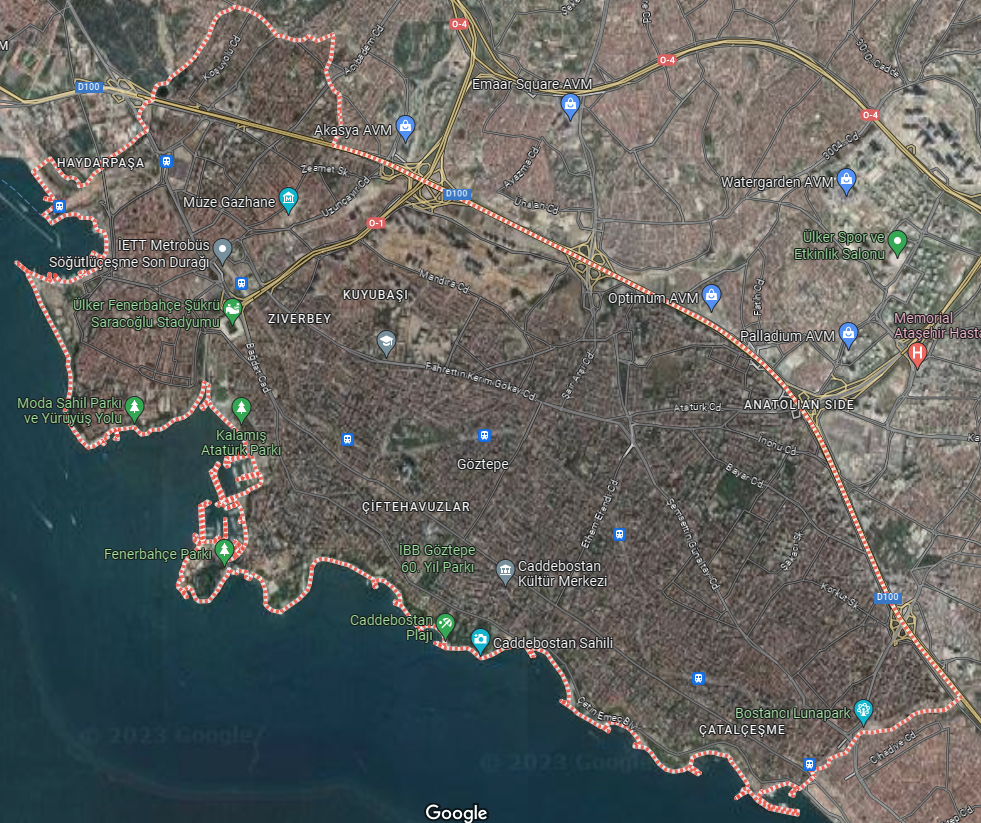
Image from Google Maps, used for commentary
Selden Vestrit, captive, ruminates on his situation as Chalcedeans view him, an oddity among a collection of oddities. The onlookers discuss selling him, ignoring his pleas. As they leave, Selden is wracked by coughing, his situation worsening as he longs for Tintaglia and freedom both.
The question occurs to me again as I reread the present chapter: To what, if anything, is Chalced an analogy? As I’ve remarked, there are analogues for other nation-states in the Realm of the Elderlings series. Bingtown and the Rain Wilds echo the United States, making Jamaillia something like Hanoverian England. The Six Duchies and the Out Islands are not unlike the indigenous American peoples, if with other influences visible and at play, so that “parallel” would be too strong a term. It is the case that the Duchies and Bingtown are or have been in position to ally against Chalced, being both vexed thereby; the analogue of Chalced would therefore be some state vexatious to multiple populations, heavily autocratic, and with a (relatively) poor human rights record.
I admit to getting somewhat outside my remaining areas of expertise, here, but colonial Spain somehow comes to mind. I am not a Hispanist; I did grow up in an area marked by Spanish colonialism, and there is something of that in even popular and public-school accounts of the local and regional histories, but I am far from a specialist in such things. I do, however, think there might be something to investigate in that line for an intrepid student who is more attuned to such concerns than I can be. (Please be sure to cite me if your papers take you in such a direction; I shall thank you.)
Similarly outside my expertise but similarly suggestive is the parallel of the names. Chalced seems to work from Chalcedon, an ancient town of Classical Asia Minor now part of the Istanbul district in Turkey. Site of some important early Christian councils and the namesake of chalcedony, it exerts some historical and religious influence…but, again, my noting that there is some interest to follow does not mean I am equipped to follow that interest in what has to be a short(ish) blog post such as this one. Again, a student of more related concerns looking at this might well have more to say. (Again, too, kindly throw me a citation if you investigate that way; I shall still thank you.)
Like what I write?
Want me to write for you?
Fill out the form below to get started!
All human-made; no AI!


 Elliott RWI
[…] Read the previous entry in the series here.Read the next entry in the series here. […]
LikeLike
[…] the previous entry in the series here.Read the next entry in the series […]
LikeLike
[…] a seemingly clandestine message from Kim in Cassarick to Hest Finbok that affirms concerns raised earlier, “Kelsingra” begins with Alise stalking through the streets of the ruined city, […]
LikeLike
[…] Chalced, the Duke of Chalced muses bitterly on the reports of failure brought before him. Ordering the deaths of families, he […]
LikeLike
[…] [36] https://elliottrwi.com/2023/06/05/a-robin-hobb-rereading-series-entry-351-city-of-dragons-chapter-1/ […]
LikeLike