Clad in gold and white and blue and
Defying a single eye to look and not
To weep
Send a salt trail falling across the cheek
Before splatting to the ground
But one of many falling thus as she
Parades about under many banners
Letting each of them flap in the wind or
Hang limply where it had been erected
As those who had hoisted them
Pant at her touch
Don’t look straight at…never mind. Photo by Lukas on Pexels.com
It is not gentle
Wringing much from those who feel it
That hot grip upon them
Pulling them forward whether they
Will or not
But they cannot keep her from coming
Themselves spent and not satisfied
They made wet by her less than
She by them
As is so commonly the case
I’m happy to write to your order; get started below!
Read the previous entry in the serieshere. Read the next entry in the seriessoon. I know you can find it.
Following a letter from Fitz to Nettle that warns against much investigation of the Skill Pillars, “Chade” begins with Fitz reminiscing about his erstwhile mentor’s tendency towards drama as he answers his summons. While he waits, he is approached by a young woman who makes seeming advances towards him, the which he rebuffs gently until Chade arrives, with Riddle assisting. Fitz reminisces about his long experience with Riddle, as well, and he and Chade confer for a time, not entirely pleasantly. Fitz realizes Nettle is Skill-riding Riddle, and he accompanies the men to a room prepared for them.
Picture possibly related… Photo by Frank Cone on Pexels.com
The woman from before greets them in the room, and Fitz is somewhat surprised to find Chade including her in their activities. Fitz intuits that she is of Farseer blood, and he is embarrassed to realize that she has duped him thoroughly. A casual comment comes from her that Fitz perceives as a threat to Bee, and he reflexively moves to eliminate the threat. Chade partially defuses the situation by noting the need to test Fitz again, citing the effects of grief upon him. He also notes his plan to place the woman, called Shun, in Fitz’s household, ostensibly as an aide for Bee, but more fully as a guard for her and a means of providing for her.
Discussion of Shun’s background follows, and Fitz puts questions to Chade through the Skill that the latter deflects. Shun expresses her distaste at the situation, which Chade validates, but he also lays out her situation as a bastard Farseer–which Fitz knows well. Fitz agrees to assist Chade with Shun, and Chade claims Shun as his own, calling her by his own surname of Fallstar. Fitz then makes to return home, deflecting attempts to keep him present; as he leaves, he and Riddle confer, Fitz averring that matters are well with him and Bee. And as he departs, Fitz ruminates on his erstwhile mentor further.
Given my comments about the past few chapters of the novel, I feel I have to note that the present chapter is a more “normal” length, not quite thirty pages in the edition I’m reading. And it does focus narrowly on a single scene, so that more “normal” length makes sense to my reading.
A couple of things strike me about the present chapter aside from the length. In it, Shun is described as being some nineteen years of age, which prompts Fitz to consider her origin. Some of that is confirmed, or at least heavily implied, by Chade’s recognition of her by surname, assigning Fallstar to her; it might well be thought that Chade, himself a Farseer bastard put to ungentle use by the Farseers, would be more careful about generating more such. (Given that Chade has access to a hangover cure, as well as any number of other fantastic concoctions, and given the attested existence of silphium, it would not be beyond imagining that Chade could have contrived birth control or an abortifacient. Indeed, Chade remarks upon several of the potential effects of his chemistries, suggesting that they might well be able to prevent conception.) However that might be, Shun’s age seems to my reckoning to put her conception between the events of Assassin’s Quest and Fool’s Errand, although, on reflection, it might have been during the former. I’m not at this point aware of any formal chronology, although I don’t doubt it could be sussed out from what is in the text, and I’m sure that some explication of the dating involved could be done to some effect; it’s the kind of thing that makes for a good short essay, really (and if the essay’s already out there, please let me know).
I wander once again, of course. I often do when I work with Hobb’s writing, getting lost in rereading as I look for things I remember. While it did, admittedly, complicate the work of writing my master’s thesis, one conference paper or another, a book chapter and a follow-up essay, an early publication, and teaching materials, I think it also speaks to the quality of Hobb’s writing. If it is so easy to get back into reading it, after all, it would seem to be doing something right.
If you like the way I write, why not hire me to write for you?
Read the previous entry in the serieshere. Read the next entry in the serieshere.
Once another piece from Badgerlock’s Old Blood Tales concludes, “Explorations” returns to Bee’s point of view and follows her progress towards her bolt-hole after Fitz’s departure to answer Chade’s summons. She begins to make plans for the space and to search out the other spaces connected to it. Her explorations take some time, enough to consume the candle she had carried with her, and she is left in darkness between the walls. The loss of light begins to panic her, and she calls aloud for the lost Molly before sinking into wordless fear.
A little more hidden than this… Photo by Ellie Burgin on Pexels.com
The present chapter is remarkably brief, a scant seven pages in the edition I’m reading. It marks a sharp contrast from the sprawl of the previous chapter, although it is at a good length. It focuses narrowly on a single event, and it leaves the focal character in a place from which she will have to be extracted. The break in action occurring where it does prompts further readerly engagement with the text. That is, readers are almost compelled to read on to see what happens next, and if it is the case that the “cliffhanger” is a commonplace, it is also the case that it is a commonplace because it works.
Too, the chapter does well at presenting both the childlike joy of exploring tunnels and the like and the fear of being lost in what would otherwise be a familiar place. It is, perhaps, my affective reading once again that I note as much, but for me, the chapter conveys the feelings authentically, and the sudden juxtaposition of them highlights the fear admirably. It’s not horror, as such, but it certainly moves that way, and it does so effectively–more effectively, in some ways, than the gorier presentations often associated with acts of horror, because it is a more common experience and therefore one that lodges more fully into the mind. (Although Hobb also handles the more “normal” horrific in the series, as witness here and elsewhere.)
Perhaps it is being played for pathos, but novel-reading isn’t necessarily a strictly intellectual exercise–nor is it the case that more formal pieces are exempt from such play.
If you’d like me to write for you, fill out the form below!
It’s not exactly a secret that I opine on holidays and other observances that occur on my regular posting schedule (as well as the occasional event that takes place off of it). So it shouldn’t be a surprise that I’d comment on Juneteenth this year, since the federal holiday takes place on one of the days I would normally post; as such an observance, and one apt to have me close my day-job for the day (I did), it’s the kind of thing that invites remarks from me. But I’m…somewhat hesitant to say much about it (though not completely so, clearly, as the very existence of this post denotes). Not that that should be a surprise, either, given what the holiday represents and who and what I am.
It’s a banner day…
(Please note that I am not in any way saying the observance should not happen or does not deserve to happen. It should, and it does.)
As is fairly common knowledge, or as damned well should be, Juneteenth commemorates the Emancipation Proclamation reaching Texas in force, the perceived end of institutionalized chattel slavery in the United States. On paper, it denotes the formal end of a long section of the history of the country, the formal end of a great wrong that had been perpetrated on generations of people. In truth, slavery continues, as the prison-labor complex shows, and the legacies of slavery continue even aside from the overt reality of it, as far too many things show to recount here and to recount in any place without being subsumed by tears long before the tale is told. So there’s some fraughtness to the observance right there.
More personally, I have to question the extent to which I have any right to mark the day. I close my day-job because the federal government is closed, and many or most banks follow suit; since I work in tax preparation and bookkeeping, both of which rely in large part on both of those, there’s not a lot of point in my spending the money involved in having the office open. That’s a piss-poor reason to do more to mark the day than that, though, even if it deserves a lot more marking that I can offer it.
No, my unease is a result, at least in part, of my recognition that I benefit from the legacies of the systems that were supposedly unmade on the first Juneteenth. I doubt that my family enslaved others (but I am not entirely certain), and I am pretty sure that at least one of my forebears fought for the Union (there’s some physical evidence suggesting such), but that does not mean I don’t enjoy benefits of a system that was built and predicated upon the treatment of people as livestock. What opportunities have not been foreclosed to me because I have the familial heritage I have and not those I don’t, I cannot really say, although I do know there are dangers I do not face because I look the way I do and live where I do. What experiences I have been able to have because others have reacted to the injustices perpetrated upon them, I have a few vague ideas, but I have not had to consider them more closely than I have because I occupy the positions I do.
I have benefited, but I have not had to pay. And there’s not really a way for me to give back those benefits; I cannot undo what has been done, whether for good or for ill (and it has too often and for too many people been ill). Too, there are limits to what I can do to improve matters, moving forward, which I recognize, even as I recognize that my pointing them out and not doing much of anything to address them makes me complicit in some ills, in many ills–but not even pointing them out makes me complicit in yet others.
I’m not trying to excuse myself, to exempt myself from discomfort. I should be uncomfortable, about this and about a lot of other things. I should also let that discomfort spur me to make things better than they are, and not just in the small ways I already do. Whether I am not so much of a coward that I will actually do something, though…
On this day, as on most every other, I’m happy to write on your behalf; fill out the form below to hire my pen!
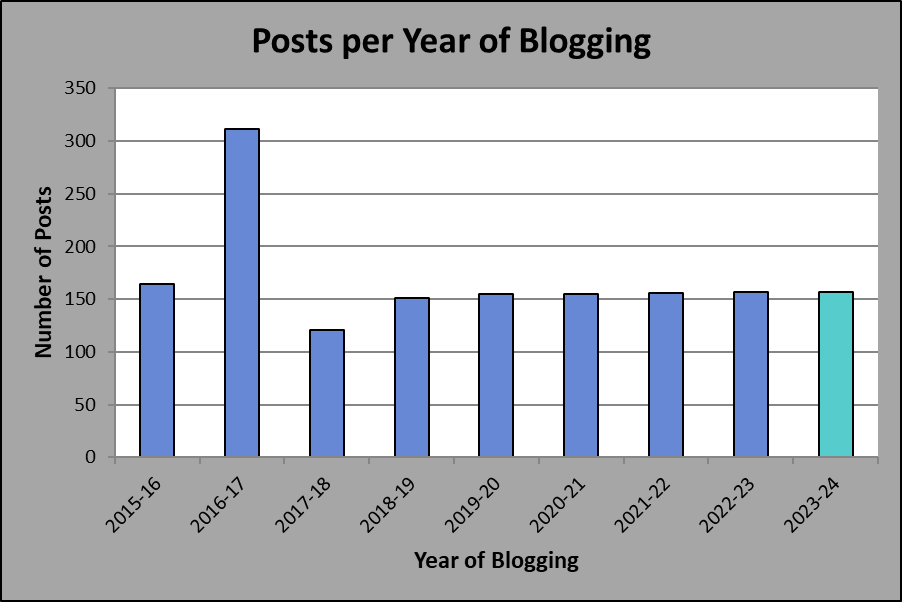
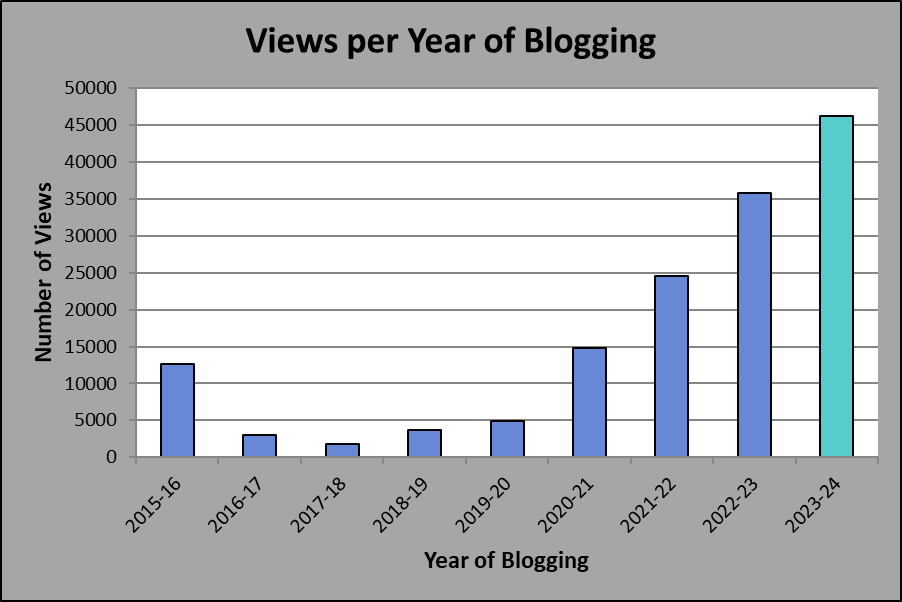
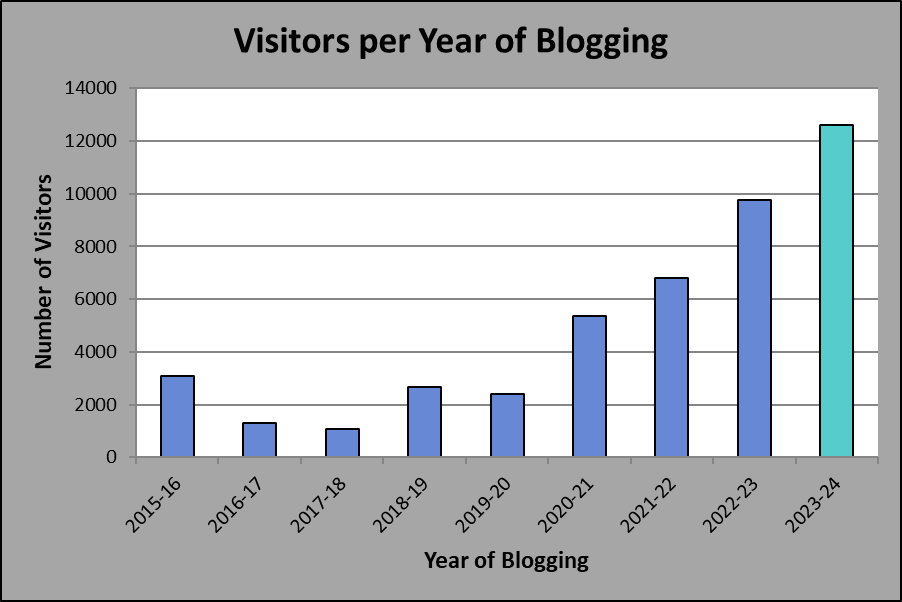
Today marks nine years since I began posting to this webspace. As I write this next entry in my series of annual reports about the status of this site, I have published 1,527 posts to this webspace (this will be 1,528), as well as revising individual pages, attracting 147,355 views from 45,024 visitors. As such, in the past year, I have published 157 posts, garnering 46,274 views from 12,601 visitors (per “Reflective Comments about the Eighth Year“).
The following graphs present changes over time, noting posts, then views, then visitors.
I continue to be pleased to have the opportunity to do this kind of thing, to have an outlet for my ruminations and occasional verse, as well as to continue to offer the resources I do (and which viewership figures tell me attract some attention; I hope they are useful). That this has been the best year I’ve had in terms of readership is also a pleasure. It suggests that I am doing something right, and there’s no small joy to find in that suggestion.
I continue to be pleased, too, to offer writing to order. If you’d like to have some done, please fill out the form below:
Such greed as gathers lucre grows apace
Swelling, suppurating, stifling grace
As, charmed by cheers while giving chase
To gold that gleams, a Stupid God looks on
And grins. It gallivants; its growing throng
Delights, depraved, distracted far too long
From worthy works by wiles ill-minded ply.
I and others often wonder why
The world will work in such a way. We cry
For aid, for answers, for some ease at last,
Seek to see the Stupid God sink past
The deeps, descend, and be from this world cast,
But holding hope is harder every day,
And mouths aren’t made so many times to pray.
Image not related. Photo by Scott Webb on Pexels.com
I’m happy to write to order, in verse or in prose–and with no AI plagiarism! Get your bespoke piece started today!
It may have come up in my recent writing that my daughter has been participating in a theatre camp near the town where I grew up. As it’s a day camp and I live an hour away, with work requiring that I be on-site at particular times, I cannot drive here there and back as was the case in some years past; consequently, my daughter is staying with her grandparents, who still live in the house they lived in when I graduated high school a couple of dozen years back. One result of that is that I have been going back where I came from–more or less; there are some caveats to consider–and have had occasion to spend a bit of time out in the town.
I can very nearly smell this picture… Photo by Pixabay on Pexels.com
Part of that time came at the end of last week. My daughter gave her weekly performance with the camp, and my wife and I–joined by my brother and his son–took her to lunch afterwards. Where we went to lunch was in the same shopping center as the first bookstore that I remember going to, and one I’ve noted once or twice before: Books to Share in Kerrville. I’m almost always happy to stop by a bookstore, generally, and I knew (and confirmed) that I had access to a substantial account at Books to Share, so we walked across the asphalt pond of the shopping center parking lot, putting in at the island of peace that the bookstore is.
Walking in, my family and I were greeted warmly, if not with full recognition; we were clearly familiar, but it had been a while since we’d been by (my wife, my daughter, and I). And I was taken back to my early childhood, released from my grandmother’s hand to nearly run among the towering stacks piled with books that had been brought in by other readers and left in exchange for discounts on others yet, a forest ecosystem I did not yet perceive as a living thing but from which I drank deeply of joy. I was taken back to being around my daughter’s age–she’s ten as I write this–beginning to venture out in earnest from the “children’s” section into “grown-up” books, of which I still have some copies on shelves that have been filled and emptied and moved across states and time zones more often than I’d prefer. I was taken back to my teenage years, when my tastes solidified (and from which they still have not thawed, in large part, even if they have grown to include more), and the stacks I would take in and out of the store swelled larger and larger.
I was taken back, too, to my college years, when my visits were fewer but more focused, my English-major self having a reading list a yard long and deeper yet, and I knew that I could find copies of the classic novels and poetry collections I needed to read and be able to write about for far less than the campus bookstore or the nascent online ordering platforms that pervade so much discourse now offer. I was taken back to my years in graduate school, when the visits were fewer yet but grown more poignant, when I could see that books I had had had continued to circulate even as people I had known since before I was in school no longer did. And I remembered the years since coming back to the Texas Hill Country, head bowed in defeat and showing my face as seldom as I could in the places I had been, thinking that they would know my shame and mock me for it as I felt I deserved to be mocked and ridiculed, even though they never did, greeting me each time with open smiles and kind words.
There’s some lesson to be taken from that, I’m sure. I’m not sure I’m a good enough student anymore–if ever I was–to learn it well.
I am sure, however, that it was good to go back, not least because my daughter fairly skipped among the stacks, face lighting with glee at getting to get books for herself to read and, afterward, to share.
If you like the kind of writing I do, know that I’m happy to do some for you! Fill out the form below to get started!
Read the previous entry in the serieshere. Read the next entry in the serieshere.
After a letter from Fitz to Nettle that discusses Verity in Kelsingra, “The Last Chance” opens with Fitz musing on the experience of his grief at Molly’s death. Amid his grief, life at Withywoods continues, and the effects on Bee are glossed to the extent that Fitz, consumed by his own sadness, notices them. His mourning and Bee’s persist past the observances of others, who have their own lives and affairs to attend to, but Fitz and Nettle do have a conversation about his Skill-imposed health. Nettle also attempts to persuade Fitz to send Bee to Buckkeep, which he refuses, and Nettle’s misconceptions about her sister are addressed. The conversation between the two is tense, but they reach an accord between them concerning Bee.
Kelsingra? Of course it’s Frozen History by MeetV on DeviantArt, here, used once again for commentary.
Nettle retires after her conversation with Fitz, and he and Bee confer at some length. Fitz is somewhat uneasy at the depths of Bee’s perception and understanding, and she makes clear that she can sense him in some ways through the Skill. Fitz considers the implications as they continue to speak together, and he puts his daughter to bed for what he realizes is the first time.
The next morning sees Fitz and Bee prepare for the day and for seeing Nettle off on her way back to Buckkeep. Nettle gone, the two proceed to their daily tasks. Fitz begins to work to catch up on what he has let slip in his grief, and a new routine begins to settle in for the pair of them.
Later, near the end of autumn, Fitz receives a summons from Chade. With some difficulty, Fitz makes arrangements to answer it, and he shows Bee part of the system of hidden rooms and corridors that pervade Withywoods. She takes to it readily, and Fitz finds himself reporting the circumstances of Patience’s death years before. Further conversation grows tense, but the tension eases in time, and Bee asks what will become of her after Fitz dies. The question staggers him, and he works to put his daughter, and himself, at ease.
The current chapter is another unusually long one, running to 51 pages. There is doubtlessly some kind of commentary to read into that, some assertion that the experience of grief dilates time, and it is the case that the present chapter glosses several months. Still, it could easily be the case that the chapter be broken at the seasonal shift; there is a narrower focus on the events of a day at that point, and it would have made sense to have the division at that point both to clearly delineate the passage in time and to highlight the shift in the pace of action. Some other narrative or editorial principle has to be at work, then, and while I have an idea about it, I would have to look farther ahead in the novel to confirm that idea–something I am not willing to do quite at the moment.
That I am not willing to look ahead in the novel is not a result of not wanting to spoil things for myself. I’ve read the novel before, after all, and deeply enough to write a review of it and to use it in at least one conference paper. No, the unwillingness comes from what I know tends to happen to me when I am going through the books about which I write: I start reading again. Indeed, occasionally, when working on earlier portions of the rereading series, I’d get to reading, and it would be hours later that I would look up, realizing I hadn’t written a damned thing and that I really needed to use the restroom. It’s a good thing to do as a reader, certainly, and when reading for the pleasure of reading. It’s not entirely helpful, however, when reading for the purpose of writing. So, while it is the case that I like doing the reading I need to do to be able to do this work, it is also the case that I am trying to get something done, and I can’t get it done if I let myself read ahead too much. I’ll lose track of what I’m supposed to be doing, and that makes doing hard.
So much said, the kind of confirmation I would need would come from something as simple as a page- or chapter-count. And I recall that, when I had students, there were more than a few who were surprised that any kind of literary analysis or interpretation could actually involve such things. I think either they did not have the kind of middle- and high-school English classes that I did, which involved counting lines and syllables in poems (something that, to be fair, I did a lot of in college and graduate school, as well); they did have that kind, but they did not realize that what can be done with poems can also be done with prose; or they did have that kind but regarded it as being something done by “lesser” students. So much said, there is quantifiable data in even the most “creative” work, although the quantitative is not and cannot be the sum total of such work or interpretations of the same; it offers one useful descriptor among many, and it serves as a useful way for those who are more quantitatively minded to get into the work of interpreting text.
Or so I found, anyway. It has, admittedly, been a while, and I am no longer doing work in the classroom.
If you like the way I write, why not hire me to write for you?
I had been reading Here She Comes Now, a collection of essays (edited by Jeff Gordinier and Marc Weingarten) that respond to the lives and works of a number of women in music. I enjoyed the reading thoroughly despite having read it only in fits and starts, most often while on the treadmill at my local gym. As I read the last few selections, slogging up a simulacrum of a hill, it occurred to me (not because it was some great revelation or deep insight on my part, but just because something popped up in my mind that ought to have done so earlier) that the book is a series of what were called “personal narratives” in the long-ago days when I had students and the longer-ago days when I trained to teach them.
The things I’ll use as a study hall… Photo by Pietro Saura on Pexels.com
Given that most of my teaching was either first-year composition or college-preparatory writing–even if, as often, under older and less kindly names–I was often asked (emphatically, with the weight of my too-small and too-needed paychecks behind the requests) to teach the genre. Given what I was taught about teaching, I tried to model the assignments for my students. Given my own experiences and the usual demands of the imposed assignment–leave it to a bunch of old English majors (not Old English majors, nor yet Olde English 800) to want literacy narratives–I struggled to do so.
That I did so, both on the specific literacy narrative and on the more general personal narrative, is a result of the kind of life I’ve led. Reading Here She Comes Now reinforced to me that the personal narrative–however focused or on whatever art it centers–relies upon a perceived or experienced pivot. That is, it has to center on a “life-changing” experience, a transformative encounter with some thing or another. For a literacy narrative, it’s often the first or most prominent formative experience of reading; for the essays in Here She Comes Now, it’s an encounter with the woman’s music that reorients the writer.
I don’t have many such experiences or encounters; my life has not been a series of sharp shifts so much as it has been a long, gentle slide, and if it is the case that I have felt myself to be jerked around on occasion, it is because I have been so accustomed to gliding along that any jostling seems rough. At this point in my life, I do not begrudge it; my skin has grown thin and my belly weak, such that upset now is as like to lead to some messy rupture as any revelation about which I might opine to some new adulation. No, for me, the staid and sedate suffice. They must; I’ve nothing else.
Such pivotal moments in my past as there are have not much been with art. Devoted as I am and have been to writing and music, engaged as I have been at times inn other arts, they have always been for me always beens. I entered into them so early I don’t remember doing so. I do have the clichés, of course: the first written death threat I received, the first time I fucked, when I realized I meant to marry my wife, the discovery of her pregnancy with our daughter, the ejection from or surrender of life in academe, that kind of thing. But of what seem so much to be common experiences not worn to cliché? Not a whole hell of a lot.
It’s honestly a good thing. My parents did well to provide me an upbringing in which it was simply a matter of course that there would be books on the shelves and in hands; that there would be music playing and instruments available on which to play it; and that I had enough food to eat and fair variety in it, as well as a stable, safe place in which to eat it. I’m not finding fault with them that I don’t have a particular, singular experience that compares with so many that I have seen reported. That said, I can’t help but wonder what I’m missing–but that’s nothing new.
I’m happy to write to order for you; if you’d like to have me do it, reach out through the form below!







 Elliott RWI