It’s the time of year again when I think about graduations, rites of passage in a set of subcultures in which I participated for a long time (and still have some part, somehow still hanging on despite the many changes to my life and work that have occurred in the intervening years). I’ve written on the subject a time or two, I know, and I’ve written on similar observances before, as well.
It’s where my kid is… Image from JCISD, used for commentary
It’s more toward the latter of them that my thoughts turn as I sit, pecking away at my keyboard to make the pixels shift and dance on the screen in front of me. My daughter, Ms. 8, has just completed her fifth grade year. In our local school district, that completion means that she has finished elementary school and will move on to middle school (here, grades 6-8). At the same time, a number of her teachers and administrators are heading off, not for summer sessions and continued schooling, but for other jobs entirely, and there are changes upcoming at the school to which she is bound; a new campus is set to open with the coming school year, with all that entails. But I’ve talked about that before, and recently; I’ll not rehash it (much) here.
I will note, though, that there have been many things marking the coming shift, the leaving behind of childhood as childhood (because there is a difference between being in an environment where most of a peer-group is prepubescent and being in one where more people than not are in the grips of hormonal upset). Ms. 8’s school did a good job of offering closure to the outgoing elementary schoolers, sending them off with hope and acknowledgment; I am glad that she got to have such things, and I am glad, too, that she is the kind of person who is open to receiving them. Not all do, and not all are, not by any means, and some of those who say they aren’t in the moment say so only because they don’t, or don’t fully.
I hope that Ms. 8 looks back on this ending with fondness. I hope that she continues to feel, as she has told me she does now, that she is loved, not only by her parents, but by those in whose community she finds herself. And I hope that she continues to be so much herself as she has hitherto been–because she’s a pretty damned good person, and I’m proud to have her as a daughter.
It’s not too late to get bespoke writing for your graduate; fill out the form below to get some started for your loved ones–all human-made, no cheap AI knockoffs!
Read the previous entry in the serieshere. Read the next entry in the serieshere.
Following a commentary on a semi-judicial proceeding, “Family” begins with Fitz and company returning to Buckkeep Castle, their progress to that point described. Fitz does not take the journey well, and he does not receive the news of a royal summons well when it reaches him. He takes some time to respond to it and appear as bidden.
The sign of mourning… Photo by Nataliya Vaitkevich on Pexels.com
When Fitz reports as ordered, he finds the Farseers in array awaiting him, as well as Hap Gladheart and the children of Burrich and Molly, their arrangement described. Soon after, the Fool is led in, as well, and Dutiful calls proceedings to order. The announcement is made to the family that Bee is lost, and Fitz is called upon to report how events have come to that pass. He does, in detail, falling to his knees as he does so. After, the family begins to grieve, and Fitz is surprised to find his kin reaching out to comfort him amid his grief, feeling himself to blame for all that has befallen.
After a too-brief time of offering up shorn hair in token of grief and commiserating with Fitz, the assembled Farseers and others begin to disperse. Dutiful leaves Kettricken and Fitz last, and Kettricken refuses to allow Fitz to vanish once again, bidding him escort her to her rooms. He does so, and she tends to him, dosing him with a soporific and noting the justice of it.
Fitz wakes in Kettricken’s bed in the morning after commiserating with her in the night, and they part. Fitz proceeds thence through the hidden passages of the castle to rejoin the Fool, with whom he confers about how to proceed. Their talk is interrupted by the delivery of a message summoning Fitz to another meeting with Dutiful, and as they part, Fitz and the Fool make mention of the latter’s lost fingertips.
The prefatory materials in the present chapter present another of the callbacks to earlier materials that my nerdy self appreciates seeing. The prefatories make reference to the use of a duel before the Witness Stones to determine justice, something long established as practice in the Six Duchies (see here). In my comments on the early depiction of the practice, I do raise some questions about it; the practice of judicial dueling is fraught, at best. Consequently, with the present chapter’s prefatory materials adding to those questions (one Kitney Moss, accused of murder, maintained his innocence despite appearing to be on the losing end of a judicial duel before the Stones, and dashed into them, inadvertently using one as a Skill-pillar despite a lack of training or understanding, and disappeared, with later circumstances bearing out his innocence), I find myself pleased; even within the milieu, the accuracy of the judicial duel is suspect, and I remain egotist enough to like to be proven right (usually; there have been times I’ve wished I’d been wrong).
Similarly, I appreciate being right about Dwalia’s glove from before. I am less pleased, however, that that pleasure reminds me that it’d been too long since I’d read the book; I’m running into things and only dimly remembering them, if at all, and then taking delight as if I’ve discovered something that I’d already seen before.
Also similar to the preface in referring back to the earlier parts of the Realm of the Elderlings corpus is the shearing and burning of hair as a token of grief. It is mentioned in the first depicted interaction between Fitz and the Fool, if memory serves (see here), and it does reappear throughout the series (as noted here). Again, my nerdy self delights in such consistencies, which I know are not easy to maintain across decades and series and thousands of pages; that they are, here and elsewhere in the Realm of the Elderlings corpus, is part of why I keep coming back to Robin Hobb, again and again.
Like what you see? Get some for yourself; fill out the form below for details!
A time of year has come again about which I have written several times before (here, here, here, here, and here). It might well be thought that, with five earlier commentaries about Memorial Day in place, I’d not have more to say about the matter, that I’d’ve exhausted myself in noting the ostensible purpose of the observance and the complicated, nuanced, fraught, and sometimes contradictory actualities of the same. And since it appears once again that a Memorial Day weekend is not seeing me uproot my family and relocate to another part of the world, that avenue of discussion would seem to be cut off, as well.
No wry comments this time. Photo by Pixabay on Pexels.com
It’s true that, this time, I’m not going to wax loquacious about the ways in which the day’s observance fails to live up to its promise. I’m not going to launch into some seething semblance of a Jeremiad this time around. I’ve done both before, clearly, and it is just as clear that my doing so does no good. I don’t feel better from some kind of catharsis, and my voice is all too easily drowned out by the cacophony into which I have shouted it so many times in the past.
No, this time, I will simply make note that the day is the day that it is, and I may perhaps find some moment to silently reflect on things. Other than that, I have work to do, and I have my family to attend to, and either of those things would be enough to occupy me well. That I have both is a blessing, and I am not unmindful of it.
I’m still pleased to put my pen to work for you; fill out the form below to get me started on it!
Earlier this week, my daughter, Ms. 8, had the opportunity to perform publicly with her elementary school band. (Owing to the small size of the local schools, kids here start band in fifth grade–which is at the elementary school in this part of the world.) It was a short performance, only two pieces, and it had been rescheduled away from being included in the broader spring band showcase; originally, the plan had been that the whole of the district’s band program, grades 5-12, would perform, but administrative dicta ensured that so much would not be the case. Some scheduling shenanigans later, the youngest of them got to show what they can do.
Nothing quite like it, really. Photo by Yevgen Buzuk on Pexels.com
In some ways, it was clear that the kids knew they had been jerked around. Admittedly, fifth-grade students, ten to twelve years old, are not noted for their focus or professionalism in this part of the world. “Let kids be kids” has some sway here, which is not a bad thing in itself. But it was also the case that the students–and I know many of them outside the classroom due to Ms. 8’s friendships and activities, as well as my own community involvements–approached the performance with an attitude of “this doesn’t matter.” It’s hard to blame them for it; administrative workings had told them that their work doesn’t matter, that others will come before they do, that they should be expected to step aside or be put aside in favor of some who have had chance after chance after chance to shine and might, occasionally, show some glimmer of excellence even as they, themselves, are slathered with another layer of patina.
Ms. 8, however, did me proud. I have heard her practice her music, and I have heard her tone improve and her technique develop. I have watched her struggle less and less to heft the horn that has been handed to her, lifting it with greater and greater ease each time. On the concert night, I saw her carry her instrument confidently onto the performance floor, settle herself to play, and play–all from memory when her peers were still bound to the pages of their pieces. And I heard her, the booming bass voice blowing from her bell to buoy up the rest of the band.
I’m an old bandsman, as I think I’ve let slip. I know in my bones what it takes to do well with a horn in hand. (I know, too, that I don’t give what it takes, so I don’t do well. It’s a sorrow, but that’s a digression for another time, a non-scholarly someday.) That Ms. 8 has done–and is still doing–that makes my heart swell. It’s not that I think she’ll turn into a professional tubist; she enjoys playing, yes, and accepts practice as necessary to playing well, but she does not have the kind of overriding passion for it that leads to pursuing it professionally. (There’s been enough of that in the family that the signs are clear to me.) But she doesn’t have to go pro to play well, nor yet to find joy in making music. She does find joy in it, and I admit to feeling no small happiness at seeing her do so.
I look forward to her next go-round.
I’m happy to write to order for you; fill out the form below to get your piece started!
I see you
Sitting at the table across the patio
Air fresh with petrichor
And the curve of your thigh where
The cut of your running shorts creeps up
The thought of my hand on the bristle of your undercut
Your bassoonist’s chin
Ah! All I can do is Lift the amber ale to my hairy lips Wipe the foam away Wondering what might have been We’re I other than I am And you perhaps than you– But I will never know so much And I don’t know if I regret it
I’m happy to write to order for you! Fill out the form below, and see what I can do!
Read the previous entry in the serieshere. Read the next entry in the serieshere.
A letter from the Duke of Farrow to King Dutiful that complains of dragons’ depredations precedes “Repercussions.” The chapter opens with Fitz struck still as Shine relates the events of Bee’s further abduction. Lant arrives, and Shine turns her attentions to him briefly before Riddle redirects her, prodding her to take the group back to the Skill-pillar into which Bee had been taken. Shine rails against the idea, and the relationship between her and Lant is let slip.
Ah, yes, this again. Source still in image.
Shine is shaken by the revelation, and the decision is made to follow her trail back to the Skill-pillar. Foxglove, under orders, takes Shine in hand, and Fitz, Riddle, and Lant backtrack her, followed by Perseverance. Riddle asks Fitz about the siblings and receives confirmation, and Lant asks and is answered about his half-sister’s situation. As they go, they find Shine’s trail and are able to follow it, if with difficulty, finding the site from which Shine had fled–and the Skill-pillar. When Fitz attempts to use it, knowing where it emerges, he is unable to due to being under the influence of elfbark and delvenbark–Outislander elfbark of particular potency. He rages at his incapacity until Riddle takes him in hand. Fitz dispatches Fleeter and Perseverance to Buckkeep with a message for Nettle, with Riddle and Lant to follow behind. Other orders are given, and Fitz prepares to keep vigil.
As Fitz waits, he ruminates bitterly, and he is terse with his soldiers as they arrive and set up camp. They are wary of him, having evidently heard of his tricks, and he is largely sleepless. He greets Nettle when she arrives and takes matters in charge, sending a coterie through the Skill-pillar to find no sign of Bee or her captors. The outlook is poor, and when a quiet Riddle and Nettle retire, a silent Fitz remains awake in the night.
Something I only noticed as I was looking back through my rereading to insert appropriate references into this part of it is that discussion of Shine’s parentage and Lant’s occurs in chapters 13. I have no way to know if this was deliberate, of course, and whether it is or not does not much matter; what does matter is that the coincidence or construction makes a pointed, morbid joke; the circumstances making their attraction unlucky are presented at symbolically unlucky times. I’d not noticed it before, as reported, but I am glad to have noticed it now; it’s the kind of textual detail that delights me and many others who go into literary study and upon which I’ve remarked at times (for example here and here), the little bit of sometimes dark humor that rewards careful attention and revisiting a text–and that reminds even a careful reader that there are always more things to pull from a text worth studying.
I note another bit of wordplay at work in the chapter, as well. Two of the soldiers accompanying Fitz are named Reaper and Sawyer. Both of their names bespeak cutting, fitting enough for soldiers using spears and swords; there’s also a bit of reaping and sowing to be found, even if it takes a little squinting to see it. But since I was already either laughing or wincing from the chapter-number thing, that bit showed itself to me.
As I reread this time, as I sat to write, I found myself distracted again by Hobb’s writing. It happens often enough, I admit (and my wife can attest to it, having seen it happen more than once); I go to work on this stuff and get swept away again by the writing. I look up, and an hour or two have passed that I had meant to put to other uses…and I do not know that I can regret it. But then, you’d expect that from someone who’s been going about this as long as I have and who looks to keep on going with it…
I’m happy to write to order for you; fill out the form below to get your piece started!
That there have been many, many interpretations and adaptations of Tolkien’s Legendarium is obvious. The most prominent of them at this point [1] is likely Peter Jackson’s series of films, which have themselves been taken (in a sort of meta-neomedievalist [2] fashion) as being sources for other, yet later adaptations of Tolkien’s works, such as the Rings of Power series and no few computer-based games. Jackson’s movies are hardly the first adaptations of the Legendarium, however; they are not even the first cinematic adaptations, as the Rankin/Bass animated movies exemplify.
Outside cinematic media, adaptations of Tolkien’s Legendarium ranged early on into visual arts, not only in covers for the books as published and in interior art from Tolkien himself and from Christopher Tolkien, but also interpretive works by such figures as Karen Wynn Fonstad, Ted Nasmith, John Howe, Alan Lee, and the Brothers Hildebrandt. No few of the images produced in adaptation have taken on pseudo- or semi-canonical status; while they are not themselves the work of The Professor, they are taken as being essential—or, at least, exceptionally helpful—to understanding and interpreting Tolkien’s works. Jackson’s reliance on several of those artists’ works for his films contributes to that taking, admittedly, but there are no few whose engagement with the Legendarium predates 2001 and whose visions of Bilbo, Frodo, and the rest long looked to calendar artwork and prints.
One artistic medium that has not received the sustained attention given to cinema or painting is that of the tabletop roleplaying game (TTRPG). That the TTRPG is an artistic medium is argued convincingly by Daniel Mackay [3], and later discussions—along with the increasing multimedia presence of TTRPGs, generally—have served to refine and deepen the conversation surrounding its artistic nature, inherently reaffirming the status of the TTRPG as art. There is an extent to which all art is adaptational, of course, going to definitional questions of “adaptation” and how much representation is intrinsically adaptational, but, more concretely, the TTRPG is, in its origins and principal iteration—Dungeons & Dragons (D&D)—founded on an adaptation of the Legendarium itself.
Mackay speaks briefly to the notion of D&D as adaptation of Tolkien, referencing Dave Arneson’s “fascination with the epic fantasy works of J.R.R. Tolkien” as informing his original work with Gary Gygax to produce wargaming rules—and the D&D rules that emerged from them [4]. Gary Alan Fine also addresses the foundational role Tolkien plays in TTRPGs [5], as does Lawrence Schick in his synopsis of the early history of TTRPGs [6]. Schick’s synopsis also motions toward some of the fraught interactions between D&D and the Legendarium, though it stops short of commenting on a lawsuit that forced changes onto D&D that moved it away from the Legendarium in some ways [7]—for a time.
Despite its ostensible motion away from its antecedent in the Legendarium, D&D continued to borrow heavily from that set of source materials—and other TTRPGs did so as well, to varying degrees. Some, such as the Middle-earth Role-playing Game (MERP), even went so far as to license the Legendarium (and to expand upon what is presented therein [8], sometimes in ways that have not necessarily aged well). More recently, something of a full circle has been drawn as regards D&D’s direct engagement with the Legendarium, with Free League’s The Lord of the Rings Roleplaying, a D&D-compatible rules-set based on and parallel to the descendant of MERP, The One Ring Roleplaying. The adaptations necessary to the production of such games illuminate both how Tolkien continues to be received and how the medieval is mis/used to undergird and inform popular entertainments.
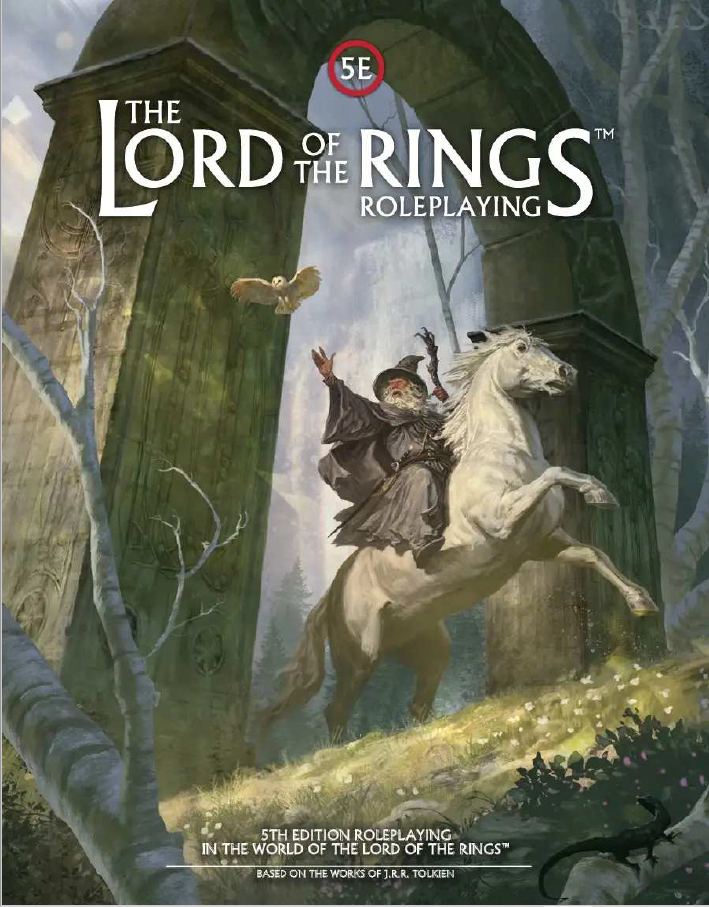
The game makes no secret of its origins [9], and could hardly do so, its primary sourcebook noting in addition to its title on its cover that it is “5th Edition [D&D] Roleplaying in the World of the Lord of the Rings™” and “Based on the works of J.R.R. Tolkien.” Said sourcebook divides itself into nine chapters [10]—Prologue, New Rules, Adventurers, Rewards and Virtues, Adventuring Phases, Fellowship Phases, The Loremaster, The Shadow, and The World—and an appendix, offering enough information for those already familiar with the fifth-edition D&D rules to begin a series of games taking place in northwestern Middle-earth in the years between the events of The Hobbit and The Lord of the Rings.
That the game expects to take place when it does—“the year 2965 of the Third Age” of the world [11]—marks it off as immediately an adaptation of Tolkien’s works. Tolkien’s narrative attentions largely focus on years surrounding the placement of the game, with The Hobbit taking place in 2941 and The Lord of the Rings taking place mostly though not exclusively in 3018-3019 [12]. While Tolkien does provide some information about the events between, it is largely in the kind of glossed description he shares with the chronicle form; 2965 is lumped into an entry covering 23 years and concerning Aragorn [13]. The game does situate itself in with those events, certainly. For one, a posited letter from Gandalf appears to address Aragorn, though not by name, and makes reference to Tolkien’s chronicle-like entry [14]. Too, the game offers simplification and expansion [15] of Tolkien’s chronicle-entries for the years 2941, 2942, 2951, 2956, and 2957-2965 [16]—necessarily and obviously adaptations of Tolkien’s words to a new medium.
The overt adaptations of time do not stop with accounting for years. Progress of the game is explicitly tied to the narrative forms the main line of the Legendarium (The Silmarillion, The Hobbit, and The Lord of the Rings) adopts. The game expects to consist of a series of Adventuring Phases punctuated by Fellowship Phases and the occasional Yule [17], corresponding broadly to such Tolkienian narrative arcs as Bilbo’s journey from the Shire to Rivendell and the time as Elrond’s guest [18], Frodo’s from the home of Tom Bombadil to Bree and the brief time there before the attack of the Nazgûl [19], or even the turbulent history of Túrin and his occasional periods of peace and respite [20]. The Yule phase is another expansion, thus necessarily adaptation, of Tolkien’s work; while the holiday is noted in the Shire-calendar [21], it receives remarkably little narrative attention, but in the game, it is a vital part of character development and progression [22], as well as offering a convenient in-game span for administrative needs [23]. In terms of game-structure no less than of narrative temporal context, then, the game clearly works from and makes explicit changes to its source materials.
Similar adaptation occurs in the geography presented in the primary sourcebook for the game. Both The Hobbit and The Lord of the Rings famously provide maps of portions of Middle-earth [24], and the latter offers some discussion of geography in its Prologue and at other points across its narrative. The game grounds itself in that geography, to be sure, quoting from Lord of the Rings in something like epigraphs for the ninth chapter—“The World”—and major sections of the same, as well as presenting the locations in Eriador named in Tolkien’s Prologue, discussed in the Council of Elrond [25], and the like. There are gestures towards other portions of Middle-earth that feature in The Hobbit and The Lord of the Rings, but Eriador is asserted as the primary location of the game [26]. This is something of a departure from the Legendarium, which directs most of its narrative attention outside Eriador, either south and east of it as in The Hobbit and The Lord of the Rings, or west of it as in The Silmarillion.
As noted Image from Nepitello et al, 177.
As with narrative time, the geographies of the game receive expansion from their antecedents in the Legendarium [27]. One example is Annúminas, which the indices to The Lord of the Rings report as mentioned thrice, once in each volume, and while it is the case that an editorial remark notes a preference for first-mentions, a number of other locations in the place-index receive an “etc.” note suggesting more appearances than are explicitly detailed [28]. Consequently, it can be understood that while Tolkien’s text makes mention of Annúminas, it does not much dwell upon it. The game, however, devotes several pages to the city, its surroundings, and its inhabitants [29], not only giving details about the status of the ruined city and changes to it in recent years, but also describing remaining populations in the area and the possibilities of things to be found therein.
Another example of geographical expansion comes in the treatment of Bree and its surroundings. In the main line of the Legendarium, Bree is an early respite for Frodo and his companions, one described in some detail and in which Frodo and his companions spend a small amount of time that receives expanded narrative focus [30]; it is one stop along their way, and not the only one, although it is an important one. As with Annúminas, however, the game expands greatly upon the description of Bree and its surroundings given by Tolkien [31]. Not only are the surrounding towns—Archet, Staddle, and Combe—described in detail in the game (as opposed to the glancing mentions given in the main line of the Legendarium), major inhabitants of each and Bree are named and described. Individual locations within the area are presented and developed, and cultural fixtures including schools and festivals are noted. Indeed, Bree is cited as being an ideal “home base” for the players’ characters, a venue where they can have met, from which they can proceed on the adventures that occupy most of the time spent in the game, and to which they can return to recuperate [32]. The shift in attitude toward the location from one stop along the way to a repeated refuge marks yet another adaptation of source material on the part of the game.
One other element of adaptation that bears attention in the game is that of the presentation of race within it. Within the context of TTRPGs, the term functions as something of a blend of discernable ethnic group and species, with members of different “races” often having divergent languages, beliefs, understandings, and physical features that transcend phenotype, as well as often but not always able to fall into romantic and sexual relationships that result in viable, fertile offspring. In this, they largely follow Tolkien, whose Elves and Men are able to give rise to children who can themselves have children, despite being sundered by mortality; whose Elves and Orcs are in their origins a single people, although treated vastly differently by the divine powers at work in their world; and who, as one commentor observes, “conflates race, culture, and ability” [33]. In Tolkien, and in the D&D that borrows at such length from him, there is a strong push towards the idea that “racial difference equals differences in ability, and even morality” [34], and if it is the case that there is argument about such points [35], that necessarily means there is enough in evidence to permit such arguments to occur, and to continue to occur.
Following prevailing TTRPG trends, the Lord of the Rings Roleplaying Game excludes penalties associated with being members of one of the player-character races (although it still ascribes them to antagonist groups, following Tolkien’s model). The game does emphasize cultural rather than racial alignment among player characters, although there is some racialization at work: “All cultures presented in this volume belong to the Free Peoples, brave nations that refuse the darkness and are often at open war with it” [36]. It also awards benefits to members of those cultures and peoples and, usefully, does offer some differentiation within them [37]. At times, there are even further adjustments to make based on locality [38], marking out further degrees of adaptation from Tolkien’s works, which tend to present the various cultural groups within races as monolithic in terms of practices (although it might well be noted that the narrative focus across the main line of the Legendarium is on a relative few families, some of whose members live for millennia or longer and which might therefore reasonably be expected to display some homogeneity).
Many of the adaptations by the game of the Legendarium serve to facilitate play. The adjustment of time allows players to inhabit a span where their characters are not and cannot be overshadowed by the major events of already-presented stories while still positioning them in a time when events will be sufficiently familiar as to be readily available for reference and understanding. Playing TTRPGs represents substantial investments of time and resources, and players are not apt to have the stories on which they labor—and it is labor—be relegated to the kind of footnote that encapsulates the deaths of Brand and Dáin II Ironfoot [39]. Setting the stories the game tells in the gaps between Tolkien’s own stories prevents such a thing from happening; there is not a grand narrative going on where the players know about it, so their own stories take on a greater feeling of importance.
The different geographical focus functions similarly, and it helps explain, besides, how such stories as the players tell can exist and not be taken up by the previously-existing narrative; chroniclers cannot be expected to document that of which they are unaware, and it is eminently plausible they will be unaware of events in regions they do not occupy or with which they do not have much exchange. But that they are not already told does not mean they are not worth telling, and players working to have their stories take place in the gaps still allows them to participate in the Middle-earth they presumably love.
The expansion of cultures and subcultures from Tolkien to the game serves to facilitate play by offering players options. One fairly consistent trend among TTRPGs and within individual examples of each is that, as time proceeds, they offer their players more options for play. In D&D, this has meant more spells, more equipment, more races, more classes, more feats—more, more, more. Players generally respond well to having additional choices, as they permit for more exact portrayals of the kinds of characters whose stories they want to tell. While in Tolkien, the cultures represented by such groups as the Fellowship of the Ring are relatively restricted in terms of background and expertise, TTRPG players are more apt to want a breadth of such things from which to draw, and Nepitello et al. provide that to them, giving them more ways to immerse themselves in the Legendarium—and not always in ways Tolkien himself treats at great length, so that greater senses of exploration and agency can develop.
The ways in which the adaptations of the Legendarium, and in which the Legendarium itself, treat Tolkien’s own antecedents do, in some respects, also facilitate play. That there is some need to simplify and streamline (what is known of) “what really happened” is not a new argument [40]. In some ways, it follows Tolkien’s own comments about secondary sub-creation [41]. In the case of the game, the simplification serves to facilitate secondary belief, the kind of immersion that allows a player to inhabit and animate a character—necessarily an incomplete person—within a world whose complexities cannot themselves be fully presented or enacted; the simplification of character demands a simplification of world to be consistent and coherent. In the case of Tolkien, writing for an audience not necessarily familiar with the antecedents but with a sense of them gleaned from non-academic sources and their pervasiveness in popular culture, something similar is at work.
More broadly, the adaptations the game makes to the Middle-earth presented by Tolkien mimic adaptations Tolkien makes to his medieval antecedents in ways that are, themselves, recursively mimetic of medieval practice. That is to say, many of the medieval sources from which Tolkien worked are themselves iterative bodies of work, gatherings of stories that develop from small mentions and are added to by later works across decades and longer. King Arthur offers one easy-to-identify example of such, growing from someone mentioned in Gildas and Nennius to a figure of renown in Geoffrey of Monmouth to a pillar of national identity and dynastic legitimacy by the time of Malory—and the sprawling body of Arthuriana does more yet. Tolkien’s non-Legendarium writings work with and contribute to that body, and even Middle-earth partakes of such things in no small part. For the game, then, to add to Tolkien in adapting him is thus only its authors doing as Tolkien did and as his own sources did; it is a reiteration of the medieval, a suggestion that audiences continue to employ not only the materials but also the methods of their predecessors.
There is, of course, more work to do to illuminate Tolkien’s reception and the mis/uses of the medieval in popular culture. A more detailed investigation of MERP and its descendants could easily be done, given more time and resources than usually pertain to papers presented at conferences. Other games could be interrogated similarly; earlier conference presentations at ICMS offer examples [42]. and each such could be treated in more depth. The unfortunate infatuation of a number of rapacious and execrable people and groups with the Legendarium, their uses of it to cloak their malevolence, misanthropy, misogyny, racism, and any number of other ills, can be and should be more thoroughly interrogated, if only to be more emphatically and effectively opposed. Each bit of explicatory work, each bit of inquiry that tends toward such ends, helps us all, and we can all use as much help as can be found.
In all, a reasonably good sourcebook from Nepitello et al lies under this cover.
[1] Given the presentation of this paper at the 2025 International Congress on Medieval Studies, its dates of composition can be guessed. That they will not be stated is an artifact of the author being somewhat desultory in effecting that composition and ashamed of the same.
[2] That is to say, a neomedievalist work that has itself become the source-reference for later works’ “medieval” trappings, much as Jackson’s films are neomedievalist in looking back to Tolkien as a source-reference for their own “medieval” trappings, while Tolkien’s works look more or less directly back to medieval sources. Thus, Tolkien’s works are medievalist, Jackson’s are neomedievalist, and those taking Jackson as a source can be called meta-neomedivalist—although it can be admitted readily that a certain amount of silliness begins to crop up in layering terms to this extent (and the presumably logically demanded deeper layerings to follow).
[3] Daniel Mackay, The Fantasy Role-Playing Game: A New Performing Art (McFarland & Company, 2001).
[12]J.R.R. Tolkien, The Return of the King (Ballantine, 1988), Appendix B. I acknowledge that my citations differ from those prescribed by Tolkien Studies; I am not publishing this paper in that journal, and I do not have the preferred editions of the texts on my shelves, so I have to cite the ones I have. That said, I will do what I can to ensure that readers with other editions than mine can do something to find my references.
[15] Note that simplification, here, is somewhat subjective. Taking as an example the respective entries for 2941, Tolkien’s ranges to 75 words and displays a Flesch Reading Ease of 72, while Nepitello et al. present 82 words with a Flesch Reading Ease of 65.3—yet the syntax in the latter is more consistent and the formatting makes for seemingly easier reading. Expansion, however, is more overt; again, Nepitello et al. appear to use more words than Tolkien, and they offer details of years that Tolkien glosses.
[23] I note with some interest the parallels between the Yule Phase and the Winter Phase of the Pendragon RPG (cf Greg Stafford, King Arthur Pendragon, 5th ed. (Arthaus, 2005), 106-11).
[24] In printing of The Hobbit I have, the maps precede the text on unnumbered pages; in that of The Fellowship of the Ring I have, they appear between the Foreword and the Prologue.
[27] The notable exception in Nepitallo et al. is the Shire, although this can be understood as reflecting the extensive description of the same Tolkien provides in the Prologue to the Lord of the Rings.
[35] See, for example, Ruth Lewis, “Provoking Thoughts: Reflections on the Section ‘Legacies of Tolkien’s Whiteness’ in the Call for Papers at the Kalamazoo Medieval Conference in the July 2020 Beyond Bree,” Tales after Tolkien: Travels in Genre and Medievalism, 27 July 2020, https://talesaftertolkien.blogspot.com/2020/07/guest-post-ruth-lewis-provoking.html.
It is something of a time of changes for my daughter, Ms. 8. She is approaching the end of her fifth-grade year, and in the small school district where she has been and is still enrolled, the end of the year marks the end of her eligibility for several programs in which she has participated for several years, now. One of them is the after-school children’s program at one of the two churches adjacent to the elementary school campus (it’s the rural Texas Hill Country, after all). Another is the after-school STEM program at our local library, which has introduced her to concepts in engineering and in the natural world (thanks to the kindly participation of local park rangers) that she likely would not have encountered otherwise.
Not too far off, in the event. Image is of the Willow City School, here.
In both cases, other opportunities are presenting themselves to her; if she continues to be involved with the church, she will be doing so in the more…focused and intentional youth group, and there are additional programs on offer at the library in time to come. (I may be presiding over one such, in fact, and possibly more than one. But more about that later if there is something to report.) But in both cases, too, there is a loss of familiarity and comfort, a motion away from something known for some time and towards something not quite as well known (although in a small town, there are few secrets).
Perhaps of more moment is that, at the end of fifth grade, she will leave a school where she has studied for several years, moving to a new one being built. Ostensibly, she will be among its first students and the first class to have the new facility for all three years of middle school (sixth through eighth grades, here, as currently constituted). Again, while there is some excitement for moving on to new things, and there is more excitement for being one of the first to inhabit a wholly new space, there is also some sadness in leaving behind the comfort of the known and familiar, as well as some shock in going from one of the leading figures on campus to having to reestablish and realign herself among her peers.
(That she does so after having had a final concert for her first year in band cancelled for eminently stupid reasons does not help matters. I do not blame her directors; I know they have acted as they have been directed to do by local administrators. I chafe that there is nothing to be done about it, and even raising much of a ruckus will cause more problems than it could ever solve, as experience taught me that I did not understand until long after it would have helped.)
I know well that such things are to be expected–praised, even. If nothing else, having ensured that my daughter is moving on to another school, another grade, another set of groups means that I have not yet utterly failed her. More importantly, it means that she is continuing to grow and become more and more the excellent person I know she has it in her to be. And I know that I (and she, because I am only writing this because her comments brought such things to mind for me) am more sentimental about such things than is likely justified; it is, after all, only fifth grade, nothing that allows new privileges or the freer exercise of individual rights. But there is something about rites of passage that compels some rumination, and not all of it is happy; there is gain, yes, and growth, but there is also loss, and things have been good even if it is time to set them aside in favor of other things yet.
I’m happy to write of happier things than this, as well. Fill out the form below to get your piece started!
Cue Peer Gynt… Photo by Ksenia Chernaya on Pexels.com
The results of Fitz’s and Riddle’s search are noted, and they are unhelpful. The pair call at nearby Ringhill Keep, which is described as they receive accommodations. Fitz, drug-addled, muddles through the meal, after which he and Riddle are taken aside by the resident Skill-user and informed that they are to return to Buckkeep with all due haste. Fitz apologizes to Riddle for having led to his rebuke, which apology Riddle sets aside, and the pair prepare to return to face Nettle and Dufitul.
The next morning, Fitz, Riddle, Lant, and Perseverance set out for Buckkeep, Fitz’s guard in tow. Reports of the previous night are offered, and Lant voices his complaints to Fitz for ill-treatment. As they proceed, Fitz and Riddle confer, and discord breaks out among the guard. They also find Shine along the way, and Fitz learns to his sorrow that Bee has been taken through a Skill-pillar.
The introductory material to the chapter once again attracts my attention. I find it interesting that Dwalia describes Prilkop as “the Black Prophet,” a description echoing that under which he was introduced to the Realm of the Elderlings corpus (see here and here). I find it also interesting that the description comes amid commentary that casts some aspersion onto Prilkop: “Since he was discovered as a natural-born rather than bred at Clerres, his time at our school was too short to be certain of his loyalty” (523). Both lead me once again to think about Manichean allegory at work, as well as the ways in which portions of the Realm of the Elderlings seem to me to refigure early US experience (about which some comments are here). I imagine that some additional updates to my earlier work will be in order, and I imagine also that I may have to review some of my older notes to reground myself in some of the prevailing theoretical discourses in which I’d need to work to follow up on this particular set of scholarly somedays.
There’s some there there.
In any event, the text of the main chapter is relatively brief, some thirteen pages in the printing I have (I really need to sit down for a while with a cohesive print-run of the Elderlings novels; there’s something in the chapter-lengths). It reads to me as being a pivot, separated out from other materials for sense and to allow greater focus on other events but still needing more development than a simple gloss would permit. Fitz’s recognition of his errors, his faults, and the ways in which those faults impact both others and the regard others have for him deserves attention, certainly, and I am put in mind of “filler episodes” in a number of television series. I note that many such episodes become some of the most favorite, though, as they tend to permit the kind of character development that receives much approval and that, frankly, many “literary” novels focus on.
I’m not upset to see it.
I’m happy to write for you; fill out the form below to get your piece started!
I recently had occasion once again to lay a fire in in my fire pit. It’s something that happens less often than might be thought for someone who has made much of living in the Texas Hill Country, and it is true that I don’t take *every* opportunity to do it that I might. Then again, it’s been pretty dry ’round these parts, so there’s been a burn ban on for a lot of the year. A little bit of recent rain, however, meant that the yard needed mowing and that the burn ban was lifted, so I took care of the one with my daughter’s help, and I took advantage of the other.
The pit in question. The image is mine. The food was tasty.
I’m not the first to find a fire a congenial thing, I know, nor yet to find cooking over one a joy. But that I ain’t the first doesn’t make either untrue; I *do* find cooking over flame–this time as often, kindled from wood I cut myself and left to season in this kindly Hill Country air–a pleasant way to spend a good bit of time, and just sitting beside a crackling pile of logs as the fall through char into ash eases quiet contemplation.
I’ve felt the need for it of late.
I’ll not get into great detail about what all’s been on my mind. A lot of it’s got to do with the work of my day-job, and while I don’t make a secret of working as a bookkeeper and tax preparer, I know well the minutiae of the work glazes a lot of eyes, and specifics of my clients are decidedly *not* appropriate topics for discussion here. And I say that knowing full well the ways in which I was loquacious in this webspace and just exactly how prone I am to four-letter words and uncouth talk in my day-to-day life.
So much being said, and even true, I do find a fair bit of peace doing such things as sitting in the shade of an oak tree as wood from another oak burns under my tending. It helps me to slow down for a while, to take my time with something l, as opposed to my normally having to plow through tasks with some speed. Too, it helps me think of myself as actually doing something decent decently; I know I’m not the only one who has some hangups surrounding the divergence between some of what used to be and some of what is, and I don’t believe I’m alone in wanting to take down some of them. Sitting at the fireside gets things off of those hooks for me, at least for a little while.
I know each time I lay in a fire that I can’t stay beside it forever. If nothing else, I need another cup of coffee or another beer, or I have to get rid of one of them I’ve had–and there’s always something else. But I do enjoy it while I can, when I can, and I always look forward to when I can do it again.
I’m happy to write in many situations for you! Fill out the form below to get me started!











 Elliott RWI