Not too long ago, I wrote about my intentions for this year’s iteration of National Poetry Writing Month. As I have promised, so do I deliver; based on such results of polling as I received, I will be writing a series of limericks centering on the theme of regret. (Alas that none thought to sponsor my endeavors–although I would still dearly welcome patronage!) It should prove an interesting challenge; limericks typically run to the humorous and ribald (as I’ve commented elsewhere, such as here, here, and here), although I have had some experience attempting (with less success than I might have preferred, with an example beginning here) to apply them to other notions. I welcome the chance to stretch myself again, and I hope to find better success this time than last.
It came up on an image search… Photo by Dahlia E. Akhaine on Pexels.com
Some other comments about the endeavor need making. For one, I do still intend to press ahead with my regular projects. Hanlon will only go through the end of April, so far as I know, so it matters to me that I keep it going here, as well. The Robin Hobb rereading is not quite at the stopping-place I had thought was coming, so I will continue it until the end of the Fitz and the Fool Trilogy before taking a short break from it (unless I get caught out even more than I seem to be already and it does, in fact, take me through the end of April to get to that point). I’ve also got a couple of conference talks that will need addressing; I know, more or less, what I want to say in each, but I do need to prepare the more formal notes for them. Going off on tangents is…not helpful in presentations, although it does very well in discussions afterward. And there is the matter of my day-job to address, as well, especially in the next couple of weeks as things grow particularly intense in it; it will be taxing, indeed.
As before, I mean to have a poem post each calendar day. Also as before, I think I will make multiple posts on the days when I have “normal” content coming out. That is, I will still have my commentaries and rereadings and the like come out Mondays, Wednesdays, and Fridays; I will supplement those days with poetry posts, and I will have the poems post at a set time each day. Maybe in the morning will be good, so as to spur me on a little bit more vigorously…or possibly to give me something else to regret; I am already amply supplied with source material, but more about which to write is not a bad thing to have.
Even as I work on other things, I am happy to write to order for you! Get your piece started by filling out the form below!
Since last week was a bit of a bust for gaming for me, I was glad to be back at the table yesterday, working after two weeks with the kids at the library to delve further into the dungeon that has been the focus of this narrative arc. Out of deference to the need for overtly educational content, I spoke briefly to the players of the narrative concepts of protagonists, deuteragonists, and antagonists, as well as how the ensemble narrative of which such tabletop roleplaying games as Dungeons and Dragons are examples functions.
Not just this, but this. Photo by Pixabay on Pexels.com
I noted to the players, too, that only six sessions remain allocated to the program by the library. It’s not the first time a game in which I’ve participated has had a definite end-date in view; most of the gaming I’ve done in recent (and less recent!) years has been done in time-limited play-by-post forum games, so I’m accustomed to having something of a ticking clock counting down. My players, for most of whom this is only the first campaign they’ve participated in, have not, although I know they have experience with deadlines. (My daughter is among the players. She has homework with due dates. She is not always fond of this.) The sense of a looming end to something they (seem to) enjoy has something of a focusing effect, at least in the moment (preteens aren’t noted for their permanence of thought, and they really should not be so), and I had the impression that things moved along at a better clip than in most previous play-sessions.
The imminent end brings to mind, at least for me, the concept of memento mori (“remember that you will die”) as well as the related carpe diem (“seize the day”) and YOLO (do I need to explain this one?)–overall the notion that time is limited and enjoyment must be wrung from each available moment. Within a game, the concepts resonate oddly; in Dungeons and Dragons, and in many other tabletop roleplaying games, death is an inconvenience more than anything else. Characters die, yes, but there are several means of resuscitation and resurrection in many games, and even in games that do not admit quite so easily of returning from the dead, it is not so difficult to produce another character and introduce that figure into an ongoing game. I have the nagging thought that consideration of such in a more formal philosophical sense would be an interesting exercise, and I wonder if someone has or several someones have written such exercises; present circumstances prevent my immediate detailed exploration of such things. (My day job is as it is, and it is getting to be busy.)
No world presented by a tabletop roleplaying game, even one that purports to exist more or less in the “real” world (the scare quotes are necessary; philosophy and the word “real” have an uneasy relationship), is the “real” world inhabited by the players. (Layers of simulacra may be in place, but the principle still holds, I think.) The assumptions that inhere in dealing with the “real” world do not apply to the world presented by the game; even when the rule is that “it works like the real world until it doesn’t,” as is often the case, the “it doesn’t” emerges remarkably quickly into gaming. The first magic missile thrown, the first undead rebuked, the first goblin guarding a chest, and–poof! The gaming world is other than the gamers’ world, and what is true in the latter is not necessarily true in the former. How thought and logic and all the other constructions thousands of years and hundreds of schools of philosophy have developed would apply in such circumstances…I am not trained well enough to venture to say, except to note that they would have to change to apply at all, were philosophers interested in treating such things.
I do not speak for them; I cannot affirm or deny that they are or are not. But it might be interesting to see what has been done or what could be done, and in another life, I might have been such a person as would do it.
Want some gaming materials written for your own? Reach out through the form below!
Read the previous entry in the serieshere. Read the next entry in the seriessoon.
An account of an early White Prophet introduces “Ship of Dragons.” The chapter begins with Bee regaining consciousness as the Fool talks to her, the experience painful to her because of the number of potential futures he represents. The Fool reports to Bee about Perseverance, carefully avoiding mention of Fitz until he is pressed directly for it and relates his expectation that Fitz is dead. Bee rails at the assertion, but as she searches within herself for the touch of his magics, she begins to accept that her father is gone.
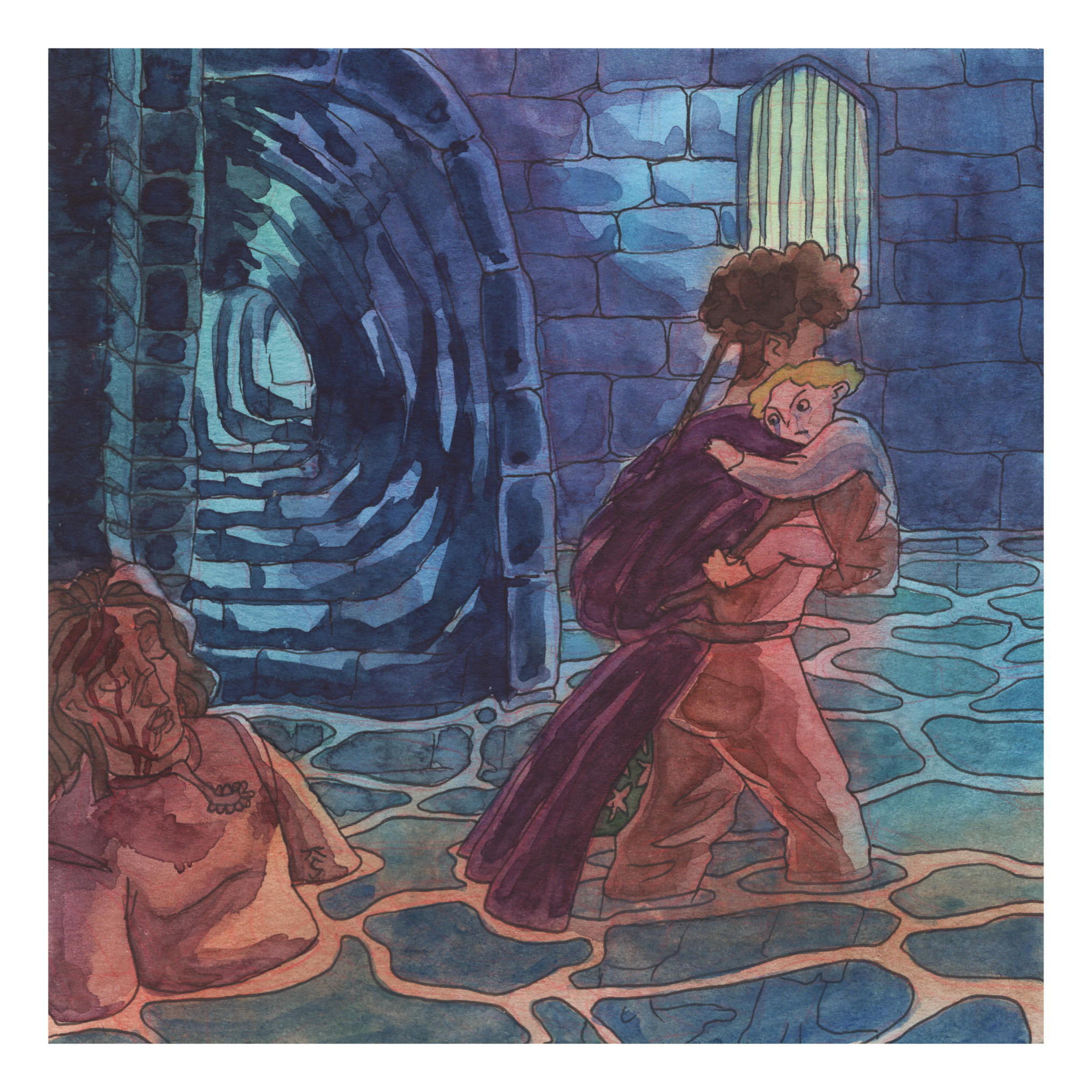
I do love this artist’s work! Katrin Supernova’s The Tunnels, here, used for commentary
At length, the pair reach Lant, and the Fool urges more haste to escape. Lant bears Bee on his back, escaping the fortress of Clerres into the surrounding countryside, where they meet Spark again. The Fool relates their expected course of action: return to the Paragon and make for Buckkeep. Bee is told that she is an aunt, and Perseverance is collected. Escape continues, and the Fool muses on the arrogance of the Servants and relates the depth of the Skill-healing Fitz forced upon him. Bee finds herself relegated to being a child who must be protected, which chafes at her, and the matter of Prilkop’s whereabouts receives attention; he had fled, but to where was not marked.
The group reaches one of the Paragon‘s boats and are welcomed aboard. The boat reaches the liveship, and its passengers board. Bee is taken aback by the liveship but soon confers silently with the craft, exchanging news. The liveship begins to transform into the pair of dragons from whose cocoons it was made, and Per takes Bee to her cabin, leaving her to assess herself and her situation. She remarks what Fitz had brought with him to save her, sorrowing over some things and exulting in the presence of her books.
Bee’s reverie is cut off by an attack befalling the liveship. She reluctantly surrenders the Silver that had been promised to Paragon, noting the power it could have offered her, and Kennitsson relays it to the figurehead. As he, joined by the son of Brashen and Althea, does so, Bee, Per, and the Fool flee the ship. Swimming away, Bee sees the liveship assailed and burning, and as the ship sinks, two dragons rise from it and begin to go about the work of destroying those who assail them. Bee watches the dragons at their work with some satisfaction as those around her work to retrieve survivors.
The prefatory comments of the present chapter once again prompt attention. Although it is not explicitly stated, it is clear to me that Gerda and the people whom she serves are the forerunners of the Chyurda; the description of Cullena, her attitudes, and the people that spring from them seem very much in line with Kettricken’s people. Deszcz-Tryhubczak writes about them, and the texts of the Realm of the Elderlings corpus support such an assertion, with examples here, here, and here, among others. That the White Prophets are known among the Chyurda is itself such an indication; the “religion” is not known in the Six Duchies during the Farseer books, and if it receives attention in the Liveship Traders works, I do not recall it at the moment. The Chyurda are further removed, geographically, from Clerres than are Buck, Bingtown, or Jamaillia, yet they are aware of the “faith”; the easiest explanation is that there was some sort of mission from Clerres to the Mountain Kingdom, and the account of Gerda presented in the preface offers some confirmation thereof. It is likely a back-filling, part of an effort to connect and unify the Realm of the Elderlings novels across themselves (and one that is not always successful, I admit; see this and this), but it is something that, at least for me, works well enough.
In the chapter, proper, there is a lot going on, and it contrasts sharply with the remarkably brief chapter it follows. I have to wonder, in fact, if it might not have been better divided into two chapters, given the pivot of Bee in the cabin; she suddenly shifts from contemplation to flight as the attack on the Paragon gets underway. I can understand, in terms of structure, that that might not be advisable; the novel prior had largely worked to alternate chapters of narrative perspective. (That it does has some resonances that frustrate interpretations of the narrative’s relation, as I’ve gestured towards previously. If it is the case that the Farseer novels are Fitz’s papers written between the end of that series and the Tawny Man novels, and the Tawny Man novels are written between that series’ ending and the beginning of the Fitz and the Fool novels, when are the recollections and notes that comprise the Fitz and the Fool novels written, and by whom? The perspective of rereading and the foreshadowing at work even for a new reader suggest that the obvious answer is not the correct one.) Adding another Bee-centered chapter would disrupt that rhythm, even as it would also move the narrative toward being more Bee’s than Fitz’s, and that might not be the worst movement to make, given context.
And, to return for a bit to affective reading: I feel for Bee. Poor kid. As the father of a daughter, and one of whom I am quite proud, I know that the day will come when I leave her, whether I want it to be the case or not. I know that she will not be able to know me the way Bee knows her father; we are close at present (she will be a teenager relatively soon; I have some idea what’s coming), but even with that closeness, we do not share thoughts and emotions the way the Skill allows. I hope nonetheless to be and to have been such a father as will make my absence a sorrow to her, even as I want her not to mourn much at my passing–but I would not begrudge her satisfaction at the fall of those she believes undo me, if that should be what happens. It’s fantasy, for the most part, of course, but even in fantasy, there are things for which to strive in “real life.”
I’ll conclude with a short note: Happy Tolkien Reading Day (again)!
Join those who have gotten help with their work! Fill out the form below!
Read the previous entry in the serieshere. Read the next entry in the serieshere.
Information about the Pocked Man legend in the Six Duchies prefaces “Touch.” The chapter begins with Fitz regaining consciousness as the Fool seeks him out, bearing Bee. The two confer about their situation, and Fitz assesses Bee’s condition through the Skill, finding her only stunned. He and the Fool fare far worse, and Fitz constrains the Fool to accept Skilled healing and to take Bee and flee. He and Nighteyes confer internally as he does so, and when that work is done, he starts to sink into welcome oblivion.
The prefatory comments of the present chapter call back to much earlier portions of the Realm of the Elderlings corpus, notably the early incidence of Forgings, Regal’s depredations on Buckkeep, and the death of Shrewd. The clear implication is that one or another of the members of Fitz’s group is being made parallel to that figure, and Fitz and Bee are the most likely candidates for being so (and in that order). The present chapter does not do much to reinforce that implication for them, however. Both are scarred, certainly, and Fitz has gotten to enjoy another encounter with Chade’s exploding powders, the very things that made him an image of the Pocked Man. Both Fitz and his younger daughter have been death-bringers in Clerres, but that has not been new to the present chapter. Why the image appears again when it does, then, does not swiftly become clear.
As I think on it, perhaps it serves as a counterpoint to Fitz’s brief prayer to Eda, made over the head of his younger daughter. It’s still uncommon for him to voice religious feeling, and Fitz remarks upon as much in the text, so the occurrence is marked. Given the repeated assertions that Eda and El coexist, there is some sense in presenting a figure tied to El in a chapter that features a rare prayer to Eda in its five-page span…but it still strikes me oddly.
I remain happy to help you get writing done at reasonable rates and without AI slop! Reach out through the form below to get me on board!
I‘d wanted to be able to post something else today, but what would have needed to happen for me to be able to do so didn’t. So much said, I did still want to put something out into the world today, if only so that I can offer the folks who have been keeping up with reading what I write something they can look at until what I expect will be regular updates resume–for a time. #NaPoWriMo2026 still looms, and my little poll is still open, so there’s still time for you to nudge me one way or another. I hope you’ll do it.
I am not in this picture. Photo by Jess Loiterton on Pexels.com
In the small Texas Hill Country town where I live, it is currently Spring Break (although not for much longer; classes resume Monday). I’ve not been able to get out a whole lot, as might be expected, but I have the impression that a lot of people are away from town, taking their kids camping or to a beach or some such thing. Given my day-job, I cannot do such things anymore; it is tax season, and I prepare taxes, so this is when I have to be working hardest. I’ve been trying to do that, keeping up with incoming returns as best as I can. Sometimes, I’m able to offer good news to clients, whether that means they’re getting money back or having to pay in less than they had thought they would have to. Sometimes, I have to do the opposite, and it’s never an easy conversation for me to have.
I am entirely sympathetic to those who have paid in throughout the year and who end up owing more tax at the end of it than they had expected. It’s vexatious to go along, doing what you’ve been told you’re supposed to do, only to find that it’s not enough; so much is true of many things other than taxes, as well. And I’ve been in the position before, finding that I’ve owed more money than I’d anticipated and not necessarily having it ready to shell out when it needed to be paid. (Indeed, I’m looking at a quarterly tax payment before too long, freelancing having been going pretty decently so far this year, and while I know that it’s in my interest to make the payment, I don’t relish the thought of doing so.) Things work out in such ways, math and application of rules resulting in inconvenience and hardship, and even when it’s not my fault that things happen the way they do, it’s not easy to tell someone that, yes, they will have to kick in more.
That doesn’t begin to touch on the people who tell themselves taxation is theft–and the irony of many of the people I have heard say such things working in public-sector jobs after attending public colleges and universities does not escape me. (I am explicitly and specifically not commenting on the in/correctness of the position, it being one of the things for which I have an eleven-foot pole, only pointing out that 1) dealing with such folks in my tax-prep office is not necessarily pleasant and 2) there is not seldom tension between stated position and observed behavior.) It’s an unfortunate reality of the occupation; although still professionalized, it’s a customer-service job as much as it is anything else, and so there are always ruffled feathers to be found.
In any event, there is always more to do. The next few weeks will be busy ones, but that’s honestly true of most times and places. And there is at least this: I am never bored.
Help me make my quarterlies; fill out the form below to see about getting some writing started for yourself!
Read the previous entry in the serieshere. Read the next entry in the serieshere.
Complaints from Chade regarding the slow progress of research into the memory cubes retrieved from Aslevjal open “Surprises.” As the chapter, proper, begins, Fitz steels himself against the task presenting itself to him, Nighteyes offering wry comments within as Fitz make preparations to draw off and dissuade pursuit of Bee. Per and Spark join him, to his annoyance, and Spark makes some adjustments to his plans before helping Per to help Fitz away. Pursuit finds them and begins to engage but is caught in the trap Fitz and Spark had set up.
Wrong kind of boom. Photo by Nairod Reyes on Pexels.com
Fitz is slowly brought back to Bee, with whom he confers again as efforts to effect escape form Clerres continue. She glosses her treatment, and Fitz conveys what news he can before he dozes off. He wakes to find himself in communion with Bee and appreciative of her strength in the Skill. Work to effect escape continues, and there is more conversation among Fitz, Bee, and the Fool, turning to prophecies and Catalysts. Bee is attacked by a released prisoner, and the prisoner is killed, to Prilkop’s sorrow. Kill totals are wryly calculated, and Fitz finds himself unable to assist the escape efforts.
At length, an opening is made into a secret tunnel, and Perseverance and Bee proceed therein. Work to widen the opening continues, and Spark joins those moving ahead. As the opening is widened further, Fitz sends the rest ahead. The Fool rejoins him, and the pair proceed, only to be told that their situation worsens. Fitz determines to proceed onward, and he is spurred by an explosion behind him.
As often happens, the prefatory materials attract some attention. It is remarked at a number of points in the Tawny Man and Fitz and the Fool trilogies that Chade had been reckless in his study of the Skill once it was made open to him, in part because he had been denied it due to his bastardy, in part out of a desire to mitigate the damage age and his particular lifestyle had done to his body, and in part because he was prone to obsession, particularly as regarded the acquisition of knowledge. The second part is perhaps the most germane to the circumstances of the chapter; Fitz comments that his body is sapping its strength to heal his wounds, repeating a process that has been at work in him since he had been ineptly healed decades before. (Chade had soon after attempted such healing on himself, if with less error due to calmer circumstances.) There is a useful warning against rushing headlong into knowledge not fully explored in the example, even as Chade’s complaints betray an eagerness to thus rush–but he is not wrong that those with greater experience and breadth of knowledge might do better to accurately classify and identify materials than apprentices, who are by their very nature less informed than they might be. There is a tension in place, to be sure, and one that memory suggests Hobb treats elsewhere; I remember Fitz noting that not all knowledge should be written due to the perils of misunderstanding and misuse. I suppose it’s something of another scholarly someday, yet another in a growing litany of them.
I do find Fitz’s comments about his life as the Fool’s Catalyst a bit amusing. The quip that “Sometimes [the Fool] is very sure a dream will come true….And then I make it not true” (642) did get a laugh out of me as I sat at my desk rereading and typing. It’s an oversimplification of events, of course–Fitz often enough acts in such ways as ensure the Fool’s visions come to pass–but I can recognize a father’s attempt at levity with his daughter for what it is easily enough, and I appreciate it.
I’m still happy to help you get writing done at reasonable rates and without AI slop! Reach out through the form below to get me on board!
Read the previous entry in the serieshere. Read the next entry in the serieshere.
A brief excerpt from Bee’s dream journals precedes “Confrontations.” The chapter opens with Bee exulting in the presence of her father and Perseverance, only to have her joy turn as Fitz bundles her up to take her to Vindeliar. She begins to persuade him that he is being ensorcelled and breaks form his grasp, taking his knife from his belt and, with the assistance of Perseverance, driving it into Vindeliar. Bee begins to succumb to Vindeliar’s magics, but Perseverance does not, and presses the attack on Vindeliar with particular vigor, killing him.
As Vindeliar dies, Fitz returns to himself and begins an assault on others of the Servants and their forces present in the room. Bee seizes on the opportunity to kill more of the Servants, joining the fight to some effect. Perseverance continues to protect her, and Fitz continues to fight, although he begins to incur injury. Capra and Fellowdy soon flee, their guards accompanying them, and Bee, Fitz, and the rest confer about events. Prilkop, who had been held near Vindeliar, is released, and Beloved attempts to make contact with Bee that she refuses. Both of the older White Prophets are taken aback by Bee’s actions, identifying her as the foretold Destroyer.
Plans for how to escape are discussed in haste, and Spark makes formal introduction of herself to Bee. Prilkop discusses the secret tunnel through which the Fool had been carried out of Clerres before, and Perseverance reports from reconnaissance that a search is ongoing. Fitz issues directives to the group and, setting his hand on Bee’s head, reflexively conveys to her his feelings about his life and hers. Nighteyes returns to Fitz from Bee and is changed by it in ways that Bee remarks, and Fitz sends the rest on ahead, although Per returns to him as the others flee.
The present chapter makes clear again that Perseverance is resistant to the Skill and to similar magics. I recall from long reading that Burrich was similarly resistant. I perceive in their common profession something of a subtle pun. Both of them work with horses, primarily (although both also find themselves devoted to Farseers)…as stablemen; insofar as both are resistant to the Skill and its uses, they are both stable men, as well. How intentional such a joke is, I cannot be sure, and intentionality is a poor judge of literary effect in any event; it is there, it amuses me, and that is enough of a reason for me to point it out.
Admittedly, the chapter itself does not admit of much humor. It does, however, follow up on some of the questions and implications of the previous chapter: Nighteyes as Wolf-Father is more than merely some echo that had lingered in Fitz from decades of a deep, magical bond. I am reminded of some old conference-work I’ve done, and I have to wonder if, like some of my other, more formal, work on Hobb, it might be worth revisiting the piece and expanding upon it with materials not available at the time I did the earlier writing. It might well be thought that I ought not to rack up many more scholarly somedays, given how many of them already wait for attention I do not know if I will ever offer, but, well, there are reasons I persisted in academe as long as I did. There are things about it I find congenial, even years away from it, even knowing that I have precious little if any place in it anymore.
Even if academe has no place for me (and, to be honest, if I have no real place for it in my life, however I might still dabble in paper-writing for myself and how much I can help others with their own work), I can still manage to come up with an idea or two and follow them out until they either make sense or get proven wrong. And I’m happy to help people do that with the works they love–because it really is love that got me into this and that has kept me doing it all this time.
I’m happy to help you get writing done at reasonable rates and without AI slop! Reach out through the form below to get me on board!
This is another Friday the 13th, a day rife with superstition. It follows another session of the tabletop roleplaying game I am running for middle-school-aged students at my local public library (where, I am pleased to note, Ms. 8 volunteers a couple of days each week). Following from last week, the players continued along with the published adventure materials, moving further into the more or less traditional dungeon on which the game is centering. Pre-generated random results yielded some interesting encounters, and there are more to follow for them.
Crack is whack. Photo by Atypeek Dgn on Pexels.com
It occurs to me that I inadvertently introduced something of a plot-hole in following the published materials. Part of what drew the characters into the intended narrative was the escape of an interpolated non-player character into a fissure in the rock. Given the published materials, there is really no place for that character to have gone. While I am not certain any of my players noticed it previously (hi, kids!), I am somewhat ashamed to admit to the gap in continuity; I will plead that I’m not as practiced as I once was and ask forgiveness for the failure. And I do have an explanation; there will have been a door or fissure the players’ characters missed, the oversight due to player absences, and which they may well encounter on the way out from the published materials. Provided I remember to put such a thing in my notes…
As to the nod to today: Friday the 13th holds a place in superstition, a conjunction of unhappy associations. Tabletop roleplaying games are, themselves, rife with superstitions, most frequently concerning the dice used to play them. The overtly educational portion of the session, which I include due to institutional concerns, treated probability (in a very introductory fashion), noting that, given equally weighted outcome generation, no specific result could reasonably be expected to follow any other specific result. That is, an honest d20 can roll twenty 1s in succession, although each roll has a 5% chance of resulting in a 1. (In contrast, a roll of honest 2d6 has something like a 50% chance of resulting in a 7, there being more combinations of two six-sided dice that add up to that result than any other result; it’s not an equally weighted outcome generation.) Much of the superstition regarding dice involves how to make outcome generation unequally weighted, and in the roller’s favor, and the overt education touched on such things. I am not immune to such superstitions, myself, and some of my past and current practices in that regard were laid out; I also invited my players to consider their own such thoughts.
Imagination matters, after all.
If you’d like me to write up something for your gaming pleasure, let me know below!
Last year, I made a stab at National Poetry Writing Month, or NaPoWriMo. In reflecting on the experience, here, I note wanting to give it another go, which remains true enough despite the amount of things I need to get done between now and the middle of April. (I need the creative outlet; there’s only so much of each day I can spend staring at tax forms.) I note also that I want to move ahead with a bit more structure, aligning the poems to a single style and to a single theme. So much remains true, and I hope to be able to compile the results into a chapbook that I can send off to contests or print and try to sell myself.
I really should do this sometime… Photo by Jan van der Wolf on Pexels.com
So, in the lead-up to NaPoWriMo 2026, I’m offering a couple of polls in which my readers have the chance to steer my work on the project. Results will be discussed on 30 March 2026–and I reserve the right to do something else entirely. I am aware of what the internet is and how it can act at times. I’ll also note that I’m much more likely to consider responses from those who chip in to fund my delinquency artistic endeavors, with those persons sure to receive public thanks. Just so you know.
As with last year, I do intend to keep my regular things going while NaPoWriMo is ongoing. Hanlon will continue through the month, and I will continue making my comments about it. I am coming up to a break-point on the Robin Hobb rereading, though, so that might go on a bit of a break while I address NaPoWriMo and one or two other things. I’m not abandoning the project; there’s a lot yet to do. But I would like to address this one, as well.
Do you want a poem, a poem of your own, whatever the polling might say? Then fill out the form; I’ll get on the horn, and we’ll talk ’bout what you’ll have to pay.
Read the previous entry in the serieshere. Read the next entry in the serieshere.
An excerpt from a letter from Chade to Fitz about Shrewd and the costs of necessary secrecy precedes “Smoke.” The chapter opens with Fitz reaching out to the Fool, thinking the latter dead. Fitz steels himself to leave his friend behind in search of his daughter and is surprised when the Fool lashes out, thinking that the Servants have come for him again. Fitz helps the Fool along, assisted by Lant, and receives report of events. Brief conference about how to proceed is taken, and the Fool offers guidance as to where Bee might be held.
Probably a little light… Photo by cottonbro studio on Pexels.com
The group finds its way into a torture chamber, Fitz aghast at its contents and implications as he searches among the present prisoners for his daughter. Progress is interrupted by a pair of guards who converse as they make a casual sweep of the area; after they have left, Fitz’s search for Bee continues, uncovering Prilkop. Fitz continues, moving with some caution against the alert status of Clerres, and he becomes aware of fire at work in the stronghold. Fitz and Perseverance charge ahead, the latter passing the former and claiming Bee.
As Fitz makes to begin exfiltration with Bee and his other companions, Wolf-Father rejoins him, making brief report. And in the moment of openness, Fitz begins to be suborned by Vindeliar’s magics, beguiled to take himself and the children to the Servants.
The present chapter offers some explanation for the presence of Wolf-Father with Bee, and I find myself easily able to imagine Nighteyes commenting that “This is pack.” The explanation carries some implications and raises some questions, of course:
Is Nighteyes unique or rare among wolves in leaving not only an echo of himself in Fitz but a lingering spirit that has agency and can move from person to person? And if he is not, what does that say about the packs of wolves that exist in the world the Realm of the Elderlings inhabits? And what of other animals?
To what else can such a spirit as Nighteyes is attach?
What other spirits are at work in the Realm of the Elderlings? (The beings in the Skill that Fitz encounters from time to time, not only those of his Skill-using kin dead or gone into dragons, are some, but are they all.)
Are spirit-like manifestations (eg, the apparitions stored in memory stone) merely echoes, or are they, too, potentially lingering sentiences that can “attach” to people and places with agency? (There is some suggestion of this in the interactions between Rapskal and Tellator, for example.)
Such things–and I make no claim that what I note above is exhaustive rather than a few minutes of not-too-deep thinking–are the kinds of things that send fandoms scrambling, I know, and might with some properties open space for other authors (and adaptors; I admit that my recent roleplaying work has me thinking in such ways) to write such that the holes are filled and implications traced out. Whether that is a good thing or not is a matter of perspective; Tolkien’s comments about bones and soup come to mind for one perspective, but my own completion- and lore-seeking self rapidly presents another. (I also acknowledge the existence of but do not care for at least one more: “Who cares?”) I point so much out not because I necessarily do want any of those gaps filled (or, more likely, patched over; I’ve seen how such things can go) but because they are useful reminders that such gaps do not detract from the quality of a work. Rather, they are necessary products of writing that reflects the messiness of reality; while there may be answers to all questions in the readerly world, none of us has all of them, so writing that strives for verisimilitude–such as Hobb’s–should also leave at least things open.
Want writing done at reasonable rates and without AI slop? Reach out through the form below!










 Elliott RWI