Following up on the previous report, students were asked to consider presentations and work towards their annotated bibliographies. The latter were to be submitted for review and instructor feedback, as well.
The course roster showed 23 students enrolled, a decline of two from last week; all but one participated in at least one online discussion during the week. An online office hour was held on Monday, 12 November 2018; one student attended.
Students are reminded that another office hour is scheduled for tonight, Monday, 19 November 2018, at 6pm Central Standard Time. Students are also reminded that the following assignments are due before the end of day (Mountain Standard Time) on 25 November 2018:
Discussion Threads: First Draft and Analyzing a Sample Argument (3 posts/thread, rubric online)
Course Project: First Draft (due as a Word document in APA format)
I recently made the note that I have never sat for a first-semester college composition class; owing to a particularly excellent high school English teacher (thank you, Mrs. Murray!) and my undergraduate school’s policy on AP classes and their equivalencies, I was exempted from that particular curricular requirement. There were certainly advantages to it; I was spared the expense of the course at the college level, for one, and, for another, I did not have to take the time to go through the class, but instead could focus my schedule more fully on what was then my major field of study.
As it happened, though, I did not attend to my major as closely as I ought to have done, and I ended up switching my course of study–to English, in the event. And while I moved directly into major coursework in that curriculum, I did, as a senior, have to round out my composition requirement (much to my annoyance, having already been successful in upper-division English classes), and doing so without the context provided by having sat for the earlier class made things less easy than they ought to have been. (I did still get an A in the class, though; I’d’ve been embarrassed had I not.)
Even as an undergraduate English major, I worked toward being at the front of a classroom; graduate work only suggested a different kind of classroom. But most of the teaching I have ended up doing has been in first-year composition classes; I’ve taught it at all but one of the colleges where I’ve taught, often in multiple sections each semester, such that I’ve lost track of how many individual iterations of the course I’ve taught. And throughout doing so, I’ve struggled with understanding how students can act toward it as they do; I’ve never been in the situation, and I was not a normal student until graduate school in any event, so my frame of reference is small, indeed.
My practice of writing the assignments I ask my students to write has been an attempt to help me better understand those I teach by putting myself into situations not unlike what they face–and it seems to be a better match with non-traditional students than with the more “normal” first-year college student. Like most of the non-traditional students, I write what I write amid working at one or more other jobs; I do not have the “typical” student’s ability to focus wholly on my coursework at this point. (To be fair, I was not as good about it when I did have that ability as I ought to have been–and I was not as good about how I exercised that lack as I ought to have been, either.) Like many of them, it’s been a while since I was a student in a traditional classroom setting, as well. But there is still the divide in that I have remained grounded in the field of study, while most or them have never had a solid grounding or have lost what they did have. Thus, while I mean to continue my practice of drafting and offering examples, I know they are only useful to a particular point.
Having been assigned once again to teach first-semester composition, I have found myself in mind again of my own lack of common collegiate experience. (I am in mind once again, after some time, of Timothy Carens and the College English piece “Serpents in the Garden: English Professors in Contemporary Film and Television.” I have to wonder how valid the assertions remain.) I am certain that my teaching has suffered because I did not face the challenges that my students do; I have not been as sympathetic in the past as I perhaps ought to have been, and it has shown in the comments that students have left me. Though I have improved, I know there is still work for me to do–and that there are things I am not likely ever to get, really, because I am not now and have not been where they are whom I teach. And that continues to sadden me.
After addressing questions from the previous class meeting and earlier, discussion turned to concerns of paragraph and essay structures before moving into more explicit address of upcoming work on rhetorical analyses. Formatting and presentation received some attention, as well, and students were offered time to complete their assignments.
The class met as scheduled, at 1800 in Room 106 of the San Antonio campus. The course roster showed 11 students enrolled, unchanged from last week. Nine attended; student participation was reasonably good. An online office hour was held on Monday, 12 November 2018; no students attended.
Students are reminded that another office hour is scheduled for Monday, 19 November 2018, at 6pm Central Standard Time. Students are also reminded that the following assignments are due before the end of day (Mountain Standard Time) on 25 November 2018:
Discussion Threads: Analyzing Persuasive Messages and Writing with Style (3 posts/thread, rubric online)
Rhetorical Analysis Planning Sheet, due online as a Word document
To continue on from earlier work (here and here), I will follow further the assignment sequence expected of the students in ENGL 112: Composition. The second paper they are asked to write is a rhetorical analysis of a classroom-appropriate* advertisement; as with the earlier profile, they are asked to precede their work on the main paper with a planning sheet. Since they are asked to do it, I will be doing it, as well, in the continued hopes that I can help my students and others by doing so.
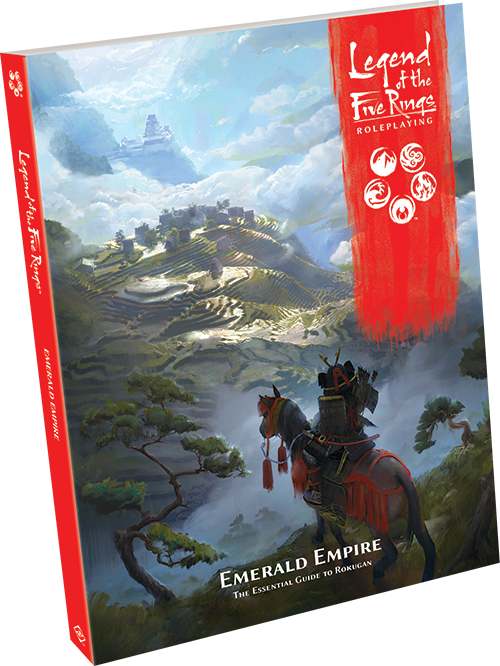
The first task was to select an advertisement to review. Given the sheer number of such available, even within the rubric of “classroom appropriate,” it was not an easy thing, at least at first. Faced with the over-abundance of examples, and feeling that I ought to make the exercise work for me as well as for my students, I focused my attention on my own interests and prior efforts for the class. (Following up on earlier course materials helps in many cases.) In terms of Google image searches to run, I went from “advertisement” to “classroom appropriate advertisement” to “advertisement Legend of the Five Rings.” Said search yielded a plethora of results, so I applied my existing knowledge to winnow the results down to those reflecting the current holder of the intellectual property of the game, Fantasy Flight Games. And, since I primarily play the role-playing game, I focused on that, selecting the promotional material for a specific supplement.
With the advertisement selected, I moved on to setting up the document for my response. As before, I eschewed the University-provided template, setting up a document on letter-sized paper with one-inch margins and single-spaced 12-point Times New Roman type. (It is not APA standard, I know, but the document is not of the sort as demands it. Rather, it follows the sample profile plan I did earlier.) I also stubbed out sections and prompts from the assignment documentation. Directions for completion were highlighted to attract attention and to serve as a reminder for later deletion. The called-for URL linking to the advertisement was easily inserted early on; I did so to be sure it got done.
I began then to address the other prompts in the document. Context for the advertisement and a description of it received attention, followed by specific work on the advertisement’s deployment of logos, ethos, and pathos. Along the way, I checked APA style guidelines to be sure I was presenting materials in a way that would oblige minimal adjustment later.
I had needed to do the descriptive work because I had needed it in place to come up with the thesis for which the later analysis calls. Once I had that work done, I was able to address the issue of whether or not the advertisement would likely succeed with its presumed purpose and audience, and I needed that information to draft the introduction and conclusion for which the current exercise called. Having it, I did so.
The content made ready, I deleted my highlighted notes and reviewed my document for style and mechanics. After making the adjustments that needed making, I rendered the document into an accessible format, which I present here: G. Elliott Sample Rhetorical Analysis Planning Sheet November 2018. May my readers use it in good health!
*As might be imagined by those who know me, either in person or from reading what I write, I have…issues with such a term. Since I’ve already treated the matter, I’ll not belabor the point at this time.
Following up on the previous report, students were asked to summarize a source they might use and to consider the reliability of online sources. They were also asked to propose and outline their course projects; instructor comments are offered to help improve further work. Students were further asked to check in once again.
The course roster showed 25 students enrolled, unchanged from last week; 21 participated in at least one online discussion during the week. An online office hour was held on Monday, 5 November 2018; no students attended.
Students are reminded that another office hour is scheduled for tonight, Monday, 12 November 2018, at 6pm Central Standard Time. Students are also reminded that the following assignments are due before the end of day (Mountain Standard Time) on 18 November 2018:
Discussion Threads: Presenting Ideas and Annotated Bibliography Practice (3 posts/thread, rubric online)
Course Project: Annotated Bibliography (due as a Word document in APA format)
Continuing a practice I most recently iterated at the end of the July 2018 session at DeVry University, and following closely the patterns established in previous practice, comments below offer impressions of class performance among students enrolled in my section of ENGL 135: Advanced Composition during the September 2018 session at that institution. After a brief outline of the course and selected statistics about it, impressions and implications for further teaching are discussed.
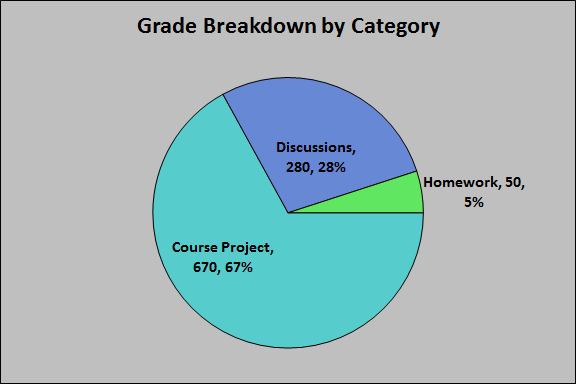
Students enrolled in ENGL 135 during the September 2018 session were asked to complete a number of assignments in quick succession. Many, and the weightiest, related to the overall course project; others were homework meant to practice skills used in the workplace and in later stages of the course project. Those assignments and their prescribed point-values are below, with relative weights shown in the figure below:
Course Project
Topic Selection, 50 points
Research Proposal, 50 points
Annotated Bibliography, 100 points
First Draft, 70 points
Second Draft, 80 points
Presentation, 100 points
Final Draft, 170 points
Career Planning, 50 points
Discussions, 280 points
Homework, 50 points
Total, 1000 points
As before, most assignments were assessed by means of rubrics provided by the institution. Some few were assessed on a percentile basis from standardized testing conducted as part of University-wide course requirements.
The section met online, with office hours generally taking place Monday evenings at 6pm Central time. Its overall data includes
End-of-term enrollment: 13
Average class score: 796.154/1000 (C)
Standard deviation: 90.997
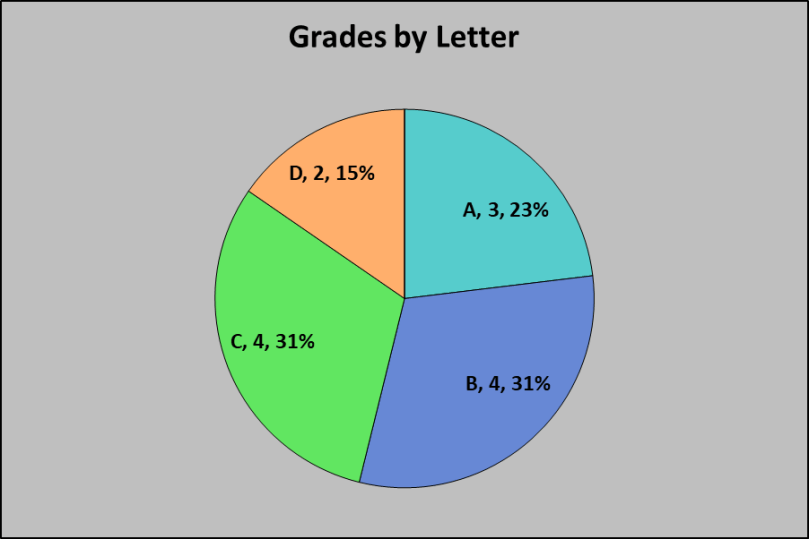
Students earning a grade of A (900/1000 points or more): 3
Students earning a grade of F (below 600/1000 points): 0
Numbers of students receiving each of the traditional letter grades are indicated below:
I was pleased to note that none of the students who completed the class failed it. It’s not been something that’s happened often in my teaching career–but I think it has more to do with students withdrawing from the class before a failing grade could be recorded than with my improving quality of teaching, more’s the pity. Still, close to a quarter of the students earned A grades, which was a pleasure to see.
During the session, albeit later than ought to have been the case, I returned to an old teaching practice of mine: doing the exercises assigned to my students. I hadn’t done so in some time, my attenuated connection to academe (about which I’ve written at some length) interfering with my doing so. Writing what my students are asked to write after a while of not doing so was illuminating; it reminded me of the struggles my students face in getting their own work done amid their lives, and it reminded me that I am somewhat out of practice doing the kind of writing expected of academics. (That I am is sensible, since I’m not a “real” academic anymore and have, in effect, given up on the idea of being one. Still, to have had a skill-set and to be aware of its diminishing is vexatious.) As such, it was useful, and I am likely to continue along the practice in the November 2018 session. I will likely focus my efforts in that regard on ENGL 112 rather than on ENGL 135, however, since the latter has a recent example, and I’ve not previously taught the former. (Indeed, I never sat for first-semester college composition, which has some implications that I may explore later.)
At the end, though, I am glad once again to have had once again the chance to teach, and I look forward to having it at least one more time as I move forward.
After addressing questions from the previous class meeting, discussion turned to writing as a process, the concept of genre, profiles as a genre, and specific assignments coming due for the course. Time was offered to students to work on their assignments, as well.
The class met as scheduled, at 1800 in Room 106 of the San Antonio campus. The course roster showed 11 students enrolled, a decline of two from last week. Six attended; student participation was reasonably good. An online office hour was held on Monday, 5 November 2018; no students attended.
Students are reminded that another office hour is scheduled for Monday, 12 November 2018, at 6pm Central Standard Time. Students are also reminded that the following assignments are due before the end of day (Mountain Standard Time) on 18 November 2018:
Discussion Threads: Getting Started Writing and Profile Genre (3 posts/thread, rubric online)
To continue on from earlier work (here), I will be drafting a profile essay of the sort my students are asked to write. For the assignment, students are asked to draft a two- to three-page profile of a person, place, or event familiar to them; the profile should adhere to APA formatting standards, although no outside information is expected or required.
As it looked as I was drafting this. Image taken from the forum where the event occurred, used for commentary.
I’ve written profiles before (here, for example), so the idea of one was neither foreign nor intimidating. And in starting one, I first set up my document to align to APA formatting guidelines: double-spaced 12-point Times New Roman on letter-sized paper with one-inch margins. I also set up a cover page with title, my name, and affiliation (for purposes of the assignment), as well as page numbering and running heads. I also opened the planning sheet I had previously drafted; since it was meant as a guide to completing the profile, it made sense to have it open while I worked. And I opened the website that hosted the role-playing game event I meant to profile, which does move a bit away from the assigned guidelines–but I needed the refresher.
With the documents and website open, I began to stub out points I meant to address in the profile. As is my personal practice, I noted the angle I wanted to push in the profile–that the play-by-post role-playing game offers a fulfilling experience well worth undertaking–highlighting it in green so that I could see it easily (and remember to delete it when done composing). Then I sketched out the beginning of an introduction and gave myself informal labels for what would follow, something like section headings that I would later delete (and so highlighted in blue, per my personal practice, to differentiate themselves from the green target of my angle while still noting that they needed to be addressed and then deleted).
That said, I started writing. The topic was one with which I was intimately familiar, so finding things to say was reasonably easy. I did need to review it for concerns of my audience; my putative primary readers are familiar with the kind of thing I discussed, though not the thing itself. Still, that was a relatively minor issue, the more so since I’ve introduced many people to the kind of thing my topic is.
With the content compiled, the formatting was re-checked to ensure ease of reading. A review of content for style was conducted, as was proofreading. All that done, the document was rendered into an accessible format, presented here: G. Elliott Sample Profile November 2018.
I hope, as ever, that the work I do is of use to my students and to others. And I am grateful for the opportunity even to try to be so.
For the first week of class, students were asked to introduce themselves and to work through developing a topic for the session-long course project. Instructor comments on the latter were offered in the hopes of prompting deeper consideration and more engaged, authentic work. Students were further asked to check in to ascertain early progress in the session.
The course roster showed 25 students enrolled; 23 participated in online discussion during the week. An online office hour was held on Monday, 29 October 2018; one student attended.
Students are reminded that another office hour is scheduled for tonight, Monday, 5 November 2018, at 6pm Central Standard Time. Students are also reminded that the following assignments are due before the end of day (Mountain Standard Time) on 11 November 2018:
Discussion Threads: Summarizing Sources and Internet Reliability (3 posts/thread, rubric online)
Course Project: Research Proposal and Outline (due as a Word document in APA format)
Information Literacy and APA Format Quiz (due online)
To continue my practice of drafting sample assignment responses for my students, I am working to follow the pattern my first-semester composition students are asked to follow and work through a series of writing assignments ostensibly meant to introduce them to the processes and demands of academic writing. Unlike ENGL 135, ENGL 112 does not ask students to address a single project, but instead calls for them to address different writing tasks throughout the term, working in small pieces to foster a skill-set that will, hopefully, serve them well in their future coursework and in their continuing lives outside the classroom.
It’s not a bad model to follow. Image taken from Giphy.com
The first piece of writing students are asked to do is a profile essay; in the first week of class, they are asked to prepare for it, reflecting writing as an ongoing process. Specifically, that preparation asks students to conduct an initial rhetorical situational analysis, examining their prospective profile topic, their angle of approach to it, their purpose for treating their topic as they do, characteristics and needs of their audience, and their own authorial perspectives and biases. It seems a good exercise to have students do, certainly, and one that would be helpful to have repeated with more detail in successive writing classes. (That it is not part of the standard assignment sequence in those classes, I know–I teach said classes.)
As with my efforts in the previous session (here, here, here, here, here, here, and here), I eschewed the University-provided template as I began my work on the exercise. Setting my Word document to 12-point, single-spaced Times New Roman with one-inch margins on letter-size paper sufficed. And, given the exercise’s constraints, I did not set up a title page or running head for the document of my response; I did, however, insert page numbers, and I offered something of a heading and title, following my practice in assignment documentation given to students. (Students will please note that this is not APA format.)
With my document’s layout set up, I proceeded to address issues of content. I started by copying the relevant questions over from the University template. That done, I began to address them, answering openly and honestly as best as I could. Given my predilections and associations, as well as the exercise’s guidelines, I opted to focus on an event–and a particularly nerdy one, at that, which can be found here: http://shadowsovernaishou.com/paintedcity/index.php. Answers to the several questions emerged easily from that decision, and I addressed the prompts of the exercise with little difficulty.
The content made ready, I reviewed my document for style and mechanics. After making the adjustments that needed making, I rendered the document into an accessible format, which I present here: G. Elliott Sample Profile Process Planning Sheet November 2018. I hope it will be useful for my students and others in the days to come.