A Rumination on Juneteenth

It’s not exactly a secret that I opine on holidays and other observances that occur on my regular posting schedule (as well as the occasional event that takes place off of it). So it shouldn’t be a surprise that I’d comment on Juneteenth this year, since the federal holiday takes place on one of the days I would normally post; as such an observance, and one apt to have me close my day-job for the day (I did), it’s the kind of thing that invites remarks from me. But I’m…somewhat hesitant to say much about it (though not completely so, clearly, as the very existence of this post denotes). Not that that should be a surprise, either, given what the holiday represents and who and what I am.

It’s a banner day…

(Please note that I am not in any way saying the observance should not happen or does not deserve to happen. It should, and it does.)

As is fairly common knowledge, or as damned well should be, Juneteenth commemorates the Emancipation Proclamation reaching Texas in force, the perceived end of institutionalized chattel slavery in the United States. On paper, it denotes the formal end of a long section of the history of the country, the formal end of a great wrong that had been perpetrated on generations of people. In truth, slavery continues, as the prison-labor complex shows, and the legacies of slavery continue even aside from the overt reality of it, as far too many things show to recount here and to recount in any place without being subsumed by tears long before the tale is told. So there’s some fraughtness to the observance right there.

More personally, I have to question the extent to which I have any right to mark the day. I close my day-job because the federal government is closed, and many or most banks follow suit; since I work in tax preparation and bookkeeping, both of which rely in large part on both of those, there’s not a lot of point in my spending the money involved in having the office open. That’s a piss-poor reason to do more to mark the day than that, though, even if it deserves a lot more marking that I can offer it.

No, my unease is a result, at least in part, of my recognition that I benefit from the legacies of the systems that were supposedly unmade on the first Juneteenth. I doubt that my family enslaved others (but I am not entirely certain), and I am pretty sure that at least one of my forebears fought for the Union (there’s some physical evidence suggesting such), but that does not mean I don’t enjoy benefits of a system that was built and predicated upon the treatment of people as livestock. What opportunities have not been foreclosed to me because I have the familial heritage I have and not those I don’t, I cannot really say, although I do know there are dangers I do not face because I look the way I do and live where I do. What experiences I have been able to have because others have reacted to the injustices perpetrated upon them, I have a few vague ideas, but I have not had to consider them more closely than I have because I occupy the positions I do.

I have benefited, but I have not had to pay. And there’s not really a way for me to give back those benefits; I cannot undo what has been done, whether for good or for ill (and it has too often and for too many people been ill). Too, there are limits to what I can do to improve matters, moving forward, which I recognize, even as I recognize that my pointing them out and not doing much of anything to address them makes me complicit in some ills, in many ills–but not even pointing them out makes me complicit in yet others.

I’m not trying to excuse myself, to exempt myself from discomfort. I should be uncomfortable, about this and about a lot of other things. I should also let that discomfort spur me to make things better than they are, and not just in the small ways I already do. Whether I am not so much of a coward that I will actually do something, though…

On this day, as on most every other, I’m happy to write on your behalf; fill out the form below to hire my pen!

← Back

Thank you for your response. ✨

Or you can send your support along directly!

Reflective Comments about the Ninth Year

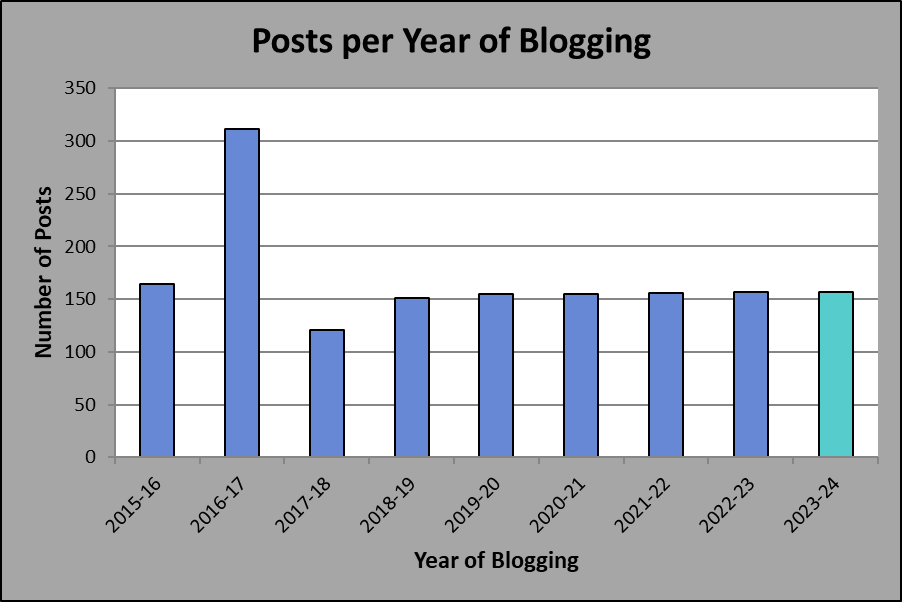
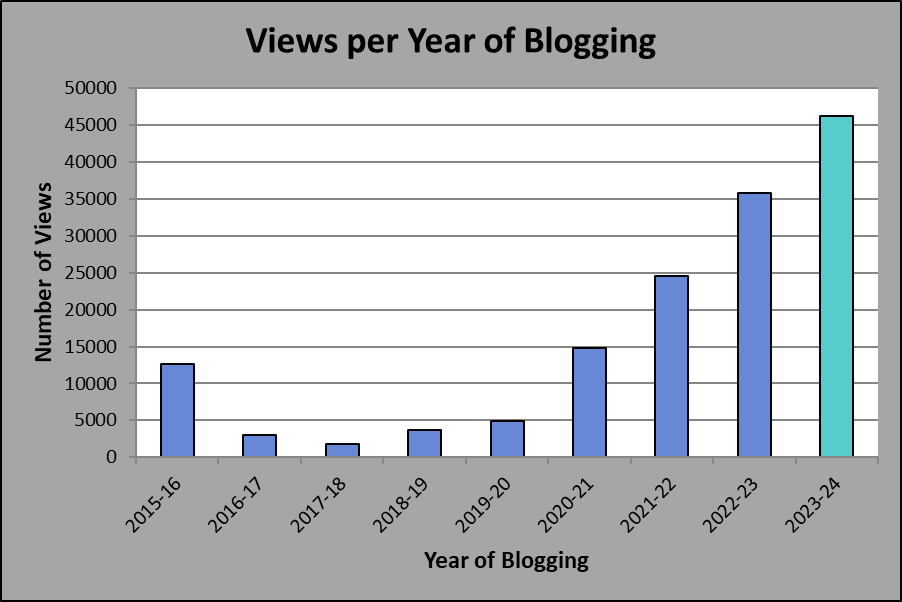
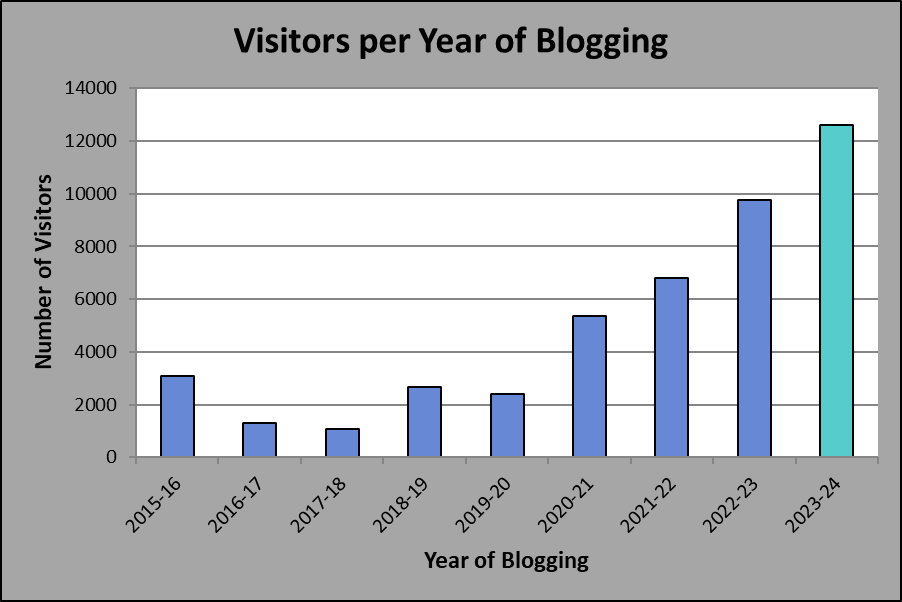
Today marks nine years since I began posting to this webspace. As I write this next entry in my series of annual reports about the status of this site, I have published 1,527 posts to this webspace (this will be 1,528), as well as revising individual pages, attracting 147,355 views from 45,024 visitors. As such, in the past year, I have published 157 posts, garnering 46,274 views from 12,601 visitors (per “Reflective Comments about the Eighth Year“).

The following graphs present changes over time, noting posts, then views, then visitors.

I continue to be pleased to have the opportunity to do this kind of thing, to have an outlet for my ruminations and occasional verse, as well as to continue to offer the resources I do (and which viewership figures tell me attract some attention; I hope they are useful). That this has been the best year I’ve had in terms of readership is also a pleasure. It suggests that I am doing something right, and there’s no small joy to find in that suggestion.

I continue to be pleased, too, to offer writing to order. If you’d like to have some done, please fill out the form below:

← Back

Thank you for your response. ✨

I’m also pleased to accept your patronage.

Hymn against the Stupid God 221

Such greed as gathers lucre grows apace
Swelling, suppurating, stifling grace
As, charmed by cheers while giving chase
To gold that gleams, a Stupid God looks on
And grins. It gallivants; its growing throng
Delights, depraved, distracted far too long
From worthy works by wiles ill-minded ply.
I and others often wonder why
The world will work in such a way. We cry
For aid, for answers, for some ease at last,
Seek to see the Stupid God sink past
The deeps, descend, and be from this world cast,
But holding hope is harder every day,
And mouths aren’t made so many times to pray.

Image not related.
Photo by Scott Webb on Pexels.com

I’m happy to write to order, in verse or in prose–and with no AI plagiarism!
Get your bespoke piece started today!

← Back

Thank you for your response. ✨

Or you can send your support along directly!

A Rumination on My First Local Bookstore

It may have come up in my recent writing that my daughter has been participating in a theatre camp near the town where I grew up. As it’s a day camp and I live an hour away, with work requiring that I be on-site at particular times, I cannot drive here there and back as was the case in some years past; consequently, my daughter is staying with her grandparents, who still live in the house they lived in when I graduated high school a couple of dozen years back. One result of that is that I have been going back where I came from–more or less; there are some caveats to consider–and have had occasion to spend a bit of time out in the town.

I can very nearly smell this picture…
Photo by Pixabay on Pexels.com

Part of that time came at the end of last week. My daughter gave her weekly performance with the camp, and my wife and I–joined by my brother and his son–took her to lunch afterwards. Where we went to lunch was in the same shopping center as the first bookstore that I remember going to, and one I’ve noted once or twice before: Books to Share in Kerrville. I’m almost always happy to stop by a bookstore, generally, and I knew (and confirmed) that I had access to a substantial account at Books to Share, so we walked across the asphalt pond of the shopping center parking lot, putting in at the island of peace that the bookstore is.

Walking in, my family and I were greeted warmly, if not with full recognition; we were clearly familiar, but it had been a while since we’d been by (my wife, my daughter, and I). And I was taken back to my early childhood, released from my grandmother’s hand to nearly run among the towering stacks piled with books that had been brought in by other readers and left in exchange for discounts on others yet, a forest ecosystem I did not yet perceive as a living thing but from which I drank deeply of joy. I was taken back to being around my daughter’s age–she’s ten as I write this–beginning to venture out in earnest from the “children’s” section into “grown-up” books, of which I still have some copies on shelves that have been filled and emptied and moved across states and time zones more often than I’d prefer. I was taken back to my teenage years, when my tastes solidified (and from which they still have not thawed, in large part, even if they have grown to include more), and the stacks I would take in and out of the store swelled larger and larger.

I was taken back, too, to my college years, when my visits were fewer but more focused, my English-major self having a reading list a yard long and deeper yet, and I knew that I could find copies of the classic novels and poetry collections I needed to read and be able to write about for far less than the campus bookstore or the nascent online ordering platforms that pervade so much discourse now offer. I was taken back to my years in graduate school, when the visits were fewer yet but grown more poignant, when I could see that books I had had had continued to circulate even as people I had known since before I was in school no longer did. And I remembered the years since coming back to the Texas Hill Country, head bowed in defeat and showing my face as seldom as I could in the places I had been, thinking that they would know my shame and mock me for it as I felt I deserved to be mocked and ridiculed, even though they never did, greeting me each time with open smiles and kind words.

There’s some lesson to be taken from that, I’m sure. I’m not sure I’m a good enough student anymore–if ever I was–to learn it well.

I am sure, however, that it was good to go back, not least because my daughter fairly skipped among the stacks, face lighting with glee at getting to get books for herself to read and, afterward, to share.

If you like the kind of writing I do, know that I’m happy to do some for you!
Fill out the form below to get started!

← Back

Thank you for your response. ✨

Or you can send your support along directly!

A Robin Hobb Rereading Series, Entry 401: Fool’s Assassin, Chapter 11

Read the previous entry in the series here.
Read the next entry in the series
here.


After a letter from Fitz to Nettle that discusses Verity in Kelsingra, “The Last Chance” opens with Fitz musing on the experience of his grief at Molly’s death. Amid his grief, life at Withywoods continues, and the effects on Bee are glossed to the extent that Fitz, consumed by his own sadness, notices them. His mourning and Bee’s persist past the observances of others, who have their own lives and affairs to attend to, but Fitz and Nettle do have a conversation about his Skill-imposed health. Nettle also attempts to persuade Fitz to send Bee to Buckkeep, which he refuses, and Nettle’s misconceptions about her sister are addressed. The conversation between the two is tense, but they reach an accord between them concerning Bee.

Kelsingra? Of course it’s Frozen History by MeetV on DeviantArthere, used once again for commentary.

Nettle retires after her conversation with Fitz, and he and Bee confer at some length. Fitz is somewhat uneasy at the depths of Bee’s perception and understanding, and she makes clear that she can sense him in some ways through the Skill. Fitz considers the implications as they continue to speak together, and he puts his daughter to bed for what he realizes is the first time.

The next morning sees Fitz and Bee prepare for the day and for seeing Nettle off on her way back to Buckkeep. Nettle gone, the two proceed to their daily tasks. Fitz begins to work to catch up on what he has let slip in his grief, and a new routine begins to settle in for the pair of them.

Later, near the end of autumn, Fitz receives a summons from Chade. With some difficulty, Fitz makes arrangements to answer it, and he shows Bee part of the system of hidden rooms and corridors that pervade Withywoods. She takes to it readily, and Fitz finds himself reporting the circumstances of Patience’s death years before. Further conversation grows tense, but the tension eases in time, and Bee asks what will become of her after Fitz dies. The question staggers him, and he works to put his daughter, and himself, at ease.

The current chapter is another unusually long one, running to 51 pages. There is doubtlessly some kind of commentary to read into that, some assertion that the experience of grief dilates time, and it is the case that the present chapter glosses several months. Still, it could easily be the case that the chapter be broken at the seasonal shift; there is a narrower focus on the events of a day at that point, and it would have made sense to have the division at that point both to clearly delineate the passage in time and to highlight the shift in the pace of action. Some other narrative or editorial principle has to be at work, then, and while I have an idea about it, I would have to look farther ahead in the novel to confirm that idea–something I am not willing to do quite at the moment.

That I am not willing to look ahead in the novel is not a result of not wanting to spoil things for myself. I’ve read the novel before, after all, and deeply enough to write a review of it and to use it in at least one conference paper. No, the unwillingness comes from what I know tends to happen to me when I am going through the books about which I write: I start reading again. Indeed, occasionally, when working on earlier portions of the rereading series, I’d get to reading, and it would be hours later that I would look up, realizing I hadn’t written a damned thing and that I really needed to use the restroom. It’s a good thing to do as a reader, certainly, and when reading for the pleasure of reading. It’s not entirely helpful, however, when reading for the purpose of writing. So, while it is the case that I like doing the reading I need to do to be able to do this work, it is also the case that I am trying to get something done, and I can’t get it done if I let myself read ahead too much. I’ll lose track of what I’m supposed to be doing, and that makes doing hard.

So much said, the kind of confirmation I would need would come from something as simple as a page- or chapter-count. And I recall that, when I had students, there were more than a few who were surprised that any kind of literary analysis or interpretation could actually involve such things. I think either they did not have the kind of middle- and high-school English classes that I did, which involved counting lines and syllables in poems (something that, to be fair, I did a lot of in college and graduate school, as well); they did have that kind, but they did not realize that what can be done with poems can also be done with prose; or they did have that kind but regarded it as being something done by “lesser” students. So much said, there is quantifiable data in even the most “creative” work, although the quantitative is not and cannot be the sum total of such work or interpretations of the same; it offers one useful descriptor among many, and it serves as a useful way for those who are more quantitatively minded to get into the work of interpreting text.

Or so I found, anyway. It has, admittedly, been a while, and I am no longer doing work in the classroom.

If you like the way I write, why not hire me to write for you?

← Back

Thank you for your response. ✨

Or you can send your support along directly!

Something Like a Personal Narrative

I had been reading Here She Comes Now, a collection of essays (edited by Jeff Gordinier and Marc Weingarten) that respond to the lives and works of a number of women in music. I enjoyed the reading thoroughly despite having read it only in fits and starts, most often while on the treadmill at my local gym. As I read the last few selections, slogging up a simulacrum of a hill, it occurred to me (not because it was some great revelation or deep insight on my part, but just because something popped up in my mind that ought to have done so earlier) that the book is a series of what were called “personal narratives” in the long-ago days when I had students and the longer-ago days when I trained to teach them.

The things I’ll use as a study hall…
Photo by Pietro Saura on Pexels.com

Given that most of my teaching was either first-year composition or college-preparatory writing–even if, as often, under older and less kindly names–I was often asked (emphatically, with the weight of my too-small and too-needed paychecks behind the requests) to teach the genre. Given what I was taught about teaching, I tried to model the assignments for my students. Given my own experiences and the usual demands of the imposed assignment–leave it to a bunch of old English majors (not Old English majors, nor yet Olde English 800) to want literacy narratives–I struggled to do so.

That I did so, both on the specific literacy narrative and on the more general personal narrative, is a result of the kind of life I’ve led. Reading Here She Comes Now reinforced to me that the personal narrative–however focused or on whatever art it centers–relies upon a perceived or experienced pivot. That is, it has to center on a “life-changing” experience, a transformative encounter with some thing or another. For a literacy narrative, it’s often the first or most prominent formative experience of reading; for the essays in Here She Comes Now, it’s an encounter with the woman’s music that reorients the writer.

I don’t have many such experiences or encounters; my life has not been a series of sharp shifts so much as it has been a long, gentle slide, and if it is the case that I have felt myself to be jerked around on occasion, it is because I have been so accustomed to gliding along that any jostling seems rough. At this point in my life, I do not begrudge it; my skin has grown thin and my belly weak, such that upset now is as like to lead to some messy rupture as any revelation about which I might opine to some new adulation. No, for me, the staid and sedate suffice. They must; I’ve nothing else.

Such pivotal moments in my past as there are have not much been with art. Devoted as I am and have been to writing and music, engaged as I have been at times inn other arts, they have always been for me always beens. I entered into them so early I don’t remember doing so. I do have the clichés, of course: the first written death threat I received, the first time I fucked, when I realized I meant to marry my wife, the discovery of her pregnancy with our daughter, the ejection from or surrender of life in academe, that kind of thing. But of what seem so much to be common experiences not worn to cliché? Not a whole hell of a lot.

It’s honestly a good thing. My parents did well to provide me an upbringing in which it was simply a matter of course that there would be books on the shelves and in hands; that there would be music playing and instruments available on which to play it; and that I had enough food to eat and fair variety in it, as well as a stable, safe place in which to eat it. I’m not finding fault with them that I don’t have a particular, singular experience that compares with so many that I have seen reported. That said, I can’t help but wonder what I’m missing–but that’s nothing new.

I’m happy to write to order for you; if you’d like to have me do it, reach out through the form below!

← Back

Thank you for your response. ✨

Or you can send your support along directly!

An Expansion on a Comment Taken from My Journals

Digging around amid the
Furrows I have raggedly plowed into
Fields that should be better regulated
That came to me in good order
I find a seed that I can plant
Water with such moistures as I can pour out until
A tangling vine springs forth to
Thread itself up the brickwork built up over many years
Cracking away the mortar as it scrabbles for purchase
Drawing from soil long since
Refined and reshaped for some sustenance
It can use to flower and fruit

It’s an appealing display…
Photo by Jane Trang Doan on Pexels.com

That fruit
Plucked and taken in
Savored perhaps for its sweetness
Or enjoyed for its tartness upon the tongue
Or maybe boasted of for its bitterness
Bracing thereby whoever ingests it
Adds to and is subtracted from
Leaving a new seed
Replete with new fertilizer
To find its own place to sprout
Take root
And offer the chance for the cycle to
Start again

I have feasted on much fruit
Whether those sold in the markets Rosetti describes
Or such as may well have been forbidden in gardens long since
Spread the seeds that I have swallowed behind me and
All too often turned to look upon what arises
Thinking weeds good crops
And plucking grain before it has a chance to grow

I’m happy to write to order for you; fill out the form below to get your piece started!

I’m happy to write to order for you; fill out the form below to get your piece started!

If you’d like to partake in this harvest, fill out the form below!

← Back

Thank you for your response. ✨

Or simply send seed money to https://www.paypal.com/paypalme/elliottrwi!

A Robin Hobb Rereading Series, Entry 400 (yay!): Fool’s Assassin, Chapter 10

Read the previous entry in the series here.
Read the next entry in the series
here.


Following a short entry in Bee Farseer’s dream journal, “My Own Voice” opens with a shift in narrative perspective to Bee as she recounts having “freed” her tongue. The day she did so is recounted in great detail, along with Bee noting her position in Withywoods relative to the other children on the estate. Similarities between her and Fitz are also noted, and Bee’s isolation from the other children is attested. So, too, is the beginning of her ability to see branching paths ahead of her, and she begins to exert agency by choosing among them. The choice allows another, larger child to abuse her in such a way that a strip of flesh holding her tongue awkwardly in her mouth is severed; the abuse enacted, she flees from them and recovers.

Fitting, somehow.
Photo by Pixabay on Pexels.com

Having recovered and begun to familiarize herself in private with the formation of words, Bee returns to her attempts at finding fellowship with the other children on the estate. The attempt goes poorly, with the other children assailing her with murderous intent. A servitor on the estate saves Bee and rebukes the other children harshly, and Bee learns their fear of her. She gives them more occasion for wariness by speaking clearly before and to them, and she begins to settle into new routines, the which are described. Some of Bee’s apprehension about Fitz is explained, and he tries to begin to bond with her over games similar to those he had used to play in Buckkeep. Bee’s performance exceeds expectations.

On another day, Bee accompanies Molly as she tends her flowers. Molly dies during doing so, and it is some time before Fitz comes looking for her. Finding them, finding Molly dead, grief pours out of him through the Skill, and Nettle realized what has happened. Bee is overwhelmed by the outpouring, and they recognize one another in their grief. She also whispers a verse from her dreams.

When I first read Fool’s Assassin, many years ago, now, I found myself confused by the present chapter. I had long been accustomed to Fitz’s first-person narration, and I had seen Hobb attempt to use a similar perspective with Nevare Burvelle in the Soldier Son novels. (I’ll get to them at some point, I know, but it will be a while, yet.) For the novel to shift to another narrative perspective, though, and one that is not much dissimilar from Fitz’s, was somewhat jarring for my initial reading. It took me a while to realize what was going on, which annoyed me–not because of the writing, but because my arrogant self chafed at not knowing. (It still does, but that’s another issue, entirely.) It was easier this time around, to be sure, but I recall it being a sticking point in the initial reading.

Yet again, as should not be a surprise at this point, I found myself reading affectively as I read the present chapter. Molly’s death–which, as things go, is a good one; we should all be so lucky as to pass in such peace–made it seem to me like somebody was cutting onions nearby. It’s not the first time, of course, even if I do feel somewhat silly at being moved (again) in such a way over a work of fiction. After all, “it’s just a book,” “it’s not like it’s real,” and “there’re things in the world worth weeping over” without looking for them in fiction. Each of those is true, certainly, and my eyes often water despite no allergen’s effect, and yet I am affected.

More “normally” or formally, I note a slight Shakespearean movement at the end of the chapter. It’s not the first time I’ve marked such a thing, as witness this. (I might have to post the paper here sometime, probably after I work on it some more. There’s a difference between a conference paper and a more developed work, and it might be good to see if I still have what it takes to do the more developed work.) It’s a commonplace in Shakespearean narration that the ends of scenes will rhyme; it’s also a commonplace in Shakespearean narration that supernatural workings rhyme. (I’m put in mind of Oberon in Midsummer Night’s Dream, for one example.) The “poem” Bee whispers into Fitz’s ear at the end of the chapter–“When the bee to the earth does fall, the butterfly comes back to change all”–though presented as prose (there ought to be a line-break at the comma), and though not strictly metrical (both “lines” can be read as trimeter, with three stressed syllables each, but the counts of unstressed syllables are irregular), seems to partake of that kind of thing (Oberon’s incantations–especially in 2.2.33-40–are in tetrameter rather than the accustomed Shakespearean pentameter, after all). I’m not going to ascribe some grand motive to the coincidence; rather, I think this is an instance of Hobb being a writer of her background, presenting the “poem” in a way that “that kind of thing should be done.”

We are all of us products of when and where we come from.

I’m happy to write to order; get started by filling out the form below!

← Back

Thank you for your response. ✨

Or simply send support to https://www.paypal.com/paypalme/elliottrwi!

A Rumination on a Museum Trip

As it happens, I’ve been away from the day job this week, ownership having determined that, after a full season and the stresses of opening a new office, the company as a whole could use a break. Steeped as I am in the things that I am, I resisted the notion–and I was somewhat justified in it, in the event, with clients making appointments and sending worried emails more or less as soon as the decision to close was made. But since I need and appreciate my paycheck, and since there are other concerns involved, I posted a sign in my office door, and I’ve been away from the office. (I go back Monday; I’ll pick up then.)

The place in question, image from Wikipedia under a CC BY-SA 4.0 license and used for commentary

In the event, things worked out well. My daughter is off from school this week, and her whirlwind summer tour of the Hill Country doesn’t start until next week. (It is a packed summer for her; she’s got a month of one theatre day-camp [plus dance and cheer instruction], two weeks of Girl Scout camp, two weeks of another theatre day-camp, and a week of a cheer day-camp before a few days off and the resumption of classes.) I’ve gotten to spend a fair bit of time with her, going to a local park and cooking out, or simply relaxing (in and around addressing regular medical appointments for her, because such things need doing, and school being out makes it easier to do them).

Thanks to no small amount of family support, I was also able to take her to the Witte Museum in San Antonio. (Full disclosure: the Witte does not sponsor or endorse me as of this writing, although I wouldn’t be sad to receive such from them.) It’s not the first time we’ve gone; we’ve toured the museum before, although it’s been a few years. It’s not the first time she’s gone; in addition to having gone with me before, my daughter’s visited with one day-camp group or another, and there might’ve been a school field trip to it. It’s far from the first time I’ve gone, either; in addition to having taken my daughter before, I did have one or two school field trips to it. But this trip was special, really. I don’t know if it’s an issue that she’s at just the right age, young enough to be enthusiastic about things and old enough to actually pay attention to and focus on what’s on display. I don’t know if it’s an issue that I’m at a good place for it, relaxed enough to not worry so much about things and to let her be while still engaged enough in things to be good company. Whatever the reason, though, she had a great time, and I had a good time; I feel like she got a lot out of the experience, and I was pleased to be there with her as she did.

Admittedly, it wasn’t the only good part of the day. But it was a good part, and I’m damned glad of it.

If you like the way I write, I’d love to know about it–and to write for you!
Fill out the form below to get your work started!

← Back

Thank you for your response. ✨

Or send your support to https://www.paypal.com/paypalme/ElliottRWI!

A Robin Hobb Rereading Series, Entry 399: Fool’s Assassin, Chapter 9

Read the previous entry in the series here.
Read the next entry in the series
here.


After a missive concerning Lant, “A Childhood” opens with Fitz lamenting Bee. He notes the slow progress of Bee’s growth, Molly’s deepening fixation on her younger daughter, and his own unease and difficulties. Fitz and Molly confer about their daughter, and Fitz remains puzzled by Bee’s seeming lack of development despite a good appetite. He also remains vexed by her clear rejection of him, and he and Moly discuss what is to be done with Bee when they grow old.

I really do love Katrin Sapranova’s work, including this piece from her Tumblr, here, used for commentary.

Time passes, and Bee continues to grow as Molly and Fitz keep her to themselves. Hap visits at intervals, as his life as a minstrel permits, bringing gifts for his foster-sister, and Nettle calls in often, although she also despairs at her sister’s status. Molly takes Bee with her about her daily routines, however, and teaches her as she did her other children, and Bee begins to attempt speech.

More time passes, Bee growing, and Fitz’s and Molly’s lives centering more and more fully on her, although Fitz recognizes himself as being at some remove from his daughter. At length, Bee approaches Fitz while he works on a manuscript, and, through Molly, she asks for paper, pen, and ink. Provided them, she illustrates a lifelike bee and writes her name, to the surprise of both her parents. Fitz considers some of the implications thereof, and he Skills to Chade a request for more writing supplies.

The present chapter, brief though it is (some twelve pages in the edition of the text I’m reading), glosses several years, bringing Bee from swaddled infancy to the age of seven and the evidence of some agency. Among the events presented in the chapter, the visits from Hap are of particular interest to me. Since the introduction of Starling Birdsong in Assassin’s Quest, the Six Duchies novels have made note both of the itinerant lifestyle of the minstrels and of the relaxation of mores with regard to them. In effect, they have license to be different than the general populace; it follows, then, that they are more apt to be tolerant of and respectful of difference than are members of the general populace. That Hap would be one of Bee’s favorites early on, then, does not seem so strange a thing.

I am struck, too, by the invocation of Thick in the present chapter. Although the current text speaks of the character with some respect, it was not always the case, as noted here. The invocation comes in the context of Bee’s depiction in ways that read to my eye as glosses of descriptions of behaviors associated with the autism spectrum. (The phrasing is as it is in part because I am the wrong kind of doctor to offer any diagnoses–and even if I were the right kind, diagnosis from narration is chimerical at best.) And it joins discussion of the Rain Wilds Chronicles’ dragons, here, in suggesting the usefulness of a disability-studies reading of the Realm of the Elderlings corpus. I’ve noted before, of course, that my own expertise does not lend itself toward undertaking such a project, although I’d be thrilled to see how it might be or has been addressed.

If you like the kind of writing I do, hire me to do some for you–written to order and plagiarism-free, guaranteed!

← Back

Thank you for your response. ✨

Or simply send support to https://www.paypal.com/paypalme/elliottrwi!