Class Report: ENGL 112, 7 August 2019

Following the address of questions from the previous class meeting and before, discussion turned to concerns of research, including the environments of writing and publication, before addressing upcoming assignments.

Class met as scheduled, if with some interruptions, at 1800 CDT in Room 114 of the San Antonio campus; the class was broadcast online, and a recording will be made available soon. The class roster listed 21 students enrolled, a decline of two since the last class meeting; nine attended live online or onsite. Student participation was good. No students attended the week’s office hour.

Students are reminded that the following are due before the end of day Sunday, 11 August 2019:

  • Discussion: Beginning Research (five posts or equivalent)
  • APA Quiz

Students are still urged to be at work on the rhetorical strategies essay, due at the end of Week 6. (A sample is available for student reference here.) Working on it longer will allow for better results.

Class Report: ENGL 112, 31 July 2019

Following the address of questions from the previous class meeting and before, discussion turned to a brief review of the pulse surveys offered during the first three weeks of class. It proceeded thence to concerns of revision, corresponding to ongoing online discussions and to be applied to upcoming assignments, which also received attention.

Class met as scheduled, at 1800 CDT in Room 114 of the San Antonio campus; the class was broadcast online, and a recording will be made available soon. The class roster listed 23 students enrolled, unchanged since the last class meeting; nine attended live online or onsite. Student participation was reasonably good. One student attended the week’s office hour.

Students are reminded that the following are due before the end of day Sunday, 4 August 2019:

  • Discussion: Revising and Refining (five posts or equivalent)
  • Rhetorical Analysis Essay

Students are also urged to be at work on the rhetorical strategies essay, due at the end of Week 6. (A sample is available for student reference here.) Working on it longer will allow for better results.

Class Report: ENGL 112, 24 July 2019

Following the address of questions from the previous class meeting and before, discussion turned to concerns of theses. It moved thence to consider rhetorical analysis before addressing upcoming assignments, notably the rhetorical analysis (of which a sample is available here).

Class met as scheduled, at 1800 CDT in Room 114 of the San Antonio campus; the class was broadcast online, and a recording will be made available soon. The class roster listed 23 students enrolled, a loss of two since the last class meeting; nine attended live online or onsite. Student participation was somewhat subdued. No students attended the week’s office hour.

Students are reminded that the following are due before the end of day Sunday, 28 July 2019:

  • Discussion: Analyzing Persuasive Messages (five posts or equivalent)
  • Week 3 Pulse Check

Students are also urged to be at work on the rhetorical analysis essay, due next week. Working on it longer will allow for better results.

Class Report: ENGL 112, 17 July 2019

Following the address of questions from the previous class meeting, discussion turned to concerns of genre, patterns of organization, and essay-building before looking at assignments.

Class met as scheduled, at 1800 CDT in Room 114 of the San Antonio campus; the class was broadcast online, and a recording will be made available soon. The class roster listed 25 students enrolled, a net loss of one since the last class meeting; ten attended live online or onsite. Student participation was reasonably good. No students attended the week’s office hour.

Students are reminded that the following are due before the end of day Sunday, 21 July 2019:

  • Profile Essay (a sample is here; please submit through Canvas as a .doc, .docx, or .rtf file)
  • Discussion: Getting Started Writing (five posts or equivalent)
  • Week 2 Pulse Check

Class Report: ENGL 112, 10 July 2019

For the first class meeting of the session, discussion opened with introductions to the subject, course, and instructor. It then turned to concerns of writing as a recursive process before beginning to talk about upcoming assignments–namely the profile, of which a sample and discussion are available here.

Class met as scheduled, at 1800 CDT in Room 114 of the San Antonio campus; the class was broadcast online, and a recording will be made available soon. The class roster listed 26 students enrolled; 11 attended live online or onsite. No students attended the week’s office hour.

Students are reminded that the following are due before the end of day Sunday, 14 July 2019:

  • Discussion: Introduction
  • Discussion: Elevator Speech (five posts or equivalent)
  • Discussion: Profiles (five posts or equivalent)
  • Week 1 Pulse Check

Reflective Comments for the May 2019 Session at DeVry University

Continuing a practice I most recently iterated at the end of the March 2019 session at DeVry University, and following closely the patterns established in previous practice, comments below offer impressions of class performance among students enrolled in my section of ENGL 135: Advanced Composition during the March 2019 session at that institution. After a brief outline of the course and selected statistics about it, impressions and implications for further teaching are discussed.

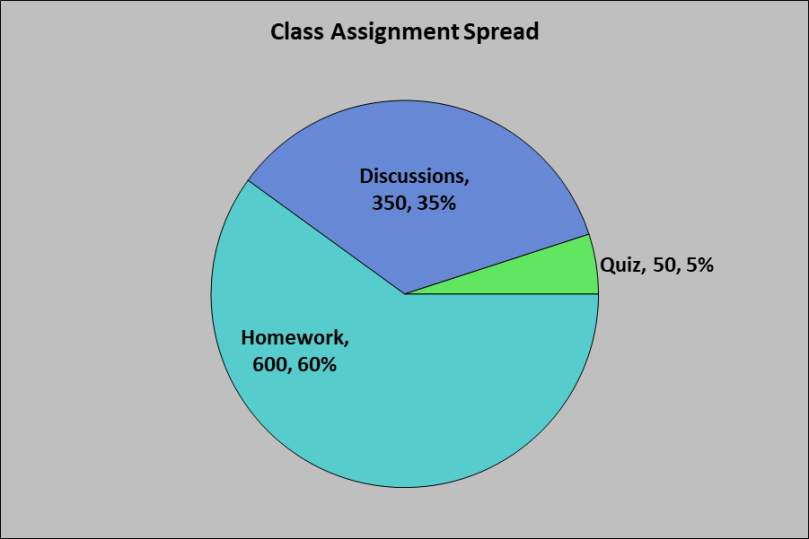
Students enrolled in ENGL 135 during the May 2019 session were asked to complete a number of assignments in quick succession. Most were directed towards the generation of a conference-length paper; some reflected ongoing discussion activities, and one was a simple online quiz. Those assignments and their prescribed point-values are below, with relative weights shown in the figure below:

ENGL 135 Grade Breakdown

Point values sum to 1,000.

Homework and presentations were assessed by adaptations of University-provided rubrics. Discussions were assessed through an instructor-developed rubric.

The section met asynchronously online, with online office hours generally being held Mondays at 6pm, US Central Time. Its overall data includes:

  • End-of-term enrollment: 12
  • Average class score: 778.5/1000 (C)
    • Standard deviation: 207.476
  • Students earning a grade of A (900/1000 points or more): 5
  • Students earning a grade of F (below 600/1000 points): 2

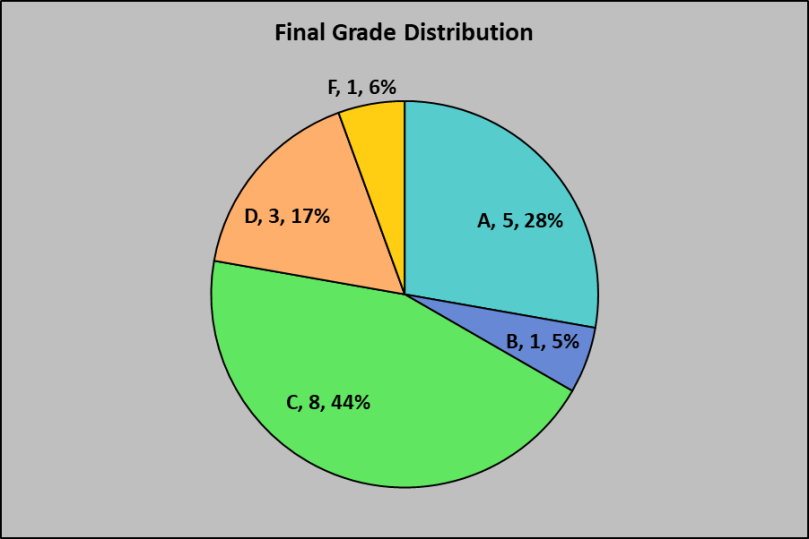
Numbers of students receiving each of the traditional letter grades are indicated below:

ENGL 135 Student Grades

Since the class met online, attendance was not assessed.

The May 2019 session is the last session taught on the model of the course with which I had been familiar. I had thought I would be teaching it again sooner than has proven to be the case, so I thought I would need to develop new materials in haste. I am glad I do not have to, though I will still miss getting to use the work I have done. So there is that.

I note with some joy the high percentage of A-earning students in the class; as many aced it as made below a B in the class. I am not given to grade inflation, certainly; looking back at previous reflections (such as this one) shows that I am willing to issue no A grades, and I have more often been accused of being a harsh grader than an easy one. The May 2019 session had a number of students in my class who made a point of consistently doing more work than they were asked to do, and I felt I should reward that additional work. It seems to have helped several of them along.

As has traditionally been the case in my classes, the chief cause of low grades among my students was that they didn’t turn in their assignments. I continue to operate under the restrictive late-submission policy from earlier sessions–namely, I do not accept late work outside certain narrowly prescribed and individually assessed circumstances–and some students ran into that. Many such dropped the class before the end of the session; I started the session with 26 on my roster (which is more than a writing class should have, but which is common, nonetheless).

Still, as ever, I am glad to have had another opportunity to put to work those skills I spent so long developing. I am glad, too, that another awaits me, and I can hope it will go as well next time as it did in the present session.

Additional Comments for the July 2019 Session at DeVry University

Since making initial comments about the session, I’ve had some additional information come up about my work in the July 2019 instructional session at DeVry University.  Namely, I’m only teaching one course this time around–ENGL 112: Composition.

Related image
Image from The Scribe’s Desk,
used for commentary.

The reduction in the teaching load does not mean all has changed, of course. The session still spans 8 July to 31 August 2019. On-site meetings for the class will still be Wednesdays at 1800 US Central Time in Room 105 of the San Antonio Metro Campus. Synchronous online sessions will still occur at the same times; sessions will still be recorded for later viewing. Office hours will still be online on Mondays at 1800 US Central Time; other meetings may still be made by appointment. And I still I appreciate having the chance to do this again.

Review of materials in the interim has shown me a few things about the course’s new assignment sequence. I am lucky in that some of what I have developed for my previous session teaching the course remains viable. There is still a profile essay called for, as well as a rhetorical analysis. Prior materials about the profile are here and here; those about the rhetorical analysis are here and here. I link to them again in the hopes that they will continue to prove useful to my students as they progress along their own work.

One of the larger shifts in the course is the alignment of the last two major assignments to a single topic. (There is mention of a course project as a separate assignment, but it does not appear in the gradebook, and it is not supported by other materials; I think it is a holdover from earlier iterations of the course.) I’ve still got some work to do on them, both in generating examples and in setting topics–for the assignments, a short essay and a short presentation, both work from a set of prescribed topics in the University’s online course offerings. The topics are decent enough this time; I’ve noted in such places as this my dissatisfaction with prior topic selections, but I think that is not the case with the new stuff. I still want to add more options, though, if only because I expect I’ll need other available topics if and when I teach the class again. My fallback, and probably the area in which I will develop the examples for the July 2019 session, is curricular reform. (I’ve floated the idea before, here and elsewhere. I’ll likely borrow from the older materials to generate the newer.) We’ll see how it goes over this time.

Over the next weeks, then, in and around posting class reports (since there are synchronous meetings, it makes sense to do them again) and adding to the Robin Hobb Rereading Series, I’ll see about getting the necessary examples and other materials put together. Even if I no longer put instructional materials together in the hopes of landing an academic job, I do still enjoy the work, and I do still think others benefit from seeing it out in the world. It is some comfort, at least.

Initial Comments for the July 2019 Session at DeVry University

I have been offered two classes for the upcoming July 2019 instructional session at DeVry University: a section of ENGL 135: Advanced Composition (which I am teaching even now) and a section of ENGL 112: Composition (which I last taught during the November 2018 session). Both are co-sat, as was the case for the SPCH 275: Public Speaking section I taught during the recent March 2019 session; they combine an on-site hybrid group with an online-only group.

Image result for teaching
Image by David Senior for Flower Darby’s Chronicle of Higher Education piece, “How to Be a Better Online Teacher,” which I likely ought to read; used for commentary.

ENGL 135 appears to have gone through a redesign, which means the materials I’ve prepared for past students will not be applicable, or not as much so, as they are for the present session. There do appear to be fewer deliverables, though, which means I will likely not have as much work to prepare things as I have had in the past–or as much work to grade, which also has its attractions. I’ll need to review the course in more detail before I proceed, however, but that’s not particularly onerous.

ENGL 112 also appears to have gone through a redesign since I last taught it, so I’ll need to review the course and generate new materials in response to it, as well. Honestly, though, it is good for me to do so. Refreshing my teaching from time to time is helpful; it keeps me from growing complacent. I have seen many instructors at several colleges and universities grow fixed in their ways, inattentive to developing knowledge in their subject areas and in teaching, generally; it has not helped the students to be mired in the understandings of thirty years ago and more, nor has it helped those of us who have done more recent work in the academic humanities, to have such be the case. Nor yet is it good for the world outside to have things root in the exhausted soil of conclusions decades out of date and unresponsive to the many things learned since.

The session spans 8 July to 31 August 2019 (that’s what my contracts say, anyway). On-site meetings for ENGL 135 will be Thursdays at 1830 US Central Time in Room 106 of the San Antonio Metro Campus; on-site meetings for ENGL 112 will be Wednesdays at 1800 US Central Time in Room 105 of the San Antonio Metro Campus. Synchronous online sessions will occur at the same times; sessions will be recorded for later viewing. Office hours will be online on Mondays at 1800 US Central Time; other meetings may be made by appointment.

As ever, I appreciate having the chance to do this again. I’d hate to think that I’d get no use out of the studying I did to learn how to do it…

A Reflection on #Kzoo2019 from an #AcademicExpatriate

Over the weekend just past, I was once again in Kalamazoo, Michigan, for the International Congress on Medieval Studies, hosted by Western Michigan University. Once again, attending was a good thing for me, even if I was only there for part of the proceedings (rather than the whole event, as I have generally been–though that has not been the case most recently). It was also good to have gotten done what I took a brief hiatus to get done, and I am looking forward to getting back to work at home and on the various projects that are represented in this webspace. But there are some things that I do need to address about the conference before I move on.

20190513_092011.jpg
It looks much the same as last year–but not quite exactly–in this picture I took.
I still cannot take credit for the title, though, even if I might continue using it.

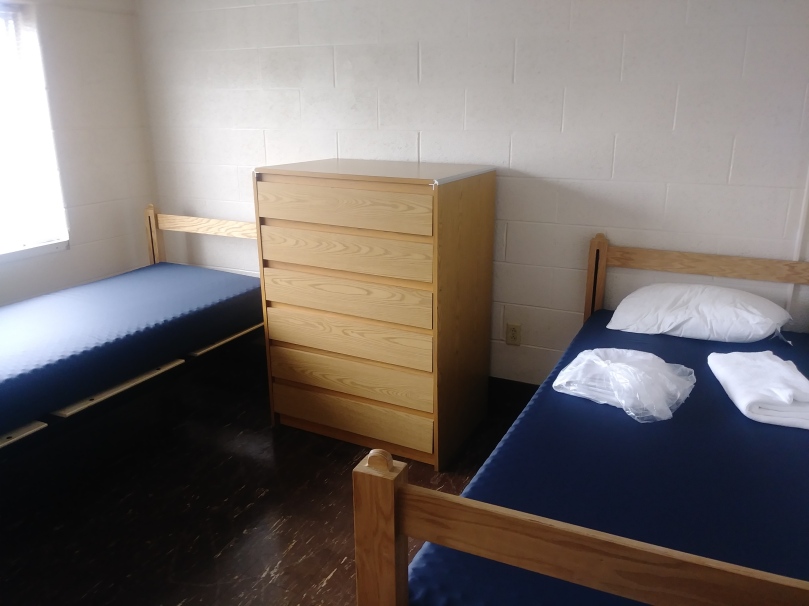
I could remark on the commonplaces of the Congress. Issues of accommodation and access deserve consideration, after all, even if I am not necessarily the best equipped or the best situated to offer that consideration. Yes, I can crack wise about the conditions of my room, shown in the relevant picture (which originally appeared on my Twitter feed, @GBElliottPhD), and I do note that there is some value for me, if perhaps less so for others, in being a bit removed from the comforts and convenience of my daily life. But I am also aware that things which serve as comforts and conveniences for me are much more important for others, and I am trying to be better about listening to scholars of differing abilities about such things.

20190511_153608.jpg
The aforementioned picture of the room. Not bad, in all.

Also important to note–because I am not about to get into the issue of comparing circumstances, and I have no desire to be taken as moving towards that issue at all–is the more-pronounced-than-usual whiteness of the Congress this time around. There was a boycott of it by a number of scholars, and I am sympathetic to it. (I was also not as aware of it as I perhaps should have been, for which I apologize.) What I read of the comments about it going into the Congress (which is less than I likely ought to have done, for which I apologize) suggested that one thing I could do to demonstrate support was to call attention to the issue in my own panels–and I believe I did so. In a business meeting I chaired, as well as in my paper presentation, I made explicit the need to do better with such things. For example, the conclusion of my presented paper:

Further study of other religious practices at work in medieval Europe than those commonly associated with medievalist tropes would also seem to be warranted, particularly as concerns depictions of in-milieu disadvantaged populations and their correspondences with real-world counterparts and analogues. Entirely too little has been done in that vein, with putatively mainstream audiences focusing more on themselves and those like them than upon respectful examination and appreciation of difference, and it has allowed rhetorics of ignorant hate to flourish entirely too much. It falls to further work on this project, and on any project, to work against such things with all possible vigor; I can hope that refinements to the current paper will serve that end.

I acknowledge that my backgrounds in racial and ethnic studies, in feminist studies, in gender studies more broadly, and in disability studies, as well as in many other areas of inquiry, are not as robust as could be imagined or hoped. The positions from which I have approached academe have shaped me in ways that have highlighted other issues that intersect with such fields but are not congruent with them, and I know I have had the privilege of looking at other things. I do not claim to have any particular expertise in them. But I can apply the expertise I have to at least point out the gaps in itself; I can refuse to pretend that my inexpertise with a thing means the thing is not worth expertise. No few humanities scholars complain of those outside the academic humanities ignoring the broad field because they do not work within it; how many of them will do the same thing with smaller areas of inquiry closer to them? I, at least, will try not to do so.

It is a small thing, I know, put against a large, large problem. But it is to be expected that the work I would do would be small; I am largely out of academe, an expatriate rather than an exile only in that I am allowed to return from time to time at gatherings such as the International Congress on Medieval Studies. I can hope that, in the coming years, others who have been here and would be here can well be here again–and I know that they can only be so, and should only be asked to be so, when they are treated with consideration and dignity. And I believe them when they tell me that they have not, even when and where I have not seen it.

Help me fund continued travel?

Reflective Comments for the March 2019 Session at DeVry University

Continuing a practice I most recently iterated at the end of the January 2019 session at DeVry University, and following closely the patterns established in previous practice, comments below offer impressions of class performance among students enrolled in my section of SPCH 275: Public Speaking during the March 2019 session at that institution. After a brief outline of the course and selected statistics about it, impressions and implications for further teaching are discussed.

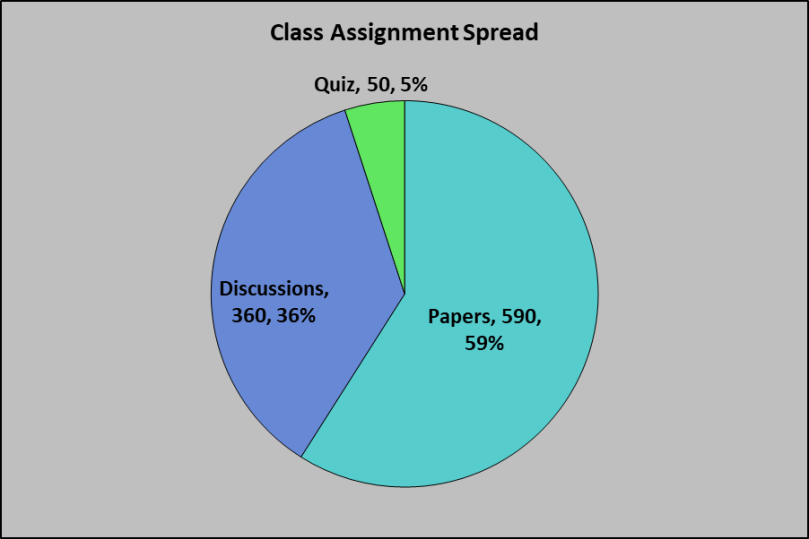
Students enrolled in SPCH 275 during the March 2019 session were asked to complete a number of assignments in quick succession. Many were irregular formal presentations; others included homework assignments preparing for and reflecting on the presentations, as well as ongoing online discussion. Those assignments and their prescribed point-values are below, with relative weights shown in the figure below:

SPCH 275 Grade Breakdown

Point values sum to 1,000.

Homework and presentations were assessed by adaptations of University-provided rubrics. Discussions were assessed through an instructor-developed rubric.

The section met concurrently on-site and online in Room 105 at the San Antonio Metro Campus on Thursdays at 6pm, US Central Time, with online office hours generally being held Mondays at 6pm, US Central Time. Its overall data includes:

  • End-of-term enrollment: 27
  • Average class score: 699.9259/1000 (D)
    • Standard deviation: 229.339
  • Students earning a grade of A (900/1000 points or more): 6
  • Students earning a grade of F (below 600/1000 points): 6

Numbers of students receiving each of the traditional letter grades are indicated below:

SPCH 275 Grades Earned

Additionally, since the class met at a prescribed time, it was possible to take attendance. Most students in the section missed at least one class meeting; some missed quite a few more, as indicated below (with the figure being classes missed, students missing that many classes, and percentage of students falling into that category):

SPCH 275 Students by Number of Absences

I must confess that this was not the best session of teaching I’ve done. Part of the issue is that the University is trying co-sat courses in an effort to fill classes; physical sections are paired with online-only. The idea is that each instructor will be able to help more students and that the students will benefit from exposure to yet more diverse viewpoints. In practice, however, it makes more work for instructors, and for those who will insist on a work-life balance, on keeping a part-time commitment a part-time responsibility, that additional work translates into less effective instruction. Or such was the case with me this time around.

I am pleased to note that more students earned A and B grades in the class than earned D and F grades. And I note, once again, that the chief cause of low grades among my students was simple non-submission of work; I can only award one score to assignments requested and not submitted. Admittedly, as part of a means to protect myself during the session, I operated under a restrictive late-submission policy, and some students ran afoul of that.

I am also pleased to note that things seem to have gone slightly better this time than last time I taught the course. It had been a year since I had a speech class, and I have evidently improved, if only slightly, in my teaching; the average score was slightly better, and I had higher percentages of students earn A grades this time than last. (The percentage of F grades awarded was reasonably similar.) So there is that to consider, as well.

As before, I am pleased to have had the opportunity to teach once again. I have been offered it at least once more (there is some suggestion there are more such opportunities to come), and I remain aware of my contingent position in the classroom. Keeping it, for what it’s worth, has been helpful.