Here again, I find myself thinking about a national observance in the United States and thinking back about what I have said about it before. (I do that a lot, as those who have read me at any length can attest. One of the better things about such informal publication as I get to have is that I have the luxury of building on ideas over time, something that more formal venues do not always allow or encourage.) There’s been a lot of change in the year since I wrote on the topic, so much that it’s often hard to track; even the more limited set of changes that I address in my primary line of work take a lot of doing to keep abreast of, and I rarely have time to look much further afield than that.
…something about holla? Photo by Javier Mendoza on Pexels.com
Some of that, of course, may be ascribed to my personal limitations. I am the man I am, trained as I have been trained and scrambling to adapt to what presents itself to me, both in the day job and outside it; there are things at which I know to look and things I don’t know I need to look at, even if they do bear in on me. I’m not disclaiming my responsibilities in this; I acknowledge my limitations.
That much noted, I find myself once again of mixed mind regarding the observance. It’s not just this observance, of course; I have a long-running unease with such things, being not much of a celebratory person. While it is the case that I do have an appreciation for ceremony and pageantry, it is also the case that I like to watch it from a distance rather than to be immersed in it; I’d rather quietly observe than participate. (I suppose so much is true for a lot of things in my life, for better or worse.) At present, I am in the middle of my busy season; that I am makes it hard to pay attention to things that are not right in front of me. (There is some wiggle room in “in front of me,” as might be imagined. But some isn’t a whole lot, and it’s certainly not all.) At most, this time, there’s a slight variation in the course of my week due to the federal holiday; things being closed that are does force some adaptation. But it’s only some; for the most part, I have to go on like it’s any other day.
I doubt I’m the only one for whom so much is true.
For a holiday, or for another day, I am happy to write for you!
To continue from last week, the group of middle-school-aged kids for whom I’m running a Dungeons & Dragons game at my local library left off between rounds of an ongoing fight, being in the process of rescuing a child about to be sacrificed by cultists for some clearly nefarious end. They seemed initially to have taken the discussion of ponerology to heart, which gratified, and play proceeded from that point to go…sideways. Some of that is to be expected in any TTRPG, of course; things move in ways not expected. Some of it, however, is going to require some redirection and resetting; the group as a whole is aware of it, so when next week’s session begins, I do not think it will be a surprise that things will start as they will have to start.
Yeah, this’ll do. Photo by Fariborz MP on Pexels.com
For the overtly educational portion of the session, I brought in an idea I’ve meant to talk about for a while: the tension between plot- and character-focused narrative. To gloss, in the former, the story is largely about outside events and reactions, while in the latter, the story is largely about internal events and how they shape the outside world. I don’t think any narrative is exclusively one or the other, although each is primarily one or the other; that is, there is always some outside event prompting response, and there is always some internality on display, although there will definitely be an emphasis of one over the other.
Within the setting of a TTRPG, the narrative will actually straddle such line as exists between the two fairly evenly. Because the story being told is a collaborative one, with the audience being the group doing the storytelling, the overall presentation is plot-driven. The collective creating audience will respond to the outside events presented to them. Each collaborator, however, will have access to the internality of the character they portray, so for each audience member, the narrative will be emphatically character driven.
This is, of course, a very surface-level treatment; more has been said about the topic, as I am already aware, Mackay having treated it, as well as Gary Alan Fine, and I know there have been other works about it that I do not have on my shelves from long ago. (One of my regrets from the attempted academic life is that I was not more honest with myself and so did not pursue such ludic concerns; I needed the formal “legit” grounding I got, but I really ought to have leaned more into my “side” interests. That the latter have stuck with me even absent institutional affiliation is telling.) But, while the kids at my table are bright, they’ve got other concerns–and so, admittedly, do I, among which are a great many other scholarly somedays.
My calendar is full. I suppose it’s a good thing; I’ve always got something to look forward to doing.
Even on spooky days such as this, I am happy to write to order, and with no AI slop!
A month or more has once again passed by,
And in that time, they have not ceased to cry,
They whom the Stupid God’s cult would deny
All grace, all mercy, kindness, aid, and weal.
The wounds the Stupid God inflicts will heal
But slowly if at all, and no appeal
Would seem to set that sentencing aside
For which the cult had all too often cried–
Not even when its own please are denied
As they not seldom are. They suffer, too,
The members of that cult, but do not rue
That they so suffer if their others do;
In others’ pain does that foul cult delight
So much that they care nothing for their plight.
Not at all related, I’m sure. Photo by maycon rodrigues on Pexels.com
If you like how I write and want me to write for you, you know what to do!
Read the previous entry in the serieshere. Read the next entry in the serieshere.
Notes from Bee’s prophetic dreams precede “Barriers and a Black Banner,” which opens with Fitz taking one of the Paragon‘s boats uncomfortably, accompanied by Spark, Lant, and Perseverance, all disguised. After valediction from Brashen, Althea, and the crew, the party proceeds toward Clerres, with Spark noting along the way that Beloved has regained some vision and concealed knowledge of it to facilitate deceiving Fitz and the rest and absconding. Fitz is chastised by his inattention and voices it to the shock of those around him.
I wish I’d found this image back in Bingtown… Photo by No Edited Pics on Pexels.com
Ashore, Fitz and his companions proceed, discussing how they will go about their intended mission. They are joined by Motley, whom Fitz bids the group ignore as much as possible, and the odds of Beloved’s success are remarked upon. Fitz, recognizing possibilities of Beloved’s designs, again urges his companions to depart, and they again refuse. The group also finds the stronghold of the Servants closed to visitors due to Symphe’s death. Against the upset, Perseverance suggests sending Motley into the stronghold to reconnoiter, and the bird flies off, Fitz watching as long as he can.
As often happens, I am taken by the prefatory materials for the chapter. The referents in the dream–Bee for a bee, Fitz for a blue buck–are clear enough. So is the heft of the metaphor; a father’s life is certainly worth exchanging for his daughter’s (although reading affectively once again, I think the exchange imbalanced; my daughter’s is worth more than mine). The foreshadowing is also hardly opaque…although how much of that is my rereading the text and knowing what will come, I cannot say. (Of course, that ends up lining up with a lot of Hobb’s descriptions of the White Prophets’ works, predictions recognized as having come true only in retrospect…which makes for a lovely bit of metanarrative and invites consideration of predetermination…more reason to return to the work again and again.)
Also of note in the present chapter is Fitz’s note that “Spark startled when I uttered a short, foul word” (564). I hadn’t been looking in the Realm of the Elderlings novels for this kind of thing, so I haven’t done the work (ah, another scholarly someday!), but I don’t recall Hobb making much use of overt obscenity; that is, she and her characters don’t seem to cuss much. Some of that, I suppose, can be excused by significant parts of the texts centering on high-class folks in high-class situations where such language would be out of place–but even among the sailors she shows, a population nearly a byword for foul language in the readers’ world, there’s little to none. I’m not sure what to make of it, actually; on the one hand, not having a deckhand say something like “fuck” (which may well be the startling word, being both short and foul) would seem to abrogate verisimilitude, but on the other, if it escapes readerly attention easily, perhaps it’s not a point that “matters” much for it.
Need some writing done? Don’t want AI slop stealing things? Turn to me; I’m happy to help!
The materials presented to my group of gaming middle-schoolers last week were a response to emergent situations I hoped to redirect and deflect before they could become problems. (I am still somewhat taken aback by one player’s stated expectations of being in opposition to me as the DM; I’m put in mind of comments from The Munchkin’s Guide to Power Gaming, which has long had a spot on my bookshelves.) This week, I returned to more or less the kind of thing that I had intended to discuss with them, one of the central questions that I had included in my pitch for the program back in 2024: what is the nature of evil?
No, we’re not monkeying around… Photo by George Becker on Pexels.com
That nature, as might well be thought, has been extensively studied and theorized about. There is, in fact, a whole discipline of inquiry about it: ponerology. (I admit that part of the reason I brought it up under that name to the middle schoolers in the context of being overtly educational is because it’s a fun word to say, especially for my overly online Millennial self recalling pwning n00bs). It can be used as a loose rubric in many kinds of humanistic analysis; while it has most notable factored into theology and political science, it can be applied in a great many other contexts, as well. Dungeons & Dragons addresses such topics fairly explicitly with its alignment system (that has shifted across more than five decades of production and play), so it does invite use as a means of exploring ponerological topics.
The situation in which the players’ characters found themselves at the beginning of the week’s session was something of a blunt presentation of the topic. They began the session where they left off the previous: fighting child-sacrificing cultists. Killing helpless children scans as a Bad Thing for most people (that there are exceptions is unfortunately clear). So is the obvious plot movement that suggests itself: the children being killed are themselves Bad Things. (Indeed, this is something that has been at the core of many Dungeons & Dragons games, that members of particular species are necessarily and inherently evil. While there are species that are representations of philosophical concepts, manifestations of other realities, applying such a rubric to physical beings is…problematic at best. Recent efforts to move the game’s official materials away from such framing have met with resistance from many players and groups. It’s not a happy thing.) I decided not to take that approach, in part because most of those at the table are still new to gaming, and I do think there is some value in presenting tropes straight on for such audiences–again, overt education is a thing in the program. I also have other plans for developing the story further, and it serves my purposes to have a clear framing for my antagonists in enacting those plans.
As I continue on in this program, I find myself reminded of earlier comments I made about how useful TTRPG materials could well be as technical writing course materials. I think I could well do more with such things at this point in my life, even so far removed from the classroom as I have become (and correctly). I perhaps flatter myself that someone might find that kind of thing useful to have me do for them; I’d certainly like to give it a try sometime…among all of the somedays already waiting for me.
If you need game materials–or instructional materials that work with games–let me know; I can help!
Not autumn by any stretch in these parts But the leaves are still falling in abundance And people scoop them into sacks Push them into piles And hope that cold winds don’t bite too deeply when they blow
Not that it takes much examination to guess at my subject… Photo by RDNE Stock project on Pexels.com
For me They are insulation and compost What I need to keep me warm What I need so that my fields will fruit And I can eat for the rest of the year
If you’d like your own piece, written to order and with no AI slop, fill out the form below!
Read the previous entry in the serieshere. Read the next entry in the serieshere.
An extended excerpt from Prilkop‘s writings, detailing his treatment by the Servants after his return to Clerres, precedes “Accusations.” The chapter begins with Bee waking in her cell from an unpleasant dream. She steels herself against Vindeliar and directs her energies towards healing before her captors arrive. After she is fed, she considers her deeds of the previous night until the remaining members of the Four arrive to extract her from her cell, betraying Vindeliar’s work upon them.
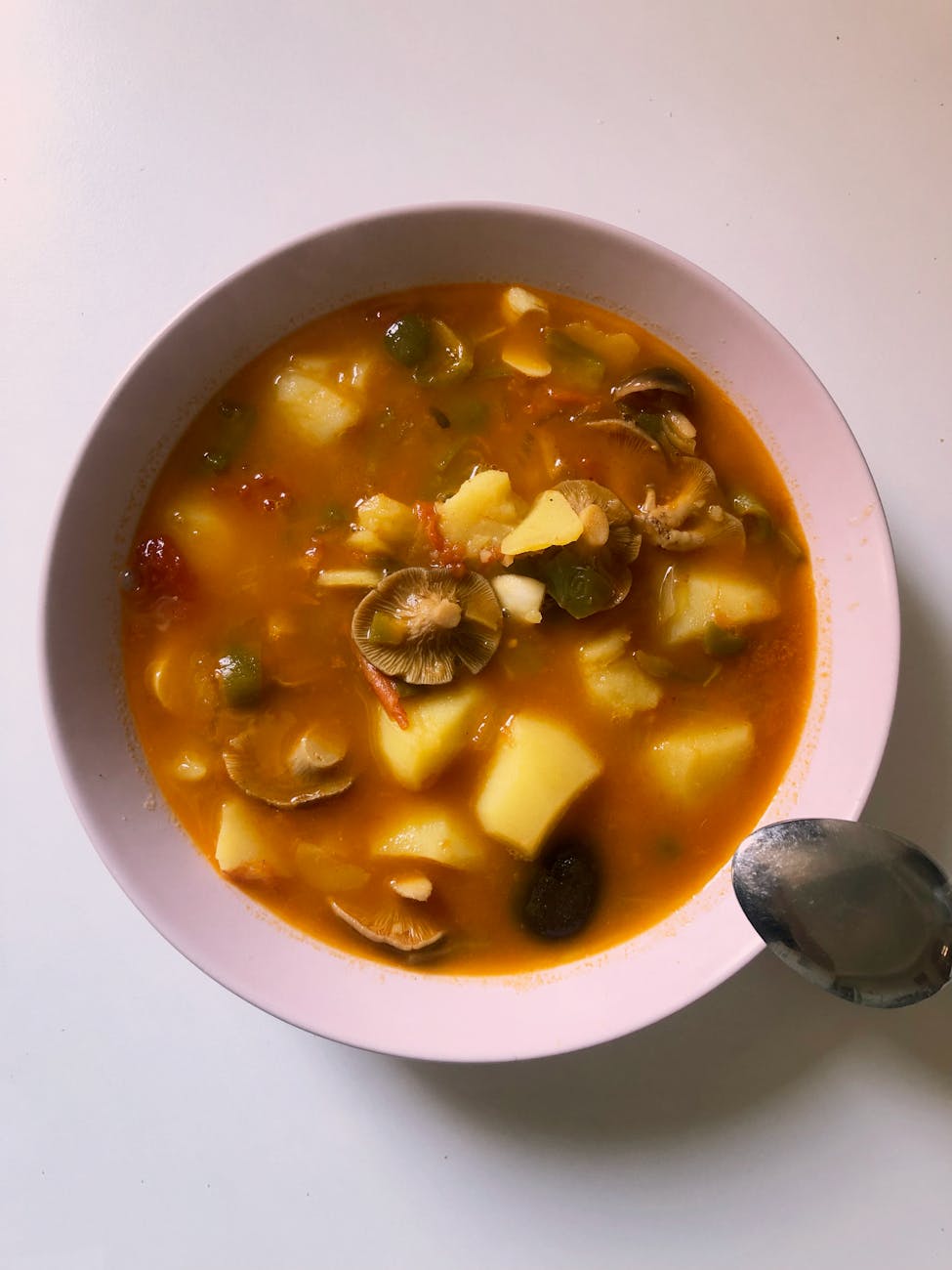
Soup receives some attention in the chapter. Photo by Campanero M on Pexels.com
Bee listens as the three remaining confer about the death of one of their own and the possibility of her complicity therewith. One of them, Coultrie, is led away, and the other two, Capra and Fellowdy, confer about what Vindeliar has said. The implications of Symphe’s death begin to be discussed, and Bee watches as power shifts in Clerres before she is confined again.
The present chapter is remarkably brief, some eight pages in the printing I am rereading. I am again taken by the desire to get hold of a cohesive print-run of the Realm of the Elderlings novels and to simply count the pages in chapter to see if there is some pattern to be found among them. I am not sure there’s anything there to find, admittedly, but I have the sneaking suspicion that there is something, and I’d have to do the work to rule out anything in any event. Ah, to have such luxury! Alas that I do not and may well never again!
Brief though it is, the present chapter serves useful functions for the reader. It continues emphasizing the hubris of the Servants in Clerres and points out the irony of their overreliance on their interpretation of prophetic foreknowledge. That is, it reminds the reader that the Servants have blinded themselves to ideas not their own, and while it is the case that a person can only come up with certain things themselves, it need not be the case that a person disregard the ideas and understandings of others. The Servants do so, and they do so at their peril, both internally (as witness Vindeliar) and externally (as Fitz and company prove).
One idea does occur as I reread, though. Throughout the Realm of the Elderlings novels, the actions of the Prophets’ Catalysts tend towards eluding prognostication. If it is the case that Bee’s actions confound the Servants’ prophecies, the idea that she is, herself, a Catalyst…tantalizes.
I still remain available to write for you, at reasonable rates and with no AI slop!
Following on last week’s activites, I returned to my local library to once again preside over a session of Dungeons & Dragons for a group of middle-school-aged children. When the game had left off last week, there was a fight over a fish brewing within the party, which made for an interesting place to break off for the evening; cliffhangers work to prompt ongoing engagement, after all. When actual play resumed, that fight got addressed; afterwards, the narrative resumed pretty much as expected. Gamers are gamers, after all, and kids are kids–and middle schoolers are still very much kids.
Somewhat ominous in context… Photo by cottonbro studio on Pexels.com
Owing to the need to be more explicitly educational, however, I did not resume play immediately on starting the session. Instead, I addressed a narrative and ludological concern: metagaming. That I would need to do so was prompted by one of the players making a comment in the previous session about trying to read my mind…by pulling out a copy of the source text I was (and still am) using for the current narrative arc. It was clear to me from the remark and the action that the player is trying somehow to “win” the game. I’ve been guilty of doing such things, myself, so I can certainly understand the impulse. While there is some sense to some kinds of metagaming (there’s no way not to do it, to some extent; that there is a game going on is always clear within it, and the tension between the real and the game drives some of the humor that invariably creeps into play), I do find myself somewhat concerned to confront it.
As I play, and as I worked to clarify to the players way back at the beginning of the program, TTRPGs should generally be collaborative endeavors. That is, those at the table should work together to tell a story that is about all of them. The kind of metagaming that seemed to me to be brewing moves more towards things being competitive, with one player trying to make the game about their one character rather than about the group. Some of this will happen naturally, of course, dice being what they are, but there seems to me to be a difference between an organic emergence of such a thing and the calculated contrivance towards the same–and the former is, in my mind, better.
I’m glad that the player in question is actually reading. I’m glad, too, that the player in question is trying to think around things. Both of those are good actions to undertake, and I could stand to see more people doing both of them. And it is the case that the player in question, being one of the more experienced at the table (mine was not the first game in which that player participated, as was the case for several others at my library table), will necessarily know more about how the game works as a game and cannot reasonably be expected not to know it. (Indeed, I’m looking at said player as a candidate to run future games, one of the goals towards which I and the program generally are working.) But I am concerned about the player–and, to be fair, others, if for different reasons–making the game about themself rather than about the group…and I admit to concern about being caught out railroading my players, which is not a good thing to do.
What I’m doing, moving forward, is making a few changes to the text I’d originally thought to use; sticky notes are my friend in this. Some of the material was designed to be dice-determined; I rolled for that previously, making notes of results. I have adjusted a few points of narrative, as well, and redone progression through the major puzzle that presents itself in the published text. The player will still have something of a leg up on the others, which is okay, but the ability to simply read ahead and know all of what is coming…that has been removed, now, which should make the playing field just a little bit more level. The others at the table deserve their chances to shine, after all…which is a useful reminder for more people than just them.
I’m happy to write for your game–and with no AI slop! Fill out the form below to begin!
Doesn’t seem very wintry to me… Photo by Elina Nieminen on Pexels.com
I am aware, of course, of broader events of greater importance going on. Winter Storm Fern swept across the Texas Hill Country and other places, dropping temperatures along with rain, sleet, and snow. I am grateful that I kept power throughout the event and suffered no damage (which has not always been the case, as I’ve noted), and I’ll admit to some delight in seeing my daughter get out and play like a much younger child in it. Events in Minnesota also attracted attention, and not only from me, and not only here, even if I have not and do not mean to comment much upon them. Still, I cannot say I did not know, and I cannot say that I am unaware of the juxtaposition at work at present. It’s not the first time; it’s happened before. It’s not likely to be the last.
I think I may be forgiven, however, for focusing more narrowly within the broader contexts in which I exist. I can do nothing about the weather and precious little about the rest, but I can show up for my family, and I was pleased to do so on Friday. My daughter, Ms. 8, sat for her first regional band clinic and concert, which was quite the event for her. She had placed into one of the honor bands composed of middle-school students who sat for a competitive audition process, one of two from her school to do so and one of two sixth-grade students from across the competitive region to do so.
Her mother and I were proud of Ms. 8 for making the attempt, and we were delighted to find that she had placed into the ensemble…but she was quite nervous about the whole thing when I took her to school on Friday, from which she would depart for the day-long clinic and the concert after. I understood as much, having been in a similar situation myself many years before, but she had earned her place in the group, and she had done the work to prepare her music since; she had given her full best effort, so whatever the outcome would be, I said, I would be proud of her. It seemed to help, and she was in a reasonably decent mood when I dropped her off and headed out to the rest of my day.
The clinic seemed to go well for her. By the time her mother and I arrived at the concert site, Ms. 8 was already on stage, ready to warm up with her ensemble. The performance they gave was quite good. I’ve attended a great many wind-band concerts, more than most people, and I’ve been in more than a few; when I say that the sixth-, seventh-, and eighth-grade students in Ms. 8’s band gave a performance that would have done more than a few college ensembles proud, I mean it. My brother, the performing musician, who was able to attend (if arriving belatedly), agrees.
The kid did alright. It made the weather after not seem so bad.
I’m happy to write to order for you, with no AI slop involved!
Read the previous entry in the serieshere. Read the next entry in the serieshere.
After a journal entry from Bee, “Unsafe Harbor” begins with Fitz grousing about sleeping poorly in advance of major tasks facing him. He rises from sleep aboard the Paragon and makes his way to the bow of the ship, considering Clerres. His reverie is interrupted by news through the Skill that he is a grandfather, Nettle having been delivered of her child, a daughter she has allowed to be named Hope. Fitz delights in the news, and he delights further in the news that Dutiful and Elliania are now expecting, their child to be named Promise. Upbuoyed by the prospect of his family continuing, Fitz returns his attentions to his task at hand, in which he is exhorted by his king.
Hard not to smile about this kind of thing, I find… Photo by Anupkumar Patel on Pexels.com
Fitz breaks off Skill contact when he feels the touch of Vindeliar’s magic upon his mind, and he hides as he can; the Paragon rejects the touch from Clerres. Fitz is aware through the Skill of how Vindeliar is being questioned about the deaths of Symphe and Dwalia, as well as how Vindeliar lashes out through the magic at those around him. Fitz struggles to disentangle himself from Vindeliar’s mind, roused to awareness in his own body by Brashen, bidding him bestir himself.
Brashen relates that Amber has absconded from the Paragon, and Fitz realizes he was drugged. He finds Spark similarly befuddled, and the two confer about Amber’s likely progress. Fitz doses himself with carris seed rather than cindin, and the two realize that one of the tubes of Silver that had been given Fitz has been taken.
Given the assertion of two new Farseer names, I am reminded in the present chapter of Hobb’s predilection in the Realm of the Elderlings novels towards emblematic names (most recently discussed here). The names in question seem uncommonly optimistic for the Farseers; Hope is something of a contrast to Nettle or Bee, and while Promise is not necessarily at odds with Integrity or Prosper (or Dutiful, for that matter) denotatively, the connotations of the latter three names are somehow sterner and more rigid. They certainly contrast with Chivarly, Verity, and Regal, and with Shrewd before, but such sequels as are hoped for by many of Hobb’s readers may well show how clear but uncommon associations of those names can be brought forward. Shrewd’s shrewdness, Chivalry’s chivalry, Verity’s verity, Regal’s regality, and Dutiful’s dutifulness can all be read in some ways as back-handed commentaries on the ostensible virtues the names represent (perhaps another scholarly someday for me), and it does not stretch credulity to think that integrity, prosperity, and promise can be similarly regarded. All that lies in a future that may be hoped for but may not come to pass, however.
The present chapter also presents a certain irony, again, of Fitz being drugged (and from his own stores, no less). It might well be thought that someone who had drugged his own companions to rebuke and had not long ago been drugged by another of them, to strong effect, would be wary of it happening again. That Fitz was so trusting…I’m not sure how to read it, honestly. On one hand, he knows and should be expected to know that Amber is problematically fixated on things; on the other, Fitz is himself publicly fixated on things and has fatigue and grief to contend with, to boot. The oversight makes some sense…but not as much as it might. At least as I read the chapter this time.
I also note, as a minor point, the extended list of effects of cindin use in the chapter. I’ve commented before on the substance and the possibility of it paralleling cocaine. The comment in the present chapter that one of the effects of cindin use is increased libido seemed to confirm it for me to some extent; I recall claims about cocaine driving sexual behaviors from my work alongside substance use disorder treatment, and a short search of formal research finds at least one study appearing to confirm the anecdotal evidence. That study–“Cocaine Administration Dose-Dependently Increases Sexual Desire and Decreases Condom Use Likelihood: The Role of Delay and Probability Discounting in Connecting Cocaine with HIV” by Johnson et al. and appearing in Psychopharmacology 234 (599-612)–might possibly have been available to Hobb during composition of the present chapter; an electronic version appears to have been in evidence in 2016, although formal publication did not occur until 2017. Even if Hobb lacked access to it, though, the fact of it…it amuses me.
I remain available to write for you, at reasonable rates and with no AI slop!











 Elliott RWI