Following the address of questions from the previous class meeting and before, discussion returned to concerns of citation, which had been brushed against during the previous week’s meeting. It then treated some common concerns of usage noted from student papers and suggested by students during the meeting.
Class met as scheduled, at 1800 CDT in Room 114 of the San Antonio campus; the class was broadcast online, and a recording will be made available soon. The class roster listed 21 students enrolled, unchanged since the last class meeting; eight attended live online or onsite. Student participation was reasonable. No students attended the week’s office hour.
Students are reminded that the following are due before the end of day Sunday, 18 August 2019:
Discussion: Integrating Research in APA Style (five posts or equivalent)
Rhetorical Strategies Persuasive Essay (in .doc, .docx, or .rtf format, please)
Students are urged to be at work on the rhetorical strategies presentation, due at the end of the session. (A sample will be made available for student reference soon.) Working on it longer will allow for better results.
Following the address of questions from the previous class meeting and before, discussion turned to concerns of research, including the environments of writing and publication, before addressing upcoming assignments.
Class met as scheduled, if with some interruptions, at 1800 CDT in Room 114 of the San Antonio campus; the class was broadcast online, and a recording will be made available soon. The class roster listed 21 students enrolled, a decline of two since the last class meeting; nine attended live online or onsite. Student participation was good. No students attended the week’s office hour.
Students are reminded that the following are due before the end of day Sunday, 11 August 2019:
Discussion: Beginning Research (five posts or equivalent)
APA Quiz
Students are still urged to be at work on the rhetorical strategies essay, due at the end of Week 6. (A sample is available for student reference here.) Working on it longer will allow for better results.
Following the address of questions from the previous class meeting and before, discussion turned to a brief review of the pulse surveys offered during the first three weeks of class. It proceeded thence to concerns of revision, corresponding to ongoing online discussions and to be applied to upcoming assignments, which also received attention.
Class met as scheduled, at 1800 CDT in Room 114 of the San Antonio campus; the class was broadcast online, and a recording will be made available soon. The class roster listed 23 students enrolled, unchanged since the last class meeting; nine attended live online or onsite. Student participation was reasonably good. One student attended the week’s office hour.
Students are reminded that the following are due before the end of day Sunday, 4 August 2019:
Discussion: Revising and Refining (five posts or equivalent)
Rhetorical Analysis Essay
Students are also urged to be at work on the rhetorical strategies essay, due at the end of Week 6. (A sample is available for student reference here.) Working on it longer will allow for better results.
One of the assignments students in ENGL 112 are asked to do in the July 2019 session, following a course redesign, is a four- to five-page “persuasion” essay that builds on the previous rhetorical analysis to see if the students can do the kind of things they’ve seen done. Students are provided a brief list of topics to address and are allowed to select others with instructor permission. They are also asked to involve at least four reliable sources, of which two are expected to come from University-accessible holdings; all are expected to be cited, in-text and at the end of the text, in APA format, and the paper is expected to conform to APA layout and usage standards. As I continue to believe that students benefit from targeted models, I think it fit not only to point to an earlier example that would still be applicable, but to generate a new one.
May we all be as productive as Kermit. Image from Giphy.com, used for commentary.
Per my previous practice, I began work by setting up a properly formatted document: letter-sized pages typed in left-aligned double-spaced 12-point Times New Roman with one-inch margins; half-inch indentations; and cover page, titles, running heads, and page numbers as prescribed by APA. Because the essay is expected to be a researched one, I also made sure to set up a references page with appropriate alignment.
That much done, I remembered that I did not yet have a topic to treat. Fortunately, I’ve written about a fair number of things, many of which have gaps that needed filling; others led to different ideas yet. I recalled that I’ve often asked students to suggest changes to their curricula and that I’ve written on such things myself (witness here, among many others). Having taught many of the writing classes that DeVry offers, I am in a position to be able to speak to what its writing curriculum does well–and does less well. And that led me to a topic.
Having arrived at a topic, I ruminated upon it, and a thesis emerged from that rumination and my past work. I typed it into my document, highlighting it in green for my ease of seeing it, and I began to draft an introduction that would lead up to it. Given the need to contextualize the topic and thesis, I was also able to pull from one of the required outside sources–a primary source, in the event, so necessarily meeting the “reliable” criterion.
With a thesis and an introduction in place, I found myself in position to draft a conclusion, leading back out from the thesis to future implications. It does not normally happen thus for me; I usually move from my thesis to drafting the body of my essay, framing that body in and filling the frame in fits and starts as ideas come to me. But I had an idea for a way out of the paper in mind, and I usually have more trouble with endings than with any other part of my papers, so I took the chance to firm up my paper’s ending early on and give myself a place towards which to write as I did the rest of the drafting.
Knowing then where I would be going with my writing, I turned to the body of my essay, drafting an initial argumentative paragraph. I knew the first point to occur to me would not be the strongest one available to me, for reasons I made sure to note in the text. Accordingly, I determined to place it early in the body of the essay, making use in a short paper of the emphatic order typically prized in writing instruction (and which I recall having noted to my July 2019 session students as being good for such a circumstance). As it developed, though, the argumentative point took on additional strength; I left it in place in favor of mixed order, a variation of emphatic order I have discussed with students and often deploy in my other work.
I pivoted thence to develop another point of argument. I knew what I wanted to say in that point, having had some time to think about the argument, but I knew I needed to look for more source materials to allow me to strike a useful balance between situated and invented ethos. As such, I searched the University library holdings for information, and, finding my initial search gave me more to handle than I could, I limited myself to peer reviewed sources from 2010 onward. A few sources turned up, but, in the midst of reviewing them, another point of argument entirely came to mind, and another, and I worked on them in turn as they arose. Doing so sent me to other sources outside the University library’s holdings as it sent me to the original sources of the University’s holdings for accurate citation data, and I worked to incorporate a variety of sources of information in the hopes of better establishing my ethos.
At length, my argument made, I reviewed my work for clarity and cohesion. I then reviewed it again for style and orthography. The reviews done, I put the paper into an accessible form, which I offer here in the hopes that it will be of help for my students–and perhaps a few others: G. Elliott Sample Rhetorical Strategies Essay.
Following the address of questions from the previous class meeting and before, discussion turned to concerns of theses. It moved thence to consider rhetorical analysis before addressing upcoming assignments, notably the rhetorical analysis (of which a sample is available here).
Class met as scheduled, at 1800 CDT in Room 114 of the San Antonio campus; the class was broadcast online, and a recording will be made available soon. The class roster listed 23 students enrolled, a loss of two since the last class meeting; nine attended live online or onsite. Student participation was somewhat subdued. No students attended the week’s office hour.
Students are reminded that the following are due before the end of day Sunday, 28 July 2019:
Discussion: Analyzing Persuasive Messages (five posts or equivalent)
Week 3 Pulse Check
Students are also urged to be at work on the rhetorical analysis essay, due next week. Working on it longer will allow for better results.
Following the address of questions from the previous class meeting, discussion turned to concerns of genre, patterns of organization, and essay-building before looking at assignments.
Class met as scheduled, at 1800 CDT in Room 114 of the San Antonio campus; the class was broadcast online, and a recording will be made available soon. The class roster listed 25 students enrolled, a net loss of one since the last class meeting; ten attended live online or onsite. Student participation was reasonably good. No students attended the week’s office hour.
Students are reminded that the following are due before the end of day Sunday, 21 July 2019:
Profile Essay (a sample is here; please submit through Canvas as a .doc, .docx, or .rtf file)
Discussion: Getting Started Writing (five posts or equivalent)
For the first class meeting of the session, discussion opened with introductions to the subject, course, and instructor. It then turned to concerns of writing as a recursive process before beginning to talk about upcoming assignments–namely the profile, of which a sample and discussion are available here.
Class met as scheduled, at 1800 CDT in Room 114 of the San Antonio campus; the class was broadcast online, and a recording will be made available soon. The class roster listed 26 students enrolled; 11 attended live online or onsite. No students attended the week’s office hour.
Students are reminded that the following are due before the end of day Sunday, 14 July 2019:
Discussion: Introduction
Discussion: Elevator Speech (five posts or equivalent)
Continuing a practice I most recently iterated at the end of the March 2019 session at DeVry University, and following closely the patterns established in previous practice, comments below offer impressions of class performance among students enrolled in my section of ENGL 135: Advanced Composition during the March 2019 session at that institution. After a brief outline of the course and selected statistics about it, impressions and implications for further teaching are discussed.
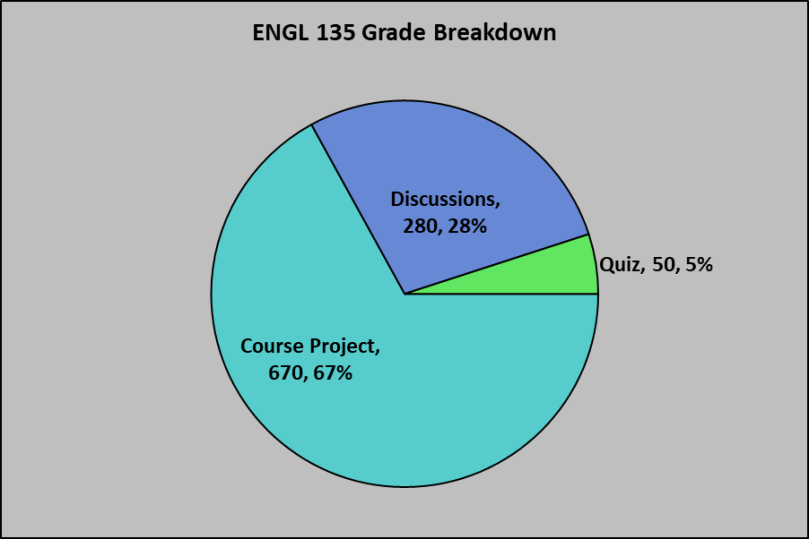
Students enrolled in ENGL 135 during the May 2019 session were asked to complete a number of assignments in quick succession. Most were directed towards the generation of a conference-length paper; some reflected ongoing discussion activities, and one was a simple online quiz. Those assignments and their prescribed point-values are below, with relative weights shown in the figure below:
Point values sum to 1,000.
Homework and presentations were assessed by adaptations of University-provided rubrics. Discussions were assessed through an instructor-developed rubric.
The section met asynchronously online, with online office hours generally being held Mondays at 6pm, US Central Time. Its overall data includes:
End-of-term enrollment: 12
Average class score: 778.5/1000 (C)
Standard deviation: 207.476
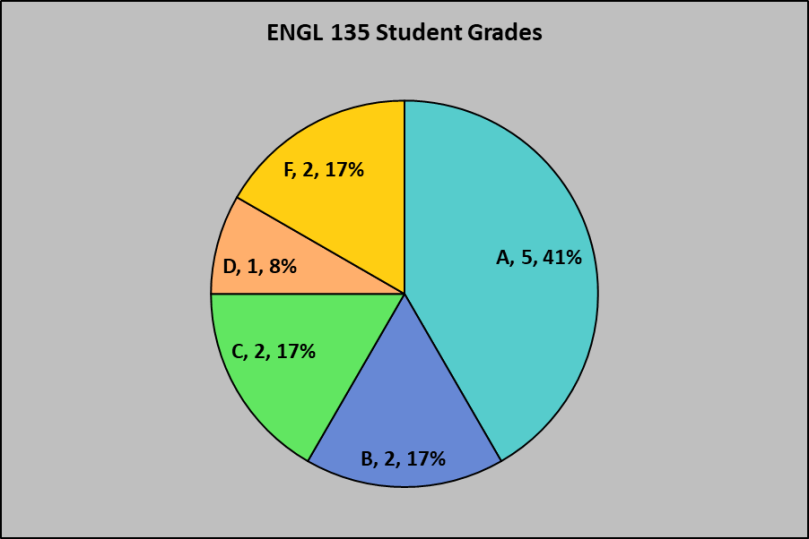
Students earning a grade of A (900/1000 points or more): 5
Students earning a grade of F (below 600/1000 points): 2
Numbers of students receiving each of the traditional letter grades are indicated below:
Since the class met online, attendance was not assessed.
The May 2019 session is the last session taught on the model of the course with which I had been familiar. I had thought I would be teaching it again sooner than has proven to be the case, so I thought I would need to develop new materials in haste. I am glad I do not have to, though I will still miss getting to use the work I have done. So there is that.
I note with some joy the high percentage of A-earning students in the class; as many aced it as made below a B in the class. I am not given to grade inflation, certainly; looking back at previous reflections (such as this one) shows that I am willing to issue no A grades, and I have more often been accused of being a harsh grader than an easy one. The May 2019 session had a number of students in my class who made a point of consistently doing more work than they were asked to do, and I felt I should reward that additional work. It seems to have helped several of them along.
As has traditionally been the case in my classes, the chief cause of low grades among my students was that they didn’t turn in their assignments. I continue to operate under the restrictive late-submission policy from earlier sessions–namely, I do not accept late work outside certain narrowly prescribed and individually assessed circumstances–and some students ran into that. Many such dropped the class before the end of the session; I started the session with 26 on my roster (which is more than a writing class should have, but which is common, nonetheless).
Still, as ever, I am glad to have had another opportunity to put to work those skills I spent so long developing. I am glad, too, that another awaits me, and I can hope it will go as well next time as it did in the present session.
Since making initial comments about the session, I’ve had some additional information come up about my work in the July 2019 instructional session at DeVry University. Namely, I’m only teaching one course this time around–ENGL 112: Composition.
Image from The Scribe’s Desk, used for commentary.
The reduction in the teaching load does not mean all has changed, of course. The session still spans 8 July to 31 August 2019. On-site meetings for the class will still be Wednesdays at 1800 US Central Time in Room 105 of the San Antonio Metro Campus. Synchronous online sessions will still occur at the same times; sessions will still be recorded for later viewing. Office hours will still be online on Mondays at 1800 US Central Time; other meetings may still be made by appointment. And I still I appreciate having the chance to do this again.
Review of materials in the interim has shown me a few things about the course’s new assignment sequence. I am lucky in that some of what I have developed for my previous session teaching the course remains viable. There is still a profile essay called for, as well as a rhetorical analysis. Prior materials about the profile are here and here; those about the rhetorical analysis are here and here. I link to them again in the hopes that they will continue to prove useful to my students as they progress along their own work.
One of the larger shifts in the course is the alignment of the last two major assignments to a single topic. (There is mention of a course project as a separate assignment, but it does not appear in the gradebook, and it is not supported by other materials; I think it is a holdover from earlier iterations of the course.) I’ve still got some work to do on them, both in generating examples and in setting topics–for the assignments, a short essay and a short presentation, both work from a set of prescribed topics in the University’s online course offerings. The topics are decent enough this time; I’ve noted in such places as this my dissatisfaction with prior topic selections, but I think that is not the case with the new stuff. I still want to add more options, though, if only because I expect I’ll need other available topics if and when I teach the class again. My fallback, and probably the area in which I will develop the examples for the July 2019 session, is curricular reform. (I’ve floated the idea before, here and elsewhere. I’ll likely borrow from the older materials to generate the newer.) We’ll see how it goes over this time.
Over the next weeks, then, in and around posting class reports (since there are synchronous meetings, it makes sense to do them again) and adding to the Robin Hobb Rereading Series, I’ll see about getting the necessary examples and other materials put together. Even if I no longer put instructional materials together in the hopes of landing an academic job, I do still enjoy the work, and I do still think others benefit from seeing it out in the world. It is some comfort, at least.
ENGL 135 appears to have gone through a redesign, which means the materials I’ve prepared for past students will not be applicable, or not as much so, as they are for the present session. There do appear to be fewer deliverables, though, which means I will likely not have as much work to prepare things as I have had in the past–or as much work to grade, which also has its attractions. I’ll need to review the course in more detail before I proceed, however, but that’s not particularly onerous.
ENGL 112 also appears to have gone through a redesign since I last taught it, so I’ll need to review the course and generate new materials in response to it, as well. Honestly, though, it is good for me to do so. Refreshing my teaching from time to time is helpful; it keeps me from growing complacent. I have seen many instructors at several colleges and universities grow fixed in their ways, inattentive to developing knowledge in their subject areas and in teaching, generally; it has not helped the students to be mired in the understandings of thirty years ago and more, nor has it helped those of us who have done more recent work in the academic humanities, to have such be the case. Nor yet is it good for the world outside to have things root in the exhausted soil of conclusions decades out of date and unresponsive to the many things learned since.
The session spans 8 July to 31 August 2019 (that’s what my contracts say, anyway). On-site meetings for ENGL 135 will be Thursdays at 1830 US Central Time in Room 106 of the San Antonio Metro Campus; on-site meetings for ENGL 112 will be Wednesdays at 1800 US Central Time in Room 105 of the San Antonio Metro Campus. Synchronous online sessions will occur at the same times; sessions will be recorded for later viewing. Office hours will be online on Mondays at 1800 US Central Time; other meetings may be made by appointment.
As ever, I appreciate having the chance to do this again. I’d hate to think that I’d get no use out of the studying I did to learn how to do it…



 Elliott RWI