A Robin Hobb Rereading Series: Entry 154: Mad Ship, Chapter 16

Read the previous entry in the series here.
Read the next entry in the series here.


The next chapter, “Taking Charge,” begins with Althea retreating from Brashen’s exit from the Vestrit home. She muses on their shared circumstances and the paths that have led Brashen back to his home port, noting the changes that have occurred in herself and positing that similar amounts of change are likely to have befallen the Vivacia. And she watches from a window as Brashen departs.

Dragon Portrait
Something like this, perhaps?
Dragon Portrait by kaseykmay on DeviantArt, used for commentary.

In the middle of that night, Malta sneaks from her room to meet with Brashen’s younger siblings, Cerwin and Delo. She mulls over the family’s situation and purposes, filled with romantic ideas, to enlist the aid of others, beginning with Cerwin. She rehearses to them the situation of the captured Vivacia, even as her opinion of Cerwin falls against what she has learned of his brother, and as she blatantly manipulates him (above Delo’s objections, it must be noted) towards aligning with her family in the coming Traders’ Council meeting. He agrees, but the form of his agreement surprises Malta, to the disappointment of her romantic ideas. As the three return to their homes, Malta considers what she perceives as Cerwin’s deficiencies against Brashen–and Brashen’s evident interest in Althea.

For his own part, Brashen exits the tavern where he had found dinner and considers his situation. He decides to abandon the Springeve, and he mulls over his experience with the Vestrit women–including Malta. His thoughts, predictably, are most on Althea, and his feet take him back to the Paragon, where Amber stands ready to the ship’s defense. The ship recognizes Brashen, though, and introduces the sailor and carver to each other. After a brief argument, Amber informs Brashen of changes that have occurred in his absence, and Brashen rehearses his news of the Vivacia. The talk sends the Paragon into a strange, painful episode, and Brashen and Amber withdraw to continue conversing. Amber waxes philosophical, and Brashen retreats–toward Bingtown and away from the ship.

When she returns to her room, Malta seeks to reach out to Reyn again. The effort is futile, and she longs for her father’s return. Reyn, however, struggles in his own dreams against a voice in his mind that pleads for release. He considers what he knows of wizardwood and its origins as cocoons for strange beings: dragons. His thoughts turn at length to Malta, and they join in dream at last. She relates the news about her father and the Vivacia, imploring his help; he demurs, and the dragon that has harangued Reyn interjects, prompting Reyn to explain much, but not all, before the dream fades–and the dragon’s voice in Reyn’s mind does not.

One thing that the chapter points out–and there are other things to take from the text–is that the expectations a person may have of people from attending to tales are not apt to be fulfilled. This is something of an interesting message to receive from an author who focuses on verisimilitude in her fantastic writing; the in-text and out-of-text comments seem to be at odds with one another. That does not mean it the in-text message is without precedent, however; Don Quixote, for example, is a warning against overindulgence in genre fiction and romantic ideas, and there are many others to be found. And it must be remembered that Malta, despite her protestations of womanhood, remains an adolescent, and one who has led a relatively sheltered, certainly upper-class life; inexperience in the young is excusable, particularly as it falls away.
Friend, can you spare a dime? A nickel? Hell, even a penny?

A Robin Hobb Rereading Series: Entry 153: Mad Ship, Chapter 15

Read the previous entry in the series here.
Read the next entry in the series here.


The chapter that follows, “Tidings,” begins with the Vestrit women at work in the household. Althea excuses herself to go into town; Malta asks if she is going to see Amber, which Althea notes she is, and the issue of them being lovers is brought up. Althea denies it vehemently and storms off; Malta delights in having occasioned the reaction, while Ronica stalks off in disgust. With them gone, Malta mulls over her situation and purposes to be in control and command of herself before considering a meeting with another potential suitor.

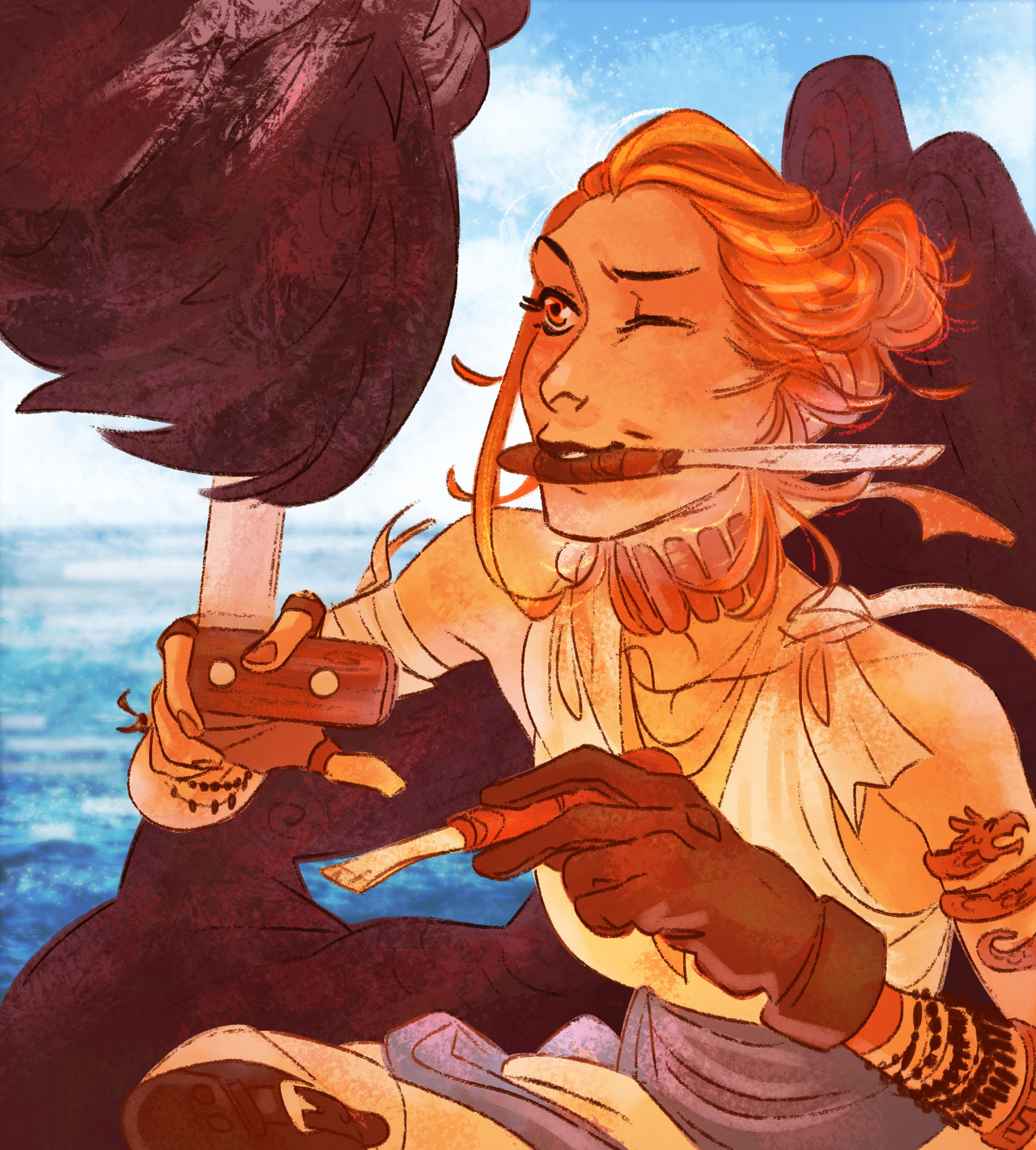
AMBER
The carver at work.
Image from noodlerface’s tumblr, used for commentary.

Elsewhere, Althea confers with Grag Tenira about Malta. He reports progress on the matter of the tariffs, as well as on the Ophelia; the latter goes well, with Amber being remarkably flexible and proficient in the work of repairing and restoring the figurehead. He also notes there’s been no word of the Vivacia, though he continues to ask. Local politics also get some attention in their conversation, and Althea finds herself thinking of Brashen Trell.

Brashen, dressed well and clean, reports to the Vestrit home. Malta greets him, sneeringly, and a tense exchange ensues before he recognizes her and notes that he has news to deliver. As she stalks off to get a runner to her mother and grandmother, Brashen mulls over the changes he sees and considers Althea’s likely disposition.

Following her conversation with Grag, Althea calls on Amber. The two confer, and Amber repeats back to Althea some of her own words from the conversation with Grag. The two confer about Althea’s desires, and Amber notes the gender dynamics that inhibit Althea’s achieving them. Sexual ethics also receive some comment.

Malta returns to Brashen, treating him with better manners, and Brashen begins to feel uncomfortable with her as they discuss his siblings. His addiction to cindin tells upon him; he is distracted, and not only by Malta’s coquettishness. When he tries to excuse himself, realizing somewhat belatedly what she is doing, he almost runs into Ronica and Keffria, who have returned. He reports to them the capture of the Vivacia by Kennit, offering what information he has available. It does not do the Vestrit women any good, nor yet does Althea’s brash entrance with Malta rebuked for eavesdropping. A fracas ensues, although it is soon quelled, and the family confers as to how to proceed.

The chapter is an excellent one for the feminist critique that pervades the Liveship Traders novels; the discussion between Althea and Amber is a frank and largely open treatment of one of the major concerns of such discourse. It also works as a striking counterpoint to the issue of the previous chapter; Althea is not nearly so constrained in her choices as Serilla is, and without the overt threats that the latter faces, but she is still very much confined by prevailing gender dynamics. One message to take away is that even the more genteel restrictions are just that; they force people to be other than they are, diminishing them all–and all of us.

I’d still love your help!

A Robin Hobb Rereading Series: Entry 152: Mad Ship, Chapter 14

Read the previous entry in the series here.
Read the next entry in the series here.

A content warning (sexual violence) is in order for the present chapter.


The next chapter, “Serilla’s Choice,” begins with the titular Serilla confined below decks on a refitted barge, seasick as she and the barge proceed with the Satrap towards Bingtown. She muses on her circumstances and situation, as well as those of the Satrap and his preferred Companion–a concubine, rather than an advisor, as Serilla is. The Satrap fares particularly poorly in the assessment, and not only Serilla’s.

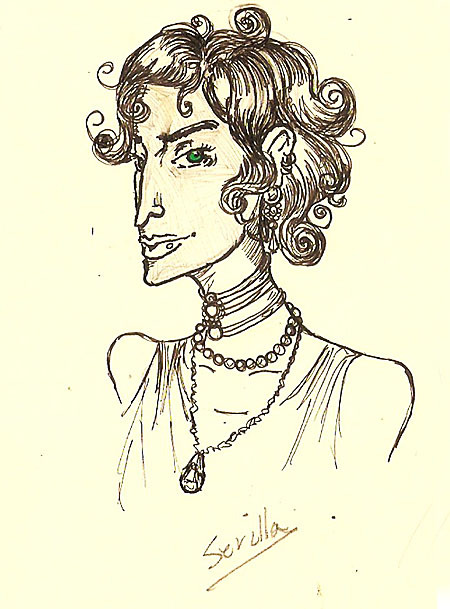
One image of Serilla.
Image taken from badgerlock’s tumblr, used for commentary

Serilla also considers the retinue that accompanies the Satrap; it is extensive and seems calculated to inflame tensions. It also seems to be a means for getting the Satrap away from power, so others might take it. And it gives the Satrap permission to indulge himself and his baser desires without having to be concerned about appearances. This becomes apparent when he threatens to have her raped by the crew of the barge if she will not sate his desires; she refuses the Satrap and is cast to the crew.

The Satrap has not been a sympathetic character prior to this point, certainly; he follows the model Hobb establishes in Regal, exchanging fratricide for satyriasis but otherwise being very much in the line of rulership as doing what he wants. The present chapter, though, pushes Cosgo from being unsympathetic into irredeemable. It will not matter what he does henceforth; the stain of his actions will no more clean from him than the spot from Lady Macbeth’s hands (and there is, at times, a motion to reclaim such characters, as I have noted elsewhere). And it is easy to read a commentary into the chapter, as has been the case with many other such; Serilla’s choice echoes what many see a learned woman faces amid the restrictions of toxic masculinities at work in the world.

It is not her work to right the wrong or to prevent it. And the rest of us need to do better about that work. Far, far better.

Care to support your local struggling scholar?

A Robin Hobb Rereading Series: Entry 151: Mad Ship, Chapter 13

Read the previous entry in the series here.
Read the next entry in the series here.


The following chapter, “Interlude,” begins with the serpent Shreever musing on the status of Mauklin’s group. She, Mauklin, and Sessurea alone remain of their original gathering; they are joined by other serpents gone feral as they press northward. Maulkin weakens and grows depressed. One of the feral serpents rises above the water and sings, and Maulklin suddenly grapples therewith, finding that a core of consciousness remains within.

Sea Serpent 2
Perhaps something more like this?
Sea Serpent 2 by verreaux on DeviantArt, used for commentary.

Through more struggle, the three are able to reawaken that consciousness; the serpent recalls his name, Tellur. Slowly, the other feral serpents also return to consciousness, naming themselves–Kelaro and Sylic. After orienting themselves, they agree to align themselves to Maulkin and to press on in search of a serpent who actually remembers what it is they are supposed to do to do more than simply survive in the flesh.

The chapters that focus on the serpents tend to be shorter than those that focus on more human characters. There is sense in this; the minds of non-human sentients would necessarily be less accessible, their actions less understandable, than those of humans to human readers. At the same time, the non-human intelligences are at work in Hobb’s literary world, and it is not good to disregard them. Showing their workings in brief serves to remind readers that there is more going on than the social upheavals clearly at work in Bingtown, in Jamaillia, and between them, while not going so far afield from them that readers lose a sense of narrative and understanding.

More people would do well to recognize that other minds are at work in the world.

It’s only a few weeks until Christmas; send me a present?

A Robin Hobb Rereading Series: Entry 150: Mad Ship, Chapter 12

Read the previous entry in the series here.
Read the next entry in the series here.


The next chapter, “Portrait of Vivacia,” begins with Brashen looking on as his captain dickers with Sincure Faldin away from Divvytown. As he does, he muses on a recent incident of violence he had had to enact against a crewman who was stealing from the ship. He also reflects on his captain’s bargaining tactics and the strangeness of putting in along the Cursed Shores, noting mentally the ways in which they live up to the name.

https://i.pinimg.com/564x/ec/ec/76/ecec761686c6dbd27a9097e21d9f80b0.jpg
Probably not the portrait in question, but compelling.
Image by Gilles Francescano, used for commentary.

As the dickering continues, Brashen considers the charts he has been making in secret and the knowledge of the waters his captain has as his own security. He also reflects on the tales he had been told of pirate settlements, seeing them now in truth when he had doubted them before. Too, he recognizes among the offerings a portrait of the liveship Vivacia that had once hung in Althea’s cabin aboard the ship. His interest in the painting and the memories it evokes in him attracts attention, and Brashen deflects adeptly, finding himself getting a report about Kennit and his activities in the Pirate Isles. Faldin invites Brashen’s captain to his warehouse in Divvytown, noting that Kennit is like to put in there soon, and the captain tentatively accepts.

Elsewhere, Wintrow marvels at the speed and skill with which the Vivacia is being restored after her struggles. Sorcor and Etta are commanding, intimidating presences aboard the ship as she is repairs. Wintrow muses on them briefly before taking food to and conversing with his father, who rebukes and upbraids him. Wintrow withdraws, somewhat shaken, and is soon after confronted by Sa’Adar. The priest attempts to persuade Wintrow to his cause once again; Wintrow refuses, violently.

Kennit regards himself and his situation as he continues to convalesce. The slow recovery annoys him, and the ship steadies him as Wintrow comes to call. Kennit is eased by his presence and asks after his tattoos. Wintrow’s answers reveal much before he makes to treat Kennit’s amputation. In the continuing conversation, Kennit finds a strangely revelatory scrap of wisdom and seems to return to himself. He orders Wintrow to help him make himself ready, and Wintrow obeys. So does Etta when she, summoned, arrives.

Brashen and the ship on which he is mate arrive in Divvytown. He recognizes the Vivacia at anchor there, and he tries to persuade his captain to travel to Bingtown after; the captain demurs. He also thinks he sees Althea aboard the ship, but that is soon and decisively belied.

There is quite a bit going on in the chapter. The mention that the Vivacia is not the first liveship to be turned pirate is something portentous, certainly, as is the confirmation to Brashen of the Vivacia‘s situation. So, too, is the tension with both Wintrow’s father and Sa’Adar; both have presented themselves as needing removal, and it might be noted that both, in displaying what appear to be symptoms of mental illness (although it is, of course, always fraught to diagnose characters in novels from what the narrator depicts of them), and both retreating under some compulsion into isolation, offer a comment on the treatment of those with mental health conditions. Working in a closely parallel field–substance use disorder treatment is classes as behavioral health, as distinct from but often related to and funded alongside mental health–I am aware that, even now, treatment is other than optimal, not least because of stigma. Whether the present chapter reinforces or speaks against the stigma is an open question, one that might well be worth discussing.

Help me make it to the end of the year?

A Robin Hobb Rereading Series: Entry 149: Mad Ship, Chapter 11

Read the previous entry in the series here.
Read the next entry in the series here.


The succeeding chapter, “Judgment,” begins with Keffria fuming to Ronica about Althea’s conduct, Malta looking on. The girl pipes up, complaining of the quiet in the wake of the Rain Wild Traders’ departure and of Ronica’s quiet rebukes. She complains of Reyn’s assertions, and, after a few more quips, the three lapse into silence.

Gavel image - vector clip art online, royalty free  public domain
This is the kind of thing that comes to mind.
Image from Clipart Library, used for commentary

Elsewhere in town, Althea eats with Amber and continues to relate her tale. She lays out her greater purposes–ending slavery, effecting Bingtown’s independence–and presses Althea for more information. They drink together, heavily, and talk turns to Althea’s intimate liaisons, then to the Paragon, liveships, and the Rain Wilds.

After a bit of tension, Amber goes on to explicate the situation of the Satrap. Something lodges in Althea’s mind, and she excuses herself back to her family home–where Malta indulges fantasies of being fought over as she waits with Keffria and Ronica for her return. Said return startles the three, and bickering ensues until Ronica quashes it with an overt explication of the Vestrits’ financial situation. After, however, discord reemerges. Ronica brokers peace again, and Malta seethes at her perceived exclusion and the seeming threat to her father.

Despite the sneering, conniving tone Malta’s perspective takes, she is not wrong in noting that Althea seems to be self-serving. Nor yet is Keffria wrong to note the dismissal of her husband by her family. Nor still is Ronica wrong in working to secure and stabilize her family. Nor, indeed, is Althea wrong to assert herself and seek to hold others to their sworn word.

But neither are they all in the right–which makes for no small part of the fun of reading. Malta approaches her situation as a game, trusting that her father will make things right for her even as he would likely readily agree to marry her off for the wealth of the Rain Wilds. Keffria fails to recognize her husband’s failures and shortcomings, as well as to assert herself and take up her rightful place. Althea is more concerned with herself than with the greater good of the family. And Ronica erred in not teaching her daughters better earlier.

One of the things that Hobb does well is to move away from the stereotypical depiction of characters; hers are nuanced, flawed, humane (even when they are not necessarily human), and that makes them more “real” than many. I would venture to say more so than in her lauded-as-realistic contemporaries, although I might be expected to be biased in such matters due to my own academic history. Still, it is the nuance and integration of things that allows for so much to take place in the novels, giving those who would carry out interpretive work more to do, and I appreciate it greatly.

Holidays are coming; help me face them?

A Robin Hobb Rereading Series: Entry 148: Mad Ship, Chapter 10

Read the previous entry in the series here.
Read the next entry in the series here.


The next chapter, “Homecoming,” opens with Althea making her way back to the Vestrit estate in Bingtown. She considers her surroundings and the changes in herself as she proceeds, noting the evidence of neglect of the grounds and its disjunction from the in-progress celebration denoted by noise and carriages. As she remains in disguise as Athel, she is greeted politely but coolly as she enters at the back of the house, and she observes the preparatory goings-on as she eats under that disguise and pieces together some picture of events.

Tivy homecoming mum | Homecoming mums, Homecoming, Style
Unfortunately, mum’s not the word this time.
Image taken from Pinterest, used for commentary.

At length, the celebration having ended, Althea is taken to Ronica. The older woman recognizes her daughter instantly and initially upbraids her for having worried her before embracing her tearfully. She briefs Althea on events that have transpired since her abrupt departure. Althea notes her objections and delivers the message she carries from the Teniras. Ronica notes her own objections, and Althea makes to return with her reply to the Teniras.

As she makes her way back to the docks, noting the changes and increased apprehensiveness in Bingtown, she encounters Amber, who enlists her aid in carrying as a cover for conversation. Each notes to the other the need to confer in greater detail than present haste allows. Amber disguises herself as a diseased slave to accompany Althea down to the docks as she listens to Althea’s tale; Althea hopes the woodcarver can help repair the Ophelia, but she will need to clear the idea with the ship’s captain.

When they arrive at the ship, Amber presents herself with celerity. The Tenira’s leap at the chance to see their ship repaired, and the Ophelia herself delights in the opportunity. There is some exchange between Amber and the Teniras as she begins working on the ship, and Althea is asked for her report; delivering it, she notes her own sadness at how events have progressed, as do her interlocutors.

The present chapter notes and discusses the omnipresence of servants in the households of the wealthy and remarks upon how it might be leveraged. It is a point of correspondence with real life, of course; even for those unable to afford servants, as such, service industry workers are everywhere, and my own experience as such a person reminds me that, yes, they listen to damned near everything. The pizza delivery person notes what’s on the television when you open your door; the package handler sees where the parcel’s from and where it’s going. It is a peculiar source of power, one that can be employed to no small effect, and one that offers the potential for significant upset–another point made in the more politically charged novels of the Liveship Traders series.

More and more, as I reread the series, I am struck by how fertile a field it is for cultivating theory-informed readings. There’s a lot to do–but that is one of the marks of better writing, that it offers and sustains multiple interpretations.

Care to send some support?

A Robin Hobb Rereading Series: Entry 147: Mad Ship, Chapter 9

Read the previous entry in the series here.
Read the next entry in the series here.


The following chapter, “Bingtown,” opens with the Paragon considering the sleeping form of Amber and the circumstances leading up to her sleeping aboard. The relationship between the two retains some tension, although they do seem to be growing closer together. And the ship wakes her from a dream she reports having repeatedly and explicates to the Paragon. When she notes dragons, and having seen dragons in the Six Duchies, the ship rebukes her, denying that what she saw were dragons. The following conversation grows heated, and Amber uncovers information in the ship’s ranting.

Ophelia's Mischief
You know where this is going.
Ophelia’s Mischief by Delfin-a on DeviantArt, used for commentary

Elsewhere, the Ophelia approaches Bingtown, and Althea finds herself unable to sleep. She confers with the liveship, interrupted by the approach of Grag Tenira and the ship’s captain. The last lays out his suspicions and concerns about affairs in Bingtown; he anticipates trouble from the encounter with Chalcedean mercenaries, and he arranges to have Althea in a position to get away from the ship if Bingtown authorities attempt to seize her.

After, Grag asks Althea about their earlier conversation. Her replies are frank and honest, not unkind but not comfortable. After an interlude, however, she agrees to consider his suit for her hand.

When the Ophelia makes port in Bingtown, Althea has resumed her guise as Athel and muses amid the work about the home port and returning to it. She marks the presence of a Chalcedean galley in the harbor and looks on as the captain badgers the tax officials. Dispute over patrols and surcharges ensues, and Althea, directed, reports as much to Grag. The captain tells her to take the tale to the town and to set aside her personal strife in the interest of Bingtown unity. After a moment, she agrees.

The conversation between Althea and Grag reinforces one of the issues brought up earlier in the Liveship Traders novels: marriage as economic contract. Unlike the earlier example, the principals in the potential union approach the topic with relatively level heads, both understanding the issues involved not only for themselves, but for their families. It is a much more sober thing than what goes on between Malta and Reyn, certainly, and it highlights another point of concern: heteronormative assumptions at play. The topic of who will leave their family’s liveship in favor of the other’s is broached, and though no resolution is expected or offered, it is clear that Tenira had never considered that he would be the one to leave his family’s ship. He assumes Althea will leave hers, joining him, rather than the other way around–and even if such an arrangement did occur, it seems to defy equal partnership that there was an initial assumption at all.

“It’s always been this way” is not, in itself, a reason to keep doing something, after all.

Care to help keep me going?

A Robin Hobb Rereading Series: Entry 146: Mad Ship, Chapter 8

Read the previous entry in the series here.
Read the next entry in the series here.


The next chapter, “Immersions,” starts with the Vivacia and Wintrow realizing Kennit has died. The pirate’s own self-awareness begins to fade and fray out, but the ship somehow reaches out to him and holds him together, bringing Wintrow to him in a psychic space and guiding the boy to put the pirate’s consciousness back into his body. They share much of their experiences with one another in the efforts, and Kennit returns to his body to find Wintrow slumped over it and Etta weeping in joy at his return. Kennit directs her to be kind to Wintrow, who has passed out on the floor of the cabin.

Shining light on 'near-death' experiences - Chicago Tribune
This is something Wintrow’d like to stop.
Image from the Chicago Tribune, used for commentary

Wintrow returns to consciousness with some difficulty, finding Kennit asleep and Etta at work on sewing. He is taken somewhat aback by her changed attitude toward him, and he asks her after her past. Her frank answer forces him to reconsider his notions, and her subsequent questions to him silence him for a time. Wintrow attempts to make amends, and their conversation turns strangely philosophical.

Etta rehearses to an increasingly uncomfortable Wintrow the beginnings of her liaison with Kennit. Wintrow’s regard for both Kennit and Etta changes as a result, and he excuses himself to attend to himself and the tasks that face him. One of them is conferring with the ship; there is some bitterness in the discussion, and some communion.

Later, the Marietta makes rendezvous with the Vivacia. Wintrow marks the state of the ship and her crew until he is summoned to tend to an angrily convalescing Kennit. Tensions grow between the two until Etta proposes a solution that pleases Kennit, and matters proceed thence.

It is perhaps a small thing in the chapter, although it seems to be important in the broader discussion of the Liveship novels, that Etta appears to have taken ownership of herself as a prostitute. Wintrow, a child who had spent most of the past few years in a monastery, might well be expected to have an uninformed view of sex and sexuality such as he displays in his thoughts during his conversation with Etta and later. That he is struck by Etta’s reappropriation or reclamation of her sexuality seems in line with that, while the reclamation itself speaks, if quietly and briefly, to the feminist critique that pervades the Liveship Traders works. It is a sometimes fraught discussion, but sex work is work, as others discuss in far greater detail and far more eloquently than is given to me to do; Kate Lister is one such person. Etta’s assertion of power through that avenue would seem to bear more investigation.

Your continued support is still kindly appreciated.

A Robin Hobb Rereading Series: Entry 145: Mad Ship, Chapter 7

Read the previous entry in the series here.
Read the next entry in the series here.


The chapter that follows, “A Bingtown Trader’s Daughter,” begins with Malta complaining as Keffria and Ronica prepare her for her first formal courting meeting with Reyn. She muses with aspersion on her situation, thinking herself beleaguered and the women of her family unfit for her father. Suddenly inspired, she begins to maneuver for control.

No Expensive Gifts
Yeah, right.
No Expensive Gifts by Dianna-Art on DeviantArt,
image used for commentary

Ronica is suspicious of Malta’s turn. She muses with aspersion on her granddaughter before assessing the situation–until interrupted by a visit from Davad Restart. After an awkward exchange of pleasantries, Restart pleads to be able to sit in on the meeting with the Khuprus visitors, calling on his old friendship with the Vestrits and citing his own poor fortunes. Ronica is about to send him away when Keffria enters and notes that the Khuprus visitors have arrived–in number and splendor.

Resigned to the social awkwardness, Ronica proceeds to greet the Khuprus visitors. Jani is complimentary of the Vestrit women and disdainful of the unaware and inept Restart. At some length, amid the excitement of the young couple, Keffria is able to bundle Restart off, and Jani and Ronica confer closely.

Malta exults in the attention paid her and the splendor of the Khuprus visit. Reyn’s forwardness unsettles her slightly, but not for long. Coquettishly, she turns the conversation to her advantage, working to steer matters to her own liking.

One of the points the chapter makes that seems particularly prominent to me as I reread it inheres in the friendship between Ronica and Davad. She makes clear that she has known the man for years, that her family and he have been friends for that long–and that friendship, to her mind, makes much of his otherwise-objectionable behavior tolerable. And perhaps it should make the repeated faux pas he commits pass without (much) comment; long-standing friendship should pass over foibles of inattention. But Davad’s insistence upon slave labor seems something that should not continue to be tolerated. (Nor should Ronica’s continued employment of Rache, frankly, though there seem to be mitigating factors in it.)

It speaks to an argument that has been more prominent of late, although not nearly so much as it should be. Friendship should not extend to the acceptance of evil. And remaining friends with those who deny the fundamental humanity of others is a tacit endorsement of that denial. As more people should recall.

Your continued support is kindly appreciated.