Report of Results from the Spring 2016 Week 7 Surveys

Following up on practices identified as useful during the Fall 2015 term, I asked students after their impressions of the course near the middle of the Spring 2016 instructional term at both Oklahoma State University and Northern Oklahoma College, where I teach as of this writing. Students were asked to fill out a survey administered anonymously online via Google, one offering a grade reward to encourage participation; initial announcements of the event are here for Oklahoma State University students and here for Northern Oklahoma College students, and the surveys were open 22-29 February 2016, so that students had ample time to address the surveys. They were substantially similar, asking the same questions but about assignments specific to the individual courses.

Throughout the survey, 49 students were enrolled in my sections of ENGL 1213: Composition II at Oklahoma State University: 16 in Section 015, 17 in Section 023, and 16 in Section 040. Eight were enrolled in the section of ENGL 1213: Composition II I teach at Northern Oklahoma College. Recorded were a total of 41 responses: 12 from Section 015, 14 from Section 023, seven from Section 040, and seven from the section at Northern Oklahoma College. While sample sizes are relatively small (particularly in the case of Section 040), they do represent large portions of the classes surveyed, making them useful in adjudging overall student impressions of how teaching is received.

As in the survey conducted at the midpoint of the Fall 2015 term at Oklahoma State University, University students were asked to identify the section of enrollment before answering open-ended questions about events in the class. Students at Northern Oklahoma College were only asked the open-ended questions, the fact of a single section being taught negating the need to ask after the section of enrollment. The specific questions posed to University and College students, as well as summaries of the answers provided, appear below, followed by comments about impressions and implications thereof.

The report makes use of nomenclature common to classroom discussion and documentation. Reference thereto can be verified on the course syllabi and calendars for the courses surveyed, available for the University here and the College here.

Oklahoma State University

The questions posed to my students at Oklahoma State University were

Answers to the First Question

The T&S and its components registered with respondents as the most helpful assignments. Nine students indicated that the whole T&S was of use, while three each indicated that the PV and RV thereof were particularly useful. Reported reasons repeatedly attest to how informative the assignment is, not only in terms of constructing an annotated bibliography, but also in terms of helping students learn more about their fields of study and the professions they hope to enter.

The StratRdg and its components also attracted favorable comment. Five students indicated that the StratRdg RV was particularly helpful, with three more commenting on the value of the StratRdg FV, and one each noting the PV and the overall assignment as of use. Reasons reported include a feeling of marked increase in writing ability and an increased attention to the details of reading and reading processes.

Additionally, three students indicated that both RVs were of benefit, citing (along with others who identified individual RVs and who are not included in this count) the access to instructor feedback as useful. Two each indicated that all assignments have been helpful and that none of them have been. Answers to the former cite remediation of lingering deficiency and focused insight into a field of study; answers to the latter cite assignments as  being unhelpful for language development and of disfavored writing types.

Return to questions.

Return to top.

Answers to the Second Question

The StratRdg and its components attracted no small amount of negative comment, as well, with seven identifying the assignment as a whole as problematic. Five thought the PV was particularly bad, three the RV, one condemned both, and one other the FV. Reasons reported include lack of experience with the instructor and the type of assignment, as well as difficulty in selecting appropriate readings.

The T&S also attracted negative attention. Eight respondents disdained the PV, three the assignment as a whole. Reported reasons include difficulty in finding appropriate sources. It is notable that many respondents neglected to offer reasons for their answers when abjuring the T&S.

Further, four students reported that no assignment stood out as least helpful, with more than one noting that all are useful and informative; another notes difficulty with assignment sheets across all assignments. One other student cites both PVs as of little value, joining comments on the individual PVs in noting that fedback derived from other students is of limited or no utility, whether due to lack of expertise or unwillingness to critique peer work.

Return to questions.

Return to top.

Answers to the Third Question

Oddly, twelve responses indicate no perceived deficiencies in instructional performance, although one seemingly jokingly notes a desire to have doughnuts brought to class. One student commented on the exceptional quality of instruction, and one commented that instruction is “detailed and entertaining.”

Ten students reported a desire for more detailed explanation, whether on assignment sheets or in comments on returned assignments. One such asks for better explanations in terms of simpler language (and two other responses speak to a desire for less elevated vocabulary in the class).

Additionally, four responses ask for some form of workshopping, whether in the sense of displaying examples of current students’ work in class or using other examples as classroom models. One speaks to each of a desire to have class notes posted online, a desire for more attentiveness to student questions, a desire for more gradual scaffolding of assignments, and more systematic use of the course textbook.

Return to questions.

Return to top.

Answers to the Fourth Question

Also oddly, fifteen responses indicate no desire to see any specific practices discontinued. Several comment favorably about the quality of instruction, with one noting the instructor has “done an excellent job as [the students’] teacher.”

Three responses each treat grading, classroom tangents, and vocabulary issues. Comments about the first note both the perceived harshness of grading and the unusual nature of the grading scale applied in class. The second sees mixed commentary, with one student noting overall enjoyment of them but annoyance at the distraction they represent; another joins a different comment (regarding a desire not to be held in class for the full scheduled meeting) in remarking that early release would be possible without the tangents. The third sees expressions of annoyance at word choice as a deliberate motion to increase the class’s difficulty.

Two students speak to perceived impoliteness (whether in terms of bluntness or in terms of ridicule of students), with a possible third moving that way. The third remarks upon yelling in class, but the response does not elaborate on whether it is thought impolite or merely an annoyance.

A few unique responses were also offered. One student comments that an assumption of good prior teaching seems to underlie instructional practice. Another notes that a repeated attendance question becomes difficult to answer from day to day. Yet another complains of spending the majority of class time treating assigned readings and student progress on papers rather than offering and discussing examples of the kind of work to be done on assignments.

Return to questions.

Return to top.

Answers to the Fifth Question

Eight responses cite instructor humor as something worth having continue in class. Notably, one of the responses to the question came signed, with a student self-identifying in the explanatory comments.

Seven other responses note the level of instructor involvement with the goings-on in class as something to maintain.  Reported responses include the “prodding” helping students to open up and thereby get direction and an expressed appreciation for examples and early indications of assignment materials.

Another six responses attest to the desirability of continuing the explanatory practices at work in the course. Responses report appreciation of the detail included on assignment documents, as well as the organization and layout thereof.

Three more students express appreciation for the examples provided by the instructor. Another two comment favorably on the alignment of the major assignments around a single project, with yet another two noting that discussions in the class should keep happening. One student speaks to each of provision of completion grades, lecture notes being given in type rather than script, peer review, and elevated vocabulary as desirable to see continued. Yet one more appears to have answered the wrong question, talking about a practice to see begun rather than one to be maintained.

Return to questions.

Return to top.

Northern Oklahoma College

The questions posed to my students at Northern Oklahoma College were

Answers to the First Question

Three responses note the utility of the drafts, whether combined (one) or focused on the Explore Draft (two). The latter was cited as being helpful in terms of how the course’s ongoing research project was clarified by the exercise.

One response noted the usefulness of the Prop RV, although it did not elaborate on reasons. Another noted that no assignment was “helpful,” although each has been instructive.

Further, one response commended practices but did not address the question posed. Another appears to have addressed a question posed for another survey entirely.

Return to questions.

Return to top.

Answers to the Second Question

No patterns of answers to the question emerge, as each of the seven responses differs. The closest thing to a pattern is that three responses comment aspersively on the drafts; one each rebukes the Explore Draft, the Prop Draft, and the drafts as a unit. The first is not explained, but the second cites a lack of understanding early in the class, and the third notes the unhelpfulness of peer comments.

Three responses move away from those solicited. One notes difficulty with the assignment sheets given, although it acknowledges that students’ “questions are always answered.” Another explicitly repeats an assertion from the first question, that no assignment is “helpful,” but that all are instructive. A third expresses annoyance with illegible comments. Finally, one answer notes that the FV has no value beside the grade issued for it.

Return to questions.

Return to top.

Answers to the Third Question

Interestingly, five students note having nothing to identify as an unmet need in the class. The remaining two ask for more organized lectures and notes, focusing on providing and clarifying data rather than querying student opinion on and response to the material.

Return to questions.

Return to top.

Answers to the Fourth Question

Also interestingly, five responses identify no practice as needing to be discontinued from the classroom. The remaining two responses must be discarded due to a survey formatting error.

Return to questions.

Return to top.

Answers to the Fifth Question

Two responses indicate a general approval of current practices. Another indicates that time for outside-of-class discussion of work is good to see. Yet another indicates that the humor deployed in the classroom is appreciated. Still another asks for continued detailed discussion of assignments. A response approves of remediation, and a final response notes that the development of rapport is a beneficial thing.

Return to questions.

Return to top.

Impressions and Implications

Relatively high completion rates suggest that the responses provided have value for the classes as they are currently being taught. There is always room for error, of course, and the classes have proceeded since the surveys were drafted and opened; answers now may well differ from answers then, were I to adjust the survey to suit new circumstances. But the data provided reads as reliable enough to use, at least for now.

I have worked to address some of the complaints that have been raised. Those about grading, in particular, have received attention in “Some Remarks about Grading.” (Indeed, some of the comments made in the document are responses to early reviews of survey responses.) Problems with tangents were identified previously, and I have worked on them, but it seems that I still have more work to do. Problems with “overshooting,” whether in harshness of grading or difficulty of working, I have also addressed, as noted in the Conclusions and Implications section of the Fall 2015 midterm report linked earlier in this report.

Yet other complaints confuse me. As noted above, several students ask for more detailed explanations of assignments. My assignment sheets already run several thousand words in length each, well in excess of the word-counts requested of students’ assignments. They already divide major writing tasks into series of smaller pieces of work to do. How much more detail can be provided in such circumstances is not clear to me–although I will note that on many of the occasions when I ask if there are any questions, I am met with silence from my students.

Many at both the University and the College, however, seem generally to approve of how their class is conducted, which seems to argue in favor of what I do in the classroom, as well as arguing against earlier online commentaries and more formal assessment instruments that have treated my teaching. Why this would be is unclear to me; I have not made much adjustment to the way I do things in the classroom in the past few terms, although I have been sure to obey the dictates expressed to me by those in authority over me. Whatever the reason, however, I appreciate that I seem to be appreciated by my current students; it is not something that is often true for those at the fronts of classrooms. I hope to be able to continue to do well through the rest of the term and into future work.
Return to top.

Sample Infographic Portfolio Assignment: Context to Answer a Question about the Comprehensive Exams for UL Lafayette PhD Students in English

What follows is an infographic portfolio such as students are asked to write for the Infog assignment during the Spring 2016 instructional term at Oklahoma State University. As is expected of student work, it treats an issue of its writer’s curriculum. It also adheres to the length requirements expressed to students. (They are asked for a statement of goals and purposes of approximately 500 words, exclusive of heading, title, and page numbers, as well as for a hand-drawn and digital-original version of an infographic; the statement below is 498 words long when judged by those standards). Its formatting, however, will necessarily differ from student submissions due to the differing medium. How the medium influences reading is something well worth considering as a classroom discussion, particularly for those students who are going into particularly writing- or design-intensive fields.

The sample below treats a question voiced in the earlier “Sample Developing a Topic and Locating Sources Assignment: Questions about the Comprehensive Exams for UL Lafayette PhD Students in English,” continuing the same project being treated for the benefit of students in classes at both Oklahoma State University and Northern Oklahoma College. Because it is a continuation of the same project, some phrasing will likely be similar to that of sample assignments written for both sets of students.

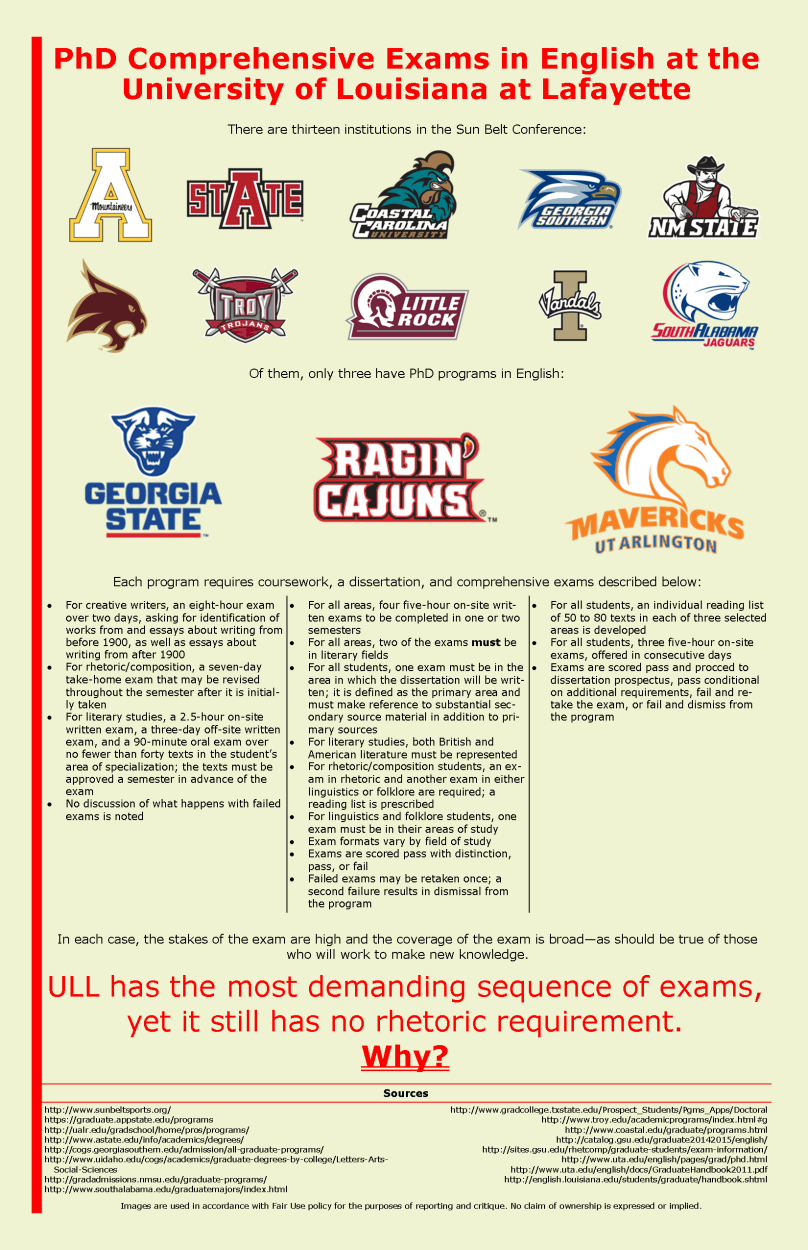
Earning a doctorate in English from the University of Louisiana at Lafayette (ULL) obliged me to sit for a series of comprehensive exams. Like my contemporaries, I had to take four five-hour tests over such areas of inquiry within English studies as English languages and literatures to 1500, early modern English literature, American literature to approximately 1900, and contemporary fantasy literatures in the US and UK. The idea behind such exams, according to how the ULL Department of English describes them on its website as of 23 September 2015, is to facilitate both teaching and continued research, ensuring that students who complete the program adequately reflect the generalist orientation of the program. Yet while the expressed requirements for the exams note that coursework across literary areas and periods must be taken, many of the students in the program are not obliged to range outside of literary studies, and most graduates will teach outside those areas–namely in rhetoric and composition. Why this is so is unclear; such a lack of clarity merits investigation.

Finding out why the PhD program in English at ULL acts as it does prompts looking at peer institutions of that school. The most immediate peers are the other members of the University of Louisiana system, given that they are unified at their higher administrative levels and therefore operate under many of the same constraints and restrictions that will affect ULL. The problem with doing so is that ULL is the only institution in the University of Louisiana system that offers a PhD in English. A slightly less immediate set of peers is the membership of the Sun Belt Conference, the schools against which ULL competes in athletic events; conferences tend to be organized to bring comparable schools into competition, so the member institutions are likely juxtaposed fairly. Too, more of the schools have PhD programs in English than in the University of Louisiana system, offering more useful data for comparison.

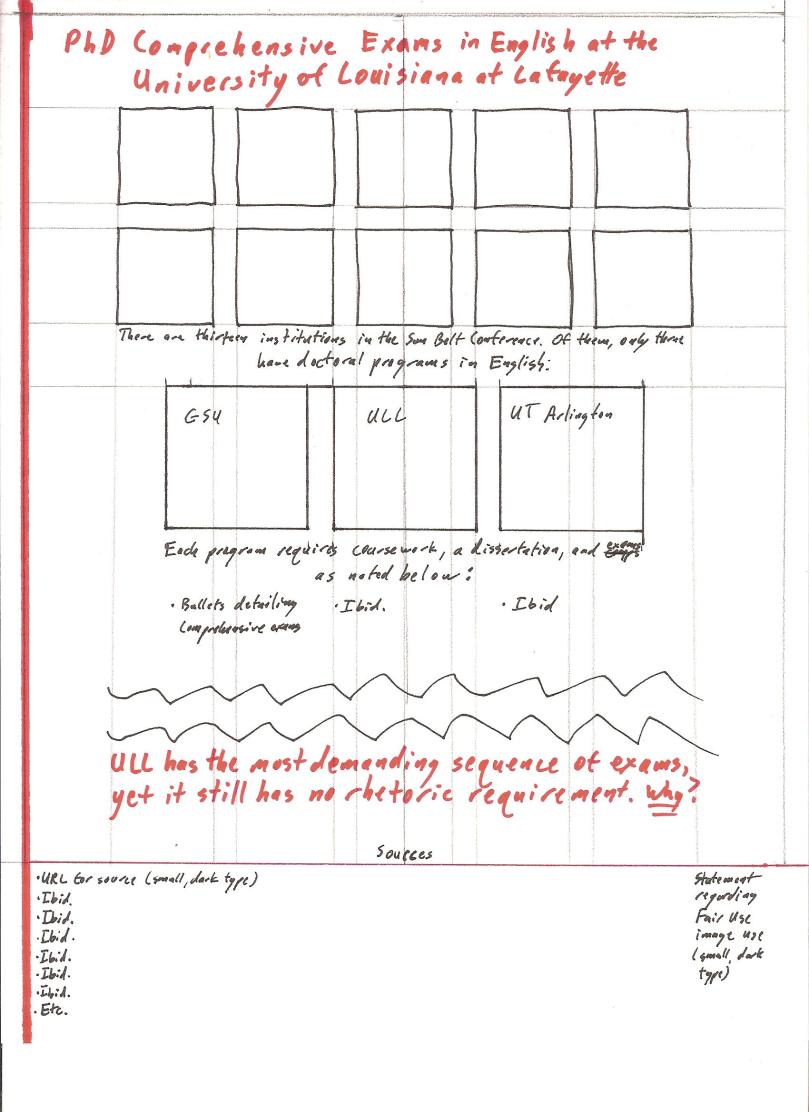
In composing the infographic, I sought to connect my presentation to the materials being presented. Consequently, I strove initially to mimic the color scheme and typefaces used by my focal materials, the description of the comprehensive exams hosted by the ULL English Department; the idea therein was that the treatment of the subject would reflect the subject itself. The infographic title was put at the top center to foreground it most prominently. Information was positioned to move from broad to narrow, leading readers down the page along a single center line. Alignment and grouping were seen to via tables, into which the increasingly narrow data-sets were set for ease of reading; while the focal information was placed near the bottom of the infographic, the plethora of earlier information serves to balance the document. Citations follow typical online practice, providing URLs for the materials collected and grouping them under a single heading at the bottom of the page; they need to be present but unobtrusive, and the placement and smaller typeface conduce to that end.

Raw-Form Infographic

G. Elliott Spring 2016 ENGL 1213 Infog Raw Form

Digital-Original Infographic

G. Elliott Spring 2016 ENGL 1213 Infog Digital Original Form

Class Reports: ENGL 1213, Sections 015, 023, and 040–29 February 2016

After addressing questions from the previous class meeting, discussion turned to further consideration of the Infog, as well as carrying over talk of previously assigned readings and materials meant to supplement them.

The survey noted last week has closed. Results will be reviewed and reported.

Students are reminded of the following due dates:

  • Infog PV (in hard copy as class begins on 7 March 2016)
  • Infog RV (via D2L before class begins on 11 March 2016)
  • Infog FV (via D2L before class begins on 25 March 2016)

Regarding meetings and attendance:

  • Section 015 met as scheduled, at 1030 in Classroom Building Room 217. The class roster showed 16 students enrolled, unchanged since the previous report. All attended, verified through a brief written exercise. Student participation was good.
  • Section 023 met as scheduled, at 1130 in Classroom Building Room 121. The class roster showed 17 students enrolled, unchanged since the previous report. Twelve attended, verified through a brief written exercise. Student participation was adequate.
  • Section 040 met as scheduled, at 0830 in Morrill Hall Room 206. The class roster showed 16 students enrolled, unchanged since the previous report. Fourteen attended, verified through a brief writing exercise. Student participation was marginal.
  • No students attended office hours.

Class Reports: ENGL 1213, Sections 015, 023, and 040–26 February 2016

After addressing questions from earlier classes, discussion asked after student thoughts on the T&S, which was due online before class began. Assigned readings and the Infog were treated thereafter.

The survey noted in class on 22 February 2016 can still be found here: http://goo.gl/forms/IWo6IHesrq. Students who confirm completion before the beginning of class time on Monday, 29 February 2016, will receive an A grade on the relevant assignment.

Students are reminded of the following due dates:

  • Infog PV (in hard copy as class begins on 7 March 2016)
  • Infog RV (via D2L before class begins on 11 March 2016)
  • Infog FV (via D2L before class begins on 25 March 2016)

Regarding meetings and attendance:

  • Section 015 met as scheduled, at 1030 in Classroom Building Room 217. The class roster showed 16 students enrolled, unchanged since the previous report. Fourteen attended, verified through a reading quiz. Student participation was adequate following the quiz.
  • Section 023 met as scheduled, at 1130 in Classroom Building Room 121. The class roster showed 17 students enrolled, unchanged since the previous report. Twelve attended, verified through a brief written exercise. Student participation was good, if distracted.
  • Section 040 met as scheduled, at 0830 in Morrill Hall Room 206. The class roster showed 16 students enrolled, unchanged since the previous report. Eight attended, verified informally; students in attendance were awarded bonus points. Student participation was good.
  • Two students attended office hours.

Attendance figures from 24 February 2016 have been recorded, as well. The efforts of Prof. Michael J. Beilfuss are appreciated.

Class Reports: ENGL 1213, Sections 015, 023, and 040–22 February 2016

After addressing questions from the previous class meeting and before, discussion touched on impressions of the T&S, the RV of which was returned to students who had submitted it appropriately, and introduced the Infog.

Students are asked to complete the survey noted in class. It can be found here: http://goo.gl/forms/IWo6IHesrq. Students who confirm completion before the beginning of class time on Monday, 29 February 2016, will receive an A grade on the relevant assignment.

Students are reminded of the following due dates:

  • T&S FV (via D2L before class begins on 26 February 2016)
  • Infog PV (in hard copy as class begins on 7 March 2016)
  • Infog RV (via D2L before class begins on 11 March 2016)

Students are reminded also that classes meet in the Edmon Low Library, Room 206, on Wednesday, 24 February 2016. No office hours will be held that day.

Regarding meetings and attendance:

  • Section 015 met as scheduled, at 1030 in Classroom Building Room 217. The class roster showed 16 students enrolled, unchanged since the previous report. Thirteen attended, verified through a sign-in sheet. Student participation was reasonably good.
  • Section 023 met as scheduled, at 1130 in Classroom Building Room 121. The class roster showed 17 students enrolled, unchanged since the previous report. Twelve attended, verified through a brief written exercise. Student participation was reasonably good.
  • Section 040 met as scheduled, at 0830 in Morrill Hall Room 206. The class roster showed 16 students enrolled, unchanged since the previous report. Thirteen attended, verified through a brief written exercise. Student participation was reasonably good.
  • One student attended office hours.

Class Reports: ENGL 1213, Sections 015, 023, and 040–19 February 2016

After asking about questions from previous classes, discussion treated student thoughts on the T&S RV, which was to have been submitted before class began.

Students are reminded of the following due dates:

  • T&S FV (via D2L before class begins on 26 February 2016)
  • Infog PV (in hard copy as class begins on 7 March 2016)
  • Infog RV (via D2L before class begins on 11 March 2016)

Students are reminded also that classes meet in the Edmon Low Library, Room 206, on Wednesday, 24 February 2016. No office hours will be held that day.

Regarding meetings and attendance:

  • Section 015 met as scheduled, at 1030 in Classroom Building Room 217. The class roster showed 16 students enrolled, unchanged since the previous report. Fourteen attended, verified by a brief written exercise. Student participation was reasonably good.
  • Section 023 met as scheduled, at 1130 in Classroom Building Room 121. The class roster showed 17 students enrolled, unchanged since the previous report. Thirteen attended, verified by a brief written exercise. Student participation was reasonably good.
  • Section 040 met as scheduled, at 0830 in Morrill Hall Room 206. The class roster showed 16 students enrolled, unchanged since the previous report. Eight attended, verified informally; a bonus quiz grade was awarded to those in attendance. Student participation was adequate, overall.
  • No students attended office hours, which were truncated as had been announced.

Class Reports: ENGL 1213, Sections 015, 023, and 040–17 February 2016

After asking about questions from previous classes, discussion offered a quick review of document formatting (particularly as applies to the T&S) and addressed progress on the T&S. Readings were discussed as time permitted.

Students are reminded of the following due dates:

  • T&S RV (via D2L before class begins on 19 February 2016)
  • T&S FV (via D2L before class begins on 26 February 2016)
  • Infog PV (in hard copy as class begins on 7 March 2016)

Students are reminded also that afternoon office hours will not be held on Friday, 19 February 2016.

Students are additionally advised that six-week grades have been published. The grades reflect current class performance and are offered in an advisory capacity; they do not factor into grade point averages, and they do not represent a guarantee or prediction of grades for the rest of the term. Reported grades were taken from D2L and do not include any adjustments for absences.

Regarding meetings and attendance:

  • Section 015 met as scheduled, at 1030 in Classroom Building Room 217. The class roster showed 16 students enrolled, unchanged since the previous report. Fourteen attended, verified through a brief written exercise. Student participation was reasonably good, if somewhat distracted.
  • Section 023 met as scheduled, at 1130 in Classroom Building Room 121. The class roster showed 17 students enrolled, unchanged since the previous report. Fifteen attended, verified through a brief written exercise. Student participation was adequate.
  • Section 040 met as scheduled, at 0830 in Morrill Hall Room 206. The class roster showed 16 students enrolled, unchanged since the previous report. Thirteen attended, verified through a brief written exercise. Student participation was adequate.
  • One student attended office hours.

Class Reports: ENGL 1213, Sections 015, 023, and 040–15 February 2016

Class time in all sections was spent on peer review of the T&S. A quiz grade was taken from the reviewed draft, as was attendance.

Students are reminded of the following due dates:

  • T&S RV (via D2L before class begins on 19 February 2016)
  • T&S FV (via D2L before class begins on 26 February 2016)
  • Infog PV (in hard copy as class begins on 7 March 2016)

Students are reminded also that afternoon office hours will not be held on Friday, 19 February 2016.

Students are additionally advised that six-week grades will be published this week. The grades will reflect current class performance and are offered in an advisory capacity; they do not factor into grade point averages, and they do not represent a guarantee or prediction of grades for the rest of the term.

Regarding meetings and attendance:

  • Section 015 met as scheduled, at 1030 in Classroom Building Room 217. The class roster showed 16 students enrolled, unchanged since the previous report. Eleven attended, verified as noted above. Student participation was good.
  • Section 023 met as scheduled, at 1130 in Classroom Building Room 121. The class roster showed 17 students enrolled, unchanged since the previous report. Fourteen attended, verified as noted above. Student participation was reasonably good.
  • Section 040 met as scheduled, at 0830 in Morrill Hall Room 206. The class roster showed 16 students enrolled, unchanged since the previous report. Twelve attended, verified as noted above. Student participation was not good.
  • No students attended office hours.

Class Reports: ENGL 1213, Sections 015, 023, and 040–12 February 2016

After addressing questions from the previous class meeting, discussion commented on performance on the StratRdg, of which grading has largely been completed (later submissions are generally graded later). It also addressed student progress on the T&S and concerns emerging from reviewed readings in advance of the expected activity during the next class meeting.

Students are reminded of the following due dates:

  • T&S PV (in print as class begins on 15 February 2016)
  • T&S RV (via D2L before class begins on 19 February 2016)
  • T&S FV (via D2L before class begins on 26 February 2016)

Students are reminded also that afternoon office hours will not be held on Friday, 19 February 2016.

Students are additionally advised that six-week grades will be published next week. The grades reflect current class performance and are offered in an advisory capacity; they do not factor into grade point averages, and they do not represent a guarantee or prediction of grades for the rest of the term.

Regarding meetings and attendance:

  • Section 015 met as scheduled, at 1030 in Classroom Building Room 217. The class roster showed 16 students enrolled, a loss of one since the previous report. Ten attended, verified through a brief written exercise. Student participation was adequate.
  • Section 023 met as scheduled, at 1130 in Classroom Building Room 121. The class roster showed 17 students enrolled, unchanged since the previous report. Fourteen attended, verified through a brief written exercise. Student participation was adequate.
  • Section 040 met as scheduled, at 0830 in Morrill Hall Room 206. The class roster showed 16 students enrolled, unchanged since the previous report. Twelve attended, verified through a brief written exercise. Student participation was adequate.
  • Three students attended office hours.

Class Reports: ENGL 1213, Sections 015, 023, and 040–10 February 2016

After addressing questions from the previous class meeting, discussion continued to treat concerns of the T&S. Attention was paid to source quality and citation.

The StratRdg is in the process of grading. It will be returned as it is graded.

Students are reminded of the following due dates:

  • T&S PV (in print as class begins on 15 February 2016)
  • T&S RV (via D2L before class begins on 19 February 2016)
  • T&S FV (via D2L before class begins on 26 February 2016)

Regarding meetings and attendance:

  • Section 015 met as scheduled, at 1030 in Classroom Building Room 217. The class roster showed 17 students enrolled, unchanged since the previous report. Fourteen attended, verified through a brief written exercise. Student participation was good.
  • Section 023 met as scheduled, at 1130 in Classroom Building Room 121. The class roster showed 17 students enrolled, unchanged since the previous report. Fifteen attended, verified through a brief written exercise. Student participation was reasonably good.
  • Section 040 met as scheduled, at 0830 in Morrill Hall Room 206. The class roster showed 16 students enrolled, unchanged since the previous report. Twelve attended, verified by a brief written exercise. Student participation was reasonably good.
  • No students attended office hours.