The topic of games ending has come up in this webspace before (here, if not also elsewhere). I always experience some sense of sadness when I have a game conclude (as opposed to simply stopping, which happens, unfortunately, and has its own issues), and this is certainly true for the most recent game in which I’ve played: Nakahama.
The header for the game in question, taken from a screen-shot
An adventure in another Legend of the Five Rings campaign, the game centered on a single province of a sort of resort planet–so, magical samurai in space. It was my first adventure in the campaign, so I entered it late; there’s a fair amount of history behind it, assumptions in play that I didn’t necessarily catch onto at first but managed to come abreast of soon enough. I’m more or less content with how my character turned out, although there’re always things I’d do differently than I did and thing’s I did do that I wouldn’t again.
It was instructive for me. In earlier comments about forum-based RPGs (like those referenced above), I remark on event design. I’ve discussed as much from time to time since, probably not at the level of depth or with the focus I ought to’ve, but I’ll note that Nakahama was perhaps the single best game for that that I’ve played. There was the kind of straightforward primary metagame mechanic that is to be expected–each “session,” make a particular roll for particular results, racking up those results across the whole game for in-milieu rewards and changes–and that was welcome in its familiarity. More engaging was a series of in-game events that each contributed towards the primary metagame while stretching players’ and characters’ abilities and understandings, each of which seemed to contribute to a Tolkienian “inner consistency of reality” and impression that the milieu exists outside of what players and their characters see. Too, the overall design was not locked into one character type or another, as often happens, but had something for most character types (I say “most” because “all” cannot really be addressed). I’ll definitely be taking some lessons from it, moving forward.
And, yes, it’s “moving forward.” I will be running games of my own, after all, and not only Hanlon (but, happily, Hanlon). I have ideas for a Legend of the Five Rings campaign that’ve been bouncing around for a good long while, now, and I should probably put some more effort into polishing them up. This is the kind of thing that sweetens the bitterness of a good game ending, the promise of a new one that takes lessons taught from it and hopes to expand upon them, making things better for everybody involved.
I’d be pleased to put together work for your games, tabletop or forum-based. Reach out through the form below to get yours started!
Not much less than a week ago, I noted wrapping up my local library’s pilot program of running a game of Dungeons & Dragons for middle schoolers. I continue to think it was a good experience for them and for me, and I continue to think that what the game taught us is worth having learned or having been brought back to mind.
I’m particularly pleased, therefore, that the program looks like it will resume next month. That is, I will continue to run Dungeons & Dragons games for middle schoolers at my local library. I rather expect, based on the feedback I got from participants, that those who have already been at my table will return to it, and that will be good; I have things to do with them (including walking them through character advancement / improvement, which I had meant to do at the end of the last session but which events and time constraints prohibited), and there is value in having stories continue.
There is some talk, too, of the program expanding, whether to a second session of middle schoolers or to a session of high school students is not yet clear. Either would work well, although each presents different challenges. With middle schoolers, there are more concerns of maturity than with high schoolers, although the ones with whom I’ve worked thus far did decently well being redirected when they needed it; really, the issue was all of them wanting to talk at once, most of them wanting to be the focus of attention. It’s not bad in itself, but taking turns being the star is still something they’re working on; they’ll get there, I’m sure. High schoolers will, in some ways, be easier; there’s more they can do and can be expected to do. But there’s also more concern about their needs; middle schoolers are still largely children, while high schoolers are more nearly adult and will have more things going on that are potentially problematic for me to address.
I know who and what I am, after all, and I am aware that my addressing particular issues is fraught.
That said, I am looking forward to resuming play in and around Hanlon. I’m looking forward to deepening my understanding and insights, as well as to seeing what else from my past experiences still holds up in current play, when I am so many years older and my players do not have the shared experience and cultural immersion–including the (internalized?) shame at pursuing a hobby that used to earn scorn, derision, and an uncomfortable amount of suspicion from religious leaders and law enforcement officials–I shared with my earlier play-groups. Also, to be sure, I’m looking forward to passing on some of the more “academic” parts of what I know about all this; there is scholarship on the matter, in addition to the ways in which tabletop roleplaying games do have educational value. After all, to play, players have to read, they have to navigate rules sets and so learn index use, they have to do quick arithmetic, and they learn quite well that random chance isn’t always, but that no roll depends on the last one made. Narrative theories can be explored, as can philosophies, and it might be that I include some short reflections on why characters take the actions they do or somesuch thing.
There’s a lot to do, and it will be good to do it.
I’m happy to write stuff for your table, too; fill out the form below to get yours started!
Yesterday, as this piece makes its way into the world, I presided over the final session of the initial Dungeons & Dragons for middle schoolers program at my local library. (It’s discussed here, here, here, and here.) In it, the party sought to make its way back to Hanlon, its objective achieved; they were sidetracked by player actions and the will of the dice into an unexpected, ultimately successful encounter. I also, in fact, put into practice my player-commendation bit that I remarked upon last week. Even if things do not resume–much as I hope they will, I cannot rely upon it–I’m glad to have done it; I like to set good expectations with my players, even when they are not so young as the kids with whom I worked these past weeks, and I think it’s important to ground children well.
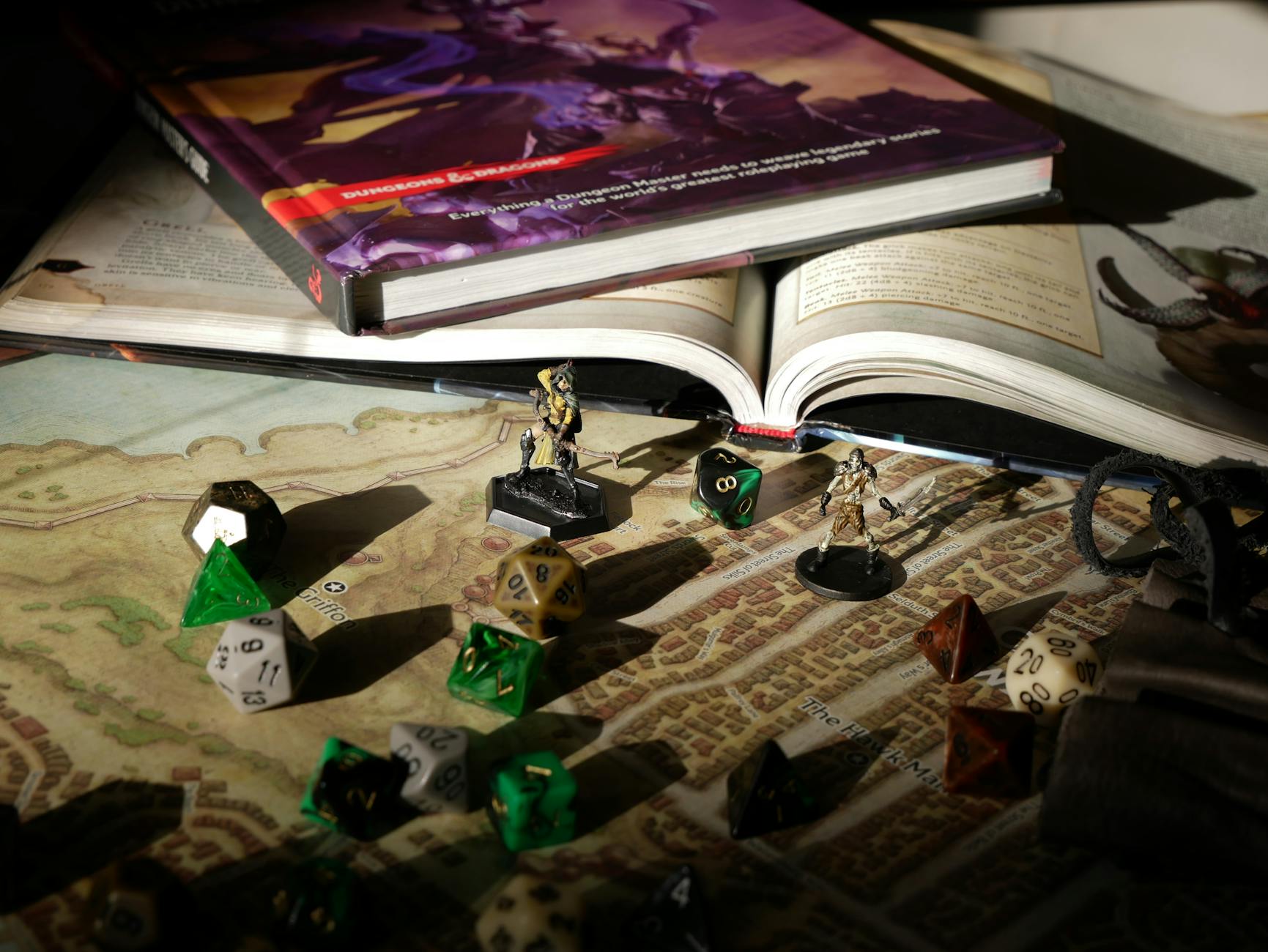
Not bad looking… Photo by Stephen Hardy on Pexels.com
There are, of course, things I would do differently if I had them to do again. With a bunch of newer players–and most of those at the table were, in fact, brand new to tabletop roleplaying games–I think it might be good to have a more overt authority in the game with them, something of a mentor figure who can, within the context of the game, offer some guidance. I am aware of the perils of the GMPC, to be sure; I’ve seen it go badly and have been guilty of making such a thing happen. But with a markedly novice group, I think it might be a good idea to have, nonetheless.
I think, also, I would try to work in more non-combat encounters and mechanics. I know, with a bunch of kids, that “getting to the good stuff” is a concern. I also know that combat can drag easily, especially if one or more of the opponents actually thinks through the fight (and if one or more of the PCs gets annoyed at the antics of another and vents their spleen). Perhaps a puzzle or two, going back to the old dungeon-delving model, might work.
Some things went well, though. Having the new players address the non-mechanical stuff is almost always to the good, and my players leaned into it even without much in the way of overt background knowledge; I’ll be doing that again, to be sure. Too, going ahead and rolling with them for (most of) their shenanigans resulted in laughter around the table, and since a large part of the reason to play any game is to have fun, things that promote such laughter are to be encouraged. And, finally, I think bringing together people from different experiences was good for everybody involved; if I can, I’ll do that much again.
In all, it was a good experience. I needed the practice in running a game at a table, and I’m glad to have helped some new gamers begin to get grounded in the hobby. After all, the children are the future, and I’d like to keep having one of rolling dice and telling lies…
If you’d like me to write gaming material for you–with no generative AI slop involved!–fill out the form below!
Since I’ve been going on for some weeks now about the work I’m doing running Dungeons & Dragons for middle schoolers at my local library (see here, here, here, and here), and because I’m in the middle of another play-by-post forum game, I’ve been motivated to look back at some of the older materials I’ve kept on file these many years. I’ve put a lot of effort into my gaming across a fairly decent spread of time at this point, and while I’ve had thoughts from time to time of what I could have gotten done had I focused on other things instead, it’s also been the case that I’ve built and maintained friendships through roleplaying games that have sustained me. I value them, and I’d not have them had I not done what I did before, so I’m grateful to have what I have.
The man himself Image is mine from years back
One of the things I found while looking was my record of a campaign in which I played while living in Lafayette, Louisiana. It’s one of those “be the party scribe for XP” things I’ve noted in earlier posts, as well as being practice in verse-forms for me. (I had some need to do so at the time. Perhaps that need persists.) The campaign stopped before it ended, more’s the pity, so the poem is incomplete, joining a number of other records in being so. What I have of it, all thirteen thirty-six-line fitts, I give here, only lightly edited from how I had it before. It shows influences and derivations, of course, but also progression, and I think it might well serve as an example of one of the things roleplaying games can do; being art, they can inspire other art.
Hreðe Clammeshearra, hard is that man, Fierce in the fight, that fiend of the chain. But long before his broadly-known days As champion of chains, when he was a child His father was felled, Fæst Hnæfessunu Who fought through the fire against many foes. He died as was destined, his doom was foretold As sages had said; he sought out the deathlands, His ancestors accepted him after his deeds. He left behind life, lost then his wife, The beautiful Cwenlic who bore him the boy Who would become Hreðe; hard was that day! For with Fæst gone, fatherless youth, Hreðe had not the help of a man In learning the man-lore and living’s best way. Fierce burned the fires fueled by his heart And against all people he often struck out, Making of all folk foes and fierce hate-men; Out he was cast, adrift and alone. Such is the fate for those who fight kinsmen. Better instead to be as a brother To brothers and blood than to bruise one’s own kin. Sorrowful solitude followed his steps; Haunted was Hreðe by mocking home-thoughts. Not strewn with flowers is the far-reaching fate Of men kinless made, no more for the young Than for warriors proven. While Hreðe wandered, Seeking safe dwelling and a seat among men, Some from the southlands sought to take women And men who might fight in manacles cold, To treat them as cattle and trade them for treasure For lust and for leisure of the lazy rich. To Hreðe a dark day was delivered harshly When summer had sped and autumn was summoned; The callow youth cast-out came upon slavers And chains then first met him.
To the wandering youth the wardens of wyrd Were less than good. Not light was the lifting Of chains for Hreðe; they chafed at his chest. The breast of a boy, broad as a twig, Hreðe still had when heavy irons First wrapped his wrists and rattled his steps. At first, Hreðe fought against fetters hard, Seeking to slay the slave-binding men. Of knot-ropes and nails he knew the pain then, As soft southern tongues slaver-words taught him. Long was the walk, the labor in lands Where men might own men and make of them beasts. Under stern steel-weights Hreðe grew stronger And wise in the ways of work-forced folk, In the south city he soon knew himself To be a man grown though by manacles mastered. Years of his youth yearned to be free While in pit and peril he performed a craft, Coming to kill in contest and sport For those who fought not but feasted and laughed As slave battled slave and one slew the other. Chains still chafed Hreðe and cheated his freedom, But they also became the best of his tools And gave him his name of Clammeshearra; If Hreðe had them, hard would he fight, Making of men meat with the fetters. Soon it was known in the southern city That Hreðe was highest and hardest of those Who fought for the fun of fat, lazy men. His name became known; none failed to speak it, Yet for all his fame, he still was not free. Not the worst in small war, not the smallest of wounds Did he deliver, of deaths not the fewest From his hand fell, and not the first taste Of free air could find him, fettered as he was. That would soon change.
The wardens of wyrd watched the young exile, Fallen Fæst’s son far in the south, Captured kinslayer, captain of slaves. Winters fifteen when he began wandering The boy had seen. Seven slave-years In pit and in peril paid for his crimes; The gods ask no more, those givers of gifts. While Hreðe warred as lazy men watched The earth masters made a mighty thing happen, Great work of gods; in the ground a cleft Opened beneath all the unmanning walls Where lazy men watched slave-warriors fight. Stones came to stand where staring men were Before they could be in a better place. The walls fell to waste. Men watched no more. The hand of Hreðe held death aloft When the walls fell. He wasted the stroke, Dealt then no death as did he before, Bowed to the blessing of the bounty-lords, Stayed the hard stroke and strayed from the pit. None could now keep him from knowing free air. Chains he took with him, champion fighter. Hreðe tight-held to hard iron bands, Solid fight-servants in his slave-days long. Not long did he linger in long-hated place, But went into the world where he could find deeds Of warrior-glory, the work that he knew. The fiend of the chain found before long Fighting-man work in freedom to do. For weak men he willingly waged a hard battle Between the slave city and a seemlier place. He traveled the trails, truest of fighters, Forgiven his faults, the folly of youth. The last joy of Cwenlic came to the coast, Saw there a city, strode to its doors. He went then inside.
The domain of Dockston did Hreðe enter, Gathered with Guildsmen for glory and honor. Hreðe the Hall of Heroes entered; A summons had sent him to that city’s heart To face a fair test and his fate to measure, To find in the Fever Glades of fen-roads the best. East went the eager one and even companions When next the sun rose, a good road to seek Through fens of Fever Glades, the fiend of the chains, Where flowed the water upon the world’s face. They traveled not silent, but spoke many words, The fiercest of fighters and his dear friends, Pious Dwarf prayer-man and pointed-ear sage, No less the little man on rapid-step legs. Their speech then was split by a scream in the fields As the fiend of the chain and his friends happened by. Lizards had lashed against little people And so they were slain and sent out in fear With fire and chain and one well-flung stone. A help to the Halflings Hreðe became With his worthy friends, a weal for the good. A stain on the soil was spilled Lizard blood When wounded by Hreðe, one left this life, And fire and stone slew yet another. Old Orchard Meadows opened its arms To the wandering warriors and welcomed them in. The citizens spoke of slinking new troubles; Them Hreðe heard and his wise companions, Sought out the source of the new sorrows. Fens then found out the fiend of the chain. In muck and mire, the man and friends trod Until the attack of oversized vermin Halted their haste. It hindered them little; Their fate was not fixed to fall in that time But that of the beast was bound to its end, And for the scale-men at the mill.
Life had left lizards at the mill. Hreðe and his folk hiked on the path; Slow was the swamp-way as they slogged along. To the place of the peatcutter the party soon came And faced a new fight on the fen’s edge. In a fan made of flame a foul plant-thing died, But a beast of bile battled them then, Spitting foul speech, sputum of death; It, too, was slain, served no stout fight. Rich was the reward and real was the joy Orchard Meadows felt at the fiend of the chains And for his friends from what they had done And had yet to do; hard work was ahead. The swamp-way was sought by soldiers again, Foul-smelling fenlands. In faith they worked To make Orchard Meadows for men a good place. As the group went to gather together A spell suddenly on the select fell; His friends had to hold Hreðe from leaping Into cool currents– compulsion befell him. A spell after slew the sprite who had made it And they then went on into the wood. A spider sprang out and sought to attack. Daggers and chains and a dart well-placed Suddenly slew it. The spider fell quickly. After spider was slain, the seekers came To the lizard lands, where lived the scale-folk. An elder of egg-born escorted them To know Nanami, the name of their leader. Words then were passed and stories woven. Foul deeds came forth and found redress. The evils of office were all undone In Orchard Meadows. Applebottom had Worked foul in the fens and fathered deceit. And end was put to it, and to him as well. There are worse things in the world.
They departed for Dockston in dourness none, Reached their rewards, new robes among them. The stealthy small one, swift-handed Milo, The talented Taren, tall and wise, Priest great in praise-work, the preacher called Mott, And heart-strong Hreðe, hero of chains And fiend in the fight, found a new name. Explorer Acolyte all later called them When they had returned from whence they set out. Great was the glory given them then. Their journey to Jesric was joyous indeed; All knew their names with no small pride. After the accolade the Acolytes new Were bound for Blackston for battle again. Zarlag had studied, searched for new lore, Then left it alone. To look for it then The fiend of the fight and his fellow-searchers Were sent for success. All seemed well at first. The seeming soon ended; others sought out The hero of chains and hand-swift stealth-man, Praiseworthy priest, and practitioner arcane. The beasts of the barrens bore down on the group, Surrounded the seekers, sought a new meal. A griffon descended, grabbed at the horse That Hreðe had brought to haul all the things That serve success well— save for great valor, For that the four had in full-hearted measure. The worker of woe on wings dropped down, Tore at the ties, the tethers of life; Great was the grief the griffon found At the attack, which Acolytes gave. It fled in fear; its fury was spent. The horse had been hurt; healing came to it By workings of wyrd against woe untimely. The party packed up, pressed on steadfastly. There was much yet to be done.
Gone then was the griffon and gathered were they Together at trail-head. They took up watches And waited as wardens while others slept. Ants made attack in early-dark morning; Mott and small Milo, they met the beasts bravely. Taren then took up a titan’s struggle And Hreðe, the hard man, was hero that time; The Fiend of the Fetters flung chains about him, And with a loud whirling went ants to their deaths, To graves after grappling with the ground-near small man. Hreðe Clammeshearra helped Milo live, Ended the argument with iron and thew. When after, at noon-tide more ants appeared, Besetting a brave one who bestrode a stone, The Chain-lord charged in, the child of Fæst, Rescued then Ralgor from rage of the creatures. The Great Forge was grateful, and grand was his welcome Of Hreðe and Mott, and Milo his kinsman, With Taren the tall. He took them with him To seek out his sleep-place, their stories to hear. When they arrived there, thieves awaited them, Halflings half ant-folk with hardened red skin; The mark of their maker and of Mithril Fort They bore on their breasts before they attacked. The fight was a fierce one, but fate was not with them Who had the Halfling hoped to despoil. They claimed that their queen would come and redeem them, Bring sorrow to stout hearts and seek all their dooms. The boasting was bombast; they were beaten well. The wardens of wyrd wanted no more To permit the pair to peer at the sun. Hreðe then halted the lives of the Halflings, Sent them to seek what solace they could, Then turned towards his own and went to the table. The Great Forge’s graces went to groundhog stew; It was a fine meal.
Morning must come to men in all lands, And it came upon Hreðe as is expected. Rightly did Ralgor set their feet running To the old tower to which they were sent. Tall, in two stories, the tower stood there, Old home of the asker who ancient lore sought, Bleak then and barren where once banners hung, And sealed was the stonework of Zalgar’s old home, Riding near ridges. Right so Taren saw Emerging far off ants from the ground And making for the east, unaware of heroes. They moved to assail them, the Acolytes new. Milo did much to mask their advance; The small man was skilled in stealthy arts. Into the earth all four of them passed, The great ones, the bold ones; they feared no peril, But pressed ahead proudly as princes of cities. Ants would assail them, and ants would then die To fire and dagger and doughty-swung mace, But the Chains’ Champion as chaff from the wheat Severed the six-legs from seeking their prey In whirling death-windmills. They went from life quickly. Through tunnels and trials, they trudged ahead, Ridding the ridge-lands of rambling vermin Both new and to come; not for long after Was wariness there where they had fought. Soon then the ant-queen came into their view, And as with her children, the mother to chains Fell in the fight; the fetters collected life From one who had owed it. It was soon done, Hreðe a hero and his folk the victors. A test for the true-hearted, a tunnel remained Which in heroes’ haste had not yet been taken. They wound their way to it, the war-mighty ones, Made progress up it. Powers awaited. More fights were coming.
In divergent directions the ant-delving wandered. The tunnel not trod the heroes then took, Searching for secrets and seeking the tower, For they knew that formian foes as yet held it. The Champion of Chains a charnel-house found Full of the dead and food no good to them. Tunnel turned away, taking them forward. A giant half-ant guarded the gate to their goal. Milo thought him mighty and made to attack; Though worthy and wily, wood swung by giants Is no easy thing to endure in arms. To Milo Mott soon made with his healing And Taren took aim at twin-headed peril, Solemn war-sorceress sought its undoing. The fierce son of Fæst entered the fight, Brought down the beast and battered it greatly; When it would seek to rise, it wound up on the floor, Tripped, taken down, and of treasures stripped. The door bore a device the ettin died before; The ant-mark appeared there, and so they went on, Opened and attacked against the foul there. More of the man-ants made as to slay them, But they were unworthy as warriors for life; They failed in the fight. So may all our foes! The brave ones sought beds after that battle, And when they woke it was to more war. As happens so often, the hardy were given In war by the wardens of wyrd the victory; Such was their skill that few stood before them And those not for long. Of such things come legends And glory and gold, gifts of all kinds. Much yet remained, though much had been done By the explorers in tunnel and trial. No foes frightened them, fast in their valor, And eager in heart, they moved ahead. Heroes should always act thus.
When rest and relief the righteous ones found, The praiseworthy priest had prayers intoned, The solemn sorceress centered her power, The small sneaking one settled his blades, And Fiend of the Fetters fight-ready was, They looked for the leavings of looters now dead. A hard fight and Halflings held as slaves they found, Breath-of-pain beetles and beating-wing flier Attacked and assailed them. All of those died; Broken and battered, the beetles fell quickly To priest and pocket-scout; a powerful leap Sent Hreðe in hatred at high-flying ant; He bore it to bottom of tunnel and beat it. The Halfings were happy that they had been saved; Walnuts and wine went off in their joy, And four went on forward with fighting to do. Ascending and searching, they scouted on forward, More formians found and fought them to death, Then reaped the rewards for rightness in valor: Gemstones and jewels and the journal sought. Taren then took it and told of its words, The black blood-writ volume; the book they sought told Of death-god’s devices and deeds to attain them. Words then of worry were spoken among them, Of fair and of foul and feats yet to do, The tome they had taken, their task had fulfilled, Yet formian foes remained to be fought Who sought to make slaves and so deserved death. Mott who was holy and Hreðe agreed; Such evil should not survive in the world. The priest of great praise and pit-fighter knew That in this as one, they would work well. One door remained. One door was closed, And on would they go, the excellent four To finish the fight and leave no foes living. Such is the way of the worthy.
The closed door was opened, and in went the heroes. There they saw sights strange and uncouth. In a wizard’s workroom, a weird scene appeared Of shelves and substances, and strapped to a table, A dark deformed ant-thing in depraved guise. Near the board-burden, on the floor beside, Stood a strong challenge that spoke to the four: “Leave now my love, and laden with treasure You may go freely. Give her no pain; She has had enough of harm in this place.” So spoke the ant-man as stood the four, But still from the burden blood-potions came And slaves made of small ones; such is not meet Save for death alone. And death came then to them. Fierce was the fight, but it finished quickly, And the warriors worthy won then the day. Yet one more fight remained to them then; They searched out the high-room, striving by stealth, Then with hard hits, to halt the advance Of unfit dominion and unclean control. The mother of misery and her last minion Were sent to the sunless, sorrowful land; One was redeemed, though without comfort, From that fierce fight, fought against magic And a queen who assumed unsolid forms. The last of the tower was taken as treasure And those who survived the slavers’ attempts Were gathered together and led to their lands. The travel was smooth, and swiftly they went From tower to tunnel to treading under heaven. For Mithril Fort, they followed the path Until, stained by smoke, the sky ahead showed Where wrack and ruin had razed the strong place; Orcs had attacked, and abomination Of size supreme and scarce to be believed. A new threat arose to be faced.
The Fall of Fort Mithril found some relief From Mott the most worthy and Milo the deft, From Taren the titan of terrible lore, From Hreðe, the hard man, the hero of chains. Young, yearning knights, the yore-heroes’ heirs, Gave word of Gheydalin, a gathering-place Soon now to suffer the sorrows of war. Mott then to mercy, and manful deeds Hreðe, Were moved and moved on to meet the new need. Swiftly they strode across silent lands, Seeking to succor the sylvan-land folk; Before the brave heroes a barking then sounded Of orcs and their orders— an awful sound. A patrolling orc-party, apart from the horde, Warg-riders and wagon-men, waited to die. The heroes then helped them; Hreðe cut their wait short Along with the others in all of their skill. Then, too, there came to them a thing not foreseen, Beast-man and beast to battle the orcs; Tekk, who transformed to tear at the throats Of enemy orcs, and his own companion, Greeted them gladly, gave them his pledge Of friendship and faith; they followed his words And gained then Gheydalin in the green woods. Walls tall and wooden wound around the village As Mott the merciful and mighty Hreðe Called up the council and cautioned attack: “A beast of soul-blackness bears down upon you; An army of orcs is after your land. Gather your good-folk, your goods leave behind, Flee into the forest before the flames come Of war and of woe. The warning please heed.” At Mott’s mild words and the mean eyes of Hreðe The people, not panicked, proceeded along And fled their fair village before the flames came. Gheydalin still perished.
With Gheydalin gone and given to ruin, The heroes for Haarston hastily traveled. The night-watch showed nothing. The next gave them rest; Watersong wound through woods to their ears And bars stood before them, man-barded guards. Their lord, Ludovico, was loath to hear counsel, A drunkard debauched, no diligent man To rule a right people against ruin coming. Milo went merry to make him to hear; The lord, Ludovico, listened then not. Hreðe then held him with hand-grip on throat As Taren the talented his teeth held closed. Ludovico listened, and led were the folk, The Haarston home-dwellers, hardly away Before came the beast to break all the town. To Linham the lost-folk led then would be; Hendrix thanked heroes and heard their words, But Milo and Mott and mighty Hreðe, Taren the talented and Tekk the wood-wise, Gathered together would go thence to Jowston; The city yet stood in sorrow’s intent. Two days they traveled until at the city They arrived in honor and opened the court. The warden would stop them, wished to deny The power and promise presented to him; Still heroes sought to say their new tidings And wake with new warnings the warrior people. Their message was made and magistrate said, “Gather together in glory the folk; Secure the city against sorrow oncoming. Tend to the tasks where your talents lie And all thanks and honor for all of your deeds.” The heroes then headed, they heard the good words, To do then the deeds to deliver Jowston. Night approached newly and nothing remained Except to face the beast.
I’m happy to put such talent as I have to work for you; fill out the form below to get a piece started!
In a piece last week, I make the comment that “At my tables, XP also result from making things better for the other people at the table, something I’ll talk about in more detail later on (but probably not today).” This, being a different day (although today on whatever day you read it), seems a good one for talking about one of the “making things better for other people at the table” I have tended to reward with additional XP; I have often had players vote for the player other than themselves whom they felt did the best job of roleplaying at the table that session, and I’ve awarded that player premium XP for the commendation of their fellows (usually something like one-fifth to one-third of the “regular” reward for the session).
I’ve seen messier tables. Photo by Will Wright on Pexels.com
In practice, it was a small thing, just a collection from those at the table of slips of paper with someone else’s name on them and counting up who got how many votes. In effect, however, it proved a powerful motivator. As I remark in the earlier piece and as is clear to most who have sat to table, the promise of a reward spurs quite a bit of effort and action; most any time XP are up for grabs, players pay attention and go out of their way to get the reward. As is also clear from experience, in many if not most cases, people are motivated by the acclaim of their peers; having evidence that those in a person’s acquaintance value the contributions made does a lot to spur more such contributions. Since in this case the “contributions” being rewarded were particular at-table behaviors, those at the table largely regulated themselves to that end, pushing further into character development and narrative engagement, even if occasionally at the expense of mechanical effectiveness. That is, they would go further into role-play as opposed to the roll-play that I have seen take over tables and towards which many who come to the older tabletop roleplaying game from the more ubiquitous and younger massively multiplayer online roleplaying game or from similarly structured single- or limited-multiplayer games tend.
I’ve not implemented it with my Hanlon players yet. I think I’ve remarked before that the program that has given rise to Hanlon is something of a pilot; there’s one more session to play that I know of, and I do not know if matters will continue afterward. I hope they do, and if they do, I think I will put the practice back into practice at my table. It’s a good one, and with such young players as I currently have, I think it will do much to help them learn to do more than come up on the rules (which is not a bad thing to do, in itself, but the game is more than the rules, really). I think it will help them get better at finding and filling their roles, and it will make them better players at the next tables they join.
I try to be helpful. Sometimes, it even works.
I’m happy to write RPG materials for your table; fill out the form below to get yours going!
I‘ve mentioned, most recently at about this time last week, that I’m running a Dungeons & Dragons (D&D) game for middle schoolers at my local public library–for pay. The game is progressing well enough; the third 90-minute session was yesterday, with six players in attendance. The party continued along the path I’d laid before them, making headway towards their assigned objective (some social structures within the game have emerged from play and improvisation, which makes some things easier than others). Fun seemed to have been had all around, so I count it as a good evening of play.
This ain’t too far off… Photo by Stephen Hardy on Pexels.com
One of the things that I’ve used to keep the party moving while allowing them both agency and a means to work around failure is something I’ve taken from my experience participating in play-by-post forum games, something about which I’ve written before (for example, the piece referenced here, as well as this piece, referenced here). That thing is employing levels of overall success based on racking up a certain amount of individual success before incurring a certain amount of individual failure.
To explain a bit: in D&D and many other tabletop role-playing games (TTRPGs), tasks that characters face are often adjudicated by a single roll of dice. In D&D rules current to this writing, the player whose character must face a task with an uncertain outcome rolls one twenty-sided die and adds (or subtracts!) modifiers, comparing the result to a set difficulty, a minimum number that must be arrived at for the character to get the task done. In other games I’ve played, things generally work similarly; the player rolls once for the character’s attempt at a task, success or failure results, and the story moves on.
The method has the advantages of being simple and quick. The die roll is what it is, the result is what it is, and consequences can flow from it with relatively little interruption of the narrative flow around which the game centers. It has the disadvantage, however, of being more or less entirely up to chance; players can build characters to stack modifiers and roll scads of dice, but there are times when the dice simply fail to deliver a success, and staking a whole story on one such shot can leave players feeling unsatisfied. In some cases, those administering the games will “fudge” numbers a bit, altering things where the other players cannot see so that they succeed at pivotal tasks, but in such cases, one might well ask what the point was of rolling dice.
The issue, for me and for more than a few others I’ve known, is that some things admit of reattempts, and some things are better represented as progressions than one-off events. In such cases, what I and some of my acquaintances and friends do is set up tasks for players that ask them to make a series of rolls in which they have to accumulate a certain number of successes before incurring a certain number of failures, say three successes before three failures. (Threes work well for reasons that others expound upon at great length across quite a few years.) Getting that done allows a superior overall outcome, while failing before succeeding still allows progression, if with some additional challenges thrown in. And it mitigates the feeling of frustration that comes from one thing going against a character, even when it flatly doesn’t make sense that that character would falter at the test in question.
Admittedly, such a setup necessarily takes longer than the traditional one-off model; there are more die rolls involved, and more things to do take longer than fewer things to do when the same number of people address them. Too, there are some tasks that probably should be one-off events: much of the combat in which characters engage in games hinges on single actions, and rightly so. But for a number of tasks, spreading out success helps to mitigate failure in ways that help keep players engaged (checking out after one failed roll is sometimes an issue, and not only for less experienced players; it happens to most or all of us), and it is something that allows for more players to be engaged in keeping things moving along, since more die rolls necessarily offer more opportunities for each player to roll, to have their character contribute to the overall success of the party in which they find themselves.
In the game I’m running at the library–which I’ve taken to calling Hanlon for ease of reference–the kids at my table found their characters in pursuit of a thief who went out into the countryside surrounding the characters’ home village. In some games, in many, there would have been a single roll or set of rolls: one to track the thief, one to pursue at speed, one to apprehend the thief. And that would work well were it time to wrap up a story arc, to conclude an episode…and if the thief escaping had no other effects on the story. None of that is the case in Hanlon, however, and so I opted to arrange matters to require a series of cycles of rolls. The characters who are best in the party at each stage–tracking, pursuit, apprehension, and foraging along the way–each get the chance to try their hand at things, contested by the thief whom they pursue. Their increasing numbers of successes bring them closer to the thief; their increasing numbers of failures leave them farther behind. If they fail enough times, they will find themselves obliged to retrace their steps, but they can still pursue the thief, if not as ably. And they can decide along the way what they do and how they do it, giving them more agency, giving the players more familiarity with the rules in which they are playing, and giving me more time with the materials I drafted to lead the players and their characters through.
There will be things for them to do that are one-and-done events. I know what’s waiting for the players’ characters, and I know what they’re capable of doing. But I also have a pretty good idea what it is the players’ characters can do, and I know well that the players, themselves, will think of things that never occurred to me…which is part of the fun I get to have running games.
It’s nice to enjoy the job.
I’m happy to generate materials for your tables, too–all without AI slop plagiarism! Fill out the form below to get yours started!
At around this time last week, I noted the start of my work as a contract programs teacher at my local library, running a Dungeons & Dragons (D&D) game for a group of middle-school-aged students. As reported, the first session went pretty well, so I spent some time in the following days developing materials for the next session, scheduled to take place yesterday afternoon into early evening as this reaches the internet. I’d planned on bringing in one more player, signed up for the program but absent on the day of the first meeting, and I’d planned on moving the whole group ahead from the introductory session into the main plot, and so I wrote with all that in mind.
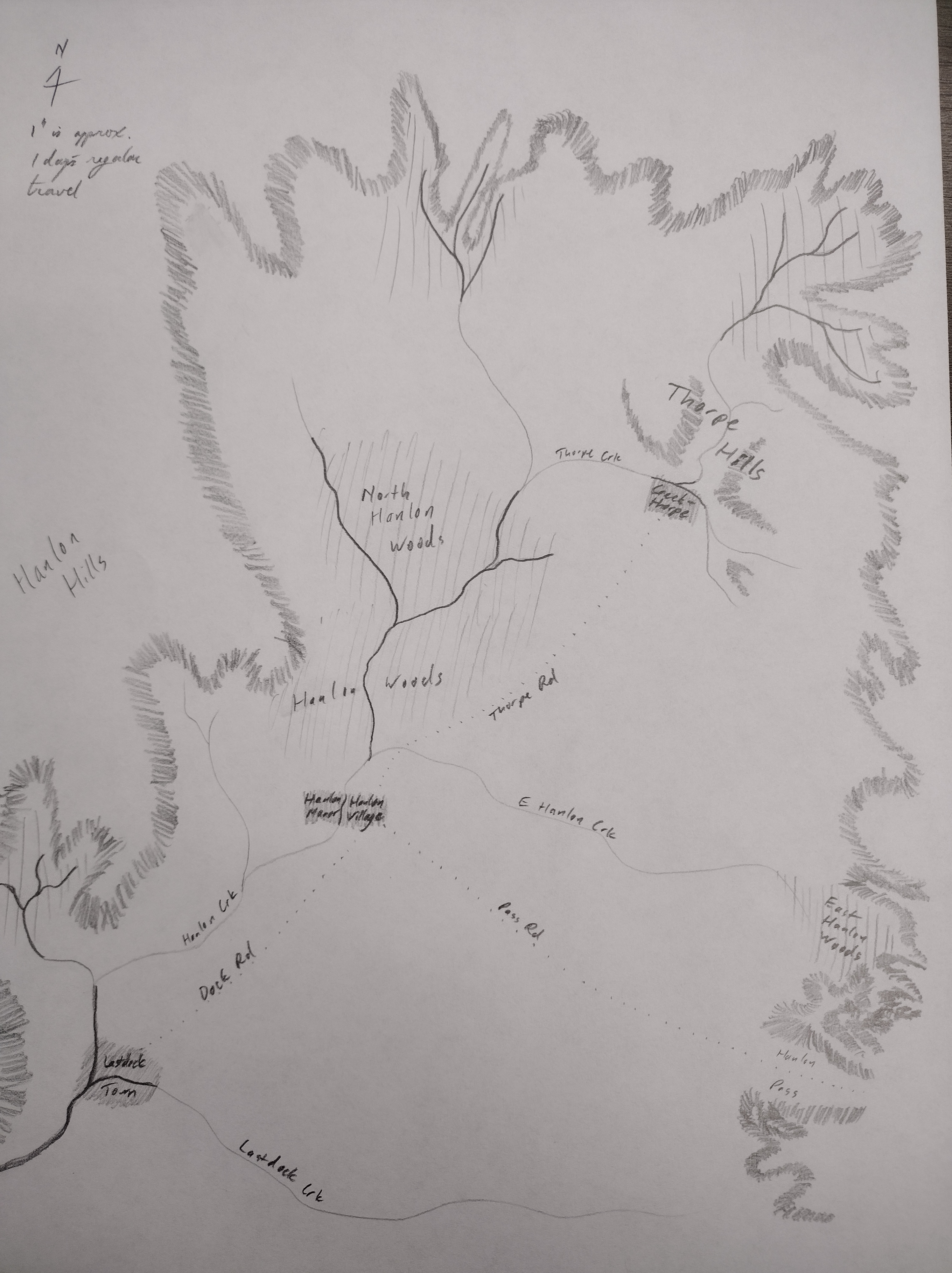
There are arts I do decently, and there are others. Image is mine.
One of the things I did, because I am often helped by doing so, was to sketch out a map of the local area. I am well aware that my pen-hand leaves a lot to be desired, and I am more than a little out of practice as a cartographer; it had been a while since I’d put together materials for a tabletop game, after all. But it was helpful for me, nonetheless, to begin to gesture towards a wider world into which Hanlon Village falls, to have a visual idea of what area is dependent on Hanlon and what Hanlon, in turn, depends upon. And it was helpful for me to have some idea of where shenanigans could take place, as well; hills and woods offer many opportunities for that kind of thing, and having some variety, some options, is a good thing.
I’ll admit to being influenced in what might be called map-making by the maps present in a lot of fantasy novels, mostly following the Tolkienian tradition; Lord of the Rings does it, but then, so do the Chronicles of Thomas Covenant and its successor series, the Wheel of Time novels, the Song of Ice and Fire novels that have managed to make it into the world, and (near and dear to my heart) Robin Hobb’s works. I’m also marked by having grown up in the Texas Hill Country; there have been times I have directly taken from maps of towns and cities in my part of the world to make towns and cities in other worlds, entirely, although I did not directly do so for Hanlon (although there were definitely local features in my mind as I did my sketch.) I’ve also benefited from reading Karen Wynn Fonstad’s works of fantasy cartography, although I’m not in any way claiming the talent or expertise she deployed. I do think it’s important to acknowledge my influences, though, even if I do not live up to their inspiration.
I’ll note, too, that I deliberately did not “fill in all the blanks,” that I left things open and did so on purpose. While I do tend to plan a lot for the games I run, I also know from experience playing and running games that the narrative does not always go as planned. There always needs to be room for players to take their stories in their own direction, and if there is a direction to go, there has to be something in that direction for them to uncover. Admittedly, there is a fair bit of manipulation that can go on; an opponent who had been hiding in a tree or behind a rock can be concealed in tall grass or in a shallow depression. But even aside from that, if the intended plot would move players east and they go west, it’s good to have a west for them to explore–and taking notes can make what is extemporized (again, I make a lot of use of Mackay’s The Fantasy Role-playing Game) more permanent, giving players some agency in creating the world in which their characters exist.
The map was not the only thing I did, of course, and could not be for me to do a decent job running the game. If I was going to send them off chasing something or other, I had to figure out who was doing the sending and what that something or other is…as well as where it ended up being. That much, at least, the map made easier; I had my idea, if one that player actions influenced somewhat. And in my earlier notes, I’d jotted down some ideas about what the something would be: a horn, passed down across generations. As to how it got from where it should be to where it was…I can’t give everything away, you know, at least not all at once.
I’m happy to generate content for your games, original and without AI plagiarism; fill out the form below to get yours started!
Among the many things of which I have made no secret is my long time playing, running, and studying tabletop roleplaying games (TTRPGs). I’ve got a whole tag about them for this webspace, for example, and the subject has popped up in other writing I’ve done, such as the piece linked here. It should be clear at this point, with my having been involved TTRPGs for more than twenty-five years, that I’m fond of them, and it makes sense that, being thus fond, I would want to share with others and bring more people into the hobby. If nothing else, doing so means I have more people to play with, and more people to play with makes it more likely there will continue to be games to play. I delight in the prospect and the (admittedly small shred of) hope for the future it represents.
Shiny math rocks go clack clack clack. Photo by allthings real on Pexels.com
To do a little bit more to advance the cause, as it were, I’ve recently taken up a contract position with my local library. (I even put it on the resume, here.) Given who I am, that I would work for a library should not be a surprise. (Indeed, when I was job-searching, I even put in for a full-time clerking job at another library. It didn’t work out, clearly, but it was one of the few applications I put in that didn’t provoke the “Why would you want this job?” response I got an awful lot.) But that that job is explicitly to run a D&D game for middle-school-age kids might be a bit of one, even if it is entirely welcome. (On my part, it very much is. There are at least a few others who welcome it, clearly, since other kids than mine are enrolled.)
There are details I cannot share, of course. I am still learning names, for one, and even when I learn them, since minors are involved, I’m not going to include that in my reports. Even my own daughter, whose name I do have some right to make free with, gets elided; there’re reasons I refer to her as Ms. 8 in my public writings. And, because it is possible that my players will actually look at my writing here (I should be so lucky as to have the readership!), I’ll not go into details about future plans, even though I have them. But I can, and almost certainly will, report on what happens in the game and with my players, doing so partly to cement my own memories of things, and partly in the hope that what I do will prove useful for others, whether as an example of what to do or as one of what to avoid.
The first session of what is, at least initially, a limited run began with a sort of Session Zero. For those unfamiliar, Session Zero is a preliminary meeting of a gaming group in which comments about basic assumptions to be observed at the table are discussed. Conduct among participants, general expectations about the game, and character formation are common topics, and those got addressed (at least in passing; there’s more that can be said and more will almost certainly need to be said as matters progress); I also gave a bit of a working definition of TTRPGs (for which I borrow from Mackay’s The Fantasy Role-playing Game, which has informed my previous work).
The Session Zero stuff done and time remaining in the planned session–the library can only offer so much space for so long at a time, after all–the players began to enjoy events at the Childsend Festival of Hanlon Village, a manor town in the fief of the imaginatively-named Lord Hanlon. I used Curio Solus’s “Festival Activities” from GM Binder, with a few quick edits for age-appropriateness, finding the games easily accessible to the several new-to-the-game players and manipulable by the few with experience, as well as a way for all of us to start to get a feel for how the system works and how the characters work. The players chose a few carnival games to play, enjoying each and doing well with them, and how they relate each to the others began to emerge before time ran out on the session.
The kids seemed to enjoy themselves, and I was pleased to be able to run an in-person game again. It’d been a while, and while I’m aware of myself as being rusty, I’m also aware of the rust as already starting to break off. Another session is planned for this coming Thursday, and I already know there will be a couple of events to come…which I need to sketch out. It’s a kind of writing I’ve done at length before, albeit in different systems than that in which I’m running a game now (the 2024 version of Dungeons & Dragons, largely for reasons of accessibility); I imagine I’ll find my way clear to doing it, and to giving the kids a good game to play.
I am, of course, open to ideas. If you have them, I’d love to hear them–and if you’d like to get mine a little bit quicker, drop me a line!
I’m happy to write content for you; reach out via the form below to get yours started!
I‘m still out of pocket, as might well be imagined, and I am going to post about what all I’ve been doing while I’ve been away from home. I’ll need to finish up before I do, however, and I’m not done yet. So much said, I did have an idea pop up, and I figured I’d spend some time getting it out down so I can keep track of it for later. Hence what follows.
Really nothing to do with what’s going on… Photo by Ithalu Dominguez on Pexels.com
That I’ve long played roleplaying games, particularly tabletop roleplaying games and their online-forum-based iterations has not been a secret by any means. I’ve written about it in this webspace more than once, after all, and usually in favorable or better terms. I’ve noted, too, that I also run such things, developing milieux and situations in which players can navigate characters to collaboratively tell stories, hopefully such as they’ll recall fondly years later. And like many people who concern themselves with narratives, I often find myself looking for new stories to tell–or to set up.
It’s occurred to me before, and doubtlessly to no few others, that things like trade shows and research conferences offer good settings for such things. By their nature, they draw people together who have common interests but diverse backgrounds and skill sets; they necessarily address questions often in the roots of games, namely “Why would my character be here?” and “Why would these characters be together?” (“You meet in a tavern” is classic for a reason, but it doesn’t necessarily explain a whole lot.)
Too, by their nature, such events are necessarily focused. Most every conference I’ve attended, and I’ve been to more than many folks, has social events and entertainment available, but all of them have had a primary focus and purpose. They’ve had structure that allowed flexibility of approach to it. Roleplaying games operate with a tension between the two; there is and has to be structure by the very nature of the narrative of which the roleplaying game is but one form, but it is impossible to anticipate all player approaches and foolish to disregard most of them. (There’s always the potential for someone to be a jerk…) As with the character-gathering, the narrative focus of a game would reward or be rewarded by setting it in something like a research conference.
Additionally, such events as research conferences, while requiring substantial setup, often handle themselves once they get going. Attendees have clear expectations, and if it is the case that people will violate them, they are yet familiar with them; people know what they ought to do, even if they don’t necessarily do it. Forum-based roleplaying games, by their asynchronous nature, reward setting up events that run themselves; that is, they do well if they set up so that players can do the event without the game’s administrator having to be much involved during the event.
I’m sure there’s more that I could say, and I might could come back to this later on. It may not be scholarly, but not all of my somedays are such…
I’m still happy to write to order for you! Fill out the form below to get your work started!
Among the many things the beginning of 2025 has found me doing is helping to administer another play-by-post iteration of the Legend of the Five Rings Roleplaying Game, about which I’ve made some comments now and again. So much is to be expected, of course; I am a big ol’ nerd, after all. (As if that wasn’t already abundantly clear.) And I have expressed my love of the game more than once previously; it shouldn’t be a surprise that I would go back to something that has given me years of enjoyment when the opportunity presents itself–as it does (in and around occasional platform problems, but those are surmountable).
I’m not running this one (again), but one very much like it. Image from my own records. I think I’ve shown it before.
With the game–which is not mine; I’m helping–I’m reminded of one of the things that I like to do when I set up events such as factor heavily in play-by-post gaming. In such events, players are typically asked to make a series of rolls (experience suggests that three is a good number), usually with some success threshold on earlier ones influencing results on later ones, to arrive at some level of success in the event. Outcomes are then typically compared across participants, with the player doing “best,” as defined in the event, receiving some reward. Such constructions do allow for variety in design and performance, and they can allow players who build characters to do some things well shine while not necessarily preventing victory by those who are less focused.
They can, however, also result in players watching their characters fail the tasks presented to them, and while an occasional failure can (and often does) make for an interesting springboard for narrative–there is an art to failposting, and it is a wonder to see done well–a series of failures becomes disheartening. It becomes even more so when the failures accrue on rolls players build their characters to do well. I know as much because I’ve seen it on both sides, as a player and as an administrator for such games.
Consequently, when I build series of events, series where it can be the case that someone does badly across the lot, I build in what I call a “backhand” prize. In one game, for instance, the focus was on the creation of a series of artistic objects, with the artist performing “best” across the board receiving an exalted social position. Given RPGs, the threshold for victory was clear enough. What I made sure to introduce was a provision that, should a character somehow fail all of their rolls to produce art, the sum of their creations would be strangely harmonious as an installation, with the character in question being lionized in milieu and receiving rewards that would have been helpful had there been other games in that vision of the Legend of the Five Rings Roleplaying Game. (Alas, as happens, real life intervened. That campaign, that series of linked games, ended. But lessons were learned, and good has come from it.)
The game I am helping to run now is ongoing. It is possible that players in it will see what I write. (I hope they will, actually; they will see that I think them a good bunch, and I benefit from wider readership.) So much means that I won’t say whether there is such a prize in the present game or what it is if there is one. But it is the kind of thing I like to do, and I think it is a good idea for others to take up, as well.
Got some game narrative needing attention? I can help! Fill out the form below to get started!




 Elliott RWI