An Older Bit of Roleplaying Game Design?

I‘ve made nothing resembling a secret of the fact that I play tabletop roleplaying games–witness this, this, this, and this for some general examples. Nor yet have I made a secret that much of my involvement in roleplaying games has associated itself with the Legend of the Five Rings roleplaying game (L5R) in its several iterations–as witness this and its antecedents, as well as this and its antecedents, this, this, and doubtless others.

This is what it looks like now.
Banner image from the current owner, Fantasy Flight Games, here and used for commentary.

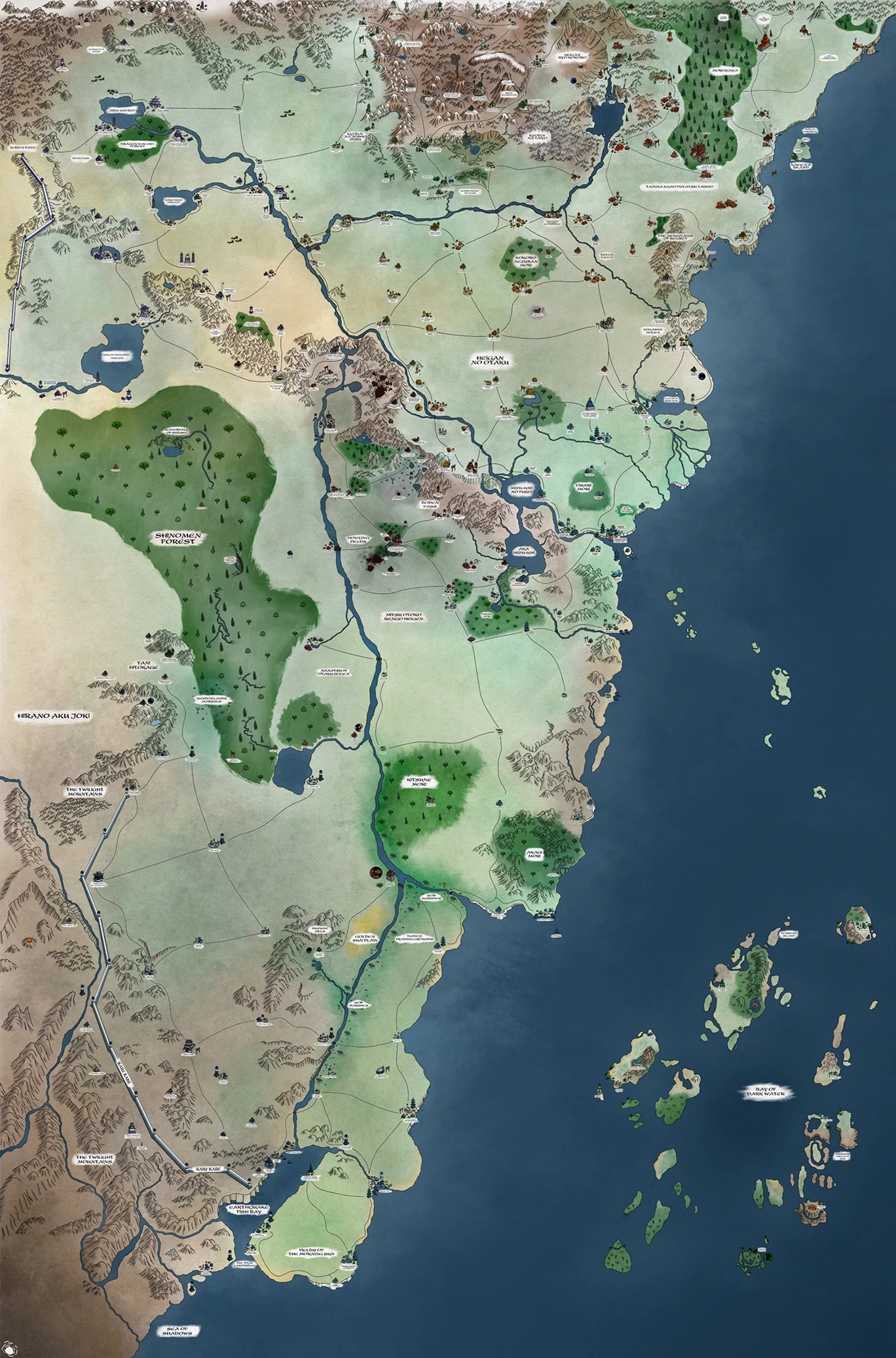
It should be no surprise that, in the years I’ve spent playing L5R that I would spend time running games–and drafting work to help me do so. And, some years ago, when L5R was in its revised third edition (it is in its fifth at the time of this writing), I put together a campaign setting for the game, one I call West of Rokugan. I forget when I started working on it; I recall that I finished it in 2010, and I have learned a lot since that point. (Hell, I’d barely passed my prospectus at that point, and I still thought I’d have the full-time continuing teaching job I had then. Ah, youth!) I had thought that I might be able to move the group I was playing with at the time towards it, but, alas, it never happened.

What did happen was what happens to many roleplaying game groups: the group fell apart. Schedules conflicted, people moved, and somehow, we never did find ourselves in another game. Nor have I been able, in the time since, to get an in-person game going–and the edition of the game has updated twice since, anyway, so the stuff that I’ve got linked above is unlikely to play well with any of the online groups to which I have access.

But I have been thinking about running a game again, and I went back through my files to look at the things that I have done as part of the prep-work for doing so. Looking back over it was…strange; it is the most involved document I’ve compiled other than my dissertation, but it has…issues. Again, I was much younger when I wrote it than I am now, and I’ve learned at least a couple of things since that point.

It’s possible, of course, that I will adapt what I have in the older materials to newer systems. It’s more likely, however, that I will pull some concepts rather than pulling the materials directly. Some things, I remain proud of; others, not so much–but it is good to be reminded, from time to time, of who and what I have been other than in my working life. And it may be that somebody gets some use out of my old efforts; I’d be gratified to learn that it happened.

Could you send a little my way to help through these strange times?

A Rumination on a Roleplaying Game Character

I have made no secret of my long-running play of tabletop roleplaying games (RPGs). Nor have I made it much of a secret that I am currently playing in an online one, another Legend of the Five Rings (L5R) game, if one using an older rules-set than the current. (It’s still one more familiar to me than the current one; RPGs update, partly to make more money, but games continue despite them.) And, as is common, I have a character in that game, one character whose thoughts and deeds I narrate in reaction to the thoughts and deeds of other players’ narration of their characters and to the overall milieu which has been presented. It is, as Daniel Mackay has described it, extemporaneous, rules-assisted, collaborative storytelling, and I have found it to be great fun across years.

Not quite this automated…
Image from Giphy.com.

The game I am playing now has me playing a hunter turning clandestine security operative, and it dovetails with a concept I’ve often turned over in my head, playing L5R. There is a group of purportedly elite guards, and it has long occurred to me that they would be in position to be kingmakers or eliminate rising threats, and it has also occurred to me that their internal affairs analogue would be both present and fearsome. The character I am playing now is working towards becoming such, although that work is not going quite so well as I might like it to. (It’s a common thread with me; I’d like most of my work to be going better.)

The thing is, much about the character is at odds with who I am. There is little clandestine about me; I am open, perhaps too much so, and make little effort to hide. Nor am I so committed to causes as I would need to be to be able to act on their behalf; I am timorous in the main, averse to risk more than desirous of reward. I am certainly not an outdoorsy type, preferring air conditioning and indoor plumbing to open skies and tree-leanin’. (I remain Texan, however.) And I am aware that playing a character is, at best, a fleeting and transitory thing; I know better than to think that my experience in the RPG translates in any way to the real world.

I know that much of the allure of RPGs is escapist. That is, they allow players to inhabit other lives for a time, leaving their own behind. And they are or at least try to be fair, which the real world decidedly does not. And perhaps it is that fairness that I look for as I play, that notion that what happens happens not because the system is set against me, but because my own skills and choices, with some random chance at work, have led to such outcomes. I know I feel forces working upon me that I can hardly name and can worse understand, and I do not think I am alone; the idea that I have some control is a welcome one, time and again, at table or in online simulacra of one.

Dice cost money, even virtually. Aid in indulging my bad habits is welcome.

Yet Another Rumination on Roleplaying Game Design

I have made more than one post speaking to my old nerdy habit of playing tabletop roleplaying games (RPGs), as well as posts regarding my thoughts about designing them. As to the latter, I find myself taking a fair bit of inspiration from Rich Burlew’s The New World series, hosted on Giant in the Playground; I’ve discussed the series elsewhere, as well. In that spirit, then, and working from materials I’ve posted in other places, I offer what appears below.

Image result for big bang
Seems someone had a blast.
Image from Phys.org.

Having noted before that my attempts to develop an RPG worked from sixes, and knowing that one of the things that people tend to do is try to explain the machinations of their observable universe in terms they can understand–usually gods and the like until observational technology allows for other ideas to take firmer hold–it makes sense to me that any RPG milieu in which I might work would offer religious ideas. And since RPGs admit of things that do not necessarily occur in the “real” world, those religious ideas might even have some in-milieu truth to them. That said, I am not necessarily convinced by religious ideologies, myself, and even if I might compose what I call a series of hymns in another webspace, it is not as an act of worship that I do it.

The idea of an anti-worship, though, of a religion that abjures the influence of the gods, is an interesting one. (I admit to being inspired in part by an episode of Star Trek: Deep Space Nine, as well.) If I follow that idea, then, and the earlier materials I’d glossed, then I would seem to need six gods to steer away from whatever people I might focus upon for the RPG milieu. The Stupid God is one against which I have inveighed at length already in what may someday be a collection of verse I would release for publication. (It might be nice to earn a bit of money in such a way.) Such a god, one that revels in and promulgates folly, would seem to be one to abjure, one to send away from the self and towards opposition. The Angry God, which I have also mentioned in other writing I’ve done, would seem to be another; there are certainly things about which to be angry, and there are benefits to being angry at times, but I’ve had a lot of anger in me for far longer than ought to have been the case, and I have not benefited from it.

Those are only two, though, and I do not know that both should be shunned as such; I have no reservations about condemning the Stupid God, for reasons I hope would be obvious, but, again, there are times anger is merited, and the god of such a thing would be useful to have on hand at such times. What to do with the others is not yet clear to me, but it is good to have some idea of how to proceed, of what slots to fill–and there is always room for things to change and grow.

May the Stupid God not claim too much of that room!

Care to contribute some more?

Another Rumination on Roleplaying Game Design

In an earlier post, I make mention of focusing my tabletop roleplaying game (RPG) design efforts on a mechanical system that uses six-sided dice for ease of reference and access. It’s not the only such piece I’ve put together, though; for example, I drafted one on Rich Burlew’s work for another venue, and it is with Burlew’s comments in mind that I proceed. He makes the comment that mechanics and story should interact meaningfully; they should fit together, rather than one being a vehicle for the other or added onto it. Things should make sense together (despite the fact that the broader world does not, not by half). And since narrative requires milieu, and RPGs are narratives, the mechanics need to integrate into the milieu smoothly.

Shiny.
Image from AnimatedImages.org.

That notion in mind, and knowing that I mean to use six-sided dice, I started looking for convenient “natural” sixes. Two emerged in short order: cardinal directions and numbers. The former might seem to be counter-intuitive; as typically represented, the cardinal directions are but four: north, south, east, and west. But up and down are also to be considered, making six principal directions and offering six points of reference: north, south, east, west, zenith, and nadir. It’s obvious upon being pointed out, really, but it’s not often pointed out that I’m aware of, so it seemed a useful beginning point.

The numbering takes a bit more explanation. But if I follow the tendency of RPGs to have human or humanoid player characters–“humans in funny suits,” to borrow one turn of phrase that Burlew is not alone in using–then a five-fingered hand suggests itself. I can count six numbers on one such hand: zero to five. If I add another hand, I can reach thirty-five without working through knuckles, as some finger-counting systems do. And that sketches out a base-six numbering system; zero to five on one hand, then back to zero with a finger raised on the other hand. The place-value even begins to situate itself.

Those two sixes, aligning neatly with six-sided dice, have their own implications. Some move in directions that will bear exploring elsewhere. Some, though, admit of more local treatment. For example, the idea of a body-based numbering system that invokes place-value, which I am told by those who study and teach math was quite a development, suggests that the narrative milieu is one that values arithmetic. It’s a strange thing to have emerge, particularly for the work of someone whose degrees are all in English, and not one that I had expected to emerge.

That’s part of the allure of stories, whether read or narrated along with others and the help of dice, that things emerge from them that had not been expected. There is often comfort in the familiar, certainly, and there is nothing wrong in itself in stories following predictable patterns. But there is something special about new and un-thought-of things popping up out of even basic background work that thrills as a writer. I can hope that, in time, such things will also prove to be to players’ delight.

Care to contribute?

A Rumination on Tabletop Roleplaying Game Design

I have made no secret, of course, that I am and have long been involved in roleplaying games, not only the iconic Dungeons & Dragons, but also Legend of the Five Rings and others. It should come as no surprise, then, that I have thought from time to time about putting together a game of my own; it should also not be a surprise that I have acted on such thoughts in the past. Indeed, my second-to-last undergraduate project was an honors thesis in which I did that very thing, though I did not do it at all well. I was not nearly so gifted an undergraduate as I thought I was, and it shows in how clunky and, well, pretentious the work I did then is.

One way to make it rain…
Image from Giphy.com.

I still toy with the idea, of course. I enjoy playing, and I can’t play unless I have folks with whom to play. And that means I have to make any game I would design accessible to people, both in terms of ease of rules and in terms of cost to play. Playing tabletop roleplaying games can be quite expensive; the rulebooks that typify them are not usually inexpensive, and even if someone can get years of use out of one, the initial outlay is something of a hurdle. I’ve not got a necessarily robust collection of gaming books, and I’ve spend hundreds or thousands on them over the years; those who have more have doubtlessly spent far, far more.

There are dice to consider, as well. One of the most common accoutrements of roleplaying games, dice can be found in extravagant numbers and styles, and they become foci of lore and jealousy, among others. They also become money-pits. My own experience in buying dice–and mine are loyal and good, though not necessarily fancy, as far as such things go–has been to the tune of hundreds of dollars across my time gaming. Again, I’ve gotten years out of them, and I did pick them up a few at a time, but it’s still an investment to get the dice roleplaying games typically demand.

Part of that cost comes from the fact that roleplaying games typically play with different types of dice, not just the cubical dice most familiar, but other sorts typically rendered as Platonic solids plus ten-sided dice. (There are other versions of such dice available, of course; my daughter picked a set that mimics gaming dungeon paraphernalia, for example.) Though they are more and more common now, they are still at a higher price-point, and they are still less accessible than the plain cubical dice that can be gotten at supermarkets and convenience stores.

It is to help get around that concern of accessibility that, when I designed a gaming system, I made sure to base its mechanics in six-sided dice. They are easily had, easily replaced, and familiar from centuries of use in popular culture. And not only as gambling devices, though that is their most common depiction; I remember elementary school math classes that used them for some basic statistics, for example. As such, when I went to set up a system to bring people in, I did so with six-sided dice at the core.

As I’ve found out in the time since, trying to orient other things around sixes has been more of a challenge. But that’s something I can return to later on…

Help fund my bad habits, please!

A Rumination on a Teaching Practice Borrowed from Tabletop Gaming

In a post I recently made to my personal blog, I make reference to some of the teaching and gaming I did as a graduate student. I remember both fondly, at least at this point, and I have done what I can to take the best parts from both into future iterations of my work in the classroom and at the table; I’ve had less success than I might hope, to be sure, but I have still had some success. And some of that success has focused on a single practice that came from the tabletop gaming I administered into some of the teaching I’ve done. It doesn’t always translate into a given class, of course; different courses call for different assignments and different techniques. But that a tool is not universally applicable does not mean it is of no value, and because I think there is some value in the practice–having students overtly commend one another in private reports to the instructor–I think it fitting to spend some time discussing it more formally than my personal blog admits.

Related image
Not atypical, this…
Image from Wikipedia, which I’d not normally use.

To explain the activity a bit: When I was in graduate school, I ran a large tabletop roleplaying game. Normally, such games will have a referee and four to six players; I was the referee, and I had thirteen to fifteen at my table. It was not always a ruly bunch, to be sure; so large a group in which individuals need longish periods of devoted attention tends to go that way. But we got on more or less well, and the players enjoyed what I gave them (I think; please don’t tell me if I’m wrong). And part of that, I think, was that I gave them encouragement to play well–beyond the intrinsic value of participating meaningfully in an ongoing extemporaneous story. For I had each player vote at the end of each gaming session for the player other than themself who had done the best job of playing at the table that night.

By asking them to do so, I encouraged them to more fully inhabit their character and the narrative milieu in which those characters were enmeshed, and to do so in a way that helped the others at the table. And I encouraged them to attend to the performances and participation of others to reward behavior that, through authentically developing and communally-determined practices, was optimal for the group as a whole. In effect, the players came to agree on community standards for behavior and participation, and they looked for ways and reasons to praise one another, rather than make mock of one another as is common at gaming tables and in too many other places in the world.

To apply that idea to classroom practice took a bit of doing. For one, it only works well in group settings, and I tend to shy away from group assignments when I can. My experience, as both student and teacher, has been that one or two group members will do all of the work, while the others coast by on the labors of the diligent. (A rant threatens to emerge; it may do so later.) However, much of the teaching I have done has been of classes that have institutional mandates for group projects (the public speaking class at DeVry was one such; the technical writing class at Oklahoma State University was another).

In the latter, particularly, I had some success with having students report on their group’s and individual group members’ progress in the assigned projects; I made it part of assignment guidelines, requiring them to submit progress reports as daily assignments, so that there was extrinsic motivation to address the tasks. (Most of the students in that course were in another writing class only reluctantly; the extrinsic motivation was needed.) But I noted with some annoyance that, while I would see participation and submission from several group members, I would not see accurate assessment of those participants who weren’t; a few noted to me that they were reluctant to “throw [another student] under the bus,” even when the group’s work as a whole suffered because of such a student.

I understand the impulse, to be certain. I’m not along in having heard that “snitches get stitches and wind up in ditches,” or other words to that effect, and I was not immune to the shame of being a tattle-tale. And, at one level, I was content to let students undercut themselves; if they did not care more about the work and their reward for it, I saw no reason I ought to do so. But, as one of the students who was exploited by group work, I hated the idea of such exploitation continuing even when students had a mechanism to prevent it (part of the students’ grades came from the mutual assessment, so they could have excluded non-participating group members).

When, instead of asking students to identify the group members who had done least, I asked them to identify those who had done most, I saw a much better response rate from them. Additionally, I received much more detailed feedback on student performance from the other students’ perspectives, which was of great help. Some of that did run to specific notes about other students’ non-compliance with the standards of their groups, which also helped me to make the adjustments I needed to make as I oversaw the groups’ work. In essence, it worked in more or less the same way with my students as it had with my players, for which reason I commend the practice to use in other classes.

It is not universally applicable, of course. Not all classes require or admit of group projects, at least not conveniently. And there are courses that operate under stricter institutional mandates, obliging specific assignment sequences and lecture topics. But where it can be deployed, the practice of having students cite and justify each other’s excellence is a useful one.

 Care to send a bit my way?

Sample Assignment Response: A Commentary Essay for ENGL 112 at DeVry University

To continue on from earlier work (here, here, here, here, here, and here), I will do more to round out the assignment sequence expected of the students in ENGL 112: Composition and develop the assignment students in the class are asked to do for their seventh week: a finalized commentary paper. I continue to hope that, despite the errors that are in any work, what I do will help my students and others to better understand what they are asked to do and so help them do it better.

Keep on doing it.
Image from tenor.com.

For the exercise, students are asked to revise their work from the previous week as needed and to add to it the remaining bulk of their papers, bringing their commentaries to a full five pages (1500 to 1750 words) plus title page and references list.  To complete it, I began by opening the document I’d made for last week’s exercise and saving it again as a new file for the final. (Keeping the earlier version separate allows for more radical revision in some circumstances.) Looking over it again, as it had been a few days since I had last done, so, I noted that I still had not settled on a thesis because I was still puzzling through my issue. I noted also that I had addressed appropriation but not appreciation; it was to the latter that I set myself.

I picked up writing where I had left off, moving directly into drafting as I thought through the issue and angle I had set for myself in the earlier work. As I drafted, too, I was able to determine a thesis, which I inserted into the usual place for such statements in first-year composition papers–the end of the introductory paragraph–before ensuring that connection to it sufficed throughout the rest of the text. I also made sure I offered the kind of conclusion to the paper–not filling out the repetitive “tell ’em what you’re gonna tell ’em, tell ’em, and tell ’em what you told ’em” model, but moving ahead from the thesis–I want to see from my students and, indeed, from most of the writing I read.

The content made ready, I reviewed my document for style and mechanics. After making the adjustments that needed making, I put the document into an accessible format, which I present here: G. Elliott Sample Commentary Final. I hope it will help others.

Help me keep doing this, please!

On a Game Recently Ended

I have mentioned that I have been a fan of things at many points in my life, but far less so now than in the past. One of the things of which I have been a fan, and perhaps the closest I come to still being one, is the tabletop role-playing game, particularly Legend of the Five Rings (L5R) in its earlier incarnations. The game is one about which I have written before (notably here), and it is one with which I have been involved since the beginning of my undergraduate years–so for quite some time, now. I have a lot of good memories bound up in playing that game; I had a lot of good times at its tables, and I have made no few excellent friends from them (even if I am not nearly so good at keeping up with them as I ought to be–but that is wholly on me).

When a couple of those friends flagged to my attention a play-by-post L5R game using the older rules-set with which I am familiar, I jumped at the opportunity. It had been quite some time since I was able to take part in such a game, and longer since I was able to do so as a player, responsible only for my one character and her part of interacting with the world rather than for the whole rest of the world (because I have run many games, singly and as part of a team). And I think I did well enough at it; my character found her way into a slow-moving romance that worked out well, as well as distinguishing herself in interesting ways throughout the game, and I, as player, am told that I made the gaming experience better for the people with whom I played. I have to consider it a successful endeavor.

There is a problem, of course–the game ended.

Oh, it needed to do so. It was time. The story that the game was set to tell was told, and the side-stories that the players brought into the game and developed through it concluded–most of them well. There are seeds of more stories to come, of course, and the game itself is but one part of a sprawling narrative into which all of us who took part are, at least in theory, invited. (That I know the person who runs the overall project–and had him playing at my own table for quite a while–helps my chances, I think.) But, as with a good book or a good movie, the fact that the game has ended is something of a sadness. I grew to love the characters even as my character grew to love her peers–some more than others, and one in particular–and I will miss them and the people whose words gave them life on my computer screen and in my mind.

Having read many, many books, though, and seen no few movies, I think I am in position to say that the sense of loss is greater with the game than with those media. For, much as I love any one novel or poem, or as immersed as I get into any movie, or as thoroughly as I have explored the expanded intellectual properties that have emerged from no few of them, or as far into scholarship and study of any of them as I have gone, with none of them have I been as immersed in the narrative as I nearly always am in the RPG–L5R, in particular. As I’ve noted elsewhere, Daniel Mackay writes eloquently and at length about the phenomenon, as does Gary Alan Fine; I think they both have good points to make about the peculiarly interactive story-making of gaming communities and the bonds that form thereby.

Those bonds, more than anything else, I will miss. I can only hope that I can maintain some of them and forge yet more in the times to come.

Sample Final Paper: Shakespeare in Legend of the Five Rings

What follows is a conference paper like that students are asked to produce for the FinPap assignment in my section of ENGL & THRE 3333: Shakespeare: Comedies & Sonnets during the Fall 2016 instructional term at Schreiner University. As with the sample proposalsample exploratory essay, and sample annotated bibliography from which it arises (and which it echoes), its topic is slightly aside from that allowed to the students; rather than treating a single work, it treats a more general Shakespearean reconstruction, looking for what prompts continuance of the Bard in popular culture. Additionally, it deviates from recommendations of composition made to students (although recommended order and obligated content differ–and the latter is addressed). It does, however, adhere to the length requirements expressed to students; they are asked for 2,600 to 3,250 words, exclusive of heading, title,  page numbers, and Works Cited. The paper below is 2,604 words long, assessed by those standards. Its formatting will necessarily differ from student submissions due to the differing medium. How the medium influences reading is something well worth considering as a classroom discussion, particularly for those students who are going into particularly writing- or design-intensive fields.

Set in a fantastical analogue of feudal Japan and China, the Legend of the Five Rings (L5R) is a tabletop gaming property that, across the first two decades of its existence, encompassed a collectible card game, a role-playing game, miniatures wargaming, and more “traditional” table games. (As of this writing, the property is undergoing a transition associated with new ownership. A card game is promised, and a role-playing game is suggested, as being forthcoming, but what connections to earlier incarnations of the property will be in place are unclear.) Each partook of an ongoing, player-driven storyline; that is, while there was an over-arching plotline for the whole gaming property, many of the points of that plot were determined by players, whether explicitly by fiat or through results achieved by victories at major gaming events. The direct and identifiable impact on storyline by players accounted for much of the game’s popularity and the loyalty of its player base. It also commanded a rich and detailed back history for the player-current narratives to emerge from, and that, in turn, included consideration of faux-historical cultural figures frequently derived from documented history and interpretations of it. (Indeed, the name of the game itself derives from Miyamoto Musashi’s Book of Five Rings, and its core rulebook is patterned explicitly on the work; no few other works are brought into the game, not seldom by name in-milieu and out.) One such faux-historical figure, Shosuro Furuyari, is a clear send-up of a particular view on William Shakespeare–one that is, unfortunately, not the most accurate view of the Bard to be found.

The focus of L5R is on the noble classes of the land of the Empire of Rokugan, the aforementioned analogue of feudal Japan and China. As noted in the core rulebook of the L5R role-playing game’s fourth edition (Carman et al., 13-71), the members of those noble classes are divided, for the most part, into various Clans and Families. The mightiest of the Clans, the Great Clans, originally descended from the divine children of the Sun and Moon, and their social roles and overall philosophies derive in large part from their founders. Each of the Clans adopts an animal totem to serve as its dominant heraldic emblem and as an overarching metaphor for the Clan as a whole. One such is the Scorpion Clan, descended from the underhanded Bayushi; its members are the spies and assassins of the Empire–its ninja–those willing to take most any means to get done whatever jobs need to get done, regardless of the stains on their personal honor. They find secrets and keep them, doing much to disguise such truths as may not be palatable or helpful–and as part of their disguising, they maintain extensive groups of actors and workers associated with acting. The set of workers includes no few playwrights, among whom is the figure of Shosuro Furuyari, acknowledged as the greatest dramatist in the milieu-–and a clear incarnation of Shakespeare.

To be fair, the nature of the tabletop role-playing game, even one with as involved a backstory as L5R, precludes full historical development. As it is, the in-game history of Rokugan is only cursorily sketched, more than a dozen centuries of material compressed into forms easily accessed by casual players (who still often find themselves daunted by the scope and extent of the material). That history occupies scores of pages across nearly two dozen books in the fourth edition of the role-playing game, some of which clarify historical circumstances for the benefit of players who wish to work in the deeper history of the game-world–as well as hundreds of other pages in the previous three editions of the game. Although the game texts are supplemented by no few works of fiction, written by the game’s writers and reflecting “official” developments of the storyline, as well as “flavor text” on any number of the associated playing cards, there is still a paucity of evidence upon which to base any assertions about in-game historical figures.

Such evidence as exists, however, serves to associate Furuyari with Shakespeare. For one, the very name of the character connects the Scorpion dramatist to the Bard. The character’s personal name, Furuyari, can be read as furu + yari–and in a language deliberately patterned after (sometimes poorly translated) Japanese. At least one meaning of furu, depending on the transliteration, is “shake,” and at least one meaning of yari is “spear.” The name therefore reads as “shake spear,” a slightly punning reference to the name of the Swan of Avon. The Bard himself was evidently aware of the joke, given what Heather Wolfe reports of his work in securing his family’s coat of arms–a spear emblazoned on the family shield, the family crest an eagle holding a spear upraised in one claw. It is a fitting name for a premiere dramatist in another milieu–how better to be shown as such than to be named with the same name as the first among playwrights?–and its deployment makes clear that the game’s writers are using the figure as a representative of the most famous of all playwrights.

Other evidence functions similarly. For example, one of Furuyari’s best known plays is One Winter’s Snowfall (Wulf et al., 32), the title of which evokes Shakespeare’s Winter’s Tale. Another of his major works, Death of the First Hantei, presents a scene in which many people lie to their liege lord to ease his mind–-but one refuses to do so, noting that he will, indeed, die while the others say he will live forever (Soesbee 28); the scene evokes Cordelia’s refusal to tell sweet untruths to her father early in King Lear. A further work, The Mask, makes much of one Scoprion leader whose identity is open (the Clan as a whole wears masks as a mocking commentary on honesty and public presentations [Wick 33-34], with the Clan leader more obliged to do so than most [Wulf et al., 5]); masking and mistaken identity serve to undergird such of Shakespeare’s plays as As You Like ItTwelfth Night, and The Merchant of Venice. A focus on the topic, then, serves to link the in-game works to the traditionally canonical, thus tying the authors together in some way.

Yet another of Furuyari’s plays is described as “a three-part epic” (“Honest”), calling to mind the Bard’s three plays about Henry IV and Henry V or the triad concerning Henry VI. Still another of Furuyari’s plays is titled Father and Daughter, and the relationship between father and daughter recurs as a plot point in Shakespeare’s corpus, comedies and tragedies both; Much Ado about Nothing, earlier portions of Othello, and the aforementioned Lear are standout examples, but they are not the only ones, by any means. Admittedly, no more than snippets of the texts of the plays are available; although role-playing games are themselves necessarily associated with theater through their performative nature (as is argued at some length by Daniel Mackay), it is not often that full scripts are presented within them. But even that can be read as evocative of Shakespeare, given such theorized lost plays as Love’s Labour’s Won; the corpus ascribed to the Bard is incomplete, so having an incomplete corpus from the foremost Rokugani playwright makes the character mimetic of Shakespeare. There are clear connections, therefore, to be made between the role-playing game’s character and the Swan of Avon.

Unfortunately, the Shakespeare stand-in in L5R is a fraud, a non-existent person used as a cover for others. In its origins, the façade serves to cover over dramatists uncertain of the reception of their plays and as a convenient vehicle for the Scorpion to maneuver into positions from which to gather intelligence (Wick 36). Agrarian feudal societies do not necessarily offer much in the way of entertainment, so traveling groups of performers were likely to be welcomed warmly–and in the hours after the plays and after-parties ended, as the grateful hosts slept, the actors could creep about and find out more than had already been revealed by careful observation and drink-loosened tongues. Later, the returned spirit of a villainous figure–again, L5R is a fantasy game, one whose supplementary materials and player involvement make much of figures of the past that can explicitly and forcefully enter into the game-world of the present–assumes the identity of Furuyari, using the reverence in which the setting holds the (imagined) writer to maneuver into positions of power and influence and thence to attempt a coup against the current rightful rulers. For a time, he stands among the closest advisers of the lord of the Scorpion Clan, only to be exposed–and to confess himself as–a traitor to that lord and to the Empire as a whole (Wulf, “Master”). Subsequently, he actively works to undermine the legitimate authorities of the Empire (Wulf, “Unfinished”). That is, by posing as the playwright, the pernicious antagonist accrues influence that is then put to vile–and objectively evil, in the context of the game–ends. Neither view of the Shakespeare-analogue–and therefore of the Bard, by proxy–is favorable; it is hard to argue that either a traitor or a fraud is venerable.

There is, admittedly, some justification for the game to use a view of the Bard as a fiction in its own fiction. Some scholars hold such views; one such is Donna N. Murphy. In The Marlowe-Shakespeare Continuum: Christopher Marlowe, Thomas Nashe, and the Authorship of Early Shakespeare and Anonymous Plays, she argues that Christopher Marlowe–notable as a playwright and poet for such works as Edward IIDoctor Faustus, and “The Passionate Shepherd to His Love”–is the actual author of those works ascribed to Shakespeare. She bases her view largely on commonalities of linguistic data (such as those featured in an NPR report of 24 October 2016 in which Gary Taylor, co-editor of the forthcoming edition of The New Oxford Shakespeare, discusses Marlowe’s co-authorship of the Henry VI plays) and the lack of reporting about Shakespeare by contemporary gossip-monger Thomas Nashe. Although Murphy’s stated views post-date initial revelations about Furuyari to the L5R player base, they reflect and emerge from a long-standing line of thought among some scholars and members of the general public that “Shakespeare” as Shakespeare is a longer-standing lie, that there was no such man writing poems and plays at the time–and if scholars who take early modern Englishes and their literatures as their specialized field of study can have such thoughts, then game designers working well outside that field can surely be forgiven for sharing them.

Or they can in part. Such scholars as Murphy are decidedly in the minority among those who make early modern Englishes and their literatures their particular areas of expertise; some will sidestep the question of “real” authorship entirely, citing the effect of the plays on prevailing understandings as more important than accidents of whose hand or hands put the words to their pages, while many more will note that Shakespeare was as real as any other author, citing not only the words of other contemporary and near-contemporary authors to do so, but also documentary evidence. And, indeed, the work of which Taylor speaks, work that would seem to support at least parts of Murphy’s conclusions in finding that some of Shakespeare’s work can, indeed, be ascribed to Marlowe, is explicitly presented as belying such assertions as Murphy’s; Taylor flatly states that “Shakespeare was not a fraud. Marlowe did not write all of Shakespeare’s works.” He is not alone in doing so, and as such, even if L5R has made some efforts to reflect scholarly thought (which it has, as the explicit invocation of the works of Georges Polti and Carlo Gozzi [301-08] in the fourth edition of the L5R role-playing game, its list of references included [384], and John Wick’s dedicatory comment to Way of the Scorpion [2] suggest), it has made inconsistent efforts–which is a shame for the game, which has otherwise done much well.

It might also be argued, and with some justice, that L5R is simply a game and that the assertions made in it are not to be taken as representative or directive–and the implications of it are far less so. L5R is a series of games, and there is a disjunction between the world of the game and the world that enfolds the game. Too, the contextual materials the game offers are scanty, as any simulation’s must be. But L5R is also a sprawling narrative, one that has pulled in thousands of audience members across decades, and it is no secret that the kinds of fans associated with tabletop gaming are often intense in their devotion to the objects of their fandom. As Flegel and Roth, Roth and Flegel, and Stein and Busse assert, fandoms take into themselves no small part of those properties of which they are fans, integrating with them in familial, communal ways; what the properties do exerts influence on who its fans are. Thus, what L5R does matters, and if it does things poorly, those things end up mattering.

Additionally, Gary Alan Fine remarks that broader, prevailing social structures are themselves composed of many smaller constituent parts–of which gaming communities are prominent examples, so that what they believe comes to shape how the broader systems of which they partake operate. Further, Teresa Copeland and her co-authors, as well as both Liz Danforth and Kat Werner, assert the utility of the role-playing game to the school and public library, and such experiences as present themselves in schools tend to shape all that follows. Paul Burda and Mark Silcox both independently argue that the role-playing game merits serious scholarly consideration, advancing their views for different reasons but to the same end–an end that moves aside from common complaints of the uselessness of academic studies, embedding gaming into what continues to happen in mainstream culture far removed from the tabletop. Finally, Stéphanie Daniau makes the case that role-playing games have a transformative power that enables more fully realized humanity, which makes their content potentially foundational to human experience. For L5R to put forth a view of Shakespeare that holds him a fiction–and one easily exploited for nefarious purposes–is therefore dangerous, even if the view is occluded and partial. That a thing works subtly and through suggestion does not mean it does not work, after all, as the victims of any number of half-heard rumors can attest.

Even with its problems of execution, though, L5R does engage with Shakespeare–and not only in Furuyari; for example, the plot of a foregrounded scene from a work of prominent in-world fiction closely mimics the final scene of Taming of the Shrew, highlighting a wager of obedience although taking it far further in the game than the Bard takes his characters on the stage (Wick 15-17). That it does so in Furuyari and elsewhere is itself an important thing. Among others, it reaffirms the central place of Shakespeare to the narrative communities that have succeeded him. It shows that the Swan of Avon still swims through the currents of popular consciousness in the English-speaking world, even in those eddies which may be thought to be far removed from the main stream, and it offers promise that the utility of the Bard and studies thereof are far from exhausted. More is being done in the prevailing cultural consciousness with Shakespeare, so more is yet to be done with what is being done, and both such mores offer no small hope for those who will continue to undertake academic study of the humanities.

Works Cited

  • Burda, Paul. “Roll a D20 and the Author Dies.” From Text to Txting: New Media in the Classroom, edited by Paul Budra and Clint Burnham, Indiana UP, 2012, pp. 1-14.
  • Carman, Shawn, et al. Legend of the Five Rings Roleplaying Game, 4th ed., Alderac Entertainment Group, 2010.
  • Copeland, Teresa, et al. “Three Different Paths for Tabletop Gaming in School Libraries.” Library Trends, vol. 61, no. 4, 2013, pp. 825-35. Project Muse, doi.org/10.1353/lib.2013.0018. Accessed 7 November 2016.
  • Danforth, Liz. “Gender and Games.” Library Journal, vol. 136, no. 13, 2011, p. 53. Academic Search Complete, search.ebscohost.com/login.aspx?direct=true&db=a9h&AN=64501689&scope=site. Accessed 7 November 2016.
  • Daniau, Stéphanie. “The Transformative Potential of Role-Playing Games–: From Play Skills to Human Skills.” Simulation & Gaming, vol. 47, no. 4, 2016, pp. 423-44, doi.org/10.1177/1046878116650765. Accessed 7 November 2016.
  • Fine, Gary Alan. Tiny Publics: A Theory of Group Action and Culture, Russell Sage Foundation, 2012.
  • Flegel, Monica, and Jenny Roth. “Legitimacy, Validity, and Wriitng for Free: Fan Fiction, Gender, and the Limits of (Unpaid) Labor.” The Journal of Popular Culture, vol. 47, no. 6, 2014, pp. 1092-1108.
  • “An Honest Ant.” Kaze no Shirowww.kazenoshiro.com/kazenoshiro/1/hhorant.php. Accessed 5 October 2016.
  • Mackay, Daniel. The Fantasy Role-Playing Game: A New Performing Art, McFarland, 2001.
  • Murphy, Donna N. The Marlowe-Shakespeare Continuum: Christopher Marlowe, Thomas Nashe, and the Authorship of Early Shakespeare and Anonymous Plays, Cambridge Scholars Publishing, 2013.
  • Roth, Jenny, and Monica Flegel. “It’s Like Rape: Metaphorical Family Transgressions, Copyright Ownership, and Fandom.” Continuum: Journal of Media & Cultural Studies, vol. 28, no. 6, 2014, pp. 901-13, http://dx.doi.org/10.1080/10304312.2014.964175. Accessed 29 September 2016.
  • Shakespeare. As You Like ItThe Necessary Shakespeare, edited by David Bevington, 4th ed., Pearson, 2014. pp. 150-89.
  • —. King Lear.The Necessary Shakespeare, edited by David Bevington, 4th ed., Pearson, 2014. pp. 656-709.
  • —. The Merchant of VeniceThe Necessary Shakespeare, edited by David Bevington, 4th ed., Pearson, 2014. pp. 74-112.
  • —. Much Ado about NothingThe Necessary Shakespeare, edited by David Bevington, 4th ed., Pearson, 2014. pp. 113-149.
  • —. Othello, the Moor of VeniceThe Necessary Shakespeare, edited by David Bevington, 4th ed., Pearson, 2014. pp. 605-55.
  • —. The Taming of the ShrewThe Necessary Shakespeare, edited by David Bevington, 4th ed., Pearson, 2014. pp. 2-41.
  • —. Twelfth Night; Or, What You WillThe Necessary Shakespeare, edited by David Bevington, 4th ed., Pearson, 2014. pp. 190-226.
  • —. The Winter’s TaleThe Necessary Shakespeare, edited by David Bevington, 4th ed., Pearson, 2014. pp. 802-44.
  • Soesbee, Ree. Winter Court: Kyuden Seppun, Five Rings Publishing Group, 1999.
  • Stein, Louisa, and Kristina Busse. “Limit Play: Fan Authorship between Source Text, Intertext, and Context.” Popular Communication, vol. 7, 2009, pp. 192-207, http://dx.doi.org/10.1080/15405700903177545. Accessed 29 September 2016.
  • Taylor, Gary. Interview by Robert Siegel. “Christopher Marlowe Credited as Shakespeare’s Co-Author on Henry VI Plays.” All Things Considered, NPR, 24 October 2016, www.npr.org/2016/10/24/499199341/christopher-marlowe-credited-as-shakespeares-co-author-on-henry-vi-plays. Accessed 7 November 2016.
  • Werner, Kat. “Bringing Them In: Developing a Gaming Program for the Library.” Library Trends, vol. 61, no. 4, 2013, pp. 790-801. Project Muse, doi.org/10.1353/lib.2013.0015. Accessed 7 November 2016.
  • Wick, John. Way of the Scorpion, Five Rings Publishing Group, 1998.
  • Wolfe, Heather. “Shakespeare Coat of Arms Discovery.” Folger Shakespeare Library, www.folger.edu/shakespeare-coat-of-arms-discovery. Accessed 3 October 2016.
  • Wulf, Rich. “Unfinished Business, Part II.” Kaze no Shiro, 2016, www.kazenoshiro.com/2008/10/06/unfinished-business-part-ii/. Accessed 4 October 2016.
  • —. “Master of Secrets.” Kaze no Shiro, 2016, www.kazenoshiro.com/2008/08/15/master-of-secrets/. Accessed 4 October 2016.
  • Wulf, Rich, et al. Secrets of the Scorpion, Alderac Entertainment Group, 2003.