Sample Diagnostic Exercise: An Entering Hope

As noted here, the students in my Fall 2016 section of ENGL 1301: Rhetoric & Composition at Schreiner University were asked to complete a diagnostic writing exercise during class on 26 August 2016. My usual practice (although I am not always able to follow it) is to do the assignments I give my students, so, as the students wrote their diagnostic exercises, I wrote to the same prompt. That prompt and my response thereto are below.

The Prompt

One motto of Schreiner University, that long displayed at the main entrance, is “Enter with hope. Leave with achievement.” With what hope do you enter Schreiner? Why do you harbor it? How do you think to enact it?

The Response

Like most or all of the students in my section of Rhetoric & Composition, I am new to Schreiner University; I grew up in Kerrville, to be sure, but I went elsewhere for my college coursework. As I return to the Hill Country, though, and to working in Kerrville, I am struck anew by the idea of entering the Schreiner community with hope—and I do have several hopes as I begin my work at the campus. Perhaps chief among them is that I will do that work well, but that would be true of any job. More specific to my work at Schreiner University is that I hope to make a new beginning for myself, primarily as a professional, but also as a person.

I have been in need of a new professional beginning, to be sure. For one thing, more than one of my previous jobs employed me on term contracts, and those terms ended without promise or hope of renewal; at the level of simple employment, then, I needed to make a new beginning. At a deeper level, though, I realize that I had grown into a mixture of complacency and, I am sorry to say, disdain for the work I had been doing at one place. (The other was much better, although the certainty of my limited term made engaging more difficult than it might otherwise have been.) I make no excuse for it; I have no excuse for it. I acknowledge my failure to commit to my earlier work as much as I could have—and maybe ought to have—done, but that does not mean I cannot also recognize that a change was needed. And it does not mean that I do not recognize I was in a bad place, mentally and emotionally; I was disconnecting not only from much of the work I was doing, but also from family and friends—and many of my colleagues did become friends—and from most of the things in which I had taken delight. So I suppose my need for a new personal beginning emerged alongside the need for a new professional beginning.

Schreiner offers me hope that I can find such beginnings again. When I interviewed for my position, I was welcomed warmly and eagerly, and I have continued to be welcomed each time I have come to campus. Faces smile when they see me here, rather than falling into frowns or turning away, and I find myself smiling in return—which is not something I was prone to doing before coming here. A new instructional term has gotten underway, and I am pleasantly surprised to see my classes holding all of the students they are supposed to; it is not something that has often happened for me before. And the upbuoying that I feel as I come onto campus follows me as I leave it; I have gone home tired, but it is the kind of tired that follows work done well and diligently rather than the tiredness of being leached of vitality and plodding along despite it. It is a kind of tired that allows me still to smile at my wife and daughter when I arrive home, rather than collapsing in on myself and walling out all that I can. It is a kind of tired that bespeaks and ongoing hope for a new beginning fostered by the simple fact that it seems to be realized as I walk onto the grounds, from building to building, and from class to class.

I hope it will endure.

Sample Student’s Own Question/Researched Paper: Why Not Have a Rhetoric Requirement among UL Lafayette PhD Students in English?

What follows is a conference-length papers such as my students are asked to write for the SOQ assignment during the Spring 2016 instructional term at Oklahoma State University and the ResPpr assignment during the Spring 2016 instructional term at Northern Oklahoma College. As is expected of student work, it treats an issue of its writer’s curriculum. It also adheres to the length requirements expressed to students (they are asked for 3,100 to 3,400 words, exclusive of heading, title,  page numbers, and Works Cited entries; the sample below runs to 3,116 words, exclusive of its own end-of-text citations), although its formatting will necessarily differ from student submissions due to the differing medium. How the medium influences reading is something well worth considering as a classroom discussion, particularly for those students who are going into particularly writing- or design-intensive fields.

Note that the paper below follows from earlier activities at both the University and the College, serving generally as a later version of them, and so it will make free use of materials developed in response to those activities.

Among the many things of which I am proud is that I hold a doctorate in English from the University of Louisiana at Lafayette (ULL). Earning it required me to sit for no few hours of coursework past my Master of Arts degree and to complete a dissertation. It also obliged me to pass a series of comprehensive exams. Those exams are described by the ULL English department in its online “English Graduate Student Handbook” as consisting of four five-hour on-site tests taken in one or two semesters and spread across four of the following areas of inquiry: English literature to approximately 1500 CE, early modern English literature, Restoration and Eighteenth-Century English literature, Nineteenth-Century British literature, British literature from the twentieth century forward, American literature to approximately 1900 CE, American literature from approximately 1900 CE, literary theory, rhetoric, linguistics, and folklore; an option exists to sit for one exam in an open topic that must be proposed by the student and approved by the Department on a case-by-case basis. (My own were in early British literature, early modern English literature, early American literature, and contemporary fantasy literatures.) The exams reinforce the avowed generalist nature of the program, seeking to equip students to research and teach across a number of fields, but a problem arises when that theory encounters predominant practice. As Holly Hassel and Joanne Baird Giordano note in a 2013 CCC article, most of the teaching done at the collegiate level is by non-tenure-track faculty, reaffirming comments from Mike Palmquist and Sue Doe in a 2011 issue of College English. Also, as Brad Hammer notes in a 2012 CCC commentary, most of the teaching non-tenure-track faculty do is in first-year composition. If the curriculum, encapsulated by the comprehensive exams, is meant to equip its graduates to enter into the academic job market, then it would be sensible for it to require coursework in rhetoric and composition as it does for literature; per the “English Graduate Student Handbook,” all students must take at least two examinations in literature, regardless of their concentration or emphasis. The same is not true for rhetoric, however, and it defies sense to think there is no reason there is no rhetoric requirement among PhD students in English at ULL. The most likely primary reason–because there are doubtlessly many contributing factors–inheres in concerns of logistics.

It is, admittedly, tempting to try to ascribe the lack of a rhetoric requirement instead to perceived disciplinary status. There is a prevailing tendency among institutions of higher learning to regard rhetoric and composition as service disciplines. That is, rhetoric and composition are held not so much to have their own distinct identity, but to exist to enable other disciplines to do the work they do. Hammer makes the point, as do Hassel and Giordano; both pieces speak to the relegation of the experience most have with rhetoric and composition to lower hierarchical levels. This is reinforced by dominant teaching practices, which assign the common classes in rhetoric and composition–first-year composition classes–to the least experienced instructors–typically second-year graduate students, irrespective of their own concentrations within English studies. My own teaching at ULL was of such a kind; while I did teach first-year courses throughout my attendance at that institution, I began to do so after completing but one year of graduate school. I was hardly atypical in that (although I might have been so in coming into graduate work with some formal teaching experience already), and the collective experience argues that the teaching of rhetoric and composition is devalued. If it is devalued, then a lack of a rhetoric requirement in doctoral examinations makes sense; the exams emphasize areas of study, and the devalued does not generally receive emphasis.

While such a thing might be true in other English departments, however, it is not at all likely to be the case for the ULL English Department. Many of the faculty list “rhetoric” or some convenient variation thereof as a principal research and teaching interest; the list of graduate faculty in the “English Graduate Student Handbook” identifies four of the 25 members included thereupon as explicitly claiming to be rhetoricians, more than any single other identification (taking the specific variations of “creative writing” listed as each constituting its own area). The more general faculty webpage identifies another member of the graduate faculty, one who does not list “rhetoric” as an interest on the graduate faculty list, as the first-year writing director, which position necessarily carries a strong professional interest in rhetoric and composition. Further, the general faculty list identifies as interested in rhetoric and composition four other members of the teaching corps in the ULL English Department–in addition to several others whose research and teaching interests are not listed and who may well therefore be rhetoricians by training. (Several faculty have been added to the roster since I completed my studies at the institution, so I cannot speak to their interests.) Additionally, several of the English faculty are prominent in rhetoric and composition studies more broadly. Clancy Ratliff, for example, is highly placed in the National Council of Teachers of English, which body concerns itself greatly with rhetoric and composition, and James McDonald, a former head of the department, has contributed much to prevailing rhetorical study. It is not to be expected that such people will devalue rhetoric and composition as a field of study; it is not to be expected that disciplinary bias argues against requiring all PhD students in English at ULL to sit for a comprehensive exam in rhetoric.

Rather the opposite of disciplinary or departmental disfavor would seem to be in place, which demands another explanation entirely–and logistical concerns seem the most likely culprit for obliging members of the professoriate to set aside their own areas of interest. And they are substantial as regards comprehensive exams. For one thing, there are interdisciplinary standards and expectations that apply to the institution of the comprehensive exam as a whole. Surveys of comprehensive exam practices conducted by Robert E. Nolan; Nicole Ponder, Sharon E. Beatty, and William Foxx; and Joseph A. Schafer and Matthew J. Giblin, among others, note that a scant few forms of exams are found in practice; the surveys work across disciplinary boundaries, which makes all the more compelling the idea that the exams must happen, and that they must happen according to particular formulas. (Notably, however, Ponder, Beatty, and Foxx identify only one program that eschews the comprehensive exam altogether [233].)  The idea receives reinforcement by the notion that the comprehensive exam serves as rite of passage, a ritual that must be performed before participants can be recognized as peers in intellectual inquiry. Nolan speaks to the issue (39, 42); as do Ponder, Beatty, and Foxx (230); as well as Schafer and Giblin (277, 284). Both a 1987 piece in The American Sociologist by Cynthia Negrey and a 2015 piece in Arts & Humanities in Higher Education by Sara Scott Shields explicate the ritual aspects of the comprehensive exam in more detail, pointing to the enduring concept of the comprehensive exam as a thing that must be done in particular ways across disciplines to ensure the very identity of the intellectual as an intellectual. Such a concept tends towards making changes to forms difficult, which may account for some part of the non-adjustment of the ULL PhD comprehensive exams in English to account for current employment demands.

More concrete a reason for maintaining comprehensive exams, as well as one more frequently attested, is to allow students to demonstrate their mastery of the existing work done in a given field. Since the doctorate, particularly the PhD, is a research degree, one whose holders are expected to generate new knowledge, that it would oblige those who seek it to demonstrate such mastery is sensible. Again, scholars across disciplines speak to the issue (Nolan 41-42; Ponder, Beatty, and Foxx 227, 229-30; Schafer and Giblin 277, 284), situating it as one prevalent in the academy broadly. Changing the comprehensive exams therefore potentially registers as a possible lowering of standards for graduates, something that any academic unit will be chary of inviting; humanities departments such as the ULL English Department, which face a prevailing social onus (the jape of “I have a degree in English; would you like fries with that?” comes to mind, despite the many problems attendant on it), will be even more likely to look askance at any adjustment that might make them look less rigorous. This is not to say that including rhetoric as a required area of examination for ULL PhD students in English would be a lowering of standards–quite the opposite is likely to be true, as is noted below–but it is to say that it might appear to be so as looked at by those outside the field who exert unfortunately disproportionate influence on the allocation of resources to the Department and whose views must therefore be considered. (Indeed, recent problems with funding of Louisiana public universities highlight the immediacy of the problem. In February 2016, Louisiana announced that a funding program upon which students and the institutions that serve them rely would be suspended, as Brock Sues reports for WBRZ in New Orleans. Rebekah Allen, writing for The Advocate, reports that universities would be expected to absorb any costs incurred. Outside concerns about funding therefore loom large.) Any change, even one that would likely be for the better, thus must be approached with caution–if it can be safely approached at all.

As noted above, requiring students to take a comprehensive exam in rhetoric would, despite potential appearances, be an increase in their workload, as well as that of the faculty involved in the examination process. The additional area requirement would oblige many students to stretch their areas of study further than the generalist curriculum in place in the ULL PhD program in English already demands. I would not have been able to focus my area of endeavor even as much as I did were there a rhetoric exam requirement in place when I sat for exams, for example, and I often experience the sense of being insufficiently rigorously trained in my primary area of study (hence my eagerness to remain in practice through certain classroom activities, such as the riddle quizzes that have appeared in my teaching and that are discussed in an older set of teaching materials [“About”]). I was not atypical in seeking to align my exam areas or the areas of intellectual inquiry they represent. Since comprehensive exams purport to have students demonstrate mastery of the literature in a given field, asking for an additional area of examination that might well be markedly dissimilar from the areas students are already studying intently presents a formidable challenge to students who are already asked to do a substantial amount of work to earn their degrees. While it might well be argued–and with some justice–that those who seek doctorates should be able to handle many intellectual challenges, it is also true that an exam that covers one thousand years of literature in a minimum of three languages (Old English, Middle English, and Latin), or another that asks for several hundred years of material that could be in three other different languages (Spanish, French, and modern English), already presents a formidable challenge. Adding to it would doubtlessly occasion comment, and unfavorable comment, from the students who would have to face such an exam; given the work that is done by graduate students, helping faculty with their own research and teaching no few classes, there is some incentive to keep them content. Since imposing additional requirements would vitiate against that contentment, it suggests another type of logistical challenge to adding a required exam in rhetoric to what students in the ULL PhD program in English face.

One such additional requirement would be an added burden of coursework. Presently, PhD-seekers in the ULL English Department are obliged to take a gamut of courses to meet distribution requirements, per the “English Graduate Student Handbook,” courses that allow them to fulfill the generalist mission of the program. Implicit in the description of the coursework is that the courses lead up to and help prepare students for their comprehensive exams, the completion of which must precede the work to develop new knowledge conducted in the dissertation. For students to be able to successfully complete their dissertations, however, they must generally focus their attentions reasonably narrowly; again, my own exam spread is not atypical, as I am given to understand it. (I remain in contact with a number of people who have successfully completed the PhD program in English at ULL, and in focal areas other than mine. The discussions, informal in nature, corroborate my own experience reasonably well.) For many students, the addition of a rhetoric exam requirement would prove distracting from their intended foci, potentially hampering their ability to conduct the sustained research and investigation that a dissertation in the humanities demands–for while many might argue that poring over texts is easy, poring over hundreds of years of texts or the thousands of years that rhetorical study would seem to oblige quickly becomes quite the demand. Again, then, the added burden is one likely to occasion unfavorable comment, making it something that must be approached carefully if at all. It becomes something of a logistical concern therefore, one not necessarily easily treated and so one that suggests being set aside in favor of more immediate concerns.

Another such concern suggests itself, although one for the faculty more than for the students. As noted above, there is a strong implicit expectation that students who will examine in an area of inquiry will take courses in that area, taking the time not spent in meeting distribution requirements to cement their knowledge and understanding of those sub-fields in advance of demonstrating that knowledge and understanding. Obliging a rhetoric exam would therefore prompt more students to take courses in rhetoric and composition–wherein lies some difficulty. Graduate courses, because they are more intense due to the higher level of study and the increased depth of inquiry prompted thereby, demand more faculty involvement than almost any undergraduate class. (Directed independent studies at the undergraduate level, as well as undergraduate thesis work, are the exceptions.) This means that they must necessarily enroll fewer students–a need more emphatic for rhetoric classes, whose very subject matter is argumentation, such that they will demand more display of argumentative technique, demanding more time and effort to assess than many other classes might. That is, while a literature class might well ask for two papers (conference- and seminar-length, or 10- and 20-page pieces), supplemented by discussion and perhaps an exam (although the last is not necessarily common, in my experience), a class in rhetoric will be likely to demand persistent writing–and so persistent assessment from faculty. If a graduate seminar has a maximum enrollment of, say 15 students (which number seems a bit high), then a literature seminar can expect to see the professor review some 30 pages per student, or some 450 for the class–and the professor is likely to read graduate work with greater intensity and higher expectations than undergraduate work will receive. A rhetoric seminar might well expect twice that–and professors rarely teach but one graduate seminar in a term.

Even if faculty are willing to bear the brunt of student ire–and they may well be, particularly since an exam and concomitant coursework in rhetoric would be helpful for those going into the dominant academic job market–they may well not be willing to take on yet more burdens than they already carry with their current teaching loads, service obligations, and the calling to research which many feel. Increasing class sizes will not work for the reasons noted above, and keeping matters as they are in terms of enrollment would also be ineffective; class size caps would ensure that students are delayed in completing their degrees, which has deleterious effects on individual students (Nolan speaks thereto), as well as on programs, as completion rates and times factor into how programs are assessed and valued. The simple solution to the issue of workload and increased enrollment–bringing in additional faculty–runs afoul of the budgetary concerns that are always present but particularly prominent at public universities in Louisiana in 2016. It might well also begin to introduce difficulties at higher administrative levels; the PhD program in English at ULL is explicitly generalist, and bringing in several additional rhetoric and composition faculty at the level they would need to be introduced–graduate faculty designation is a separate thing, markedly subject to administrative shenanigans, as my experience has shown me–would begin to argue that the program is adopting a rhetorical focus. Such adoption might lead to the perception that the program is duplicating other institutions’ works–even if ULL is the only institution in the University of Louisiana system that offers a doctorate in English (Elliott, “Sample”), there are other public school systems in the state and other institutions available. Access to such a thing through other venues might well suggest that the ULL program is redundant and can be eliminated therefore. It is not something that would be good to see for the faculty, understandably, nor yet for those who have yet to complete their courses of study or who have already done so. Another systemic concern that argues against requiring an exam in rhetoric, useful though it would be, thus presents itself.

The kinds of logistical challenges that attend on requiring PhD students in English at ULL to sit for a comprehensive exam in rhetoric are formidable, certainly, and facing them will take no small degree of political will at the institutional level and above. As the only member of the University of Louisiana system to grant a doctorate in English and one of only three in its athletic conference to do so (Elliott, “Sample”), it does not face much competition, and so it may not have much immediate reason to change. But it does have long-term reasons to adjust how it prepares its students. The more of its graduates who can successfully enter the academic workforce, or who can successfully pivot into the kinds of professional writing demands of the emergent workplace, the more attractive ULL and its English Department will both be, which cannot help but conduce to the long-term health of the organizations. Obliging PhD students in English to sit for an examination in rhetoric–and to take the courses that such an examination effectively demands–will help in both cases, suggesting that the change, although difficult, is one well worth making.

Works Cited

  • Allen, Rebekah. “Gov. John Bel Edwards on Radio Show: ‘I can’t guarantee TOPS will be fully funded next year.'” The Advocate. Capital City Press, 12 February 2016. Web. 5 April 2016.
  • Elliott, Geoffrey B. “About Riddles.” Geoffrey B. Elliott’s Teaching Blog. Geoffrey B. Elliott, 11 October 2012. Web. 5 April 2016.
  • —.”Sample Infographic Portfolio Assignment: Context to Answer a Question about the Comprehensive Exams for UL Lafayette PhD Students in English.” ElliottRWI. Geoffrey B. Elliott, 1 March 2016. Web. 1 April 2016.
  • Hammer, Brad. “The ‘Service’ of Contingency: Outsiderness and the Commodification of Teaching.” CCC 64.1 (September 2012): A3-A7. Print.
  • Hassel, Holly, and Joanne Baird Giordano. “Occupy Writing Studies: Rethinking College Composition for the Needs of the Teaching Majority.” CCC 65.1 (September 2013): 117-39. Print.
  • Negrey, Cynthia. “How I Demystified Academe and Got a PhD.” The American Sociologist 18.1 (Spring 1987): 58-62. PDF file.
  • Nolan, Robert E. “How Graduate Students of Adult and Continuing Education Are Assessed at the Doctoral Level.” Journal of Continuing Higher Education 50.3 (Fall 2002): 38-43. PDF file.
  • Palmquist, Mike, and Sue Doe. “Contingent Faculty: Introduction.” College English 73.4 (March 2011): 353-55. Print.
  • Ponder, Nicole, Sharon E. Beatty, and William Foxx. “Doctoral Comprehensive Exams in Marketing: Current Practices and Emerging Perspectives.” Journal of Marketing Education 26.3 (December 2004): 226-35. PDF file.
  • Schafer, Joseph A., and Matthew J. Giblin. “Doctoral Comprehensive Exams: Standardization, Customization, and Everywhere in Between.” Journal of Criminal Justice Education 19.2 (July 2008): 275-89. PDF file.
  • Scott Shields, Sara. “Like Climbing Jacob’s Ladder: An Art-Based Exploration of the Comprehensive Exam Process.” Arts & Humanities in Higher Education 14.2 (April 2015): 206-27. PDF file.
  • Sues, Brock. “Budget Concerns Cause State to Temporarily Suspend TOPS Payments.” WBRZ.com. WBRZ, 11 February 2016. Web. 5 April 2016.
  • U of Louisiana at Lafayette Department of English. “Current Faculty and Staff.” U of Louisiana at Lafayette Department of English. U of Louisiana at Lafayette, 8 December 2015. Web. 1 April 2016.
  • —.”English Graduate Student Handbook.” U of Louisiana at Lafayette Department of English. U of Louisiana at Lafayette, 23 September 2015. Web. 5 April 2016.
Sample Special Exercise: No Horsing Around–I’m Fighting a Duck

What appears below is a response to the Special Exercise (SpEx) assignment required of the students enrolled in my ENGL 1213: Composition II classes during the Spring 2016 instructional term at Oklahoma State University. Circumstances surrounding the SpEx allowed students to do a fair bit of preparation for it; I have availed myself of similar opportunities by setting up the initial essay materials (such as this prefatory blurb), but I composed the actual text of the response (below) in roughly the same amount of time allotted to the students. I try to model the behavior I want to see.

I have studied Japanese martial arts since I was twelve years of age. Although my training in them has been inconsistent, it has spanned more than two decades and several styles: what is currently taught as taiho-jutsu, Kodokan judo, and Aikikai aikido. Consequently, I entertain the conceit that I have some idea what I am doing on the mats and, although I hope never to put it to the test, in an actual fight. Owing to that conceit, I assert that I would rather fight a single horse-sized duck than 50 duck-sized horses, if ever such a situation were to arise.

This does not mean I do not think I would do well against the horses. A decently-sized duck is perhaps a foot tall, a foot and a half long, and maybe three-quarters of a foot wide. Scaling down a horse to such a size would make what is normally a formidable animal far less so. It would still be able to kick, to be sure, but the kicks would be of far less power, driven by greatly reduced muscle mass, and although the similarly shrunken hooves would focus that force, it would be able to be delivered only to my legs and feet, perhaps up to just above the knee. Bites would be similarly restricted in power, scope, and range. Having studied judo, with such foot-sweep and -reap techniques as kouchi garide ashi haraihiza garuma, and osotogari, I know that I am well able to endure abuse to the parts of my body likely to be affected–and to press on despite the abuse. In brief, I would be well able to endure what each horse could deploy against me, which would help me to fight successfully.

The horse would not be alone, however; 50 such animals would be arrayed against me, and any fight against multiple opponents is necessarily more complicated. Training in Aikikai aikido has shown me the truth of the assertion. But it has also allowed me tactics to use in such situations. Continual movement, so that the bulk of attackers cannot rush on at once, is key, and even if I do get cornered, there are only so many attackers that can reach me at once. More than a few will get in each other’s way, allowing me an avenue for reprisal. It might well be a brutal one, in which I use my superior size (for I am far larger than a duck-sized horse) to seize one attacker to use as a weapon against the others, adding (admittedly sickening) blows from above to the kicking and stomping that fighting such smaller opponents suggests.

Fighting the duck would be better, however. While such an opponent would be physically larger than I am, I am accustomed to working against larger combatants; I often worked with larger and heavier people than myself in judo and aikido. Also, a single opponent is generally easier to defeat, as there is less need to attend to other factors than the single opponent than in a fight with multiple attackers. And scaling up the duck to the size of a horse would take away one of the few combat advantages it might otherwise have; a bird so large would not be able to fly, certainly not from a standing takeoff such as it would have to use to be efficacious in a fight. Indeed, the duck’s mobility would be sharply limited, as ducks on land are ungainly and awkward; I would have no trouble maneuvering into favorable positions from which to attack the duck and strike it repeatedly until it either fled or fell.

Another factor that makes fighting the duck a better option than fighting the horses is the issue of cleaning up afterwards. Both horses and ducks are free with their excretions. Fifty sets of excretory organs will leave a large mess than one, or at least a more widely distributed one, so that cleaning up after the fight against the horses will be more of a chore than would cleaning up after the fight against the duck. And if the fights were to the death, rather than to unconsciousness or retreat, the disparity of cleanup would be greater. Fifty duck-sized horses would need disposal, meaning fifty broken bodies of animals would have to be handled. A single large duck, however, could be butchered for meat–and a fair bit of it, too, as well as far more readily and easily than the horses. There would be less waste from the duck, then, than from the horses, so that the end of the fight against the duck would be better than the end of the fight against the horses. The end of the fight is the thing that matters most about it, so a better ending makes a better fight; fighting the duck is the better option.

Either situation–fighting 50 duck-sized horses or fighting a single horse-sized duck–is unlikely. It is not as though a coruscating series of high-pitched whinnies or a resounding, mighty QUAAACK! will herald the coming of the horses or the duck, and it is far less possible that both will occur in such a way as to afford me the choice of which to confront. If, through some unintended consequences of genetic research or some malevolent machinations of a mastermind, the situation does arise, however, I know what I will do. I can only hope that others will attend to the other problems, though, while I ensure that the duck is defeated.

Sample Annotated Bibliography: Why Not Have a Rhetoric Requirement among UL Lafayette PhD Students in English?

What follows is an annotated bibliography such as my students are asked to write for the AnnBib assignment during the Spring 2016 instructional term at Northern Oklahoma College. As is expected of student work, it treats an issue of its writer’s curriculum. It also adheres to the length requirements expressed to students (they are asked for a two-paragraph introduction that contextualizes the project and outlines the methods for selecting materials, as well as six annotative entries, exclusive of heading, title, and page numbers; the sample below provides them), although its formatting will necessarily differ from student submissions due to the differing medium. How the medium influences reading is something well worth considering as a classroom discussion, particularly for those students who are going into particularly writing- or design-intensive fields.

Please note that the bibliography below treats the same topic addressed in earlier sample assignments written throughout the Spring 2016 instructional term; it is, in effect, an expanded version of the T&S assignment required of students at Oklahoma State University, for which a sample assignment has been provided (here). Some materials will be duplicated from the earlier version.

I hold a doctorate in English from the University of Louisiana at Lafayette (ULL). Earning it obliged me to take many hours of coursework, draft and defend a dissertation, and sit for a battery of comprehensive exams. Those exams are described by the ULL English Department as helping to prepare students for teaching and research–but most of the teaching that I have done since leaving ULL has been in rhetoric and composition, and the training the exams promote and assess did not require me to make much if any formal study of that area of English studies. That a combination of logistical and disciplinary factors contribute to the lack of a rhetoric requirement in a battery of generalist English exams seems likely, but more investigation is needed to ascertain whether or not it is.

Conducting such an investigation suggests looking at discussions of comprehensive exams, generally, as well as of the disciplines in which the specific exams being discussed might exist. Those discussions are easily found in a number of disciplinary-education journals, such as are available through the Oklahoma State University library and through subscriptions to publications of organizations invested in English education, such as the National Council of Teachers of English. A few prominent results of searches through such materials are related below; they, and other sources yet, argue for a dominant format of comprehensive exams and a view of the field into which graduates of the ULL English PhD program will enter, highlighting some of the disconnections between how the program prepares its students for their likely career paths.


Hassel, Holly, and Joanne Baird Giordano. “Occupy Writing Studies: Rethinking College Composition for the Needs of the Teaching Majority.” CCC 65.1 (September 2013): 117-39. Print.

The article argues against perceptions among writing scholars that devalue the work done by most writing teachers, who work in two-year and open-admission institutions. After defining a number of its terms, the authors note that studies of such teachers are not proportionate to the work they do. They continue with discussions of the two-year teaching environment, the focus of writing scholarship on four-year and elite institutions and the concomitant problems associated with community colleges, and what benefits would accrue to teachers and scholars from a reconsideration of such positions as they outline. The article concludes with a few recommendations of how to proceed, namely the support of research by and about two-year and open-admission institutions.

Of particular importance in the article is a quotation from a  Chronicle of Higher Education article by Schmidt, one noting that non-tenure-track faculty account for more than three quarters of teaching positions (119). While it does not discuss the comprehensive exam as an item, it does point towards the ubiquity of writing instruction by those with graduate degrees in English, irrespective of their specialization; it is a point the article reiterates. As such, it helps provide context and support for the need for graduate students in English to take exams and concomitant training in rhetoric, since it is from rhetoric that the practice of teaching writing emerges.


Nolan, Robert E. “How Graduate Students of Adult and Continuing Education Are Assessed at the Doctoral Level.” Journal of Continuing Higher Education 50.3 (Fall 2002): 38-43. PDF file.

The article encourages discussion of the forms comprehensive examinations in doctoral coursework should take to increase completion rates and more accurately reflect the expectations placed on those who pursue advanced graduate study. After explicating then-current demographic data among graduate students, the piece lays out its purpose and summarizes previous studies of the topic. It then lays out its methods–noting the group surveyed and describing the survey used. Findings follow, identifying major trends about the timing, format, and intentions of comprehensive exams. The article concludes with notes that indicate no consensus among programs about how to hold comprehensive exams and what they ought to do.

The article may suffer somewhat from concerns of age, and repeated mentions of what various things “presumably” do weaken some of the rhetorical force of the piece. The brevity of the piece may also be of some concern. The article does, however, provide a useful summary of tendencies in how examinations have been conducted at the doctoral level across disciplines. In that regard, the article offers a useful starting point for discussion of any topic treating comprehensive exams at the doctoral level. As background material for framing investigation of the comprehensive exam, then, it is worth reading.


Palmquist, Mike, and Sue Doe. “Contingent Faculty: Introduction.” College English 73.4 (March 2011): 353-55. Print.

Introducing a special issue of College English they edit, Palmquist and Doe note the centennial of the National Council of Teachers of English, the quarter-century anniversary of the Wyoming Resolution (one of the major statements regarding contingent those members of college and university faculties with the least protection), and the many statements made by scholarly societies calling for improvements to the working conditions contingent faculty face. They then lay out the contents of the special issue of the journal, summarizing three articles and three discussion forums that occupy the following pages.

Of particular note in the piece are cited comments from the American Association of University Professors and a committee of the Modern Language Association of America. Combined, the comments speak to the prevailing conditions faced by those who will teach English. Most postsecondary teaching positions are contingent, and most composition teaching is done by contingent faculty. The chance that a graduate of any English PhD program will teach composition off of the tenure track is therefore substantial, making preparation for that work all the more important–and its lack all the more curious.


Ponder, Nicole, Sharon E. Beatty, and William Foxx. “Doctoral Comprehensive Exams in Marketing: Current Practices and Emerging Perspectives.” Journal of Marketing Education 26.3 (December 2004): 226-35. PDF file.

The authors identify and explain then-current and -emerging practices regarding doctoral comprehensive exams in United States marketing programs. After offering a general introduction to the topic, the authors review available literature on the topic, focusing largely on Bloom’s taxonomy. Methodology follows, with a survey described and the process of its dissemination, completion, and interpretation articulated. Results detailing the perceived purposes of doctoral comprehensive exams, structures of those exams, and changes to the latter are presented, and less traditional emergent structures–an “original papers” approach, an “extended take-home,” a “specialist,” and a “no exam–no paper” approach–are explicated. Results are discussed, and a conclusion suggesting that the traditional closed-book format of comprehensive exams will be less common in marketing schools finishes the article.

Although Ponder, Beatty, and Foxx discuss marketing, specifically, many of their assertions are likely applicable to other fields. Despite common perceptions of advanced education as liberal and socially deconstructive, academia tends to remain wedded to older structures, so the “traditional” examination structures discussed in the article are likely to be represented in other fields and programs entirely. If such points of correspondence are in place, then others may also be, making the conclusions reached by the article at least provisionally applicable to other areas of advanced education. Also notable in the article is the concern voiced by some faculty that changes to traditional exam structures “are depriving students of the opportunity to integrate a broad range of knowledge at a deeper level than they will ever have an opportunity to achieve again” (234), offering an unusual perspective on the comprehensive exam that may well bear examination.


Schafer, Joseph A., and Matthew J. Giblin. “Doctoral Comprehensive Exams: Standardization, Customization, and Everywhere in Between.” Journal of Criminal Justice Education 19.2 (July 2008): 275-89. PDF file.

The authors describe general tendencies regarding treatment of comprehensive exams by programs awarding doctoral degrees in criminal justice. The need for systematic study of criminal justice programs is articulated before the doctoral comprehensive exam is contextualized. Exam procedures are described and historicized. Study methods–largely focused on conducting surveys and interviews–are described and findings articulated, the latter focusing largely on the forms the exams take. Findings are subsequently discussed, identifying and commenting on the patterns that emerge from the study and treating relative merits of several exam formats. The article concludes with questions about the ongoing utility of curricular standards to both the discipline and the broader community the discipline serves.

Although Schafer and Giblin treat the discipline of criminal justice, specifically, they ground their article in information deriving from studies of other fields–notably including rhetoric–and assert that their own discipline largely follows the structures of others. The conclusions they reach about their own field therefore present themselves as able to be generalized back to those other fields, so that what they say about comprehensive exams can be applied to other areas than their own. Additionally, their relatively recent (to this writing) article allows their conclusions to be taken as more timely, and their relatively extensive bibliography offers useful insights as to further reading.


Scott Shields, Sara. “Like Climbing Jacob’s Ladder: An Art-Based Exploration of the Comprehensive Exam Process.” Arts & Humanities in Higher Education 14.2 (April 2015): 206-27. PDF file.

Following an epigraph taken from Scripture, Scott Shields explains that her piece is a reflection on the experience of doctoral comprehensive exams. The reflection is framed in terms of the general shape and purpose of the doctoral exam, described as having ritual aspects that are not clear to graduate students who will soon take such tests; the author notes desiring to explicate the ritual through narration in reflection. Excerpts of exam questions and answers, as well as visual and verbal materials taken from personal journal entries relating to the exam experience follow; reflections on individual exam components accompany each set of materials. Ultimately, the author arrives at the notion that the value of the comprehensive exam is in its facilitation of individual focus on personal growth leading to shared experiences.

While the piece is unconventional, it is of value in that it offers an inside perspective on comprehensive exams; most treatments of the subject look at them from the perspective of having long completed them. The anecdotal and idiosyncratic nature of the article may read to some as lessening the effectiveness of the piece as a whole, but that same individualistic narration does much to remind readers of the deeply personal nature of the comprehensive exam. It bespeaks the overall engagement with subject matter inherent in the comprehensive exam, making it all the more important that the exercise is directed to good effect.

Sample Infographic Portfolio Assignment: Context to Answer a Question about the Comprehensive Exams for UL Lafayette PhD Students in English

What follows is an infographic portfolio such as students are asked to write for the Infog assignment during the Spring 2016 instructional term at Oklahoma State University. As is expected of student work, it treats an issue of its writer’s curriculum. It also adheres to the length requirements expressed to students. (They are asked for a statement of goals and purposes of approximately 500 words, exclusive of heading, title, and page numbers, as well as for a hand-drawn and digital-original version of an infographic; the statement below is 498 words long when judged by those standards). Its formatting, however, will necessarily differ from student submissions due to the differing medium. How the medium influences reading is something well worth considering as a classroom discussion, particularly for those students who are going into particularly writing- or design-intensive fields.

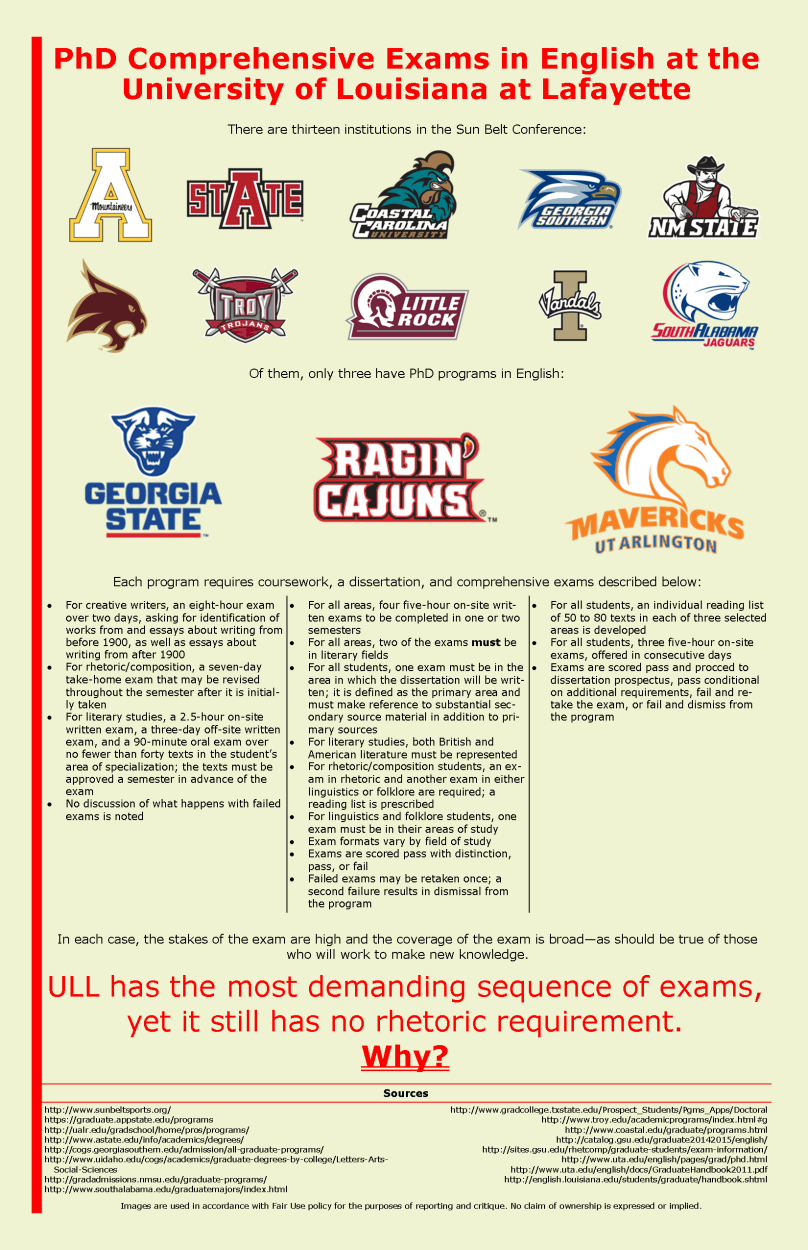
The sample below treats a question voiced in the earlier “Sample Developing a Topic and Locating Sources Assignment: Questions about the Comprehensive Exams for UL Lafayette PhD Students in English,” continuing the same project being treated for the benefit of students in classes at both Oklahoma State University and Northern Oklahoma College. Because it is a continuation of the same project, some phrasing will likely be similar to that of sample assignments written for both sets of students.

Earning a doctorate in English from the University of Louisiana at Lafayette (ULL) obliged me to sit for a series of comprehensive exams. Like my contemporaries, I had to take four five-hour tests over such areas of inquiry within English studies as English languages and literatures to 1500, early modern English literature, American literature to approximately 1900, and contemporary fantasy literatures in the US and UK. The idea behind such exams, according to how the ULL Department of English describes them on its website as of 23 September 2015, is to facilitate both teaching and continued research, ensuring that students who complete the program adequately reflect the generalist orientation of the program. Yet while the expressed requirements for the exams note that coursework across literary areas and periods must be taken, many of the students in the program are not obliged to range outside of literary studies, and most graduates will teach outside those areas–namely in rhetoric and composition. Why this is so is unclear; such a lack of clarity merits investigation.

Finding out why the PhD program in English at ULL acts as it does prompts looking at peer institutions of that school. The most immediate peers are the other members of the University of Louisiana system, given that they are unified at their higher administrative levels and therefore operate under many of the same constraints and restrictions that will affect ULL. The problem with doing so is that ULL is the only institution in the University of Louisiana system that offers a PhD in English. A slightly less immediate set of peers is the membership of the Sun Belt Conference, the schools against which ULL competes in athletic events; conferences tend to be organized to bring comparable schools into competition, so the member institutions are likely juxtaposed fairly. Too, more of the schools have PhD programs in English than in the University of Louisiana system, offering more useful data for comparison.

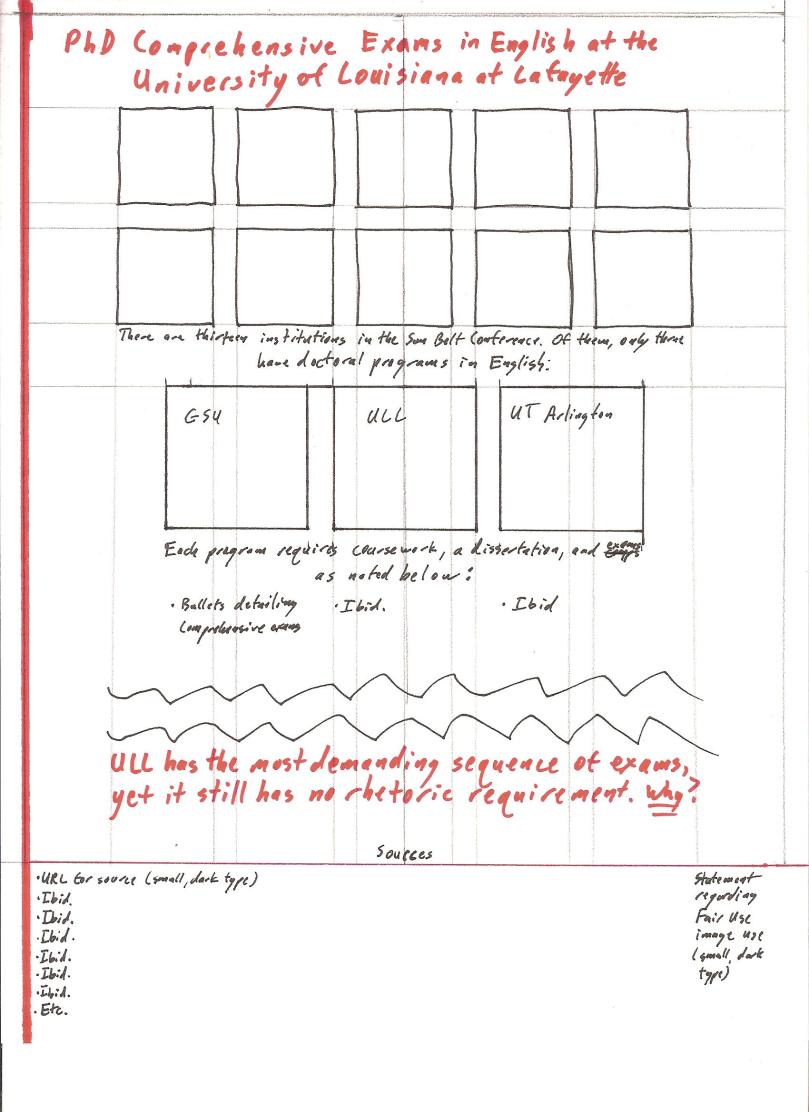
In composing the infographic, I sought to connect my presentation to the materials being presented. Consequently, I strove initially to mimic the color scheme and typefaces used by my focal materials, the description of the comprehensive exams hosted by the ULL English Department; the idea therein was that the treatment of the subject would reflect the subject itself. The infographic title was put at the top center to foreground it most prominently. Information was positioned to move from broad to narrow, leading readers down the page along a single center line. Alignment and grouping were seen to via tables, into which the increasingly narrow data-sets were set for ease of reading; while the focal information was placed near the bottom of the infographic, the plethora of earlier information serves to balance the document. Citations follow typical online practice, providing URLs for the materials collected and grouping them under a single heading at the bottom of the page; they need to be present but unobtrusive, and the placement and smaller typeface conduce to that end.

Raw-Form Infographic

G. Elliott Spring 2016 ENGL 1213 Infog Raw Form

Digital-Original Infographic

G. Elliott Spring 2016 ENGL 1213 Infog Digital Original Form

Sample Exploratory Essay: Why Not Have a Rhetoric Requirement among UL Lafayette PhD Students in English?

What follows is an exploratory essay such as my students are asked to write for the Explore assignment during the Spring 2016 instructional term at Northern Oklahoma College. As is expected of student work, it treats an issue of its writer’s curriculum. It also adheres to the length requirements expressed to students (they are asked for approximately 1,000 words, exclusive of heading, title, page numbers, and any formal end-citations that may become necessary; the sample below is 1,000 words long when judged by those standards), although its formatting will necessarily differ from student submissions due to the differing medium. How the medium influences reading is something well worth considering as a classroom discussion, particularly for those students who are going into particularly writing- or design-intensive fields.

Please note that the essay below follows from the earlier sample topic proposal, here. Because it is a continuation of that same project, much phrasing will be similar to that in the earlier document.

Earning a doctorate in English from the University of Louisiana at Lafayette in 2012 required me to take coursework and complete a dissertation, both of which register in public consciousness. It also required me to do something perhaps less well known: sit for comprehensive exams. Widely required across disciplines, the exams serve several purposes; in most cases, they are prerequisite to beginning work on the dissertation. In the English department at my graduate school, they also serve to help reinforce the generalist nature of the department and suit graduates of the program to the work of teaching after they have earned their degrees. In the event, however, most of the teaching done by those who earn graduate degrees in English is the teaching of writing, and there is no requirement that graduates of the PhD program in English at the University of Louisiana at Lafayette demonstrate proficiency in the relevant area of English studies–rhetoric and composition–as there is that they demonstrate proficiency in one or more areas of literature. Why this is the case is not entirely clear, although some potential reasons suggest themselves.

One such is a logistical reason. Although it is not the case that coursework necessarily directly or fully prepares students for their comprehensive exams, it is not at all expected that students will sit for exams in areas outside their classroom experiences. That is, students rarely if ever take exams in an area in which they have not taken courses; examining in a given area effectively obliges sitting for coursework in it. Graduate classes tend to have low enrollment caps–which is good, given the relative intensity of the interactions between professors and graduate students. (In practice, the relationship is much more like a master/apprentice dynamic than the “traditional” teacher/student pattern in force at the undergraduate level, particularly at the doctoral level.) Having a doctoral rhetoric requirement would oblige either a raising of such caps, which would likely diminish the quality of instruction in rhetoric classes by diminishing the time each professor has available to interact with students, or the hiring of additional faculty in rhetoric and composition, which would likely not be feasible due to ever-tightening budgets. Although not perhaps the most pedagogically valid reason not to have a rhetoric requirement, it is a remarkably sound practical concern, and academics do well to recall that they must negotiate the tensions between the embodied and the intellectual.

Another reason may have to do with the disciplinary status of rhetoric in the Department. There is a prevailing tendency, albeit one that is diminishing, to regard rhetoric and composition as service disciplines. That is, rhetoric and composition are held not so much to have their own distinct identity, but to exist to enable other disciplines to do the work they do. This is reinforced by dominant teaching practices, which assign the common classes in rhetoric and composition–first-year composition classes–to the least experienced instructors–typically second-year graduate students, irrespective of their own concentrations within English studies. My own teaching at that institution was of such a kind; while I did teach first-year courses throughout my attendance at the University of Louisiana at Lafayette, I began to do so after completing but one year of graduate school. I was hardly typical, and the collective experience argues that the teaching of rhetoric and composition is devalued. If it is devalued, then a lack of a rhetoric requirement in doctoral examinations makes sense; the exams emphasize areas of study, and the devalued does not generally receive emphasis.

There is some vitiation of the point, however, as still another possible reason is motioned towards in the University of Louisiana at Lafayette English Department’s 2010 online English Graduate Student Handbook. The document, which includes the Department’s treatment of the doctoral comprehensive exams, explicitly notes that “Both the M.A. and Ph.D. degrees offered by the UL English Department are generalist degrees in English and American literature [emphasis added].” That is, they explicitly and specifically frame themselves as literature degrees primarily, falling in line with traditional conceptions of what an English department is and does. It would be expected that such degrees would de-emphasize rhetorical/compositional study in favor of their stated foci. A problem with accepting such an explanation uncritically emerges, however; were the degrees meant to be literary, there would not be options for students to focus their curricula and examinations primarily on non-literary fields. Yet it is the case that the doctoral program in the English department permits, and perhaps encourages, other approaches than literary study, as such. The aforementioned Handbook notes

In addition to the traditional M.A. degree in literature, masters students may pursue an M.A. with an emphasis in American Culture, English as a Second Language, Folklore, Linguistics, Reading, Creative Writing, Professional Writing, or Rhetoric; and in addition to the traditional Ph.D. in literature, doctoral students may pursue a Ph.D. with a concentration in Creative Writing, Folklore, Linguistics, or Rhetoric.

The avowed availability of other emphases and concentrations than literature belies the statement that the graduate English degrees are “in English and American literature”–specifically because not modified. More justification for such a reason, then, would be needed–although it may well be available.

That a few reasons there might not be a rhetoric requirement included among the doctoral comprehensive exams in English at the University of Louisiana at Lafayette suggest themselves does not mean no others are possible, of course. Any one analysis will be limited in what it can treat, and additional causes may arise from outside those limitations. In any event, however, whatever the reason that the doctoral comprehensive exams in English at the University of Louisiana at Lafayette lack a rhetoric requirement is, having that answer will prove of benefit to those students who mean to pursue a career in English studies; knowing what schools offer what curricula and why will help in selecting the most appropriate programs to try to enter. Since graduate school is arduous and expensive, careful selection is vital, indeed.

Sample Developing a Topic and Locating Sources Assignment: Questions about the Comprehensive Exams for UL Lafayette PhD Students in English

What follows are a topic proposal and annotated bibliography such as my students are asked to write for the T&S assignment during the Spring 2016 instructional term at Oklahoma State University. As is expected of student work, it treats an issue of its writer’s curriculum. It also adheres to the length requirements expressed to students (they are asked for 325 to 650 words in the proposal and several citations and brief paragraphs for the annotated bibliography, exclusive of heading, title, and page numbers; the proposal below is 388 words long when judged by those standards, and the annotations after the introductory paragraph are appropriate in content), although its formatting will necessarily differ from student submissions due to the differing medium. How the medium influences reading is something well worth considering as a classroom discussion, particularly for those students who are going into particularly writing- or design-intensive fields.

The text works in tandem with “Sample Topic Proposal: Why Not Have a Rhetoric Requirement among UL Lafayette PhD Students in English?” The text thereof is available here : https://elliottrwi.com/2016/01/14/sample-topic-proposal-why-not-have-a-rhetoric-requirement-among-ul-lafayette-phd-students-in-english/

To earn my doctorate in English from the University of Louisiana at Lafayette, one of the many things I was asked to do was sit for a series of comprehensive exams. Like my contemporaries, I had to take four five-hour tests covering knowledge selected from among twelve separate areas of inquiry within English studies. The idea behind them, according to how the school’s Department of English describes them on its website as of 23 September 2015, is to facilitate both teaching and continued research, ensuring that students who complete the program adequately reflect the generalist orientation of the program. Successful completion of the exams is required before advancing to work on the dissertation in which the doctorate concludes, and continued presence in the program hinges on passing the exams. They are therefore of singular importance.

Because the comprehensive exams are as important as they are, they are perpetual subjects of discussion, both for those who sit for them and for those who administer and assess them. They are described by the Department in part as being meant to demonstrate students’ mastery of various areas in support of the generalist nature of the program, and the expressed requirements do tend toward that goal–but there are areas in which the comprehensive exams could align more closely to the goals of the Department and to its students.

Investigating the comprehensive exams could easily follow several paths. One would be to ask why the Area 1 requirement is framed as it is. Focusing on English languages and literatures prior to 1500, it effectively covers multiple distinct languages, as the differences between Beowulf and Chaucer attest, and the separation of the area at 1500 seems at odds with prevailing understandings of changes to the language–the medieval in England is usually held to end at 1485. Another question to ask could be why all students are not asked to sit for an exam in rhetoric. All students are asked to sit for exams in literature, and there is certainly nothing wrong with such a requirement, but more students will teach composition classes, and having a background in that sub-discipline would be helpful. A third possibility, although by no means the last, would be to ask why the comprehensive exams retain their traditional on-site, in-the-room form, when so many other schools and fields administer them differently.

Answering any such questions will benefit from recourse to the many discussions of curriculum and exams that go on. Various educational agencies and organizations will have something to say about how exams are conducted, as will disciplinary organizations. Publications of the National Council of Teachers of English and the Modern Language Association of America suggest themselves as useful initial avenues of inquiry. So do pieces from such databases as the Educational Resource Information Center. A few selections from simple keyword searches of such sources appear below.


Hassel, Holly, and Joanne Baird Giordano. “Occupy Writing Studies: Rethinking College Composition for the Needs of the Teaching Majority.” CCC 65.1 (September 2013): 117-39. Print.

The article argues against perceptions among writing scholars that devalue the work done by most writing teachers, who work in two-year and open-admission institutions. After defining a number of its terms, the authors note that studies of such teachers are not proportionate to the work they do. They continue with discussions of the two-year teaching environment, the focus of writing scholarship on four-year and elite institutions and the concomitant problems associated with community colleges, and what benefits would accrue to teachers and scholars from a reconsideration of such positions as they outline. The article concludes with a few recommendations of how to proceed, namely the support of research by and about two-year and open-admission institutions.

Of particular importance in the article is a quotation from a  Chronicle of Higher Education article by Schmidt, one noting that non-tenure-track faculty account for more than three quarters of teaching positions (119). While it does not discuss the comprehensive exam as an item, it does point towards the ubiquity of writing instruction by those with graduate degrees in English, irrespective of their specialization; it is a point the article reiterates. As such, it helps provide context and support for the need for graduate students in English to take exams and concomitant training in rhetoric, since it is from rhetoric that the practice of teaching writing emerges.


Nolan, Robert. E. “How Graduate Students of Adult and Continuing Education Are Assessed at the Doctoral Level.” Journal of Continuing Higher Education 50.3 (Fall 2002): 38-43. PDF file.

The article encourages discussion of the forms comprehensive examinations in doctoral coursework should take to increase completion rates and more accurately reflect the expectations placed on those who pursue advanced graduate study. After explicating then-current demographic data among graduate students, the piece lays out its purpose and summarizes previous studies of the topic. It then lays out its methods–noting the group surveyed and describing the survey used. Findings follow, identifying major trends about the timing, format, and intentions of comprehensive exams. The article concludes with notes that indicate no consensus among programs about how to hold comprehensive exams and what they ought to do.

The article may suffer somewhat from concerns of age, and repeated mentions of what various things “presumably” do weaken some of the rhetorical force of the piece. The brevity of the piece may also be of some concern. The article does, however, provide a useful summary of tendencies in how examinations have been conducted at the doctoral level across disciplines. In that regard, the article offers a useful starting point for discussion of any topic treating comprehensive exams at the doctoral level. As background material for framing investigation of the comprehensive exam, then, it is worth reading.


Ponder, Nicole, Sharon E. Beatty, and William Foxx. “Doctoral Comprehensive Exams in Marketing: Current Practices and Emerging Perspectives.” Journal of Marketing Education 26.3 (December 2004): 226-35. PDF file.

The authors identify and explain then-current and -emerging practices regarding doctoral comprehensive exams in United States marketing programs. After offering a general introduction to the topic, the authors review available literature on the topic, focusing largely on Bloom’s taxonomy. Methodology follows, with a survey described and the process of its dissemination, completion, and interpretation articulated. Results detailing the perceived purposes of doctoral comprehensive exams, structures of those exams, and changes to the latter are presented, and less traditional emergent structures–an “original papers” approach, an “extended take-home,” a “specialist,” and a “no exam–no paper” approach–are explicated. Results are discussed, and a conclusion suggesting that the traditional closed-book format of comprehensive exams will be less common in marketing schools finishes the article.

Although Ponder, Beatty, and Foxx discuss marketing, specifically, many of their assertions are likely applicable to other fields. Despite common perceptions of advanced education as liberal and socially deconstructive, academia tends to remain wedded to older structures, so the “traditional” examination structures discussed in the article are likely to be represented in other fields and programs entirely. If such points of correspondence are in place, then others may also be, making the conclusions reached by the article at least provisionally applicable to other areas of advanced education. Also notable in the article is the concern voiced by some faculty that changes to traditional exam structures “are depriving students of the opportunity to integrate a broad range of knowledge at a deeper level than they will ever have an opportunity to achieve again” (234), offering an unusual perspective on the comprehensive exam that may well bear examination.


Schafer, Joseph A., and Matthew J. Giblin. “Doctoral Comprehensive Exams: Standardization, Customization, and Everywhere in Between.” Journal of Criminal Justice Education 19.2 (July 2008): 275-89. PDF file.

The authors describe general tendencies regarding treatment of comprehensive exams by programs awarding doctoral degrees in criminal justice. The need for systematic study of criminal justice programs is articulated before the doctoral comprehensive exam is contextualized. Exam procedures are described and historicized. Study methods–largely focused on conducting surveys and interviews–are described and findings articulated, the latter focusing largely on the forms the exams take. Findings are subsequently discussed, identifying and commenting on the patterns that emerge from the study and treating relative merits of several exam formats. The article concludes with questions about the ongoing utility of curricular standards to both the discipline and the broader community the discipline serves.

Although Schafer and Giblin treat the discipline of criminal justice, specifically, they ground their article in information deriving from studies of other fields–notably including rhetoric–and assert that their own discipline largely follows the structures of others. The conclusions they reach about their own field therefore present themselves as able to be generalized back to those other fields, so that what they say about comprehensive exams can be applied to other areas than their own. Additionally, their relatively recent (to this writing) article allows their conclusions to be taken as more timely, and their relatively extensive bibliography offers useful insights as to further reading.

Sample Strategic Reading: Bringing Forward a Way the Past Is Brought Forward

What follows are a summary and description of reading strategies used to create it such as my students are asked to write for the StratRdg assignment during the Spring 2016 instructional term at Oklahoma State University. As is expected of student work, it treats a document in the writer’s field (in this case, medievalist studies*, with the document itself appearing here), presenting it to first-year students in that field. (The text shows up with a Flesch-Kincaid grade level of 13.2, which indicates an early first-year college student.) It also adheres to the length requirements expressed to students (they are asked for a 300- to 500- word summary and a 700- 1,000-word description of reading strategies used, exclusive of heading, title, and page numbers; the sample below has a summary of 376 words and a reading strategies description of 1,000 words when judged by those standards), although its formatting will necessarily differ from student submissions due to the differing medium. How the medium influences reading is something well worth considering as a classroom discussion, particularly for those students who are going into particularly writing- or design-intensive fields.

Bonnie J. Erwin’s “‘Is This Winning?’: Reflections on Teaching The Two Noble Kinsmen” appears in the 2014 issue of The Year’s Work in Medievalism. In the article, Erwin asserts that teaching students about the medieval through the early modern that engages with the medieval is particularly effective, citing a reading of Shakespeare’s The Two Noble Kinsmen against its source in Chaucer’s Knight’s Tale as a useful case study of how such teaching could work. Following an epigraph from E. Talbot Donaldson and the presentation of the thesis, the article lays out the context of teaching: an introductory literature survey broadly treating the distant past and arriving at the idea that peripheral figures allow closer interrogation of the past. Erwin notes the self-positioning of the play as outsider to the medieval antecedent before glossing the in-class contextual materials given her students, namely chivalric literature and explications of its ideologies. She notes also that her students largely focused on the Shakespearean Emilia, using her as a means of entry into the work. Her contrast with her Chaucerian counterpart is noted, as are the differing narrative attitudes towards the characters. The article comments on the lapses in Chaucer’s Knight’s narrative control over Emelye and its contrast with the seeming self-actualization of Shakespeare’s Emilia, with prior student discussions references to illuminate assertions.

Afterwards, Erwin lays out a series of classroom activities she conducted with her students. They initially divided into five groups, each treating one of the characters most prominent in discussing love in the play. Groups were asked to interpret the assigned character’s stances on love and friendship, interrogating the particular position and its supporting evidence; the group focusing on Emilia receives special attention in the article, with comments from students related. Students were subsequently redivided into discussion groups and asked to debate from characters’ perspectives about the preferability of courtly love or early modern friendship; the latter was valued over the former, with Emilia held up as offering the exemplary critique of the former. Problems students identified in Emilia are also noted in the article, which concludes with note of an extension activity and the idea that the medieval and other pasts are still in dialog with modern ideas of the self, offering a conversation well worth investigating.

Selecting a medievalist text to summarize took a bit of doing. Most scholarship in the field is expansive, displaying both the interdisciplinarity common to the field and the attention to detail that bespeaks long-tended love of the subject. Neither makes for the most accessible text, although both do much to enrich prevailing understanding of how what has gone before works with what is going on now. The Year’s Work in Medievalism, however, tends to offer reasonably easily treated pieces, such that an article from the journal can be used to demonstrate how to approach scholarly reading, generally, and medievalist scholarly reading, in particular.

Before selecting the text, I knew I would be using it to draft a summary and description of my strategies for reading. Having an understanding of the uses to which a given scholarly text will be put helps inform the reading done, as it shapes what the reader will look for in accomplishing the reading. Since I knew what I would be doing with the text, I knew that when I looked through it, I would need to point out the thesis of the work, as well as indications of the major points of discussion and the ways in which those points were treated. I also knew that I would need to point out any paratextual features–that is, those parts of the article not necessarily included in the text proper but still necessarily related to it. With such ideas in mind, I plunged into the reading.

I quickly noted not the title, which seemed to my eyes a standard piece, but the epigraph from E. Talbot Donaldson. Its placement on the page, markedly different from that of the main text, attracted attention. Its source, one of the major critics of medieval literature, also attracted attention. Donaldson’s words carry weight with medievalists, so his deployment before the article even begins situates the article as engaging with some of the major threads of medieval studies. It also serves to position the article in tension with commonly received wisdom, identifying the context in which Erwin’s discussion takes place.

Pressing onward from the epigraph, I scanned the first paragraph, looking for the article’s thesis in one of the traditional places: the beginning of the first paragraph and the end of it. I found it in the latter, noting its presence in the margins and underlining it to call visual attention directly to it. I also underlined a few sentences earlier in the paragraph, sentences that bridge from the epigraph to the thesis and which seem to correspond to my own other interests; highlighting them will prompt later recall.

As I continued reading, I noted that the next paragraph serves to contextualize Erwin’s discussion. That is, it articulates the circumstances in which Erwin came upon the idea her article explicates. I highlighted a few key sentences that describe that context, but I largely passed on from the paragraph. Context is useful and necessary, certainly, but for my immediate reading purpose, it sufficed to note the presence of the context and a cursory image of it.

The article continues with a description of how The Two Noble Kinsmen situates itself as a medievalist text, something I underlined as being of interest to me as a medievalist. When it returns shortly after to a discussion of the class from which the article arises, it offers something else of interest to me as a medievalist: a comment about the lapse of a major medieval construct. I highlighted it and appended a bit of marginalia, connecting it to a conference paper I gave some time ago. Building the connection to my own prior knowledge helps me to place Erwin’s work in context, as well as to broaden my understanding of materials with which I was already familiar. Additionally, the simple act of writing helps cement the connection through engaging multiple means of recall. (Underlining does, too, if not as specifically and therefore less powerfully.) I also highlighted the citation embedded in the paragraph and its related footnote; the source referenced appears to be one of interest to me, so calling attention to it serves as a reminder of my ongoing need to read.

Erwin presses on to relate her students’ progress through the exercises associated with the reading, and I underlined the major assertions she makes in the piece. The specific support for those assertions I left unmarked, having skimmed over them. I need to know that there is support, and I may need to know what that support is later, but the immediate purpose of my reading does not demand that detail, so I let it lie. It results in some of the pages of my copy of the article being less heavily marked than others, to be sure, but that is not a problem now.

It had been, though, as I had skipped over more than I ought to have done, something I realized as I came initially to Erwin’s summation of classroom findings. They had not made sense to me on first reading, prompting me to recognize that I had glossed over vital details. At that point, I made a note in the margins indicating how far back I would need to read, and I re-read the text from that point. As I went through again, I paid closer attention, underlining details that illuminated the summation I had earlier failed to understand. The reading made more sense in the repetition, as is often the case, and I moved into the conclusion, underlining again the major points Erwin makes.

My own reading methods are idiosyncratic, certainly, developed over years of reading and reading in my field. They pull upon substantial background knowledge in determining what is important to highlight for the purposes I am about at any time. Knowing those purposes , though, is a useful first step; even reading slowly with “Does this inform what I am doing?” in mind helps make the reading go better, and practice helps with speed later.

*The term denotes studies of how the medieval is mis/used and mis/appropriated by later periods. Study of the medieval itself is necessary to study of the medievalist, but the medievalist study also has to encompass knowledge of the receiving period. More information can be found from the International Society for the Study of Medievalism and the Tales after Tolkien Society. Return to text.

Sample Topic Proposal: Why Not Have a Rhetoric Requirement among UL Lafayette PhD Students in English?

What follows is a topic proposal such as my students are asked to write for the Prop assignment during the Spring 2016 instructional term at Northern Oklahoma College. As is expected of student work, it treats an issue of its writer’s curriculum. It also adheres to the length requirements expressed to students (they are asked for 300 to 500 words, exclusive of heading, title, and page numbers; the sample below is 372 words long when judged by those standards), although its formatting will necessarily differ from student submissions due to the differing medium. How the medium influences reading is something well worth considering as a classroom discussion, particularly for those students who are going into particularly writing- or design-intensive fields.

I received a doctorate in English from the University of Louisiana at Lafayette in 2012, having completed a dissertation in late medieval literature and having passed with distinction comprehensive examinations in medieval English literature, early modern English literature, early American literature, and fantasy literature of the United States and Britain from 1950 to 2009 (when I sat for my exams). Composing the dissertation and studying for the exams, as well as taking the coursework that informed both, offered me rewarding experiences that I am glad to have had, as well as enabling many others outside the classroom that have been to my benefit.

Even so, they did not wholly equip me for the kind of work I have faced since leaving the school. The comprehensive exams, particularly, are discussed by the English Department that requires them in terms of both research and teaching, but most of the teaching that I and others who have earned graduate degrees through the Department has been in rhetoric and composition. Even those of us whose areas of interest and expertise are wholly literary are asked to teach more writing than anything else—and it is not something for which we are adequately prepared. Yet those students who concentrate in rhetoric and composition are prepared to teach literature, compelled to sit for exams in literary areas even as literature students are not obliged to sit for an exam in rhetoric.

Why no such requirement is in place bears some inquiry. The PhD program in English at the University of Louisiana at Lafayette is explicitly generalist in its orientation, and requiring all students to take an examination in rhetoric—effectively calling for them to take coursework in rhetoric, as well—would reinforce that orientation. Additionally, it would, as is gestured toward above, help students prepare more effectively for an academic job market that will call most of them to spend time teaching writing courses off of the tenure track, whatever their specialization may be. The Department and its doctoral students would therefore be better placed within the academy, helping the Department to continue offering its graduate programs and its graduates to secure employment in the short and long terms.

Sample Evaluation: Fitting a Fictional Puzzle into Place

What follows is a sample of an evaluation such as my students are asked to write for the Eval assignment in the Fall 2015 term at Oklahoma State University. As is expected of student work, it treats the same piece treated in the earlier (sample) textual analysis, and it borrows text from the earlier assignment–as is to be expected. Additionally, it adheres to the length requirements (the assignment asks for 1,750 to 2,450 words, exclusive of headings and citations; the sample is 1,905, judged by the same standards), although the formatting will necessarily differ due to the different medium of presentation. (This is particularly true for the Works Cited list, which is bulleted for ease of reading online; paper-formatted essays should not bullet their citations.) How the medium influences reading is something well worth considering as a classroom discussion, particularly for those students who are going into particularly writing- or design-intensive fields.

In a 15 August 2015 New York Times opinion piece, “Puzzling through My Fiction,” Ben Dolnick treats the use of crossword puzzles as practice for writing fiction. He asserts that solving puzzles is an analogous practice to sorting out narrative prose and plot arcs. The process he describes as common to both moves through at least four phases–“The Blank Beginning,” “The Walk-Away,” “The Dam Breakage,” and “The Slow Clap.” Each is provided illustrative examples of how crossword-solving reflects narrative construction, making clear the connections between the two. An end-note describes it as the last entry in the Draft series maintained by the New York Times, and it is good that the series ends on an effective piece of writing. It is good also that it ends on one generally representative of that series, and Dolnick’s piece is typical of Draft series essays.

There are limitations to such a claim, of course. At one level, pieces which end series are by dint of that ending atypical. A “normal” member of a series is written and presented in a context that implies more is to come. A planned end to a series is not, but will typically be written to bring to completion any lines of discussion that are still ongoing; it may also work to reflect upon the series as a whole, offering summative statements of the series’ accomplishment of its expressed purposes and other comments meant to offer a vision of the collection of works. Since such a reflection is not likely to be the ongoing purpose of a series, a work which offers such reflection cannot be typical of it; since concluding members of a series are likely to offer such reflection, it follows that they are not likely to be typical of their series; and since “Puzzling through My Fiction” is described in an addendum as “the last essay in the Draft series,” it seems likely to be atypical of that series.

Such an assertion, although sensible in itself, falters when the note is made that Dolnick’s essay does not take the reflective stance expected of concluding articles. It falters further when the article is assessed against a sampling of other entries in the Draft series. To offer some standards for evaluation of the last article in the series, the first article in the series–Jhumpa Lahiri’s “My Life’s Sentences”–seems a useful counterpoint. Six other articles from the series, some of which have proven useful for teaching–Aaron Hamburger’s “Outlining in Reverse”; John Kaag’s “The Perfect Essay”; Phillip Lopate’s “The Essay, an Exercise in Doubt”; Sean Pidgeon’s “Rapturous Research”; Molly Ringwald’s “Act Like a Writer”; and David Tuller’s “The Jargon Trap”–complete the survey sample. Taken together, they suggest some common features among the members of that series, helping to assert the typicality of Dolnick’s piece.

Perhaps the most obvious unifying feature of the series is its initial impetus, noted in an addendum to the Lahiri piece that begins it; Draft is “a [then] new series about the art and craft of writing [emphasis in original].” Other articles surveyed bear out the initial assertion; among others, “Act Like a Writer” gestures toward the subject in its title and addresses the utility of writing character biographies for actors, “The Essay, an Exercise in Doubt” treats an oft-derided writing genre, and “The Jargon Trap” treats concerns of style and usage. Dolnick’s article, linking the process of fiction writing to the processes involved in another activity, corresponds perhaps most closely to Ringwald’s among the examples surveyed, but it treats writing as a general topic, and in so doing, it marks itself as fit for inclusion among the Draft series in at least one regard.

Less obvious but more concrete concerns also suit Dolnick’s article to the Draft series. For example, “Puzzling through My Fiction” is of a length similar to the articles surveyed. Those articles range in length from the 700 words of Pidgeon’s piece to the 1,213 words of Ringwald’s, but they tend to cluster in the higher end of that range. The average word count among them is 1,020.86, with a standard deviation of 173.25 words. Dolnick’s piece is 1,118 words long, less than a hundred more than the average and well within one standard deviation of that number. As such, it is firmly in accord with other Draft articles in terms of word count, helping to mark it as typical of the series as a whole.

Other, similar concerns further position the end of the Draft series as representative of the collection. Reviewed essays in the series run from ten paragraphs–Pidgeon’s is again the shortest article among those investigated, being the one with ten paragraphs–to eighteen–Ringwald’s is again the longest, at that length. On average, Draft essays cover 13.43 paragraphs, with a standard deviation of 2.94. Dolnick’s “Puzzling through My Fiction” takes up some 15 paragraphs, no more outside a single standard deviation of the average than its word count. Its paragraph count is therefore every bit as representative of the series it ends as is its word count.

Average paragraph length functions similarly to indicate the representativeness of Dolnick’s concluding Draft article of the whole series. Paragraphs in the articles reviewed range in length from the 67.29-word average of Hamburger’s article to the 101.55-word average of Lahiri’s. The average paragraph length of the articles is 77.33 words, with a standard deviation of 12.78 words. “Puzzling through My Fiction” averages 74.53 words per paragraph, less than three words off from the average paragraph length of the surveyed contributions to the series. That it cleaves as closely to the average paragraph length as it does may be a small point, but it does serve to reinforce the idea that the last article in the Draft series represents the series as a whole.

Reading level also helps to demonstrate how “Puzzling through My Fiction” is typical of the Draft series. The Flesch-Kincaid grade level of articles surveyed ranges from the 6.6–that is six months into sixth grade, per idealized United States standards–of Lahiri’s piece to the 11.5–five months into eleventh grade, not long before most students in the United States will take a final battery of standardized tests for their schools, as well as college entrance exams–of Pidgeon’s; the average is 9.46, with a standard deviation of 1.70. Dolnick’s article displays a Flesch-Kincaid grade level of 10.0; it is aimed at those just beginning their sophomore year of high school. Being less than one standard deviation away from the average reading level of Draft articles surveyed suggests that it is in line with what is to be expected of Draft articles in yet another regard, further supporting the idea of Dolnick’s piece as a synecdoche for the series it concludes.

Examination of such mechanistic factors as word and paragraph counts or reading levels may not be something commonly thought of as appropriate to the review of texts, but they do offer quantifiable data that can be used to argue a point convincingly. More typical of the study of writing, however, is the identification of problems; a commonplace concerning those who teach writing (voiced among the surveyed essays by Kaag) is that they search out mistakes, pouncing upon them. Something to pounce upon in several of the essays reviewed is the use of second person reference, which often reads as presumptuous. It certainly does so when it appears in Ringwald’s piece and Pidgeon’s, Hamburger’s and Lopate’s and Kaag’s. (There are, admittedly, instances in some of those essays, as well as in others reviewed, in which the “you” used is appropriate–even when outside of quotation.) Dolnick’s essay, as is noted elsewhere, also deploys second-person references annoyingly (Elliott). Annoying as it is, though, it is typical of Draft essays; the annoyance appearing in Dolnick is another indication of its typicality.

Also typical of the study of writing is examination of opening devices, and in its opening, “Puzzling through My Fiction” is typical of the articles surveyed, suggesting it is typical of the series they represent. The articles surveyed tend to open with brief first-person statements that give context to the essays that follow. “The Perfect Essay” offers one such example, opening with the following five sentences: “Looking back on too many years of education, I can identify one truly impossible teacher. She cared about me, and my intellectual life, even when I didn’t. Her expectations were high — impossibly so. She was an English teacher. She was also my mother.” In doing so, it serves to offer the tone of the piece–reflective and not overly serious–as well as asserting Kaag’s ethos and indicating the vehicle for presentation. A sense of the author’s voice emerges quickly, making the piece more human and therefore more accessible immediately–as is the case for the other articles surveyed.

Something similar occurs with “Puzzling through My Fiction.” The piece opens with a sketch of a childhood construct:

When I was growing up, crossword puzzles were — along with watching Ken Burns movies and eating lox — among the unfathomable pleasures of grown-ups. My grandmother would sit in her den for hours, the puzzle in her lap, looking blankly around the room as if she had just read a piece of news whose enormity she could scarcely comprehend. Other adults would periodically drift by to offer their condolences (“A nine-letter religious figure, hmm…”) and I would stare from the rug in disbelieving boredom.

In three sentences, the author suggests the didactic tone of his article–a child at the feet of family elders is often in a position to learn–and the motion towards tone is typical of opening paragraphs among the essays surveyed. The sentences also assert authorial ethos through noting long association and involvement with the topic, a move common in Draft essays. The vehicle for the presentation–crossword puzzles–is indicated, as well, which also serves to align the opening with Draft standards. Dolnick’s introduction further constructs a vision of a simple childhood mystified by the pursuits of adults–something with which many readers can identify, having been similarly mystified children themselves. That identification serves a humanizing function also typical of Draft essay openings.

Essays in the Draft series also tend to return to the authorial first-person in their endings. Aside from Hamburger’s essay, which leaves off first-person references after the second-to-last paragraph, the essays surveyed all return to authorial self-reference in their final paragraphs, whether by making some statement about things that have been learned or through offering some heartfelt recommendation for actions to take. “Puzzling through My Fiction” does much the same thing, concluding with a comment about the thrill of realization “is why I [Dolnick] became a writer.” The piece comes close to ending on the word “I”; it certainly ends reflexively, and in doing so, it positions itself yet more decisively as a representative ending to the Draft series.

It is a shame that the Draft series has ended; there is more to say about writing than the contributions to the series can contain, other accounts of writing than those offered already. That it ends on a piece that is of a piece with the rest of the series, however, is welcome. If nothing else, Dolnick’s “Puzzling through My Fiction” is a fitting conclusion, serving to remind readers that more things are connected than might initially appear to be. Searching out those connections seems a thing worth doing.

Works Cited

  • Dolnick, Ben. “Puzzling through My Fiction.” New York Times. New York Times, 15 August 2015. Web. 23 October 2015.
  • Elliott, Geoffrey B. “Sample Textual Analysis: Picking apart a Fictional Puzzle.” ElliottRWI. Geoffrey B. Elliott, 30 September 2015. Web. 29 October 2015.
  • Hamburger, Aaron. “Outlining in Reverse.” New York Times. New York Times, 21 January 2013. Web. 23 October 2015.
  • Kaag, John. “The Perfect Essay.” New York Times. New York Times, 5 May 2014. Web. 23 October 2015.
  • Lahiri, Jhumpa. “My Life’s Sentences.” New York Times. New York Times, 17 March 2012. Web. 23 October 2015.
  • Lopate, Phillip. “The Essay, an Exercise in Doubt.” New York Times. New York Times, 16 February 2013. Web. 23 October 2015.
  • Pidgeon, Sean. “Rapturous Research.” New York Times. New York Times, 5 January 2013. Web, 23 October 2015.
  • Ringwald, Molly. “Act Like a Writer.” New York Times. New York Times, 18 August 2012. Web. 23 October 2015.
  • Tuller, David. “The Jargon Trap.” New York Times. New York Times, 4 August 2014. Web. 23 October 2015.