Read the previous entry in the series here.
Read the next entry in the series here.
After a passage from an assassin’s instruction manual opining on the inherent cruelty of the profession, “Assassins” begins with Fitz killing the messenger that had reached him, musing that, despite the endorsement of the victim, it was his worst killing–and that he was involving Bee in the worst of his business. But with the killing accomplished, he bears the messenger’s body to a woodpile, Bee trailing behind him. The pair prepare the body and set the pile alight, making a pyre of it, and they confer about their cover story. They confer, too, if somewhat obliquely, about Fitz’s quiet work for the Six Duchies.
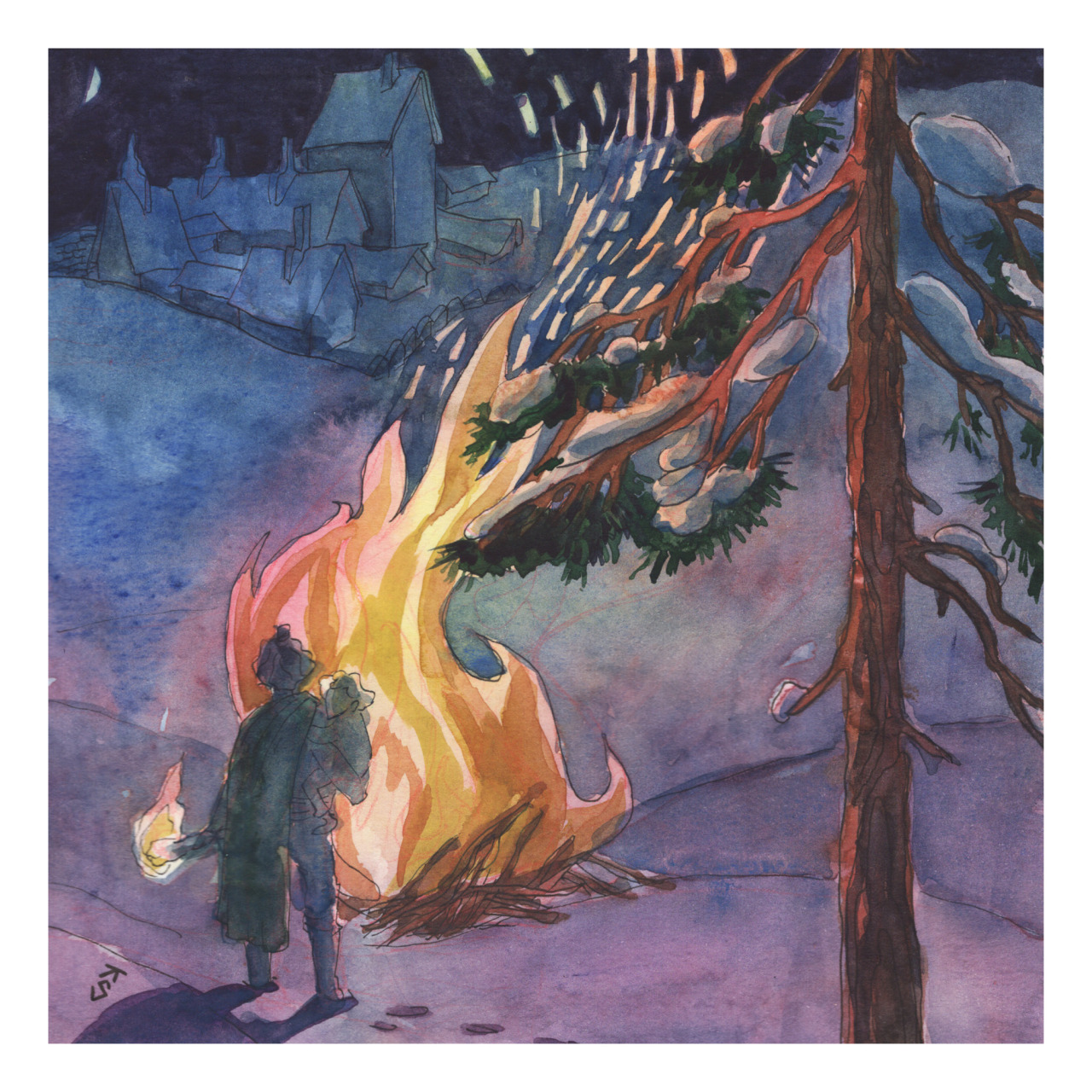
Katrin Sapranova’s The Messenger, from her Tumblr feed, used for commentary
Fitz finds himself puzzling over the message the Fool had sent to him, trying to suss out the parentage of the Fool’s child. Garetha, who had provided flowers for Lord Golden and thereby shown her knowledge of his identity, is offered as one possibility; she is not the only one. At length, Bee interrupts his reverie, and the two proceed back inside, Fitz rebuking himself for his many follies along the way. His thoughts turn dark, and Bee has to lead the pair of them back home.
Within, Fitz begins to see to Bee, considering ramifications of his actions, until interrupted by shrill screaming from Shun. She has woken form a dream in guilt and terror, and Riddle sees to her as Fitz searches her rooms. Finding himself dissatisfied with Shun and confused by Chade’s interest in her, Fitz stalks on to settle matters. When he returns to where he had left Bee, however, he finds her gone, and the search for her begins.
The present chapter is relatively brief, some fifteen pages in the edition of the book I am reading. I have yet to puzzle out any consistent pattern in the chapter-lengths, although I admit that I have not been doing enough work on that issue to have come to any conclusions. It is the kind of thing that could underpin a decent study, I know; I actually recommend it as an exercise for students when I write lesson plans as a freelancer (which happens less often anymore than I might prefer, although I’ve got a couple such jobs on my plate at the moment, so it’s fresh in my mind).
In those long-ago days when I had students and the audacity to think I was doing a decent job with them, I would suggest such an approach or a similar one to those of my pupils who thought there was no “real data” to be found in literary pages. (A few scholars, noted here, here, and here, might have been good to be able to reference then, as well, but I did not know about them at that point.) There is information in the paratext of a work no less than in the text, and that in one certainly influences the other. I’ve long known it, and Oliver, among others, cites a number of scholars in confirmation thereof.
As I’ve been getting back into more scholarly work–and I have been, and not only on the Fedwren Project–I’ve noticed my reading is shifting again. I am still decidedly affective when I read, something for which I know several of my professors would rebuke me were I still under their supervision. (Since I am not, I doubt they are aware of what I am doing. Such is life, I suppose.) But I have also begun to remember more as I write, which prompts me to review again those sources I have so often handled to find where it is I remember the remembered from and to link back to them (because this is an online composition, and linking is the preferred citation method, even when it is the case that many things thought stably and permanently online are…less so). I have begun to remember what I had wanted to make myself become, and I have begun to remember the joy and animation of it–strange as it might well seem to those who have not felt elation at puzzling out some knotty set of references or allusions or the like, who view the work of literary criticism as dry and dull and dreary.
Such long sustained me, though, and it is good to feel it move within me again.
If you like the way I write, you might hire me to write for you; get started by filling out the form below!


[…] Read the previous entry in the series here.Read the next entry in the series here. […]
LikeLike
[…] the previous entry in the series here.Read the next entry in the series […]
LikeLike
[…] Bee returns to the messenger’s pyre, rekindling the flame and ruminating on the messenger and on bits of prophecy of which she is […]
LikeLike
[…] papers. He further ruminates on the messenger that had reached him and the clear signs that she and her pyre had been observed; more rumination about how to proceed on the Fool’s request and how to […]
LikeLike
[…] for her. Fitz soon joins her, and she rages at him for not having consulted her in his haste to address the issue of the messenger. He accepts the rebuke, to her chagrin, and he lays out plans for the coming days. Bee’s […]
LikeLike
[…] her day as she makes for her former chambers, and after some attempt to commune with what might be the messenger’s ghost, she enters the hidden corridors. Within them, she encounters the cat of her acquaintance, with […]
LikeLike
[…] a lovely bit of additive foreshadowing at work. The messenger that had reached Fitz at Withywoods, whose body he had burned, had reported being infected in such a way as to make contact with her a peril. In the present […]
LikeLike
[…] is somewhat embarrassed by other comments not voiced. Fitz’s situation is compared to that of a messenger from the Fool who had reached him, and although Nettle continues to question whether Bee speaks truth, Kettricken purposes to go to […]
LikeLike
[…] openly. Fitz briefly entertains possibilities of healing and return to Buckkeep, but the memory of the messenger from the Fool he had burned asserts itself as specific physical symptoms manifest, to Fitz’s […]
LikeLike