I‘ve mentioned, most recently at about this time last week, that I’m running a Dungeons & Dragons (D&D) game for middle schoolers at my local public library–for pay. The game is progressing well enough; the third 90-minute session was yesterday, with six players in attendance. The party continued along the path I’d laid before them, making headway towards their assigned objective (some social structures within the game have emerged from play and improvisation, which makes some things easier than others). Fun seemed to have been had all around, so I count it as a good evening of play.
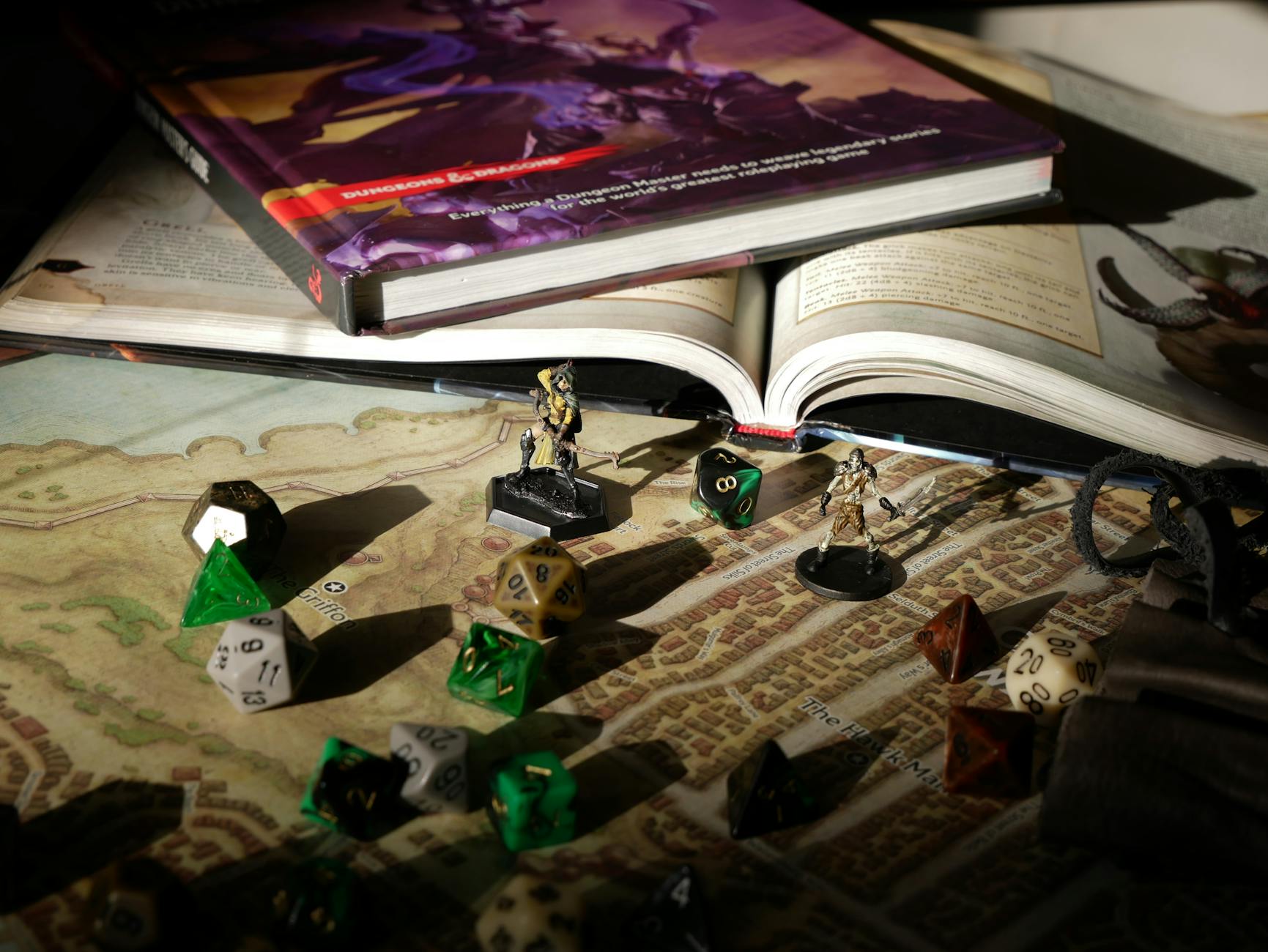
Photo by Stephen Hardy on Pexels.com
One of the things that I’ve used to keep the party moving while allowing them both agency and a means to work around failure is something I’ve taken from my experience participating in play-by-post forum games, something about which I’ve written before (for example, the piece referenced here, as well as this piece, referenced here). That thing is employing levels of overall success based on racking up a certain amount of individual success before incurring a certain amount of individual failure.
To explain a bit: in D&D and many other tabletop role-playing games (TTRPGs), tasks that characters face are often adjudicated by a single roll of dice. In D&D rules current to this writing, the player whose character must face a task with an uncertain outcome rolls one twenty-sided die and adds (or subtracts!) modifiers, comparing the result to a set difficulty, a minimum number that must be arrived at for the character to get the task done. In other games I’ve played, things generally work similarly; the player rolls once for the character’s attempt at a task, success or failure results, and the story moves on.
The method has the advantages of being simple and quick. The die roll is what it is, the result is what it is, and consequences can flow from it with relatively little interruption of the narrative flow around which the game centers. It has the disadvantage, however, of being more or less entirely up to chance; players can build characters to stack modifiers and roll scads of dice, but there are times when the dice simply fail to deliver a success, and staking a whole story on one such shot can leave players feeling unsatisfied. In some cases, those administering the games will “fudge” numbers a bit, altering things where the other players cannot see so that they succeed at pivotal tasks, but in such cases, one might well ask what the point was of rolling dice.
The issue, for me and for more than a few others I’ve known, is that some things admit of reattempts, and some things are better represented as progressions than one-off events. In such cases, what I and some of my acquaintances and friends do is set up tasks for players that ask them to make a series of rolls in which they have to accumulate a certain number of successes before incurring a certain number of failures, say three successes before three failures. (Threes work well for reasons that others expound upon at great length across quite a few years.) Getting that done allows a superior overall outcome, while failing before succeeding still allows progression, if with some additional challenges thrown in. And it mitigates the feeling of frustration that comes from one thing going against a character, even when it flatly doesn’t make sense that that character would falter at the test in question.
Admittedly, such a setup necessarily takes longer than the traditional one-off model; there are more die rolls involved, and more things to do take longer than fewer things to do when the same number of people address them. Too, there are some tasks that probably should be one-off events: much of the combat in which characters engage in games hinges on single actions, and rightly so. But for a number of tasks, spreading out success helps to mitigate failure in ways that help keep players engaged (checking out after one failed roll is sometimes an issue, and not only for less experienced players; it happens to most or all of us), and it is something that allows for more players to be engaged in keeping things moving along, since more die rolls necessarily offer more opportunities for each player to roll, to have their character contribute to the overall success of the party in which they find themselves.
In the game I’m running at the library–which I’ve taken to calling Hanlon for ease of reference–the kids at my table found their characters in pursuit of a thief who went out into the countryside surrounding the characters’ home village. In some games, in many, there would have been a single roll or set of rolls: one to track the thief, one to pursue at speed, one to apprehend the thief. And that would work well were it time to wrap up a story arc, to conclude an episode…and if the thief escaping had no other effects on the story. None of that is the case in Hanlon, however, and so I opted to arrange matters to require a series of cycles of rolls. The characters who are best in the party at each stage–tracking, pursuit, apprehension, and foraging along the way–each get the chance to try their hand at things, contested by the thief whom they pursue. Their increasing numbers of successes bring them closer to the thief; their increasing numbers of failures leave them farther behind. If they fail enough times, they will find themselves obliged to retrace their steps, but they can still pursue the thief, if not as ably. And they can decide along the way what they do and how they do it, giving them more agency, giving the players more familiarity with the rules in which they are playing, and giving me more time with the materials I drafted to lead the players and their characters through.
There will be things for them to do that are one-and-done events. I know what’s waiting for the players’ characters, and I know what they’re capable of doing. But I also have a pretty good idea what it is the players’ characters can do, and I know well that the players, themselves, will think of things that never occurred to me…which is part of the fun I get to have running games.
It’s nice to enjoy the job.
I’m happy to generate materials for your tables, too–all without AI slop plagiarism! Fill out the form below to get yours started!


 Elliott RWI
[…] continue on from three weeks ago, the week before last and last week, in which I discuss running a Dungeons & Dragons (D&D) role-playing game (RPG) for some […]
LikeLike
[…] doing running Dungeons & Dragons for middle schoolers at my local library (see here, here, here, and here), and because I’m in the middle of another play-by-post forum game, I’ve been […]
LikeLike
[…] & Dragons for middle schoolers program at my local library. (It’s discussed here, here, here, and here.) In it, the party sought to make its way back to Hanlon, its objective achieved; they […]
LikeLike