To continue from last week, as I met again with the participants in my local library’s Dungeons & Dragons program, I asked if any of the participants who had expressed interest in running one-shot games had any narrative ideas for me to review, collecting those present so that I could look over them. Details of what I got, I’ll not give here, both because I do not want the other participants to have a leg up and because the content is not mine to disseminate. Even my own gets glossed here, and I’ll not expose more of the participants’ work than I do my own, not at this point and not with this group. What I will say, however, is that what I received has potential, although there will be some work to develop that potential.
Math rocks go clatter clatter clatter. Photo by Stephen Hardy on Pexels.com
As I have written and continue to write gaming materials for the group (and some is still in flux, matters having changed since the beginning of play), I find that I am running a more complex game than I had originally intended. I suppose this is a good thing; using more mechanics not only pushes me to know more about the game I am administering, but it also exposes the participants (of whom several are playing their first game) to more of the mechanics so that they learn them, as well. I will admit that it does make for some challenges, however; having to come up to speed on things as I draft materials from them takes some doing, and I’ve not done that particular kind of doing in a while.
So much said, doing so puts me back into the tradition of TTRPG play, knowing that many of the early game-runners did so as their players learned alongside them; it was not as if, going back to 1974 or thereabouts, DMs had decades of experience with TTRPGs upon which to rely as they put together materials for their tables. They did well enough, if with some fits and starts along the way, but their work still went ahead, and I take some comfort from that as my own game work goes ahead, in Hanlon and in other games where I play and which I may soon start to run again. After all, one of the effects of gaming is…more gaming, and I look forward to doing some of that more, from both sides of the table.
I still remain pleased to write TTRPG (and other) stuff for you; fill out the form below to get yours started!
Continuing from last week, as I met again with the participants in my local library’s Dungeons & Dragons program, I presented the group with an opportunity for the aspiring Girl Scout to take command of the in-game party as they faced a challenge I’ve had prepared for them for some months, now. (I had had it set on something of a randomizing countdown, a mechanic to make it certain to occur but that allowed for it to happen earlier than might be expected; it is a device I might use in other games, although probably at the table, proper, rather than in a play-by-post game…but who knows?) It was her first time doing so, so there were some snags, but nothing major and fewer than expected, so I consider the exercise a success. I’ll be working with the aspiring Girl Scout on the next phase of her project, developing a one-shot to run with the group, which I look forward to doing, both because it will help her and because it will help me refine some of what I need to do to help others in the program come up to being able to run their own games–part of the point of the library program, as it happens.
I think it is a good pattern to follow in training up potential game-runners, the one we’re following at my local library: work the candidate through a series of games before gauging interest before having the candidate take on in-game leadership for an encounter or event. The expected next step, and the one I have more or less assigned to other participants at the local library who have expressed interest in running games, is to solicit narrative ideas; I take the approach that mechanics should flow from story, rather than the other way around, and I’ve had a fair amount of success in that with multiple groups across some years, now, so I think I’ll stick with the approach. (“If it ain’t broke, don’t fix it” comes to mind as a useful principle, and changing for the sake of changing annoys me immensely in both my personal and professional capacities.) I’ll review those narrative ideas with the candidates, and then we can work out what mechanics need to emerge from them, helping the candidate compose a brief and coherent narrative arc that they can then try out with the existing group.
Such is the path on which the aspiring Girl Scout currently walks, anyway; I am still testing and refining things, which she accepts as part of the process of development in which we are all engaged. And I do mean all; despite my decades of experience on both sides of the GM screen, I have things to learn as a player and as someone who runs games. A play-by-post I’m currently in is helping me with the former at the moment; the middle schoolers continue to help me with the latter. I am grateful for both, as the better I get at both, the more I enjoy them, and it is nice to have something to enjoy in this world we occupy.
I still continue to be pleased to write TTRPG (and other) stuff for you; fill out the form below to get yours started!
Continuing from last week, as I met again with the participants in my local library’s Dungeons & Dragons program, I followed up with them about moving towards running their own games. One of the participants, I know, is working on a leadership program (the Program Aide Award) with the local Girl Scout troop, and it made sense to me that the library gaming group would offer a laboratory through which to accomplish the tasks required for that award. I asked the group if they would be amenable to helping one of their own with that task; the response was favorable, so I will be working with said aspiring Girl Scout to see about how to address the required tasks.
Yes, those Girl Scouts, although it’s not the right season for this yet. Photo by ROMAN ODINTSOV on Pexels.com
This is not the first time I’ve had thoughts about other ways than as a good game to play that the TTRPG is useful. The genre informs some scholarship I’ve done (see this for a recently released example), and it serves as an impetus to the generation of more art than itself (see this for comments to that end, as well as what might pass for an example of art, broadly defined). It also suggested itself to me as a useful teaching tool, back when I had students; it has helped me to generate assessment items such as this, and it seemed to me to be a good fit for particular classes, as witness this and this. I’m sure there’s other utility to it, just as I’m sure that utility is not the only or even the primary measure of a thing’s value to me or to the world I inhabit.
For the Program Aide Award, the library game suggested itself as an available means of accomplishment due first to the fact that the aspiring Girl Scout already knows the group with which she would work. She also is in position to confer with the group’s leader and to assist with a meeting; I know few DMs or GMs who couldn’t use a hand keeping track of some of the paperwork involved in administering a game. Further, the aspiring Girl Scout could easily lead a single group activity; TTRPGs, being collaborative, do invite some rotating leadership, and any given player’s character can easily take point on any particular activity. (Indeed, administering games well necessitates presenting a variety of scenarios so that every player character can have a chance to be at the front of things.) And there would be opportunities to reflect upon and build upon that single-activity leadership to so something that serves as a useful step on the path towards running lasting games: running a one-shot game, which would be a full meeting (at least) of the local library game group. That one-shot would complete the award’s requirements, which I recognized and which the aspiring Girl Scout recognized, hence the request to the group for their assistance with it.
After the request was made, play proceeded. The party was able to enjoy a little bit of down-time, a layover that coincided with a local festival, which the players enjoyed. It is something of a breather for them, honestly; the harder part of the adventure is yet to come for them, with political entanglements that will need addressing and that will set things up for future games–because I do anticipate that the game will continue, at least for a time, and as the players develop, their challenges will also need to.
I still continue to be pleased to write TTRPG (and other) stuff for you; fill out the form below to get yours started!
Continuing from last week, as I met with the participants in my local library’s Dungeons & Dragons program, I asked them their thoughts about running games in the future. After all, the library’s program has as one of its explicit goals the cultivation of participants who can run games of their own, so querying the present participants for who would like to undertake that work seemed fitting. I expect that future sessions will work to articulate not only concerns of narrative–since such games as Dungeons & Dragons are storytelling, narrative concerns matter–but also of effective administration.
I didn’t choose the life; the life chose me… Photo by u041au0430u0442u0435u0440u0438u043du0430 u0416u043eu0441u0443u043b on Pexels.com
Following the more formal discussion, play resumed. Because I had an understrength group, I adjusted some of the cumulative-result roll thresholds downward, and things seemed to go generally well. Not all of the dice agreed with all of the players at the table, to be sure, but that’s only to be expected; dice lent from the library won’t answer as well as those that have been lovingly trained over time. And even with the dicing setbacks, the kids had fun facing the challeneges posed to them–including in some inventive ways I’d not considered when I posed them.
I look forward, still, to continuing this expedition of herding a gaze of jimothies from a rural village to the trade center. I think that next week’s session will take the group to and through the regional capital. There, they’ll have the chance to seek new supplies and information, and they’ve learned that the information I make available is material they can use, moving forward. For me, it’s an easy enough thing to make happen; for them, it’s a new and exciting concept, or a lived-life iteration of something they’ve gotten to learn about in their English classes, and seeing them make the connection and have the realization is a large part my enjoyment of the game.
We’ll see if the same is true for them when they start to run things.
I continue to be pleased to write TTRPG (and other) stuff for you; fill out the form below to get yours started!
Following up from last week, as I met with the participants in my local library’s Dungeons & Dragons program, I asked them about what the term “medieval” means for them. In doing so, I addressed some of the overtly educational goals of the program; one of its framing questions is “Why do tabletop roleplaying games, and Dungeons & Dragons in particular, make so much use of the (pseudo-)medieval(ist) as they do?” so having an idea about what the medieval is matters for discussion. And I found that the participants, ranging from sixth- through ninth-grade-aged, collectively understand it as being old Europe and strongly associated with fantasy, although some of that is because several are returning from earlier games with me in which I talked about that kind of thing. (One of them is my daughter, poor girl.) I’m sure I’ll have more to say about it, moving forward.
The question of what the medieval is is one with which I have been concerned for a while, now, as might be expected. Some of my earlier pieces in another webspace (see this, this, this, this, and this for examples; there are others) speak to questions about how to identify the medieval; any number of things I’ve posted in this webspace treat such questions, as well. Issues of definition are always…squishy; there is always some uncertainty at the boundaries of categories, much to the frustration of many. Yet they are also important to address, if only because none of us can do all of what needs to be done, and having some framework for understanding can help a person to focus attention to better effect.
Such things can, of course, be misused. They often are, in practice. But so much is true of everything that gets done, including something so seemingly banal as a game like Dungeons & Dragons.
In any event, last night’s session of play went well. The dice treated the players decently, allowing them to move ahead with their primary objective. They also got to take a useful little side-excursion in which they showed some excellent lateral thinking. It’s the kind of thing that motivates deeper player engagement, and seeing it happen is the kind of thing that makes running games eminently enjoyable for me. I delight in seeing my players think their way around issues, which I know is not always the case. Still, it gives me hope that some of them will be able to take on the work of running games of their own, and that will have a number of effects I will be glad to see arise.
I am still pleased to write TTRPG (and other) stuff for you; fill out the form below to get yours started!
Following up from two weeks ago, comments about last Friday’s observance needing to be made, there are things to say about last week and about yesterday. For the first, I came into the session expecting to start actual play with the participants at the table, characters have mostly been built across the initial two 90-minute sessions (with some “homework” assigned); anything that hadn’t been built yet, I thought, could be compiled during play, and it seemed to me to be important to get things moving in earnest. That more or less seemed to be the case, albeit with some stubmbling along the way, but the players at the table gave every sign of enjoying what was presented to them and looking forward to what was to come.
They see me rollin’… Photo by DS stories on Pexels.com
For the second, yesterday, the adventure got underway in earnest. I can now (because the game is going, so this is not a spoiler) report that the primary plot for the game (tabletop roleplaying games generally being narratives means that such terms apply) has the players’ characters herding a group of jimothies* from a rural village to a regional trade center. I’ve got procedures and events set up for the group; they’ve made a start on them, already having some success and encountering some challenge. The latter was not concluded by the end of the brief session (I’ve only got an hour and a half with the group each week), but that’s not such a bad thing; there is a clear and engaging beginning point waiting for the next session, for which I and my players are eager.
Something that stood me in good stead in my preparations for the event was my development of some in-milieu lore at both the local and regional levels. Character creation had assumed that the characters were all from the same region; characters had the opportunity to select specific districts of origin within that region. This had some in-game effects, allowing characters who selected the district of origin in which they found themselves to bypass certain rolls. As the game develops, it will also allow them to face particular challenges; I’ve not yet worked out all the details, and, out of concerns about metagaming, I’d not give many of them if I had. Still, the players at the table seemed to appreciate being able to learn things, and the returning players were able to explain some of the jokes to the new ones, helping to bring them into the game, as it were. I consider it a success.
As I continue to develop game materials, I keep falling back on my experience playing in and running play-by-post games.** I know I’ve commented as much in the last several entries in this series of posts, but it remains true, and there is some delight in my bringing something back around; play-by-post gaming emerges from tabletop gaming, and bringing its practices back to the table is a nice little cohesive progression for it.
* I use the term as a genericized reference to Seattle’s Jimothy, for which in-game statistics are available here. Hanlon is a fictional milieu; Jimothy need not be a unique thing within it, and it makes sense to me that jimothies in Hanlon would be a species related to but distinct from raccoons. That there are implications of such a distinction, I am aware (such as situating a setting at some removal from the Tolkienian fantasy tradition from which D&D emerges [see here], as witness this, this, and this, among others); some of them are apt to come up in the game.
** In addition to brief references throughout my Hanlon posts, I discuss play-by-post games here, here, here, here, and here, among others. And I’m reminded that I probably ought to get another existing piece up onto this blog at some point that currently lives in my notes.
I am yet pleased to write TTRPG (and other) stuff for you; fill out the form below to get yours started!
Following up on last week, I continued to work with the students taking part in the Dungeons & Dragons game at my local public library o get their characters built for the game, moving forward; it was, in effect, Session Zero and a Half. With as many as were at the table, and as relatively few sets of materials as were present, it took some doing, but I feel like good progress was made. It helped that one of the stated goals of the program is to develop players who can run games of their own; since dealing with building characters is part of running games, having one or two of the more senior participants work to help others build their own characters seemed a useful part of training.
It’s a good result. Photo by Lucius PK on Pexels.com
I’ve had my own building to do, as well. While I was able to get a lot of information put together in advance of the previous session, there was still more I needed to have ready to go for the players; that is now completed, to my great comfort. It helped that I was able to leverage a fair amount of my expertise participating in online play-by-post games, something I think I noted, and I’m minded that the kind of adventure I have planned for the young players at my table is one that would work, with some adjustment, for a more mature group (and a larger one, although I had nine people at my table last week, which is a pretty damned big group, all told). It is something of an escort mission, one resonant with local history and that makes use of silly internet memes–so a good kind of thing. For another group, a less-memed such mission might work; similarly, one that faces multiple challenges of the sort I have planned for the kids, and on a more predetermined than dice-driven schedule, might well work. (And, honestly, for a play-by-post game, it would be better to have things scheduled out; there is an expectation of scheduling rather than spontaneity in such a setting.)
I know that escort missions often annoy in video games. The escorted often have poor pathfinding and action trees, making them unwieldy to play around. That’s part of why I’m working with the memes at my youth table*; my thought is that the silly nature of what the players and their characters have to address will offset at least some of the annoyance, given how often people are willing to put up with vexations if there’s a laugh to be found (or something cute, which I think is the case for what I’m having the youths treat). In the case of what I’m offering to my current players, the common patterns of escort missions make sense; I can’t give too much detail here against the possibility that one or more of my players will do the work of looking up what I write,** but silly things of limited wisdom and some intelligence can be expected to act in…odd ways. And that can work with adult groups no less well than with younger ones, honestly.
Too, the escort mission does allow for a particular narrative focus. While railroading remains problematic at best, as I’ve noted, younger groups often do need a bit more overt direction than older ones. More open-ended things, while rewarding player initiative and creativity, offer ample opportunity for distraction and, in my experience, character and player conflict. Older goups tend to handle such conflicts better, in addition to being more willing than younger ones to let stories form around them. For larger groups–and I have a larger group at present–it’s more helpful, as well, to have the greater focus; with many people working together, things can go well, while having them work at cross-purposes means things don’t go much at all. And having them go really does make for a better time for all involved.
It is a game, after all, and even if it, like all works of art,† does other things, it has as its purpose working toward making a good time for all involved.
* Another part is to amuse myself. I get to have fun at the table, too, after all.
** Given that one of the players is my daughter, I know at least one of them is aware of my blogging in this webspace. I would not be surprised to learn she’d mentioned as much to her friends at the table, and I’d honestly welcome it if one of them tried to do the kind of metagaming that looking at what I write here would entail; it would show engagement with the game and its materials. I would have to address the matter, of course, for reasons I’ve discussed previously, but I can appreciate the initiative and investment. To avoid the need to address, then, I keep things somewhat obscure here. Perhaps sometime I will post the narrative materials here. Maybe.
† I follow Daniel Mackay’s The Fantasy Role-playing Game: A New Performing Art for this. I’ve referenced him more than once before, as witness this, this, this, this, and this.
I still remain pleased to write TTRPG (and other) stuff for you; fill out the form below to get yours started!
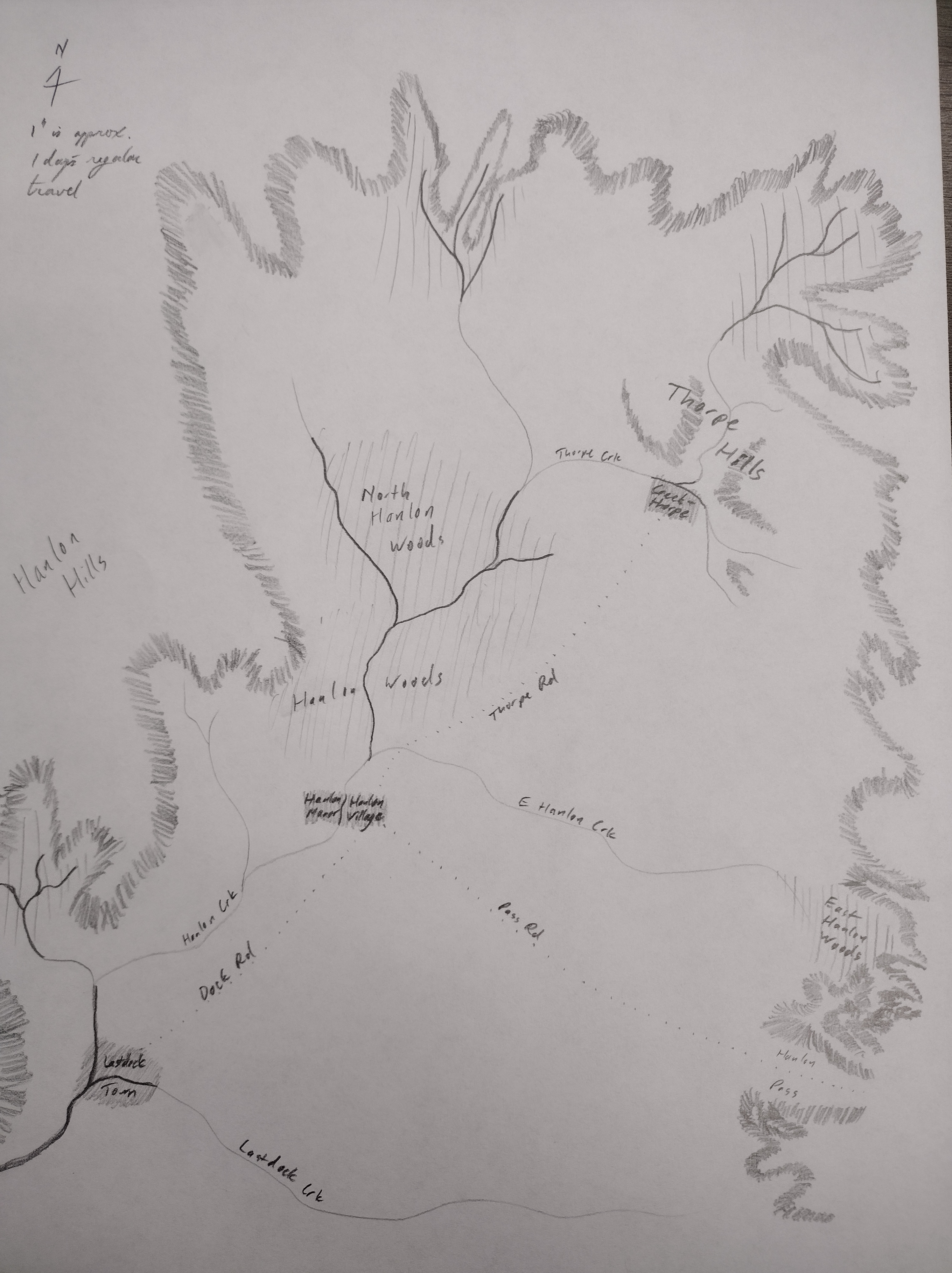
I‘m pleased to report that the expectation I noted a while back has come to pass: yesterday, I returned to work at my local public library, administering a game of Dungeons & Dragons for students of such age as to attend middle school. I also returned with them to the narrative milieu in which I had worked with the previous game: Hanlon. I did so in part because it would allow me to use materials I’d already developed in the course of administering games here (helping me to have more planned and scripted, thus helping me keep things running well). There is thus some sense of continuity available to the returning participants (of which there are some, including my daughter). I did advance the in-game time past when the previous game had ended, so while there is much that is or may be familiar to those returning (including a few inside jokes that I am inserting specifically so they can get them), there is also much that will be new to them, and new players at the table will not be alone in casting about for what’s going on.
We’re back, baby! Image remains mine from here, for what it’s worth
Yesterday’s session was an extended Session Zero, laying out a number of standards and expectations for play; the hosting library wanted me to make sure to make those expectations more explicit this time around than previously. Part of that was talking about the kind of narrative on offer at present, both contextually and in specific, and I returned again to the framing question suggested before: why the neo/medieval(ist) is a dominant setting for Dungeons & Dragons and for tabletop roleplaying games, more generally. Character building also took some time; rather than arriving with pregenerated characters, as I had last time around, I walked participants through building their own, which building followed from the discussion of the kind of game being offered. Character builds should complete soon (I’ve got many participants and short sessions), with play to begin in earnest thereafter.
I’m honestly looking forward to the coming games. It’s been a pleasure to do the writing I’ve been doing in their support, and the participants seem eager to get into things. (That’s always a good sign.) I’ve been plying the skills I’ve developed in years of putting together play-by-post games, setting up structures that should allow for a variety of approaches and some dynamism of response while still nto putting me in the position of having to wing everything. And as I’ve been going along, more and more parts of the narrative have been slotting themselves into place on the page; while the main thrust of what is facing my players is admittedly somewhat silly, it is taking place amid surroundings that both call back to earlier games (as noted above) and gesture towards deeper concerns that permit of yet further future work, as well as offering fertile ground for the next set of people to administer games in. After all, one of the program’s objectives is to cultivate players who can run games of their own, both helping the local library’s programs to grow and helping the hobby itself endure for decades more than it has already enjoyed.
One other note: special thanks to Paul Murphy for his kind support of this webspace!
I remain pleased to write TTRPG (and other) stuff for you; fill out the form below to get yours started!
Finishing from the previous session, participants in the game of Dungeons and Dragons that I had been running at the local public library had their players make final attempts to extricate themselves from the dungeon into which they had paritally penetrated. Following the conclusion of play, participants were asked their opinions of the program and its contents, as well as for ideas for future such offerings, should any be made. Given the completion of another narrative arc, characters were permitted to advance to the next level of achievement, and participants were given their materials as something resembling a parting gift (they had previously been in my possession).
Time to put the books away… Photo by Stephen Hardy on Pexels.com
Having previously conferred with library administration, I can report that it is likely the program will be renewed in the fall term, with specific dates to be determined. It may be that some game other than Dungeons & Dragons will be on offer; it may also be that other groups will be branched out from that which played at my table these past several months. More details than just the dates are yet to be determined, although I am pleased that there is room for the program to continue and for me to remain engaged with it.
As has often been the case in the past when I have concluded a session with students–and the participants in the library’s game have been students, overt educational objectives having been addressed with them by request–I have some reflection to offer. One piece of it is that, should I do such a program again, I will approach it with a clearer and more focused educational agenda. It is easy for me to forget how to deal with participants at the ages with which I worked these past months; my teaching experience had been focused on older students almost exclusively, and it has been thirty years and more since I was the age those most recently at my table are. I do think the question about setting posed late in what might well be called a term–why the neo/medieval(ist) as a dominant setting for Dungeons & Dragons and for TTRPGs, more generally–is a good one; I also think the ponerological question from long before is a good one. (Indeed, play began to move back to consideration of the nature of evil as things went on; I could wish there had been more time to explore it.) There are others, to be certain, and I have time to consider one or more of them before any new program begins.
I think also that I need to go into things with a clearer sense of the narrative I want to address. If I am being honest, a lot of what I did with the kids was flying by the seat of my pants; I did not have as much planned as I probably ought to have had, and there were some times, as I believe I have noted, when I was flatly stalling for time with the participants. In the past, when I have run games, I have generally done so with firmer ideas of what was happening and what could happen; I have done a lot of planning for things, a lot of scripting, a lot of determining what would happen in the world absent the actions of my players’ characters. I did not do so this time, and it left me a bit out of my element. Again, though, I have time to prepare in advance of future programs, and there are definitely some ideas that came up in what I improvised for the participants these past several months that I would like to revisit and expand upon in some detail. What those are, of course, I cannot here say; it is possible that some or all of the recent participants will return for future games, and I do not want to spoil the surprise for them. Part of the value of the story is a sense of wonder, and surprise helps develop such a sense. It’s not the only thing that does, admittedly, but it is one thing that does.
(It might be worth noting here that I do not mean to adapt the Realm of the Elderlings for TTRPG purposes. It might well be thought that I would do so; I am more than passingly familiar with the corpus and its contents, after all, and there is no small worth in the old advice to “Write what you know.” So much said, however, I do find my gaming useful as a diversion from the other things that I do, even if it is often related to them, and it is good to get away from my everyday. Too, it would be obvious, and I do try not to be quite that obvious.)
There are things I think I did well with the participants and which I hope to do again. While it is the case that more than one of them was more concerned with the character looking cool than doing well, and more than one of them thought that a starting character would be able to perform legendary feats as easily as breathing, I did work to let characters attempt things that I knew had no actual chance of success, to not quash the ideas without taking the chance on them–and, when it was actually sufficiently well explained and justified, letting the dice let things happen. It resulted in some interesting happenings during the campaign, providing some entertainment that would not otherwise have occurred–and the game is, fundamentally, about entertainment, even as it does do a number of other things for those who participate in it. And I do think that I offered those players who wanted to avail themselves of it the chance to deepen and refine their characters beyond the surface-level concerns of stats and equipment; there was development on display, and I am glad to have facilitated it.
More importantly, I contributed to the delinquency of minors helped a new generation of gamers get started in a hobby that has been a source of joy and community for me for decades. I have helped them to take some of their early steps into a broader world, one that reaches back more than fifty years and has, in my experience and others’, fostered a worldwide community that comes together, yes, to roll dice and tell lies, but more to make stories together, refining and passing forward some of the most fundamentally human acts. And in doing that, I have made the world just a little bit better, for which I am glad.
I’m still happy to help you have your own TTRPG stuff; fill out the form below for its start!
Picking up from the previous session, pregame discussion for the penultimate scheduled session asked participants to reflect upon narrative endings–namely, what makes for good ones and why those are good. Part of the purpose of the discussion was to gesture towards the stated desire for overtly educational content in the game; part, too, was to develop materials for the final session. As previously, while there is hope for continuation in a future term, there is no guarantee of the same; sequel hooks are already in place if there is a return to Hanlon, but if there is not, then there will, at least, be some resolution to be found for the players and their characters.
Within the game, proper, players’ characters continued their attempt to withdraw from the dungeon they had been investigating for the last many sessions. It is the case that their decision to do so in the previous session came as a surprise to me, and it was not a universal that they wanted to do such a thing; there were a couple as wanted to press on, but the majority thought they should escape. I’ll confess to a little chicanery in keeping them in the dungeon for the remainder of the previous session, although I had evidently given myself enough narrative room previously to make it make sense in context. (The characters had, some time back, tripped a trap that had no visible effects at the time; the players accepted that the effects manipulated the layout of the dungeon to some extent. It was serendipitous; I wish I could take credit for foreseeing things in such a way. I suppose I have more to learn about running games, even all these years into doing so.)
I suppose there is a lesson to take from the experience in that having things happen without obvious effect now allows flexibility in storytelling later, something of a variation on Chekhov’s gun. I’ve done a few such things, as I think on it, whether a pressure plate triggering some strange ticking or a spell scroll making itself available to one or another of the players’ characters’ who might, if it is remembered, find some use in the party’s current situation. Railroading–that is, forcing players’ characters into a single path of action–is generally regarded as a bad thing in tabletop roleplaying games; players like to have agency over their characters’ lives, even if those characters are moving through a dungeon that generally admits of “forward” and “backward,” with the latter leading to no treasure or glory and most characters being actively interested in at least one of those things. If there is to be any of it, whether because of outside demands or because a person running a game has to scramble to address something entirely unexpected and has to stall for time to do just that, it works far better if there is something on which it can be predicated sensibly within the context of the game, itself.
How and whether I will make use of any such lessons, I cannot know. Whether or not I will run a game again is uncertain, honestly; I am not so young as I once was, and other things increasingly command my time and attention. Gone are the days when I can spend many hours of each day poring over the books and staring at the webpages I’ve needed for the games I’ve played. I do nurture some hope, though, that some of what I’ve been able to do at the table so far will translate to others taking up the work of running games, helping others to sit around their own tables, rolling dice and telling lies to the delight of those taking part.
I’m happy to help you have your own TTRPG stuff; fill out the form below for its start!