Read the previous entry in the series here. Read the next entry in the series here.
The following chapter, “Kettle,” opens with an account of Kettricken’s removal to Jhaampe and her searches for Verity in the Mountain Kingdom. It moves thence to Fitz joining the smuggling party’s preparations for departure. More have joined, and Fitz replaces one of the regular cart-drivers who has fallen ill. He finds himself charged with driving an old woman who complains of the changes.
An image of the title character by ladyatropos on DeviantArt, here, and used for commentary
The party sets out through the snowstorm, and Fitz attempts to chat with his passenger. She is generally quiet, however, though she does identify herself to him as Kettle; he recognizes her as being from Buck Duchy, which she does not deny. They do warm towards one another as the day goes on and the party makes camp for the night. The disposition of the smugglers in the camp eases Fitz somewhat, and Starling eases the rest with her music.
Fitz is disturbed from his following rest by the return of Nighteyes, who glosses his adventures with a far-away wolf-pack. They confer, and Nighteyes reveals that he is bound by Verity’s command no less than Fitz is; they depth of their connection startles Fitz. He finds, too, that he must account for Nighteyes to the party, which he does–though clever phrasing is needed to quiet Starling’s questions before they form.
Later in the night, Fitz feels the touch of Regal’s mind through the Skill. It unnerves him, though he realizes it is not directed towards him. He is more disturbed when he sees what Regal is able to do through the Skill, and he learns that Regal still searches for him along the paths to the Mountain Kingdom. Nighteyes offers some small reassurance.
Yet again, I find myself pressed not to read a novel written decades ago against current political events. In the chapter, Hobb, through Fitz, describes Regal as parasitic, “as a tick or leech [that] bites into its victim and clings and sucks life from” that victim–Will, in the present case. It is a particularly vivid image, apt enough for a despotic and illegitimate ruler. It is also one that seems to be something at odds with what such an awareness as the Wit provides would suggest. I comment in another webspace about the recognition of a (presumably non-Old Blood) falconer that such creatures as vultures and cockroaches serve useful purposes in the world despite their unsavory presentation; something similar would seem to be called for here. Fitz, however, uses parasites as similes for Regal, whom he hates
To borrow from Malory, the parasites “but did their kind” and do not deserve opprobrium for it–the more so because it is implied that such creatures do not really register to the Wit. That is, the milieu suggests that within it, although wolves and bears and eagles and weasels are sentient enough to conduct conversations through the Wit, smaller invertebrates are not. If they are not sentient, as other creatures–to include Regal–are, then they cannot be held to account for their actions, as such, and it seems…out of keeping with the milieu for one of the Old Blood to look down upon natural processes so.
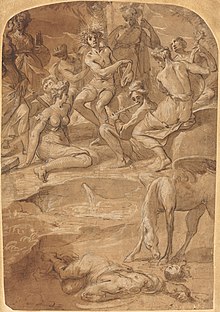
Apollo and the Muses on Mount Parnassus by Johann Christoph Storer, held at the US National Gallery of Art; I am told it’s a public domain image.
I make my prayers that some of nine might answer–
I know I’ll not hear that nonet at once,
And who scores for such a chorus, anyway?–
But all too often
The winds I would send forth
Are swallowed up by stronger breezes
Drowned out in cacophony
And come to no more effect than many other prayers
Directed more diversely I gave up such devotions as others regularly observe
Seeing no effect from them that I would prize
Or that I thought altered by my words
But I still open myself to visits from those nine
Because they or something like them happens
And I can sit and scrawl out something
Or strike small blows in some succession
And have something emerge I show to others I can hear the song and praise its unseen singer
But if no music finds my ears
I cannot say somebody’s called a tune
Read the previous entry in the series here. Read the next entry in the series here.
The following chapter, “Smugglers,” opens with a brief comment about minstrels’ social status in the Six Duchies before moving to Starling’s return to her lodgings, where Fitz has elected to spend the night. Fitz soon absents himself, bathing and taking stock of his situation. It is not to his liking, but he recognizes he has no choice in the matter.
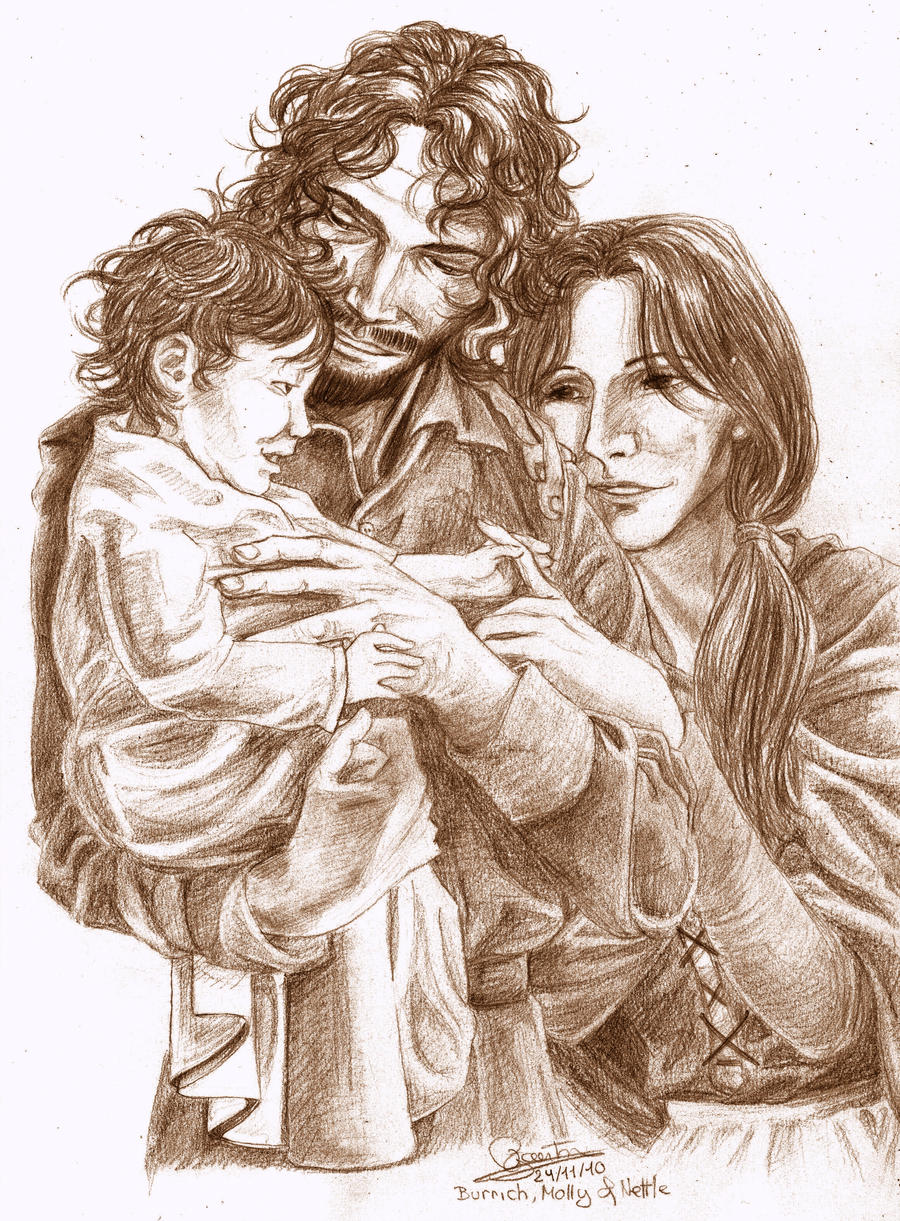
Happily ever after by Andromeda-Aries on DeviantArt, here, offers something like what Fitz sees (and is used for commentary)
Returning to Starling, Fitz allows her to reshape his hair and beard in the interest of making him less immediately recognizable by members of his former caravan in the town. He is pleased with the result, and he accompanies Starling as she makes for the smugglers. She tells Fitz that they will be accompanying a group of pilgrims who had been delayed in reaching the Mountain Kingdom by Regal’s embargoes.
At length, they reach the smugglers and begin to dicker over the terms of their passage. They eventually strike a deal, and Fitz and Starling overnight at the smuggler’s house. They share a bed but no intimacy, and Fitz soon finds himself dreaming of Molly. He sees her invite Burrich into her home more fully–and he sees a wolf running alone across the fields.
It is interesting to note in the present chapter ways in which Fitz’s upbringing continues to hamper him when he is removed from the social circles of that upbringing. Some of that hampering is to be expected, of course; few do well in situations for which they are unprepared, and moving through different social groups generally brings a person into situations for which they are unprepared. My own experience bears it out; I was raised as a working-class Central Texan (with some caveats, to be sure), so I had several culture shocks when I moved for graduate school and a couple of times afterward. Now that I’m back in the Hill Country, I find myself operating in different social circles than my parents, and I am not always at ease in them. I misstep repeatedly, just as Fitz does in dealing with the smugglers–for which Starling rebukes him, if quietly.
It is another instance of me reading affectively, another instance of me reading in ways my training in graduate school would scorn, I admit. I should be looking at the chapter through one theoretical lens or another, even if so simple a lens as that of reception studies, which I employ elsewhere. There are political commentaries to be found in the chapter, certainly, and any number of other analyses could be done, I’m certain. I might even still have the necessary equipment to conduct some of them. But as I am further and further removed from the search for tenure-track work, as I am further and further away from the classroom, I find such readings less and less compelling. This is not to say they are not of value; they are, illuminating texts in ways that do not appear to causal discourse and revealing things about writers and readers and the contexts in which they are enmeshed that can be used to effect. That they are, though, does not mean I am the person to perform them–and I may never have been, despite my earlier work to that end.
Read the previous entry in the series here. Read the next entry in the series here.
The next chapter, “Blue Lake,” opens with a brief description of the titular lake and town. It moves thence to Fitz walking through the night and into day back towards the watering hole where he had been captured. He takes some time to rest, eat, and clean his wounds; when he sleeps again, he dreams of Burrich and Molly once again. The dream reaffirms to him, painfully, that those in his old life think him dead.
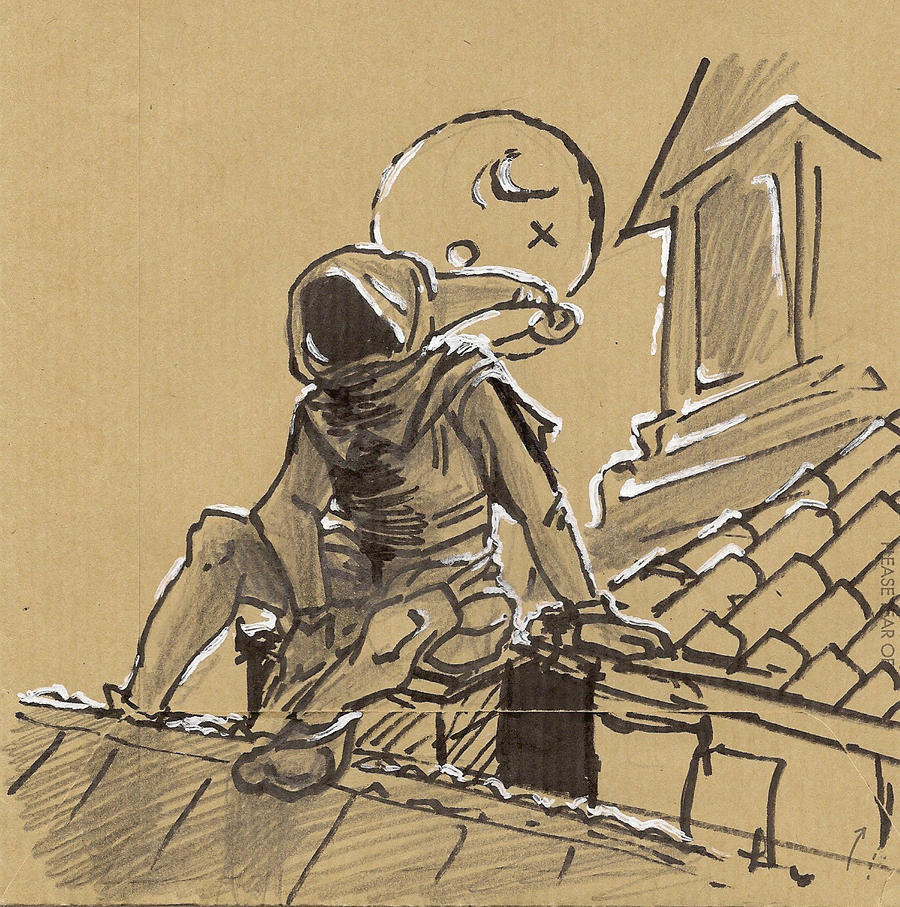
Seems a fit place for an assassin… +Rooftop+ by u-chi-ne on DeviantArt, here, used for commentary
At length, Fitz reaches Blue Lake and considers his situation. He describes the town as he reaches it, noting its low and sprawling nature. He also resupplies as best as he is able with his limited resources. He is stymied, though, when he tries to book passage across the lake, and finds a place in an inn for the duration. Lodging there allows him to learn the local gossip, which eases his apprehensions about being captured–at first. Fitz learns not long after that Regal himself is out on the search for him.
Fitz makes to surveil the lodgings Regal is reported to have secured. He also plots how he will make another attempt on the usurper. As he moves to enact that plan, a weasel, sent to him by the final urgings of its bonded Old Blood partner, warns Fitz of a trap awaiting him–one in which Will is involved. Fitz thanks the weasel for the warning and speeds him on his way to his own vengeance.
When Fitz returns to his inn after aborting his mission, the minstrel Starling greets him, offering to share a meal and tidings with him. Fitz apprehensively agrees; she reiterates to him that she seeks a song that will survive her, and he once again tries to put her off. She persists, however, and lets him know that there are still smugglers working to move people and goods between the Six Duchies and the Mountain Kingdom, despite Regal’s decree of a closed border. Starling offers to take him to them, and she notes that his actions in Buck had saved her brother. It eases him.
Once again, it is difficult not to read the chapter against current politics, with ostensible hardening of borders at the behest of corrupt leadership juxtaposed with the continued permeability of those borders. The last part of the chapter, in which Starling tells Fitz that his actions had done some good in the world, is a welcome bit of respite. Hobb makes a habit of putting Fitz into less-than-pleasant situations, and he does not respond optimally to them, in the main. (I am not claiming I could do better, of course, but one need not be able to do a thing to know that a thing can be done. How many coaches train people to perform better than they themselves ever did?) To have outside acknowledgement that the things he has done were helpful, even if only in small ways and only temporarily, seems a particular blessing. It is something I have occasionally enjoyed; every so often, a former student lets me know they’re doing well or thanks me, and it is gratifying.
In Hobb, though, it promises that worse is yet to come…
On 29 June 2018, Allison Schrager’s “The Modern Education System Was Designed to Teach Future Factory Workers to Be ‘Punctual, Docile, and Sober'” appeared on Quartz.com. In the article, Schrager asserts a need to rethink current educational structures in the US–and to have that rethinking driven by corporate leadership. She glosses the history of public education from the viewpoint of industrialists invested in having a workforce habituated to factory shift-work standards, noting the unease of transition from self-directed home-based work to boss-commanded factory work. She also calls upon current business leaders to consider and push for changes to educational systems.
This is the kind of thing that happened with my daughter. Image from studentreasures.com, here, used for illustration
Schrager is, in her core assertion, correct; the educational system/s in the United States were set up in large part to respond to circumstances that are no longer in place. Manufacturing is an increasingly small part of the professional environment, so having systems of schools set up to supply manufacturing workers with ready-to-go employees is not wise. (Whether it ever was is another question entirely, one worth considering, but not one I’m going to go too deeply into here at present.) She is correct, too, in noting the sociocultural shifts that accompanied the economic shift from home-based work to factory-based. And there is some sense to the idea with which Schrager concludes, that those who will complain about the mismatch of graduates’ abilities and their own interests would do well to work to change schooling.
But.
Corporate and business interests leading changes to education is what has produced the putative problems identified in the article–as well as the many, many other problems identified in other places. Testing companies are easy examples to find, certainly, but there are others; calculator manufacturers and textbook producers (when separate from the testing companies) are also prominent, and there is a long-standing comment about the economic utility of a workforce smart enough to run machines but not critical enough to ask why they need running. Any changes to schooling need to be made with a clear idea in mind of what the point of schooling is–and I am not a fan of the idea that school ought to be a place where a person learns how to have a job.
As I write this, it is my daughter’s 100th day in school. She was excited at the prospect, certainly, and I am glad she was; it’s good to see her enthusiastic about being with people her age and forming relationships that may well last for decades. (I’m still in contact with a very few people I knew when I was that age, and I am aware of the relative lack of such connections I have; living in a smaller town tends to point out who all stuck around and who didn’t.) It did prompt a bit of reflection on my own educational experience, some of which was at the very school my daughter now attends. Certainly, things have changed–and largely for the better. Her school environment is immensely more nurturing than I remember mine being, which I think good. (I admit I approached school with a bad attitude–not disdainful of learning, but dismissive of my fellow students’ intelligence; it did not make for a good time, and I do not wonder much at my lack of connection to people in my hometown.) There seem to be more opportunities available to her than were to me, as well, and that is to the good. And what I have seen of the curriculum so far seems generally fine, though I have some specific disagreements–but that’s always true.
I know that I am not in line with many prevailing thoughts when I express my worry about education-as-job-preparation. I’ve been at the front of too many classrooms whose students viewed their degrees only as credentials for work to be sanguine about the prospect of the same thing happening to my daughter. And, yes, I have chafed at times at the mismatch of my own academic training and the professional circumstances towards which it was aimed; I do not know that I will ever be over the bitterness of it. But I also know that that training and the system in which I was reared (and how applicable “system” is to something that has emerged out of no unified plan, even if it does tend to favor particular sets of people consistently, is an open question worth discussion–in another place and time) are products of that same impetus Schrager describes. I do not necessarily share her ideas about the best way to amend things, but I very much agree with her that changes are needed.
Change is always needed. Everything can always be better, and it cannot become better while remaining as it is.
I don’t claim to know what the changes would look like that would make things better. I imagine they would have to destabilize the current systems to a great degree, which would cause difficulties; while testing companies and many other corporate interests in education are decidedly problematic, many or most of the people I’ve known who’ve gone into teaching do so to help people, and they would be displaced by such structural shifts. So I acknowledge that change is likely to be slow and that it is certain to be fraught. But that doesn’t mean it doesn’t need doing–or that it’s not worth the effort.
Read the previous entry in the series here. Read the next entry in the series here.
The next chapter, “Suspicions,” opens with a brief note on the addictive ecstasy of the Skill. It moves swiftly thence to the caravan’s travel the next day. Fitz, having a clear head from not having drunk to excess the previous night, works along the way; when he refreshes himself, Starling pulls him aside to warn him that Regal’s guards have been looking for a man who looks very much like him.
To be fair, it is a distinctive look. FitzChivalry Farseer by WhiteElzora on DeviantArt, here, used for commentary
That night, Starling sings a song about Fitz’s martial exploits. Members of the caravan discuss it and its implications as Starling expounds on the history. An uneasy night passes for Fitz before the caravan continues, and the young woman whom Fitz had refused previously tumbles to the idea that Fitz is himself and pursued by Regal’s forces. Starling speaks with him after, intimating a desire to follow him on his path to Verity. He tries to set it aside and deflect her interest, to little avail.
A few more days pass before Regal’s forces come upon the caravan. One of the guards had been among Fitz’s tormentors. They do not recognize Fitz at first, but in the night, they seek to come upon him unawares. The Wit prevents it from happening, and, after an inspection that confirms his identity, Fitz tries unsuccessfully to flee.
Fitz wakes once again to pain, and his captors take him off. They soon begin to experience no small gastrointestinal trouble, results of Fitz’s surreptitious poisoning of them. The trouble worsens, and guards begin to die; none of them survive past the next midday. Fitz frees and resupplies himself, and he is bolstered by a faint touch of Nighteyes’s mind upon his through the Wit.
It is hard to be aghast at Fitz’s reactions in the chapter, although he does kill several people in a particularly unpleasant way. Still, they are taking him to be killed–again–in public agony, so it is difficult to feel sorry for his slain captors–even aside from the one who had worked upon Fitz in the previous novel. Hobb does point out through the last of the guards to die that some people simply get swept up in things there is no way they can recognize the overtones or implications of, but, particularly in the present climate, it must be recognized that simply going along and following orders does not absolve a person of responsibility for the aid and support of evil. Not all who are, to follow Arendt, banal in their evil are punished for their complicity as overtly as the unfortunate final captor in this chapter, but some are.
It is another reminder that more people need to heed than do. It is another reminder that evil needs to be opposed–and that what many think evil is not.
Read the previous entry in the series here. Read the next entry in the series here.
The next chapter, “Shepherd,” opens with a brief note about Chade’s activities after the death of Shrewd and Regal’s removal to Tradeford. It moves thence to Fitz’s description of the convening caravan. He dreams that night of Molly, realizing she had left him to protect their child–a daughter whom she is delivering even then, aided by Burrich. Fitz almost leaves off what he is doing to go to them, only to be forestalled by the echoes of Verity’s Skill-driven command.
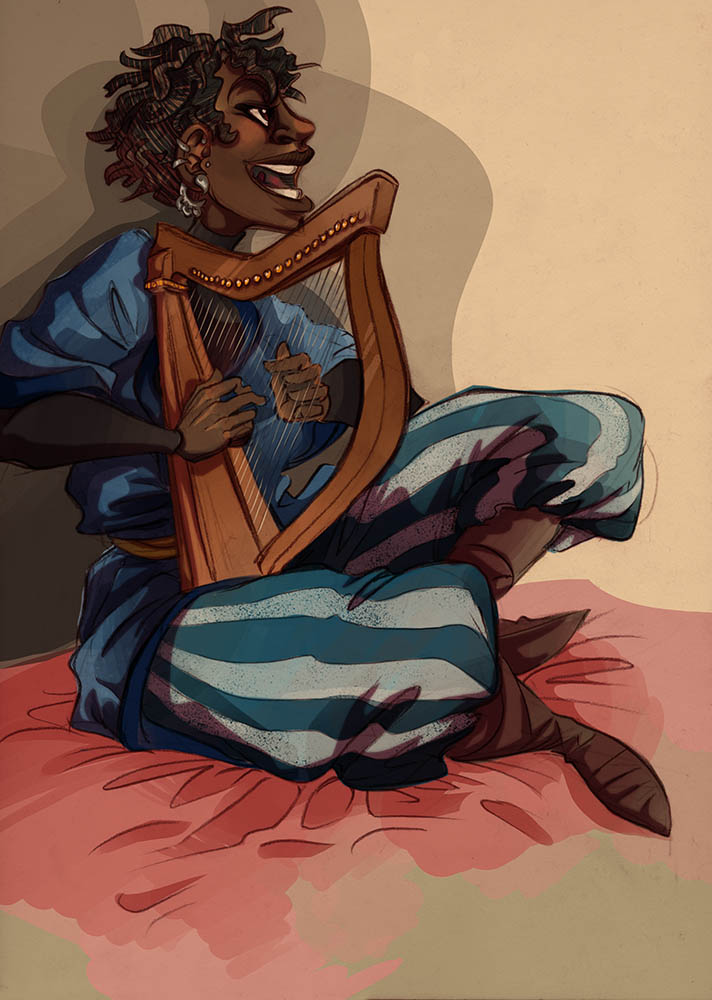
Starling Birdsong by Mimi-Evelyn on DeviantArt, here; image used for commentary
Fitz considers the command upon him even as he cannot resist it, and he spends the next few days in a daze, plodding along with the caravan and attending to his assigned tasks with it. A minstrel traveling with the caravan, Starling, sometimes seeks his company, and guards in local livery give Fitz pause, but the journey is long dull. Fitz considers the possibility of raising his daughter with Molly once his work for Verity is done.
The tedium is interrupted by the apprentice of one of the performers traveling with the caravan. Fitz makes to tend to an injury she has incurred, and she propositions him. He refuses her offer, knowing that it would be no comfort to him to accept it, and she grows angry, indeed.
I find myself reading affectively once again, particularly as I read Fitz’s consideration of being a father. Certainly, father-figures feature in the Farseer novels; Fitz is marked by separation from Chivalry, Chivalry is separated from his father by his own fatherhood, and the surrogates that come into Fitz’s life–Burrich and Chade–clearly love him but regard him other than as a son. That he would turn over the idea of fatherhood in his head would not be wondered at even were he a more “normal” son and father. The Six Duchies clearly expects that a child’s parents will be present and in a relationship with each other (something answering to the putatively prevailing expectations of Hobb’s presumed primary audience), and, being in such a situation myself, I note that I still have thoughts in that line–and my daughter was born in 2014.
And I share, perhaps, with Fitz (again, I know I am reading with affect, and I ought to know better, but still…) an eagerness to be part of my child’s life–though I doubt it is to the extent that a young man who grew up without a father would. Knowing what is coming–this is a reread–gives me pause as I consider it, and I am reminded that I am fortunate to have been with my child as much as I have been. I am also reminded that I need to give my kid a hug, telling her once again that I love her, next time I see her–and I am glad it won’t be too long…
On 5 January 2017, a revision of Sara Holbrook’s “I Can’t Answer These Texas Standardized Test Questions about My Own Poems” appeared in the online Huffington Post. In the article, Holbrook discusses the misuse of her poetry by the authors of the 2013 and 2014 Texas standard middle-school assessments. She does so first by noting that one of the poems used by the test is distinctly inappropriate for middle-school readers; she then remarks on the for-profit nature of standard test production and apologizes for the authors’ oversights. Holbrook moves on to note the unfair demands on teachers tasked with test-prep, citing one teacher who had emailed her with questions. She then points out the folly of the test questions and of the tests themselves, noting a study that asserts demography is as predictive of “student achievement” as the tests used to assess it. After comes a screed against reliance on the tests, followed by a parsing of the questions asked by the test about her own poetry.
If only… Image taken from Texas Monthly, here, used for commentary
I read the article from the vantage of being a product of Texas’s public education, being one of the “test run” for the assessment culture that has grown up (I do not apologize for the pun), being a former teacher, having been one of those paid to write exam questions (although for college rather than high- or middle-school students), and being (at least in my own mind, through with some outside evidence) a poet; as might be thought, I have a fair bit to say about it and about the broader circumstances that surround it. As might also be thought, little of it is favorable. Some of it even includes naughty words; they are the right ones, I think.
As someone who came through public education in Texas–I graduated from the local high school in 2000–I got to have a fair bit of experience with the rites and rituals that mark moving through the grades, though they have since grown more strict and ossified, constraining more people more tightly in their stony grip. Grades mattered, yes, but not so much as the tests; however high a GPA, a bad day during testing week meant make-up work or worse. I am fortunate in that I take tests well by simple virtue of practice, but being accustomed to testing rather than to more authentic, organic ways of demonstrating proficiency or mastery, I have suffered since; I was taught to test in school, and even in graduate school, I spent more time worrying about completing assessments and passing benchmarks than about what I ought to have been. It’s part of why I don’t have an academic job. Clearly, I’m not going to be too happy looking back upon it.
I think I am part of the groundwork for the assessment culture that has grown up in education since the early 2000s. In school, I was part of the gifted-and-talented program; the idea is that students deemed to be academically exceptional are placed into more challenging, accelerated coursework so that they can more fully develop their intellectual faculties. But what it was for me was more a series of tests that seemed never to end than anything else; I recall being pulled from music and gym classes to take standardized test after standardized test, something like “Let’s see how much we can push the smart kids and dial back slightly from that.” While my later school years did offer me coursework that helped me in college, I feel I missed out on a lot of what I would have otherwise gotten. My brother felt similarly; when he had the opportunity to get into gifted-and-talented work, he refused it, citing my example. When, therefore, Holbrook comments about what is lost to students when they are obliged to focus on test prep, I cannot help but think she is right, that standardized testing is wrong.
I know I have made much of not having secured a full-time continuing teaching position; that I have made much of it comes from having long, long wanted to teach as a career. I trained for it, and no small amount of that training had me working in classrooms with students–which meant I got to help with test prep for a fair bit of the time, and I got to help proctor exams during my student-teaching semester. The kind of nervousness betrayed in the email Holbrook presents was common among the teachers with whom I worked, and no wonder, given that their already-insufficiently-compensated work was imperiled by students having a bad day (or coordinating efforts, which I know happens; I’ve been part of it in other circumstances), and I have to wonder if they knew then as I know now that years of work in the classroom looks to folks hiring like no work at all. (I’ve said it before, but I do not tire of it: fuck George Bernard Shaw.) And test-prep is a time-suck for all involved; it does get in the way of having teachers who enjoy the job and are driven to excel at it no less than it does the students’ love of learning. Neither is a good thing; both are reasons to get rid of the droning dull exam.
I do have to say, though, that working on writing exams was a generally pleasant experience. I made a fair bit of money doing it when I needed a fair bit of money; I benefited from exams being for-profit concerns, though not nearly so much as did the people in charge of such companies as I contracted for. And I was able to put my experience taking so damned many exams to good use; I had and have a developed sense of what questions are “supposed” to look like, how answer-sets should function. As such a professional, then, I quail at the kinds of questions Holbrook reports; the answers are inane, and there are answer-sets in which no one answer appears as best, which is the supposed standard used to determine whether or not a student has answered “correctly.” I held my PhD when I wrote tests; I believe I can claim some expertise with the subject matter. Like Holbrook, I cannot settle easily upon an answer; I can hardly think that seventh- and eighth-graders would do better–unless they have been carefully directed to approach poetry in exactly and only one way, and that a way that those of us who do or have done the work of looking at literature do not. It’s not an argument in favor of the kind of test Texan students take.
And that last bit scares me as someone who has some interest in “creative” writing. Here, I disagree with Holbrook to some extent; I do not think that I have the sole and definitive answer about a poem’s meaning, even when I’ve written the poem, and I do not think that my statements about intent are necessarily authoritative (again, I do not apologize for the pun). Wimsatt and Beardsley have the right of it; authorial intent is a faulty standard to apply, in part because it is outside the text, and in part because it cannot be accurately ascertained. I do not necessarily recall what I was thinking when I wrote a given piece, and even if I do, what I remember may not be what was. Yes, the tests ask about authorial intent rather than narratorial motion (which is shitty test-writing), but even asking the author–as Holbrook calls for–is not necessarily enough to get the “right” answer. Nor, again, is it the case that there is one “true” reading of a poem; indeed, one of the things I sought to stress to my literature students is that the very thing that keeps a piece of literature under study is that it sustains multiple interpretations. But that runs counter to multiple-choice exams, which is why it doesn’t get the support it ought to–and which is another reason why the damned tests, as written, are so fucking bad.
None of this is to say there should not be standards. It’s also not to say there shouldn’t be some standardization; there are reasons a nation-state might want to insist on such things, and some of them are even good ones. It’s clear to me, though, that the standardization that is in place is not aimed at serving such ends as might be thought of as worth having; rather, it’s a means of control and punishment, a means to bring others to heel–and for certain select groups to take money from the public purse as they do it. It’s a load of bullshit, somewhere between the Frankfurtian and the Fredalian, and it stinks, indeed.
Read the previous entry in the series here. Read the next entry in the series here.
The next chapter, “Hiring Fair,” opens with a brief commentary on slavery in the Six Duchies before moving on to Fitz’s difficulties in setting out to reach Verity, as he has been commanded through the Skill. The geography of his expected path is glossed, and he begins to look for means to cross the intervening distance. He also considers his circumstances and the fact of his isolation.
I see the earring as something like this piece on Etsy, here; image used for commentary
As he makes his way onward and resupplies, Fitz is offered gold for the earring he had from Patience, that had been Burrich’s, as well as information about its earlier provenance. With difficulty, he refuses the offer, keeping the earring and looking for work that will take him in the direction he needs to go. He does not find it that day, but he does learn local gossip: Chade is being hunted as he is, with hefty rewards offered that would likely not be paid. And when Fitz sleeps, he dreams of Chade.
The next day sees him find some work and the promise of a caravan to accompany. He works throughout the day on odd tasks to see him through, and he muses on the kind of life he might otherwise have had as he considers how to answer Verity’s demand.
It is good to see the earring Fitz has deliberately retained come up again. Authors keeping their characters’ equipment in mind is always good to see; narratives do well to follow their own rules. Too, having the earring appear in the chapter both on Fitz’s person and in descriptions of him promulgated by Regal’s forces serves as a reminder of the dangers of sentimentality and nostalgia (and I am not unaware of the irony of my making such comments; I am more nostalgic than is good for me and more sentimental than is comfortable for most folks). Keeping too tight a hold on the past imperils the present and the future.
Fitz’s musing on his individual inadequacy early in the chapter is of some note. Many “heroic” narratives go to great lengths to identify their protagonists as sufficient to all the tasks that confront them–perhaps with struggle, perhaps with training, but still sufficient. (It is for such reasons that many who are themselves execrable look to “heroic” narratives for inspiration and seek to link themselves therewith; they imagine themselves as the protagonists, feeling adequate for once.) Fitz, although long since a subversion of “heroic” narrative tropes, is, by his own admission, not enough on his own; he cites the contributions of others to his skill and performance, confessing his insufficiency in their lack. It is something to which Donne speaks, of course, that all are interconnected, and others echo him.
More would do well to listen better and to heed what they hear.
Read the previous entry in the series here. Read the next entry in the series here.
A chapter titled “Assassin” follows, opening with a passage about the recent Skillmasters of the Six Duchies and the strange manner in which Galen, the last of those, formed a coterie. It moves thence to track Fitz’s reconnaissance of Regal’s palace. He is able to exploit gossip and the largesse of a few sympathetic people to gain entrance, and, when within and safely concealed, makes ready to carry out his assassin’s work.
FitzChivalry Farseer by vihmakivi on DeviantArt, here, gives some idea of how the haggard assassin looks; image used for commentary
Thinking himself ready, Fitz proceeds, noting the grandeur of the halls through which he creeps as he goes along. One of his former tormentors spots him but does not recognize him until after Fitz has killed him.
After disposing of the body as best he can, Fitz continues on his errand, still creeping and marveling. The efforts of Regal’s Skilled servants break upon him, and Verity steadies him through a hint of that magic; Fitz hides and forces himself to calm before proceeding and marveling yet further.
At length, Fitz finds Regal’s chambers and sets to work poisoning his possessions. Verity queries him through another touch of Skill, and Fitz responds in kind. But as Fitz is about that task, he is spotted by a guard; though he kills the guard, another of his tormentors, he realizes that Will had been using the guard’s senses–he has been found out. Fitz makes to flee, only to fall further into Will’s power, and he realizes that death is once again his only option. Verity then reaches out through the Skill in anger and power, binding Fitz to come to him and leaving him room to flee.
Fitz makes his escape, stealing a horse along the way, but he is recognized as himself as he does so. As he flees, he comes through the King’s Circle and is revolted by the depredations he knows transpire therein. He eventually gets clear of Tradeford, sending the stolen horse back to its stable with the Wit, and begins another journey–this time, to join Verity, wherever he may be.
The present chapter occasions a sharp change in the direction of the novel. Leading up to and into it, Fitz had had the goal of killing Regal–though he was often distracted from it by idle thoughts of the life he had once led and the possibility of leading other lives yet, whether among the Old Blood or among the more “normal” people of the Six Duchies. Leaving the chapter, however, he has the burning command imposed upon him, not just by the king he acknowledges as rightful, but by force of magic; it does not leave his mind as the desire to kill Regal appeared to have done on occasion.
I suppose, as I consider the chapter I have reread again, that the command inscribes another trauma onto Fitz, who has already suffered many (and who does not deal well with several of them–as is to be expected in a milieu that admits of no therapies for such). It is one that Verity himself has acknowledged is a thing wrongly done, even if done without intent. Again, my understanding of and training in trauma theory are sharply limited, so I would not venture to say much–but I will remark that it seems Fitz is being set up for yet more pain to come.