As it happens, I’m working primarily as a freelance writer and tutor at this point, other work not being what I’d thought it would be. Now, those of you who’re looking at this know how I write and what I tend to write about, and those of you who keep coming back seem to like what I do, so I’ll put it to you this way: If you’ve got some writing that needs doing, some writing that needs reviewing, or some literary or writerly thing that seems to be messing with you, or somebody you know does, reach out. My rates are reasonable, and my results speak for themselves.
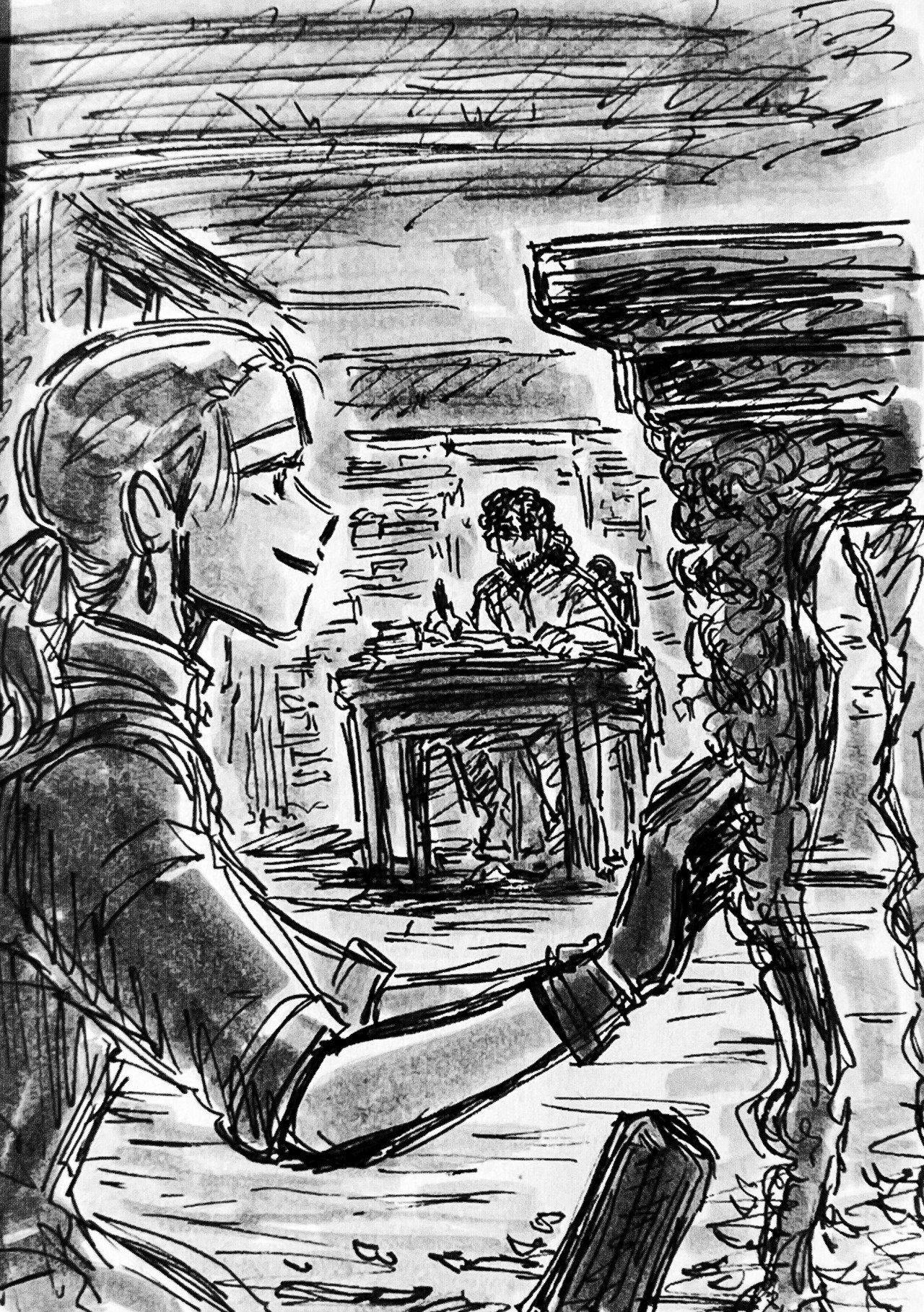
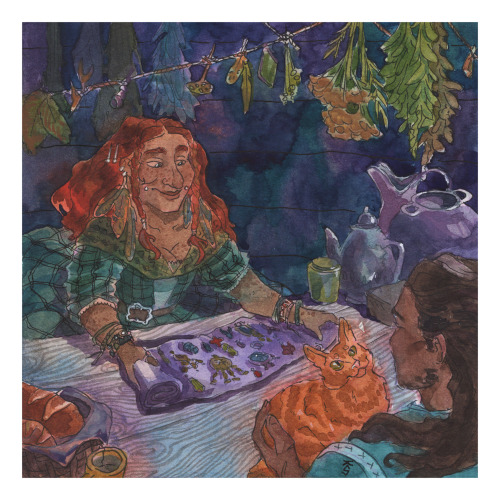
How can you say “no” to this? Image is mine, multiple ways.
I work in the following:
Literary research
General informational/documentary research
Proofreading
Style editing
Grant writing
Copywriting
Creative writing (especially poetry)
Literature and writing tutoring
So, if you or someone you know needs help with any of those, reach out in the comments below. I’ll see them there!
I look forward to hearing from and working with you!
Read the previous entry in the series here. Read the next entry in the series here.
The following chapter, “Obliteration,” opens with a selection from an account of the battle in Bingtown Harbor before turning to Fitz returning to his room in Lord Golden’s suite to find an argument between Golden and Laurel in progress. He halts rather than intruding, overhears the message Laurel has for him, and enters to confer with the Fool after Laurel stalks off. He also notes a need to go into town to offer a series of apologies, and the Fool notes such arrangements as he has made as they confer about Fitz’s meeting with Kettricken. He also stalks off to his own private room, leaving Fitz-as-Badgerlock to go about his day.
Yes! YES! Image from one of many internet forums, used for commentary.
When Badgerlock meets Laurel in the stables, she takes him to what had been Burrich’s residence in them–and Fitz’s, early on–to confer privately about news she has received from her Old Blood kin of Piebald machinations at work in Buckkeep. The remaining Piebalds, following the maimed and convalescing Laudwine, thirst for power and revenge; Badgerlock glosses his own recent local encounter with the group, and he wonders if Chade can be of any help to Laurel and her kin. They part amicably, understanding one another in that regard.
After, Badgerlock takes his time getting to Jinna’s, purchasing gifts for her and waiting as she conducts her business before being taken inside. And in the wake of his going in, Fitz thinks of Molly, as he had not in some time, noting his lack of connections that had been highlighted by the conference with Kettricken. The two talk about Jinna’s magic and what it shows her of Badgerlock, and her cat interrupts rudely as talk turns to Hap and his dissolution. Badgerlock’s lack of knowledge becomes evident, and he makes off awkwardly to see to his foster-son.
Hap complains of the apprentice-work to which he is put, Badgerlock reminding him that such work is only to be expected. It falls on deaf ears, as do Badgerlock’s concerns about Hap’s infatuation with Svanja, a local girl.
After, Badgerlock returns to Buckkeep Castle, where a summons to Chade awaits. It gives him cover to return to his hut near Forge, and he speeds thence as best he may. He finds that it has been visited, likely by a neighbor, and he notes the thefts as he culls his work. Some things, he retains; most go into a fire. Taking with him pots of preserved herbs, he leaves the rest to burn, uncertain of what might have escaped him.
I will say that Fitz is not the only one who looks back over the writing they’ve done and has thoughts of burning it all. I feel the temptation myself, even now, even about the things I’ve managed to shepherd into publication and which I know have received some approval. (I’ve been cited a few times. It’s nice.) And there have been times, indeed, when I’ve succumbed to the temptation, purging papers and files and things that I have had–and there have been times I’ve regretted doing so, largely because events occurred afterward that would’ve been easier for me to address had I had what I had thrown away.
At the same time, there is only so much baggage from the past a person can carry around. I know that from experience, too. So I can’t say that Fitz has the wrong of it to burn it away…
Read the previous entry in the series here. Read the next entry in the series here.
The next chapter, “Shared Sorrows,” begins with verses from Starling Birdsong before turning to Fitz waking where he had dozed off while awaiting Dutiful. The Prince has not attended his scheduled meeting, occasioning rueful disappointment from Fitz. He leaves a message for the wayward royal and returns to Chade’s hidden rooms, where he is again confronted by the power of Thick’s Skill. He steels himself against it and, when Chade addresses him as though he were a young child, intercedes, noting Thick’s different intellect and Dutiful’s neglect.
Chade swiftly conducts Fitz to a meeting with Kettricken, who mourns for the lost Nighteyes. Her mourning triggers Fitz’s, and the two weep together for a time. Kettricken then brings up the topic of Dutiful’s Wit, noting its source in her, and she speaks with Fitz regarding his comfort and care. She also repeats something of Shrewd’s old gesture to Fitz, and Fitz asks her about Rosemary. She notes the disposition of her former adversary, as well as others, and Fitz begrudgingly accepts the reasoning involved.
Their talk turns to the Piebald threat, both as it directs itself toward Fitz in particular and as it menaces the Six Duchies more generally. And it takes in some of the Outislanders’ concerns, as well, before Fitz excuses himself with Kettricken’s welcome wishes for healing.
The return to Thick in the present chapter would seem to be a motion towards consideration of neurodivergence and disability. As is the case with many things, my scholarship and background is deficient in terms of treating those concerns, although I’d imagine that such scholars as Kisha Tracy would have more to say about it. (At least I can point to other scholars this time!) From the vantage of re-reading, I can say that it’ll be something of a theme, moving forward; Hobb gets into many kinds of difference in her novels, treating them openly (if perhaps not always ideally) in a way that too many other authors elide, especially in fantasy fiction. (Problems with similar concerns have been noted.) I’m glad to (again) see it happen with Thick; at least the conversation is happening.
The present chapter also reinforces something I’ve noted as being an issue throughout the Six Duchies novels. Throughout, there is a clear message that upright conduct is, ultimately, untenable on its own; the exalted courtly structures so frequently depicted in fantasy literatures and held up as aspirational examples flatly cannot exist on their own. No, they consume and cast out, making use of “necessary evils” such as Fitz is trained to be and setting them aside–and if it is the case that Fitz accepts effective exile, it is also the case that he has little choice in the matter. And that says something worth attention.
Read the previous entry in the series here. Read the next entry in the series here.
The succeeding chapter, “The Betrothal,” opens with a brief in-milieu commentary on the use of herbs and intoxicants in Skill training before pivoting to Fitz and the Fool altering Badgerlock’s clothing to permit him to carry some assassin’s equipment. They confer about their situation and reminisce about Buckkeep as it had been in their shared youth, and they make their way to the feast hall where Dutiful’s betrothal to Elliania will be celebrated.
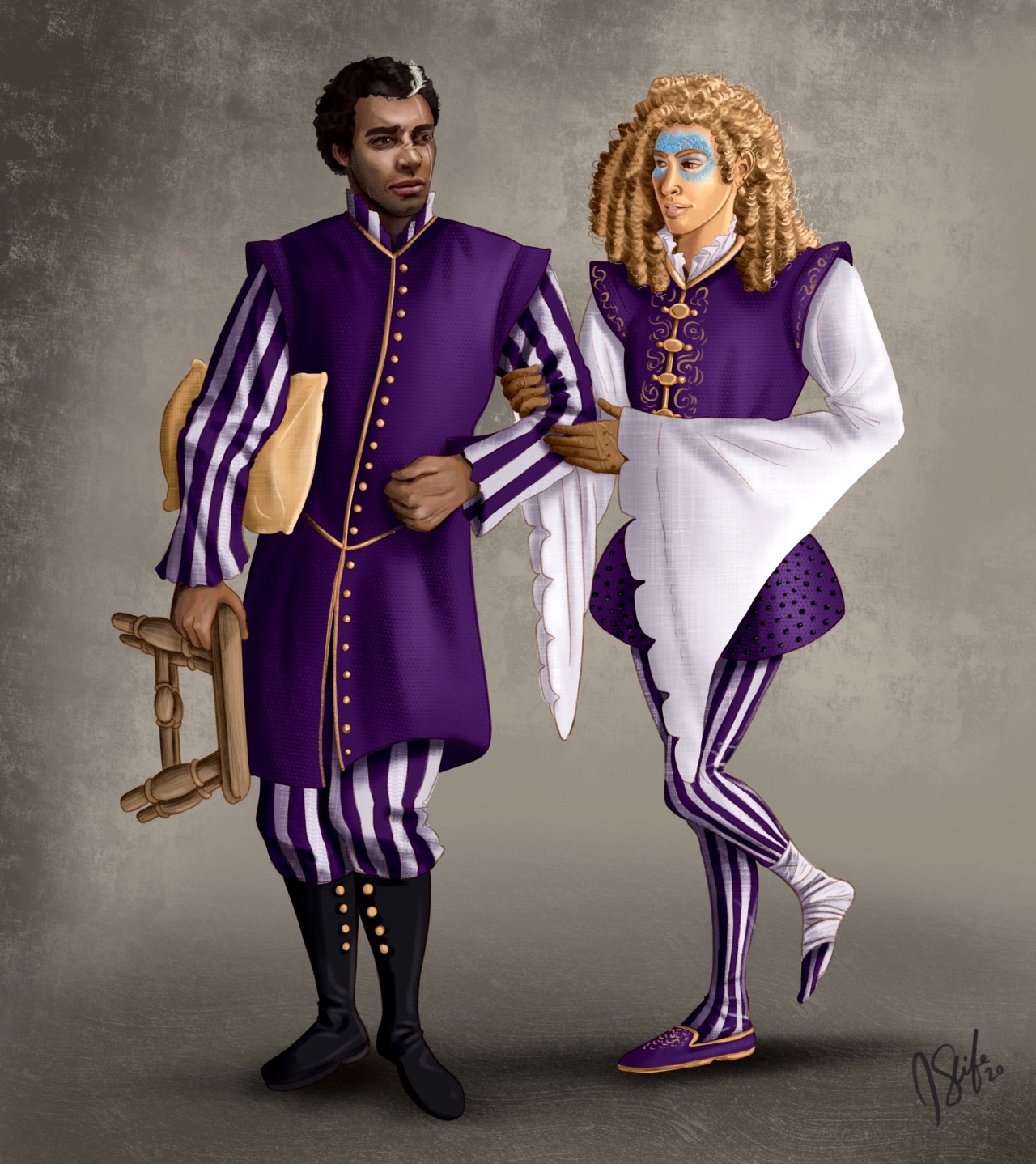
In all their glory… Image from Faceless Frey’s Tumblr, used for commentary.
Arriving, Badgerlock takes stock of the current situation of the Great Hall, marking entrances and behaviors as minor nobles flock to Lord Golden and some of the Outisland delegation arrives; he also glosses more of the Outisland sociopolitical system. He also assesses the nobles who cluster around Lord Golden, marking how the latter handles them–until Kettricken and Dutiful make their entrance, and all attention turns to them. The Queen and Prince are followed by the Narcheska and her party, all described along the way. Several of the Dukes follow in turn, then Outislander and other Six Duchies nobles–including Starling and her husband, Lord Fisher.
Badgerlock continues his survey and assessment of the guests, marking Civil Bresinga’s location and starting as Lady Patience arrives and is seated. He is also startled as Dutiful reaches out to him via magic, blending Skill and Wit, and again as he notes the presence of Rosemary, who had occasioned harm in years past. He marks how conversations flow as dinner begins and proceeds, and he attends carefully to the reactions of the assembled nobles as the Prince and Narcheska are betrothed–and as the Outislanders ply their own customs.
Festivities continue, as do the assessments, and Dutiful and Elliania acquit themselves well. Lord Golden plies his hangers-on, and intoxicants emerge through the proceedings. At length, Golden begs leave to depart, and he and Badgerlock make their exit. In their chambers, they exchange news, thinking fondly of Patience as they discuss her. Fitz retires, mulling over what he has to do–and there is much he has to do–and, in his dreams, he communes with his daughter through the Skill.
A couple things stand out to me as I reread the chapter again. One of them is Fitz’s comment about resenting the changes to Buckkeep from the days of his youth; he notes that his resentment comes in part from the erasure of his own history–and in part because the changes, which have largely left him behind, prompt him to “feel stodgy and old.” It’s something with which I have some familiarity, affectively reading as I do; I’ve had occasion to go back to places where I’d been before in years longer ago than I care to consider closely, and the differences between then and before, good as they in most cases are, remind me of the passed years and the missed opportunities in the long-ago thens I once had. I know what I havebeen, what I am still, and so I read as I read.
Another thing that stands out is the overt sexual attention Badgerlock receives from one of the lords flocking to Golden. Again, with earlier Elderlings novels, the case could be made that the Wit stands as a metaphor for homosexuality; again, the present series makes the homosexuality explicit, and I find it…difficult to accept as a metaphor what is openly stated. Perhaps the issue is that the concept has grown past the metaphor, with the homosexuality needing no more obfuscation and the Wit itself having moved beyond the need to be a stand-in for some other thing, taking on its own narrative force rather than serving as an allegory for something else. How much that might parallel other allegorical readings, I am not sure, but I find it a matter of some interest; perhaps I will remember the passing fancy long enough to actually look into it, now and again.
Read the previous entry in the series here. Read the next entry in the series here.
The following chapter, “Echoes,” opens with an in-milieu commentary about the end of the Red Ships War. It turns then to Fitz returning to the chamber he has as Tom Badgerlock, assessing the room sadly before arming himself and tending to his servant-duties. Among them, he begins to resume weapons training, using it as one opportunity to reaffirm his identity as Badgerlock, in the hopes of dissuading those who might recognize him as Fitz.
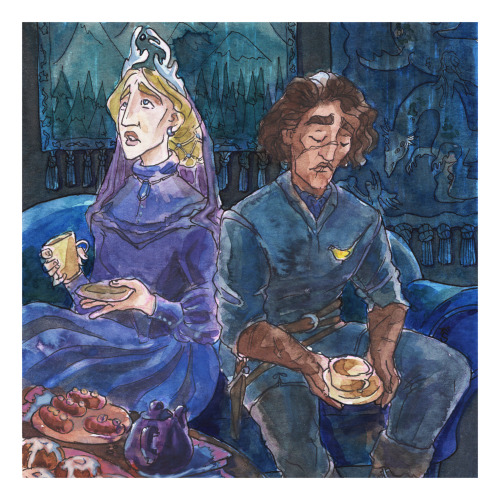
Something like this… Image here, used for commentary.
After his training session, Fitz-as-Badgerlock finds his way to the steam rooms used by guards to bathe, and he washes himself before some of the local guards enter. As he makes to leave, he is harangued by a young guardsman; after an exchange of words, the young guard swings at Badgerlock, swiftly losing the ensuing fight. After a time spent in conversation with the other guards, including one Fitz recognizes from his youth but who does not seem to recognize him in turn, Fitz makes his exit and prepares to go out riding with Lord Golden and Prince Dutiful. Laurel meets him at the stables, asking after Golden and Dutiful; Badgerlock offers little detail before having to wait for the others, who arrive accompanied by Civil Bresinga and others.
At length, they ride out together, and, when they are at some distance from Buckkeep, Dutiful turns to Badgerlock and asks after his lessons sharply; Badgerlock responds with somewhat mocking courtesy, and Dutiful rides off. Badgerlock pursues, and they apologize each to the other before awkwardly arriving at accord, largely over discussing Verity. Golden joins the conversation, aiding it, and they learn more of the Piebalds’ machinations through the Bresinga family. Talk turns to the Narcheska, as well, and the conversation reveals some of Dutiful’s own blindnesses–not surprising in a boy of fourteen–and the bias of the Six Duchies’ information on the Outislands. They arrange for Dutiful to have a Skill lesson the following morning, and they make their way back to Buckkeep. Once there, Lord Golden contrives to be “injured,” allowing Badgerlock an opportunity to be present in the halls of power for a ceremony that evening.
Such passages as the in-milieu commentary that opens the chapter are among the many things the prompt a reading of the Six Duchies as another iteration of the generic northern / western European medievalist mishmash setting common to Tolkienian-tradition fantasy literature; ringing of the Arthurian Avalon and the Tolkienian Ar-Pharazôn–a king in black and gold waiting for a final battle–the description of Verity’s quest to the Elderlings is very much in line with mainstream Anglophone fantasy literature, and the inaccuracies in presentation smack of the agglutinative legend-formation that associates itself with some of what might be anachronistically termed long-running narrative franchises. Not for nothing did I go into a conference presentation with ideas about the ways in which Hobb recapitulates and nuances the tropes she inherits from earlier authors, to whom she acknowledges a debt. Nor yet is it the case that the presence of one set of tropes precludes another; as I said to students when I had them, one of the marks of good art is that it sustains multiple discourses, and Hobb’s Realm of the Elderlings does that.
Read the previous entry in the series here. Read the next entry in the series here.
There is some ableist language to deal with in the present chapter.
The next chapter, “Chade’s Servant,” opens with in-milieu commentary on the White Prophet Hoquin before turning to Fitz realizing he is fleeing again, reverting to his childhood behaviors. He sits down in the corridors’ darkness to ponder his options and the likely goals of the Piebalds. He realizes that he is an intended target for the Piebalds, likely to be used by them to drive home their influence over the Farseers.
While mulling over the affair, Fitz overhears the complaints of Dutiful’s intended, the Narcheska Elliania, and uses the spy corridor to observe her more closely. He marks the close relationship between her and Peottre, her mother’s brother, as well as the strange intrusion of a servant who carries orders from “the Lady.” A tense exchange and magical working ensue, and Fitz makes to reach Chade’s chamber.
Therein, Fitz encounters a strange servant, finding him immensely powerful in the Skill. The servant rages at Fitz for a time but eventually returns to his duties, grousing at him all the while in both words and magic, and Fitz begins to be plagued by a headache. He is roused later by Chade, who asks after him, and Fitz reports the Skill the servant–Thick–has. Chade is initially incredulous but soon accepts Fitz’s report; they confer about how to handle the untrained talent and about the situation with the Piebalds. They gloss over Chade’s apprentice assassin, and Fitz reports what he has learned about Elliania. Chade jokes that Fitz is now a journeyman assassin, which Fitz considers uncomfortably and briefly. Talk returns to the Outislanders and their customs, and Chade reassesses matters. He also cautions Fitz regarding Dutiful, and the two confer further on their current situation and the steps they must take to ensure matters proceed well.
Thick has appeared in the novel previously, and Fitz notes as much in the present chapter. This is the first extended focus on him, however, and it presents some problems–largely in the language used to depict him in-milieu. Yes, I know that the chapter is narrated by FitzChivalry and will necessarily reflect his biases, which themselves reflect the biases of the fictional culture in which he is enmeshed and from which he emerges; I know, too, that while Fitz is sympathetic, he is constructed to have any number of failings and foibles and worse about him, and even if he is part of a persecuted minority–although not comfortably so on either side of the exchange–there are other ways in which he remains privileged even in his servile guise as Tom Badgerlock. Intersectionality is a thing, and it was twenty years ago, if less openly than now. Additionally, I know that my attitudes have shifted in twenty years, and I do not recall being taken aback by the presentation of Thick when I first bought and read the book as I am now. But I am, and although I am not as up on disability studies as might be hoped, I am aware enough of it to know that those who are so versed might have things to say about the text. (I note with some interest that the works I’ve annotated as of this writing do not seem to treat it–which is not to say it does not deserve treatment, but none of us can do all of the work that needs doing.)
I’ll note, too, that it was consideration of the present chapter that did much to inform my reconsideration of the Realm of the Elderlings milieu. The explicit discussion of matriarchy among the Outislanders prompted my reconsideration of the cultural antecedents of that culture; I am reminded of as much again in the present chapter, along with the unpleasantly colonialist connotations (drive not least by Chade’s offhanded remark about the Outislanders “leaving behind” their matriarchy–although the Six Duchies does seem to be relatively gender-neutral). So there’s probably more of that kind of thing to be coming in my comments about the succeeding chapters…
You may make the choice from the menu
I said
But someone else decides what’s on it
He said
Then get up and leave the restaurant
And I didn’t argue with it then
Sitting around the tables in a study group
With people who I knew agreed with him
Who have always been the ones to drive to that restaurant
Or another just like it
And who haven’t had to worry that
If they got up to leave
Someone wouldn’t scream
They’re skipping out on the bill
And call for aid
That is aid only for some
And they all know who they are
And they all know who they are not
And who they are not for
And who haven’t had to worry that
If they got up to leave
They would be standing up alone
And what sticks up gets hammered down
And who haven’t had to worry that
If they got up to leave
They wouldn’t have a way to get home
Because the restaurant is not where they would choose to be
Far away from where they rest their hearts
But they had to go where they were brought
Because walking until your feet bleed
Isn’t really an option when
You have to be on your feet all day
Every day
And your shoes are wearing thin
And who haven’t had to worry that
For a long while at least
They can’t afford another restaurant
Or a grocery store
Or a pot to cook in
Because choosing not to eat
Isn’t really an option when
You do still have to work the next day
But I should have argued
Shouted to the winds that blow
Summery breath from many directions
Even if their howling would have drowned out my voice
I should have gotten up and left
Even though it was no restaurant
If I did not like what was being served
But I was not the one who drove
And I could not have taken my party with me
Read the previous entry in the series here. Read the next entry in the series here.
The first chapter of the novel, “Piebalds,” opens with in-milieu commentary detailing the groups origins, propaganda, and practices. It moves then to pick up directly where the previous novel ends, with Fitz-as-Badgerlock ending the night in Jinna’s home, waiting for Hap to return; Fitz muses on circumstances, including the revelations each has about the other. At length, Hap returns, exulting in Tom’s unexpected presence; he briefly seeks to relate his deeds and doings before being reminded that he has work in the morning, and he goes off to bed. As Tom makes to leave, Jinna again warns him about Hap’s dissolution.
Fitz’s sudden worry… Image from friendly ghost on Tumblr, here, used for commentary.
As Fitz makes his way back to the castle, he is pursued and accosted by Pieblads who mock and taunt him. He is unassailed, however, and recriminates himself for his oversights as he proceeds back. The annoyance becomes anger as he reaches the castle gates and accosts the guards on duty, though he soon realizes his error. Swiftly enough, he returns to the duties he has as Badgerlock to Lord Golden, reporting events to him there. Golden notes Chade’s actions from the previous night, and as the two confer about all that must be done, Fitz realizes he has left his notes in his cottage–where any could find them. The Fool urges caution against Fitz’s sudden concern. Fitz accedes and makes preparations for the day to come.
The present chapter does an admirable job of explicating the events of the previous novel, catching up readers who either began the series on the second novel (I’ve had to do it several times for freelance work, so I know it happens for good reason) or who had had some time between reading Fool’s Errand and starting Golden Fool. And it does a good job of laying out the central conflicts of the present novel, hinting towards tensions surrounding homosocial and homosexual relationships as well as pointing out the problems of the Piebalds and of Dutiful’s training–in addition to motioning towards the cultural friction between the Six Duchies and the Out Islands. In brief, the first chapter does all of what a first chapter ought to do, which makes for helpful rereading; even if it’s not been long since I finished Fool’s Errand again, it’s been a while since I’ve been able to read Golden Fool for more than citation-mining, and it’s a welcome return.
Read the previous entry in the series here. Read the next entry in the series here.
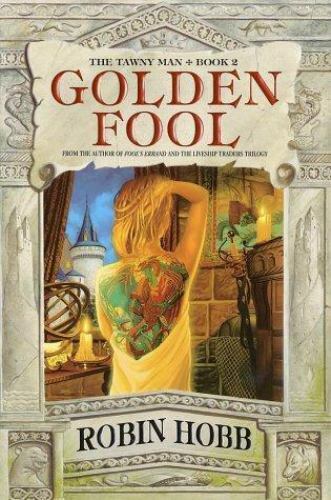
The second novel of the Tawny Man trilogy begins with abortive in-milieu comments from Fitz about the loss of Nighteyes before pivoting to Fitz’s ruminations about his efforts to compile a history of the Six Duchies. He notes the repeated intrusion of the personal into what he had intended as the general. He also notes his utter bereavement in the wake of the wolf’s death and the strangeness of his choice of isolation thereafter.
The edition I’m reading… Image taken from an eBay ad, used for commentary.
Fitz then turns to reminisce about his time with the Lady Patience, noting remarks she’d shared with Lacey about the fixed attitudes of those unwed by their thirties; he notes that he falls under their rubric, having confessed as much to the Fool. He marks the Fool’s reply–respectful disagreement–and moves into ruminations on the bonds of family. Freedom, he notes, means a severing of ties; isolation is the price of self-determination, but the choices that lead to it can be amended.
As I noted before, I did not make the mistake of skipping the hardcover as the Tawny Man trilogy continued, but picked up Golden Fool as soon as I saw it on the shelves. At that time, I was an undergraduate at the University of Texas at San Antonio, commuting from Kerrville to San Antonio five days a week to go to school and delivering pizza evenings and weekends, so I had low expenses and cash in my pocket, as well as access to bookstores–so I saw it soon after it hit the shelves. If memory serves, I read it cover to cover in a night, a delirious experience that has stuck with me strangely; I miss having the luxury of giving so much time to something at a stretch and having the focus to sit and read for hours, immersing myself in the synthesis of written word and feel of page and smell of it. Even now, when I can sit at my desk at home–and I suppose I need to do another office piece–I have many concerns to command my attention; I have to take such chances as this to read what I like to read, as they are rare unless they are made to be present. But I think it’s doing some good that I do so; certainly, there’re people reading what I write about what I read, and I hope it’s helping.
As to the philosophical import of the prologue: it is present, certainly, and those who are more studied in such matters can well discuss the ideological tensions that are at work in it. To my eye, there is something to read into it of the US idealization of self-determination, of rugged individualism; being Texan, I am surrounded by the idea that a person ought to stand on their own, entirely, rather than prizing the community. At the same time, I am aware of my own isolation from a great many things; like many people who spend a fair amount of time online and/or writing, I am removed from events even as I am affected by them, and like many men in the United States, I find it difficult to make new connections. That so many of those I have had have fallen away over time–as they are wont to do if not actively maintained–leaves me in a small world.
Perhaps that is part of why I read; I get some sense of connection by seeing into the lives of even fictional others. And perhaps that is part of why I reread; by turning the pages again, I can maintain some sense of connection back to who and what I have been, and if not at my best, it’s better than none at all…
Read the previous entry in the series here. Read the next entry in the series here.
The final chapter in the novel, “Buckkeep Town,” begins with in-milieu comments on fennel before turning to Fitz waking in his chamber after a long sleep. He and the Fool trade comments, and he resumes his guise as Badgerlock and makes his way out into Buckkeep Town. Badgerlock considers the townsfolk he passes as he moves through the bedecked city, musing on Dutiful’s circumscribed life along the way to Jinna’s. There, she greets him, welcoming him in from the weather and conversing with him about her concerns for Hap before inviting him to stay a while longer.
Once again… Katrin Sapranova’s Jinna, here, used for commentary.
The brief epilogue, presented as a retrospection by Fitz, sees him muse on his efforts to compile a history of the Six Duchies and the overturning of those efforts by weather and passers-by. His comment near the end that “the past had broken free of my effort to define and understand it” is a telling one, I think. There is a tendency to view history as a fixed, immutable thing, and while it is the case that the events that happened in the past happened and cannot be changed, their presentation–which is what history is: the report and record and transmitted understandings of events and their importance–can and do shift and evolve over time. In part, this is and should be a reaction to the revelation of more and better information; new sources are found, new physical evidence emerges from the ground and from people’s holdings, and so knowledge changes, forcing interpretations to change along with it.
Of course, even so much gets opposed by a great many people, who want to think that history is what they were (badly) taught in their own histories, and that what their teachers told them (ineptly and in a rush, while they themselves listened far less than attentively) is Truth, immutable and Good; when new tools and rubrics for processing and assessing the information emerge, as they will as long as more people apply themselves to the study of the subject, they react even more strongly, perceiving the questions (rightly) asked about the narratives they imbibed not as critical questions aimed at generating better understandings, but instead as attacks on them, personally. Few of us are as important as that, truly–and Fitz, who is as important as that in his own milieu, seems to recognize it, offering a lesson many of us would do well to learn better than we have.