Class Reports: ENGL 1213, Sections 015, 023, and 040–25 March 2016

After addressing questions from the previous class meeting, discussion asked after student impressions of the Infog, of which the FV was due before class began. Student progress on the SOQ was discussed, and information about the SpEx disseminated.

Students are reminded of the following due dates:

  • SpEx (in class on 1 April 2016)
  • SOQ PV (in print as class begins on 8 April 2016)
  • SOQ RV (via D2L before class begins on 15 April 2016)

Regarding meetings and attendance:

  • Section 015 met as scheduled, at 1030 in Classroom Building Room 217. The class roster showed 16 students enrolled, unchanged since the previous report. Thirteen attended, verified through a brief written exercise. Student participation was good, if subject to distraction.
  • Section 023 met as scheduled, at 1130 in Classroom Building Room 121. The class roster showed 16 students enrolled, unchanged since the previous report. Fourteen attended, verified through a brief written exercise. Student participation was good, if subject to distraction.
  • Section 040 met as scheduled, at 0830 in Morrill Hall Room 206. The class roster showed 15 students enrolled, unchanged since the previous report. Ten attended, verified informally. Student participation was reasonably good.
  • Two students attended office hours.

Class Report: ENGL 1213 at NOC, 23 March 2016

After addressing questions from previous classes, discussion asked after impressions of the AnnBib RV, which was to have been submitted before class began. Comments about assigned readings were voiced, and information regarding the ResPpr was presented.

Students are reminded of the following due dates:

  • AnnBib FV (due online before class begins on 30 March 2016)
  • ResPpr RV (due online before class begins on 13 April 2016)
  • ResPpr FV (due online before class begins on 20 April 2016)

Students are informed also that the College final exam schedule for the current term lists the appointed exam time as 1400-1550 on 2 May 2016. Students should expect to meet in the regular classroom for it.

The section met as scheduled, at 1300 in North Classroom Building Room 311. The roster listed seven students enrolled, unchanged since the previous class meeting. All attended, verified informally. Student participation was good.

No students attended office hours since the previous class meeting.

Class Reports: ENGL 1213, Sections 015, 023, and 040–23 March 2016

After collecting the T&S Update and addressing questions from the previous class meeting, discussion asked after progress on the Infog, of which the FV is soon due (see below). Assigned readings and the SOQ also received attention.

Students are reminded of the following due dates:

  • Infog FV (via D2L before class begins on 25 March 2016)
  • SpEx (in class on 1 April 2016; information is forthcoming as of this writing)
  • SOQ PV (in print as class begins on 8 April 2016)

Regarding meetings and attendance:

  • Section 015 met as scheduled, at 1030 in Classroom Building Room 217. The class roster showed 16 students enrolled, unchanged since the previous report. Fifteen attended, verified through a brief written exercise. Student participation was reasonably good.
  • Section 023 met as scheduled, at 1130 in Classroom Building Room 121. The class roster showed 16 students enrolled, unchanged since the previous report. Fifteen attended, verified through a brief written exercise. Student participation was markedly restrained, and students were dismissed in favor of working on their assignments.
  • Section 040 met as scheduled, at 0830 in Morrill Hall Room 206. The class roster showed 15 students enrolled, unchanged since the previous report. Eleven attended, verified through a brief written exercise. Student participation was subdued.
  • Two students attended office hours.

Class Report: ENGL 1213 at NOC, 21 March 2016

After addressing questions from previous classes and addressing formatting concerns, discussion focused on matters of assigned readings, long neglected in favor of assignment discussions and instructor illness on 9 March 2016.

Students are reminded of the following due dates:

  • AnnBib RV (due online before class begins on 23 March 2016)
  • AnnBib FV (due online before class begins on 30 March 2016)
  • ResPpr RV (due online before class begins on 13 April 2016; note that materials for the assignment are not yet developed as of this writing)

The section met as scheduled, at 1300 in North Classroom Building Room 311. The roster listed seven students enrolled, unchanged since the previous class meeting. Six attended, verified informally. Student participation was reasonably good.

No students attended office hours since the previous class meeting.

Class Reports: ENGL 1213, Sections 015, 023, and 040–21 March 2016

Spring Break being done, discussion noted upcoming assignments due. Much attention was given to the SOQ, for which the assignment sheet was distributed during class time.

Students are further reminded of the following due dates:

  • T&S Update (in print as class begins on 23 March 2016)
  • Infog FV (via D2L before class begins on 25 March 2016)
  • SpEx (in class on 1 April 2016; information is forthcoming as of this writing)

Regarding meetings and attendance:

  • Section 015 met as scheduled, at 1030 in Classroom Building Room 217. The class roster showed 16 students enrolled, unchanged since the previous report. All attended, verified through a vote on the subject of the SpEx. Student participation was reasonably good.
  • Section 023 met as scheduled, at 1130 in Classroom Building Room 121. The class roster showed 16 students enrolled, unchanged since the previous report. Thirteen attended, verified through a vote on the subject of the SpEx. Student participation was subdued.
  • Section 040 met as scheduled, at 0830 in Morrill Hall Room 206. The class roster showed 15 students enrolled, unchanged since the previous report. Eleven attended, verified through a vote on the subject of the SpEx. Student participation was reasonably good.
  • No students attended office hours.

Some Remarks about My Writing Process

Much of the teaching that I do takes place in writing and writing-intensive classes. As much as I am able, I try to structure the assignments in those classes to promote writing as a process, working through cycles of drafting and revision in the hopes that students will benefit from time and attention paid to their work. (The Student’s Own Question assignment for the Spring 2016 Composition II class at Oklahoma State University–working through prewriting, a peer-review version, two instructorreview versions, and a final version–serves as one example.) Because I try to model the behavior I like to see from my students (as exemplified by the sample assignment responses I post), it makes sense to me that I would do something to explicate my own writing processes. Hence the discussion that follows, which works through a treatment of how I set up my writing situation before it looks at my drafting and revision processes. A few concluding comments follow afterward.

Setup

One common piece of advice given to writers is that they should find the circumstances most conducive to their compositional processes and produce them as much as they can when they make to write. It is not always feasible to do so, of course, but it is eminently desirable. When I sit down to write, I prefer to do so with a cup of coffee and music playing. The former is usually provided either by the office in which I work or by a helpful home pot; the latter typically comes from a streaming radio service to which I subscribe and which I have calibrated through long trial and error to give me the kind of music that works well for me. Others’ preferences will vary, and many are discussed in CCC 66.1 and 66.2, but this discussion treats my writing processes; the circumstances described are those I prefer.

Another part of my preferred setup is that it facilitates access to materials. I have written elsewhere about surrounding myself with scholarly apparatus; it is a habit I have not abandoned, despite the mixed valence of that surrounding as a symbol. I subscribe to a number of scholarly journals, and I make no small number of notes in the texts and margins thereof. Having access to them helps me to carry out many of the writing tasks that I do as a matter of course. Also, I still page through printed texts more quickly than I can scroll through electronic ones–and because I do not always remember the exact wording I seek, skimming the texts helps me to find the ideas I need to pull into my work. When I can, I set up my writing situation such that it allows me easy access to those materials; they may not be in arm’s reach, but I try to have them no more than a few steps away from me.

Much of the writing that I do is done in response to a call for papers, a freelance order, or an assignment such as I give to my students. This means that, in most cases, I am addressing a specific prompt, enacting in my professional and academic work much the same kind of thing that I ask my students to do. I am also generally provided with some idea of the writing that needs to be done, which soon leads me to the kind of idea I will pursue. Knowing what kind of idea usually gives me some indication of the structure I need to use to support the idea, and so I will generally set up the kind of writing I need to do by stubbing out sections. Sometimes, as in the composition of this piece or the summaries and commentaries I draft for freelance orders, those sections will take formal headings; how I handled doing so in the former appears below:WritingProcess1

Other writing tasks may not offer the kind of clear idea that allows for a formal outline, or they may not be of the sort that admits of formal section headings. In such cases, I still stub out the basic shape of my paper, usually using phrasing placed into square brackets as informal guideposts for how to move through what I write. Having such a structure in place helps me get through the paper, both in giving me direction and in giving me convenient breaking-points if I need to use them.

Return to top.

Drafting

Once I have set up my writing situation as best as I am able, including generating the basic idea and stubbing out the structure of the piece, I sit down to write. I rarely compose in a linear fashion; while I typically draft an introduction in at least a working version when I set up my materials, I do not typically move through the first identified section into the second and on through the document. Instead, I jump around, moving from identified section to identified section as ideas come to me. For example, in this very piece, I moved from what is now the first paragraph of the Setup section to drafting this paragraph; the idea for it came to me at that point, and I made sure to set it down on the electronic page before I forgot it. In my freelance summaries and commentaries on popular works, I will usually draft front and back matter before moving through the summaries that occupy the middle of the ordered texts, moving back and forth among points in both. Again, it is a process that works for me and that has emerged across thousands of hours of writing. Others’ results may vary, but I seek in this piece to explicate my own processes.

I confess that I am often distracted in my drafting. The writing I do at home finds itself set aside in favor of family and household concerns; that I do at the office sees (usually welcome) interruptions by colleagues and others. Both sets of distractions do present threats to my compositional process; it is easy to get involved in other things than writing, even that writing done explicitly for pay. And my disordered compositional process is prone to the distraction, as well; returning from interruptions does not always come with a clear indication of what I was doing or where I was going with the paper. Even with such problems, however, I find that my process works reasonably well for me; I am able to get done the writing I need to get done, and in such a way that my freelance clients consistently rate my writing as excellent; my academic endeavors are reasonably successful, as well.

Return to top.

Revision

I work from an idea of writing as a recusrive process, following training I received as a graduate student in English. This means that not only does my drafting not proceed in a necessarily linear fashion, but also my process of adjusting and correcting the writing proceeds in an other-than-lockstep pattern. At the sentence level, I correct and adjust wording continuously as I move through the writing (something that electronic writing facilitates much better than manuscript, which is one argument in favor of it). It happens frequently, almost with every sentence that I write, and it goes beyond correcting my occasional typographical error to rethinking wording and phrasing as I go about placing ideas on the page.

At the structural level, I find that I sometimes reconsider not only my formal headings but how I will move into and through each. For example, when I initially set up this piece, I had thought I would do a simple three-heading structure. As I have moved forward with it, I have added a formal fourth heading (for the conclusion, below), as well as aligning with prevailing online compositional practice and embedding links into the document to help navigate it. I had not initially thought to include them, but the piece has grown somewhat larger than I had first expected, and adjusting the composition to ease the reader’s burden seems a thing worth doing.

In addition, I realized that I needed to include information about my broader setup practices. Initially, I had thought to begin the Setup section with the paragraph starting “Much of the writing,”but further consideration prompted me to adjust the idea. Similar things often happen while I am amid my writing, and so I make similar revisions, inserting new materials into places that seem to need them. It usually works out well for me, helping me to address my readers more usefully, whether in clarifying materials for my students, satisfying my clients, or explicating materials more fully for fellow scholars.

That I do revise amid composition does not mean I do not revise after generating what I think is an acceptable initial draft; I certainly do so. Often, I do so by printing out a physical copy of the document I am drafting, reviewing in print what I see thereupon. Changes I note to myself as needing to be made are incorporated from the end of the document back; doing so makes it easier for me to find the places in the earlier version of the document I note as needing alteration. I also have at least one other reader look at what I write, usually another person with degrees in English but whose area of expertise is other than mine. Doing so allows me not only to have my basic argumentative or iterative form examined, but also the clarity of my writing–if I am writing clearly enough that a non-specialist can easily understand what I am trying to convey, then I am writing well, indeed.

Return to top.

Conclusion

There is doubtlessly more I could say about my writing process. The variations of it I deploy to meet specific writing tasks could each be given a section or a whole post to itself, and even for the things I have discussed, there are more details that I could include. What I hope to have given is a useful summary view of my writing process, one that will perhaps be of benefit to my students now and in times to come.

Return to top.

Edited on 21 March 2016 to account for vanished media.

Class Reports: ENGL 1213, Sections 015, 023, and 040–11 March 2016

After an earlier absence on the instructor’s part (during which instructional materials were provided, here), class discussion resumed with inquiry into student impressions of the Infog. (The RV thereof was to have been submitted before the beginning of class time today.) Also noted was information about the T&S Update; a paper version of information recently added to the assignment webpage was distributed. Future assignments were noted, as well.

Students should please note that the course syllabus has been updated: G. Elliott Spring 2016 ENGL 1213 Syllabus and Course Calendar Revision 2.

Students should please also note that email responses during the break will be limited.

Students are also advised of a notice from the Program director, in which she asks that students be informed that

On Tuesday, March 22nd (the week after spring break), Dr. Chris Carter from the University of Cincinnati will be presenting his most recent research examining videography and police brutality.  Dr. Carter’s talk is part of the Arts and Sciences Humanities Speaker series and will be at 6:30 pm in the Peggy V. Helmerich Browsing Room in the Edmond Low library.

Students are further reminded of the following due dates:

  • T&S Update (in print as class begins on 23 March 2016)
  • Infog FV (via D2L before class begins on 25 March 2016)
  • SpEx (in class on 1 April 2016; information is forthcoming as of this writing)

Regarding meetings and attendance:

  • Section 015 met as scheduled, at 1030 in Classroom Building Room 217. The class roster showed 16 students enrolled, unchanged since the previous report. Eleven attended, verified through a brief written exercise. Student participation was good.
  • Section 023 met as scheduled, at 1130 in Classroom Building Room 121. The class roster showed 16 students enrolled, a decline of one since the previous report. Ten attended, verified through a brief written exercise. Student participation was reasonably good.
  • Section 040 met as scheduled, at 0830 in Morrill Hall Room 206. The class roster showed 15 students enrolled, unchanged since the previous report. Nine attended, verified through a brief written exercise. Student participation was reasonably good.
  • One student attended office hours.

For 9 March 2016

As it happens, I do occasionally get ill such that I cannot take the risk of coming in to work. Such a thing has happened to me today; I know what it is, and I am getting it taken care of, so I should be able to be back to work when I am next scheduled to be. In the meantime, however, there are some things that need to be discussed for my students at Oklahoma State University and Northern Oklahoma College. They should appear below.

Oklahoma State University

Students of mine at Oklahoma State University should be working on their Infog, of which the RV is due before the beginning of class time on 11 March 2016. That RV is supposed to consist of a statement of goals and purposes, a raw-form infographic, and a digital-original form of the infographic, all in a single Word document. Compiling the document will require students to insert graphics, and legibility of the graphic may require resizing pages. I had meant to cover one method of doing so in a single document with my students today; since I am not in the classroom, that will not be possible, so I am putting together this commentary to help with that task.

Please note that the directions below are written from the perspective of a PC user; commands for Mac and other platforms will be different. Please note also that the directions below work from previously existing materials, the sample infographic provided for students, here.

Drafting the statement of goals and purposes should work much as previous assignments for the class have; the text should be left-aligned in double-spaced 12-point Garamond, Georgia, or Times New Roman type, with paragraphs indented half an inch from the margin and headings, title, and page numbers in place as normal. It should look something like this:G. Elliott Spring 2016 ENGL 1213 Infog Example Img. 1

After completing the text of the statement, hit the enter key once to move the cursor to a new line. Then start a new section of the paper. To do so, go to the “Page Layout” tab at the top of the screen and select it. Next, select “Breaks,” which should offer a drop-down menu. On that menu, under the heading “Section Breaks,” select the “Next Page” option, which will move the document to a new page, with that new page being a new section of the document able to be adjusted independently of the other parts of the text. The selection should look something like this:G. Elliott Spring 2016 ENGL 1213 Infog Example Img. 2

Once the selection is made, the screen should look something like this:G. Elliott Spring 2016 ENGL 1213 Infog Example Img. 3
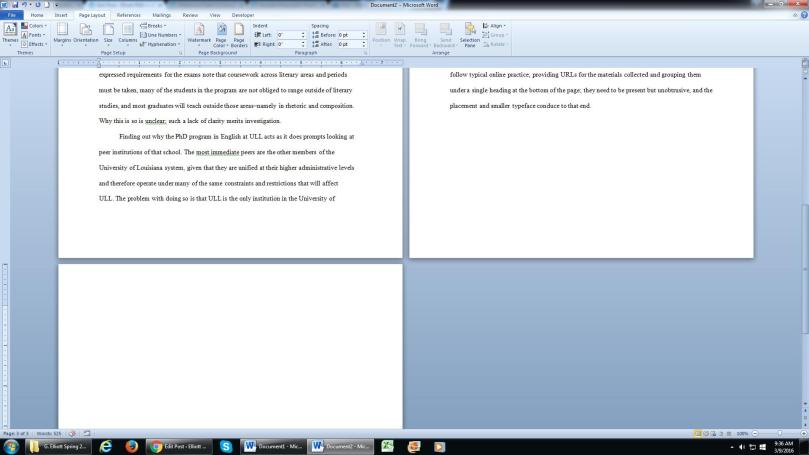
Page numbers will need to be inserted into the new section; the document is continuous, and the pagination needs to reflect it. And it will be helpful to have a subject heading that indicates what content will be in the new section; my sample post on the blog called it “Raw-Form Infographic,” which seems a useful label. I put it into my document, changing the spacing on that line to “Single” to facilitate image placement. (It is a variation from “normal” formatting, admittedly. Visuals introduce changes.) A problem arises, however, in that my hand-drawn raw-form infographic is on letter-size paper, as are many done by students. Inserting that image into another letter-size page will shrink it, making it more difficult to read than it needs to be.

To allow the image to show up at full-size, then, the page into which it is inserted must be made larger. (Keep in mind that it has to fit onto the page along with its label.) Margins will do well to remain at one inch, so the page will need to be two inches wider than letter-size: 10½ inches. Height will need to accommodate the label; an inch in addition to the two added for margins should suffice, making the overall page height some 14 inches.

Making the adjustment necessitates returning to the “Page Layout” tab at the top of the screen, selecting it, and selecting the “Size” button thereupon. Doing so will produce a drop-down menu, at the bottom of which is “More Paper Sizes,” which is the appropriate choice. Selecting it brings up something like this:G. Elliott Spring 2016 ENGL 1213 Infog Example Img. 4
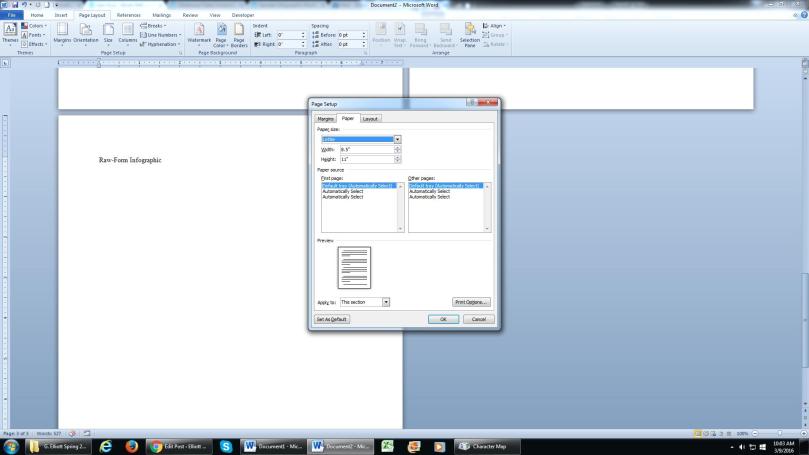
The “Height” and “Width” boxes can be adjusted by selecting them and putting in new values. For mine, they are the 14 inch height and 10½ width noted earlier. Also, in the “Apply to” box, I selected “This section,” which I recommend to others. Upon making the adjustments and selecting “OK,” I received a message about the printable area, which I opted to ignore for the present purpose. That done, my document came to look like this:G. Elliott Spring 2016 ENGL 1213 Infog Example Img. 5
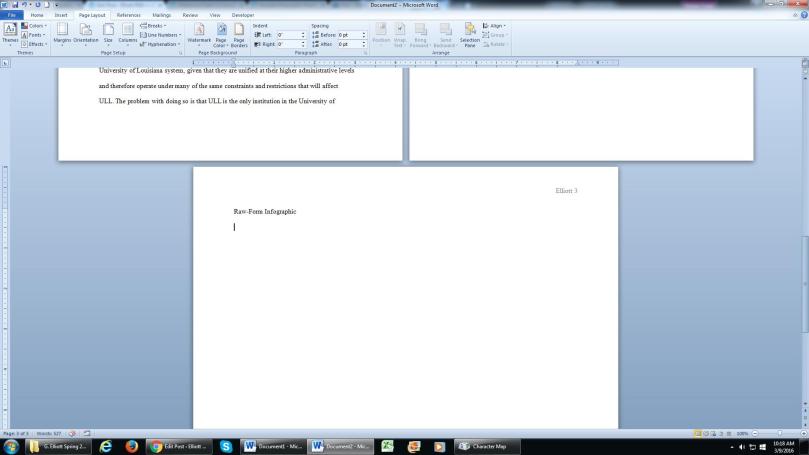
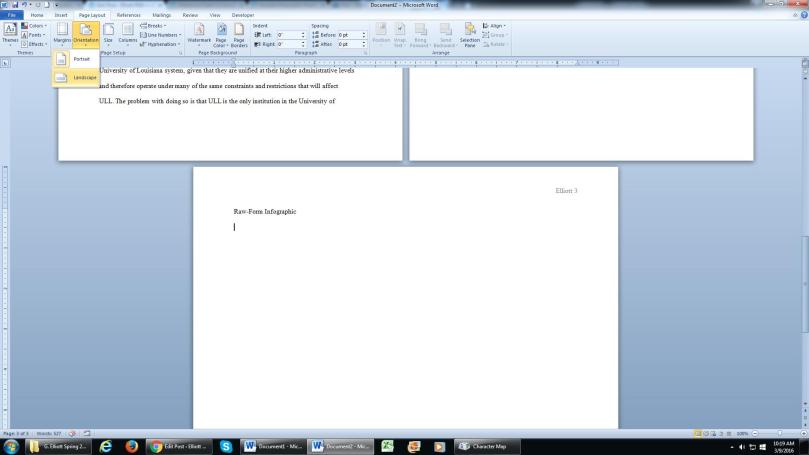
Students whose raw-form infographics are oriented horizontally rather than vertically will also need to adjust their page layout to suit. This is done by going to the “Page Layout” tab once again, this time selecting it and selecting the “Orientation” option appearing thereupon. Normally, documents will be in the “Portrait” orientation; a horizontal layout will need to be adjusted to the “Landscape” orientation, done by making the appropriate selection. (Keep in mind that room still needs to be accorded to the label on the page; the page will need to be 11½ inches high and 13 inches wide to accommodate.) Something like the following should appear:G. Elliott Spring 2016 ENGL 1213 Infog Example Img. 5.1
With my page set up appropriately to accommodate the raw-form image, the time came to insert the image into the document. To do so, I placed my cursor where I need the image to appear: the next line of text after the label. That done, I selected the “Insert” tab at the top of the page, clicking on the “Picture” button beneath it; the following appeared as I did so:G. Elliott Spring 2016 ENGL 1213 Infog Example Img. 6

A file-selection menu appeared, and I selected the raw-form infographic I had drafted and scanned in. (I used my home scanner; scanners are available to students in the Edmon Low Library, and their use is intuitive. I do recommend saving images as .jpg files, however.) Doing so placed the raw-form infographic in the document where I wanted it to be, as shown below:G. Elliott Spring 2016 ENGL 1213 Infog Example Img. 7
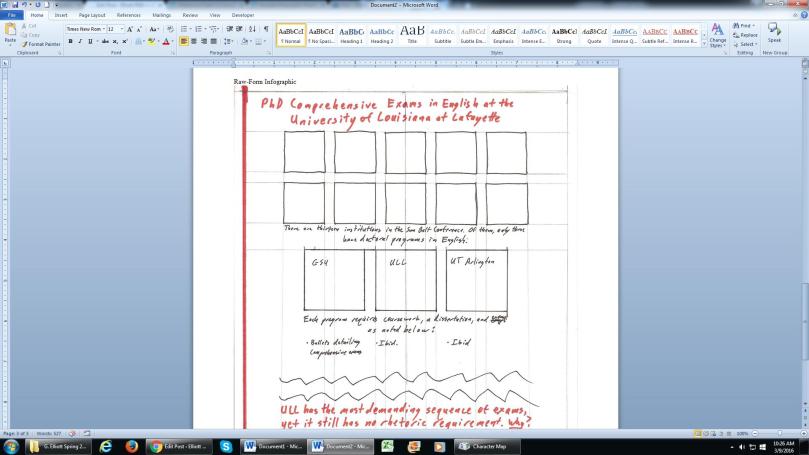
That done, I went to the end of the document (hold “Ctrl” and press “End” on the keyboard) and repeated my earlier process of starting a new section of the document to facilitate insertion of the digital-original form of the infographic. I also repeated my earlier process of adjusting the page size to suit the digital document. Because I formatted the digital-original version as a tabloid-sized document (11 inches wide, 17 inches high), and I still needed a label (“Digital-Original Infographic,” after the online version), I set my page size to 13 inches wide and 20 inches high. Afterwards, I inserted the label and the image, with the following result:G. Elliott Spring 2016 ENGL 1213 Infog Example Img. 8
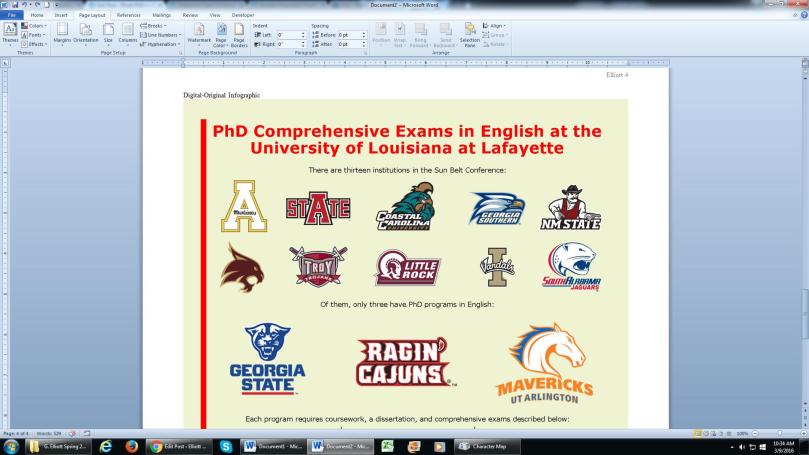
The resulting document appears here: G. Elliott Spring 2016 ENGL 1213 Infog Formatting Walkthrough Result.

Return to top.

Northern Oklahoma College

I had intended to discuss more citation styles with my students at Northern Oklahoma College today; my absence will prevent that from taking place. That said, I can point them again to the Purdue OWL discussion of MLA standards, here. I can also offer them some questions to ask about sources when determining whether or not they are likely to be valid for the AnnBib on which they are to be working.

I have noted before that information is not neutral; the selection of what information is to be presented is a deliberate choice, one stemming ideally from considered judgment and therefore interpretive decisions. Concerns of ethos attach themselves to such interpretations; knowing what types of information the expected audience is likely to consider reliable and presenting those types helps writers to present themselves to their audiences as being reliable and worth attention. Academic audiences are likely to consider primary source materials reliable (although there may be quibbling over which edition of a given primary text is the best to use); one cannot discuss a thing without reference to that thing. That primary materials are so necessary, however, means that they are not appropriate for inclusion in an annotated bibliography in most circumstances. Secondary and tertiary/critical sources, however, are–provided they are of sufficient quality.

Determining whether they are happens through developing answers to a series of questions, of which a selection appear below. Each source will need to prompt some questions of its own, so there is no way to account for all of them that might do well to be asked. Also, there is no guarantee of reliability, as it is possible for error to persist despite the best and most sincere efforts of those producing work–whether because new data is uncovered later or elsewhere or because, as the adage has it, “Even Homer nods.”

Keep in mind that there are multiple people involved in the dissemination of information. For most reliable secondary and tertiary/critical sources, there will be an author, an editor or editors, and a publisher or publishers. Similar questions will apply to each, with one or two others worth asking, as well; the first of them is “Is the author/editor/publisher identified?” While there are circumstances in which anonymity is desirable or even necessary, people are generally less willing to associate their names with what they know is wrong; having those involved in the production of a source identified is therefore an easy, early indicator of whether the source can be a quality source. (Admittedly, many hold sincerely to cockamamie ideas. Again, answers to such questions move towards reliability; they do not guarantee it.)

Related to that question is that of “What background does the author/editor/publisher have with the subject being described?” While past performance is not an absolute predictor of current or future performance, it is the case that someone who repeatedly does well with a thing is likely to continue to do well with that thing. The reverse is also true.

Also related, and of perhaps greater importance, is “What does the author/editor/publisher gain from others?” This can be rephrased in part as “Who pays?” It can also be “How does the author/editor/publisher benefit?” While admittedly cynical, the idea that people will work to suit their interests and act in ways that benefit them–whether those ways are generally ethical or not–is one that needs to be considered, as it skews perspectives as much as if not more than any other concern.

Less cynically, having identification of the author/editor/publisher allows for the question of “Who/what else works with what the author/editor/publisher produces?” If materials known to be good use the current piece or others produced by the same agency, and they do so favorably, the materials under review are more likely to be good, as well. Conversely, if good materials disparage the work done by the agency responsible for the reviewed material, that material is likely to be less helpful. Again, the reverse is also true.

A similar question, albeit one oriented towards the past, is “From what does the author/editor/publisher work?” If the material being reviewed uses good materials and commends them, it is more likely to be good. If it disparages them, it may still be good; one of the things that scholars accept is that their work may be supplanted by further study and the revelation of new information. Sometimes, advancing that new information requires the outright rejection of the old.

Two other questions present themselves for particular attention. One of them is “What is the medium of presentation?” Marshall McLuhan famously quips that “The medium is the message” in Understanding Media: The Extensions of Man, and he is, in large part, correct. The manner in which information is presented influences how it is received, and, as dominant communicative theories hold, the reception determines what information is actually transferred–not only in terms of the explicit data, but also in parallel concerns that do much to influence perceptions of reliability and applicability of the information to other venues. The degree of adherence to the conventions of a particular medium deployed in a given source help speak to its credibility and reliability (although, again, they do not guarantee it)–particularly in the case of scholarly literature, which is conventionally peer-reviewed (i.e., the materials are blind-assessed by experts in the field, and usually substantially adjusted based on those assessments, before being allowed to proceed to publication).

The other is “How timely is the source?” Timeliness does not necessarily equal recency, although a more recent source will generally be more helpful than an older one, as it allows for more information to have been uncovered. That said, enough time for fact-checking needs to be allowed to avoid things happening like the CERN neutrino kerfluffle in 2011 and 2012. Also, projects that track historical progressions (and many will need to do so, if only to provide adequate surveys of prior treatments of the material) will necessarily need to examine earlier sources.

There are, as noted above, other questions that can be asked–and that should be asked. Those noted above, however, should offer a useful beginning from which students can work on the AnnBib and other projects, both in my class and in their writings yet to come.

Return to top.

Updated 1 April 2016 to adjust grouping.

Class Report: ENGL 1213 at NOC, 7 March 2016

After addressing questions from previous classes, discussion focused on concerns of citation. The Purdue Online Writing Lab discussion of MLA format and style, here, informed much of the talk.

Students are reminded of the following due dates:

  • AnnBib RV (due online before class begins on 23 March 2016)
  • AnnBib FV (due online before class begins on 30 March 2016)
  • ResPpr RV (due online before class begins on 13 April 2016; note that materials for the assignment are not yet developed as of this writing)

The section met as scheduled, at 1300 in North Classroom Building Room 311. The roster listed seven students enrolled, unchanged since the previous class meeting. All attended, verified informally. Student participation was good.

One student attended office hours since the previous class meeting.

Class Reports: ENGL 1213, Sections 015, 023, and 040–7 March 2016

Class time in each section was spent on the Infog PV. As announced, a quiz was taken from the presence and general quality of the work during class time.

Students are reminded of the following due dates:

  • Infog RV (via D2L before class begins on 11 March 2016)
  • T&S Update (in print as class begins on 23 March 2016; information is forthcoming)
  • Infog FV (via D2L before class begins on 25 March 2016)

Regarding meetings and attendance:

  • Section 015 met as scheduled, at 1030 in Classroom Building Room 217. The class roster showed 16 students enrolled, unchanged since the previous report. Fourteen attended, verified through the aforementioned quiz. Student participation was good.
  • Section 023 met as scheduled, at 1130 in Classroom Building Room 121. The class roster showed 17 students enrolled, unchanged since the previous report. Fifteen attended, verified through the aforementioned quiz. Student participation was good.
  • Section 040 met as scheduled, at 0830 in Morrill Hall Room 206. The class roster showed 15 students enrolled, unchanged since the previous report. Twelve attended, verified through the aforementioned quiz. Student participation was adequate.
  • No students attended office hours.