Continuing on from the previous week, students were asked in discussion to present the first paragraphs of their first drafts for student critique and to analyze sample arguments. They were also asked to draft and submit first drafts of their papers for instructor review.
The course roster showed 19 students enrolled, a decline of two from last week; all but one participated in one or more online discussions during the week. An online office hour was held on Monday, 24 September 2018; no students attended.
Students are reminded that the third office hour will be tonight, Monday, 1 October 2018, at 6pm Central Daylight Time. Students are also reminded that the following assignments are due before the end of day (Mountain Daylight Time) on 7 October 2018:
Continuing on from the previous week, students were asked in discussion to practice annotated bibliography entries and to discuss presentations of ideas. They were also asked to produce a brief annotated bibliography and to submit a final pulse-check.
The course roster showed 21 students enrolled, a decline of six from last week; all but two participated in one or more online discussions during the week. An online office hour was held on Monday, 17 September 2018; no students attended.
Students are reminded that the third office hour will be tonight, Monday, 24 September 2018, at 6pm Central Daylight Time. Students are also reminded that the following assignments are due before the end of day (Mountain Daylight Time) on 30 September 2018:
Discussion Threads: The First Draft and Analyzing a Sample Argument (3 posts/thread, rubric online)
Course Project: First Draft (due as a Word document in APA format)
Continuing on from the previous week, students were asked in discussion to work through summarizing a source and investigate reliability of online sources. They were also asked to sit for an online APA quiz, to complete a “pulse check,” and to draft a topic proposal and tentative outline for their course project.
The course roster showed 27 students enrolled, a net gain of one from last week; most participated in one or more online discussions during the week. An online office hour was held on Monday, 10 September 2018; no students attended.
Students are reminded that the third office hour will be tonight, Monday, 17 September 2018, at 6pm Central Daylight Time. Students are also reminded that the following assignments are due before the end of day (Mountain Daylight Time) on 23 September 2018:
Discussion Threads: Presenting Ideas and Annotated Bibliography Practice (3 posts/thread, rubric online)
Course Project: Annotated Bibliography (due as a Word document in APA format)
While it might seem somewhat odd to offer a report of activities for a class that does not actually meet, some running commentary seems in order for even a wholly online class. To that end, the following:
During the first week of the session, students were asked to introduce themselves and to work through developing a topic for the session-long course project. Instructor comments on the latter were offered in the hopes of prompting deeper consideration and more engaged, authentic work.
The course roster showed 26 students enrolled; 19 participated in online discussion during the week. An online office hour was held on Tuesday, 4 September 2018, adjusted from the normal Monday meeting due to a holiday; one student attended.
Students are reminded that the second office hour will be tonight, Monday, 10 September 2018, at 6pm Central Daylight Time. Students are also reminded that the following assignments are due before the end of day (Mountain Daylight Time) on 16 September 2018:
Discussion Threads: Summarizing Sources and Internet Reliability (3 posts/thread, rubric online)
Course Project: Research Proposal and Outline (due as a Word document in APA format)
Information Literacy and APA Format Quiz (due online)
Continuing a practice I most recently iterated at the end of the May 2018 session at DeVry University in San Antonio, and following closely the patterns established in previous practice, comments below offer impressions of class performance among students enrolled in ENGL 062: Introduction to Reading and Writing during the July 2018 session at that institution. After a brief outline of the course and selected statistics about it, impressions and implications for further teaching are discussed.
Students enrolled in ENGL 062: Introduction to Reading and Writing during the July 2018 session were asked to complete a number of assignments in quick succession. Many, and the weightiest, related to the overall course project; others were homework meant to practice skills used in the workplace and in later stages of the course project. Those assignments and their prescribed point-values are below, with relative weights shown in the figure below:
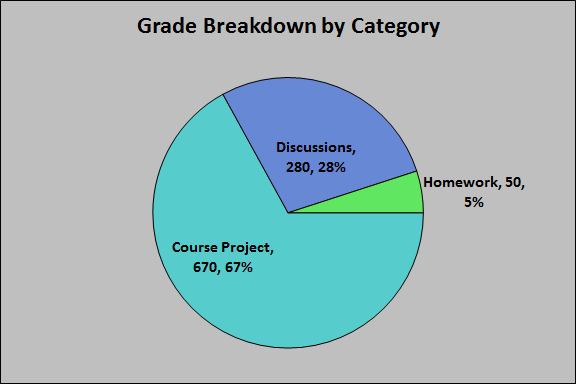
Homework (a developed paragraph, a summary and response, and two essays in two versions each)- 370/1,000 points
My Reading Lab (reading skills and reading level assessments)- 300/1,000 points
Discussion Posts (three posts in each of two graded discussion threads weekly)- 280/1,000 points
Reflection on Progress and Plan for Improvement- 50/1,000 points
As before, most assignments were assessed by means of rubrics provided by the institution. Some few were assessed on a percentile basis from standardized testing conducted as part of University-wide course requirements.
The section met on Thursdays from 1800-2150 in Room 107 of the San Antonio campus of DeVry University. Enrollment was low–only two students as the class began, dropping to one before the class ended–so presentation of students’ statistics is inappropriate; there are insufficient numbers to allow either anonymity or the extraction of useful data.
Teaching so small a class had its benefits, certainly. I’ve got a fair amount of experience as a tutor, so I was able to operate the class as a sort of extended tutorial, though my tutorials are usually more responsive and flexible than a prescribed assignment sequence allows. I do have to note that the relatively low workload made for an easier time of things for me, and I am not ungrateful–particularly given that the next session looks like it will ask quite a bit of me (I’m only teaching one class, but it has 28 students in it as I write this–and it’s a wholly online composition course). In all, it catered to my strengths, and I feel I did a good job of it this time around.
I still appreciate having had the chance to teach again, and I once again look forward to having others in the new session and in sessions yet to come.
Discussion was meant to address questions from the previous week and earlier before turning to summative thoughts about the course. Time to complete the assignment for the concluding week of the course was to have been offered.
Class is reminded of the upcoming assignment:
Homework: Reflective and Planning Postscript, due online as a Word document in APA format before the end of 1 September 2018
The session closes at the end of the day on Saturday, so all work must be submitted by then to be counted.
The class roster listed one student enrolled, unchanged from last week. None attended, assessed informally. No student attended the most recent office hour.
After addressing questions from the previous week and earlier, class turned to workshopping student work in advance of the second draft of the final essay being due. Student questions were addressed as they arose.
Students are reminded of upcoming assignments:
Discussions (three posts per graded thread), due online before 0059 on 27 August 2018
Homework: Essay 2, Graded Draft, due online as a Word document in APA format before 0059 on 27 August 2018
My Reading Lab: Reading Textbooks Topic and Post-Test, due online before 0059 on 20 August 2018
One selection from My Reading Lab: Next Reading (in the Reading Level part of My Reading Lab; requires the Lexile Locator [which will be unscored]), due online before 0059 on 20 August 2018
The class roster listed but one student enrolled, a decline of one from last week. The student attended and participated well. No student attended the most recent office hour.
I have been offered a section of ENGL 135: Advanced Composition for the September 2018 session at DeVry University in San Antonio–and I’ve signed my contract for it. The course will run from 2 September through 27 October 2018, and it will meet wholly online. I admit to preferring hybrid or on-site courses to fully online work, but I also admit to preferring having income to not, so I was pleased to accept the course.
Ah, to see such a thing… The image comes from DeVry University. It seems to fit, given the topic here.
I note, also, that there have been some adjustments to the assignment sequence in the course. As such, I’ll need to adjust my teaching materials somewhat from those I’ve been using for the past couple of years. It’s not a bad thing; updates need to happen as more research is done into what best practices are (even if that research tends to focus on traditional undergraduates, who are not the students DeVry tends to teach), and there were things in the previous assignment sequences that flatly did not work well.
Whether or not I assign a topic for consideration is still undetermined. I did not have great success with it the last time I did so, as I believe I noted. My concerns about it remain in place–the more so with a wholly online class, where students are typically even more pressured to cleave to assignments as prescribed and less inclined to range out from their expectations. (It’s not my first wholly online course, and my own mother completed a wholly online degree. I’ll admit my experience is limited, but it is still what I have to work with.) If I do, I do not think I will restrict myself to the previously assigned topic; again, few of the students I taught felt as if they could meaningfully address it. (I wonder if it derives from their having been underserved by their previous academic experiences.) Perhaps if I prescribe a topic, I will work with humor once again–although the circumstances of the class are not such as admit of jocularity easily.
In any event, I have it to do one more time, at least. Even if I do confine myself to the “standard” offerings this time around–and I might, that I might better negotiate the changes to the course sequence since the last time I taught it–I will be glad to have the opportunity to work with students yet again, hopefully to help them move beyond the idea of research as compiling and reporting information only and into the notion of research being the revelation or creation of new knowledge. Students in first-year writing classes do not necessarily often make such breakthroughs, but when they do, it is quite a joy to see; every time I am able to help it happen, I am pleased with myself.
Every time it happens, whether I am responsible for it or not, the world is that much better off than it was before. And more of that needs to happen.
Class was intended to address questions from the previous class meeting and before and turn to organizational patterns before briefly treating some concerns of paratext. Instructor absence prevented that, however. Instructional materials, including an attendance-equivalent, were sent to students.
Students are reminded of upcoming assignments:
Discussions (three posts per graded thread), due online before 0059 on 20 August 2018
Homework: Essay 2, First Draft, due online as a Word document in APA format before 0059 on 20 August 2018
My Reading Lab: Patterns of Organization and Inference Topics and Post-Tests, both due online before 0059 on 20 August 2018
One selection from My Reading Lab: Next Reading (in the Reading Level part of My Reading Lab; requires the Lexile Locator [which will be unscored]), due online before 0059 on 20 August 2018
The class roster listed two students enrolled, unchanged from last week. No students attended the most recent office hour.
I‘ve noticed recently that my blog has been attracting more attention. Since close to the end of July, there’s been an upswelling of interest in what I write here, which I appreciate greatly. To illustrate, the week of 15 July 2018, which was a typical week for my blog in the time since I stopped trying to be a full-time academic, saw an average of six or so views a day from five or so visitors–and had days of no readership. The following week, however, saw an average of more than 45 daily views from more than 43 viewers, increases of 727% and 839% over the previous week, respectively. The most recent week, beginning 29 July 2018, saw an average of more than 66 views per day from 65 viewers, another 145% and 151% respective increase from the previous week.
You can guess when I wrote this, I suppose. Image taken from the readouts WordPress gives me about my blog.
Again, and this needs to be emphasized, I greatly appreciate the interest in my work. I write here for others to read, and seeing that others do read what I write warms my cockles. It is because I want them to continue to do so that I find myself asking why it is so, what I have done that has prompted the renewed attention to my blog.
That most of the views I’m seeing reported are for assignment guidelines I’ve posted–which seems to be the case–suggests that my assignments are being used as models. Whether it is for instructors giving their own assignments or for the teaching of instructors about how to design them–and, in the latter case, whether as positive or negative examples–is less clear. I understandably hope it is one of the first two rather than the third, though if I have made enough of a name for myself that I have become an anti-role-model, I can comfort myself with the idea that no publicity is bad publicity. I have a long history of playing villains, after all, as those who have known me can attest.
The problem, of course, is that I am no longer in a position where I have leave to write my own assignments, not even so much as in the managed situation at the end of my time at Oklahoma State University. As such, I’ll not have much more of such material to contribute as has been receiving attention, though I am sure I could come up with some kind of assignment sequence that might be used, something not necessarily grounded in any one school’s programmatic requirements. Indeed, I recall a CCC article that proposes a writing studies curriculum; it might make sense to design assignments to suit it, and then to do something similar for the kinds of literature classes I would teach, had I but world enough and time–and opportunity, unlikely as I know it to be.
In any event, I can hope that attention to some of my materials will prompt attention to more of them, and I hope to be able to produce more that people enjoy reading or find useful to have at hand. I’m not intending on giving up anytime soon, and I am thankful for having had the readership and support I have had to this point. I look forward to yet more.