The regular class meeting for the week was displaced by a holiday, so the class was given a narrated PowerPoint presentation that covered the basics of what would have been the week’s lesson. Office hours were given over to addressing student questions about and engagement with the lesson.
Students are reminded that the following assignments are due before the end of day (Mountain Standard Time) on 2& January 2019:
Discussion Threads: Generating Ideas and Planning Your Essay (3 posts/thread, rubric online)
To follow up on the work of last week and continue what I’ve found to be a useful pattern in other classes, I mean to return to drafting sample assignments to help my students better understand what they are asked to do for the class. I also continue to hope that my efforts will prove to be of both that benefit and others to readers yet unknown to me. In doing so, I narrate my process of composition and present the sample paper near the end of this blog post.
Cat videos are internet-appropriate, right Image from Giphy.com.
For the week’s assignment, students are asked to compile a first draft of an essay that addresses one of two assigned prompts, both of which respond to themes in assigned readings. The essays are asked to be three paragraphs in length–introduction, body, and conclusion–and to come under a cover page in APA formatting. No requirement for outside sourcing is expressed, so no outside sourcing is expected, though there is specific reference to the assigned readings, themselves, so it might be permissible.
To respond to the exercise, I began by setting up an APA-format document in Word. That is, I set up my document in double-spaced 12-point Times New Roman typeface with one-inch margins on letter-sized paper. I also arranged my cover page, running head, and pagination as prescribed by APA style. Given that I did not expect to need to use outside sources, I did not set up a references page.
That done, I settled on a topic to which to respond, whether responses to homeless persons or a central idea around an inspiring person. The second seemed a better fit for the class and the assignment, so I opted for it. With that done, I had to identify a person I find inspiring, and, with the person identified, I had to settle upon a central impression to convey about that person. (I’d done so in an earlier piece, so I had some experience to help me along, even if the subject differed.)
I typed that central idea into my document, then copied and pasted it on the next line of my document and highlighted the second in green. I tend to do so when I compose essays so that I know what thesis I am trying to support; as I draft forward, I do so behind the highlighted thesis, leaving it as an ever-present goal for my essay to achieve.
With a thesis in place, I worked to offer a paragraph of support for it. I try to draft essays thesis first, then body, so that I know where I am going for my introduction and whence I will proceed for my conclusion. The body drafted, I began to work on my conclusion, since I was already at that point in the paper; I rephrased my highlighted thesis, stripping away the highlighting, and wrote a brief note discussing future implications of that thesis.
After I put together a brief conclusion, I returned to the beginning of the paper to lead through an introduction into the thesis I had constructed. Following a common introductory pattern, I offered some context for discussion before moving to narrow my focus and identify my topic. The thesis I already had in place followed, giving me a complete paragraph that already moved into a body of work.
With that done, I reviewed the piece for readability. I once again applied the Flesh-Kincaid reading level test, which again returned a result in line with what I had hoped to find. I was therefore able to proceed thence to review my document for style and mechanics. After making the adjustments that needed making, given exercise requirements and ease of reading, I put the document into an accessible format, which I present here in the hopes that it will be of use: G. Elliott Sample Essay.
I have commented from time to time about my own writing and my writing processes, not only here, but also in other venues. I’ve also recently looked back over some of the stuff that I’d written before, partly because it was relevant to the writing I was doing more recently, and partly because I am still subject to fits of nostalgia. Sometimes, those fits do something decent for me; I did a few things decently in my younger years, at least, and I have not let their promise lapse utterly as seems to have been the case with quite a few other things. Sometimes, they do bad things to me, largely when I end up dwelling on what could have been but now never will be. Occasionally, though, they give me occasion to pause for rumination–not that I am short on things that offer such gifts.
Image from Giphy.com
Across years of study and years after formal study ended, I have been writing. I flatter myself to think that I’ve gotten better at it over that time; I know I’ve gotten more willing to put the writing where other people can see it, and I know I continue to harbor the idea that the writing I do is of some value to others. And not just in the way that any writer who writes for a public has to harbor such a thought (and all do, else they’d not put their writing where others are apt to see it); as the sample assignment responses I’ve been doing suggest, I expect the writing I do to be of direct benefit with tasks at hand in, at least the short term and for at least some of the work I do.
But I’ve also mused in other venues about looking back over older essays of mine and revising and otherwise updating them. (Admittedly, paratext is what comes to mind, but paratext is important, as I’ve argued and as others have far more eloquently and successfully argued.) I’ve got most of my old papers–those written since I gave up on trying to become a band director when I grow up–on file, and a great many of them would work as the kind of thing I tend to post here. They need more work than reformatting and insertion of paratextual norms such as illustrative and decorative graphics and HTML-compliant section headings, of course. Even the things I wrote a scant few years ago show their age and my relative immaturity, and I know that the things I wrote in my first year as an English major are far more dated, far less refined, far more annoying than what I put out now. (I have more sympathy with some of my professors now than I once did.) Revisiting and amending the work, though, might well do me some good; there are at least a few ideas that could stand some attention and refreshing, and the rest could well be taken as the kind of penitence a man like me might well do.
At the same time, with few exceptions, the repetition I already do is not the best. I am self-conscious about it already, as I think I’ve shown recently. And I’ve noted in other venues my expectation that saying again what I have already said, and to much the same audience that heard or read it the first time, will read other than optimally. I do not know that what I wrote in days gone by will seem repetition to those who have been reading me more recently, to be sure, but I also do not know that they will not be. And I am not certain that I will do well to work again with ideas that I had once had and put into words years ago; I am not so far past my dissertation as I am past quite a few of the other pieces, and I do not know that I can stand to look at the thing again to make it a monograph, as I know I was supposed to have done. (That I did not doubtlessly contributes to my not having secured work in academe, not that making the monograph would have guaranteed a damned thing.) The thought of catching up on the scholarship and writing the at-least-one additional chapter stymies me. The thought of going further back and trying to do more causes me to balk utterly.
Perhaps it is good to leave some of the past in the past. Perhaps it is good to have moved on from some things, to put them down and not pick them up again, not because others will need to take them up, but because they should be trodden into the ground by unseeing feet and covered over by the sediments of passing years, what was in them leached out and returned to the source form which they sprang or else locked away from view forever.
After addressing questions from the previous class meeting and offering an administrative note, discussion moved in sequence through concerns of definition, genre, paragraphing, and APA formatting. Time was given to upcoming assignments, and students were afforded time to work on their own responses to those assignments.
Students should note that, owing to the MLK holiday, campus will be closed on 21 January 2019. A WebEx meeting will replace the regular office hour at 1800 on 24 January 2019. This schedule supersedes and replaces that announced last week.
The class met as scheduled, at 1800 in Room 114 of the San Antonio campus. The course roster showed three students enrolled, unchanged from last week. All attended; student participation was adequate.
An online office hour was held on Thursday, 10 January 2019, at 1800. None attended. The next will be online at 1800 on Thursday, 17 January 2019
Students are reminded that the following assignments are due before the end of day (Mountain Standard Time) on 20 January 2019:
Discussion Threads: Trying out Transitions and Practicing Main Ideas (3 posts/thread, rubric online)
While last week may not have seen the kind of assignment for which I can offer a sample to my students, this week does. Accordingly, I will do as I have said I will do and work to offer a sample of the kind of work I would like to see from my students, hoping that having a concrete example will help them to do better work. I also continue to hope that my work will help others outside my classroom, as well.
A common symbol of achievement. Image from Time.com
The assignment faced by students in the second week of Introduction to Reading and Writing at DeVry University in San Antonio is to draft a solid paragraph on one of four topics: educational reform, gender difference, family, or discrimination. Each is narrowed slightly from the overall topic heading, and responses are expected to consist of at least 100 words in APA format. The paragraph is asked to make a point, provide illustrative evidence, and explain how the evidence functions to bear out the point.
To address the exercise, I began by setting up my APA-style document. That style guide asks for black, double-spaced 12-point Times New Roman with one-inch margins on letter-size paper, with running heads, page numbers, and title page in prescribed places; I set my document to those standards.
That done, I settled quickly on a broad topic, opting to treat class discrimination. The topic had been on my mind as I had been working on other writing, so it was an easy choice to make. Focusing more narrowly was a bit more of a challenge; a paragraph will admit of but one instance, and there are entirely too many instances of class discrimination. I opted to take what I think is an unusual approach; most pieces on discrimination treat the discrimination against those in perceived lower positions by those in higher, but there is discrimination by the perceived lower against the higher, as well–or, rather, concerns not unlike covert prestige apply. That is, eminence in areas other than are commonly recognized as conferring eminence are prized, and the commonly prized derided. Again, such matters had been on my mind already, so arriving at an example to treat was easy.
Having made the decision about the topic, I began to draft my paragraph, opening with context to aid readers in understanding my approach. From context, I moved to pivot into my specific topic, an instance of discrimination leveled at me, presenting it as the central point of the paragraph. I then moved to offer specific illustrative examples to support that point. Those provided, I connected the information I had offered back to the central point I meant to make in the paragraph, and I then offered a concluding sentence to wrap things up.
With that done, I reviewed the paragraph for readability. Applying a fairly common test, the Flesh-Kincaid, returned a result in line with what I had hoped to find; I know I have a tendency to wax verbose in ways that are not always helpful, and it was a relief to find that I had not done so. I was thus able to proceed thence to review my document for style and mechanics. After making the adjustments that needed making, given exercise requirements and ease of reading, I put the document into an accessible format, which I present here: G. Elliott Sample Developed Paragraph January 2019. May it and its successors prove of benefit now and in time to come!
On 8 January 2019, Erin Bartram’s “How PhDs Romanticize the ‘Regular’ Job Market” appeared in the online Chronicle of Higher Education. In the article, Bartram relates a facet of her experience transitioning out of academe, namely the common expectation of those moving into so-called alt-ac and post-ac careers that the job market in the world outside the ivory tower is better than that within it. She argues that the non-academic job market requires the same kind of clear vision academics are expected to have about their own fields and in-industry hiring practices. The article continues by listing factors to consider while engaged in the search for out-of-academe work: reflection’s limitations, prevailing labor competition, mismatches between credentials and requirements, employer uncertainties, and prevailing misunderstandings about academics. Bartram ends on a valedictory note, commenting that the difficulties of the labor market are not reflections on job-applicants’ character, that the success of one makes the success of another easier, and that those of us who have been forced into academic exile or expatriacy are working on a (perhaps romanticized) common cause.
Once again, the image is from the piece discussed.
This is hardly the first time I’ve written in response to what I’ve read from Bartram, as witness this, this, and this, at least. It seems to be something of a pattern for me to do so, and I have to wonder how it reads, partly to her (if she is aware of being so discussed) and partly to my own readers, who may or may not be tired of seeing me come back to the same ideas time and again. Then again, I’ve read a lot of novels that have had the same plot–and sell millions of copies. I may be forgiven, then, for coming back to a writer whose work I’ve treated before.
Of particular note to me are the fourth and fifth of the listed factors for consideration in the article: “Employers are not so sure about your ‘transferable skills'” and “Misperceptions about PhDs persist.” I’ve noted before that my own search for full-time work outside academe took some doing, and that, while I have a solid job with promotion prospects at the moment, I am not so far into it or so far removed from the frantic search that it does not still resonate with me. And that resonance is what makes the two points stand out; they are things I encountered repeatedly as I looked for work, and they came up–and come up–even with the job I currently have.
Regarding the former, the idea of transferable skills, I followed the advice I’d been given, both about making arguments in general and in applying for jobs, more specifically. I made the case that the things I had learned to do as I learned to be a scholar would help me to do the things I would need to do in the job. Poring over manuscripts and early editions of texts taught me attention to detail and record-keeping. Writing paper after paper after paper helped me develop a typing speed that is the envy of many a clerical worker. Training in several languages helped me learn better how to communicate with a variety of people. Working through courses and curricula helped me learn how to budget time effectively to address short- and long-term goals, and to do so with minimal oversight and direction.
Making that case did not help me much against automated HR systems that regard coursework–and teaching–as things other than the skills required for the job and so discard such resumes as mine out of hand. And it did not much help with employers who felt similarly, or who saw coursework as a pale imitation of experience (which it is, in many ways, though there are things that individual experience teaches only at great pain) and thought that my lack of the latter made me less desirable than others. Even in my current job, there are times when what I have been trained to do that lines up with the stated job description for my present and presumptive positions only does so on paper; my ingrained reaction is the wrong one.
Such concerns interact with the latter of Bartram’s points, the idea of misconceptions and misunderstandings. One thing by which I’ve been struck in my time in my present position is the strange regard in which I am held. My coworkers look to me for guidance and insight because I have the credentials that I have, but they are not seldom inclined to disregard what I offer because it proceeds from a place of erudition; I still seem to them to be too pointy-headed for a lot of things I say to work, even when I untangle no few problems that they have. When I interviewed for the job, after having resigned myself to the loss of a long-time dream in terms of the academic job search (I was several years at it before the realization broke upon me), I got the question of why someone with a PhD would want to work the work I work now. And while more than a year at the job has allayed the idea that I am looking in earnest to get back into academe, I am certain it was in force then–and I suspect that it persists to some extent even now.
(For the record, while I do still work as a contingent academic, and I would not be averse to picking up a little more work in that regard, I have no intention of leaving my current agency. I doubt I’ll get a better offer than what I have now, at least for quite a while, and I see no reason to give up what I’ve managed to cobble together without damned good cause.)
I know that I am fortunate to have found an agency that was desperate enough to take a chance on me–and that is actually a pretty decent job. Sure, it could be better, but no job couldn’t. And I know I am fortunate because I know Bartram has the right of it; employers often look askance at PhDs, both because what academia does is seen as at odds with what the world outside it does and because those who have lived the life of the mind are looked at as longing to return to it. And there is longing for it on my part, to be sure, as I am certain is true for others. But I am equally certain that many of us who are now on the outside, or who are only in the lowest basements of the ivory tower, know well that we will never reach its higher floors and that it boots nothing to bloody our knuckles by knocking yet longer at the doors that lead to them. Those of us who seek outside work and who have it now want nothing more–or less–than to be able to support ourselves in line with what we have long been promised, and in as many words: if we work hard and do the right thing, we’ll have decent lives.
For the first class meeting of the session, introductions were made to the discipline, course, and instructor. The materials provided in the course shell were expanded upon, assignment guidelines were reviewed, and time was afforded to students to work on their assignments.
Students should note that, owing to the MLK holiday, campus will be closed on 21 January 2019. A WebEx meeting will replace the regular class meeting on that date; it will begin at the regular class time.
The class met as scheduled, at 1800 in Room 114 of the San Antonio campus. The course roster showed three students enrolled. Two attended; student participation was reasonably good.
An online office hour will be held on Thursday, 10 January 2019, at 1800.
Students are reminded that the following assignments are due before the end of day (Mountain Standard Time) on 13 January 2019:
Discussion Threads: Introduction, Reading and Writing: My Strengths and Weaknesses, and Time Management Strategies (3 posts/thread, rubric online)
As I’ve moved into a new session of teaching, I had meant to begin developing sample assignment responses again. They seem to have helped my students in the past couple of sessions, and I do want to help my students succeed, despite what many of them seem to have thought over the past however many years I’ve taught. But when I went to look at the current session’s assignments for the first week, thinking I would get a head start on developing those new examples, I found that they are online quizzes.
I cannot offer examples of such things. For one, I do not know how limited the quiz bank is from which the students are asked to work; were I to address questions from them, I would be giving students answers, and while I approve of giving models, doing the assignments for them passes lines I am not willing to cross. For another, I am relatively certain I would get into some kind of trouble for posting the questions directly. And were I to try to write an independent example of such a quiz, it would require more work than I am willing to do without additional compensation. (I enjoy writing essays; I find the work of doing so meditative, and I often learn things from it. Quiz-writing is much more meticulous, and while it can be remunerative, I am not likely to draw extra pay for providing supplemental materials to my already-enrolled students. I do the job because I need money, after all.)
For now, therefore, I will have to defer what should have been an example of an assignment response, waiting until next week, when actual written responses begin to be asked of the few students enrolled in the current session. Because there are few, I will be able to attend to them more closely than larger classes permit, which should be to the good for the students and for me. For when I have to assess work at speed, I find myself looking for different things than I would prefer to seek but which I can only work to uncover when I have time to spend–and that is not the case with over-enrolled writing classes that have institutional deadlines I must meet. That seems not to be an issue this go-round, and I am grateful for it. I hope I have cause to continue to be.
On 4 March 2018, Justin Stover’s “There Is No Case for the Humanities” appeared in the online Chronicle of Higher Education. The article opens with the stark statement that the academic humanities are already nearly dead, offering examples of that near-death, before announcing its overall topic and framing the following discussion in terms of its strange support from the cultural right and left. Stover then addresses prevailing critiques of the academic humanities: their overspecialization, overproduction, and under-teaching. After, he lays out some historical context for the current problem of the humanities, namely that they have been supplanted by the university’s expansion into fields previously assigned to other kinds of institutions, before addressing the inadequacies of common defenses of the humanities. The article proceeds to articulate the academic humanities’ core function: the development of a common culture and class to carry it. The inability to articulate the value of that commonality outside of it is what makes for a lack of case for the humanities, and Stover notes that that lack does not mean the humanities should not be defended or that they will not last beyond the falling-away of institutional support for them.
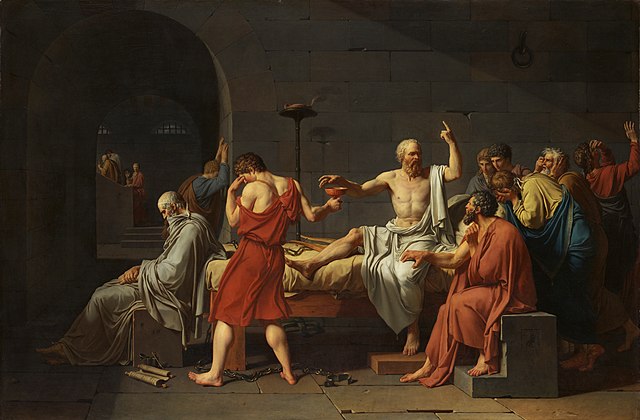
Jacques-Louis David’s The Death of Socrates seems fitting.
Before I move into more ruminative responses to Stover, I need to note a couple of things that stood out to me as I read. For one, I am tempted to read Stover’s piece against that of Bennett’s, to which I recently responded. For another, Stover makes the comment that humanities scholarship is “not written to be read, at least in the normal sense of the term”; I find myself wondering what that “normal” sense is. Later, he makes the statement that “The university can be many things, but without [humanities scholars], a university it will not be,” which seems to me to be a bit vainglorious and myopic. Admittedly, accreditation requires a certain number of humanities courses, but the relegation of those courses to adjuncts and visiting faculty–to academic expatriates such as I am–satisfies the inclusion but does not satisfy the soul, as it were. Academic and disciplinary ghettoization happen, and more in the humanities than in other places, it seems.
Those things noted, I think Stover has the right of it. Academe does tend to replicate itself, and it is used as an entree into a particular set of cultural norms, themselves emerging from historically exclusionary and discriminatory preferences and still, in many cases, reinscribing them. And it is true that those norms cross national boundaries, but they are hardly so cross-cultural as might be hoped; there is ample attestation that taking them on involves self-alienation from home cultures, and I could add mine to the litany of them. It is also true that the academic humanities need defense if they are to persist in the university, though whether or not they should is another matter. Movements toward open-access and decentralized work, increasing numbers of academic expatriates who have found no room for themselves within the transnational culture of academe but who still want to contribute to a field from which they feel themselves to have derived benefit and purpose, suggest that the institution is not so necessary now as it was–but only relatively recently was.
It is further true that the humanities cannot justify themselves outside themselves, no less so than theologies require belief to justify themselves, and systems of law, and other human endeavors that Stover mentions. And I might note that faith in such things is diminishing no less than faith in the value of the academic humanities. If the humanities are framed as being in need of defense, it is clear that they–and other fields, to be sure–are losing and are likely to keep on doing so. If they have made promises, they have failed to meet them. They have lied, and to many people over no small amount of time, and it is not unfitting that liars suffer for what they have said wrongly.
On 13 April 2018, Eric Bennett’s “Dear Humanities Profs: We Are the Problem” appeared in the online Chronicle of Higher Education. The article opens with a summary of the progressive work done by humanistic academic study before pivoting into the assertion of its title and glossing disciplinary history from the First World War onwards. The decentering and deconstruction of literature from the 1970s on receives substantial attention as leading to the effective expulsion of humanities scholars from civic regard. Bennett returns to the 2016 elections for an example of the uselessness of humanistic self-disinvestiture before moving back into an explication of historical circumstances that once empowered humanistic study and on into a critique of new media and its studies. He then proceeds to posit a corrective, of which much seems to be a return to older norms of scholarly conduct and intention that ultimately reads as somewhat naïve.
It’s another where the picture comes from the article underlying the piece.
I do not know what I expected to get out of reading the piece, honestly. Perhaps I looked at it initially from a sense of Schadenfreude, a delight in the misfortunes of a community that I sought to enter and by which I was more rejected than not. (I acknowledge that there are many ways in which I remain quite bitter. It is not good for me, to be sure, but I have been more bitter than the coffee I drink for nearly as long as I’ve been drinking it; I don’t know who and what I am without it anymore, or even if I have a who and what I am without it. But that is a rumination for another time.) And there is some irony to be found in people ruining a thing in an attempt to save it, as well as in neglecting historical underpinnings while interrogating them. For my erstwhile colleagues are not wrong to note that the things set up as bulwarks were set up to protect particular things and people–and not others. And they are not wrong to note that maintaining such systems also maintains the discrimination upon which they are established. But neither is Bennett wrong to note that moving away from them has had consequences many who work to dismantle the objectionable find objectionable. We cannot be surprised at a disregard for fact when so much work has been done to question the nature of fact–or we should not, since it is clear that many are.
Perhaps I actually looked for some kind of solution to the problem presented. Bennett seems to be arguing for a return to older ideas, which is problematic for a number of reasons. One of them is that those older ideas do contain and reinforce various discriminations that should not be in place. It is true that any judgment will necessarily discriminate, and I do not think Bennett is wrong in concept; there are things that are to be decried, although determining the point at which they become so can be somewhat fraught. (For one example relatively close to home for me, formal English is moving away from the inclusive masculine, the assumption of “he” as the default pronoun, yet, to my knowledge, formal Spanish retains the construction. Mixed groups are referred to in masculine declensions–though Ustedes is a thing. So does it become necessary to decry the construction, or is it necessary to allow another culture to retain its norms?) But that very fraughtness, which is good insofar as it demands that people think on things and reflect, works ill in that it works to allow for the kind of shenanigans seen too often in current political offices in the US and elsewhere.
Also problematic is the fact that the older models are unpalatable because they are older and slower. Some few are able to take the time to reflect and consider, true, but far more are enmeshed in the brutal demands of daily living, working as they can to scrape together what they can so they can last into the next day and do it all again. It is a Maslovian concern; many people cannot devote the time to thinking through things that they need to think through because they have to devote all their time to staying alive, without which no discernable thought occurs. At the end of a long working day, insofar as I have such things, I seek ease and solace, not the challenge and rigor of thinking through things. The stack of reading beside my bed speaks to that. Yet I am trained to do that very thing. So if I reject doing it when I am tired, I can hardly blame those who are not trained as I am for turning away from it when they are tired–and I know that many are perpetually tired; again, they are worn down from daily life and its demands, so they can hardly but be.
(I do not mean to excuse people from their misdeeds. Tired as many are, they still actively work to ill in the world, and that is not something that should be lauded even if there are other things about them that should. But I know I contribute to suffering, as well; I do not exempt myself from such condemnation. And I am unwilling in my present circumstances to take the risks that extricating myself from at least some of the complicity would entail. So there is that.)
Whatever the reason I looked at the article, though, and whatever problems the solution towards which Bennett gestures has, the idea of the title is one worth considering. Those who have studied the academic humanities–often with literature standing as metonym for the broader group of fields, which is its own problem–have done much to make themselves less than amenable to public understanding and sympathy. We–and I am among the group even now, as seems fairly obvious–put ourselves outside the world even more strongly than the traditional town and gown divide would have it, in part because there is less overt a connection between what we do and the parts of people’s lives that help them to survive than between them and other fields, and Maslovian logic holds, at least in part. And I do not know how to address the matter; I have no more workable solution than Bennett. Perhaps the solution is to let the institution die and, in its fall, open up space for something new to grow that might well be what we need.





 Elliott RWI