My head is full
Less now of words
Than of allergies’
Lin’gring curse
Or of some illness–
It were worse
Were it thus–
So I am terse

Photo by Pavel Danilyuk on Pexels.com
Even with a runny nose, I can write for you!
My head is full
Less now of words
Than of allergies’
Lin’gring curse
Or of some illness–
It were worse
Were it thus–
So I am terse
Even with a runny nose, I can write for you!
Read the previous entry in the series here.
Read the next entry in the series here.
Following an excerpt from Symphe’s papers, “The Pirate Isles” begins with Fitz mulling over his continued voyage aboard the Paragon as the liveship obliges Althea, Brashen, and the crew to proceed past their intended and agreed-upon destination towards Clerres. The ill regard in which the crew holds him and his company is noted, and the routines into which Fitz and his company settle further are described.
One evening, Fitz disguises himself in Elderling garb and reconnoiters the liveship. Unseen by the crew, he overhears Clef teaching Per, as well as Lant and Spark discussing romantic entanglements. The latter gives Fitz cause to ruminate, and he retires.
The voyage continues, and matters worsen aboard the Paragon. Fitz confers with the Fool about the matter, as well as about how he feels himself treated by the Fool as Amber. The conference leaves Fitz angry, and he walks the decks to try to ease himself. An earlier argument with the liveship is rehearsed, and Kennit’s exploits are glossed to Fitz as the Paragon enters the Pirate Isles and is spotted by one of their ships. A conference about that ship is begun among Amber, Fitz, Althea, and Brashen, and the perils that present themselves at that juncture are noted.
The liveship shudders and shifts as the other ship approaches, and Paragon determines to make for Divvytown. Matters grow tense as the other ship draws closer, and the liveship consents to follow it, finding mooring near the Vivacia. As the ship is tied off, Fitz urges Lant to take Spark and depart, but is rebuffed once again. Fitz prepares messages for Buckkeep as ship’s matters are conducted, and he is aboard as the Paragon makes to confront the Vivacia. The two liveships confer at some odds, and Fitz is nearly overwhelmed by the magical energies that flow between the craft, and he is roused by a messenger bespeaking the return of Amber, Althea, and Brashen to the Paragon. Althea and Brashen’s son joins them, and Fitz muses on the complications that surround them all.
The present chapter is one of the longer ones in the novel thus far, running to thirty pages in the printing I am re-reading. The length does allow for a fair amount of material to be presented in a way that makes sense, in context; exposition is always a challenge to address well, but using time aboard ship with little else to do to address it picks up the gauntlet with relative ease.
That noted, I do find the introduction of the romance between Lant and Spark a bit abrupt. It does seem to surprise Fitz, admittedly, so I can accept it as a thing that had been going on “off-screen,” as it were, but I think I would have liked a bit more lead-up to it, a bit more foregrounding. In a series of novels that largely predicates itself on prognostication, I don’t think that’s too much to ask. (At the same time, I note something of a back-handed joke in the relationship, a spark setting off a lant[ern]. [Yes, it’s FitzVigliant, not Lantern, but still…]) Not that I could do better, admittedly; I do not claim to be able to do so much, and I do not want to be understood as doing so. But that does not mean I cannot point out what I see–or what I would have liked to have seen, even in a series of works I have repeatedly affirmed and demonstrated that I very much enjoy and appreciate.
I’ll note that my issue with the romance is not the romance itself. It makes sense that those who are in close proximity for extended periods of time would get to know one another better the longer they are together, and it does not exceed belief that that greater knowing would lead to greater affection leading towards love. Hell, I met my wife in graduate school, and while that’s not quite as sequestered an environment as Spark and Lant have shared, being in a post-baccalaureate program together does mean you see an awful lot of a relatively restricted number of people, the more so when you share office space as my wife and I did (about which a bit here). And it’s not like amorousness is new to the Realm of the Elderlings; Fitz has had his share, as have Althea and Brashen, as well as others who figure prominently in the milieu. It’s part of life for many people (I see you, aro folks), so it should be present in the work of an author who prizes verisimilitude, even if it’s not the protagonist’s focus at any given point in that work.
The holidays draw closer, and bespoke writing still makes a great gift–that I can help you get!
At around this time last week, I noted the start of my work as a contract programs teacher at my local library, running a Dungeons & Dragons (D&D) game for a group of middle-school-aged students. As reported, the first session went pretty well, so I spent some time in the following days developing materials for the next session, scheduled to take place yesterday afternoon into early evening as this reaches the internet. I’d planned on bringing in one more player, signed up for the program but absent on the day of the first meeting, and I’d planned on moving the whole group ahead from the introductory session into the main plot, and so I wrote with all that in mind.
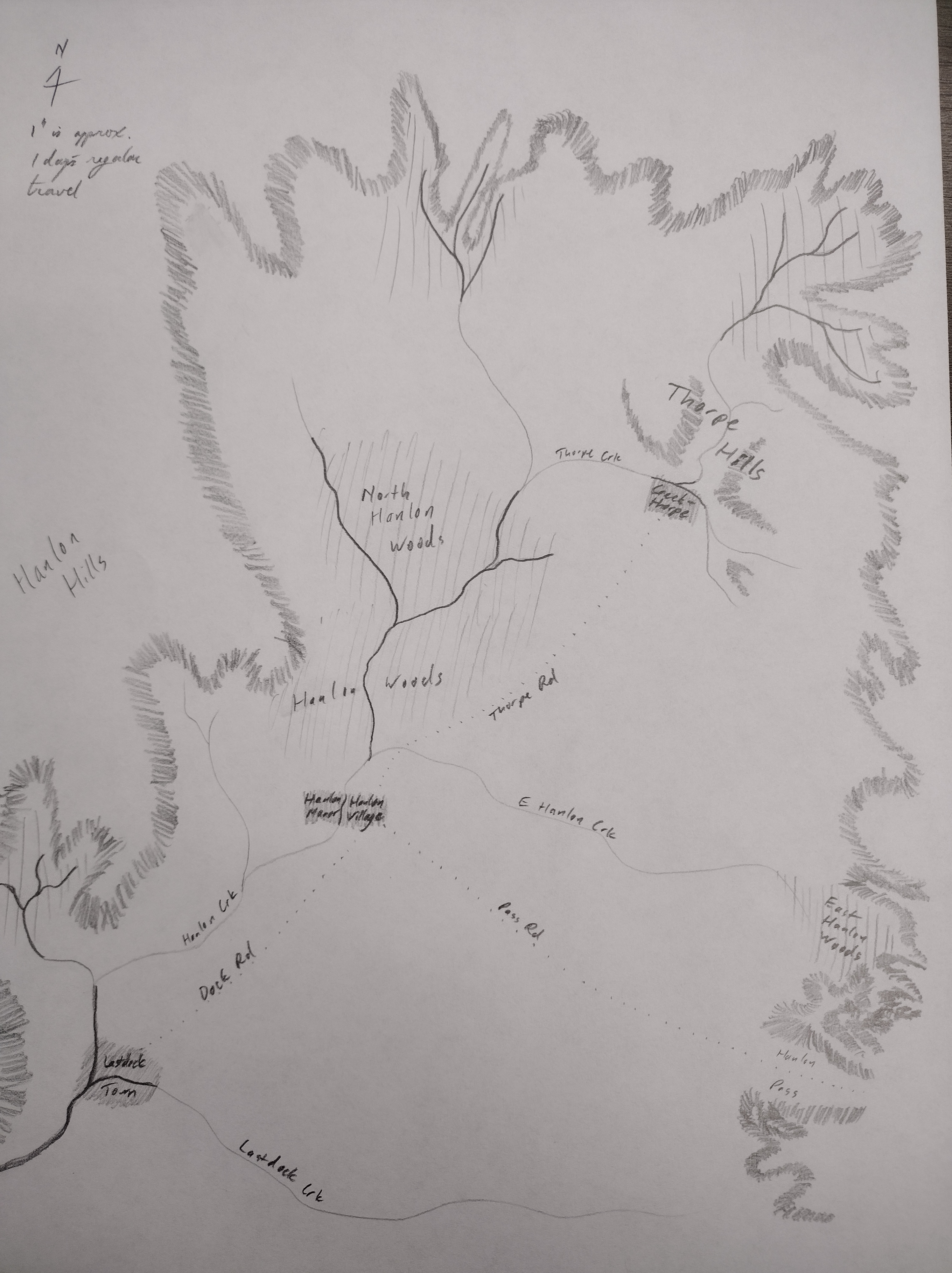
One of the things I did, because I am often helped by doing so, was to sketch out a map of the local area. I am well aware that my pen-hand leaves a lot to be desired, and I am more than a little out of practice as a cartographer; it had been a while since I’d put together materials for a tabletop game, after all. But it was helpful for me, nonetheless, to begin to gesture towards a wider world into which Hanlon Village falls, to have a visual idea of what area is dependent on Hanlon and what Hanlon, in turn, depends upon. And it was helpful for me to have some idea of where shenanigans could take place, as well; hills and woods offer many opportunities for that kind of thing, and having some variety, some options, is a good thing.
I’ll admit to being influenced in what might be called map-making by the maps present in a lot of fantasy novels, mostly following the Tolkienian tradition; Lord of the Rings does it, but then, so do the Chronicles of Thomas Covenant and its successor series, the Wheel of Time novels, the Song of Ice and Fire novels that have managed to make it into the world, and (near and dear to my heart) Robin Hobb’s works. I’m also marked by having grown up in the Texas Hill Country; there have been times I have directly taken from maps of towns and cities in my part of the world to make towns and cities in other worlds, entirely, although I did not directly do so for Hanlon (although there were definitely local features in my mind as I did my sketch.) I’ve also benefited from reading Karen Wynn Fonstad’s works of fantasy cartography, although I’m not in any way claiming the talent or expertise she deployed. I do think it’s important to acknowledge my influences, though, even if I do not live up to their inspiration.
I’ll note, too, that I deliberately did not “fill in all the blanks,” that I left things open and did so on purpose. While I do tend to plan a lot for the games I run, I also know from experience playing and running games that the narrative does not always go as planned. There always needs to be room for players to take their stories in their own direction, and if there is a direction to go, there has to be something in that direction for them to uncover. Admittedly, there is a fair bit of manipulation that can go on; an opponent who had been hiding in a tree or behind a rock can be concealed in tall grass or in a shallow depression. But even aside from that, if the intended plot would move players east and they go west, it’s good to have a west for them to explore–and taking notes can make what is extemporized (again, I make a lot of use of Mackay’s The Fantasy Role-playing Game) more permanent, giving players some agency in creating the world in which their characters exist.
The map was not the only thing I did, of course, and could not be for me to do a decent job running the game. If I was going to send them off chasing something or other, I had to figure out who was doing the sending and what that something or other is…as well as where it ended up being. That much, at least, the map made easier; I had my idea, if one that player actions influenced somewhat. And in my earlier notes, I’d jotted down some ideas about what the something would be: a horn, passed down across generations. As to how it got from where it should be to where it was…I can’t give everything away, you know, at least not all at once.
I’m happy to generate content for your games, original and without AI plagiarism; fill out the form below to get yours started!
Again, I want to take up pen and write
Against the horror of the growing night
That creeps upon the world. The fading light
Of hope that lingers yet is growing dim
Amid a flood, and I can barely swim
In calmest waters. I grow yet more grim
As I stare through my dirty windows’ panes
And see the world, see its increasing pains
And know I can do little ‘gainst the gains
That swelling ill accrues. I strive for joy,
Of course, and look for something to upbuoy
Myself, but need more than a simple toy
To move my mind. Today, both pen and page
Can offer little to my mood assuage.

Help me make things a little better by having me write for you!
Read the previous entry in the series here.
Read the next entry in the series here.
A brief excerpt from Bee’s dream journals precedes “Trader Akriel.” The chapter opens with Bee dickering with a merchant aboard the ship where she has been captive. Bee offers to indenture herself to the merchant, her situation rehearsed, and the merchant lays out some of her own situation before agreeing to take her on.

The agreement made, Bee assesses her situation again, and she is taken by the merchant, the Trader Akriel, to her own quarters. There, Bee is given instructions and follows them, although not entirely to Akriel’s liking, and the pair begin to settle into a routine. Bee takes the opportunity to learn about her putative owner, and Akriel tests certain of Bee’s skills in order to market her better.
At length, Akriel takes Bee ashore in the port of Sewelsby. There, as Bee notes her surroundings, she takes lodgings and goes about her business, leaving Bee to see to her comfort. Bee accomplishes this, and she makes to greet Akriel upon her return, only to find her ensorcelled by Vindeliar and preceding him, Kerf, and Dwalia. A brief fracas ensues, leaving Akriel dead and Bee recaptured.
Bee wakes to find herself chained and dragged by Dwalia and Vindeliar, who have left Kerf behind as they continue to flee. She begins to offer resistance but is dissuaded therefrom decisively, and she reluctantly accompanies Dwalia as they depart.
The present chapter recalls to me my assertions regarding Bingtown mirroring the early United States; this piece fairly encapsulates them. Akriel calls to mind figures I recall being discussed without irony, “kindly” slavers who were “nice” to the humans they held as chattel and were “dispossessed” in the wake of the Emancipation Proclamation and the 13th Amendment. From that perspective, it is a challenge to read her sympathetically, to feel even as much pity for her death as Bee reports. And for those who might contend that Bee made to indenture herself, for one, she is yet a child, and for another, she is in such exigent circumstances as do not admit of truly free choice–and I have to think there is a parallel there to the also-unironically-discussed indentured servitude of Irish populations in early US history, as well. But I’d have to do some more reading to be as certain of that as I’d like to be to discuss it at any greater length.
So much said, it remains the case that Dwalia is far worse an evil than Akriel represents, with the clear and continued implication that those she serves are yet more evil for accepting and encouraging that service in the manner of its delivery. Akriel is foul, certainly, for trading in human lives without regret, but the rapaciousness with which Dwalia proceeds, coupled with what is attested by the Fool and others about the conduct of the Servants…I suppose I also need to look further into ponerology, which though continues to provide morbid amusement for me even after Halloween has happened. And I think that the Realm of the Elderlings novels could well sustain an extended inquiry in that line; there is enough treatment of evil in a variety of forms and degrees that there would be much to say, I think, although, again, I’d need more background to address it well. Despite the regard in which I’ve been told I’m held more than once, I’m not so good at evil as to have that work ready to hand.
We’re approaching the holidays, and bespoke writing makes a great gift!
Among the many things of which I have made no secret is my long time playing, running, and studying tabletop roleplaying games (TTRPGs). I’ve got a whole tag about them for this webspace, for example, and the subject has popped up in other writing I’ve done, such as the piece linked here. It should be clear at this point, with my having been involved TTRPGs for more than twenty-five years, that I’m fond of them, and it makes sense that, being thus fond, I would want to share with others and bring more people into the hobby. If nothing else, doing so means I have more people to play with, and more people to play with makes it more likely there will continue to be games to play. I delight in the prospect and the (admittedly small shred of) hope for the future it represents.

To do a little bit more to advance the cause, as it were, I’ve recently taken up a contract position with my local library. (I even put it on the resume, here.) Given who I am, that I would work for a library should not be a surprise. (Indeed, when I was job-searching, I even put in for a full-time clerking job at another library. It didn’t work out, clearly, but it was one of the few applications I put in that didn’t provoke the “Why would you want this job?” response I got an awful lot.) But that that job is explicitly to run a D&D game for middle-school-age kids might be a bit of one, even if it is entirely welcome. (On my part, it very much is. There are at least a few others who welcome it, clearly, since other kids than mine are enrolled.)
There are details I cannot share, of course. I am still learning names, for one, and even when I learn them, since minors are involved, I’m not going to include that in my reports. Even my own daughter, whose name I do have some right to make free with, gets elided; there’re reasons I refer to her as Ms. 8 in my public writings. And, because it is possible that my players will actually look at my writing here (I should be so lucky as to have the readership!), I’ll not go into details about future plans, even though I have them. But I can, and almost certainly will, report on what happens in the game and with my players, doing so partly to cement my own memories of things, and partly in the hope that what I do will prove useful for others, whether as an example of what to do or as one of what to avoid.
The first session of what is, at least initially, a limited run began with a sort of Session Zero. For those unfamiliar, Session Zero is a preliminary meeting of a gaming group in which comments about basic assumptions to be observed at the table are discussed. Conduct among participants, general expectations about the game, and character formation are common topics, and those got addressed (at least in passing; there’s more that can be said and more will almost certainly need to be said as matters progress); I also gave a bit of a working definition of TTRPGs (for which I borrow from Mackay’s The Fantasy Role-playing Game, which has informed my previous work).
The Session Zero stuff done and time remaining in the planned session–the library can only offer so much space for so long at a time, after all–the players began to enjoy events at the Childsend Festival of Hanlon Village, a manor town in the fief of the imaginatively-named Lord Hanlon. I used Curio Solus’s “Festival Activities” from GM Binder, with a few quick edits for age-appropriateness, finding the games easily accessible to the several new-to-the-game players and manipulable by the few with experience, as well as a way for all of us to start to get a feel for how the system works and how the characters work. The players chose a few carnival games to play, enjoying each and doing well with them, and how they relate each to the others began to emerge before time ran out on the session.
The kids seemed to enjoy themselves, and I was pleased to be able to run an in-person game again. It’d been a while, and while I’m aware of myself as being rusty, I’m also aware of the rust as already starting to break off. Another session is planned for this coming Thursday, and I already know there will be a couple of events to come…which I need to sketch out. It’s a kind of writing I’ve done at length before, albeit in different systems than that in which I’m running a game now (the 2024 version of Dungeons & Dragons, largely for reasons of accessibility); I imagine I’ll find my way clear to doing it, and to giving the kids a good game to play.
I am, of course, open to ideas. If you have them, I’d love to hear them–and if you’d like to get mine a little bit quicker, drop me a line!
I’m happy to write content for you; reach out via the form below to get yours started!
I‘ve not made a secret of volunteering with the band programs at my local school district. Even before my daughter, Ms. 8, enrolled in them, I started doing what I could to help them out, announcing their halftime shows, hauling pit equipment, and performing occasional patch-work on instruments so that they could be taken out onto the field one more time. It’s been a pleasure and a privilege to get to do so for a couple of years now, and I hope to be able to continue to do so for at least a few more years.

Volunteering with the bands this year has taken me to an awful lot of football games, at home and away–and away games are generally away, two hours and more of drive time for me and up to half again as much for the students as they ride their wholly unmagical yellow school buses from our small town to that against which they play on any given week. (There have been more away games than home ones, too, given some ongoing construction concerns.) Last week was not an exception, even if, due to the threat of heavy inclement weather, the schools opted to swap game dates, so that the varsity teams played Thursday and their junior-varsity counterparts played Friday.
The irony was lost on few when, a few minutes into the first quarter of the game, the heavens opened and dumped something like an inch and a half of rain before the quarter ended.
I helped the students get things packed up that would not take the rain well: woodwind instruments, whose pads would swell and deform from too much wet, and pit equipment, some of which relies on circuits and power sources that don’t react well with water. And so I was, like them, soaked to the skin, and soon started to feel the creeping chill of a darkened evening after a front rolled through. Unlike them, I had had experience with such things, and I was able to help them gain experience with how to deal with them.
We were all wet, yes, and there was no sense denying it. And the woodwinds and pit needed to be put away. But the brass and the battery remained, and they played. At first, it was a scant handful of them. A baritone player whose plume drooped damply but whose spirits stood strong, blasting out a fanfare he’d been working on for weeks when the football team managed to make a good play on an unexpectedly muddied field. A sousaphone player blasting out the horn-call a departed friend had figured out. A drummer beating out a tattoo in time with the cheerleaders’ ongoing efforts. Each doing something against the shock of sudden water since passed, and each encouraged by a clap on the shoulder or a smile.
Seeing such, others soon joined. Sections stood to sound their songs. Drum majors, freed to call their cadences, queued up pieces and had the band play them. Clarinetists and flautists and saxophonists, hands without horns, lifted their voices to yell their pride and hope. Drummers hammered out cadences, and the band danced with them as they had hardly done before, those with horns swinging them as cued, those without feeling the rhythm and responding nonetheless.
The band that night was a band, moving as one in many parts and feeling, clearly, the exaltation of pouring themselves into a performance. And I was proud to be even so small a part of it as I was.
I look forward to seeing them do it again, though I’ll hope for a little drier a seat next time around.
If you’d like some writing done, talk to me!
Read the previous entry in the series here.
Read the next entry in the series here.
After a somewhat extended commentary from the Servant Symphe regarding the Fool, “Paragon‘s Bargain” begins with Fitz trying to fill his days aboard the liveship with useful tasks, only to find himself wracked with regrets regarding Bee. Fitz does learn some details about the Rain Wild river and how the liveship operates upon it, and the patterns of his days aboard and of his company’s are related.

An evening comes that interrupts the regular pattern, with Brashen and Althea requiring Fitz to dine with them. They explain their concerns about the Paragon‘s behavior on the trip to him, relating some of the ship’s history and expressing unease at the increasing association between the liveship and Amber. Their talk together is interrupted by upset from the liveship, the visage of which has transformed to something more draconic. The Fool as Amber had administered Silver to the liveship, which surges with power and unrealized desires. Fitz realizes the truth of the ship’s words about its draconic nature, and he and others begin to be overwhelmed by the latent power in the dragons that make up Paragon.
A brief fracas ensues, after which conference is undertaken about events. The Fool as Amber explains the reasoning behind the events; the Paragon has been to Clerres and can return there, willingly in exchange for the opportunity to drink enough Silver to become the dragons that should have been. Brashen and Althea recognize that they will be professionally undone by such an event, contracts they had made broken by the preemption of their vessel and work, and the Fool asserts that Bee yet lives, so that the haste for Clerres becomes important. Fitz is obliged to reveal more of himself and his daughter than he would have done, to his cold anger, and he finds himself confronting the liveship again, if briefly.
Returning to his cabin, Fitz finds that the Silver he had been given remains intact, and he returns to Brashen, Althea, and Amber. More difficult discussion follows, and Fitz is convinced, at last, that his daughter yet lives.
The present chapter makes use of the deus ex machina trope, and pointedly. It’s not the first time the Realm of the Elderlings novels have engaged in it–examples present themselves here, here, and here, among others–and it’s not necessarily a bad thing that it happens, as I’ve noted elsewhere. I am somewhat struck by it in the present chapter, however, because it appears to contradict earlier in-milieu assertions, and without enough cause to excuse it. That the Silver the Fool-as-Amber administers would have powerful effects upon the Paragon is to be expected; the substance is repeatedly asserted to be singularly potent, and the wizardwood of which the liveship is made is itself more than moderately magically active. That it would have transformative effects is not beyond expectation, either; it is noted earlier in the Realm of the Elderlings works that the dragons were themselves enhanced by access to it, that enhancement doing much to explain their possessiveness regarding it.
The notion that it could restore to life creatures long dead from their reshaped and incomplete cocoons–because that is what wizardwood is, and it surpasses expectation that every scrap of both cocoons made into the Paragon is present within the vessel–is, to my reading, too much, however. I find myself wondering if the bargain that has been struck is an authorial oversight or a lie on the part of the Fool-as-Amber. In the former case, it would be an unfortunate lapse, one that diminishes the quality of otherwise excellent work. In the latter case, it would seem to be a substantial deviation of character behavior, and while that might be explicable as a result of urgency, it is still strange to consider against more than a dozen novels that don’t exactly lack for urgency in their events; it still comes off as a weak point in the writing, which is always sad to see.
I’ve spent a lot of time reading Hobb’s writing. I’ve spent a lot of money to get to do so. I point both of these out as support for the idea that I am fond of Hobb’s work; I return to it again and again for reason. I do not make comments against it because I dislike it; I make the comments that I do because, despite my overall enjoyment of and appreciation for the work, there are places where it does not do as well as others, and it would be dishonest of me to ignore them.
I still remain pleased to go to work for you; fill out the form below to get your own custom work started!
While it is the case that no few marching bands have had their contest seasons end, it is also the case that many are moving ahead to higher-level contests; Bandtober is far from done, and so I will have more to say about it yet than the one or two comments I’ve made about it in the past few weeks. One part of that “more” is that I have continued to work with the marching band at my local high school, not only because my daughter is in the band program and I want her to have the best possible program as she moves ahead, and not only because my being out in the community and helping with such groups is good for me and for the business I manage, but also because I have long benefited from strong band programs, and I believe in them as Good Things (yes, the capitals are on purpose). What I learned from being in bands across years has done a lot to sustain me, and it has opened up opportunities for me that would not have been available had I not had the experiences I did in the band programs that were far kinder to me for far longer than I deserved; I do want other people to have such opportunities, and so I work to help make them available, even if only in small ways as I am able.

My third year of high school was an interesting year to be in the band. The school district where I was enrolled had declined to replace the marching band uniforms I and the rest of those in the band had worn my freshman and sophomore years despite those uniforms being clearly well beyond their expected lifespan. Many or most of them were mildewed through, the fungus resisting all attempts to dry-clean it away. Many or most of them were stained with years of adolescent sweat that had stewed in uniform bags and dark closets, what should have been white yellowed beyond redemption and what was blue splotched and speckled with dark spots that no scrubbing would take out. No few of them had hook-and-loop closures that had long since failed but still demanded wear, obliging several to trust themselves to safety pins that all too often came undone and hooked themselves into the backs of necks, adding bloodstains to already-befouled jackets. And for all of that, for all the complaints across years about all of it, the district shrugged its collective shoulders and muttered something about budget constraints before buying jockstraps in bulk and pom-poms aplenty.
The band’s answer, or the answer fit for anything resembling public discussion, was to have each member purchase their own uniform for the year. Given the show we marched (“1945,” complete with swing classics and patriotic medleys) and where we were going to start marching it (Kerrville has long been billed as a retirement community, and a lot of the retirees were and are veterans, no few of whom then remembered the 1940s), the decision was made to have those uniforms mimic the khaki uniforms of World War II US service personnel, complete with rank markers to denote class and leadership positions. They weren’t perfect replicas, of course, but they worked well enough for what we needed them to do. (That the color guard wore maroon didn’t hurt, either; there were and are a lot of graduates from Texas A&M in town.)
I remember the uniforms taking more care and maintenance than the ones we had had before, but that had the advantage of having me in a clean getup every time I took the field. (Taking care of my uniform is also part of how I learned to iron a shirt and trousers, skills I have definitely used since.) I also remember that, between the publication of our buying our own uniforms and how we performed in them, the school district found space in the budget to buy a new set of uniforms (for which I was the test run, as it happened; it might have been coincidence that the “display model” sent was in my sizing, but perhaps not). And that outward show of support, I am given to understand, helped things continue in a good way for a while…but by that time, I wasn’t around to see what was happening. My brother was, but I had other concerns then.
Maybe I shouldn’t have. Maybe I should have been more open then than I was to keeping in touch with people and institutions in which I had played some part. It’s certainly the case that, as I’ve moved back and moved on, I’ve searched for connections; I’d’ve had an easier time of doing so had I not made as much of a point of letting them go in my youth. I’m fortunate that the work I do now allows me to do something to establish new ones, and I can hope that what I do here and now will help those who have followed after me to have it at least a little easier than I did.
Need some writing done? Why not ask me? My rates are reasonable, and my work is good…
There are some times I find that I
Am up to my elbows or to my eyes
In work; it’s always a surprise
Despite how often it happens.

Alas that this is such a day
When I would rather be at play,
But I’m at work, and so I pray
For strength, as often happens.
Like my little bit of verse? Want some of your own? I can help with that!


