Read the previous entry in the series here. Read the next entry in the series here.
The next chapter, “Family Reunions,” opens with a confused Wintrow accompanying Etta aboard the Marietta, the two conferring about their removal from the Vivacia and Wintrow trying to puzzle out his purpose and the reasons for recent events. She notes her pregnancy to him, and they continue to converse awkwardly, and he advises her to hold the news from Kennit for a time.
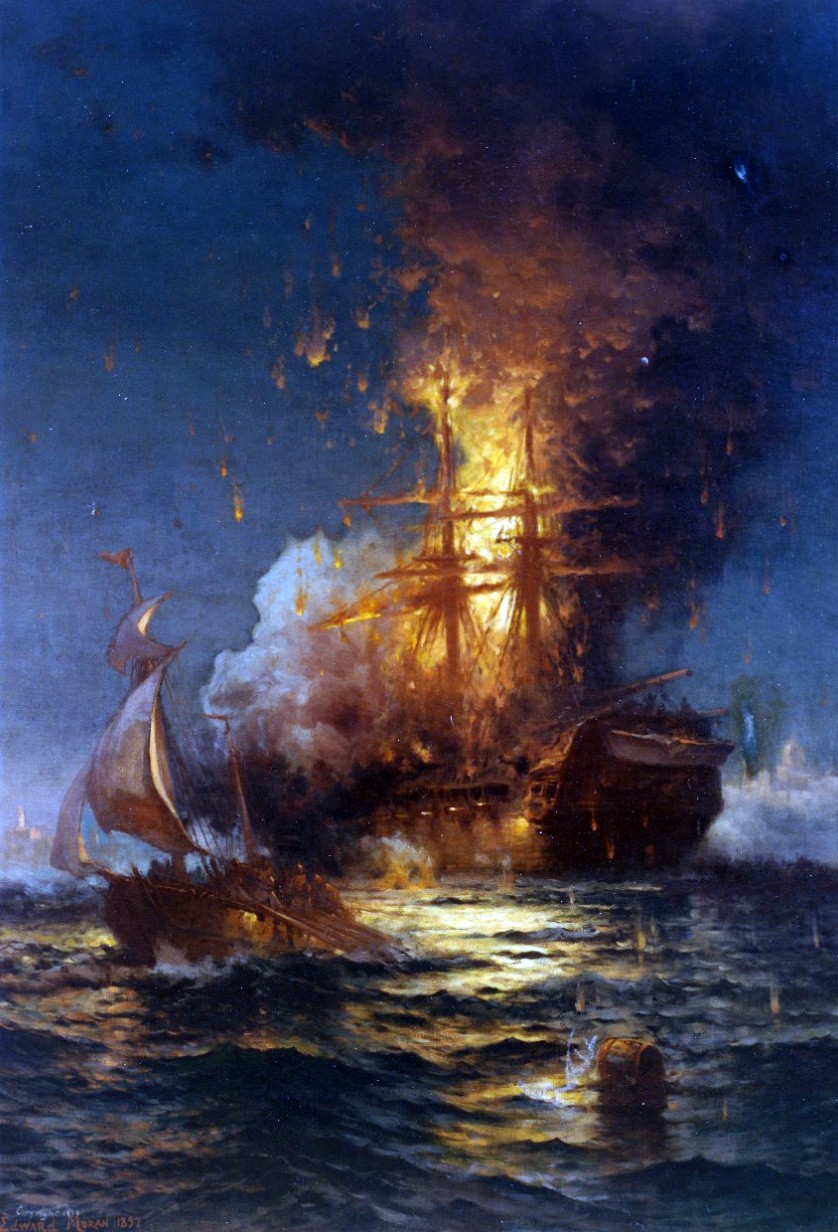
Something like this, perhaps? Image is Burning of the Frigate Philadelphia in the Harbor of Tripoli, February 16, 1804, on the US Navy’s website, which I believe makes it public domain; it is used for commentary here.
The Paragon withdraws inside himself as fire burns upon him. The ship is aware of the crew below deck, including Amber. The ship is also aware of serpents outside, in the waves, that press for the reawakening of the dragon memories within–and that the ship tries to reject.
Althea comes to aboard the Vivacia and takes stock of her situation. She reaches out to the ship and is rebuffed decisively and angrily; Kennit enters and cautions her against repeating the attempt, noting its sources. Althea asks about her crewmates and receives answers along with a spiced wine concoction; she is soon soundly intoxicated and lapses into unconsciousness. Kennit regards her avariciously, and the wizardwood charm on his wrist rebukes him sharply for his intentions.
Aboard the Paragon, Amber pleads for her own life and those of the crew. The personalities of the dragons within the ship reassert themselves forcefully, and Amber strives towards communion with them; the personality of the ship pleads for survival and is told to join or die. Realization of what she must do breaks upon her, and the dragons agree to share the body of the ship; Amber calls out raggedly to Clef, sending the boy to where Brashen commands a work crew with a message to try a hatch she had cut in the floor of the captain’s cabin while she dwelt aboard the beached ship earlier. Brashen redirects efforts to that end, reaching more of his crew and preparing to abandon ship. But the ship decides to live and closes the seams that had been allowed to spring open, the dragon-personalities deciding as Clef indicates.
Etta and Wintrow return to the Vivacia, finding Kennit angry at their return. He rebukes them and issues orders regarding Althea and Jek, and they accede to his manipulations as the ship sets out for Divvytown.
The issue of the mixed-plank construction of the Paragon comes up again in the present chapter, as does that of the torturous existence of dragon-personalities “beneath” the awakened liveships’. Certainly, the experience of integrating different personalities in the Paragon is an unpleasant experience for all involved, and it becomes easy to feel for the ship in the chapter; really, there seems there was never any chance for happiness for the vessel, even aside from the problems inherent in the origin of liveships, generally. This is not to discount the systemic problems of generational exploitation of genocide–because that is what happened, here. It is, though, to note that the Paragon was almost set up to directly experience failure and torment, not only from the oddity of construction, but also from being forced to bear witness to the traumas it saw early in life. And taking on Kennit’s burdens, as well…in many ways, Hobb is a sadist towards her characters. Authors must be so, of course; there is no story without conflict, and conflict necessarily inflicts upon those who undergo it. Text
Read the previous entry in the series here. Read the next entry in the series here.
The following chapter, “Paragon of the Ludlucks,” starts with Althea aloft aboard the Paragon, sighting the Vivacia. She reports the finding to Brashen, and the two confer about their plans before they make ready to confront Kennit–hopefully to talk and to reclaim the Vestrit family ship, but possibly to fight.
The proprieties at all times? Image taken from Tenor.com, here, used for commentary.
Aboard the Vivacia, Kennit receives a report of the Paragon‘s sighting that he does not seem to need. How he knows the ship is the Paragon confounds him, and the wizardwood charm at his wrist speaks ominously before Kennit orders a wary approach to the oncoming vessel, privately purposing to sink the Paragon for the liveship’s knowledge of his past. He joins Etta and Wintrow on the foredeck as the sight of the coming ship rattles him; Etta reports that Wintrow is torn, as he must be, by the situation, and Kennit orders him away with Etta as he tries to persuade Bolt. After he departs, having surprised them all with his swift insistence that his place is with Kennit, the pirate captain inquires if Bolt can have the serpents scuttle the Paragon; the ship answers in the affirmative but presses Kennit about the inquiry. She also calls in his debt to her, bidding him marshal his entire fleet to the escort of the serpents to the Rain Wilds and calling him by his full, true name–Kennit Ludluck–to bind him. He agrees once again and, after some discussion, the serpents swim off to assail the Paragon.
Brashen watches Althea and a boat crew make for the Vivacia, the time leading up to the expedition rehearsed; Amber had noted an imminence about the proceedings. Althea looks back to him and the ship before they proceed, and she is shocked by the attack of the serpents upon the liveship; she orders her crew to proceed to the Vivacia with all speed. Brashen orders his ship’s crew to brace for the attack and attempt to flee; the Paragon belays the orders and calls out to the serpents in turn, confusing them as Amber narrates what she can of events.
Shreever considers as the Paragon converses with the assembled serpents, prodding them away from Bolt. The white serpent Carrion upbraids the serpents for following orders that Bolt relays from Kennit, and She Who Remembers calls for a pause to gather more information. The call is not universally accepted, and a fracas ensues that catches the Paragon and the crew upon the ship up in it as collateral damage. Brashen orders such damage control as he can until Clef tells him that Althea’s boat has been seen to be capsized; he orders retrieval.
Kennit watches events from the Vivacia and orders an assault on the Paragon. Battle is joined and quickly won–by Kennit’s crew. Brashen surrenders to save his crew, and he is confined with them below decks as Kennit begins to tour the ship that should have been his. He finds the condition of the vessel agreeable–until the ship begins to speak to him, relating the sad story suffered long and beginning to rage as realization breaks. But the ship is persuaded to ancestral loyalty, and Kennit makes to burn what had been his family’s liveship–with the crew aboard.
Back aboard the Vivacia, Kennit is presented with the surviving boat crew–Althea and Jek. He bids them be taken aboard and has the ship set out for Divvytown–leaving Etta and Wintrow behind.
I am sure there are comments about competing masculinities that could–and perhaps should–be made, using the current chapter as explanatory material. Kennit’s seems to be toxic enough, to use a term that fits but that would not have been much employed when the novel was being written. (I say “much,” of course, because I am not as up on such discussions and their backgrounds as I perhaps ought to be; I do not know enough to say “not at all,” but I do know that the term was not part of mainstream discussion then as it often-wrongly is now.) Rather than trying to work through his trauma–and he does carry trauma, though that does not excuse his later actions–he seeks to eliminate what serves as the repository for it; rather than acknowledge and deal with his pain, he tries to deny it, the lives of others be damned. It is something that is all too common, of course–and the idea of sealing pain away is something that comes up elsewhere in the Elderlings novels; it is something of a theme in Hobb that might be worth untangling with further, careful reading…
I have commented once or twice before in this webspace about the ways in which I go about writing. As I’ve continued writing–that I have should be clear enough–I’ve made some changes to my processes, at least as pertains to some of the specific writing work that I do. One of the more frequent (and lucrative!) writing tasks to which I attend is drafting month-long lesson plans for various books and other works. It’s taken me a few tries to get a good process down that lets me move swiftly and effectively through the tasks, and because I think it will help, I offer an overview of that process below.
I can’t pull off such shorts Image from Giphy.com, here, and used for commentary.
When I accept an assignment–how I decide what I take is a discussion for another time, if ever–the first thing I do is get hold of a copy of the text to discuss. Sometimes, I already own a copy of it; I was an English major and I did teach literature for some years, so I do have a lot of books. Sometimes, I am able to borrow a copy from family or friends; I tend to hang around with literate types. On occasion, I make a quick purchase (business expenses are fun!), but most often, I take a trip down to the local library and borrow what I need. I pay into the public library system, after all, so I should be able to use it, much as I use roads and public utilities. And then I sit down to read.
Time was, of course, that I had time to spend days on end doing nothing but read. I remember those times fondly; I remember feeling myself grow intellectually, and I remember the feeling being exhilarating. No single moment stands out for me, admittedly, as is the case with some of my martial arts studies long ago or my band performances even further back, but it was a more sustained joy for me–and one that current circumstances no longer permit me. I have to work my day-job, after all, and I get to enjoy time with my family that I did not have when the thing I was supposed to do was my book-learnin’.
Now, though, I read in fits and starts. When I am able to devote hours at a stretch to a text, I make good progress through it; I do not read as swiftly as I used to, being somewhat out of practice, but I can still chew through several hundred pages in a day if given otherwise-idle time in which to do it. And I always read the text I’m writing up straight through once, reading as if just to read; doing so builds familiarity with the work, as I told students when I had them, which makes the subsequent work easier to do.
With the first reading done, I stub out the write-up. Again, I’ve gone through a few such write-ups at this point, and experience with them has helped me develop a template from which to work for the work I continue doing. It is set up with common expectations; I alter as needed, based on the work’s own subdivisions, getting the document ready to hold the required numbers of required items. Details of that, I must leave to the imagination; I do have to keep something to myself, after all.
Not that I’m incredible… Image from Giphy.com, here, and used for commentary.
Once the write-up is stubbed out, I begin reading the assigned text again, using the second reading to draft a summary of the text, section by section, chapter by chapter, passage by passage. The work I do in the Hobb Reread has been useful practice for such activities; it’s part (but only part) of why I keep going with that project. I might occasionally stop the summarizing for a moment to make a note of some comment that will be useful for one of the required items in the write-up, but, for the most part, I plow straight through on the reading-and-summary work as I reread the text for the first time. It is slower going on the second reading, to be sure, as the necessary pauses to type things out mean less focused reading, but the familiarity developed in the first read-through is a help.
The second reread, which I try to start the next day after I complete the summarizing, goes slower yet, and it is because it is on that second rereading that the bulk of the write-up gets done. Attention to the details of the text and its paratext matters; it is from such details that the lesson-planning proceeds. And I have to be judicious in what I select from the details; the lesson plans ostensibly align with Common Core standards, which means they are aimed at use with high school students, and such experience as I have being one and training to teach them tells me that there are some things to which I might attend and which I might well treat with college students that I dare not handle with them. Parents can be…difficult.
The third reading is usually the last for me; I try to have things done with the write-up when I am done with the third reading. The rule of three might be something of a cliché, I admit, but it is something that works in the situation I’m in, and, to borrow another cliché, it ain’t broke, so I ain’t tryin’ to fix it.
A few years ago, I ruminated on the observance that has come again today. The comments still largely apply; there remains something perverse in the tendency of the United States to commemorate events by sales and to make of what should by its own rhetoric be a somber occasion into a fetishistic paean to excess, but I will still take the opportunity to rest up a bit, being off from my regular job. I am not less perverse than others, and no few would argue that I am more so, not least because I make such comments.
This is the kind of thing, yes. Image from the US Army, here, which I believe makes it public domain.
There were several years in which today, and the weekend that is extended into today, saw my family move. When we left Oklahoma, we did so on Memorial Day weekend. When we moved within the Hill Country earlier, we did so on Memorial Day weekend. This time, we will not be; it’s not impossible we’ll move on Independence Day weekend, but this Memorial Day, we’re at home, more or less. Still, as I look toward making another such move, I cannot help but wonder if that is, itself, a fitting marker for the day. Is uprooting and relocating, starting a new life and necessarily leaving the other one behind, somehow mimetic in some small way of what today is supposed to mark and honor and which it commemorates only in perfunctory fashion for most, despite their full-throated jingoistic protestations? I suppose I could draft some verse that spins out a tenuous connection, holds it up to glisten in the light and seem larger than it is by the refraction, but I, being small, would struggle with such a task more than it likely deserves.
We are all of us small, in truth. Some of us are made smaller by such days as today, not because we could not measure up to those who have gone before, but because we have allowed ourselves to be made so–or, indeed, reveled in the diminution, thinking that what is gained is worth the exchange. As I look around, though, and see only some small pockets of quiet amid the tumult, and the smiles strained upon the faces of those outside them, I cannot think the price-tags accurate.
Read the previous entry in the series here. Read the next entry in the series here.
The ensuing chapter, “Prisoners,” begins with Jani Khuprus seeing to Reyn’s comfort as he prepares to be carried by Tintaglia once again. Dealings with the dragon are detailed, and Reyn and Selden confer briefly before Tintaglia goes aloft, bearing Reyn as he seeks Malta through the bond created by their dream-sharing some time ago and reinforced since.
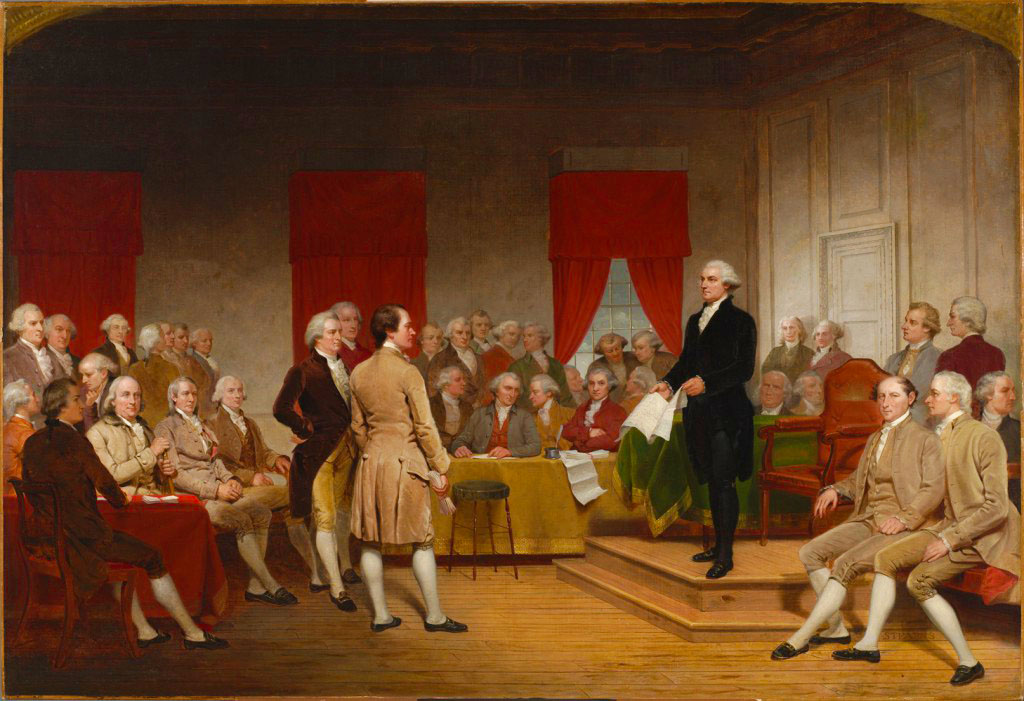
This kind of thing again… Image is from the National Endowment for the Humanities EDSITEMent, here, which I think makes it public domain.
Malta wakes from a vague recollection of connecting with Reyn to survey her materially improved circumstances aboard the Chalcedean ship with the Satrap. She also rehearses the ways in which her situation has deteriorated with the reassertion of the Satrap’s power and prestige, but, after questioning her father’s regard for her, she resolves herself to continue to press her own position on the ship. The appearance of pirates disrupts the flow of her work, however, and the Satrap rejects the notion that the Chalcedeans would be overwhelmed by the advancing raiders. She begins to dress him in his demanded resplendence as the sounds of conflict reach them.
Aloft, Tintaglia shakes Reyn back into his body. They converse briefly, not without tension, and the search for Malta continues as Reyn muses over relative powers at sea.
Aboard the Chalcedean ship, the Satrap makes to assert himself to the pirates despite Malta’s attempts to dissuade him. She accompanies him above deck and finds that the pirates have taken the ship; she falters when the Satrap proclaims himself as such to the victorious pirates and sickens when she sees the carnage of the taken deck. Malta affirms his identity, though, and declares her own; the pirates, laughing in disbelief, take them and the ship into their possession.
The thought suddenly, strangely occurs to me that the Bingtowners and pirates seem to be the only people depicted in the Elderlings corpus who seem to have blue-water shipping as it is typically understood. Yes, the Out Islanders can likely make such crossings; the ships they are described as having do evoke Viking longships for Tolkienian-tradition readers (or Haida war canoes for others), and such vessels can cross open water, but the frequency of raiding and other clues suggest that the Out Islands are not so far from the Six Duchies as might otherwise be thought. The Chalcedeans are explicitly reported to use galleys, and while such ships in the readers’ world might have crossed the Mediterranean, they were more used closer to the coast than far from it. The liveships, though, and other traders’ vessels described are depicted as striking out across open ocean, though, or at least in terms like the ships of the Golden Age of Sail. Perhaps they are to be taken as “more advanced” because of the technological distinction? I am not sure, although that suggests itself as a point that could be made…
Circumstances seem to have confirmed something I suggested not long ago: I’ll be moving again. My wife has accepted a promotion that comes with a transfer, and while I’ll be keeping the job I’ve had for a while, staying where I am now would make for too long a commute for her to be tenable. As such, we’re relocating to a place from which we’ll both have a bit of a drive to where we need to go: Johnson City, Texas.
It’s a nice, place, too. Image taken from the city’s website, which, I believe, makes it public domain.
I know that I’ve had somewhat to say about living in the Hill Country, particularly in the town where I grew up–such as this. And I confess to some apprehension about the whole thing. Johnson City’s a lot smaller than Kerrville, and though it’s only an hour away on a fairly easy drive, it’s still away from a town I’ve been reminded offers a lot of good–that I’ll now not have quite so easy access to as I do now. (Yes, I’ll still be working where I work, which puts me just outside of Kerrville, but there’s a difference between commuting to a place for work and living in that place.) And my daughter will be leaving friends she’s known for years, which is not an easy thing to do.
At the same time, the coming relocation has shaken a number of things loose that have needed to be shaken loose. It has pushed me to be more appreciative of things, for one, and such appreciation is frequently noted as a good thing. Too, the promise of new things to explore and to do entices, and Johnson City offers a fair bit for that; there’s history to the place, including a national park, as well as a pretty good children’s museum and some good food and drink.
Further, at long last, we’re buying a home instead of renting. I’d planned to for a while, as might be guessed from comments I’ve made about wanting to put down roots and provide more stability for my family. Somehow, though, there was always some reason for me not to do so, not to put out feelers and get ideas about what I could do on that score; the pending relocation somewhat forced the issue. And it was scary; in many ways, it still is. But it’s also exhilarating, and the further I get into the process of it, the more excited about it I get; I am looking forward to having the keys in hand, and I am looking forward to the new adventure that the move presents.
Read the previous entry in the series here. Read the next entry in the series here.
The chapter that follows, “Strategies,” opens with Althea relocating into the first mate’s cabin aboard the Paragon, with Haff settling into the second mate’s berth, and Amber complaining bitterly about the oppressive humidity and fog. She rehearses a conversation she had had abed with Brashen the night before, noting their situation and inveighing against the former first mate. They also voice a vision of a future together, possibly despite their families’ desires and Bingtown’s disapproval. Althea sets the vision aside, turning instead to more practical matters of how to handle Kennit and attempt to reclaim the Vivacia. Pointed questions from Jek interrupt Althea’s reverie, and a tense conversation is soon diverted by laughter and consideration of how matters have fallen out in the wake of the attempted mutiny and successful desertion before Althea muses again on what they will do.
A studied, subtle insult? Image from Michelle Tofahrn, here, used for commentary.
In Bingtown, Serilla confers with Mingsley over tea, reviewing their current situation and the fallout from the work to reconstitute Bingtown’s government. The Trader is aspersive, but Serilla retains control of matters, assuming a position for herself in the negotiations outside the various factions still present in Bingtown and articulating her expectations of the nascent political order. Mingsley rails against her, but she takes his imprecations as benedictions.
Also in Bingtown, Reyn watches the Kendry return to port with a shrunken crew; Tintaglia notes to him that the Ophelia is following soon after. He muses on the changes he has had a hand in enacting in the liveships and in the Traders’ society that relies upon them for its economic heft. He notes that he should be happy, but he is not, largely because Malta remains absent. Selden retrieves him from his perch, explaining as he does some of the cognitive differences between dragons and humans. Selden also asks if he is turning into a Rain Wilder, noting some fear of drowning in memories; Reyn offers the boy reassurance as he can.
It is a brief chapter, certainly, although not as brief as some. Even so, it manages to counterpoint the previous chapter well; I note again the parallels between Malta’s work and Serilla’s, as well as the ways in which they run askew of one another (discussed here and here, among others, and with a content warning). And I note the overt consideration of unintended consequences on Reyn’s part; reintroducing a powerful species to the world after it had been driven nearly to extinction cannot but alter things. Hobb is scarcely the first author to treat such ideas, of course; Crichton is perhaps the most prominent prior example, but he is not the only one. Still, it tends to be something treated less in fantasy fiction than in science fiction, and it makes for an interesting thought experiment, in any case.
Read the previous entry in the series here. Read the next entry in the series here.
The next chapter, “Loyalties,” opens with Kennit reviewing a letter from Sincure Faldin and musing on its contents–among others a description of the investigation by the Paragon‘s crew. The news of the Paragon rocks him, and he contemplates killing and replacing his entire crew, as well as fleeing the Pirate Isles entirely. But his attention returns to those gathered around him: Sorcor, Etta, Wintrow, and Jola, the last of whom is currently the first mate on the Vivacia. Kennit muses on his successful piracy, aided by the serpents that come at his ship’s call, per agreement. As the news received from Faldin is discussed, Wintrow makes note of one of the names mentioned in it: Brashen Trell. Kennit marks the shift in attitude from Wintrow and from the ship as Wintrow discusses his aunt, whose presence on the Paragon and in Divvytown is also marked. Ominous words are exchanged afterward.
Not as far off as might be thought… Image from Giphy.com, used for commentary.
Aboard the Chalcedean ship, Malta continues to suffer the Satrap and the crew. She muses on her situation–it is not a good one–and upon the status of her family. She also absently picks at a scar on her forehead, finding its texture rough and its extent greater than she had anticipated. As she considers matters further, Malta begins to more coldly assess her circumstances and the ways in which she can achieve and retain agency, and she begins to proceed along those lines, making for the ship’s captain. When she finally confronts him, she seems to make some progress at improving her situation and the Satrap’s, though the latter is hardly conscious of it until water for bathing and clean clothes are brought to their cabin.
In the evening, Wintrow and Kennit confer with Bolt. The ship is acerbic at the prompt to consider Althea, but agrees, along with Kennit, not to harm Althea. Wintrow pleads for more but is rebuffed and sent off to Etta. After, Kennit’s wizardwood charm speaks up openly, and it and the ship press the pirate savagely about the Paragon and his experiences with that ship.
A couple of things come to mind as I reread the chapter. One is that the focus on Kennit’s internal state seems set to breed sympathy for the man in the reader, even as it presents thoughts of wholesale slaughter. Perhaps “understanding” would be a better term, though; I do not think that such attitudes are regarded as favorable, but I do think that Kennit expands upon some ideas that are present in Regal Farseer. I acknowledge the difficulty and presumption in conducting psychoanalytical readings of characters in works of (fantasy) fiction, but I do think there’s a useful reading in there–and one that explains but does not excuse the character’s behaviors and attitudes.
Another is that Malta’s shift in attitude and behavior aboard the Chalcedean ship seems ripe for reading as a reflection of various reclamation ideas, a deployment of repressive patriarchal gender roles in an attempt to secure her own advancement. A comparison to Serilla’s machinations, both during her travel from Jamaillia with the Satrap and in Bingtown afterwards, seems ripe for making, as well, although I note again that I do not have the theoretical or critical background to do a good job of analyzing and interpreting it to any substantial degree. Still, I cannot help but see the parallels in play, and I find myself wondering how often I am confronted in such ways, with people adopting what they believe are my expectations in an attempt to get from me what they want. I know there are ways in which I serve to deny or restrict the agency of others in unacceptable ways (there are limits to be enforced in some situations, though, and not always those voluntarily accepted; I would be a poor father not to work to keep my seven-year-old daughter safe, after all, and doing so does sometimes mean I have to disallow her from things), and I am sure that those over whom I have power do things to get around those denials and restrictions, even if I am not always aware that I am imposing them. But that is a facet of privilege, and there is much comment to be made about how relative privilege is addressed in the Elderlings corpus as a whole…
The text below was presented at the Tales after Tolkien Society‘s sponsored session–Deadscapes: Wastelands, Necropoli, and Other Tolkien-Inspired Places of Death, Decay, and Corruption–at the online 2021 International Congress on Medieval Studies; some emendations to suit the medium are made without further comment. Embedded images were not presented, but are included to aid discussion.
Robin Hobb1 is a pseudonym of Washington-state-based author Meghan Lindholm; under the pseudonym, she has written multiple works, far exceeding the output of certain fantasy authors who are her contemporaries, including the sixteen novels (along with assorted novellas and short stories) set in the Six Duchies, Bingtown, Jamaillia, and lands accessible from them–the Realm of the Elderlings corpus. Nine of those novels–the Farseer, Tawny Man, and Fitz and the Fool trilogies–center on the character of FitzChivalry Farseer, the bastard son of the heir apparent to the Six Duchies, trained as an assassin and wielding two powerful magics. The remaining seven–the Liveship Traders trilogy and the Rain Wilds Chronicles tetralogy–focus on Bingtown and the nearby Rain Wilds; characters move among the series, and the events in one series influence our outright give rise to those in subsequent series, although each can stand as an independent reading. Throughout them, Hobb nuances the tropes and patterns common in the literary traditions of which she partakes; while her work is clearly in the Tolkienian tradition,2 including those antecedents of it identified by Anderson,3 it features substantially a number of elements not frequently seen within that tradition,4 and she tends to move away from the commonplaces while remaining grounded enough in them to draw readers along. Her tendency towards nuance extends to sites of memory, not so much in denying proper honors to the dead, but in playing with the very idea of death; her specific motion away from tropes about memorials offers a further suggestion of the limits of such literary traditions as the Tolkienian and possibly points to ways they can be reclaimed and reimagined to good effect.
The Typical Sites of Memory: The Stone Quarry, the Dragon Garden, and Kelsingra
The sites of memory in the Elderlings novels that most closely correspond with the literary traditions in which Hobb operates appear initially in the third Elderlings novel, Assassin’s Quest, as a ruined city, a quarry of magic-imbued black stone and an overgrown collection of carved and colored statues of dragons and similar creatures, ranging to a winged boar and an antlered, man-faced chimera.5 The collection is even commented upon as possibly being a graveyard; “Perhaps there are tombs beneath these creatures. Perhaps this is some strange heraldry, marking the burial places for different families,” the narrator remarks.6 Called to mind are such sites as the Arthurian Avalon and the Tolkienian Rath Dínen, with the latter’s “pale domes and empty halls and images of men long dead” and separate houses for the corpses of separate families.7 Called to mind, too, are the mausoleums and cemeteries of the readers’ world that often show in darkened stone markings indicating who is interred that would not be decipherable to those not trained in reading those markings, as well as the cenotaphs that mark the fallen who could not be recovered.
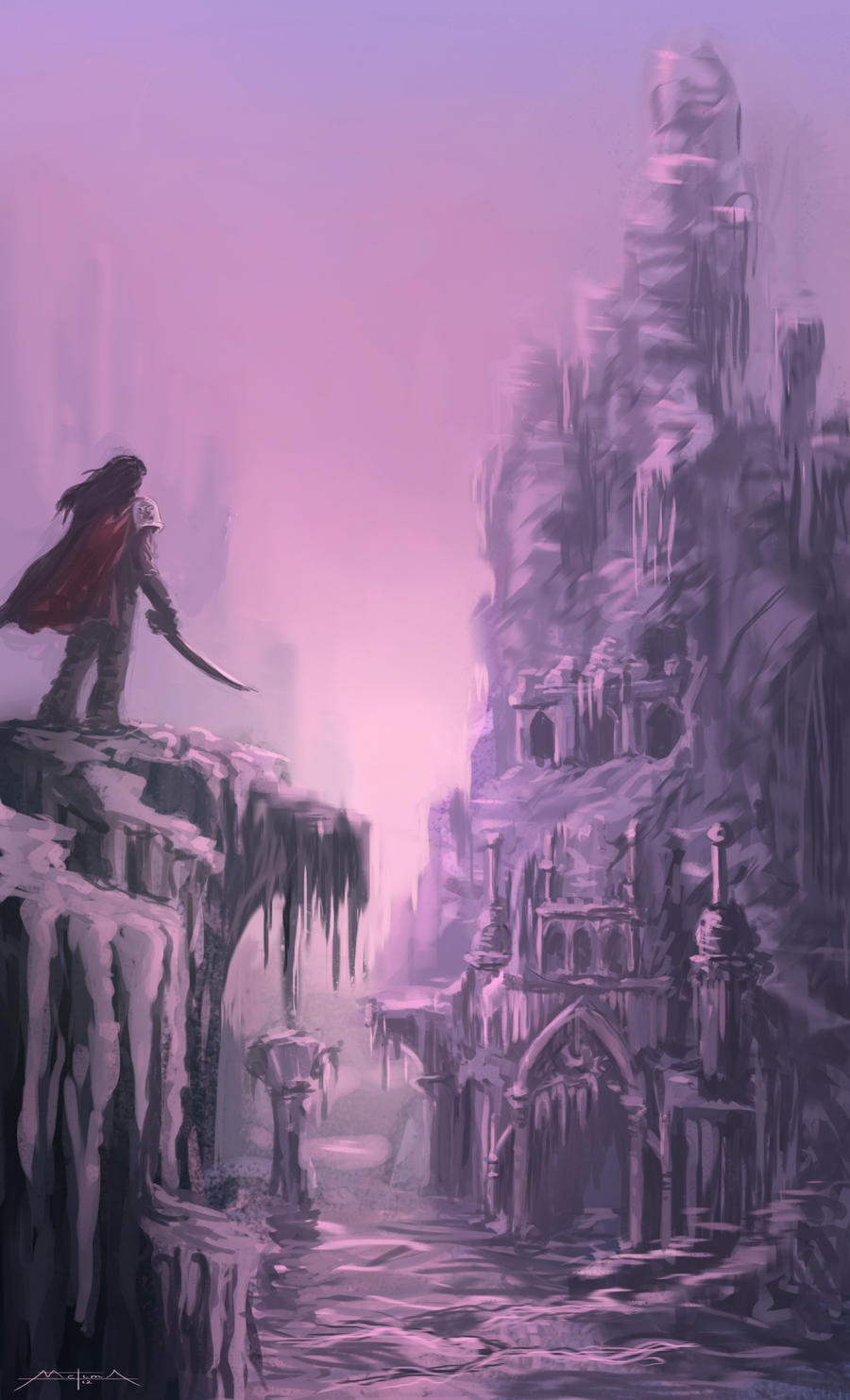
There’s a reason I used this image before. It’s Frozen History by MeetV on DeviantArt, here, used for commentary.
Both the garden and the quarry are associated in the novel with a series of roads made from the black stone of the quarry and a city largely built of the same substance: Kelsingra. That city is itself a silent memorial of a bygone civilization, empty of life but filled with memories of it that intrude into the consciousnesses of those who enter it and have the Skill to perceive them. When FitzChivalry first encounters Kelsingra, he finds it empty, perceiving no signs of life around him;8 as he searches it, he finds that “Whole domes of roofs had fallen in…outer walls had fallen away entirely, exposing the inner chambers and filling the street below with rubble” and sees, among others, “the tatters of ancient hangings, a collapsed wooden bench.”9 When another character later comes there, she finds it similarly devoid of the population it once had and cast into ruin by some long-ago cataclysm, claimed by no others, not even the creeping of vegetation and animal life that would normally swallow ruins in time.10 At the same time, the stones of Kelsingra–and of the dragon-garden–store and re-present memories to those with access to the appropriate magics; again, the stone dragons can be reawakened with the proper offerings, and even the dead city “replays” its memories for FitzChivalry as he stalks through it, immersing him in images of the daily lives of inhabitants.11 Clearly, then, the city is a testament to the departed, serving as a necropolis and, more literally than many others, as a locus of recollection.
As with much else that Hobb writes, however, she nuances her major sites of memory away from her prominent literary antecedents–given the context of the genre, particularly Tolkien, with whose work Hobb is avowedly more than familiar.12 The statues in the stone garden, all of which initially appear as sleeping creatures,13 are not grave-markers; they appear asleep because they are asleep, constructions imbued with the personalities and essences of the magic-users who carved them14 and able to be reawakened and summoned to aid with the correct combination of offerings.15 Again, the Arthurian comes to mind–the “once and future king” idea emerges prominently with a former ruler of the Six Duchies being among those carved figures.16 So does the Tolkienian, as the Dead at Erech are similarly brought forward,17 although there is a marked difference between the two, a nuancing away from Tolkien’s prevailing ideas. For while both the Dead of Erech and the stone-garden dragons are summoned by extra-natural means to help repel largely naval invading forces from the key nations,18 the Dead are addressing their earlier failures,19 while the stone-garden dragons are acting as the result of their successes.20 Indeed, the carvings are in most cases a reward for those who complete them,21 a fulfillment rather than a punishment.
Too, the fates of those sites differ. In traditional Arthuriana, Avalon remains “another place,”22 generally outside access despite protestations of its “real” location. In Tolkien, Rath Dínen is not much mentioned after the death of Denethor and the rescue of Faramir; it remains in place to receive Aragorn, but its tale does not extend past that.23 Kelsingra, and presumably the quarry and garden with which they are linked, end up subject to looting24–not only by FitzChivalry as he tries to survive pursuit and serve the king who has called him to his nation’s aid,25 but also by avaricious merchants.26 Although the looting does not, ultimately, occur in force,27 the fact that the potential for it is recognized and acted upon at all is a marked deviation from the idealization of Tolkien and of much other fantasy literature in the Tolkienian tradition. Attention to such concerns–the all-too-human factors of avarice and pettiness–is a hallmark of Hobb’s writing; that they manifest with regards to the deadscapes Hobb presents points towards a reimagining of the tropes with which Tolkien and those following him work, bringing fantasy literature more in line with the observable world of the reader and helping it to speak towards more attainable hopes for the readers’ world.
The Strange Sites of Memory: The Liveships
In the Realm of the Elderlings, Hobb also presents an uncommon–and unexpected–class of sites of memory: the liveships. As the name suggests, the liveships are living vessels, constructed from a substance called wizardwood and quickening to thinking, feeling life after taking in the spirits of three people of the same family–a life that depends for its stability and security upon the continued presence of a member of that family upon the ship’s decks.28 Peculiar to the Bingtown Traders, they are faster, better ships, more resistant to storm and wave, immune or nearly so to the barnacles and rot that plague other wooden vessels, and they alone can navigate the caustic waters of the Rain Wild River, from which flow the treasures that ensure Bingtown’s economic existence. As such, they are highly prized–such that a multi-generational loan, secured by potential marriages, to purchase one is not at all uncommon29–and, in some ways, are regarded as both enduring members of their owning families and the defining emblems of those same families.
Even so, the liveships are openly acknowledged to be memorials to the dead; not only do the lives in their names come from the deaths of their family members, as attested, but they take on the memories and knowledge of those family members.30 And, because they remain in service across generations, they function as repositories of their families’ histories long after their quickening; for example, one of the first such ships, the Tarman, remains in service despite having been built before the magical properties of wizardwood were known,31 and the ship remains in conference with its family even so. To ship on them, then, is to sail among the dead and alongside the dead, and while there are other stories of such things–the Flying Dutchman is only the most prominent example–they are not as common as other encounters with the departed, not as common as sites of memory and tombs visited happily or reverently, and it is certain that the liveships are valued and appreciated by the Bingtowners.32
But.
The unusualness of the floating memorials that the liveships are is not confined to the fact of their magic or their water-borne work. There are many magical memorials in fantasy fiction, after all, and Tolkien writes of the ability of water itself to recall earlier events.33 No, the chief motion away from the Tolkienian tradition that Hobb makes with the liveships is one that points back to earlier beliefs about magic as being unnatural and despicable. There is motion towards the idea early in the Liveship Traders novels, when a character who had been in training as a priest evidences concern about and suspicion of his own family’s liveship,34 although his suspicions fall far short of the reality that emerges throughout the series. For the wizardwood of which the liveships are built, and of which other items of extranatural power are made, is not wood at all, but the cocoon-material of dragons–and not all of the dragons whose cocoons were harvested were dead before their cocoons were opened and cut apart.35
More, as is made clear through the series, the dead dragons remain in the wizardwood no less than the spirits of those who die upon the ships’ decks–aware of what happens “above” them in the consciousnesses of the liveships that form from the quickening even as they are imprisoned in forms imposed upon them.36 Indeed, so powerful do the echoes of the dragons remain in the wizardwood that combining the cocoons of multiple dragons leads to the untenable instability of a ship built from such a combination.37 Marlowe’s Mephastophilis comes to mind,38 and surely being left in a state of undeath, aware but unable to interact in any meaningful way, is an ongoing hell not often seen employed and exploited by the “heroic” characters in Tolkienian-tradition fantasy fiction. Even when, as happens at least once, the underlying dragon-persona can emerge to the “front” of the liveship, its existence remains a partial and circumscribed one, far different from the free-ranging (and, indeed, imperious) life a dragon would otherwise have in the Elderlings corpus.39
The liveships, then, in addition to being sites of memory are sites of torment, legacies of oppression and exploitation that are not the less heinous because so many who perpetrate it are (kept) ignorant of the import of their deeds. Nor is it made less heinous by the individual resolutions to which the liveships come, integrating the “levels” of their personalities–dragon, human, and created liveship–into cohesive wholes; they emerge from trauma, yes, and continue to take in the lives of those who sail upon them, but they continue, too, to carry the memories of what has been done to them. And while works in the Tolkienian tradition do make much of redemption, of persevering through suffering and past it, they do not as often reckon with what befalls those who do so suffer when those who made them to suffer yet remain in the world alongside them. Yet that is what those among Hobb’s readers who have suffered must do, and in looking at that ongoing life, after the “happily ever after,” as in other things, Hobb usefully moves beyond the confines of mainstream fantasy literature.
Coda
Again, Hobb writes within the Tolkienian tradition, borrowing from medieval and medievalist antecedents as well as other influences and working to nuance and adapt the prevailing tropes of that literary tradition. In her alterations to common depictions of wastelands and deadscapes, of sites of memory, as in her shadings and nuances of other tropes,40 Hobb provides a more authentic, accessible, verisimilitudinous fantasy literature than do many of her contemporaries and predecessors, which allows the quiet messages that emerge from her work to lodge more deeply and powerfully with readers. Those messages, speaking among others to the problems of colonialist agendas, to concerns of gender identity and equality, to political and interpersonal theories, to self-determination, and to increasing inclusivity, are well worth hearing; anything that makes them come across more easily and to more people is to be prized, therefore, and the more so in that it repudiates the ongoing misuse of the observed medieval and of medievalist fantasies by execrable groups with opprobrious ideologies that deserve all opposition.
Notes
I note that I write this while living on land once inhabited by the Lipan, Gaigwu, and Nʉmʉnʉʉ peoples and from which they have been in large part displaced by colonialist misdeeds–from which too many continue to suffer and against which much more needs to be done. The acknowledgement does not suffice, but to fail to do even so much is not acceptable.
The related city of Frengong, lying under the city of Trehaug, is looted almost entirely; it is the source of the wizardwood of which the Bingtown liveships are made, as well as many other treasures taken from the remains of the dead. There is something of a colonialist theme at play in the Elderlings novels; explicating it lies outside the scope of this paper.
Hobb, Assassin’s Quest, 525-26.
Robin Hobb, City of Dragons (New York: HarperCollins, 2012), 125-29, etc.
Robin Hobb, Blood of Dragons (New York: HarperCollins, 2013), 409-15.
Robin Hobb, Ship of Magic (New York: Bantam, 1999), 47-49.
Ibid, 47, 337, 625-26, 714.
Ibid., 160.
Robin Hobb, Dragon Keeper (New York: HarperCollins, 2010), 20.
The example of the Paragon in the Liveship Traders novels is a notable exception, of course–but it is remarked upon by many of the characters in those novels as being an exception, and despite the problems attendant upon the ship, many characters see value therein.
J.R.R. Tolkien, The Silmarillion (New York: Ballantine, 1982), 8.
Hobb, Ship of Magic, 152, etc.
Robin Hobb, Mad Ship (New York: Bantam, 2000), 43-47, etc.
Read the previous entry in the series here. Read the next entry in the series here.
The following chapter, “Bingtown Negotiations,” starts with Ronica looking over the remains of the old Traders’ Concourse as the people of Bingtown gather together. She notes, too, that the people assembled are strangely equal, affected alike by war and grief. Notably, Serilla, Caern, Kelter, and members of the Traders’ Council are in attendance, as are representatives of the Tattooed, the Khupruses, Mingsley, and Selden; the last claims to be present to intercede between Bingtown and Tintaglia, and he reports on her current status. Keffria regards her son strangely, taken aback by the changes to him.
The assembly begins to confer, fractiously at first, spurred by Caern. Serilla unceremoniously rejects him and attempts to assert authority; the rejection is upheld but the authority rejected, in part by the Tattooed. Jani speaks in favor of the position outlined by the Tattooed, as well. And Tintaglia arrives, announcing her presence decisively and berating the people gathered together. Selden again intercedes, diverting what seems promised retribution, and Ronica senses the political realignments at work. Tintaglia again reiterates her command that the folk of Bingtown help her save dragonkind, noting the means to do so; negotiations regarding how best to do the work required ensue, and a tentative accord is in place when Keffria interjects regarding Malta. Reyn rushes to her aid, and Tintaglia rages–but does not attack, physically. Reyn is, however, pulled into her psychic power, where he is shown Malta. But even that revelation does not bind him to her will; negotiations continue, and it is averred that all who seek to remain in Bingtown and the Rain Wilds will agree to the arrangement and to the governance of the Bingtown Council, which is opened to new elections from among all the groups present.
Bingtown appears to be on the rise from the nadir of the previous chapter, with new beginnings and what seems to be a more stable, inclusive form of government in the offering. I am reminded again of parallels to the stories about the emergence of the United States (stories, I emphasize; I know that the histories are not so happy or fortunate, and that current events continue not to be so), and I do note that Hobb’s parallel is more open than even those happy tales. Women and minority populations are explicitly and specifically included, and those who had been enslaved are afforded equal status in the emerging system, with slavery being prohibited in both its chattel and indentureship forms. It is refreshing to read a piece of historicist fiction–that is, one that borrows from historical details without pretending to accurately represent bits of history–that does not laud the prejudices of the past and overtly reinscribe them, but instead offers a view of how things can be better.
It would be nice if more people would work towards such things.









 Elliott RWI