Continuing on from the previous week, students were asked in discussion to present a draft of their course project for peer review. They were asked to revise the previously submitted first drafts in light of instructor and peer comments, as well, improving upon the earlier materials.
The course roster showed 18 students enrolled, a decline of one from last week; fifteen participated in online discussions during the week. An online office hour was held on Monday, 1 October 2018; no students attended.
Students are reminded that the next office hour will be tomorrow, Tuesday, 9 October 2018, at 6pm Central Daylight Time. Students are also reminded that the following assignments are due before the end of day (Mountain Daylight Time) on 14 October 2018:
In an earlier post, I note that I ought to follow the pattern my second-semester composition students are asked to follow and work through selecting a topic and several other assignments to the generation of a conference-length paper. Doing so continues to sound like a decent enough idea, so, even though I will have to make some emendations to things in the interest of not doing students’ work for them and to keep materials that are the school’s where the school wants them, I mean to press ahead. And that means I will begin the current series of exercises with that expected of students at the beginning of the session: topic selection. After providing some context for the work, I’ll write through my process of generation and, at the end, append the resulting document, hoping that it will prove useful to my students and to others’.
Picking a topic sometimes feels like this. Image from Giphy.com.
In ENGL 135, students are asked to work from four broad headings: Education, Arts & Culture, Technology, and the Environment. For topic selection, students are asked to first develop five questions about one of those four headings before expressing their stake in their chosen area of inquiry. They are then asked to cite and summarize two sources that offer differing views of their topic before proceeding to identify an audience to which to direct their efforts. Finally, they are asked to develop what amounts to a working thesis for their project so that, in the following weeks, they have a direction for their research to follow–even though that direction may well change in light of additional information found. The whole is to be presented in a template provided by the University; a pre-formatted Word document awaits them, and all they need do is fill in the required information in the indicated locations.
Given my worries about documentation, I’ll not be using the template provided to students. I will, however, be following the standard formatting for their assignments; DeVry University operates in APA style, so I will adhere to it as best as I am able for formatting, citation, and writing style–in the documents I prepare. (My writing in this webspace will continue to follow my usual patterns. It is explanatory rather than demonstrative.) Because I want to make sure I do that correctly, I’ll set that up first, setting my document’s type to 12-point Times New Roman, typing a title page, and setting up my running head and page numbering as appropriate. (Students are given a tutorial for how to do it, and I’ve given pre-formatted templates any number of times. Still, they have problems. I do not understand why.)
The document formatted, I then proceed to address the questions posed, taking them from the template provided to students. Working with how I tend to work, I copy the questions over from the student template and stub out spaces for my answers; I benefit from having a framework, although I deliberately keep my conceptions loose, as I expect that my ideas will change as I go through doing the work. I also make a few adjustments to formatting in the interest of easing reading. (Again, I am not working form the student template, so I have to make changes.)
With my framework in place, I then begin mulling over my possible topic. As a scholar in the humanities, my inclinations are initially towards education and arts & culture as broad headings. As a long-time educator, I have done a fair bit of work looking into how to teach–indeed, the current project arises from my desire to return to a best practice I well know. I am concerned, however, that doing a project meant to serve as an example of best practice on best practice will, in its meta-educational nature, come off as a bit awkward–particularly if my research ends up suggesting that my practice is not among the best. (If it is, it is a thing I need to know, of course, but I am not certain that this would be the appropriate venue for the revelation to be made.) So perhaps that is not the best path for me to take.
Instead, I might focus on one of the other parts of my life, the participation in the community band about which I’ve written. I know that one of the purposes of that ensemble is to help those of us who used to play and miss playing to play again; I know also that one of the things that is happening in that ensemble is that high school students who fill out the sections are benefiting from the experience of the more senior members of the organization. Because there is benefit accruing in more than one direction, it occurs to me that questions of support are relevant–and so I begin to have questions to brainstorm and fill our my self-created template.
Having developed an initial raft of questions, I move on to consideration of my own stake in the overall field. Rather, I move back to it, because my selection of the general heading and of the specific topic preceded my coming up with questions to ask. I am a member of a community band, so questions about its representation and support bear in on my membership and participation in the ensemble.
With questions and my involvement established, the time is come to get a feel for the field. Using Academic Search Complete through the school’s library, I search for “community band” in full-text peer-reviewed journals, limiting myself to a few document types (articles, book chapters, and case studies) published since 2010. Only five articles appeared, which tells me that there is much to do in my area of inquiry (and that future research will need to take a broader view–though I note there is an International Journal of Community Music that might continue to be a useful resource); I reviewed and summarized the two that seemed most amenable to the present purpose.
That done, I moved to considerations of audience. It occurred to me that there are two potential threads of discussion my paper might follow: support and representation. They will speak to different audiences. Concerns of support would be addressed to members of my local community and community groups that are in position to offer support. Concerns of representation would be addressed most likely either to the general readership of my blog or to the more academic readership of such publications as the International Journal of Community Music. The latter will rely more upon documentary information and logical development of argument than the former; the former will take more of a pathos appeal and a less intricate presentation. And such information found its way into my topic selection document.
At that point, I had almost all the content needed for the exercise, and I moved to fill out the last part, addressing my specific issue and angle. If I work on the issue of support, I will do so with an eye to getting support together for the community band in which I play now. If I work on the issue of representation, I will do so with an eye towards maintaining or enhancing the authenticity of representation. I am still not sure, though, the direction the project will take–although I tend to think that the issue of support will be more amenable to treatment than that of representation, at least within the terms of the course project I expect my students to complete. As I progress through the process through which my students are moving, I will decide more fully, but that seems the direction to start moving in.
Having made such notes in my document, I reviewed my text for overall style, glancing over it to make sure paragraph length is as it should be and vocabulary reflects the project being conceived and the materials treated so far. I also looked for typographical errors, making one or two final passes from my usual amid-writing corrections. That done, I saved the file in an accessible format, the which is included below:
I expect I will be continuing to work on this project, leading perhaps to a document I can use as a basis for other work–but, more hopefully, to a series of piece I can use to help my students do better in successive terms.
Continuing on from the previous week, students were asked in discussion to present the first paragraphs of their first drafts for student critique and to analyze sample arguments. They were also asked to draft and submit first drafts of their papers for instructor review.
The course roster showed 19 students enrolled, a decline of two from last week; all but one participated in one or more online discussions during the week. An online office hour was held on Monday, 24 September 2018; no students attended.
Students are reminded that the third office hour will be tonight, Monday, 1 October 2018, at 6pm Central Daylight Time. Students are also reminded that the following assignments are due before the end of day (Mountain Daylight Time) on 7 October 2018:
I have not exactly hidden the fact that I am continuing to teach despite my certainty that I will never have the kind of full-time teaching job I expected to have either as an undergraduate or a grad student. Many of the posts I make in this webspace are devoted to that end, in fact, such that listing them would be folly; they are easily enough found. And of the classes I have taught, the one I most often find myself teaching is second-semester composition, whether as a traditional English 102 or under some other name used by one school or another for purposes that are not always clear to me. Indeed, nine of the last twenty-one classes I’ve taught since returning to Texas (including the course in progress as of this writing) have been of such sort–more than any three other courses in that time combined.
A Site of Writing The image is mine from several years back.
Teaching such classes takes up a fair bit of my time (though far less than it used to) and perhaps a larger part of my thoughts than it should. And some of those thoughts run back to when teaching was my primary job and I thought I’d be doing it as a career. Then, I made a point of writing samples of the assignments I asked of my students, offering them models to follow in putting together their own work. I’ve not been doing so in the past year or so, partly because I already have quite a few examples developed, and partly because, well, teaching’s a part-time job for me at this point, and I’m not sure I have anything better–or even else, really–to offer my students now. That I don’t still do so sometimes nags at me. I am still doing the work, and I still want to do well all the work I do; not working alongside my students seems somehow to be an admission of deliberately doing badly. Too, I feel my own skills in researched writing are decaying somewhat; I do not do much scholarship of any sort any more, tending more towards ruminations like this or my commentaries on the Tales after Tolkien Society blog. And because that makes me less good at what I’m teaching, it makes me less good a teacher, which sits ill.
I suppose the answer is to follow the course sequence my second-semester composition classes are facing, working through a nebulous topic selection process to generate a proposal and tentative outline before producing an annotated bibliography and generating three drafts of a paper and a presentation based on it. And I suppose my students would benefit from having not only the embedded model to follow, but also my comments about my process in putting such a paper together. It looks like I will be teaching second-semester composition again before the year is out, so even if it is late to help the students I have now, it may well be of use to those who will follow after them…
Continuing on from the previous week, students were asked in discussion to practice annotated bibliography entries and to discuss presentations of ideas. They were also asked to produce a brief annotated bibliography and to submit a final pulse-check.
The course roster showed 21 students enrolled, a decline of six from last week; all but two participated in one or more online discussions during the week. An online office hour was held on Monday, 17 September 2018; no students attended.
Students are reminded that the third office hour will be tonight, Monday, 24 September 2018, at 6pm Central Daylight Time. Students are also reminded that the following assignments are due before the end of day (Mountain Daylight Time) on 30 September 2018:
Discussion Threads: The First Draft and Analyzing a Sample Argument (3 posts/thread, rubric online)
Course Project: First Draft (due as a Word document in APA format)
On 27 August 2018, I wrote here about my continuing, asymptotic disentanglement from academe. As I did, I made the note that “I acknowledge that there are critiques to be levied at my employment by a for-profit institution. I may well address them in another post to this webspace; for now, they would be a bit of a distraction.” This is the “another post” noted, the one in which I make some effort to address such critiques, although I recall having spoken to the issue previously. I cannot recall where, though, so this will have to do, at least for the moment and partially. I cannot envision all critiques, after all.
Yep, this is where I do it. Image taken from the DeVry website, used for comment and critique It seems appropriate.
One such critique that comes to mind is that, in working for a for-profit institution, I am complicit in the exploitation of the (broken) student loan system in play in the United States, particularly regarding the (non-traditional, academically and economically disadvantaged) population the institution serves. And I cannot deny that I am somewhat culpable. I do the work I am asked to do, and I accept money for doing so; I am part of the system that makes such things happen. But I do not get much of that money–more I will also note that I came into the job when I had few or no other prospects; as no few find, certain clusters of letters at the end of a name make many job searches fruitless. For me, the job was something of a desperation play, a stopgap measure that has ended up being less temporary than I had thought it would be–but one that still serves to help me address my own issues of student debt. (And I attended second-tier state schools with significant financial support, so mine is less than many others’–but it is still no small burden to bear.)
Perhaps that is not sufficient justification. Better, though, is that teaching at such a school does help me to reach out to its students. Typically, those enrolled at for-profit schools are those who have not been able to enroll in more traditional programs. Much is made about such students being hand-waved through on their way to credentials rather than taught; I work against such things, treating those students in much the same ways I have treated students at more traditional institutions. I expect them to attend to details and think through their implications, and I challenge the ideas they present (as well as the forms in which they make the presentations, partly because I am paid to, and partly because the students need to be doing things by choice and deliberately, rather than flailing about). They can do as well as any other students, and they deserve the same degree of rigor and challenge as do other students–and while I cannot attest to what does or does not happen in others’ classes, I know they get them in mine.
Again, I know there are other critiques that can be leveled at my work, both others of which I am aware and more which I am not. But I flatter myself that I am making things at least a little bit better through the work I do at DeVry.
Continuing on from the previous week, students were asked in discussion to work through summarizing a source and investigate reliability of online sources. They were also asked to sit for an online APA quiz, to complete a “pulse check,” and to draft a topic proposal and tentative outline for their course project.
The course roster showed 27 students enrolled, a net gain of one from last week; most participated in one or more online discussions during the week. An online office hour was held on Monday, 10 September 2018; no students attended.
Students are reminded that the third office hour will be tonight, Monday, 17 September 2018, at 6pm Central Daylight Time. Students are also reminded that the following assignments are due before the end of day (Mountain Daylight Time) on 23 September 2018:
Discussion Threads: Presenting Ideas and Annotated Bibliography Practice (3 posts/thread, rubric online)
Course Project: Annotated Bibliography (due as a Word document in APA format)
While it might seem somewhat odd to offer a report of activities for a class that does not actually meet, some running commentary seems in order for even a wholly online class. To that end, the following:
During the first week of the session, students were asked to introduce themselves and to work through developing a topic for the session-long course project. Instructor comments on the latter were offered in the hopes of prompting deeper consideration and more engaged, authentic work.
The course roster showed 26 students enrolled; 19 participated in online discussion during the week. An online office hour was held on Tuesday, 4 September 2018, adjusted from the normal Monday meeting due to a holiday; one student attended.
Students are reminded that the second office hour will be tonight, Monday, 10 September 2018, at 6pm Central Daylight Time. Students are also reminded that the following assignments are due before the end of day (Mountain Daylight Time) on 16 September 2018:
Discussion Threads: Summarizing Sources and Internet Reliability (3 posts/thread, rubric online)
Course Project: Research Proposal and Outline (due as a Word document in APA format)
Information Literacy and APA Format Quiz (due online)
Continuing a practice I most recently iterated at the end of the May 2018 session at DeVry University in San Antonio, and following closely the patterns established in previous practice, comments below offer impressions of class performance among students enrolled in ENGL 062: Introduction to Reading and Writing during the July 2018 session at that institution. After a brief outline of the course and selected statistics about it, impressions and implications for further teaching are discussed.
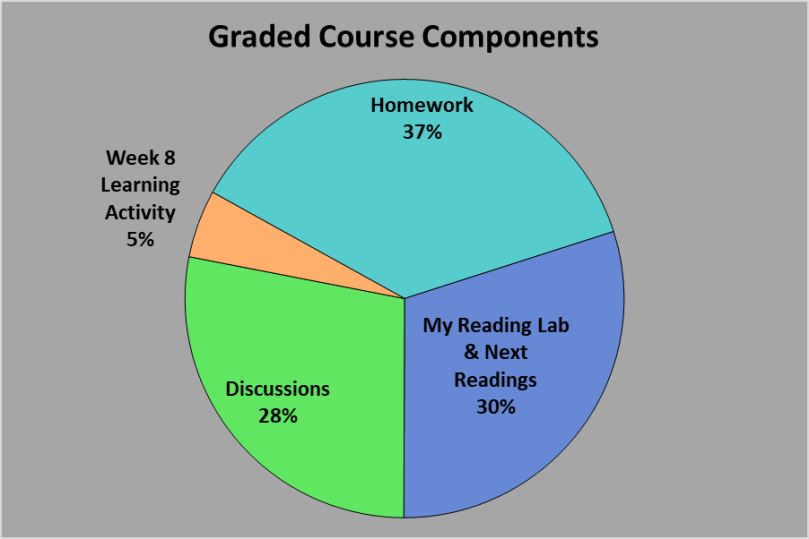
Students enrolled in ENGL 062: Introduction to Reading and Writing during the July 2018 session were asked to complete a number of assignments in quick succession. Many, and the weightiest, related to the overall course project; others were homework meant to practice skills used in the workplace and in later stages of the course project. Those assignments and their prescribed point-values are below, with relative weights shown in the figure below:
Homework (a developed paragraph, a summary and response, and two essays in two versions each)- 370/1,000 points
My Reading Lab (reading skills and reading level assessments)- 300/1,000 points
Discussion Posts (three posts in each of two graded discussion threads weekly)- 280/1,000 points
Reflection on Progress and Plan for Improvement- 50/1,000 points
As before, most assignments were assessed by means of rubrics provided by the institution. Some few were assessed on a percentile basis from standardized testing conducted as part of University-wide course requirements.
The section met on Thursdays from 1800-2150 in Room 107 of the San Antonio campus of DeVry University. Enrollment was low–only two students as the class began, dropping to one before the class ended–so presentation of students’ statistics is inappropriate; there are insufficient numbers to allow either anonymity or the extraction of useful data.
Teaching so small a class had its benefits, certainly. I’ve got a fair amount of experience as a tutor, so I was able to operate the class as a sort of extended tutorial, though my tutorials are usually more responsive and flexible than a prescribed assignment sequence allows. I do have to note that the relatively low workload made for an easier time of things for me, and I am not ungrateful–particularly given that the next session looks like it will ask quite a bit of me (I’m only teaching one class, but it has 28 students in it as I write this–and it’s a wholly online composition course). In all, it catered to my strengths, and I feel I did a good job of it this time around.
I still appreciate having had the chance to teach again, and I once again look forward to having others in the new session and in sessions yet to come.
Discussion was meant to address questions from the previous week and earlier before turning to summative thoughts about the course. Time to complete the assignment for the concluding week of the course was to have been offered.
Class is reminded of the upcoming assignment:
Homework: Reflective and Planning Postscript, due online as a Word document in APA format before the end of 1 September 2018
The session closes at the end of the day on Saturday, so all work must be submitted by then to be counted.
The class roster listed one student enrolled, unchanged from last week. None attended, assessed informally. No student attended the most recent office hour.


 Elliott RWI