A Robin Hobb Rereading Series: Entry 360: City of Dragons, Chapter 10

Read the previous entry in the series here.
Read the next entry in the series here.


Following an exceptionally brief entry in Detozi’s log, “Kidnapped” begins with Malta and Reyn conferring about Leftrin and the Tarman and the message Malta had received. Reyn departs to confer with the captain, leaving Malta to pick her way back to their home with some difficulty. After he does, and as a storm builds, Malta begins to experience contractions and calls out for help.

Foreboding?
Photo by Johannes Plenio on Pexels.com

Reyn hustles towards the Tarman in the growing storm, worried about Malta but pressing on from the urgency of his errand. He is able to find Leftrin, and the two confer aboard the liveship. Noting Leftrin’s maneuvering with his crew, Reyn recalls a kinship bond between himself and Leftrin, and the two reminisce briefly before Reyn presses for news of the dragons and their keepers. Leftrin attempts to defer a visit to the Khuprus holdings, and Reyn reflects on his wife’s insights. Leftrin’s niece inserts herself into the discussion, and Leftrin reluctantly accedes to her request and Reyn’s.

Malta continues to struggle to shelter, trying to comfort herself amid the storm as her incipient labor reminds her of the changes to her physiology occasioned by becoming an Elderling. She calls for help again and is answered by a man with a Chalcedean accent who hustles her along to a shelter of which she disapproves.

Reyn chafes at Leftrin’s delays and makes arrangements to hasten their travel to his lodgings. When they arrive thereat, they mark Malta’s absence, and the search for her begins.

In her “rescuer’s” room, Malta continues to undergo labor, and that “rescuer” ducks out. When he returns, he is accompanied, and the two men–Begatsi Cored and Sinad Arich–confer about her as her labor pains continue. Their plan–to harvest Malta and her child and present them as if parts of dragons–is laid out as Malta delivers and attempts to conceal her child. Arich departs, and Begatsi makes to slaughter Malta and her newborn; she takes the chance of attacking him as soon as she can, stabbing him in the throat. At length, she is able to regard her newborn son, and she sorrows at his appearance. Bundling him up, she flees back into the stormy night.

This is not, of course, the first time that Malta has been captured by Chalcedeans; she spends a fair bit of Ship of Destiny in such circumstances, beginning here. It is therefore not a surprise to me, not only because I have read the book before (even if it was a while back), but because I have much more recently reread the earlier-published novel, that Malta has the reactions she does. That Chalced is openly, belligerently misogynist is long-established, not least by Malta’s experience; that it has no real regard for human life, engaging in chattel slavery as it does, is similarly long-established (that part goes back to Assassin’s Apprentice, in fact, if obliquely; it is clearer at the beginning of Assassin’s Quest). The level of depravity involved is not quite as clear–or as deep–in the earlier works, however, and I wonder as I reread the text if Hobb is not reaching for some new sensationalistic overture here or if this is not how Chalced has “always” been.

(Yes, I am aware that I am writing about a fictional place as if it is a real one. Yes, I know it is affective at best, and that things are not at their best. I have been many times accused of not knowing what “the real world” is like–but then, I never have gotten a straight answer from those I’ve asked what “the real world” is.)

(Yes, that is distinct from the MTV reality series. Quotes and no capitals rather than italics and title case.)

If I wanted to read the chapter as a commentary on current concerns–which reading would be doable, certainly; looking at how works speak to times that follow their release is a commonplace, after all–I might note that the presence of a brothel in the Rain Wilds (and presumably more than one, though only one appears in the present chapter) and its easy acceptance or of failure to see the depravity looming in its own chambers can be interpreted as a natural outgrowth of the mercantilist tendencies at work not only in the primary milieu, but also in the real-world (that term again) societies of which that milieu is analogue. While there are certainly many who control wealth in the Rain Wilds, most of that wealth derives from the exploitation of graveyards and the slaughter of nascent children–something that might well be read as mimetic of abortions. (It’s not much of a stretch, really, from a society that quietly but unashamedly practices eugenicist infanticide.)

The question always does arise, of course, when reading fictional analogues of real-world groups of how much is commentary on the source and how much is differentiation from it. Are the practices depicted rebukes of the society upon which the primary milieu is based, or are they deliberate insertions that proceed, perhaps, from necessity within the milieu and which serve to frustrate the one-to-one correspondence between “real” and “fictional” cultures that overly-simplistic readings (and writings!) would suggest?

Such answers exceed the confines of a single blog post, necessarily. The medium does not invite the kind of reflection and interpretation such answers require for their derivation. Length alone becomes an issue; this post is approaching 1,000 words at this point and already seems to drag on, while fuller investigation gets verbose. This paper is a short example at around 2,200 words. But that the answers need to be elsewhere and that they need to have time and space to grow do not mean they do not need to be given.

Maybe, someday, I’ll work on them.

If you like how I write and would like me to write for you, fill out the form below!

← Back

Thank you for your response. ✨

I’d also be happy to have your direct support!

A Robin Hobb Rereading Series: Entry 359: City of Dragons, Chapter 9

Read the previous entry in the series here.
Read the next entry in the series here.


Following a short, sharp rebuke of Kim by Detozi, “Return to Cassarick” begins with Leftrin approaching a Cassarick aware that he is inbound due to the Tarman having encountered fishing boats that raced ahead of them with news for the city. Leftrin’s preparations for return to Cassarick and reporting to the local Council are noted, and the local terrain and conditions are glossed as Leftrin approaches his home port. So are other ships afloat as the Tarman comes into a berth and is moored, and Leftrin issues a series of orders to his crew. And, buoyed by his crew’s confidence, he sets out to collect the fees the Council promised.

This one seems a flighty sort.
Photo by Monica Oprea on Pexels.com

Elsewhere, Malta regards herself and her burgeoning pregnancy as Reyn tends to her. The two tease one another as they confer until interrupted by news of the Tarman‘s return. Thus informed, the pair proceed towards the meeting of the Traders’ Council they know will ensue, proceeding with care due to Malta’s pregnancy.

Leftrin purposefully makes slow progress towards the Council meeting, his dealings along the way summarized. At length, he arrives, and the arrayed Council that greets him is described–including Sinad Arich, whom he remembers meeting and whom he suspects of perfidy. Being recognized, Leftrin makes his initial report and presents his claim for agreed-upon payment. Questions and challenges from the Council follow, some of which are pointed, and Leftrin’s response to certain of them is decidedly legalistic but technically correct, emerging from conference with the close-reading Alise.

The emergent uproar among the Council is quieted and the meeting continues, with more questions for Leftrin that he addresses. Insinuations of foul play follow, and Leftrin bristles at the insult but does not avenge it in the moment. The questions being raised, however, the Council is obliged to determine that Leftrin’s success must be affirmed before payment can be released. In the wake thereof, Leftrin presents a message to Malta, along with a token that affirms his report. Amid the ensuring tumult, he departs.

Leftrin’s legalistic refusal of the Council’s demand for a report, concocted with Alise’s assistance, calls to mind The Merchant of Venice 4.1. For all its anti-Semitism (and there is no shortage of ink spent to the discussion thereof, such that I do not need to contribute to it) the scene points out that a society that binds itself by explicit contracts does well to mind the particulars of those contracts–including what is omitted from them. It also points out, however, that there is peril in relying upon such legal niceties; Shylock, remember, comes to an end he would not prefer for insisting upon the letter of his contract against advice and remuneration. And Leftrin does find himself somewhat stymied by legalistic maneuvering, so there is some small part of that at work.

Whether Leftrin will suffer more…well, in many narratives, he would be certain not to do so, but Hobb does not hesitate to make her characters suffer, and greatly.

One of the things that I and others note in Hobb’s writing is a marked effort towards verisimilitude. It’s something about which she comments (and which, I admit, I often reference). People manipulating legal proceedings and documents is certainly enough of a commonplace, in the United States and elsewhere, that it carries with it the Tolkienian “inner consistency of reality” that fosters Coleridgean willingness to suspend disbelief; that is, it carries verisimilitude. To my mind, the wrangling with the local Council rings true not just of the type, but also of the US-parallel I’ve noted in this reread series I see the Traders’ society as being. Considering the things that I’ve seen happen in local and larger governments and government-like entities, Hobb’s depiction is not just true to life, but true to my life; affective a reading as it is, it is something that makes the text work better for me.

(It’s not a secret that I work with reader-response criticism to a fair degree. I’m not necessarily strongly theoretically grounded in it, to be sure. I’m too far outside academe at this point to be able to maintain such a grounding, given the amount of ongoing reading necessary to do so and the reading-time I must dedicate to other things, not least the primary sourcing for this rereading series. But I digress. Again.)

I don’t imagine, though, that I’m alone in having such a reaction. Hobb’s had enough works published that it’s clear someone keeps buying them, and not only me. While I do have multiple copies of some of her books on my shelf, it’s not enough to keep a publisher producing them. I’m glad there are others doing the work.

If you like the way I write and would like me to write for you, fill out the form below!

← Back

Thank you for your response. ✨

Or you can help me keep going!

A Robin Hobb Rereading Series: Entry 358: City of Dragons, Chapter 8

Read the previous entry in the series here.
Read the next entry in the series here.


As another hateful missive from Kim in Cassarick reaches Detozi in Trehaug, this one treating infestations and allegations, “Other Lives” begins with Carson and Sedric conferring about the reasons behind the choice of Kelsingra’s location. The shifting shape of their life together receives some attention, as does their living situation–the latter of which rankles against the cleanly Sedric as Relpda’s hunger begins to press upon his mind. Sedric notes differences between his current and former lovers, and he and Carson confer together about their relationship and about the dragons that are in their care.

Not a bad snack.
Photo by Luis Merlos Vega on Pexels.com

Thymara and Rapskal elsewhere confer abut Heeby’s increasing carrying capacity, which Rapskal demonstrates with little regard for Thymara’s wishes. Thymara arrives at realizations bout herself as Rapskal conducts her to Kelsingra. After an awkward dismount, Thymara surveys the city, Rapskal explaining his understanding of it and his inability to accurately convey that understanding to the others in their party. Thymara struggles to process the information and her place within it, and she comes to accept Rapskal’s assertions that they have but to remember the magic available to them as nascent Elderlings. That magic inheres in memory stone, and Thymara recoils at engaging with the material and the memories within, but Rapskal is able to persuade her to make the attempt at doing so.

Sintara grouses at having not been tended by Thymara, and her vexation is interrupted by the realization that Thymara is no longer accessible to her. Sintara reasons this means Thymara is dead, and she considers what other keeper she would take. She also reasons that Thymara’s death is Heeby’s fault, and she rages against the other dragon, and in her anger, she takes to the sky, exulting for a moment in doing so before becoming aware of doing so and faltering for a moment. In panic, Sintara makes a pair of shaky kills, taking heart and finding rest in doing so.

An interlude of a shared memory of long-ago lovers falling into an assignation follows. Thymara begins to emerge from the shared memory as Rapskal, still caught in it, presses forward with the assignation. A chance comment snaps Thymara fully from the memory, and she rebukes Rapskal bitterly as he attempts to explain matters. The explanation fails to satisfy, and Thymara stalks off, the prospect of falling into memories again calling to her until she realizes, belatedly, Sintara’s peril.

The present chapter reinforces the connection between the Elderlings and the Skill that I have noted, not only in my recent discussion of “Dragon Dreams,” but also in earlier entries in this series. Tintaglia’s connection to Nettle in the Tawny Man novels suggests the connection quite strongly, as does Selden Vestrit’s behavior in Buckkeep, and so does the propensity of Skill-users to find their way to the old stone-quarry and carve themselves into dragons. Thymara’s immersion in the memories of the long-dead Amarinda echoes the dangers of Skill-euphoria against which Fitz is warned and the perils of which he knows well, and Rapskal’s conduct is hardly a commendation. (I must note, though, that Rapskal, being under the influence of another stored personality, may not be wholly responsible for his actions. It’s not unlike intoxication in some regards, but there is an active sentience at work in the memory stones that is not found at the bottom of any cup or in the smoke of any toke.) So there is more thematic unity to be found in the Elderlings corpus, which is to its good.

The interchange between Sedric and Carson at the beginning of the chapter attracts my interest for a number of reasons, most of which have to do with my continued affective reading. Living where I do as I do (the rural Texas Hill Country), and being the kind of person that I am (a nerd, and a particularly bookish one), I understand Sedric’s…misalignment with the demands of living in the outskirts of Kelsingra. I, too, prefer to bathe regularly and to dress in clean, dry clothes; I, too, know that I would not do well if I were left to my own devices to find food and shelter outside of the comforts of civilization, that I would need assistance that I have nothing approaching a right to expect. At the same time, I also understand Carson’s attitude; I, too, want to make sure that those I love have what they want, and I grow frustrated at my all-too-limited ability to provide it to them. Again, I know it to be affective and therefore not necessarily desirable reading, but I am who I am. Clearly.

I note, too, amid Rapskal’s discussion of the Elderling civilization centered on Kelsingra a certain…parallel to another still-too-present feature of life in the United States: segregation. Rapskal remarks that “That side over there, all those huts and things, those were built for the humans….This side, all of this, this is for us” (149-50); it reads to me like a clear physical separation of people, and one distinctly unequal in application and benefit. It reads to me like a ghettoization of the have-nots within eyeshot of the haves, where each must look upon the other with something not apt to be love. A person might wonder what might end up being tried in what passes for the small towns thereabouts.

I’d be please to write to order for you–and without the worries of stolen work and AI aggregation!
Interested? Fill out the form below!

← Back

Thank you for your response. ✨

I’m also happy to accept your patronage!

A Robin Hobb Rereading Series: Entry 357: City of Dragons, Chapter 7

Read the previous entry in the series here.
Read the next entry in the series here.


Following a brief missive that warns of illness among the cotes, “Dragon Dreams” opens with Sintara dreaming of easy flight and a full belly as she returns to Kelsingra. The dream consists of ancestral memories, tantalizingly incomplete, from which she wakes amid a storm, cramped and cold and hungry. Grousing about Thymara and the other keepers, and the arrangements they have made, she reviews the current situation and stalks out into a nearby meadow. There, she reflects further, and she begrudgingly attempts to practice flight in the pre-dawn dark.

Not quite…
Image from Universal Music Group, here, used for commentary

Meanwhile, Alise huddles against the inclement weather, reflecting on her situation (taken regularly to Kelsingra by Heeby) and the likely whereabouts of Leftrin (aboard the Tarman, nearing Cassarick), mourning for the changes she know will come. She determines to wander and take in all she can of the city, and her progress through it is described. Exploring, she finds a room carved in figures of jesters and performers, which she accidentally activates with a touch upon a vein of magic in the stone. It startles her momentarily, and she soon mourns for what she knows will be lost.

Alise leaves the room, finding the weather cleared and herself recalling Leftrin’s words to her upon his parting a month previously. She settles in to eat lunch, forcing herself away from thoughts of material comforts that intrude upon her, and her continued survey of Kelsingra is detailed. Proceeding further, Alise finds herself surrounded by the memories embedded in the stones of the city, losing some time amid them. As she goes yet further, though, she finds a room that seems to have been despoiled already, which revelation angers her, and she blames Rapskal for it. She does realize, however, that the room in which she finds herself shows a map of Kelsingra, which revelation brings her hope, and she makes her way out to where Heeby awaits her.

The present chapter reflects at some length on the likelihood of destruction in the interest of moneymaking. I cannot help but see a number of parallels at work, both to the early United States (to which I have long held the Traders are akin) and to contemporary events. Alise’s lament that the statues of Kelsingra will be pillaged, the worked materials separated from their contexts and auctioned off a piece at a time, is one that echoes comments about older (and still too-current) museum and antiquary practices, such things as have led to bits and pieces of grave offerings and monuments being taken across countries and continents, displayed as showcases for passers-by to gawk at them or hoarded in collections so that dragon-like collectors can gaze upon them in greedy delight, taking them as evidence of their superiority. And they also seem to ring to me of the kind of comment I hear from folks who’ve lived in the Hill Country longer or more continuously than I have, that people coming in and building up what had previously been rolling hills of oak and cedar and mesquite that echoed flatly in the still heat of summer air ruins the very thing that they seek who come here.

It is a mark of good artwork in any medium that it speaks both to contexts of composition and contexts of reception clearly.

It is of some interest to me that, for all the work that the Rain Wilders did to harvest the leavings of the Elderlings’s other settlements, they seem to have little understanding of what those things harvested do. Admittedly, the Skill seems to be largely a thing of the Six Duchies, but, given broader contexts, it does seem bound up with the Elderlings, and it is strange that the calling-ritual conducted in the Six Duchies would have found no respondents among the Rain Wilders and Bingtowners, especially given that those touched by the Rain Wilds are suggested to have some sensitivity to the Skill. It’s another instance, to my eye, of problems attendant upon canon-welding, but, while I might note that a thing is there and causes some issue, I acknowledge that I have not the insight or ability to offer any advice. And it would be presumptuous as all hell to think that I ought to, anyway.

Need some writing done to order–all human-done, no AI?
Let me know with the form below!

← Back

Thank you for your response. ✨

Or simply send your support!

A Robin Hobb Rereading Series: Entry 356: City of Dragons, Chapter 6

Read the previous entry in the series here.
Read the next entry in the series here.


After a missive noting formal complaint of message tampering and advising caution and documentation, “Marked by the Rain Wilds” opens with Malta and Jani Khuprus conferring together about the former’s plans. Malta notes her intent to accompany Reyn to Cassarick, hoping for news of the Tarman. The relationship between mother- and daughter-in-law is glossed, along with the history of the Rain Wilds Traders and the tree-cities they built. Jani advises Malta to dress to impress, and the two talk frankly of pregnancies and miscarraiges. Business partners’ labor practices are discussed as matters of concern, as well, as are concerns of integration of the Tattooed into Rain Wild society.

Progress…
Malta Vestrit, From Entitled Brat to an Elderling Queen on vrgo.tumblr.com, used for commentary

Talk returns to Malta’s pregnancy and the difficulties attendant upon it, not only those for pregnancies in general, but also the specific concerns that the Rain Wilds impose. The stark choices that face Malta–and all mothers in the Rain Wilds–are noted, and Malta’s reactions to them are glossed as she tries to distract herself with necessary tasks. She also reflects on her personal history following her reception by the Satrap. The reverie and discussion are interrupted by Reyn’s arrival and jesting with his wife and mother. Jani excuses herself, and Reyn conducts his wife to their waiting transport, the pair joining Reyn’s sister, Tillamon, along the way. Some tension with Tillamon is noted, and the group proceeds.

As they make for their ship, the River Snake, developments in shipbuilding and the implications for Rain Wild trade are discussed. The trio boards and is scarcely settled in before the ship gets underway, and Malta finds herself considering herself and her sister-in-law, and talk turns to that end briefly before going to concerns of pregnancy and midwifery. The dragon keepers are cited as beacons of hope for children who would otherwise be discarded, and Malta and Reyn determine to leave the fate of their coming child in divine hands.

There are several clear parallels that arise for me as I reread the present chapter. I’ve noted before my interpretation of Bingtown and the Rain Wilds as a gloss on the early United States. In keeping with that, I have to read the discussion of the Tattooed as a parallel to those surrounding enslaved populations in the United States and the ongoing effects of that ancestral wrong that persist into the present day. I’ve also noted having long lived in central Texas, and so I cannot help but read in the present chapter echoes of discussions surrounding immigration that I have heard and still hear, and not always gladly. Both sociohistorical items are heavily racially charged, and in the novel, the parallels are also based around what might well be termed racial or ethnic divisions (largely but not exclusively indicated by skin, in the event). There is the usual frustration of the parallels by Hobb; the Tattooed are marked as such, rather than born as such, and the Rain Wilds Traders are not the icons of “purity” upon which the wrong-headed racist / ethnocentric / supremacist discourses Hobb obliquely references (deliberately or otherwise does not matter) rely. They yet remain clear enough to be issues of discussion, however, both in themselves and in how they reinforce ideas of the sourcing for the Elderlings novels.

Another that comes across to me is the parallel between the discussion of Malta’s pregnancy and discussions of abortion and other reproductive rights. When the novel was published, in 2012, arguments surrounding abortion rights were particularly heated in legislatures, with a remarkably high number of restrictions on those rights put into place. I reread the chapter now and write in the wake of the 2022 Dobbs decision. Other, lower-profile, pieces of legislation addressing other reproductive rights has crowded in between, much of it conducing to strip from those who must bear the burdens of reproduction control of that reproduction. “Just keep your legs closed” is not good advice (though “keep your pecker in your pants” is). It’s a concern that emerges repeatedly in Hobb’s work, the Realm of the Elderlings and elsewhere (as noted here, among others), and it’s one with which people still too much grapple, usually to the detriment of those affected.

I’m happy to write to order for you; fill out the form below to let me know what you need!

← Back

Thank you for your response. ✨

Or simply send along your support!

A Robin Hobb Rereading Series: Entry 355: City of Dragons, Chapter 5

Read the previous entry in the series here.
Read the next entry in the series here.


Following advice of a reward for information about Sedric and Alise from their families and an accompanying brief message to Detozi that notes questions of transmission integrity, “A Bingtown Trader” begins with Hest surveying Alise’s chambers in his home. He muses in annoyance on the chambers and their erstwhile occupant, and he fumes at the expense of having taken Alise as a wife and the pretense that his doing so enacts. The implications that Alise and Sedric have run off together, though Hest knows them to be false, rankle and affect his business dealings, annoying him yet further. His steps against his lover and his wife are rehearsed, and his reverie is interrupted by a visitor from Chalced.

Oh, right. This guy.
Image for commentary, of course.

Hest seeks to rebuke the visitor and is assailed for his troubles, soon pressed hard for information he does not have about Sedric’s dealings with Chalcedean agents. He is also conscripted into Chalced’s mission to acquire dragon-parts for their ruler’s health, given grim reminders of the importance of that mission to deliver.

It would seem to have been a while since Hest last appeared “in the flesh” in the narrative, as such; he is referenced and recalled, but to have him present in the narrative present is not something that happens often. And that is likely for the best; he is, as has been remarked on more than one occasion by more than one character, an unpleasant person with few, if any, redeeming qualities. Admittedly, Hobb has dwelt on such characters more than once before; depictions of Will and Regal in the Farseer novels come to mind, as do depictions of Kyle Haven in the Liveship Traders novels. Still, that Hest has only this brief direct part in the narrative after so long outside it seems marked, suggesting to my mind that he is functioning as a place-holder and character-type rather than as an actual character. That is, Hest is not important to the narrative in himself so much as he is important to the narrative for his interactions with other characters.

The potential problem that arises with this is that characters who are treated in such ways tend towards enacting and reinforcing stereotypes. Used for their narrative functions rather than having their development presented and explored, such characters do not invite the level of craft and attention that more focal figures receive, and it becomes easy to present them via a kind of short-hand, evoking or outright presenting types likely to be taken in and understood by broader readerships–and, all too often, those types are unflattering representations of classes of people. That they are so easily accessible is the result of long years of infelicity and worse, problems likely to continue because they continue to be used with minimal critique in the media people take in.

If you like the writing I do and would like some done for you, fill out the form below, and we’ll get started!

← Back

Thank you for your response. ✨

You can also always offer direct support!

A Robin Hobb Rereading Series: Entry 354: City of Dragons, Chapter 4

Read the previous entry in the series here.
Read the next entry in the series here.


After a seemingly clandestine message from Kim in Cassarick to Hest Finbok that affirms concerns raised earlier, “Kelsingra” begins with Alise stalking through the streets of the ruined city, mentally categorizing and interpreting what she sees in something like an exercise in amateur archaeology. The strange condition of the buildings and the occasional echoes earlier presentations of the city, and Alise muses on matters at some length as she surveys the site. With thoughts turning to possible futures, Alise confers with Leftrin, who notes the problems that face the expedition despite best efforts being made by all members of the party. Alise offers a solution to at least part of their problem, but Leftrin argues against it, citing the reasons it would not work and that they should not attempt it. Leftrin’s own proposal receives similar treatment from Alise in turn, and the two make to return to the Tarman together. They are interrupted in their progress by an encounter with an agitated Heeby and a stricken Rapskal, to whom they attend. Reviving him from strange visions, they proceed.

It returns!
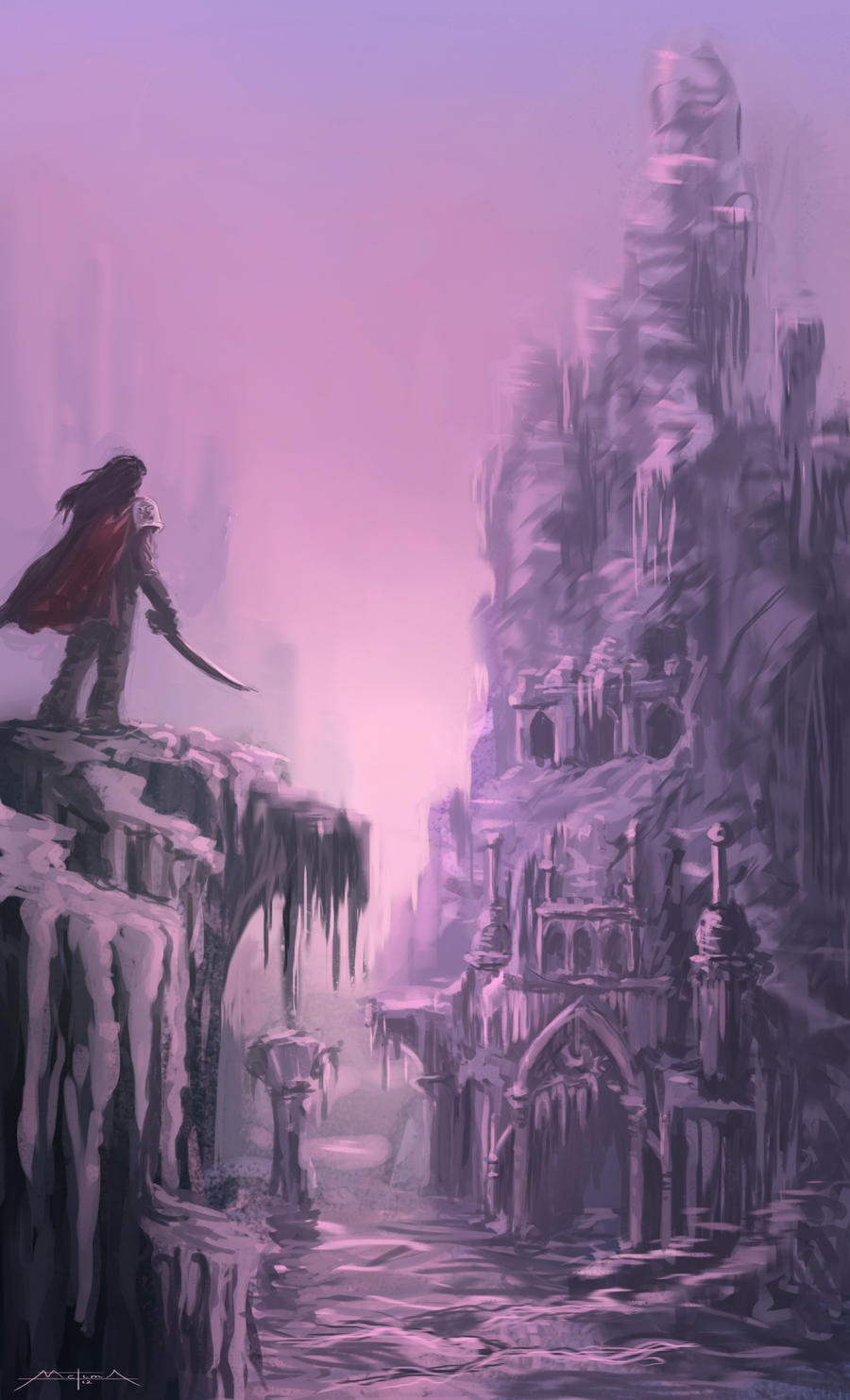
Once again, Frozen History by MeetV on DeviantArt, here, used for commentary.

Heeby bears Alise and Leftrin back to the Tarman in turn. Alise considers the experience as she is taken aloft. Leftrin watches anxiously as she goes, Rapskal offering some cold comfort as the two confer about Rapskal’s experience with the carved stones of the city. Leftrin presses Rapskal for details and receives cryptic answers about the purposes of the memories embedded in the stones. Given the responses, Leftrin opts to send Rapskal on ahead, awaiting a later turn to cross the river back to his ship and crew.

Before getting into discussion of the main chapter, I have to note once again my appreciation for the prefatory materials for each chapter–and their integration. I enjoy getting the sense that the narratives I take in take place in a world that exists outside the context of those narratives, and while this sometimes must mean that such indicators only tangentially affect the main narrative, it is also a pleasure to see them tie into themselves. It’s a bit of storytelling craft I like seeing at play.

As to the main chapter: I appreciate that Alise, even in the act of surveying what is present in Kelsingra, begins to move from simple recording into interpretation of data. It’s something of a popular misconception, I find, that the work of those who look to the past–be it in formal histories, in archaeology, or in older literatures–is a matter of rote memorization, a “these-are-the-facts-and-you-have-to-know-them” approach to the echoes of lives lived (sometimes not-so-) long ago. But it is not, or it is, at least, not only that. Yes, the available information has to be recorded, but the record has no meaning until it is acted upon; meaning and understanding are necessarily matters of interpretation. Indeed, even the selection of what merits inclusion in any kind of formal record is an interpretive act. (Consider: there is no way to take in and put down all of the possible data, so only what’s “important” gets noted. But how does a person know what’s “important” in a given context? By making an interpretation, hopefully based on an empathetic understanding deriving from intensive training and study, but always necessarily reflecting the inherent and ingrained biases present in the person making the record.) And, as Leftrin motions towards, the earlier interpretations will necessarily influence those that come later on–something with which my own trained field grapples, not always well.

Clearly, there is more work to do.

I continue to offer bespoke, human-crafted writing with no AI!
Need more details? Fill out the form below!

← Back

Thank you for your response. ✨

I’d be happy to have your support!

A Robin Hobb Rereading Series: Entry 353: City of Dragons, Chapter 3

Read the previous entry in the series here.
Read the next entry in the series here.


A message from Detozi to her new relation, Erek, commending him and advising him precedes “Pathways,” which begins with Thymara considering her upbringing in the Rain Wilds and the disjunction from it to her present circumstances near Kelsingra. Local geographical features, described, intrigue her. The difficulties imposed on her by inclement weather and degraded equipment are noted as she is joined by Tats. As they proceed together, the two talk about the likely permanence of their relocation, and Thymara finds herself assessing her long-time friend again. The gain and loss involved in the relocation receives attention, as well, and Thymara carefully considers the options available to her–including in terms of relationships, returning to the ideas of social sexual taboos that she had been raised to respect.

Nice rack.
Photo by Pixabay on Pexels.com

The conversation between Thymara and Tats is interrupted by her sighting game, which is described. Before the hunters can seize upon it, however, Heeby falls upon it, fouling Thymara’s shot and taking the meat. The hunters move on, getting distance from the feeding dragon and the smell of death that will drive other quarry away, and they talk about their relationships with their dragons–and hers with her family. They are interrupted again by the arrival of Rapskal, who apologizes for Heeby’s interference in their hunt before annoying Tats into stalking off. Rapskal asks Thymara to go to Kelsingra with him to show her something.

Thymara reflects on her one sojourn to the ruined city, which is described in some detail. The strange juxtaposition of desolation and preservation receives attention, and the sound of wolves drives most of the keepers away. Rapskal, however, carried by Heeby, visits frequently.

Rapskal reiterates his plea to Thymara, which she refuses, citing the need to feed Sintara. He grudgingly offers to help her hunt, and she similarly accepts his offer.

Elsewhere, Selden is rousted brusquely and in some confusion, roughly assessed by his enslaver and a potential buyer. Selden protests the treatment proposed of him, but the enslaver and the potential buyer reach an accord, and terrible proceedings begin.

The description of the game sighted by Thymara and taken by Heeby reads to me as nothing so much as a moose, which could “have slung a sleeping net between the branches of his two flat-pronged antlers….His shoulders were immense, and a large hummock of meaty flesh rode them” (49). While moose do occur in Eurasia, they are most commonly associated with the subarctic regions of North America, another suggestion that the Realm of the Elderlings is well read as borrowing more from the New World than the Old. (Someday, perhaps, I will return to the project in a more sustained way; I do not know if I have another chapter in me on the subject, but perhaps I do.)

Less fortunate a parallel is in the enslavement of Selden. The degradations and desecrations involved in slavery in the Realm of the Elderlings novels are attested early on and in detail, and matters have not improved. Indeed, Selden fares worse than his brother did, not indentured against debt but flatly treated as butcherable livestock despite the acknowledgement by his enslavers of his sentience and, indeed, humanity. I cannot help but perceive the echoes of the system of chattel slavery that marks the early history of the United States, the effects of which remain all too present in the lives of all too many. This is not to say that other times and places did not have their own barbarities; of course they did. But that others have done wrong does not excuse the wrongs one does; whataboutism is a distraction, and tu quoque is long identified as a fallacy for good reason.

As I consider the matter of parallels further, I find myself somewhat stymied. If it is the case, as I have argued, that the Realm of the Elderlings should be read as a fantastical gloss on the Americas (not so much as Gernia in the Soldier Son novels, as I have had recent cause to reflect upon, but still), then I have to wonder what Kelsingra ought to be heard as echoing. Should the ruined streets and broken towers be regarded as some refiguration of X̱á:ytem, perhaps, or Cahokia? Do the cyclopean remains of Chichen Itza offer an antecedent, or does Teotihuacan, or Copán, or Tenochtitlán? Or is this, instead, a case where the fantastic emerges from the mundane, the miraculous from the quotidian?

I confess to not being adequately informed about any of them to offer any kind of useful answer to such questions–only just barely enough to be able to ask them. But perhaps others, more knowledgeable, can offer those answers.

I shall read and learn eagerly from those who do.

I remain happy to write to order, eschewing AI; get more details by filling out the form below!

← Back

Thank you for your response. ✨

Your kind support remains greatly appreciated!

A Robin Hobb Rereading Series: Entry 352: City of Dragons, Chapter 2

Read the previous entry in the series here.
Read the next entry in the series here.


Following an extended acerbic commentary from Kim in Cassarick rebutting allegations made, “Dragon Battle” begins with Sintara assessing the situation in which the dragons find themselves., pining over the loss of what she and they should have been. She muses on flight and upon mating, growing annoyed, and thinks about Thymara until interrupted by the awkwardly-landing Kalo. Kalo prods her to attempt flight again, and she reacts harshly, provoking a fight among the males present. Mercor interrupts the fight, defeating Kalo and rebuking Sintara. She stalks off, where Thymara confronts her as she begins to tend to her injuries, and Sintara begins to soften slightly toward her keeper as she returns to the other dragons, assessing events. But only slightly; their continued conversation about flight annoys the dragon, and she sends her keeper hunting as her thoughts turn again to Kelsingra.

Not far off, in the event.
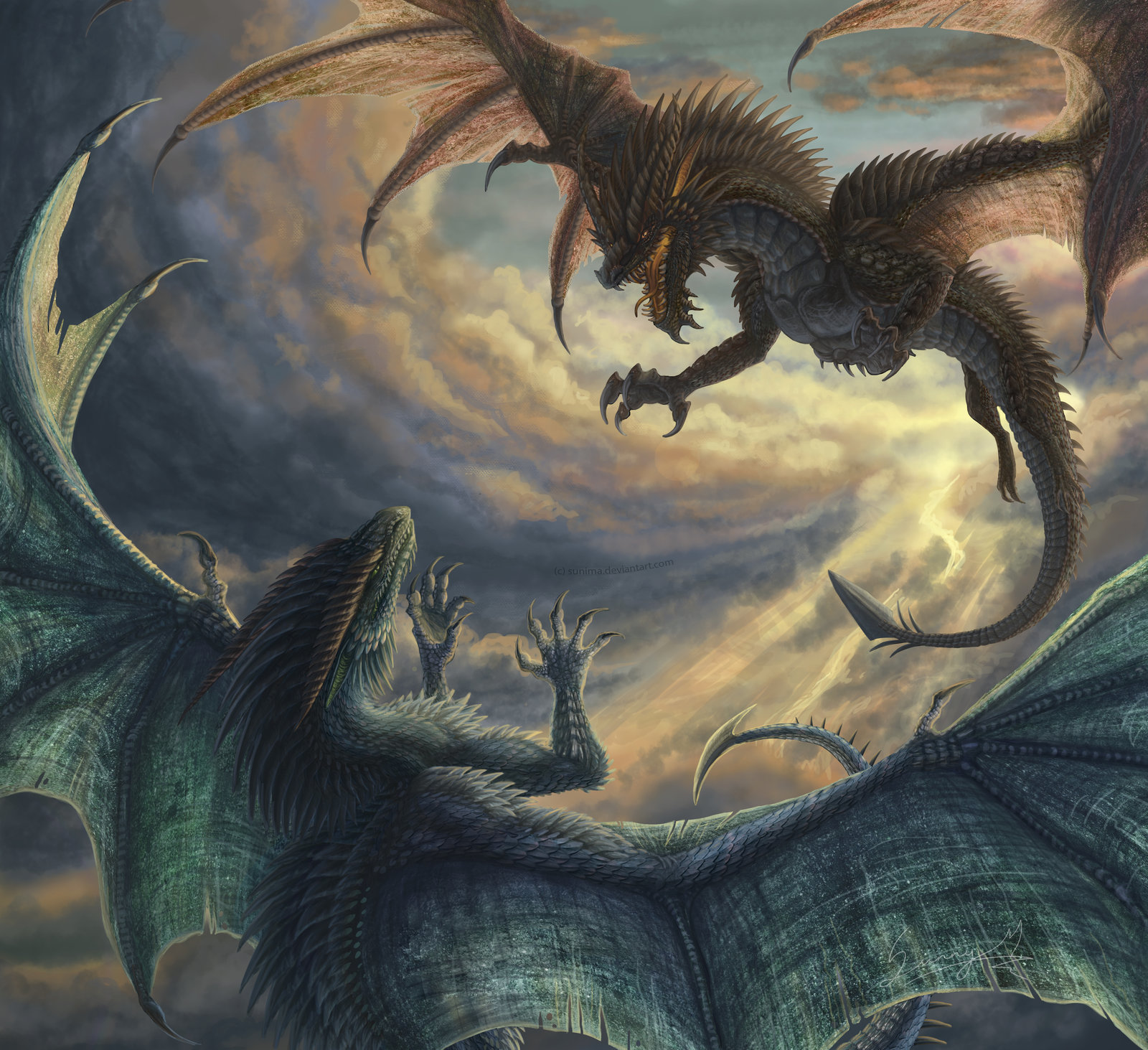
Sunniva Myster’s Dragons about to Fight on ArtStation, used for commentary

Sedric calls to Carson as the latter faces Kalo, urging him to calm as his own keeper is retrieved. Said keeper and another, Davvie and Lecter, have been irresponsible in their affections, provoking comment from Carson about his nephew. Sedric finds himself thinking about dislocation and of his lover, and Carson extends amiable gestures that please the Bingtowner. Sedric marks the ways in which Carson is changing under the influence of his dragon, and his mind turns to Hest. Carson marks it and asks after it, praising Sedric for the ways in which he has changed in the Rain Wilds. The possibilities of the future, good and bad, ring through Sedric’s mind, and he and Carson confer as they work together. Carson notes Sedric’s increasing capabilities, sparking pride in the man.

Once again, I find myself reading with affect as I reread the present chapter. I’ve not made any secret of growing up in a family of tradespeople; I’ve also not made any secret of growing up and living again in the central Texas Hill Country. Both push towards physical labor as a means of making a way in the world. I, however, have always been…brainier than I am brawny. While I carry more weight than is good for me, more of it is flab than muscle-slab, and while I am a willing hand to many things, I am not as able of one as would be best. A recent experience of doing some work around my house reminded me of it, pointedly and unpleasantly. (I’m fine, thanks. Just clearly not used to doing much physical work anymore, if I ever was.) So I find that I feel for Sedric in the present chapter, not because I am a long-closeted man who is finally able to be open with an understanding, non-abusive lover, but because I am a bookish sort among hand-working folk, and I am aware of the lack in myself.

I read the section focusing on Sintara and Thymara with less affect, to be sure–I do not have much, if anything, in the way of shared experience there–but not with less attention. I find it of interest that Thymara’s choice to abstain is so poorly regarded by other characters in the text as it is; while it is the case that some of Thymara’s choice is culturally driven, some of it is wariness of likely consequences (the observance of which seems like it ought to be lauded), and, in either case, the decision on whether or not to have sex is and should be hers to make. Yes, Thymara is somewhat naïve to think that things can always remain as they once were–a naïveté to which I think many fall victim, myself not excepted–and she might well be questioned, in character and by her readers, for it. But for deciding, as her culture dictates, as her presumed readership’s culture presumably dictates (because even more than a decade after the novel’s publication, there remains an expectation of chastity on the part of young women that is not applied to other populations), to withhold her intimate affections, knowing the consequences of indulging them in an unsettled environment and as a member of a population with a low rate of successful births, she should not be.

And, really, none of her readers’ choices in that regard should be questioned, either. Just in case you think I’m more worried about the page than people.

I continue to be happy to offer my writing services–all human-done, with no AI involvement–at reasonable rates. Fill out the form below for details!

← Back

Thank you for your response. ✨

I also appreciate gifts and sponsorships!

A Robin Hobb Rereading Series: Entry 351: City of Dragons, Chapter 1

Read the previous entry in the series here.
Read the next entry in the series here.


Following an extended message between bird-keepers treating concerns of information security, the first chapter of the novel, “The Duke and the Captive,” begins with a messenger reporting to the Duke of Chalced in fear or reprisal for the ill news he carries. The messenger is escorted away, and the ducal palace is described in some detail as the Duke is tended and receives a fuller report on actions in the Rain Wilds. His own situation is described in some detail, both his failing health and dearth of legal heirs, and his anxiousness to consume dragon-blood and -flesh to assuage both. The Duke lashes out, feebly but pointedly, at those around him.

Something of an antecedent?
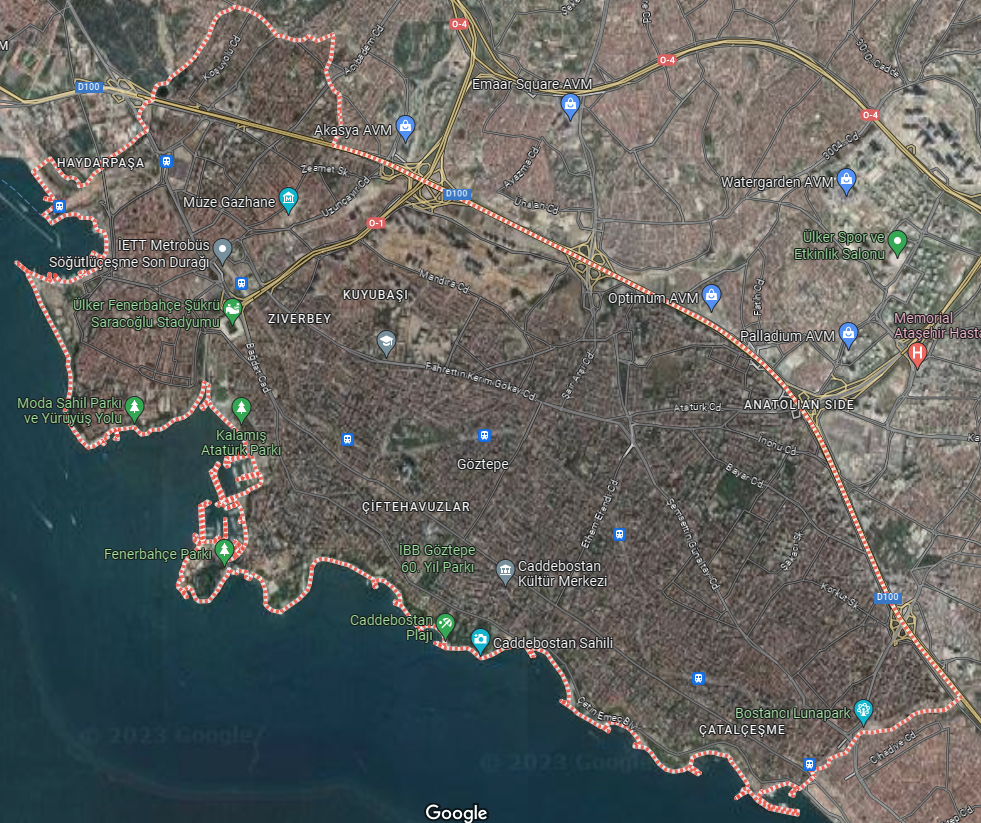
Image from Google Maps, used for commentary

Selden Vestrit, captive, ruminates on his situation as Chalcedeans view him, an oddity among a collection of oddities. The onlookers discuss selling him, ignoring his pleas. As they leave, Selden is wracked by coughing, his situation worsening as he longs for Tintaglia and freedom both.

The question occurs to me again as I reread the present chapter: To what, if anything, is Chalced an analogy? As I’ve remarked, there are analogues for other nation-states in the Realm of the Elderlings series. Bingtown and the Rain Wilds echo the United States, making Jamaillia something like Hanoverian England. The Six Duchies and the Out Islands are not unlike the indigenous American peoples, if with other influences visible and at play, so that “parallel” would be too strong a term. It is the case that the Duchies and Bingtown are or have been in position to ally against Chalced, being both vexed thereby; the analogue of Chalced would therefore be some state vexatious to multiple populations, heavily autocratic, and with a (relatively) poor human rights record.

I admit to getting somewhat outside my remaining areas of expertise, here, but colonial Spain somehow comes to mind. I am not a Hispanist; I did grow up in an area marked by Spanish colonialism, and there is something of that in even popular and public-school accounts of the local and regional histories, but I am far from a specialist in such things. I do, however, think there might be something to investigate in that line for an intrepid student who is more attuned to such concerns than I can be. (Please be sure to cite me if your papers take you in such a direction; I shall thank you.)

Similarly outside my expertise but similarly suggestive is the parallel of the names. Chalced seems to work from Chalcedon, an ancient town of Classical Asia Minor now part of the Istanbul district in Turkey. Site of some important early Christian councils and the namesake of chalcedony, it exerts some historical and religious influence…but, again, my noting that there is some interest to follow does not mean I am equipped to follow that interest in what has to be a short(ish) blog post such as this one. Again, a student of more related concerns looking at this might well have more to say. (Again, too, kindly throw me a citation if you investigate that way; I shall still thank you.)

Like what I write?
Want me to write for you?
Fill out the form below to get started!
All human-made; no AI!

← Back

Thank you for your response. ✨

Or extend your patronage directly!