A Robin Hobb Rereading Series: Entry 285: Fool’s Fate, Chapter 8

Read the previous entry in the series here.
Read the next entry in the series here.


The succeeding chapter, “The Hetgurd,” opens with an Outisland creation narrative. It moves on to the arrival of Dutiful’s company in Zylig, a port in the Outislands. Riddle assists Fitz in seeing to Thick and his own preparations, and their approach to the town is detailed. So is the town itself as Fitz and Thick catch up to the rest of their group while Dutiful accepts the greetings of the Hetgurd. Fitz and Thick are shown to their lodgings, their progress through the town detailed and their surroundings described.
The current scene…
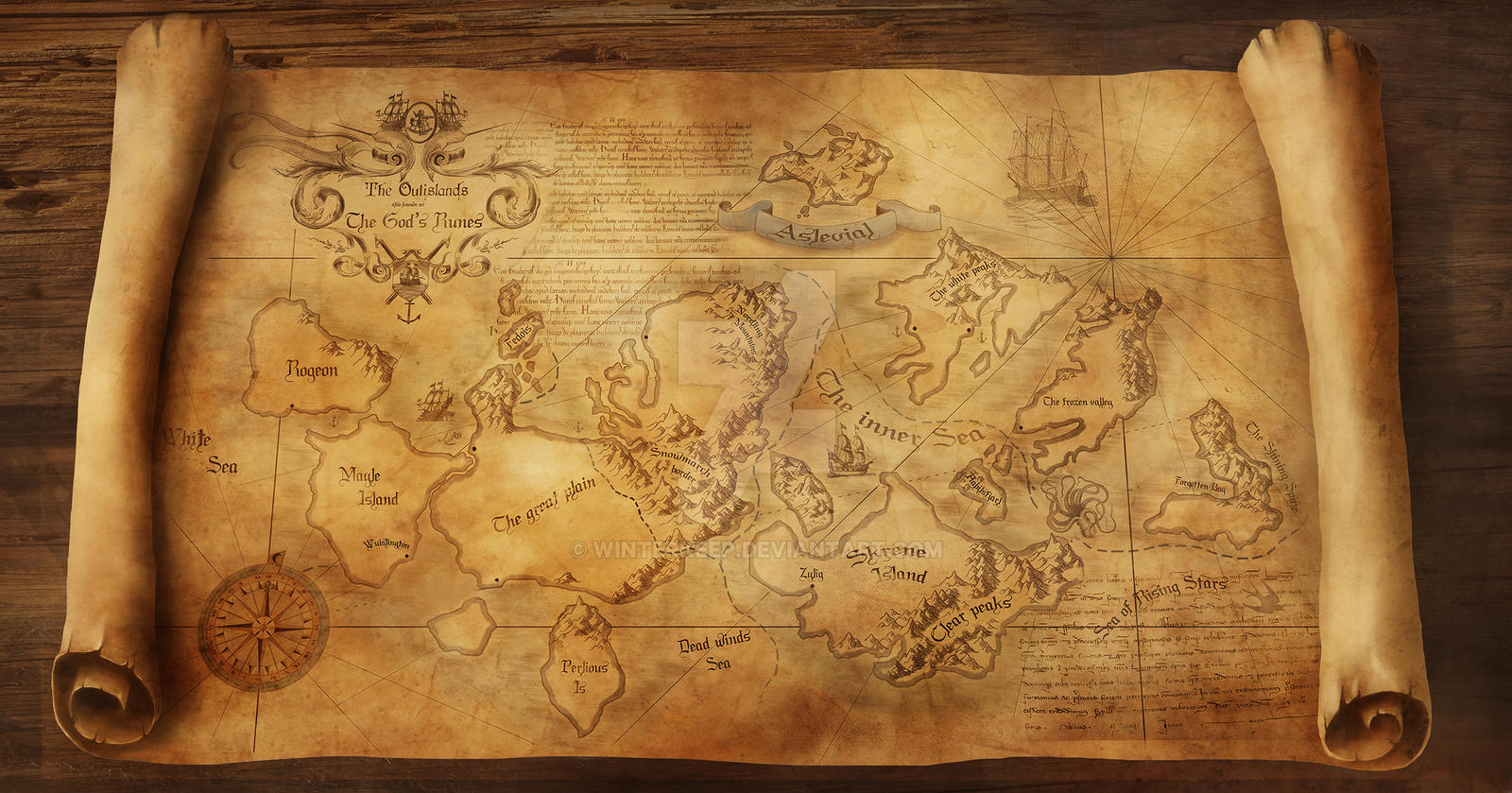
Winterkeep’s Map of the Outislands, from Hobb’s universe on DeviantArt, used for commentary.

Fitz gets food into Thick and eats, himself, then scouts out their lodgings. He slips into the initial meeting between Dutiful and the Hetgurd–a group composed of the various clans’ warleaders, or “kaempra.” Riddle briefs him on the limited happenings thus far, and Fitz turns his attentions to the ongoing discussion, in which the kaempra press Dutiful about his intended dragon-slaying, and he responds to their concerns. Dutiful, Chade, and Fitz exchange ideas via the Skill, and they use that magic to convince the kaempra to adjourn discussion, allowing them time to confer.

The conference comes swiftly, Dutiful and Fitz informing each other what they know and have figured out. Chade offers some rebuke to Fitz before they are interrupted by the arrival of Peottre Blackwater, who notes some political tensions and offers a means for resolving them. Chade takes over the conversation with Peottre, to some annoyance on Dutiful’s part, and arrangements are made at some length.

The Hetgurd and the kaempra who compose it factor heavily into the reading and interpretation I had originally had of the Out Islands (and I note the frustration of the term in the present chapter as previously) as analogous to the Vikings in popular–and some medieval–conception, one I realized at an inconvenient moment was not as accurate as the understanding that later emerged for me. They’re not the only such things, for example, but they do much, for reasons I explain. And as I reread the chapter, I am minded of other associations, having read Njal’s Saga relatively recently. I am not convinced to return back to my earlier idea, but I am, at least, satisfied that I had decent reason to think what I used to think.

There is some comfort in having been wrong for the right reason.

I continue to appreciate your support!

A Robin Hobb Rereading Series: Entry 284: Fool’s Fate, Chapter 7

Read the previous entry in the series here.
Read the next entry in the series here.


A chapter titled “Voyage” follows, opening with an in-milieu commentary about Out Island civic structures. It moves thence to Fitz rising reasonably well rested and returning to Thick, whom Web still attends. After an exchange that leaves Web smiling, he departs, and Fitz confers with Dutiful through the Skill about Thick, who wakes in nascent illness. Dutiful gathers him back into his cabin, although Thick goes reluctantly, and Fitz tends to Thick further as Dutiful’s “Witted coterie” attends on him.

Much better for Thick, this attitude…
Photo by Pixabay on Pexels.com

After the meeting, Swift is left with Fitz, Web offering insight about him as he departs and Fitz sets Burrich’s son about errands. Matters do not go well, and Swift is dismissed at Chade’s suggestion; the assassins and the prince confer about Thick afterward, Fitz noting the assistance of Nettle, and a pattern of attention and attempted soothing settles upon them.

In a Skill-dream, Nettle vents anger at Fitz for the message he had her convey to Burrich. The words had touched him deeply, sending him toward Buckkeep. Fitz attempts to explain himself to Nettle without revealing too much, and matters proceed. Fitz continues to work with Swift and seeks without success to confer with Web, and he discusses the Wit with Dutiful and Chade. Chade bristles at the topic somewhat, but he relents.

I’m not entirely sure what to make of the chapter as I reread it this time. Part of me wants to read it as something of a commentary on age, particularly on Chade’s part–he lampshades it, certainly, and there’s other justification in it. Burrich’s reported behavior also suggests something of such a reading. The idea is foggy in my mind, though, as I write this, and I have to wonder if it is simply an issue of my needing another cup of coffee as I read again.

And there’s the possibility of narrative necessity. The present chapter does gloss a lot…

Care to send a bit my way?

A Robin Hobb Rereading Series: Entry 283: Fool’s Fate, Chapter 6

Read the previous entry in the series here.
Read the next entry in the series here!


The following chapter, “Voyage of Dreams,” begins with a translation of a scroll regarding the Wit before moving into Fitz’s travails attending on the vehemently seasick Thick. The ship’s crew mocks Thick relentlessly, but nothing can be done lest worse repercussions follow, and Fitz comes to realize that Thick’s outpouring of Skill is having unintended effects for all aboard.

Sadly true…
Cotton Vitellius A XV, f 200 v, at the British Library, used for commentary.

Fitz pleads through the Skill for aid, learning to his surprise that Swift had taken ship along with them, and Chade and Dutiful come at length to assist him with Thick and confer. Chade notes his work to hinder the Fool’s departure from Buckkeep, and Fitz muses over the machinations with some regret. And ministrations towards Thick progress to little effect.

Later, as Thick sleeps fitfully, Web joins Fitz in his vigil, the two conferring about theology for a bit before Fitz asks Web about Swift. The conversation prods Fitz, and Web withdraws, leaving Fitz to realize what he has done and finding some shame in it until he is joined by Riddle. The two confer, Riddle reporting news from the guard company; matters deteriorate among them as among the ship’s crew.

Fitz reaches out to Dutiful and Chade for assistance again, the three conferring and finding there is little they can do for their companion. Fitz grows increasingly concerned for Thick and the situation, and Web approaches him again. After a prickly exchange, Web offers to watch Thick; Fitz, authorized to do so, allows it, and he marvels at Web’s insights and fretfully considers the state of affairs aboard ship.

Settling in to sleep, Fitz finds himself again assailed by Thick’s Skilling. He is not the only one, Nettle having entered the dreamscape in which Thick has enmeshed them, and she rages against Fitz for her brother’s absence despite his promises to her. She agrees to assist with Thick, despite her anger at him, and accepts a message to convey to Burrich. Through her Skill in dream, Nettle calms Thick, dismissing Fitz’s assertion of her magical prowess.

I have noted before that Hobb makes much of verisimilitude in the mundanities of her setting, referencing her own comments to that effect. The introductory blurb on the present chapter is another instance of her doing so, and one that speaks to my medievalist self. One of the challenges that faces scholars of medieval literature is that relatively little survives. Little enough was produced, given the difficulties of making text happen. Materials fade over time, physical objects decaying with the passage of years–and then there is mischance such as the Cotton Library fire, which resulted in much loss (about which some information here). It’s not necessarily something that a general readership will consider, but it is something that many readers of fantasy literature–there’s a lot of overlap with medievalists–will have in mind. Seeing it in print adds to the authenticity of Hobb’s narrative world for me, something else I appreciate about her writing.

Can I count on your support?

A Robin Hobb Rereading Series: Entry 282: Fool’s Fate, Chapter 5

Read the previous entry in the series here.
Read the next entry in the series here.


The next chapter, “Departures,” opens with in-milieu commentary from an older Skillmaster before moving into Fitz’s conference with Chade in advance of their departure regarding Web’s knowledge of Fitz’s identity. They talk of Web and the formation of a de facto Witted coterie in Dutiful’s service–including Web, Civil Bresinga, and the minstrel Cockle, all of whom are set to accompany the Prince to the Out Islands, to Chade’s vexation.

Unfortunately not available to Fitz…but available at HEB, whence this image used for commentary; thank you for supporting the Kerrville economy.

Fitz calls on Hap, finding him hard at work in his apprenticeship and applying himself diligently, if in the hopes of renewing his relationship with Svanja. That done, Fitz secures his sea-chest aboard the ship on which he will sail, the Maiden’s Chance, and emerges to find Lord Golden attempting without success to take ship. Fitz is spotted by Golden and is chagrined at his part in the deception that has led to Golden being barred from accompanying Dutiful to the Out Islands. He also muses on its effects as he makes his final few preparations for departure before finding his bunk for the night.

Asleep, Fitz encounters Nettle in dream again, and they confer about Swift’s promised return and about Tintaglia. He wakes from a nightmare soon after and prepares himself for the day, not long afterwards being made to stand and wait as the various departure ceremonies take place. The party making the trip to the Out Islands is described in some detail, as is the billeting of said party. Thick’s discomfort at the travel soon manifests in others via the Skill that pours forth from the little man, and Dutiful soon Skills to him that he will be assigned to attend Thick. Reporting to that duty, he muses bitterly on “The adventure of travel by sea.”

As I reread the chapter this time, I was minded of a change in nomenclature from the Farseer Trilogy to the Tawny Man. The former uses the term “Outislands” where the latter uses “Out Islands”; similarly, “Outislanders” and “Out Islanders.” Words matter, not only in novels, and not only in this part of Hobb’s work, and I have to wonder what it is the shift in term, small and subtle as it is, signifies. There has to be something–despite the claims of some who would argue that the curtains are blue always and only because the curtains are blue; each word in the text is chosen, placed deliberately, and adjusted by consideration between author and editor, and both respond to the situations in which they have lived and do live. The curtains could easily be red or white or absent, so that even if the author is not consciously aware of a reason to make them blue, the author is responding to a context in which a curtain is or ought to be blue. Similarly, for the nomenclature to change indicates a context in which it ought to change the way it changes. Understanding it is not necessary to enjoy the story, of course, but it does not necessarily preclude that enjoyment, either–at least, not when it is done well.

So there’s that, at least.

I always appreciate your patronage!

A Robin Hobb Rereading Series: Entry 281: Fool’s Fate, Chapter 4

Read the previous entry in the series here.
Read the next entry in the series here.

And happy Sousa Day!


The following chapter, “An Exchange of Weapons,” opens with a passage ostensibly written by Fedwren of Hod, Weaponsmaster at Buckkeep late in Shrewd’s reign. It turns to Fitz’s consideration of his possessions and work to secure them against his absence and his trip to the Outislands as part of Dutiful’s guard. He is interrupted in the work by Dutiful, to whom he gives the sword that Verity had wielded and given him just before entering his dragon. At the gift, Dutiful bids Fitz wait; he departs and returns with Chivalry’s sword, and Fitz considers the blades as he and Dutiful handle them. To Dutiful he remarks that he appreciates the gesture of being given his father’s sword, but he cannot bear it, noting the reasons why he cannot. Dutiful accepts the reasoning but makes a substantial gesture in reply that moves Fitz.

Some of this kind of thing…
Image from the Oakeshott Institute, used for commentary.

In the wake of the exchange, Fitz reaches for some connection to his late father, but finds none. Sleeping, he finds himself drawn to Nettle again in dream, and the two confer about a dilemma she has, having illicitly helped Swift come to court against his parents’ wishes. Tintaglia intrudes into the dream, assailing Fitz until dismissed by Nettle, and Fitz wakes.

In the morning, Fitz breakfasts in one of the castle gardens, where he is approached by Starling. She suspects that her husband is unfaithful, and the two commiserate for a time. After, Fitz heads to the Queen’s Garden, where Swift awaits him; he rebukes the boy for his deceit and sharply sends him home.

I am taken, as might be thought, by the titular exchange of weapons. Sentimental as I am, I cannot help but be moved by Dutiful’s assertion to Fitz that “when I take your father’s sword from you, I will return my father’s sword to you”; it is a boyish thing, perhaps, but it is one that bespeaks a shared experience of growing up cared for but without a parent (although, as in many things, Dutiful has a far easier time of it than Fitz–but then, he isn’t the protagonist, really). And it may be that I remain boy enough to appreciate such things boyishly, though that might come as a surprise to many.

Please help support your friendly online writer!

A Robin Hobb Rereading Series: Entry 280: Fool’s Fate, Chapter 3

Read the previous entry in the series here.
Read the next entry in the series here.


The next chapter, “Trepidation,” begins with an in-milieu vignette regarding the White Prophet Hoquin before glossing more of Fitz’s preparations for travel. He reviews the information he has about the itinerary he faces, which will include a visit to the port city of Zylig, where the Hetgurd–“a loose alliance of Outislander headmen”–sits, before a call in at Wuislington on Mayle and thence to Aslevjal. Fitz also frets about those who will remain when he is away. And he is disturbed from his reverie by the quiet, unexpected entrance of the Fool.

Lots of this going on…
Photo by Eva Elijas on Pexels.com

Fitz and the Fool talk together, Fitz noting his concerns for Hap and the two finding themselves at ease with one another until Fitz recalls his plan to keep the Fool from taking ship for Aslevjal. Their talk turns to performativity, the Fool noting that he is not merely one thing, but that each role he plays is simply a revelation of a part of himself. The subject to the Fool’s impending death is treated, as well, and Fitz rails against it as the Fool lays out his bequests.

After the conversation with the Fool, Fitz gives his lesson to Swift, the boy once again nearly belligerent about his magic. The lessons go awkwardly, as does Fitz’s self-castigation afterward. And he finds himself calling on the Fool again, summoning him to the Skill lesson with Dutiful, Thick, and Chade. He finds him drunk and maudlin, but he drags him along through the secret passages anyway, surprising his students with the visitor’s presence. But the Fool is welcomed in and joins the practice as best he can–which is not much, in the event, until the Fool applies his Skill-silvered fingers to where they had touched Fitz before. Fitz is rocked by the experience, and Chade dismisses most from the lesson to confer with Fitz and the Fool. The talk does not go well, with Chade and the Fool exchanging sharp words about the need for dragons in the world.

The Fool makes his courtesies and departs, and Chade rails about him to Fitz in his absence. For his part, Fitz, observes that he has hardly been consulted about the choice the Fool and Chade seem set to have him make and makes his own exit, back to the hidden workroom. There, he finds a gift from the Fool, and it gives him pause.

The bit about the Fool’s roles being parts of himself put on display brings to mind Whitman’s Song of Myself: “Do I contradict myself? / Very well then I contradict myself. / (I am large. I contain multitudes.)” I’ve noted before, several times, that others write of performativity in Hobb’s Elderlings novels more eloquently than I can; as before, I recommend the sources on it in the Fedwren Project. But, thinking about it, the Fool’s assertion makes sense. I am not quite the same in person as I am online, after all, and even online, I show different parts of myself to different communities in which I participate. Similarly, I do not show to my daughter the same parts of myself that I show to my mother, nor to my mother all the same parts I show my daughter, and I show neither of them so much of myself as I do my wife. And that is as it should be. The Fool simply does it…more. But that is part of the purpose of fantasy fiction (and other forms, to be fair), to enhance things to as to show them more fully and allow their deeper exploration.

And there is always more to know.

Help me close out the month right!

A Robin Hobb Rereading Series: Entry 279: Fool’s Fate, Chapter 2

Read the previous entry in the series here.
Read the next entry in the series here.


The second chapter, “Sons,” opens with an in-milieu historical gloss of the foundation of Buckkeep by a settling Out Island raider named Taker. It pivots to Fitz’s continued preparations to accompany Dutiful to the Out Islands, including his tutoring in the Out Island language and his instruction of Swift. The latter grates on him somewhat, not least because the boy continues to be almost belligerent about his Wit, and Fitz seeks out Web. Getting to him alone takes some doing, but Fitz achieves it through indelicate means, and during their conversation, Web lets Fitz know that he knows his true identity. He also agrees to teach Swift–if Swift seeks him out–and extends the same offer to Fitz.

Lots of this, yes.
Photo by cottonbro on Pexels.com

Unsettled, Fitz makes to mull over the matter and goes in to Buckkeep Town to distract himself. There, he meets with Hap, who admits to him that he is falling in with Svanja again, despite her clear perfidy. He notes the likelihood that he is being deceived, but also notes that he cannot help himself. The two talk together as amiably as might be expected, and they part in familial love. Afterward, Fitz walks through the town, considering changes, the prospects of unpleasant travel, and the looming confrontation with the Fool over his not going to Aslevjal.

Fitz notes that the reputation of the Fool as Lord Golden has grown obscene and prodigal. He puzzles over the changes to his friend, even in an already flamboyant persona, musing that some are merely covers for his intent to go to Aslevjal and to maintain information on Bingtown and points south. After witnessing an exchange that bears in on Lord Golden’s finances and being seen by the man himself, Fitz returns to Buckkeep alone.

A couple of points attract my interest in the present chapter. One is the encyclopedic entry at the beginning. I’ve commented on Hobb’s use of the device before, several times, and I note that the story is not dissimilar to that of the entry of the Angles, Saxons, and Jutes into what is now England–or, indeed, the Danes centuries later. Indeed, it’s a point worth remembering that many, many peoples live now where others lived before, and they maintain kinship with those where they themselves came from. It’s not always easy or comfortable to remember, of course, and it does tend to run afoul of nationalist assumptions and assertions, but there it is.

The other, and this is eminently affective, is the exchange between Fitz and Hap over Svanja and Hap’s apprenticeship. I am not so far removed from the experience of being a teenager as I should like to be as keeps me from recalling it–including the strength of hormone-driven infatuation and the equally hormone-driven anger at people not sharing adolescent certainty. Nor am I so far removed from Fitz’s experience of seeing one’s child doing something…inadvisable…and being unable to prevent it (at least without taking steps that are themselves…objectionable). Again, I feel for the characters involved–which is to the narrative’s credit. Readers are supposed to feel for the characters, after all…

As ever, I am grateful for any support!

A Robin Hobb Rereading Series: Entry 278: Fool’s Fate, Prologue and Chapter 1

Read the previous entry in the series here.
Read the next entry in the series here.


In the brief prologue, “Battling Fate,” Fitz opines briefly on the White Prophet religion before pivoting to his own place in it. His repeated encounters with death are glossed as part of the Fool’s efforts to force the world into a better course, and Fitz notes the presence of an opposing force targeting the Fool.

Fool's Fate (Tawny Man, #3) by Robin Hobb
Looks familiar…
Image from Goodreads, used for commentary.

The first chapter, “Lizards,” opens with a brief comment from Fitz that notes the Fool’s assertion that death awaits him on Aslevjal and his request that Chade ensure the Fool would not travel to the Out Islands with Dutiful to fulfill the betrothal challenges the Prince and the Narcheska had exchanged. It moves then to the return of spring to Buckkeep and the lightening of Fitz’s mood as he prepares to meet with Swift in the Queen’s Garden. The boy arrives and presents himself as he has been directed, and the two begin to feel one another out. Swift discloses skill with a bow, and he notes having made a sharp break with his past, which Fitz–as Badgerlock–takes in stride. Swift’s near-belligerence about the Wit, however, earns him some chastisement, and he is dismissed sullenly so that FItz can clandestinely meet with Dutiful, Chade, and Thick for their Skill instruction.

Fitz’s tutees are described as the four sit to practice their magic together. They report minimal success with a practice assignment, but Thick and Dutiful both report having dreamt of a blue dragon in the night. Fitz elucidates Dutiful’s report to Chade, Thick contributing some information, as well, and Fitz notes his supposition that the dragon in question is Tintaglia. They converse further, FItz and Chade speaking at some length after the training session ends. Chade notes his worries for his intelligence efforts, and the continuing threat of the Piebalds is noted. Fitz offers aid, and Chade makes another play for Nettle, despite Kettricken’s earlier words on the matter.

I write this in the wake of Winter Storm Landon (#TexasFreeze) having frightened those of us who remember Uri’s visit to Texas. The thought of returning spring is a welcome one; like Gandalf as “The Ring Goes South,” I could stand to have warmer feet. The thought of dealing with a surly teenager is…less welcome, much less one who seems bound to press the spirit of things with the letter of them; I find myself feeling for Fitz once again. Too, being pressed by many tasks…once again, I know I should not be reading with affect, but I seem unable to help myself. Perhaps it is the pleasure of being able sit and read again…

Send some support my way here, or drop me a line, and we can talk about what all I can do for you!

A Robin Hobb Rereading Series: Entry 277: Golden Fool, Chapter 27 and Epilogue

Read the previous entry in the series here.
Read the next entry in the series here.


The final chapter of the novel, “Spring Sailing,” opens with a kind of creation story recounted in Badgerlock’s Old Blood Tales before offering something akin to a reverdie that summarizes developments in Buckkeep at the approach of spring. Preparations for Dutiful’s trip to the Out Islands progress, and the party to accompany him on that trip is determined. Civil and Web, Chade and Thick, are set to go, and Fitz is “randomly” chosen as part of Dutiful’s guard complement. Others make their own arrangements to go along. Lessons of various sorts go on, and Swift finds his way back to court, entering Kettricken’s service as a page, evidently turned out by Burrich.

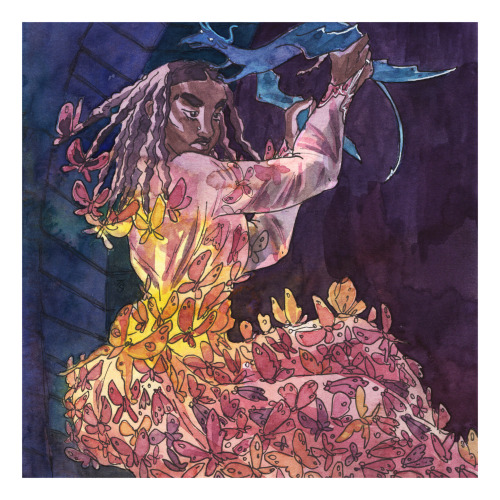
Butterfly Dress
Illustration series for the Golden Fool by Robin Hobb
She seems to have it handled…
Katrin Sapranova’s Butterfly Dress is used for commentary.

Fitz finds himself in mind of Nettle, and they Skill together. They are interrupted by the intrusion of a blue dragon, from which Nettle forcefully extricates them. Fitz ponders the event and continues about his preparations, including calling on Hap, who now makes good progress in his apprenticeship. The quiet interdiction of the Fool proceeds, as well, although the Fool still clearly intends on taking ship for Aslevjal to face doom. Fitz and Chade confer on that point and several others, including Chade’s continued progress in the Skill and Fitz’s preferred armaments for what they expect to face as they head to the Out Islands and Aslevjal. Fitz is also tasked with tutoring Swift, surprising him.

Later, Fitz calls in on the Fool, the two reaching some reconciliation, even as both acknowledge that things cannot go back to how they had been before their falling out. And in the brief epilogue, Fitz reflects on his writing efforts and the seeming cycles of life, commenting finally that “Perhaps having the courage to find a better path is having the courage to risk making new mistakes.”

It feels as if it’s taken forever for me to get to this point in the rereading–and there’s more to do yet, with another novel in this series, two more series and some scattered other works in the Elderlings corpus, a whole ‘nother series, and some assorted other works to treat. It’s good to have a project, though, and I’m not complaining at all about doing this. Really, it’s a treat to read the work again; I’ve not been able to do such things much for a while, and it’s a pleasure.

More on the present passage, though: I note with some interest the reported development of the Stones game Fitz had learned from Kettle and passed on to Dutiful as part of his Skill training. Having become a seeming pastime of the heir apparent to the Six Duchies, the game has become a preoccupation of the nobility at court, and consequently a focus of conspicuous consumption as well as what might well be thought some kind of organized play. That speaks powerfully to the verisimilitude Hobb identifies as a major component of her writing, because it is the case that people will find things to occupy such hours of leisure as they can find, it is the case that those who vie for favor will attempt to emulate the tastes and patterns of those whose favor they seek, and it is the case that those who seek to elevate themselves will often make a show of what they already have as a means of displaying that they deserve to have more. Yet such concerns are overlooked in many works of speculative fiction, or they are only glancingly treated. That Hobb attends to them–and that she does so consistently across novels and series, not only with the “Prince’s Stones,” but also with particular recreational intoxicants–is one of the things that makes her narrative milieu so compelling.

Send some support my way here, or drop me a line, and we can talk about what all I can do for you!

A Robin Hobb Rereading Series: Entry 276: Golden Fool, Chapter 26

Read the previous entry in the series here.
Read the next entry in the series here.

And happy Valentine’s / Singles Awareness Day / Monday to you!


The penultimate chapter of the novel, “Negotiations,” opens with an in-milieu proverb: “One man armed with the right word may do what an army of swordsmen cannot.” It proceeds thence to continued discussions between the Old Blood delegation and Kettricken’s court. Web suggests that much might be eased by Kettricken taking Old Blood people openly into her household, and he offers himself as one such–doing so with remarkable grace and to evident acceptance.

Restaurants and COVID-19: How to Safely Dine at Your Favorite Place
The Old Blood masking up hits differently now…
Image via Healthline.com, used for commentary.

Fitz watches as the Old Blood delegation dines, sans Web, and continues watching afterward as negotiations begin to stall out. Boyo tries to bring up personal grievances and is shunted aside in favor of more global concerns. Silvereye voices historical grievances and calls for extensive retributive justice, only to be rebuffed. Matters degrade, only to be interrupted by one of the Old Blood needing to attend to her gravid Wit-bonded animal. Fitz continues to observe from hiding, joined by Chade; they watch as Silvereye reveals herself to be affiliated with the Piebalds. Civil Bresinga joins the meeting, confessing himself and pleading on the Farseers’ behalf; his testimony sways opinion, and the meeting with the Old Blood delegation ends with far better prospects than it began. Civil discloses his Wit to the court, and legal reforms are proclaimed. The delegates are returned to their people, Dutiful returned, and things seem very much improved.

I note Fitz’s assertion that Web “sounded more like a Jhaampe Wise-man settling a dispute than a spokesman for the Old Blood” early in the chapter, and I delight in having more parallels between the Old Blood and the Mountain Kingdom. It’s a pleasure to see more evidence to support an idea I have, of course–although, again, a targeted reading would be needed to see if the notion can be borne out.

For those reading along with my little series–thank you! I’m glad to know that folks are looking at what I write here, and I’m happier to know that it’s doing some folks some good (I’ve gotten a few messages to that end). It may not be much, but if I’ve made your day a little better, then it’s worth doing.

I appreciate your support!