A Robin Hobb Rereading Series: Entry 245: Fool’s Errand, Chapter 25

Read the previous entry in the series here.
Read the next entry in the series here.


The following chapter, “Ransom,” opens with a brief note about recognizing children who have the Skill before moving into Fitz and Dutiful arriving through the Skill-pillar back whence they had fled. Fitz reassesses their situation, finding it suboptimal, but is surprised that his horse, Myblack, awaits them. He hustles Dutiful along, the horse following, until he can get the Prince astride the steed. As they proceed, Fitz hums to himself, speaking to Dutiful about his magics; Dutiful notes that the woman is with him, raging at his inability to attack Fitz through the Skill-command. He also speaks of his cat and the ways in which the woman in the cat would not allow the cat to be a cat.

Australian Mist.jpg
Here, Kitty, Kitty, Kitty…
Regis2007’s picture of an Australian Mist Cat, hosted on Wikipedia, here, and carrying a CCBYSA3.0 license; used for commentary.

Fitz becomes aware of pursuit and of the suffering of his wolf, and the Prince’s abductors emerge. Fitz threatens Dutiful, and pursuit pauses, one pursuer questioning why Fitz stands against others of the Old Blood; Fitz lays out his reasoning, and the pursuer rages against the Farseers. Dutiful hears it, and Fitz learns the underpinnings of the plot against Dutiful; the deaths of the Witted at the hands of the Six Duchies and their Farseer monarchs. Fitz manages to dicker for time and the release of the Fool and Nighteyes, a thin hope for all involved, and they are taken to where the abductors hold Lord Golden and Nighteyes. Fitz directs the Fool and communes briefly with Nighteyes, sadly so, and Dutiful begins to be possessed by the dead woman, Peladine, but he offers some resistance.

Things just do not seem to improve for Fitz, do they? At least he recognizes his own complicity in creating the current situation, although he had no way to expect that many or any of his entanglements would occur as they have in the novel. And it is not as if he had not already given his life in service to the Six Duchies…but even that does not mean that his actions did not give rise to what befalls now, as well as what is portended. Because the deal Fitz has struck with the Prince’s abductors, the Piebalds, is a tenuous one at best, and he has to expect that it will not be honored. As suspicious as Fitz is even of those closest to him, he can hardly not believe that others, less kindly disposed toward him, will be forthright…

Send some money my way?

A Robin Hobb Rereading Series: Entry 244: Fool’s Errand, Chapter 24

Read the previous entry in the series here.
Read the next entry in the series here.


The next chapter, “Confrontations,” opens with a story about the Others related in-milieu before pivoting to Fitz dreaming of Verity’s tower, Verity, and Jinna; it is an unpleasant dream. Fitz soon tumbles into communion with Nighteyes; the wolf offers a dire report of the circumstances in which he and the Fool have found themselves. Nighteyes also notes on the interpenetration of a deceased woman in the cat with which Dutiful is bonded. The Fool is assailed, and Fitz loses the connection to his wolf.

Something like this, perhaps?
Kristine W’s Rooster Crown Feather on ArtStation, used for commentary.

Fitz wakes and reassesses his situation and Dutiful’s. It has not improved, and he makes to wake the Prince. Dutiful responds harshly, and Fitz’s own anger rises in response. He stalks off to gather food, finding more wooden feathers as he does, and he makes to cook them as Dutiful returns. The Prince’s abductors work through him, and he attacks Fitz, only to be subdued swiftly and with ease–at first. The woman interpenetrated with the cat uses the boy recklessly, however, and Fitz is forced to fight more forcefully, inadvertently laying a Skill-command on the boy not unlike one Chivalry had laid on Galen before. He considers events in the wake of the command, forced to assess the situation again, and he makes to reconnoiter, securing the feathers as he does so and as he and Dutiful eat and wash.

Searching, Fitz comes across a number of alcoves filled with treasures; curious, he investigates further. The treasures defy him, and he scouts more, finding nothing. He notes as much to Dutiful, and the two confer about the Prince’s magic and how he has been trapped by it. Dutiful disbelieves to the extent he can, but Fitz has the right of it, and as the proceed, Dutiful stumbles upon a treasure showing a figurine of a woman on a fine chain. An Other soon confronts them, demanding the surrender of the treasures they have found; Fitz refuses, and they escape through the Skill-pillar, emerging in a ruined Elderling city. They transit again in haste, and Fitz wonders if Dutiful’s mind can endure it.

I appreciate the references back to earlier works in the Elderlings series, the attempt to harmonize the various series. It’s not necessarily an easy thing to do, of course, and fandom can be (often is) punitive about such things. I have not been immune to commenting on such things, of course, and some earlier comments I have made are not necessarily as I would have them be–although it is the case that narrative consistency from an author who asserts the importance of verisimilitude, whose work does much to foster a Tolkienian inner consistency of reality, is a subject of fair critique. Here, though, the connections are clear enough to readers who have been doing their reading, and they do not conflict of run into retcon–which makes things all the better, although retconning may not be the worst thing. We are supposed to revise ideas when new information emerges, after all…

Remember, remember, the fifth of November, and send me some cash for my pot?

A Robin Hobb Rereading Series: Entry 243: Fool’s Errand, Chapter 23

Read the previous entry in the series here.
Read the next entry in the series here.


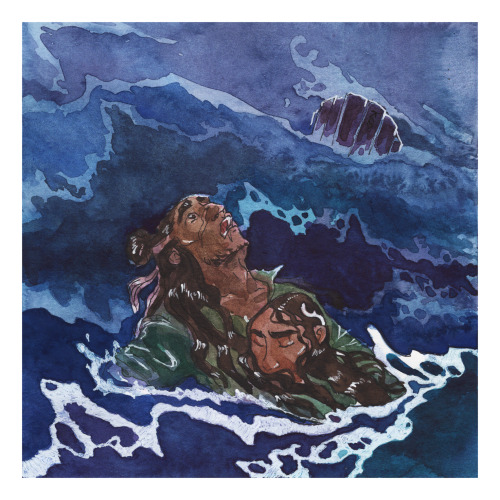
A chapter titled “The Beach” follows, opening with a brief statement regarding the Skill before noting Fitz and Dutiful’s emergence from a Skill-pillar into the surf. Disoriented, Fitz struggles to preserve the Prince and to bring them above the surface of the water; the task proves challenging but is accomplished. The enormity of their situation breaks upon Fitz, and he rages as he drags Dutiful along to higher ground, away from the incoming tide. Dutiful presses him with questions and accuses him of being a Farseer bastard as Fitz further assesses their situation.

Sea Skill Pillar
Illustration series for the Fool’s Errand by Robin Hobb
All washed up…
Katrin Sapranova’s Sea Skill Pillar, used for commentary.

As Dutiful realizes their situation, Fitz grows disappointed in him, then shunts aside the feeling in favor of securing food and rudimentary shelter. He reaches out via his magics to Nighteyes and the Fool, finding neither, and gruffly tends to Dutiful. He finds that the Prince has slipped into a Skill trance and plunges into the magic after him, very nearly losing himself amid the magics and distracting thoughts of others. A strange being within the Skill reassembles him and Dutiful both, chiding them gently as they are reconstructed.

In the wake of it, Fitz wanders across the beach, finding a strangely carved wooden feather; he secures it as he further assesses his situation. With fatigue pressing him, and with nothing else to do, he sleeps.

It’s clearly a bad situation the pair are in in the present chapter, in an uncertain location, far from friends and support, and with no clear means of return to their accustomed locations. Once again, I find myself reading with affect, feeling for Fitz as he is confronted by Dutiful’s relative incapacity. I work with teenagers, and I know from that work they tend to think themselves apt to any task they fancy; I also know they are not so apt as they think themselves, and I know the vexation of seeing clearly what will befall them even as they fail to heed any semblance of warning about it. (Indeed, as I write this, I’ve not long since completed a round of grading, in which several students failed to heed the advice I gave them. It annoys.) So, yes, I find myself in sympathy with Fitz, who had to be far more capable at Dutiful’s age than Dutiful seems to be, and who confronts once again youth as youth, which is not easy for those who no longer have their own youth.

My birthday’s tomorrow; send a present?

A Robin Hobb Rereading Series: Entry 242: Fool’s Errand, Chapter 22

Read the previous entry in the series here.
Read the next entry in the series here.


The subsequent chapter, “Choices,” opens with a short piece about the White Prophet and Catalyst before resuming narration with the retrieval of Dutiful. The Prince queries Lord Golden about Badgerlock and avers his lack of desire to return to Buckkeep. He tries to act upon it, but Badgerlock restrains him swiftly and decisively; the Prince pleads to return to his beloved. Badgerlock denies him, and Golden plies him more gently. They learn of the Prince’s intentions; he knows himself to be possessed of the Wit and seeks to remove himself from leadership in the interest of preserving the Six Duchies. Badgerlock rebukes him, and Nighteyes’s arrival occasions an outburst from the Prince.

Escape
Illustration series for the Fool’s Errand by Robin Hobb
Something like this, yes.
Escape by Katrin Sapranova, used for commentary.

Fitz and Nighteyes confer about the matter as Fitz makes to prepare camp, the strangeness of the woman Dutiful regards being seemingly absent coming up again. Fitz presses the matter with Dutiful, infuriating him with his crudeness and leaving openings for Golden to press more subtly. Nighteyes makes snide comments in the Wit as Dutiful shows himself to be an infatuated young man.

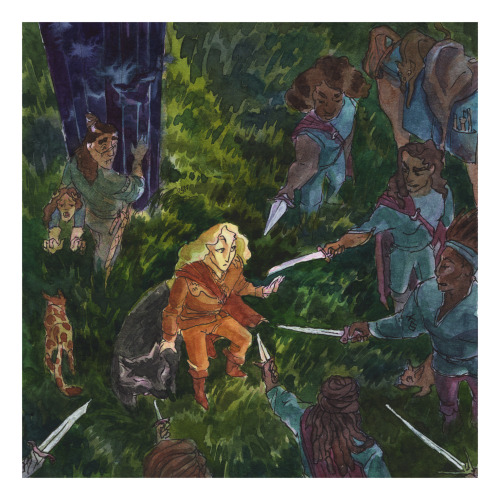
After, Fitz and the Fool tend their horses, conferring about Dutiful as they do and as Nighteyes watches over the youth. Fitz takes up watch, from which he is later summoned by Nighteyes; Dutiful is out of his body, and Fitz follows him through the Skill. With the combination of that and his Wit, he realizes that Dutiful is dangerously entwined with his bond-beast, a cat–and that the cat is interpenetrated with the psyche of a woman, one who approaches with companions in anger. Nighteyes realizes that the woman is in the cat, and Fitz breaks off the magical connections, pain blooming inside him. The party prepares to flee again, under extreme duress, and they proceed raggedly until they can flee no further. There, they make a stand as they can, their backs to a Skill-pillar upon the barrows they had passed before. Surrounded, they are assailed, and Fitz drags Dutiful through the Skill-pillar to an uncertain destination, leaving the Fool and Nighteyes behind.

I once again find I cannot help but read affectively, this time with more than my usual sympathy for Fitz. I’m not much older now than he is in the text; I also deal with teenagers on a regular basis, being a high school teacher, and I find myself confronted just as much by the naivete of their infatuations–and chagrined by my recollections of my own. Admittedly, I’m not in danger of my life that I am aware of at any given time, nor am I possessed of strange magics that blend uncomfortably within me, although I do have a predilection for stimulant use to accentuate what powers of mind I do possess. (They are not as many or as extensive as once they were; age works upon all who survive to see it.) Even so, I’m used to dealing with teenage shenanigans, and I find it trying at times; I can only guess how one less schooled to such things feels in having to deal with them.

It’s not a comforting thought.

My birthday yet approaches; send a give?

A Robin Hobb Rereading Series: Entry 241: Fool’s Errand, Chapter 21

Read the previous entry in the series here.
Read the next entry in the series here.


The next chapter, “Dutiful,” opens with another selection from Badgerlock’s Old Blood Tales before moving into Fitz waking slowly and in discomfort from a half-remembered dream; he realizes that the prisoner has escaped, and the Fool notes that Laurel is also gone, arriving at the conjecture that she took him and fled. The two confer, the Fool noting his fear for Fitz, and they set out in pursuit once again.

“And without your brain, too, alas.”
Photo by Steve on Pexels.com

The trail is clear enough, and Fitz opines that they will face resistance, including some likely from Dutiful. Nighteyes gives off of the chase with the clear trail, acknowledging an inability to keep pace. The Fool presses Fitz about his dream-sharing, and Fitz sights their quarry, assessing the situation glumly. The approach to the target is made, and melee ensues. Fitz reaches Dutiful, disoriented by the similarities between himself and the Prince–though he knows the reason. With difficulty, Fitz extricates Dutiful from the fracas, and he and the Fool make their flight.

It had to happen, of course, that Fitz would encounter Dutiful, and it had to happen that the physical similarities between the two would be remarked upon. Even had Dutiful not been conceived as he was, he would still be close kin–a first cousin–to Fitz, so that some similarity in appearance would be likely. But he was conceived as he was, and as someone who is similar enough to his own father to be mistaken for his (younger) brother, I know well that a son can favor his father’s appearance to an uncanny degree. (Seriously, even the patterns of the veins on the backs of our hands is the same, let alone our faces and frames.) That said, I’ve had a lifetime to be accustomed to the idea of my similarity to my father; he’s had my lifetime to be similarly accustomed. Fitz has not, and I can well understand his shock at seeing his own younger face, a face that might have been his own in other circumstances, looking back at him. So, yes, I again read affectively, but not without reason, I think.

But then, I would think that.

Send me a birthday present; I’m getting older soon!

A Robin Hobb Rereading Series: Entry 240: Fool’s Errand, Chapter 20

Read the previous entry in the series here.
Read the next entry in the series here.

I suppose this one will need a content warning.


The chapter that follows, “Stones,” opens with a short passage about torture before moving into the continued pursuit of the Prince by Fitz, the Fool, and Laurel. They find the trail of the Prince and his company, as well as the site of an ambush of their pursuers; Fitz is not much affected by the carnage, though Laurel is, and, after an assessment of the changed circumstances, they press on. Coming to a barrowfield, they note some of the deeper histories and legends of the area before they press on.

Badgerlock
Not a face to see on a dark night.
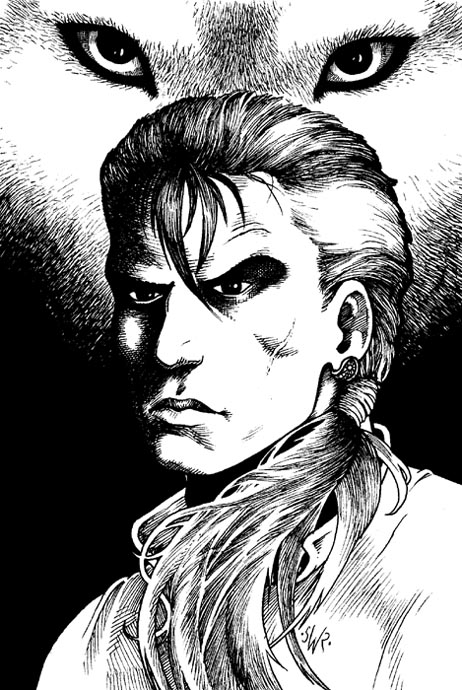
Moriadat’s Badgerlock on DeviantArt, used for commentary.

A warning from Nighteyes indicates that the party is pursued, and they hasten forward, narrowly avoiding being taken unawares in ambush. A short fracas ensues, with Fitz taking captive the archer who had lay in wait for them. He is not gentle with the young archer as he pushes his party to shelter for the evening. While there, Fitz begins to question the youth, letting him stew as he reconnoiters. Once he returns, he resigns himself to the course that seems clear before him, and he begins to torture the youth into providing information about the Prince’s whereabouts and his company. Laurel’s pleas and the Fool’s fail to dissuade him; only the emergence of Nighteyes gets through to Fitz, and at the wolf’s insistence, he leaves off. But he also becomes sharply aware of the wolf’s fading life, seeking to steady his companion only to be rebuffed just as the archer attempts escape. The youth is soon restrained, harshly, even as he rants about the plan to free Dutiful from bondage. Fitz attempts to correct him and is soon brought to rest by the wolf’s insistence.

There is a bit of Hobb’s Tolkienian roots in the scenes that Fitz, the Fool, and Laurel pass in pursuit of the Prince. The barrowfield they encounter, with the stories of spirits rising from the graves to prey upon the living, calls to mind the Barrow-Downs and the Barrow-Wights. It is no surprise, of course; Hobb herself attests to her early engagement with Tolkien, and, writing in the genre she does, she can hardly not engage with his works (even if, as I’ve argued, there are other sources more powerfully at work in her work). Nor is it necessarily a surprise that she works with a trope about which I’ve written elsewhere: the empty countryside of the medievalist kingdom. Even if an expectation is tacit, it is felt and often met–and there is an expectation that medievalist areas are sparsely populated, especially in the wake of a plague within a couple of generations (the Blood Plague referenced in several of the Elderlings novels) and of a rampaging war scarcely a decade gone.

Following a trend is not blameworthy in itself, of course, but it does provoke some interest. What gets carried forward, and what functions that carry-forward serves, are well worth interrogation and investigation.

I suppose I ought to comment about the near-torture, as well. I am not sure, however, what to say about it. I am not sure at all.

Can I count on your continued support?

A Robin Hobb Rereading Series: Entry 239: Fool’s Errand, Chapter 19

Read the previous entry in the series here.
Read the next entry in the series here.


The succeeding chapter, “The Inn,” opens with a brief commentary on the gladiatorial King’s Circles that had arisen under Regal before turning to Fitz waking without pain from Skilling and communing with Nighteyes briefly. He returns to Golden and Laurel, and pursuit of the Prince continues. Fitz lapses in his charade with the Fool, chastising himself mentally for the failing, and they continue on until nightfall.

I saw the sign…
John Howe’s The Piebald Prince Inn, used for commentary.

That night, they lodge in an inn, the Piebald Prince. Fitz muses with unease on the name of the place, and he watches as the party’s horses are billeted for the night. He rejoins Golden and Laurel for dinner, overindulging and occasioning comment from Golden about the effects of Smoke–a popular intoxicant–upon him; Fitz stumbles through the following hours uneasily. In the night, the Fool wakes him with concern, and Nighteyes realizes that the stone from which the inn is built is the same as in the dragon-quarry and on the Skill-road, with the same effects on Fitz as before, and Fitz makes his way outside to be away from it.

Once outside, he finds himself in communion with the Prince again, and the Fool sees to him again. They confer briefly, and Fitz moves off, called by Nighteyes to see the wrong he has found: a drawn-and-quartered man. Laurel soon joins them, and they confer, in turn; it is clear the Prince and his companions or abductors are on the move, fleeing the kind of execution of which the evidence remains hanging before them. They rejoin Golden, who is making a ruckus about bedbugs in his bedding as an excuse for the trio to ride out in haste. They note the risks, but they also note the dangers for delay.

I delight in the clear ties back to earlier parts of the Elderlings corpus; the nerd in me–and, let’s be honest, that’s more of me than not–enjoys having consistency across intellectual properties and within milieux. I like the call-backs and the continued consequences of things within the setting; it helps with the Tolkienian “internal consistency of reality” that promotes Coleridgean willingness to suspend disbelief, often already noted to be necessary for fiction generally and for speculative and fantastic fiction, in particular. Events matter within the text, and that’s good to see.

I appreciate, too and again, the imperfections of the characters. That Fitz and the Fool lapse in their performances as Badgerlock and Golden is a good touch, adding more authenticity to the narrative. Performative as many things are, there are roles and roles, and that the players imperfectly inhabit the newer roles rings of truth to me. It’s one of the things I’ve long appreciated about Hobb’s writing, that she does such things; her characters are not Mary Sues or Marty Stus, both of which too often appear.

I would very much appreciate your support.

A Robin Hobb Rereading Series: Entry 238: Fool’s Errand, Chapter 18

Read the previous entry in the series here.
Read the next entry in the series here.


The next chapter, “Fool’s Kiss,” opens with another in-milieu commentary from Badgerlock’s Old Blood Tales before pivoting into Fitz following Nighteyes, finding him at length and offering some small treatment. The two confer briefly about how they will proceed, Fitz worried for the wolf as he returns uneasily to the Bresinga household. There, he resumes his role as Badgerlock to the Fool’s Golden, and the latter works along a plot to effect their speedy departure, if at the cost of some scandal.

Fool-ish Golden Lord
Such devious plotting…
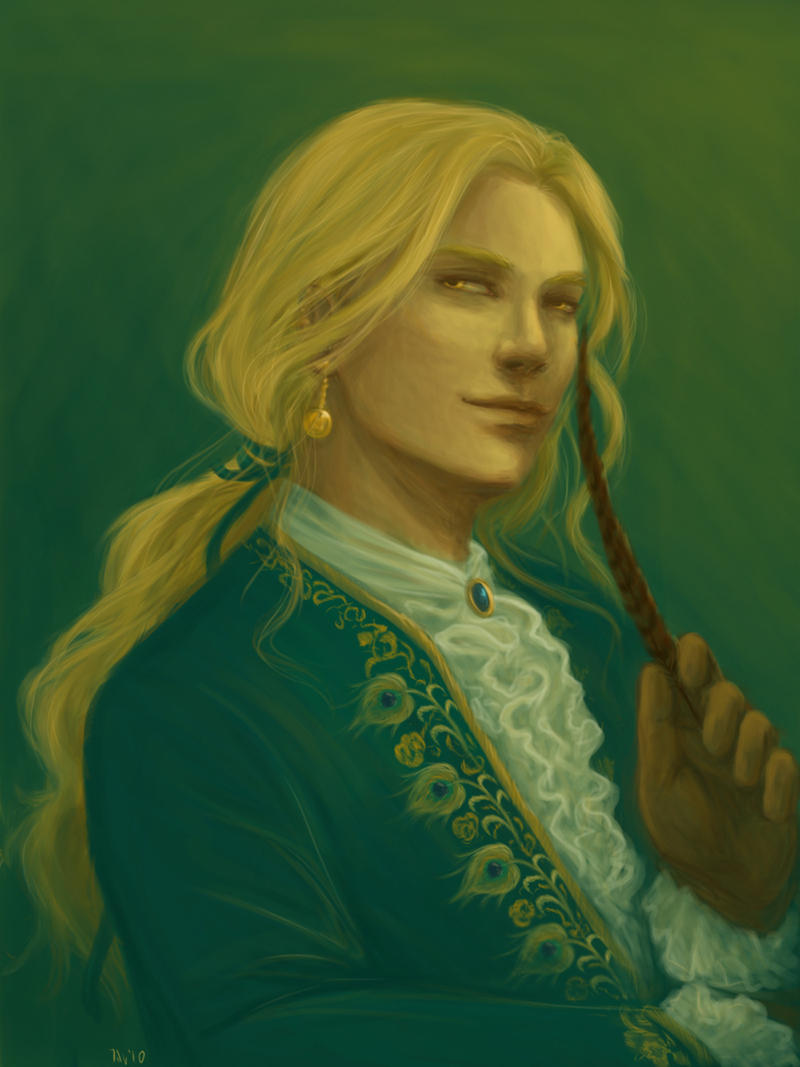
Fool-ish Golden Lord by A6A7 on DeviantArt, used for commentary.

Badgerlock accompanies Golden, with Fitz musing ruefully upon it, as the latter returns to the Bresingas’ great hall, where he flirts audaciously with another guest, making himself the happy center of her willing intentions. Badgerlock watches with a strained equanimity as Golden continues to press his flirtation, noting the reactions of others present. They confirm to him that no few present are of the Old Blood, and he begins to reason through implications thereof. He is prevented for further observation by Golden’s dismissal of him, but he learns no small amount through listening to servants’ talk as he scrounges his own meal from the leftovers.

Some time later, after he has managed to slip back to his quarters, Badgerlock is summoned to attend to Golden, who is clearly suffering the ill effects of too much strong drink. Once he has retrieved Golden, he asks what has happened; the Fool replies that he kissed the Bresingas’ son, Civil, which event will occasion their shamefaced departure the next morning. And when that morning comes, Fitz emerges to find the Fool making himself look all the worse, so as to ease their leave-taking; the formalities are accomplished, and Golden, Laurel, and Badgerlock depart the Bresingas’ household in their continued search for Dutiful. Bidden, Badgerlock rushes off ahead to where Nighteyes has continued to track the Prince; they continue their pursuit, joined at length by Laurel and Golden. Matters grow tense with Laurel, who has suffered social pains at the hands of the Old Blood, and who has not been wholly honest with Badgerlock. And in the night, Fitz reaches out with the Skill, not finding Dutiful but instead a sense of simple peace.

Ah, here it is: the place where the idea that the Wit is a metaphor for homosexuality begins to get…frustrated. Here, Hobb begins to bring in overt homoeroticism–a tacit had been possible early in the Farseer novels, as well as afterwards–and, to my eye at least, it is difficult for a thing to be made a metaphor for something present and direct in the text. A hint is not an open statement, after all. I do not know yet, because I have not gotten to a place where I can think about it yet, whether or not the presentation of homoeroticism here–which becomes somewhat more later–is homophobic, as such; certainly there are homophobic characters, but I do not recall as I write this if they are depicted…well, anyway, it will be something to consider as I look at the novel again, as I keep looking, as I keep wanting to do.

Help fund my girl’s Halloween?

A Robin Hobb Rereading Series: Entry 237: Fool’s Errand, Chapter 17

Read the previous entry in the series here.
Read the next entry in the series here.


A chapter titled “The Hunt” comes next, opening with a selection from Badgerlock’s Old Blood Tales before pivoting into a dream shared between Fitz and Dutiful. In the dream, the two–and others, a woman and a cat–realize that they are pursued and attempt to evade that pursuit, only to be found out in a way that leaves Fitz in pain and craving elfbark. Through the burgeoning pain, Fitz tries to press for Dutiful’s recovery; the Fool dissuades him and tends as he can in the absence of elfbark to his spreading pain.

Cat Hunt
Illustration series for the Fool’s Errand by Robin Hobb
I do so love her work…
Katrin Sapranova’s Cat Hunt, here, used for commentary.

There is little rest for him; Fitz-as-Badgerlock and the Fool-as-Golden take part in a hunt the next day, with their preparations and setting-out detailed. The hunt proceeds, and an excuse for Badgerlock to part from the rest of the hunters is made; he seizes upon it, and makes for Nighteyes, who has been attacked by Dutiful and the cat. Fitz attends to his long-time companion as he can and receives such report as the wolf can make; Fitz reluctantly returns to the hunt in time to see it end, and the two plot to head out to pursue Dutiful as soon as possible. Fitz makes shift to prepare for their departure but is informed that they will not be able to leave easily; still, an excuse for Badgerlock to be away from festivities is concocted, and Fitz begins the search for Dutiful anew.

I’ve noted before my appreciation for the Asimovian device with which Hobb opens the chapters of the Farseer and Tawny Man trilogies, the citation of in-milieu reference works. It’s not only because I retain some nostalgic fondness for Asimov (I am aware of how…problematic a figure he is, but the books read in youth tend to stick in the mind far past it.) There is a certain humor in a work narrated by a character featuring work by that same character in such references–but then, I cite myself often enough that I have to regard myself as the butt of such a joke in my turn. It’s fortunate, then, that I’ve long since learned to laugh at myself, if perhaps not to do so kindly. But then, I have it coming.

Aside from that, I’m not sure I have any comments about the present chapter. There’s probably something to mine in the contemplation of mortality that marks it, but I’m not really in a place where I can do that kind of work. At least, not at the moment…

Help me keep going?

A Robin Hobb Rereading Series: Entry 236: Fool’s Errand, Chapter 16

Read the previous entry in the series here.
Read the next entry in the series here.

And my apologies for the delay in getting this out…


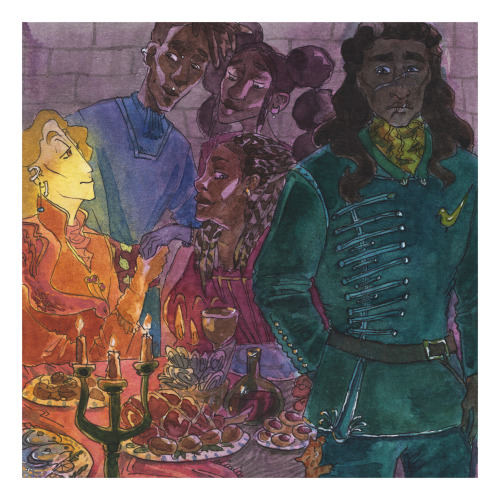
The following chapter, “Claws,” begins with an in-milieu gloss of the recent history of the Bresingas before turning to Fitz-as-Badgerlock following the Fool-as-Golden to the appointed feast hall; Fitz marks the appearances of those in attendance as the two of them proceed. Reactions are noted, as well, and Badgerlock takes up his position as bodyguard. is difficulty standing watch is noted, as is the information he takes in from his unaccustomed position.

Dinner at Bresingas
Illustration series for the Fool’s Errand by Robin Hobb
Ahh. Perfect.
Katrin Sapranova’s Dinner at Bresingas, here, used for commentary.

Golden steers conversation so as to encourage a fair amount of exposition about hunting cats, their rearing, and their practice. As Golden turns the talk to Prince’s hunting cat, Badgerlock finds himself subjected to the attentions of an insistent kitten; it occasions some comment, innocuously enough, and dinner proceeds. Golden turns conversation to the Prince’s cat again as Fitz confirms that the Bresingas are Witted, and Golden tries to draw out information from them. The meal is shortly thereafter called to a close, and Golden and Badgerlock retire to their chambers.

Fitz makes a search of the rooms and asks after the Fool’s condition, finding the latter exulting in having given a good performance. Fitz, as Badgerlock, ventures to the kitchens to get his own meal and to take in such gossip and rumor as can be heard. He hears a few things and puzzles out some more before having another encounter with a cat, one that gives him cause for concern; he begins to think his own Wit-bond will be known.

When he reports back to his chambers, he finds Laurel in attendance on Lord Golden. They confer about findings; Laurel has learned that Dutiful has been present. Fitz awkwardly retires for the night, comforted by the bare touch of Nighteyes’s mind on his own.

Interestingly, as I am rereading the chapter, my wife and I are adopting a kitten, Stormy; our daughter has wanted a new one for some time, and we are in a position to take on the additional responsibility. Now, ours is hardly hunting stock; she’s a rescue kitty, adopted from a nearby nonprofit. Still, though, it’ll be interesting to see if our Ms. 8 bonds with Stormy the way her mother did with other cats we’ve had.

Myself, I’m more a dog person. I’m sure there’s some joke to be found in that, somehow.

I note that the present chapter makes much of performativity. I’m not the only one to note the phenomenon in Hobb, of course; both Räsänen and Sanderson speak to it, for example. The Fool is overt about it in the present chapter, however, citing his conduct with the Bresingas as a performance and noting that Fitz is the only real audience for that performance–and since Fitz is the reader’s access to the milieu, the reader becomes part of the audience at both the usual readerly level and alone with Fitz within the milieu. It seems to me, as I read the chapter again, a strange blurring of narrative perspective; it remains first-person due to the narratorial style, of course, but it also seems almost to become metanarrative, raising a number of questions in me that I’m not sure how to articulate well, let alone answer.

The only solution is to read more and think on it. Fortunately, I’m inclined toward both.

Help me get back on track?