A Robin Hobb Rereading Series: Entry 279: Fool’s Fate, Chapter 2

Read the previous entry in the series here.
Read the next entry in the series here.


The second chapter, “Sons,” opens with an in-milieu historical gloss of the foundation of Buckkeep by a settling Out Island raider named Taker. It pivots to Fitz’s continued preparations to accompany Dutiful to the Out Islands, including his tutoring in the Out Island language and his instruction of Swift. The latter grates on him somewhat, not least because the boy continues to be almost belligerent about his Wit, and Fitz seeks out Web. Getting to him alone takes some doing, but Fitz achieves it through indelicate means, and during their conversation, Web lets Fitz know that he knows his true identity. He also agrees to teach Swift–if Swift seeks him out–and extends the same offer to Fitz.

Lots of this, yes.
Photo by cottonbro on Pexels.com

Unsettled, Fitz makes to mull over the matter and goes in to Buckkeep Town to distract himself. There, he meets with Hap, who admits to him that he is falling in with Svanja again, despite her clear perfidy. He notes the likelihood that he is being deceived, but also notes that he cannot help himself. The two talk together as amiably as might be expected, and they part in familial love. Afterward, Fitz walks through the town, considering changes, the prospects of unpleasant travel, and the looming confrontation with the Fool over his not going to Aslevjal.

Fitz notes that the reputation of the Fool as Lord Golden has grown obscene and prodigal. He puzzles over the changes to his friend, even in an already flamboyant persona, musing that some are merely covers for his intent to go to Aslevjal and to maintain information on Bingtown and points south. After witnessing an exchange that bears in on Lord Golden’s finances and being seen by the man himself, Fitz returns to Buckkeep alone.

A couple of points attract my interest in the present chapter. One is the encyclopedic entry at the beginning. I’ve commented on Hobb’s use of the device before, several times, and I note that the story is not dissimilar to that of the entry of the Angles, Saxons, and Jutes into what is now England–or, indeed, the Danes centuries later. Indeed, it’s a point worth remembering that many, many peoples live now where others lived before, and they maintain kinship with those where they themselves came from. It’s not always easy or comfortable to remember, of course, and it does tend to run afoul of nationalist assumptions and assertions, but there it is.

The other, and this is eminently affective, is the exchange between Fitz and Hap over Svanja and Hap’s apprenticeship. I am not so far removed from the experience of being a teenager as I should like to be as keeps me from recalling it–including the strength of hormone-driven infatuation and the equally hormone-driven anger at people not sharing adolescent certainty. Nor am I so far removed from Fitz’s experience of seeing one’s child doing something…inadvisable…and being unable to prevent it (at least without taking steps that are themselves…objectionable). Again, I feel for the characters involved–which is to the narrative’s credit. Readers are supposed to feel for the characters, after all…

As ever, I am grateful for any support!

A Robin Hobb Rereading Series: Entry 278: Fool’s Fate, Prologue and Chapter 1

Read the previous entry in the series here.
Read the next entry in the series here.


In the brief prologue, “Battling Fate,” Fitz opines briefly on the White Prophet religion before pivoting to his own place in it. His repeated encounters with death are glossed as part of the Fool’s efforts to force the world into a better course, and Fitz notes the presence of an opposing force targeting the Fool.

Fool's Fate (Tawny Man, #3) by Robin Hobb
Looks familiar…
Image from Goodreads, used for commentary.

The first chapter, “Lizards,” opens with a brief comment from Fitz that notes the Fool’s assertion that death awaits him on Aslevjal and his request that Chade ensure the Fool would not travel to the Out Islands with Dutiful to fulfill the betrothal challenges the Prince and the Narcheska had exchanged. It moves then to the return of spring to Buckkeep and the lightening of Fitz’s mood as he prepares to meet with Swift in the Queen’s Garden. The boy arrives and presents himself as he has been directed, and the two begin to feel one another out. Swift discloses skill with a bow, and he notes having made a sharp break with his past, which Fitz–as Badgerlock–takes in stride. Swift’s near-belligerence about the Wit, however, earns him some chastisement, and he is dismissed sullenly so that FItz can clandestinely meet with Dutiful, Chade, and Thick for their Skill instruction.

Fitz’s tutees are described as the four sit to practice their magic together. They report minimal success with a practice assignment, but Thick and Dutiful both report having dreamt of a blue dragon in the night. Fitz elucidates Dutiful’s report to Chade, Thick contributing some information, as well, and Fitz notes his supposition that the dragon in question is Tintaglia. They converse further, FItz and Chade speaking at some length after the training session ends. Chade notes his worries for his intelligence efforts, and the continuing threat of the Piebalds is noted. Fitz offers aid, and Chade makes another play for Nettle, despite Kettricken’s earlier words on the matter.

I write this in the wake of Winter Storm Landon (#TexasFreeze) having frightened those of us who remember Uri’s visit to Texas. The thought of returning spring is a welcome one; like Gandalf as “The Ring Goes South,” I could stand to have warmer feet. The thought of dealing with a surly teenager is…less welcome, much less one who seems bound to press the spirit of things with the letter of them; I find myself feeling for Fitz once again. Too, being pressed by many tasks…once again, I know I should not be reading with affect, but I seem unable to help myself. Perhaps it is the pleasure of being able sit and read again…

Send some support my way here, or drop me a line, and we can talk about what all I can do for you!

A Robin Hobb Rereading Series: Entry 277: Golden Fool, Chapter 27 and Epilogue

Read the previous entry in the series here.
Read the next entry in the series here.


The final chapter of the novel, “Spring Sailing,” opens with a kind of creation story recounted in Badgerlock’s Old Blood Tales before offering something akin to a reverdie that summarizes developments in Buckkeep at the approach of spring. Preparations for Dutiful’s trip to the Out Islands progress, and the party to accompany him on that trip is determined. Civil and Web, Chade and Thick, are set to go, and Fitz is “randomly” chosen as part of Dutiful’s guard complement. Others make their own arrangements to go along. Lessons of various sorts go on, and Swift finds his way back to court, entering Kettricken’s service as a page, evidently turned out by Burrich.

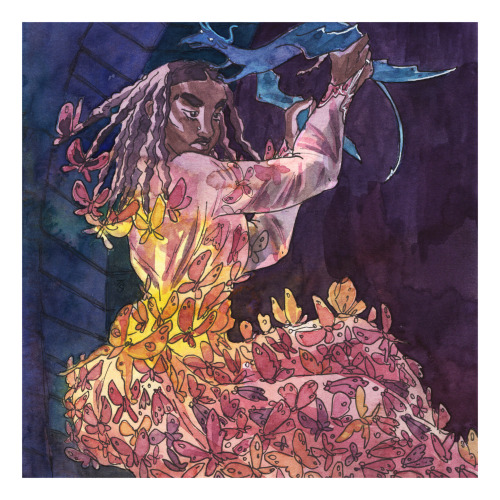
Butterfly Dress
Illustration series for the Golden Fool by Robin Hobb
She seems to have it handled…
Katrin Sapranova’s Butterfly Dress is used for commentary.

Fitz finds himself in mind of Nettle, and they Skill together. They are interrupted by the intrusion of a blue dragon, from which Nettle forcefully extricates them. Fitz ponders the event and continues about his preparations, including calling on Hap, who now makes good progress in his apprenticeship. The quiet interdiction of the Fool proceeds, as well, although the Fool still clearly intends on taking ship for Aslevjal to face doom. Fitz and Chade confer on that point and several others, including Chade’s continued progress in the Skill and Fitz’s preferred armaments for what they expect to face as they head to the Out Islands and Aslevjal. Fitz is also tasked with tutoring Swift, surprising him.

Later, Fitz calls in on the Fool, the two reaching some reconciliation, even as both acknowledge that things cannot go back to how they had been before their falling out. And in the brief epilogue, Fitz reflects on his writing efforts and the seeming cycles of life, commenting finally that “Perhaps having the courage to find a better path is having the courage to risk making new mistakes.”

It feels as if it’s taken forever for me to get to this point in the rereading–and there’s more to do yet, with another novel in this series, two more series and some scattered other works in the Elderlings corpus, a whole ‘nother series, and some assorted other works to treat. It’s good to have a project, though, and I’m not complaining at all about doing this. Really, it’s a treat to read the work again; I’ve not been able to do such things much for a while, and it’s a pleasure.

More on the present passage, though: I note with some interest the reported development of the Stones game Fitz had learned from Kettle and passed on to Dutiful as part of his Skill training. Having become a seeming pastime of the heir apparent to the Six Duchies, the game has become a preoccupation of the nobility at court, and consequently a focus of conspicuous consumption as well as what might well be thought some kind of organized play. That speaks powerfully to the verisimilitude Hobb identifies as a major component of her writing, because it is the case that people will find things to occupy such hours of leisure as they can find, it is the case that those who vie for favor will attempt to emulate the tastes and patterns of those whose favor they seek, and it is the case that those who seek to elevate themselves will often make a show of what they already have as a means of displaying that they deserve to have more. Yet such concerns are overlooked in many works of speculative fiction, or they are only glancingly treated. That Hobb attends to them–and that she does so consistently across novels and series, not only with the “Prince’s Stones,” but also with particular recreational intoxicants–is one of the things that makes her narrative milieu so compelling.

Send some support my way here, or drop me a line, and we can talk about what all I can do for you!

A Robin Hobb Rereading Series: Entry 276: Golden Fool, Chapter 26

Read the previous entry in the series here.
Read the next entry in the series here.

And happy Valentine’s / Singles Awareness Day / Monday to you!


The penultimate chapter of the novel, “Negotiations,” opens with an in-milieu proverb: “One man armed with the right word may do what an army of swordsmen cannot.” It proceeds thence to continued discussions between the Old Blood delegation and Kettricken’s court. Web suggests that much might be eased by Kettricken taking Old Blood people openly into her household, and he offers himself as one such–doing so with remarkable grace and to evident acceptance.

Restaurants and COVID-19: How to Safely Dine at Your Favorite Place
The Old Blood masking up hits differently now…
Image via Healthline.com, used for commentary.

Fitz watches as the Old Blood delegation dines, sans Web, and continues watching afterward as negotiations begin to stall out. Boyo tries to bring up personal grievances and is shunted aside in favor of more global concerns. Silvereye voices historical grievances and calls for extensive retributive justice, only to be rebuffed. Matters degrade, only to be interrupted by one of the Old Blood needing to attend to her gravid Wit-bonded animal. Fitz continues to observe from hiding, joined by Chade; they watch as Silvereye reveals herself to be affiliated with the Piebalds. Civil Bresinga joins the meeting, confessing himself and pleading on the Farseers’ behalf; his testimony sways opinion, and the meeting with the Old Blood delegation ends with far better prospects than it began. Civil discloses his Wit to the court, and legal reforms are proclaimed. The delegates are returned to their people, Dutiful returned, and things seem very much improved.

I note Fitz’s assertion that Web “sounded more like a Jhaampe Wise-man settling a dispute than a spokesman for the Old Blood” early in the chapter, and I delight in having more parallels between the Old Blood and the Mountain Kingdom. It’s a pleasure to see more evidence to support an idea I have, of course–although, again, a targeted reading would be needed to see if the notion can be borne out.

For those reading along with my little series–thank you! I’m glad to know that folks are looking at what I write here, and I’m happier to know that it’s doing some folks some good (I’ve gotten a few messages to that end). It may not be much, but if I’ve made your day a little better, then it’s worth doing.

I appreciate your support!

A Robin Hobb Rereading Series: Entry 275: Golden Fool, Chapter 25

Read the previous entry in the series here.
Read the next entry in the series here.


The next chapter, “Convocation,” begins with an excerpt from an in-milieu fairy tale before turning to the emergence of spring at Buckkeep, Fitz glossing his experiences in advance of the planned meeting with the Old Blood delegation. From his position in the Queen’s Guard, he watches with some interest as plans shift, to the disapproval of both the Guard commander–Marshcroft–and Chade, and Laurel assumes a position among the departing company.

Wait, you mean he’s not one of these?
Photo by Pixabay on Pexels.com

The group rides out and is met on the road by the Old Blood delegation, who confront them before they arrive at the agreed-upon location out of an abundance of caution. Kettricken surprises all again when she offers to leave Dutiful in the care of the Old Blood while she hosts their embassy; through the Skill, Dutiful notes that he had been unaware of the arrangement, though he understands it. He eschews guards other than Laurel despite protests, and he Skills to Fitz to let him know that he is not to pursue, either. Emissaries are exchanged, the Old Blood presenting Web, who serves as as much of a leader as they have. And Web makes a point of talking to Fitz, to his unease, as the Queen and her entourage return to Buckkeep.

The arrival of the party, sans Dutiful, at Buckkeep occasions concern and tumult. Web continues to attend more closely to Fitz than comforts him as the Old Blood embassy is billeted. When, at last, he is able to excuse himself, he keeps an ear on gossip and reports as he eats among the other guards; afterward, he navigates the hidden corridors to Chade’s secret chambers and the Queen’s council room. Fitz arrives to find an argument between Kettricken and Chade in progress. Kettricken gets the better of it and gives Fitz his assignment. He attends to it, spying on the Old Blood delegation, at which Chade joins him at length. They learn of some agitators among the delegation–Boyo and Silvereye–and Skilled conversation with Dutiful notes that he is being treated decently.

After, as Fitz makes for the guardroom for a late meal as Badgerlock, Web runs into and accompanies him. Conversation moves from strained to spirited and engaged as Web plies the guard for tales. Fitz muses that his presence seems to be doing the diplomatic efforts good.

I’ve noted elsewhere the interesting social structures at work in the Elderlings novels. The Six Duchies operate in many respects as a stereotypical “feudal” court, following common patterns of structure and intrigue (per my thesis). The Outislands follow another, more nuanced social structure (per this chapter), and the Mountain Kingdom follows yet another (noted here and elsewhere). I’m not alone in making such observations–obviously, really. With the description of Web in the present chapter as someone who is not a ruler, but an advising counselor, I find myself wondering if the Old Blood in the Six Duchies and the Mountain Kingdom operate along similar social rules. I’d have to do a dedicated rereading to be certain–and the gloss that I’m doing presently is not the kind of targeted investigation I mean–but there are some evocative parallels. Web’s status is one, while Kettricken’s Wittedness (noted here and elsewhere) is another; there are clearly Old Blood in the Mountain Kingdom, among others. Again, it’s a tantalizing implication, one that might be worth following up on–later.

Thank you for helping me to keep doing this!

A Robin Hobb Rereading Series: Entry 274: Golden Fool, Chapter 24

Read the previous entry in the series here.
Read the next entry in the series here.


The following chapter, “Connections,” opens with in-milieu commentary about the White Prophet and Catalyst from the perspective of the priesthood of Sa before turning to Fitz’s frantic Skilling to Chade. He meets with his old mentor, reporting his findings and concerns, the two connecting the Pale Woman to Elliania through Henja and conferring about steps to take as they move forward to address the challenges Dutiful and Elliania had presented to one another. Their talk ranges to Skilling before Chade informs Fitz that he will be “hired” into the Queen’s Guard so as to report on the coming meeting with the Old Blood delegation and secure Dutiful as he attends it.

Kettricken’s Fox Pin – inspired by the Farseer trilogy by Robin Hobb
Something like this at Fitz’s breast…
From Hannah Hitchman, used for commentary

Skill lessons resume, if with some difficulties and missteps, and Fitz continues to recover from his near-death. He is accepted easily into the Queen’s Guard, guessing that others in it are clandestine agents, a well. Fitz improves his relationships with both Thick and Hap, but his relationship with the Fool grows more and more tenuous. For his part, Lord Golden begins to slide into dissolution. Fitz also muses over the arrival of Civil Bresinga at Buckkeep, and he confers with Dutiful about him before one of their Skill lessons, and during that lesson, Thick demonstrates the depth of his power in the magic. Chade uses the opportunity to summon Skilled ones to Buckkeep, and another voice makes itself heard to Fitz, though not the others.

One of the things in Hobb’s prose that sometimes grates is a tendency to rush things later in her novels. The present chapter is an example of it, with much glossed so as to make room for events that have to be put into the book before it concludes. This is not to say that much attention needed to be paid to the events that are glossed over, certainly, nor is it to say that I could do better. The latter is assuredly untrue; writing fiction is not among my skills (even if writing about it very much is!), though that does not mean I cannot comment on what seem to me to be lapses in excellent work. Loving a thing–and I think I’ve made it clear that I love reading Hobb’s writing–does not mean ignoring areas where it is not as strong. And what’s coming is an area of strength, so there’s that.

Send some support my way, or, for custom work, contact me through the form below!

← Back

Thank you for your response. ✨

A Robin Hobb Rereading Series: Entry 273: Golden Fool, Chapter 23

Read the previous entry in the series here.
Read the next entry in the series here.


The succeeding chapter, “Revelations,” begins with an in-milieu discussion of body-sharing among the Witted and their animal partners. It moves thence to follow Fitz’s continued convalescence. As he recovers from his ordeals, he calls on Hap at his apprenticeship and on Jinna. The former regards him warmly, though briefly, as work calls. The latter effectively ends their friendship, unable to move past the loss of her ability to fit him into her tokenism.

Art by Steven Youll
Steven Youll’s cover art makes more sense…and is used here for commentary.

Tom returns to Buckkeep and makes for the practice courts, finding himself much reduced by his injuries and recovery. He takes his time answering a summons from Lord Golden, contemplating what he has missed out upon as things have changed around him. When, at length, he does find Golden again, he is informed that Chade had been who wanted to see him. He also shows Fitz his tattoos, discussing them as Fitz notes their similarity to the Narcheska’s; the Fool relates bitter personal history and raises the specter of the Pale Woman again. The Fool also discourses on events to come, noting having had to keep Fitz from dying and that death awaits him on Aslevjal.

I find it interesting that Hobb makes the Wit a more general metaphor for minority status in the present chapter via Jinna’s tokenistic regard for Tom Badgerlock. Fitz realizes that he had been regarded as “one of the good ones” by her, a phrase I know is all too familiar for all too many people; the one the book uses is that “She had been willing to make an exception for me, but when I killed, I had proved her rule,” as if many, many others, Witted or otherwise, do not kill in the Six Duchies and in the Buckkeep Town Jinna claims as her native home. Again, it’s not to be expected that every character in a novel will be a “good” one, nor is it to be expected that even a “good” character will be uniformly positive. Indeed, I’ve noted repeatedly that it’s part of the authenticity and verisimilitude of Hobb’s writing that her characters falter and fail.

Send some support my way, or, for custom work, contact me through the form below!

← Back

Thank you for your response. ✨

A Robin Hobb Rereading Series: Entry 272: Golden Fool, Chapter 22

Read the previous entry in the series here.
Read the next entry in the series here.


The next chapter, “Connections,” opens with an extended complaint from one of Chade’s agents on Aslevjal before the narrative returns again to Fitz convalescing. The shape of Fitz’s days is glossed, as are events at large in Buckkeep’s court, including garbled reports from Bingtown and further south. Fitz also considers the feathers he found on the beach while fleeing with Dutiful and again contemplates placing them in the Fool’s Rooster Crown.

Aslevjal
You know it’ll come to this…
Winterkeep’s Aslevjal on DeviantArt is used for commentary.

One night, as he convalesces, Fitz is visited in his dreams by Nettle. She weeps over the strain between Burrich and Swift, not knowing its cause, as neither of them will speak of it. Fitz offers little comfort, and he finds little as he contemplates what Burrich might do to avoid repeating his “mistakes” with Fitz with his own son. After he wakes, he returns to Lord Golden’s suite, where he finds Hap pleading for access. Golden gives it and departs, leaving Hap to fret over Tom Badgerlock and report his folly with Svanja. Tom again offers little comfort, and he and Hap part amicably.

With Hap returning to his apprenticeship, Tom discusses the feathers with Golden, meeting with little interest or engagement. Shaken by the realization of how badly he has harmed their relationship, Fitz withdraws to Chade’s chambers and falls into a sleep from which he is wakened roughly by Dutiful, who has been guided to Chade’s hidden room by Thick. They confer, and Dutiful sends Thick off to fetch more food. While Thick is about the errand, Dutiful confronts Fitz with knowledge of his true identity, relating how he came by the knowledge. Fitz warns Dutiful of the implications and ramifications of the knowledge, the two reaching an accord as Thick returns with a large pie the three gleefully devour.

In the present chapter, Fitz opines on secrets that become so not because they are deliberately hidden, but because they are the answers to questions never asked, the results of assumptions made and never examined. I find myself reading affectively once again, wondering what I do not know because it never occurred to me that I ought to ask, contemplating what I will not tell my daughter for the same reasons. Part of why I keep a journal is so that she will have at least some of the answers in time to come, although I am aware that no words can bring in the whole of a thing.

Still, what I can leave, I do. It will never be enough, but nothing will be. And it will be something, at least.

← Back

Thank you for your response. ✨

And, as ever, I’m happy to accept your patronage!

A Robin Hobb Rereading Series: Entry 271: Golden Fool, Chapter 21

Read the previous entry in the series here.
Read the next entry in the series here.


The succeeding chapter, “Convalescence,” opens with an in-milieu note about the Witness Stones before turning to Fitz’s continued recovery from his assault and Skill-healing. Lord Golden continues to be concerned for his servant, and Tom Badgerlock accepts the ministrations grudgingly. Chade calls on him at length, and Fitz rails weakly as he presses for information about what had happened. Chade reluctantly reports how matters had led to Fitz’s release from prison, if circuitously, and Fitz accepts the necessity of having handled the situation he had occasioned thus.

Croaker
It’s a fair likeness of the man…
Croaker by Pti-SPB on DeviantArt is used for commentary.

During the course of their conversation, Fitz realizes Chade has used the Skill to heal himself, as well, and he cautions Chade against its misuse. The rebuke is not gentle, but Fitz does persuade Chade to avoid relying on Thick for strength in the Skill magic–though he does not agree to halt his own forays, and departs before conversation can continue further.

The next several days pass with Fitz continuing to recover his strength and bodily reserves, slowly. When, at length, he makes to shave, he finds that the marks of old injuries are reduced or gone. The Fool opines that Chade had thought Fitz knew such Skill use and withheld the knowledge from him, and Fitz takes himself off to Chade’s hidden chambers. After sleeping heavily therein, he eats and studies materials left for him that confirm some of what he has suspected about Skill-healing, among others.

Fitz muses on Chade’s Skill-study within the social context of the Six Duchies. He determines again to shave, and Chade joins him after he does so. The two confer, and they work haltingly together to restore the appearance, at least, of some of Fitz’s injuries. They confer about them, as well, and about bodies more generally. Talk turns to Thick, and Fitz again urges Chade not to draw upon the younger man for strength. Chade agrees to study under Fitz’s tutelage, though his own studies will continue.

Consideration of Thick in the present chapter attracts my attention as I read it this time. I note that Chade, of all people, regards Thick as not so much broken as different:

Chade shook his head slowly. “‘Different’ is not ‘wrong,’ Fitz. Thick’s body recognizes itself as correct. His differences are no more to him than…well, here I am guessing, but I suspect that just as one man is tall and another is short, so it is with Thick. His body grew to some plan of its own. Thick is what he is. Perhaps we should just be grateful that we have him, even if he is different.”

Admittedly, Chade has tended to take a more pragmatic view throughout the series, adopting an almost Machiavellian attitude regarding the stability of the Six Duchies. Fitz’s Wit in the Farseer trilogy gives him much less pause than it does most others–even some who share facility with that magic. Even so, there are many ways in which he remains what might well be termed socially conservative within the milieu. And he is guilty of treating Thick as…less than earlier in the present series, with Fitz being the one to voice objection to his attitude. Yet here, Fitz takes the more ableist view, regarding Thick as deficient and needing correction.

But then, nobody gets everything right, certainly not on the first try, and the characters do seem to be learning, which is a good sign.

← Back

Thank you for your response. ✨

As always, your kind gift is greatly appreciated!

A Robin Hobb Rereading Series: Entry 270: Golden Fool, Chapter 20

Read the previous entry in the series here.
Read the next entry in the series here.


The following chapter, “Coterie,” begins with a comment from Fedwren about the political structure of the Six Duchies before turning to Fitz waking in captivity and in pain–again. Another prisoner attends to him, albeit roughly, and Fitz realizes he is one of Chade’s agents. He Skills with Dutiful, who reinforces the coded message Fitz’s fellow prisoner passes along. He is also briefed on his situation with local law enforcement–which is not good, as he is accused of multiple murders.

Healing
Looks about right…
Healing by Crooty on DeviantArt, used for commentary.

Fitz slips in and out of consciousness across the ensuing days, his condition worsening. The pretense for extricating Fitz from prison–he had killed in the course of defending himself and Lord Golden’s property–is rehearsed, as is Fitz’s relocation to Lord Golden’s chambers in Buckkeep Castle. Chade, the Fool, Dutiful, and Thick gather together to attempt to heal him via the Skill, failing initially but stumbling at length into an unexpected and extreme healing that addresses not only Fitz’s current injuries–which run to a punctured bowel and blood poisoning–but also a number of others he had incurred over the years.

In the wake of the healing, Fitz realizes that they have inadvertently formed a coterie–and a ragged, unbalanced one. He lapses into unconsciousness again, sleeping several days with few interruptions that he recalls. One is Kettricken tending to him, and they discuss the extent of his healing and her appreciation for his presence, who remembers what she has lost.

I’ll note that there is some deus ex machina at work in the present chapter, although some of it may well be foreshadowed by Kettle. And my comments about the device hold true now as then: it “is not a reason to take on a particular literary atheism.” Agnosticism, perhaps, but not straight-out atheism.

The healing, too, does seem to function as something of a literary climax, although the novel has already featured such. Admittedly, there are multiple narrative threads going on in the novel, in the series, and in the broader corpus; the restoration of the Skill to the Six Duchies could well be taken as such a thread, independent of the political entanglements of the nation-state or the coming-of-age narratives surrounding Dutiful and Elliania. I might someday perhaps work on a larger scholarly project that untangles and interprets such things, or I might only annotate the work someone else does in that line, but I think it might be a thing worth pursuing…

I offer writing and tutoring services at reasonable rates; get in touch!