A Robin Hobb Rereading Series: Entry 224: Fool’s Errand, Chapter 4

Read the previous entry in the series here.
Read the next entry in the series here.


The next chapter, “The Hedge-Witch,” opens with a discussion of a hedge-witch and her magic’s efficacy before pivoting to Fitz and Hap moving through their summer together, Fitz considering apprenticing the boy in or near Buckkeep and denying that he postponed to avoid the pain of parting from him. He also mulls over the effects his most recent meeting with Starling has had on him, as well as on the passage of time’s effects on Nighteyes.
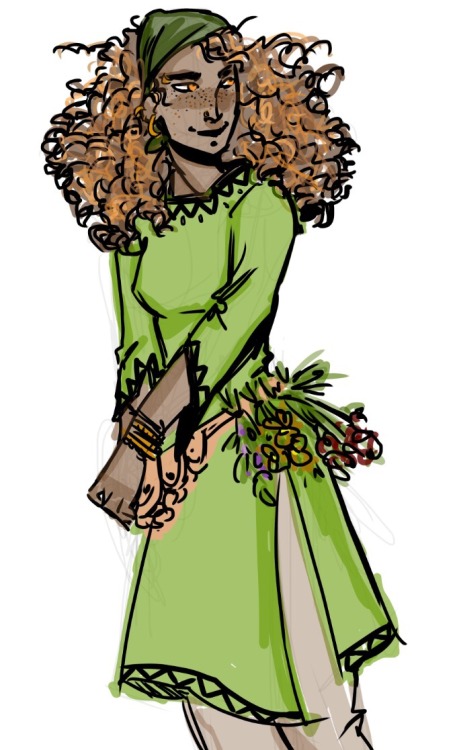
meidiama:
“Ok, so I’m only a few chapters in, but I had to draw something, so here’s Jinna the hedge-witch
”
The titular Jinna.
Image from Talking about the Weather, used for commentary.

When Fitz, under his alias of Tom Badgerlock, and Hap visit a nearby market town, they meet a hedge-witch Hap had first met in Buckkeep: Jinna. Introductions are made and characters are described, and Fitz is distracted as Hap invites Jinna to stay with them when she passes that way. Fitz rehearses what he knows of hedge-witches as he observes Jinna peddle her wares until a neighboring farmer, Baylor, arrives. Baylor insinuates that Fitz or Nighteyes has taken some piglets he had had, and Fitz braces for a fight with the man, citing his traumas as impetus for his tendency towards violence; the attitude cows the man and intimidates many onlookers, and conversation swiftly shifts to perceived depredations of the Old Blood. The rest of the day passes uneventfully; Jinna sells much, while Fitz and Hap do not, and they fret over the apprenticeship fee to come.

Later, as they head home, Hap asks Fitz about his origins. Fitz is moved to sympathy, and they make their way to their cottage. Along the way, Nighteyes queries Fitz about the decision to send Hap to an apprenticeship and travel, regarding both ideas as foolhardy. At the cottage, Hap and Fitz confer about the apprenticeship fee, Hap offering to hire himself out to raise the money, and Fitz takes inordinate pride in the young man.

That night, Fitz dreams a Skill-dream, communing unknowingly with a young man at Buckkeep and with a cat. The latter attracts Nighteyes’s attention, and both settle back into sleep. The next day sees Hap strike out to raise money, and Fitz somewhat listlessly attends to domestic tasks, drawn to Skill and resisting it. A not-much-later evening sees Jinna call on him, availing herself of the offer of hospitality made at the market; she reports having met Hap on the road, and the two pass a convivial evening together. They confer about reading and education, disagreeing on some particulars but agreeing on several points.

The next morning sees Jinna and Fitz make a trade of goods. As they do, Jinna susses out that Fitz is of the Old Blood, and Fitz is convinced of the efficacy of Jinna’s hedge-magic as well as unsettled by her insights. But they part amicably with something of a promise to meet again.

Interestingly, while there’s some mention of other magics in the Six Duchies than the Skill and the Wit, there’s not much explication of them prior to the present chapter. Hobb doesn’t do as a number of other fantasy authors do and lay out a system of magic (I recall Lyndon Hardy for some reason), but I have to wonder if it’s not precisely in the elision of systemic detail that Hobb is able to achieve the verisimilitude for which she attests striving. Getting mired in details offers opportunities for getting the details wrong, or in running into contradictions with them–plot holes that annoy no few readers (among them me, when I notice them). Glossing minutiae avoids that problem, even if it does force the writer to strike a careful balance. Enough has to be depicted to be distinct, but not so much can be depicted as to run into the aforementioned problems. Hobb manages it well in the present chapter, which helped me read the book the first time–and has helped me reread it once again.

I’m about to start back up in the classroom; help support my teaching?
A Robin Hobb Rereading Series: Entry 223: Fool’s Errand, Chapter 3

Read the previous entry in the series here.
Read the next entry in the series here.


The following chapter, “Partings,” begins with “cited” commentary on the Wit before moving to Fitz watching as Hap falls asleep at the fireside. Leaving Nighteyes with the boy, Fitz returns to his cottage, musing over his arrival at his present life from the Cleansing of Buck and the reintroduction of Starling into it amid assignations. He contemplates the looming finality of their relationship, as his own codes will not permit him to knowingly cuckold another. Starling does not take the news well, seeing rebuke–to some degree rightly–in it.

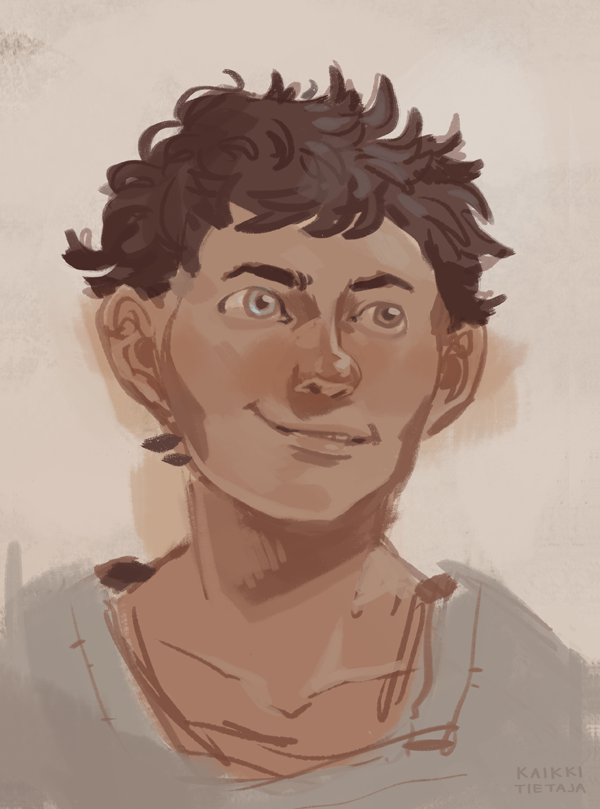
kaikkitietaja:
“A quick painting of Hap because I really want to draw some pre Tawny Man art of him and Tom later c:
”
Hap…
Image from Prophets become Catalysts, used for commentary.

Starling also lets slip that she had known Chade had visited, and Fitz pieces together that she has been an informant for his old mentor for some years. She also lets slip that tensions between the Six Duchies at large and the Old Blood population within it are rising, with a partisan group among the latter–the Piebalds–presenting trouble. The story underlying the group’s name is explicated, and Starling notes that there is some suggestion that Fitz yet lives. She also relates more news and rumor concerning the Old Blood in the kingdom, as well as actions taken against them. Involvement in such matters by Kettricken and Chade is noted, too, just before the hurt between Starling and Fitz is reawakened. Hap ventures in at about that moment and receives the brunt of the minstrel’s tongue, and Fitz rather flatly sends Starling away. A sense of something new coming prickles Fitz as she departs.

That something else is coming is clear, of course, from it being only the third chapter of the novel. That so much of the chapter is taken up with explication doesn’t hurt that, either–and there’s some value in putting that explication in the mouth of a minstrel, a sort of traveling memorial in the Six Duchies; it makes sense for such a person to hold forth on events throughout an area. (I’ll note, too, that some of the commentary looks ahead to another of Hobb’s works; I’ll end up treating it in the reread, I’m pretty sure, if not for a long while.) So that much reads as authentic, organic, consonant with experience and observation; it’s a good thing.

Less good, although not dissimilar from events in the readerly world, is the continued treatment of the Wit magic as metaphor for homosexuality. Again, the metaphor will be substantially frustrated, and in the present series, but, as in the Farseer novels, the magic–an inborn quality–is still linked with depravity. It remains…uncomfortable, but my comments about discomfort continue to apply. And what is my discomfort reading against that of those who do suffer under such an onus? It’s something to keep in mind…

Help me round out the month the right way?

A Robin Hobb Rereading Series: Entry 222: Fool’s Errand, Chapter 2

Read the previous entry in the series here.
Read the next entry in the series here.


The next chapter, “Starling,” begins with an encyclopedia-like description of the minstrel before moving into Fitz musing over her keeping Hap away and his own laziness in attending to the upkeep and maintenance of his humble home. When they return, he notes the changes to them and to himself, contrasting them and considering that he needs to see to Hap’s apprenticeship and training. Fitz greets the pair warmly, and Starling returns the warmth, but Hap is standoffish and goes aside; Nighteyes accompanies him as Fitz sees to Starling.

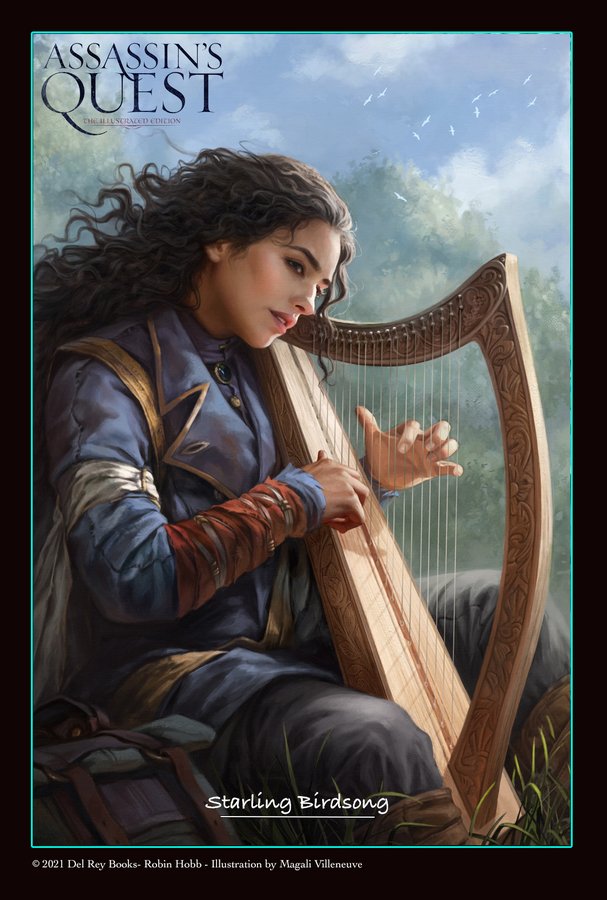
Image
The official image of the named character; source in the image, reported here, and used for commentary

As Starling settles in, she and Fitz confer about his return to Buckkeep, and she marks the changes in him before waxing eloquent on the virtues of urban life and privations of rural; Fitz finds himself musing on might-have-beens, and their talk continues over dinner as Nighteyes reports Hap is well out in the field. Fitz and Starling have sex, and, in the night, Fitz makes his way to where Hap is camping for the night. He stokes the fire and wakes the youth, learning what has him out of sorts; Starling is married, and not to Fitz, and Hap thinks the disjunction between what he has been taught and what he has learned makes a mockery of him. Fitz and Hap confer about the revelation and return to accord, Hap moving on to relate his experience in Buckkeep.

One incident stands out, one in which Hap watched a woman be stoned to death for being possessed of the Wit, the magic that allows communion with animals. Fitz is stunned into silence as Hap continues, relating fears of another war coming. Conversation resumes, and Fitz considers next steps he must take, and he and Nighteyes confer about what they will do together. The wolf notes approaching changes, “like a bigger predator coming into our hunting territory.”

The present chapter and the previous do a fair amount of what early portions of a novel are “supposed” to do; they offer exposition, setting up information about the milieu and major characters within that milieu. In the case of the present series, itself a sequel, there is also the burden of glossing events in the previous series, allowing the present one to stand alone–although it is certainly enriched by reading the earlier novels. (Or consulting a handy rereading guide, perhaps?)

Of particular note is the focus on the opprobrium under which the Wit magic operates. I’ve noted, following others, that the Wit serves as a metaphor for homosexuality (here, here, here, and here, if not elsewhere), and, considering the publication of the novel in the early 2000s, persecution of homosexual people was still a concern. (It remains one even as I write this, although less emphatic of one, for which I am grateful.) As I consider it now, it gets…less comfortable; I’ve heard any number of people argue that permitting homosexual relationships will lead to bestiality, and the Wit trends in that direction, so that the metaphorical connection is…squicky. (This leaves aside furries, of course, but that’s a whole ‘nother thing.) Admittedly, the metaphor breaks down–in the present series, no less–but still…

Uncomfortable re/reading isn’t bad reading, though. We should have to reconsider things over time. Even if we remain with earlier conclusions, we’re the better off for it.

I can still use your support!

A Robin Hobb Rereading Series: Entry 221: Fool’s Errand, Chapter 1

Read the previous entry in the series here.
Read the next entry in the series here.


The first chapter in the first novel of the Tawny Man series, “Chade Fallstar,” opens with the cryptic Kelstar’s Riddle: “Is time the wheel that turns, or the track it leaves behind?” It moves thence to Fitz, narrating in first-person, noting the return of a familiar figure to his life when he was thirty-five; he muses on middle age and its uncertainties as he details his situation and circumstances leading up to the arrival; Nighteyes, the wolf, sleeps and dreams, and Hap, his fosterling, is away with the minstrel, Starling. Nighteyes wakes and rebukes Fitz for his angsty reminiscences and abjures the lingering draw of the Skill that Fitz details.

Fool's Errand (Tawny Man, #1) by Robin Hobb
The edition I’m reading again…
Image from Goodreads, used for commentary.

Fitz is further shaken from his reverie by the wolf’s announcement of a stranger approaching. It is Chade Fallstar, Fitz’s mentor in assassination, now openly a royal councillor; he is described as he brings gifts and news to his grand-nephew. Fitz notes that he goes by Tom Badgerlock in his current life, citing a shock of white hair, as he tends to his guest and asks after his purpose; Chade reports on his lost daughter, Nettle, and his and Nettle’s shared foster-father, Burrich. Fitz tries to puzzle out his old mentor’s motives as reporting continues, and Chade eventually lets slip that the queen, Kettricken, and he want Fitz to return to Buckkeep to serve as tutor to the sole prince of the realm, Dutiful.

Fitz initially refuses the offer, though not without reservation, and Chade presses him about his reasoning. Fitz continues to articulate his refusal, noting his willingness to leave aside the pension he had quietly been receiving; Chade does leave the topic aside, and his visit continues amicably afterwards. Among the topics treated is Chade’s experimentation with blasting powder, which he demonstrates in Fitz’s hearth, to their mutual regret.

The next morning, Chade makes ready to leave, and Fitz sends him off with a selection of offerings from his home. After, Fitz muses on the visit as he and Nighteyes make to hunt, and he contemplates returning to the Mountain Kingdom and what he found–and left–there.

The Tawny Man series is the first of Hobb’s series that I started buying while it was still coming out, and I lament that I did not pick up a hardcover of Fool’s Errand when it hit shelves; I did not make the mistake again. It was a delight to return to Fitz and the Fool, to the Six Duchies, the first time I read the book; it was one of those I bought, sat to read, and lifted my eyes from the pages only a few hours later, having finished. I feasted upon it hungrily, wolfing it down (yes, pun intended) as it were bread and I a starving young man; I glutted myself upon it. But it is better than bread and beef and beans and beer at the board, for when taken in, it yet remains and can be feasted upon again and again.

At least until the pages tear and the binding falters. But my copy’s not nearly there yet.

Help me track down and snag a hardcover?

A Robin Hobb Rereading Series: Entry 220: Ship of Destiny, Epilogue

Read the previous entry in the series here.
Read the next entry in the series here.


The brief epilogue, “Metamorphosis,” focuses on the serpent, Shreever, finding rest after the struggles to return to the ancient cocooning grounds. Relatively few of the serpents survived, a small population from which to rebuild a species, but hope persists as the return of dragons is promised.

Sleeping Dragon
Something like this?
Image via the Smithsonian, used for commentary.

I appreciate that the novel ends on a note of hope–not untrammeled hope, as there are losses acknowledged, but hope, nonetheless. Although the new normal that promises to emerge in the Realm of the Elderlings is a different one, entirely, it seems it may be a good and useful thing, one more attentive to many. And I can hope that the readers’ world will follow suit, somehow, sometime.

The series will continue with a return to the Six Duchies in Robin Hobb’s Fool’s Errand.

Support my pressing ahead with this project?

A Robin Hobb Rereading Series: Entry 219: Ship of Destiny, Chapter 40

Read the previous entry in the series here.
Read the next entry in the series here.


The final full chapter, “The Rain Wild River,” starts with Althea considering the progress of the Paragon as the ship and a small crew continue to work on behalf of the nascent dragons. The crew’s dispersal is noted, as is Amber’s work to further decorate the figurehead in a motif of charging bucks. The two review their progress towards the ancient spawning grounds, including the loss of serpents and the moodiness of the liveship. The serpents’ arrival and cocooning are glossed, and Althea muses on her younger nephew, Selden, whose connection to the dragons is noted, as is Clef’s progress learning to read and write.

This is going to matter later…
Source in image, used for commentary.

The Paragon calls out to be run aground in a clear channel of one of the Rain Wild’s tributaries. The ship notes they are at the site where an older pirate had stashed his largest prize, a treasure ship bound for Jamaillia with annual tribute. The history of the hoard is noted, and it is given to the crew’s claim. Work to retrieve the hoard proceeds, with materials and labors described; Brashen is taken with Althea and begins plotting out with her how they will employ their shares of the take. Brashen considers Althea as he calls a halt to the retrieval efforts against the oncoming evening and storm.

Later, Amber approaches the figurehead with a request for a specific item from the take, a wizardwood crown. The ship remembers the crown, although not in great detail, and Amber appropriates it. The ship guesses that she is soon to leave, which she confirms, noting a need to head north to friends long unseen. The ship also notes how one of the former crews died, as well as that Kennit died twice, saved by the ship–at some cost to Kennit. Amber waxes philosophical, and they part in peace.

Althea dreams badly, and in the dream, the ship visits her, calling her to the foredeck. She arrives there, and the ship demands the hurt that had been caused her–not the memory, which is hers, but the continuing pain of it, which the ship draws from her. She wakes fully on the foredeck, Brashen rushing to her amid the storm and takes her below decks. There, she reports her violation to him and pleads with him for a continued relationship; they reconcile, the effects of which are felt throughout the ship as Amber takes her leave with the ship’s blessing.

It makes sense to some degree, of course, that the lingering narrative thread of Althea’s trauma resolving would receive attention in the final chapter–even if it is something of a deus ex machina at work. From the vantage of re-reading, of course, it makes sense in the broader context; even without that, reading through the Elderlings novels in order of publication offers some clues about the mechanism at work. That, combined with the overt foreshadowing of future work in Amber’s discussions, not only ties up the plot of the Liveship Traders novels, buy integrates them more fully with the other novels in the milieu–it serves a structural function, even if perhaps at the cost of the narrative.

The novel’s not done, of course; there is an eplilogue. And then the reread moves on to the Tawny Man novels, including the last paperback Hobb I’ve bought…

Help me get settled in better?

A Robin Hobb Rereading Series: Entry 218: Ship of Destiny, Chapter 39

Read the previous entry in the series here.
Read the next entry in the series here.


The penultimate chapter, “Bingtown,” begins with Ronica and Keffria making ready to receive Serilla, Keffria fretting about the state of their home and the differences of that state from what it had been. Reactions to recent news are noted, and Keffria notes the promises of rebirth and regrowth inherent in the spring emerging around her. Serilla delivers the news she has been given; her formal position with the Satrap is rescinded, harshly, something acknowledged as scapegoating but inevitable. She also dickers with the Vestrit women for a place in their household, offering to assume the formal oversight duties on behalf of the family; Keffria accepts.

furniture attic
Not the only room like this I’ve seen…
Image from Shutterstock, used for commentary.

I’m struck by the brevity of the chapter; it is one of the shortest in the series, if not the shortest (though I’m not looking back over the series to check, admittedly), and it wraps up the narrative arcs of three major characters. It seems it should be longer–unless there is some comment to be made that the women involved in the chapter–Serilla, Ronica, and Keffria–are being put aside as no longer important. And that may have some justification; Ronica is certainly elderly, and neither Serilla nor Keffria are young, while the promise of future stories does belong to the younger participants in the narrative. So perhaps that is what is at work, here–although I do still tend to feel there’s something of being rushed about this…

Spare a dime? More?

A Robin Hobb Rereading Series: Entry 217: Ship of Destiny, Chapter 38

Read the previous entry in the series here.
Read the next entry in the series here.


The ensuing chapter, “Jamaillia City,” opens with Malta musing on the splendor of her assigned chambers and the attentions paid her by servants. The surroundings and ministrations are detailed, as are the changes to Malta’s own appearance. Etta is attended similarly, though the loss of Kennit still hurts her, and she works to comport herself as the queen she is recognized as being. Malta also muses on Etta’s perceptions of Kennit and her own of Reyn, and the promotions of both Etta and Wintrow–the latter by unanimous consent of the captains who had followed Kennit–are noted as Malta and Etta join Wintrow and Reyn, all attired for formal reception.

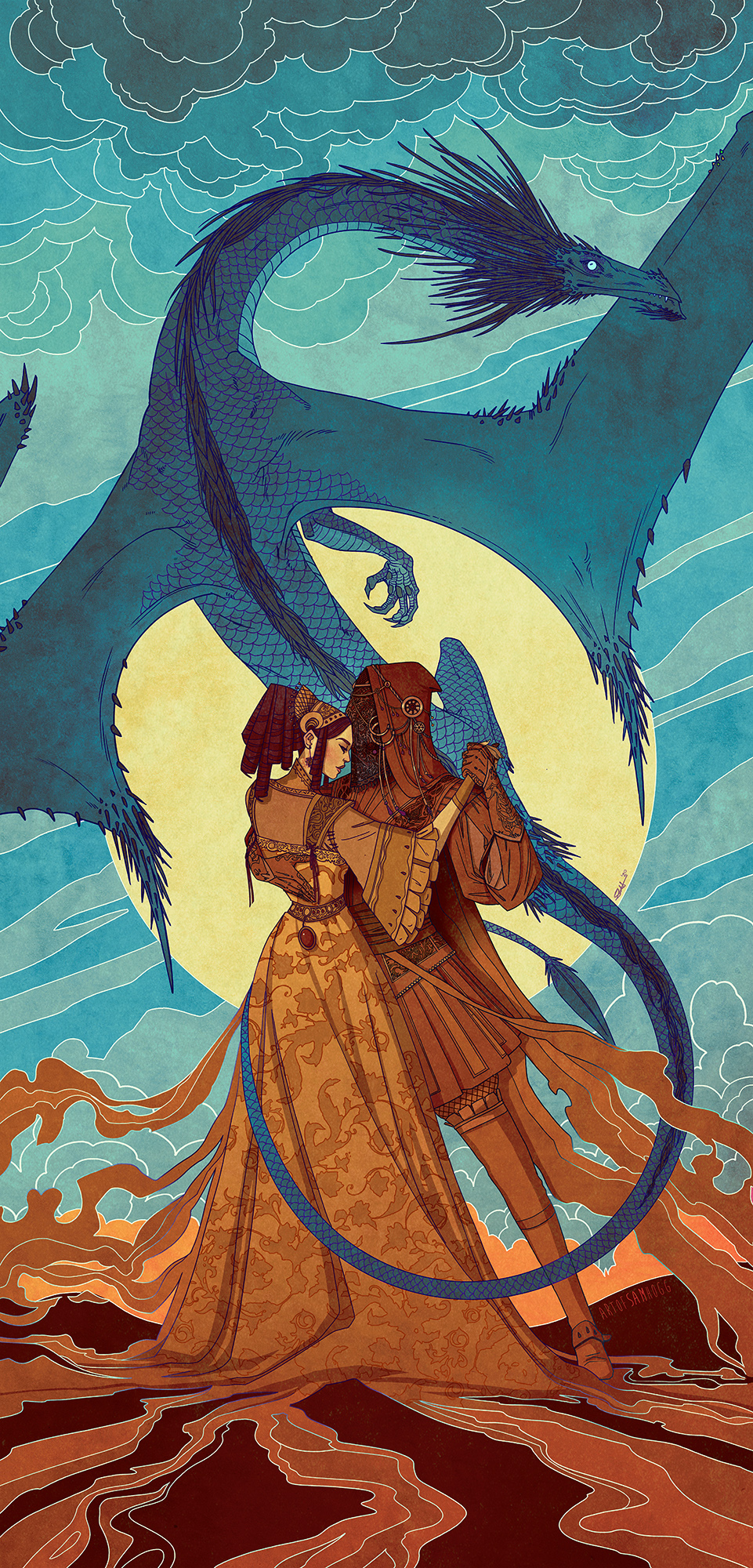
Image
Quite the striking image…which is Sam Hogg’s, used for commentary.

The group calls upon the Satrap in a hall that is described, along with their locations and relative precedence. Malta’s continuing machinations are glossed, as are the changes to the prevailing state of affairs. The Pirates–with recognition of national sovereignty, the capitalization seems in order–and Traders make to take their leave of the Satrap, and Reyn and Malta confer about their upcoming nuptials and progress in Bingtown and on the Rain Wild River. Talk turns to others’ romances, then to liveships, about which Reyn has some ideas. They dance together, reveling in one another, and Etta and Wintrow confer a bit pettily about the way they do so.

In the harbor, the Ophelia confers with the Vivacia, the two liveships gossiping. Jek joins them, and the ships note the tensions between recalled lives and experienced ones, and the Vivacia recommits to her current life.

I find Reyn’s note about the liveships that do not recall dragon-lives of interest. He remarks that it is possible some of the cocooned dragons died before their cocoons were opened–and while ignominous disposal of the bodies of sentient life rankles even so, it does offer the prospect of ethical wizardwood harvesting. If memory serves, it’s something discussed in later books in the Elderlings corpus; I will be continuing my rereading for the foreseeable future, so I’ll have a chance to come upon it again. Whether I will remember to connect back to this entry at such times as I come across other references, I don’t know; I have the suspicion that I do poorly with such things. But that might also give me more to do, here, and I like getting to roll around in this, so…

Help me get supplies for my daughter’s coming school year?

A Robin Hobb Rereading Series: Entry 216: Ship of Destiny, Chapter 37

Read the previous entry in the series here.
Read the next entry in the series here.


The following chapter, “A Dragon’s Will,” starts as a group from the small pirate fleet–Althea, Brashen, Malta, Reyn, Wintrow, Amber, Jek, and Red–readying a landing place and food for Tintaglia. She alights without dignity and takes food with complaint, and she reports the status of her serpents as she comments favorably on Malta and Reyn. The dragon’s imperiousness sits ill with Wintrow, and a tense exchange ensues that Malta manages to defuse.

File:Muddy beach 2 - geograph.org.uk - 1140082.jpg
Something like this, perhaps?
Image is Jonathan Billinger’s Muddy Beach 2, used for commentary under a CCBYSA 2.0 license.

Back aboard the Motley, further negotiations ensure, spearheaded by Malta; Althea finds herself approving of Malta’s work in that line. As the talks proceed, Althea realizes that the world has shifted, fundamentally, something she discusses briefly with Brashen as the talks conclude and the parties begin to disperse. Jek ships out aboard the Motley, while Amber accompanies Wintrow to the Vivacia, and Brashen and Althea return to the Paragon. After reporting things to the ship, they retire to Brashen’s cabin and make ready for bed; Althea struggles with herself as they compose themselves for the night’s rest.

Etta considers Amber and Wintrow as the two make to confer; her own status is strange to her, and she tries to reconcile herself to it. Meanwhile, Amber apologizes to Wintrow for having failed to find him before, to Wintrow’s confusion. Amber also offers cryptic wisdom. The beginnings of a hailstorm force them below decks, and Wintrow joins Etta.

Althea wakes from a nightmare, having struck Brashen in her somnolent thrashing. He believes they are to part; she disabuses him of the notion, and the two affirm their mutual love. Althea, though, holds something back.

The theme of arrogance, touched upon again in the present chapter, is one that pervades the Liveship Traders series. While there are a great many characters who do well to take pride in themselves and their abilities, no few of them take far more than is due them. It is not only the dragon–though a prideful dragon is a long-standing literary trope, to be certain–but several of the ships’ captains, as well as many of the wealthy and ennobled depicted in the series. Many of them learn humility, to be fair; those who do not seem either to be the dragon or to die. I am sure there’s some lesson to take from it, just as I’m certain that more could (and perhaps should) be done to explicate the theme–but that will be for another piece than this one.

Help me move into the new month?

A Robin Hobb Rereading Series: Entry 215: Ship of Destiny, Chapter 36

Read the previous entry in the series here.
Read the next entry in the series here.


The next chapter, “Secrets,” begins with Althea musing on the situation of the pirate forces and the Paragon as they flee northward–away from Divvytown. Wintrow commands the pirates, and Althea notes his control with approval; she also musts on the disposition of her brother-in-law’s corpse. The Jamaillian ships give chase, Althea noting that they will suffer lingering effects of the encounter with the serpents; Brashen notes, too, that Wintrow has hostages to employ. He also notes the supposedly ornamental axe the Paragon had wielded; Amber has no clear reply. And an exchange between Brashen and Althea reminds her of what she has suffered and the complexities of her entanglements.

Something like this, kind of…
Image is from the Britannica, used for commentary.

Brashen considers matters, as well, musing on Althea’s reclaiming the Vivacia. Considering the implications, he realizes that he has a family again aboard the Paragon. And at the figurehead, Etta tries to make sense of what has become of Kennit; the Paragon notes that Kennit is part of the ship, now, no longer distinct. The ship also reports that Kennit “loved you [Etta] as fully as his heart could love,” the specific wording indicating much.

Brashen answers a summons to the Vivacia, not entirely graciously; Etta, Amber, and Althea accompany him, and the confer about their relative situation as officers from the Motley and the Marietta precede them to the Vivacia. Aboard, they meet with Wintrow, Jek, Malta, Reyn, Sorcor, Red, the Satrap, and the hostage nobles. News is briefly and incompletely exchanged before Wintrow calls the meeting to order. The treaty between Jamaillia and the Pirate Isles is agreed upon, at least tentatively; details remain to be discussed. Etta will serve as Queen Regent for her unborn child and Kennit’s. The Vivacia will go north to escort the serpents to their spawning grounds; Wintrow asks Althea to sail aboard their family liveship, and he asks Brashen to take the Paragon thence, as well. Reyn and Malta note the situation with the Chalcedeans, warning against their depredations and the Jamaillian nobles’ perfidy. And they are interrupted by a frantic sending from Tintaglia; she weakens, and the serpents have been beset.

There’s something of a denouement in progress in the present chapter, to be sure, with resolutions of several narrative threads approaching or concluded. My comments about things wrapping up neatly and swiftly, made in earlier rereading entries, still apply to some extent, although the effect seems lessened in the present chapter. There are clearly still issues to resolve, and there’s not much book left at this point; a handful of chapters and an epilogue remain for the novel and the series as a whole. I do still remain struck by the strange amalgamation of things going on in the milieu, but I’ll not rehearse comments I’ve long since made–at least not this time. Instead, I mean to plow ahead into the next chapter, doing so while I have some time to do it.

Help me recover from moving?