A Robin Hobb Rereading Series: Entry 194: Ship of Destiny, Chapter 15

Read the previous entry in the series here.
Read the next entry in the series here.


The following chapter, “Serpent Ship,” opens with the white serpent–who insists on being called Carrion–accosting Maulkin and the other serpents in his tangle. Carrion tries to get himself killed, repeatedly, and Sessurea is only barely discouraged from obliging him by Maulkin noting the scent of She Who Remembers in the water. They proceed towards the smell, finding sound that echoes it and rushing off to heed the call to recall.

Bulb GIFs | Tenor
Not unlike this, no.
Image taken from Tenor.com, used for commentary.

She Who Remembers frets briefly as she rushes to meet the serpents, Bolt lagging behind. Maulkin greets her, and the two enter a communion that gives Maulkin back his full memory, and the memories spread to the other serpents. From the deck of the Vivacia, Kennit watches in amazement as the serpents churn and commune, and Bolt reiterates her demand to him, to which he agrees readily.

Elsewhere aboard the ship, Etta presses Wintrow as the young man considers his place and purpose. He voices his uncertainty to her, and she prods him to learn more–navigation, for one, and a return to his priesthood. They converse about the matter, and both realize that both have placed their faith in Kennit and not themselves–and that it should be in the latter. He slips into a strange meditation as he considers her words, and she quietly departs.

In the water, She Who Remembers considers Bolt and Wintrow with some confusion and trepidation. Maulkin joins her and notes his own suspicions, and they observe as Wintrow confronts the ship. It assails him, but the violence against him only spills his blood upon her wizardwood planks, where it soaks in and enhances the intertwined connection he has perceived within him and among them.

Once again, I find myself reading with affect as I read the passage wherein Wintrow considers that he cannot return to the priesthood that he had thought once and for years was his calling. I am in a similar place, having been obliged to exit the ivory tower in whose basements I long labored, hoping for a chance for a room of my own within it. I do well enough in my life outside it, of course, and I recognize that it has no real place for me within, but I still labored long to dwell within it, and that work cannot be undertaken without it doing much to the worker’s heart, in turn. I have not plied such waves as Hobb relates Wintrow has, nor are my scars as deep or extensive, but my currents have carried me far away, and my skin is far from smooth anymore, and I know not how to chart a course back to were I was before.

Can you spare a dime?

A Robin Hobb Rereading Series: Entry 193: Ship of Destiny, Chapter 14

Read the previous entry in the series here.
Read the next entry in the series here.


The next chapter, “Divvytown,” begins with Brashen considering the approach to the titular settlement from the deck of the Paragon, musing over changes to the place since he was there previously. He confers with Althea on the matter, and they determine to proceed with the sunrise. The ship puts in, surprising them all with knowledge of the local waters, and, when Brashen asks, the ship agrees to guide them into Divvytown on the spot. As the ship does so, the Paragon considers the approach and is startled by Amber waxing poetic on their progress through the night. The ship reflects with some trepidation on Amber’s words and considers those exchanged between Brashen and Lavoy to the aft.

52516560_2167733726856979_979163590420332544_n
How much of this can go around?
Image from Texas A&M University, which makes it a government document and therefore, if I understand correctly, public domain.

The Paragon puts in stealthily at Divvytown, and Brashen summons Althea to him after sending the rest of the crew, save a small watch, below deck. They confer, more about their romance than about the work at hand, as they survey the town and plot their landing party. Amber and Clef are excluded, as are Lavoy and Artu; Jek and a handful of others are to be brought along, and Lop left with orders to get Clef ashore if there’s trouble. The landing proceeds, with Brashen issuing and affirming orders to his selected crew, adopting a braggadocio act when confronted by local authorities appointed during the town’s reconstruction; he successfully plies the locals as Althea turns over what they learn in her head and reluctantly reassesses the possible situation with the Vivacia–as well as Kennit. The news from Bingtown takes her aback, as well.

After the local authorities approve of them, Brashen has his landing party disperse to gather information and gives orders to take on provisions. He also confers with Althea as the two of them surveil the town’s streets together. She is taken by the image of what could be that she sees reflected in windowglass as they do. And as she learns of her brother-in-law’s fate, she sorrows for the crew lost and for her sister–but not for the man, himself.

At the dock, Paragon muses over the oddities of time and his blood-borne connection to Kennit until disturbed by a gig from the town, one person aboard which identifies the ship as having been Igrot’s. The assertion upsets the ship, and the noise of the upset reaches Brashen and Althea in the town. They hasten towards the ship and are greeted by Clef, Jek, and all but two of the other landing party members; they return to the ship, where Lavoy confronts Brashen and assails him before leaping overboard–and a number of crew join him as the Paragon flees Divvytown under full sail.

This is not the first chapter of a Liveship Traders book to be titled “Divvytown.” The one that is, here, and the changes from the earliest appearance to the present chapter are marked. Kennit has clearly made an impact upon the place, and, as Althea is reluctantly obliged to consider, not all of it is for ill. Indeed, much of it is for good, in itself. That does not elide the ill Kennit has done and is yet doing–the chapter presents itself as contemporaneous with the trip to take Wintrow to Others Island, giving a sense of how the component parts of the novel fit together–and it is good to remember that it is too much to expect that the extraordinary will only be so in one direction. Then again, working to erect what amounts to a nation demands a certain degree of hubris; there are presumption and arrogance inherent in the notion that one person’s ideas are good enough to rule others by. Too, it is long known that a certain ruthless pragmatism is required in a great many endeavors.

I am reminded, however, that manure is often used to fertilize, and plants that bear good fruit grow well from having shit at their roots.

Your help to keep this site going would still be welcome.

A Robin Hobb Rereading Series: Entry 192: Ship of Destiny, Chapter 13

Read the previous entry in the series here.
Read the next entry in the series here.

A content warning is likely in order.


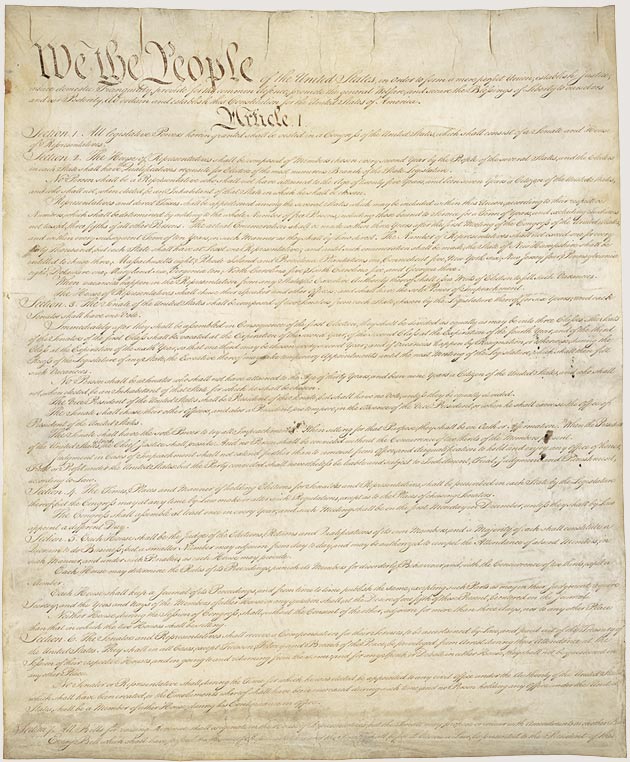
The chapter that follows, “Surviving,” begins with Keffria and Selden talking on the deck of the Kendry as the liveship approaches Bingtown. The harbor is desolated, the ruined hulks of ships visible in the water and the lingering damage to the town visible, as well. Keffira frets for her family, the fates of most of whom are uncertain to her.

The Constitution of the United States | National Archives
This seems to be evoked…
Image from the US National Archives, which I’m pretty sure makes it public domain.

Reyn and Jani are also aboard the Kendry, and they confer about their own mission to beseech aid as they approach the injured town. Trehaug is in dire economic straits, the earthquake having rendered the retrieval of Elderling artifacts impossible, and the extinction of the Rain Wild Traders looms. Keffria invites the Khupruses to lodge with her, which offer they accept, and Grag Tenira arrives to spirit the group away under cover–and to the waiting Ronica.

Aboard the Chalcedean ship, the Satrap whines; at Kekki’s insistence, Malta offers some gentle advice and comfort, musing on their unpleasant situation and tending to the Companion as best she can. The value of Kekki’s advice is made clear as Malta rehearses an assault upon her. The Satrap continues to treat her as a servant, and Malta is accosted again; she falls, opening a wound she has been considering for some time. As she makes to bind it, she realizes that Kekki has died as the Chalcedeans hail another ship.

In Bingtown, Serilla takes lunch and considers her worsening situation. Roed Caern grows increasingly cruel and paranoid as many sets of machinations unfold; she wonders how to place herself among them in the wake of a message from Mingsley. She also considers Ronica, musing on the older woman’s wisdom.

Grag and Reyn confer as the latter makes ready to join a gathering. They exchange tidings, including Reyn’s certainty that Malta is dead. Similarly, Ronica affirms herself to Keffria and reminds her that she, not Ronica, is the Vestrit Trader. And at the gathering, Keffria takes her rightful place, despite her pain and loss. News is exchanged and counsel taken for how to proceed; the potential for a break from Jamaillia and a new system of rule for Bingtown is discussed, and Reyn, at Selden’s prompting, begins to explicate some of the longer history of Bingtown and the Rain Wilds.

I am again taken by the similarity between events unfolding in Bingtown and what I remember being taught and reading later about concerns surrounding the Revolutionary War. (I am aware that what I was taught was markedly jingoistic in addition to being simplified for consumption by children. The latter is excusable, even perhaps necessary; the former is not. And, recall, I grew up in small-town Texas–for good and ill.) I’ve noted that in other work–and I’ll get to that work, worry not–Hobb makes much use of early US history to inform her fictional milieu; I haven’t done the reading to the extent that I should (yet) to confirm it, but it does not stretch credulity to think that Hobb is doing much the same thing in the Liveship Traders novels that she does in the Soldier Son series. And she seems to be offering some corrections, being explicit in the incorporation of women in the proposed renewed Bingtown as equals–formally and legally, not just conventionally–and noting usefully that “A manner of speaking becomes a manner of thinking.”

Indeed, that comment is more true than many people want to believe. I don’t necessarily fully subscribe to Sapir-Whorf, but it is an idea that merits more thought than most afford it.

I can always use your support.

A Robin Hobb Rereading Series: Entry 191: Ship of Destiny, Chapter 12

Read the previous entry in the series here.
Read the next entry in the series here.

A content warning may well be in order.


The succeeding chapter, “Alliances,” begins with Brashen conferring with the Paragon, trying to elicit some reaction from the figurehead as the sentence of isolation relaxes. The ship tries to wound the captain with words, but fails; Brashen’s melancholy has already cut him. They reach an uneasy detente of sorts, though it seems to satisfy neither ship nor captain.

storm GIF
Not a welcoming thing, no.
Image taken from Giphy.com, used for commentary.

Elsewhere, Tintaglia soars about the waves, considering her situation, the need to find the last young of her species, and the changes to the geography from what she recalls in her ancestral memories. She muses with disgust on humanity before encountering a serpent that has gone almost completely feral, trapped in a backwater and raging at her as she tries to aid it. Her efforts are of no avail, and she performs a final mercy on the serpent, tasting the lingering despair of his existence as she does so. Departing, she begins to consider how humanity might be brought to the dragons’ aid.

Aboard the Paragon, Lavoy reports to Brashen. The captain issues a series of directives to the mate, most of which are not to the latter’s liking. After dismissing Lavoy, Brashen considers the coming conflict with Althea with trepidation and longing.

For her part, Althea manages her watch and muses on her situation with Brashen. She muses over the crew assigned to her, assessing their strengths and weaknesses evenly, and Brashen informs her of the imminent rescinding of the isolation order for the Paragon. Althea accepts the order and considers its likely impact on the sullen Amber before her thoughts turn toward the Vivacia and the plan to retake her. When Brashen issues his orders, including the change in watch-crews, Althea seethes but holds her peace; she seethes more when, as she comes off watch, Clef conveys a summons to the captain’s quarters.

Althea reports as ordered, and Brashen invites her to voice her complaints to him. After a bit of prodding, she does so, somewhat vehemently. Her complaint–that he had shamed her by ordering her back from battle–provokes an unexpected apology that shifts into an anguished declaration of love from Brashen. That, in turn, moves into an assignation that leaves Althea feeling nearly fulfilled.

On the foredeck, Amber confers with the ship, trying to explain the finality of death. The ship is aware of and confused by what Brashen and Althea do in the captain’s cabin, however, and is distracted from the conversation thereby.

I am aware that, as a reader, I am supposed to be in favor of Althea and Brashen re/beginning a romantic relationship. Certainly, the novels have thrust the two of them together repeatedly and given them opportunities to fall in and out and in again. But I cannot help but read the encounter between them in the current chapter as some combination of contrived–it’s a novel; of course it is–and harassive. Brashen is the captain of the Paragon; Althea is second mate and therefore under his direct command as an officer in the ship’s complement. She is not in a position to be able to refuse his advances, really, and a diminished capacity to refuse them necessarily makes for questions about their acceptance. Certainly, were I to act so in my leadership role, I would (potentially) provoke harassment proceedings; the lack of an analogous legal recourse within the milieu of the novel does not mean the act is less–questionable? Reprehensible? Illicit? Immoral? Wrong? I am not sure what word applies here, really, but I am sure that the passage in question is…uncomfortable reading, even for me. How it would strike people more directly touched by such acts in their own lives, I am not sure I am equipped to consider.

Care to lend a hand?

A Robin Hobb Rereading Series: Entry 190: Ship of Destiny, Chapter 11

Read the previous entry in the series here.
Read the next entry in the series here.


The chapter that follows, “Bodies and Souls,” begins with Wintrow considering his convalescence as he hobbles across the deck of the Vivacia towards the figurehead. There, he confers with the ship, confronting the dragon-personality that has ascended to the fore, and a tense exchange between the two ensues. Wintrow realizes his mind and heart are divided, and he he skeptical of the dragon’s desire to have him leave the ship. Etta joins the conversation, but matters do not ease, despite the dragon-personality’s flattering. She seeks to confront the dragon-personality in her turn, and Wintrow is dismissed–with a clear warning.

Not the best soundtrack for the chapter, I admit, though I have enjoyed listening to it over the years…
Image from the group’s website, used for commentary.

After Wintrow retires from the foredeck, the dragon and Etta have their talk; Etta knows the personality she faces is not that the ship had had. The dragon-personality names itself Bolt to her, explaining it and remarking that she will not share her true name. As Etta considers, Bolt urges her to remove her wizardwood charm and take control of her reproductive rights, noting the effective inability of males–dragon or human–to properly regard them. Etta complies, and Bolt eats the charm, rendering the decision irreversible.

The serpent Shreever considers the increasingly large group of serpents that has gathered around Maulkin. Sessurea joins her briefly before scenting something and thrashing about to uncover the form of a fallen dragon, one of many in a place that once stood above the waves but has sunk beneath them. Maulkin seeks to rally the serpents once again, but is challenged by a white serpent who reports having conferred with and fled from She Who Remembers; Mauklin subdues the challenger and commands that he take them back to She Who Remembers.

Kennit regards himself and his situation as he makes to confer with Bolt again. Etta reports some of what she has learned to him, and Kennit is skeptical of her changed attitude–and that of his crew–as he strides to the foredeck to speak with the ship. After an enigmatic conversation, Kennit agrees to the terms Bolt has laid out for him; she will permit herself to be sailed by him and will help him to pirate well, and she will receive her due in return. At her urging, Kennit calls on Wintrow and appears to heal his scars; the act fatigues both of them greatly, and when Kennit wakes later, he marvels to find himself happy–and more to find Bolt singing to serpents that rise from the sea.

Bolt’s comments–and how helpful to have a name!–to Etta regarding childbearing are telling, I think. Certainly, “debates” in the United States regarding reproductive rights and choices were ongoing as the novel was brought to publication (the scare quotes are because there should not be a debate; medical decisions are the patient’s to make, or the proxy assigned by the patient, period), and putting comments affirming reproductive rights in the mouth of an antagonistic character–not an antagonist as such, but certainly not a friend–puts the novel in an ambiguous position among them. Bolt, after all, is in some opposition to characters the reader is encouraged to support, but those characters are not necessarily “good,” not necessarily to be emulated; it defies an easy assignment of support or denial of the position. At the same time, Bolt argues against the particular form of contraception and prophylactic Etta employs; again, the commentary is made ambiguous by being placed in the mouth of a morally ambivalent character–and one that decidedly hails from an older time (as well as another species). And there is the problem of the comments essentializing women to their reproductive capabilities–perhaps less overt an issue as the novel reached publication but certainly one that demands attention for a later rereading.

I could still use, and will continue to appreciate, your kind contributions.

A Robin Hobb Rereading Series: Entry 189: Ship of Destiny, Chapter 10

Read the previous entry in the series here.
Read the next entry in the series here.


The next chapter, “Truces,” begins with Ronica musing lightly on her improved methods of skulking and spying on Serilla in what had been Restart’s home. The legal proceedings against the estate are settled, although Ronica wonders if coercion or bribery by Roed Caern is behind their end. Ronica overhears news of the Satrap’s escape from captivity in Trehaug–and that Malta is implicated in a conspiracy to effect that escape. She also overhears the evolving machinations of both Caern and Serilla, and she swiftly moves to retrieve Rache and make to flee.

Mad ship
Whereabouts they are on this map is unclear…
Image taken from the publisher’s site, used for commentary.

As her conversation with Caern is interrupted by coffee service, Serilla considers her situation and the tensions in her uneasy alliance with him. Among others, she recognizes him as a threat not unlike the Satrap aboard the Chalcedean ship, an experience from which she has not recovered. She also believes she notes Ronica’s eavesdropping and is convinced she has given her a tacit warning. As conversation continues, Caern continues to rail against the Vestrits, even as Serilla is not convinced that they are traitors to Bingtown; as he rails, her perception of his threat grows, and she almost reflexively gives in to his demand for Ronica’s location, that he might seize her. She laments her action, unhelpfully.

Ronica and Rache, however, are striking out across the less-kept areas around Bingtown to try to get to a section of the city where Caern will have less sway and power. Rache notes that the difficult passage was the best route to take and attests to the many shantytowns that have sprung up in the area, refuges for the Tattooed who could not escape the city as a whole. Ronica is again taken by the numbers of people trafficked into Bingtown as she and Rache reach their destination: Sparse Kelter‘s home. They are welcomed and fed and lay out their situation, which is dire and threatens all the populations of Bingtown.

Caern comes across in the present chapter as the kind of figure–present in the United States in abundance as the novel was brought to publication, and unfortunately increasingly vociferous and violent since–who longs for a return to an idealized past that never was. “Send them back” is his battle-cry, “they can never really be like us” is his mantra, and they are all too familiar from the real world, and just as heartless and ultimately short-sighted in it as in the novel. That Serilla recognizes his folly and the threat it presents is a point in her favor, but it does not outweigh her reliance upon that folly to secure her own position; she is complicit, more than many, in its peril, something that many others would do well to note in their own lives and in a world that still too much devalues the lives of those who look different and who do not come from inherited positions of power within social structures designed to reaffirm and reassert that power, both with physical violence and with other forms of coercion.

Any chance of sending some help my way?

A Robin Hobb Rereading Series: Entry 188: Ship of Destiny, Chapter 9

Read the previous entry in the series here.
Read the next entry in the series here.


The next chapter, “Battle,” begins with Althea fretting about the performance of the crew of the Paragon in battle drills. She ascends the rigging to join Amber on watch, conferring with her regarding her condition and recent events. Both of them voice distrust of Lavoy before their conversation is interrupted by the approach of pirates. Chaos ensues as the crew of the Paragon shambles towards readiness, Brashen having to direct crew that should already have known what they were about and noting Lavoy moving with a hand-picked force of his own.

Work in progress - UItimate Admiral: Age of Sail - Page 5 - General  discussions - Game-Labs Forum
Yo, ho, ho!
Image taken from Game-Labs, used for commentary.

The pirates begin to board, and battle is joined. The crew of the Paragon is able to repel the boarded, if with difficulty and the direct involvement of the liveship. In the wake of the fight, only one captive remains after Lavoy’s work; he is questioned on the foredeck, where the ship finds his answers upsetting and unsatisfying; the Paragon seizes upon the chained captive, pulling information from him before breaking his body and tossing it into the sea. Lavoy, who had been inveigling the ship for some time, feigns surprise and shock at the event; he is not believed as Brashen tries to reassert calm and control over the crew.

After, Brashen considers his injuries and the straitened situation in which he finds himself, caught by what he believes his duties as captain are. The ship muses similarly, if more sullenly amid contemplation of the spilled blood and course for Divvytown and Kennit to which Brashen has turned his attention.

I find myself once again reading with affect, with understanding coming from my own time and current circumstances, and as my eyes take in Lavoy’s protests that what the ship has done is not his fault–after he had spend long cultivating the ship and a select group of the crew–I cannot help but picture him with oranged skin and a poorly-done comb-over. I know, of course, that that’s not the specific comment being made in the chapter, but I also know that one of the things that makes a work of written art a better one is that it will take additional interpretations–the kind of thing described as “speaking to other times” when I was going through school. (Is that enough reason to keep using the phrasing? Maybe not. Hell, I’m not even sure the folks reading this have that frame of reference–which might be such a reason. Maybe.) So I (again?) think it’s not a bad thing that I read the chapter affectively. The emotional involvement’s what drives the initial interrogation, after all…

I can still, of course, use your help.

A Robin Hobb Rereading Series: Entry 187: Ship of Destiny, Chapter 8

Read the previous entry in the series here.
Read the next entry in the series here.


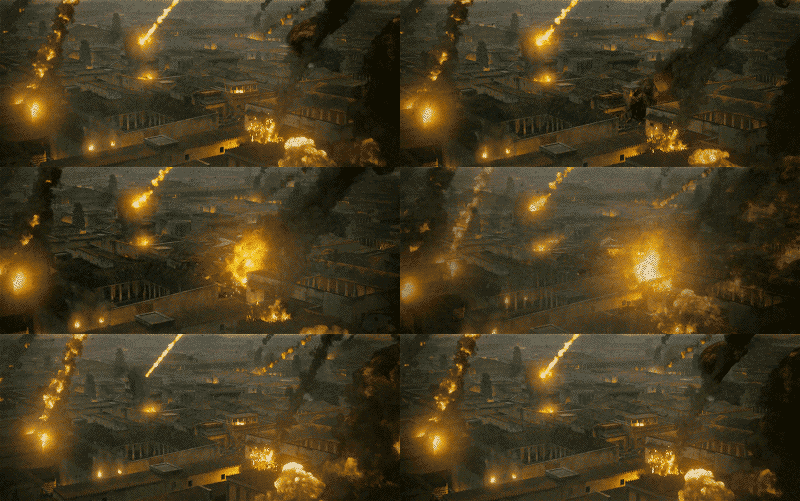
A chapter titled “Lords of the Three Realms” follows, and it opens with Tintaglia killing a bear and searching for signs of her kind after gorging upon it. She notes changes from what her ancestral memories tell her, and she worries as she continues her search.

On February 21, their world will end in fire.
Yeah, that’d ruin your day.
Image from the Pompeii movie website, used for commentary

Malta muses on her straitened circumstances as she, the Satrap, and Kekki continue downstream. The Satrap inveighs heavily, and Malta fumes at him.

Tintaglia kills again, a boar, and she arrives at the site of a ruined Elderling town, far fallen from the glories she recalls it having had in her ancestral memories. She rages against the loss and begins to despair of being the last of her kind.

Malta wakes to see the form of Kekki in a heap in the boat, and she fears the other woman is dead. She is not, although she is in poor condition, and she strikes a strange deal with Malta, offering her aid if the younger woman will help her live. The Satrap sights a Chalcedean ship and hails it despite Malta’s protestations; the Chalcedeans take them aboard in some confusion, but are persuaded of the Satrap’s identity. He begins to ply his status with them, swiftly returning to his drug use and imperious hauteur; Malta is forced to consider changed circumstances and notes the Satrap’s revealed physical form with bemused disappointment. After she has cause for concern about Kekki again, she and the Satrap have another sharp exchange, and Malta realizes the water provided for the Satrap’s bath is from the Rain Wild River; she smiles as she realizes it will scald him and pours more onto him.

I note that the issue of addiction crops up again in the present chapter as in so much of the rest of the Realm of the Elderlings corpus, and I note how often in the books that such intoxicants are ascribed to disreputable types–particularly Chalced. I note, too, that misogynist patriarchal attitudes are explicitly and repeatedly ascribed to Chalced, along with many other reasons for scorn and opprobrium. I note also that–at least at this point–Chalced is a largely unseen other; it stands outside both the Six Duchies and the Bingtowner / Jamaillian polities, with rumors of its militaristic depredations and the actions of mercenary crews–not necessarily representative of the general population, and not necessarily accorded much agency or narrative perspective–the only real depictions of them. While the point is clearly made that Chalced is bad and that the qualities most associated with it are also bad, the kind of othering taking place is…not necessarily ideal.

Too, the issue of addiction is one that touches me more than many and certainly more as I do the reread than as I read the novels earlier. Hobb makes a point of portraying some of her addicted characters sympathetically–Brashen Trell in the present series and Fitz in the Farseer novels come to mind as examples. And Fitz, especially, suffers for his reliance on chemicals to do the work he is called upon to do. And that reminds me: the sympathetic characters use the drugs they do–usually stimulants of one form or another–chiefly to do their assigned work or to recover from having done such work. It’s something I see often among the clients I see in my current job; they are hooked on illegal or illegally used substances, yes, but not because they don’t want to work. Instead, they get hooked because they do want to work, and what they take either helps them to do more or helps them not hurt so damned bad from having done more. At first, anyway.

I continue to appreciate any support that you can offer.

A Robin Hobb Rereading Series: Entry 186: Ship of Destiny, Chapter 7

Read the previous entry in the series here.
Read the next entry in the series here.


The next chapter, “Dragon Ship,” begins with Wintrow being forced back into consciousness by the dragon that underlies the Vivacia. His return to thought presents the ship with the revelation of what she truly is, and it breaks forcefully and painfully upon her. Wintrow staggers to the foredeck to try to comfort the ship and is rebuffed by the dragon, which contests psychically with the ship for control of the craft. Kennit is aware of the tumult and comes forward as well as the struggle continues, emerging into the physical world as the dragon tries to take over the figurehead and turn its arms against the ship. Suddenly, the figurehead loses all color and returns to being still wizardwood; the sight rattles Kennit, and, at Etta’s urging and Wintrow’s, he withdraws; Wintrow follows suit.

Probably not this kind of thing, no…
Image of a section of the Bayeux Tapestry, taken from Wikipedia and used for commentary as permitted by a Creative Commons license

Below deck, Etta tends to both captain and boy, musing on the latter’s injuries and the former’s evident despair. Wintrow reports what he can of his experiences and understanding to Kennit, the captain reacting poorly and in some disbelief to the information provided. After more conference, though, Kennit regains his confidence and purposes to reawaken the ship. He also plies Wintrow with liquor and has him put to bed, after which he takes a tour of the ship, coming to talk with the figurehead–which surprises him by answering his words in the dragon’s upbraiding voice. A tense exchange follows, and a tentative agreement between the dragon and Kennit is struck; the charm at Kennit’s wrist notes approval. And, nearby, She-Who-Remembers sings to the ship, settling in to follow her onward.

Some of what occurs in the chapter, some of the ideas that come up elsewhere and tie into Wintrow’s discussion in the chapter, are matters it occurs to me to treat in my forthcoming paper for the Tales after Tolkien Society at the 2021 International Congress on Medieval Studies; they are worth treating (as I clearly think), but because I am promised to deliver original work, I cannot give that treatment here at the moment. Later, though, I may well do so; I’ve done such things before, after all…

Aside from such things, though, there’s not a lot that strikes me about the present chapter–unless it is that Etta seems uncommonly servile in it. I am not sure how to regard it, even having read the novel more than once before; I am not certain what attitudes are being depicted, really, and so I do not know as I write this what I should make of it. But fiction, even escapist fiction, does not need to resolve all things at all times; it is okay for there to be uncertainty in the reader. Maybe there even should be some of that; if nothing else, it leaves more room for other stories to follow.

I can still use, and remain grateful for, your financial support.

A Robin Hobb Rereading Series: Entry 185: Ship of Destiny, Chapter 6

Read the previous entry in the series here.
Read the next entry in the series here.


The chapter that follows, “An Independent Woman,” begins with Serilla considering the weather as Bingtown approaches winter. She muses on the changes she had seen in Bingtown while touring it the day before, grousing about her thwarted dreams and fretting about her future prospects; the Satrap remains absent, and the ministers and hangers-on who had plied him earlier remain in place in Jamaillia–in power. She seizes upon the idea of uncovering the part of the plot against him that centers in Bingtown as a means to retain and secure her own safety and stability in the wake of the depredations done to her by the Satrap and others.

I imagine something like this for the hall…
Photo by Pixabay on Pexels.com

Serilla is distracted from her reverie by the announcement of Ronica Vestrit, and Serilla muses for a time on the situation that has led to Ronica sheltering under what had been Restart’s roof. It has eased her surveillance of and control over her, but it has also left her subject to the older woman’s harangue–the which continues when Ronica enters with a ledger in hand. A tense exchange ensues, and Ronica reviews what she knows of Serilla; Serilla gets the worse of the exchange, and Ronica leaves her, considering whether to linger in a position to overhear news from Roed Caern.

Said news comes from the Rain Wilds, Serilla realizing the importance of the message before it is delivered. When she opens it, she receives the news that the Satrap has gone missing from Trehaug in the wake of the earthquake; Caern advises her to do nothing at present, and she realizes she is slipping into his power.

Ronica is unable to glean any of the news, and she returns to her chambers, where Rache continues to work. Roncia stresses to Rache that she is free to leave, owing her nothing; Rache replies that the Vestrits are the only ones who have shown her kindness in Bingtown. She also notes news, reporting to Ronica about the state of the town and identifying Sparse Kelter as a man of some interest. Ronica notes that she will continue to do what she can to ensure that Bingtown survives as itself and that her family has a place to which to return. They confer further, and Ronica has to be reminded of the current and former slave population–the Tattooed–in Bingtown in her plans. Rache explicates the distributed system among the Tattooed, which Amber had helped set up, and notes Amber’s assertion of being a prophet.

Later, Ronica reports to the Traders’ Concourse, the condition of which is detailed. She sets about cleaning and lighting the hall, following an old tradition, and she is soon joined by other Traders, who join in the same work. It has a salutary effect as Ronica reflects on Bingtown’s history, but Ronica is dismayed that the meeting waits to convene until Serilla arrives. When the Companion does, she does so ostentatiously and imperiously, and she is taken aback when the Council presents a plan upon which she had not been consulted. Citing precedent, the Council pushes a moratorium on confiscation and eviction, as well as increasing civic duty-time. Serilla tries to regain control of the situation, of her situation, and does not succeed; Grag Tenira manages to convene a panel to investigate Restart’s death.

Ronica considers Serilla and muses upon her suddenly altered situation as the Traders’ meeting proceeds and concludes. She confers with Grag as the latter offers her a ride home and affirms his belief in the Vestrits’ loyalty to Bingtown amid wry jests regarding his suit for Althea’s hand.

The chapter does offer some attention to the enslaved population in Bingtown, which is not always the case, and the reminder that Ronica evidently needs to recall them has some…uncomfortable overtones. But that’s always part of the problem, of course, that those in power or recently dispossessed of it tend to overlook or ignore those without, especially the most abject among them. Such matters are more prominent now than when the novel was released, of course, even though they were certainly present at the time, but I reread as I am now, remembering little of who I was then except that I was a little shit who thought himself far better than he was. I like to think I have improved; I hope I have, at least. And that Ronica has the decency to be ashamed of her oversight when she is reminded of it is a hopeful sign; the habits of a lifetime are not easily set aside, but they can be set aside, with attention and care–and more of us can afford to pay such a price than do.

Buy me a cup of coffee, maybe?