A Robin Hobb Rereading Series: Entry 112: Ship of Magic, Chapter 11

Read the previous entry in the series here.
Read the next entry in the series here.


The following chapter, “Consequences and Reflections,” opens with Althea consulting the Bingtown equivalent of an attorney regarding the terms of her father’s will. They are, unfortunately, clear, and clearly not in her favor. She also asks about Kyle’s oath about ceding the Vivacia to her if she could present proof of her honest sailor’s skills; her interlocutor notes that it would likely work, but counsels her against pursuing the action.

Disconcerting?
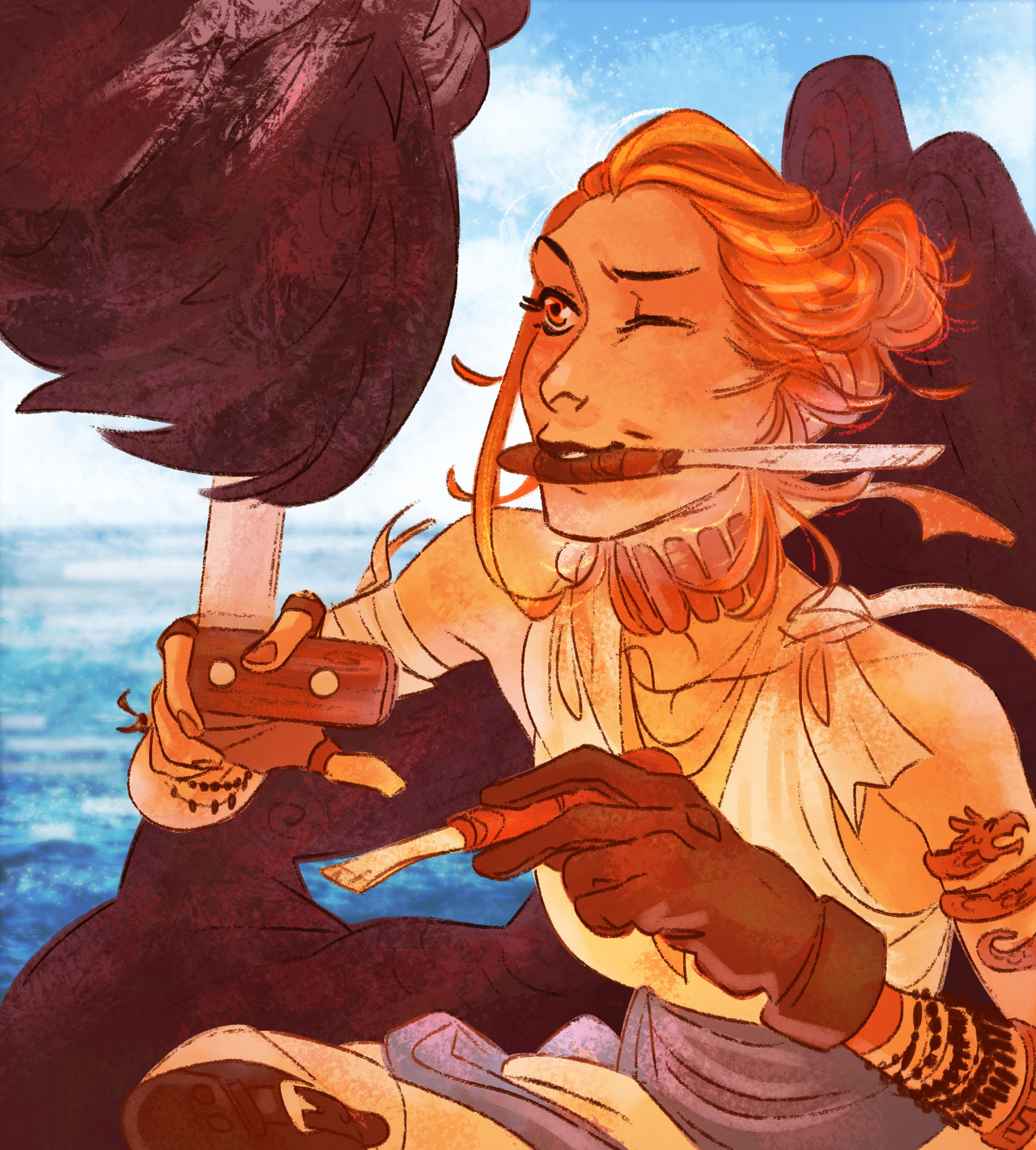
-Amber- by AngellaMireille on DeviantArt, used for commentary

After Althea leaves, she fumes, musing on her situation, and determines that she will not live on her sister’s charity. She also calls upon the Vivacia at the docks, reminiscing on the status of women among sailors as she does so. As she begins to confer with the ship, she realizes that she can feel Wintrow at work aboard her–and that his suffering marks the ship, to its potential future peril. When she is interrupted by Torg, she sits upon her anger and counsels the ship to set it aside; the ship does not, but acts against the mate.

As Althea leaves, promising to return to the ship, she wonders about the ship’s intentions and harbors dark thoughts of her own. She also has an uncomfortable encounter with Amber, though the two exchange no words, and there is no hostility made manifest between the two. After, she eats and gives thought to how she will proceed afterward, being unwilling to accept more of her family’s charity, and she begins to realize how dire her family’s situation is. She also gives more thought to the Vivacia and her nascent development, comparing her to other notable liveships–including the Paragon, whose history she rehearses in part; the part is tragic enough.

After the meal, she sends a note to Ronica and walks out amid the shops selling goods from up the Rain Wild River. She sees Amber again, at her shop this time, and considers her situation again before making her way towards the beached Paragon.

The story of the Paragon that Althea rehearses is, as noted, a tragic one, the more so given that it depicts the ship as having come into consciousness amid fear and pain. Death has already been established as necessary to quicken a liveship–three generations of a single bloodline–with implications that the Liveship Traders novels do begin to investigate, but there is a patent difference between lives ending of old age and its often-associated infirmities and the calamities that befell those whose lives quickened the Paragon. It is hardly to be wondered at that a consciousness that forms amid such trauma would have problems, as ascertained by the standards generally applied. (How apt the application is is something with which the books concern themselves later.) The repeated traumas clearly do not help, either.

Help me recover from the weekend’s holiday?


A Robin Hobb Rereading Series: Entry 111: Ship of Magic, Chapter 10

Read the previous entry in the series here.
Read the next entry in the series here.


The following chapter, “Confrontations,” opens with Althea waking to the sound of Ronica berating Kyle for punching his adolescent son. Kyle responds harshly before backing off of a position he realizes is perilous for him. Althea enters abruptly and confronts him, but she is soon distracted by tending to Wintrow. She rages against her nephew’s situation for a moment as he continues to try to remove himself from that situation, and, in a rage, Kyle vows that he will cede the Vivacia to Althea if any captain vouches for her seamanship. He also rages against his own son, sending him packing off to the ship under duress before rebuking Althea. Ronica quashes the argument. She accepts the blame for Althea’s disinheritance, explaining her reasons for it and noting the terms of Keffria’s enfranchisement. Althea cannot but continue to inveigh against the situation, and, in the face of the continued insistence upon it, she leaves.

image
This rather speaks for itself.
Meme from FitzChivalryFarseer on tumblr, used for commentary

Kyle resumes inveighing against Althea, and when Ronica rebukes him for his behavior, he turns his anger upon her–not physically, but still coercively, and partly through exploiting Keffria’s indecision. Ronica reassesses her elder daughter, not favorably, and she is shocked yet again when Kyle announces his intent to trade in slaves. When he is met with objections to that plan, he demands charts to the Rain Wild River, only to be told that they had been destroyed. He disbelieves and continues to rage, and Ronica takes herself and Keffira away from him.

Kyle’s patriarchal tendencies are on full display in the present chapter. He demands Wintrow’s obedience physically, notes that things are done well “for a woman,” and rages at the Vestrit women because they “have no sons to protect” them or “men to take over the running of the holdings.” He repeatedly asserts that he is “the man of this family” and therefore its rightful head, owed obedience by all in it. It is an all too common attitude even now, that the presence of a penis is the primary determiner of ability, and it is still an all too common attitude that command means the imposition of will despite the knowledge and expertise of others. I must confess to being guilty of some of the same follies, and I am trying to sit with the discomfort that being reminded of them produces in me. But perhaps I am overly affective a reader in doing so.

I note as I reread the ways in which Kyle approaches Kennit. Both of them appear amid the trappings of bourgeoisie success; Kyle stands in a house built by settlers over generations and staffed by servants, commander of a vessel owned by the family descended from those settlers, concerned more with money than anything else. He is not heir to that family, as such, but married into it and is imposing his own views upon it rather than even attempting to understand the people he seeks to rule. Might he, himself, be taken as a metaphor for colonialist discourse, especially given his physical description in the text? Might he point towards intersectionalities of oppressive structures? Might someone still vested in academe make such arguments?

Help me mark tomorrow’s holiday?

A Robin Hobb Rereading Series: Entry 110: Ship of Magic, Chapter 9

Read the previous entry in the series here.
Read the next entry in the series here.


The next chapter, “A Change of Fortunes,” opens with Brashen approaching the derelict liveship Paragon. He banters with the ship briefly before boarding with permission and returning to a rack he had established on a previous excursion. The ship is strangely pleased to have him aboard again.

Anyway, here’s an adorkable sailor. I’m glad I got Brashen to look like I imagined him when reading.
The sailor himself, as reader emmitys puts it here; image used for commentary

Kennit and Sorcor confer aboard the Marietta. Kennit again pushes his idea of pirate civilization, and he begins to win Sorcor over to it, the added details presented doing more to persuade the mate of the captain’s plans. Sorcor’s vehemence against slavers surprises Kennit, but he agrees to the amendment on which Sorcor insists. Sorcor blanches a bit at Kennit’s plan to take a liveship, but he strikes a deal to pursue a slave-ship for every liveship they pursue–one to which Kennit agrees.

Wintrow faces his family as his father, Kyle, insists that he sail aboard the Vivacia instead of returning to his monastery. Wintrow tries to refuse, but he is knocked unconscious by his father.

The chapter delves further into the overt politicism of the Liveship Traders novels, especially in Sorcor’s emphatic assertions regarding slavery. The chapter affirms his experience as legal property and begins to touch on the horrors of such a status; no words can truly convey such horrors, of course, but the descriptions of the tanning work to which Sorcor was forced and the conditions aboard the slave ships are particularly evocative. (They are more so amid the current-to-this-writing protests of George Floyd’s murder, Breonna Taylor’s, and far, far too many others’.) That Hobb is pulling from depictions of the Middle Passage is clear, and it is equally clear that slavery is being presented as evil even by the standards of the evil.

I cannot help but note, also, Kennit’s reluctance to engage slavers in the way Sorcor calls for him to do (ultimately successfully, it must be noted, but still). Kennit drapes himself in trappings of wealth gotten through effort, yes, but still stolen, and he frames his plans in terms that read to me remarkably like the putative American Dream; what he describes rings of suburbia in my ears. Yet for all that, Kennit resists the idea of freeing slaves and ransoming slavers, preferring the economic benefits of interfering with the slave trade to the moral imperatives of interdicting it. Again, while such issues were far from inaccessible in the context of composition, present circumstances call for a much more emphatic, and much less sympathetic, reading. Kennit may not be a slaver himself, but he is okay with slavery–so long as it makes him money, and it is only when his continued tolerance of slavery begins to threaten his economic plans that he relents and agrees to work against it.

More people need to be better about it than Kennit than are.

We’re half through the year; send me a bit to help me make it the rest of the way?

A Robin Hobb Rereading Series: Entry 109: Ship of Magic, Chapter 8

Read the previous entry in the series here.
Read the next entry in the series here.


The following chapter, “Night Conversations,” starts with Keffria tending to her mother and her children before slipping into bed with her husband, Kyle. After they reconsummate their marriage, they fall to talking about the events surrounding the funeral. Kyle inveighs against Althea, and Keffria finds herself in agreement with him, musing on the “man’s load of decisions and work” her mother had faced instead of the genteel lives of other Trader women.

image
The lady of the chapter
A portrait of Keffria Vestrit by electorpeach on Tumblr, used for commentary

The conversation turns to Wintrow. Keffria’s hopes for and pride in him are rehearsed, only to be thwarted by Kyle rising, ostensibly to check on Althea, whom Brashen is escorting back to her family’s home. As they proceed, they banter–more drunkenly on Althea’s part than on Brashen’s. Althea vows to reclaim the Viviacia and to make Brashen her first mate when she is captain. Brashen makes note of a woodcarver’s shop–Amber’s–as they pass, and Brashen begins to muse again on his situation.

When Brashen delivers Althea to her family’s door, Kyle greets them–harshly, going so far as to swing on Brashen. The commotion rouses Ronica, who rushes in and quashes the upset, dismissing all present. Brashen stalks off towards the Paragon.

Elsewhere, the serpent Maulkin wrestles with memory, and the serpents he leads press on northward.

The present chapter shows more of the more overtly political / critical nature of the Liveship Traders novels. Keffria’s musings on her mother’s work and Kyle’s blatantly paternalistic, patriarchal attitude are foregrounded, and neither is portrayed particularly pleasantly. Keffria’s musings come off as naive and spoiled (particularly when read against Hobb’s biography, and while biographical criticism is fraught as a sole means for determining meaning, it does have some value in discussing contexts of composition), while Kyle’s conduct is stereotypical in form. Internalized and externalized patriarchy are on negative display, and not inappropriately, maugre the heads of no few who bewail “social justice warriors” in their purportedly escapist works.

It is still the case, unfortunately, that only escapist works seem apt to engage with issues of parity; the “real” world does not do much more, in the aggregate, than pay lip-service to it, when it even does so much as that. (Yes, I am aware there are exceptions. The overall tendency remains in place, however.) One of the things that escapist works do is show what could be; one thing no few works do, even those that purport to be nonfiction, is present what their writers think ought to be. For those who look at relative parity as being objectionable, I have many words, though few enough that I would include here; there are other places for me to say such things than this, and fog the air blue with those exhalations. I look with hope for such things, though, and if it makes me a fool to trumpet it, then I will be a fool, for I will not stop winding that particular horn.

Support is always appreciated.

A Robin Hobb Rereading Series: Entry 108: Ship of Magic, Chapter 7

Read the previous entry in the series here.
Read the next entry in the series here.


The following chapter, “Loyalties,” begins amid the continuing funeral rites for Ephron Vestrit, who is buried at sea. Wintrow looks on uncomfortably throughout, not understanding the customs of the Traders. He largely escapes the notice of his family until Kyle sees him stumble and disdainfully assigns him to the new second mate, Torg. Torg puts Wintrow to work to keep him out of the way, and Wintrow struggles with the busywork.

One of the focal characters…
Wintrow Westrit by Chidori-aka-Kate on DeviantArt, used for commentary

After, when the family makes to depart the Vivacia for their home, the ship complains. More familial drama threatens to erupt, and Ronica stems it with a few quiet words to the ship and to Kyle. Wintrow is tasked to remain aboard the ship for the night after he escorts Ronica to the waiting carriage. She speaks to him of the ship, though he claims not to understand her. His unease with the quickened ship stems from his religious convictions, and the regard in which others hold him creeps into his mind. He moves to confront members of the crew and Torg, and while things go passably with the crew, Torg is another matter, entirely.

Wintrow leaves Torg and finds himself in conversation with the ship. He finds himself strangely stirred by her words.

Elsewhere, Althea drunkenly muses over her failures and regrets, and she mourns her father. Her family’s handling of the Vivacia rankles her, and she has trouble when she makes to leave. Fortunatley, Brashen is in the same tavern she is, and he makes to escort her home.

Once again, I find myself rereading affectively, sympathizing with Wintrow Vestrit in a way that was likely desired of audiences–and a fairly easy sell for the “typical” readership of fantasy novels. I have made no secret of being a nerd; if nothing else, I maintain this webspace and others (here and here), which is often regarded as being nerdy. Too, I got into grad school (and not for medicine or an MBA), which is nerdy, and I did so off of roleplaying games, which is even nerdier. And in keeping with that, I spent a lot of time in cloistered study–not unlike Wintrow, nerdy boy removed from “real” “manly” life that he is. (Yes, I have issues with it. Go figure.)

Consequently, the interactions with Torg struck something of a chord with me. I’ve known the type, as I think many have; I’ve been on the receiving end of the type, as I know too many have. And I continue, even now, to wonder how such people so often end up in positions of petty authority that they then use to berate and belittle and bedevil those about them. For they do, in life as in art, though art at least tends to offer their comeuppances for the audience’s view; the real world is less giving in that, often in keeping the comeuppance from ever happening.

Is it any wonder that I and those like me read what we do?

Can you help me make my nerdery pay?

A Robin Hobb Rereading Series: Entry 107: Ship of Magic, Chapter 6

Read the previous entry in the series here.
Read the next entry in the series here.


A chapter titled “The Quickening of the Vivacia” follows, opening with Ephron being brought aboard the ship on a litter, as if cargo rather than the long-time captain of the vessel, while Brashen watches in pain. He helps Althea lay the man directly on the deck, and he springs to Ephron’s order to aid Althea in retrieving the peg from the figurehead, the older man praising him. They are able to return the peg to Ephron just in time to give it him before he dies, choking, and amid the revelation that the Vivacia will go to Keffira rather than to Althea.

Althea is soon wrapped up again in her grief at the loss of both her father and what she had thought was her birthright. The family fracas continues, with Kyle ranting about the incapacity of his elder son and Althea returning the peg to its hole to quicken the Vivacia, aided by Brashen. After she briefly confers with the now-wakened ship, she hears Brashen put off her decks, and, after another small fracas, she follows.

https://theplenty.net/wiki/images/8/8d/Ship-of-Magic-port.jpg
A take on the Vivacia, source in the image, used for commentary

For his own part, Brashen pulls his discharge pay and tries, without success, to get a ship’s ticket–a reference for his skills at sea. He plots his next course of action with no eagerness, regretting earlier lack of thrift, but he is interrupted by Althea storming by, and he follows her once again.

I am minded as I read the chapter again of funerals I have attended, in which I have participated or to the foci of which I have been close. There have been more than a few, if less than there have been for all too many of my age, who reached adulthood just before 9/11 and the jingoistic fervor that followed it, dragging many into service and into early graves or worse. It has often been the case for me that I have acted…badly…at such events and in the days and weeks surrounding them. I am given to understand that it is not uncommon, that many people are at their worst when dealing with the deaths of others, particularly those who had been close to them as an indulgent father is to a beloved daughter. (My daughter is beloved; I do not know how indulgent I am.)

I have asserted before, I think, that one of the strengths of Hobb’s writing is its nuanced authenticity. Her characters act like people rather than like roles, and even the protagonists of her novels display behaviors and attitudes that are other than optimal. They are certainly on display in the present chapter, with the family fracas surrounding Ephron Vestrit’s death showing most of the Vestrit family other than at their best. It is still clear that readerly sympathy is directed away from Kyle Haven–the slut-shaming in which he indulges after Althea re-seats the figurehead peg is hardly a valorization–but even with that, he is not the only one acting badly.

Avoiding Mary Sue is a good thing.

Can you spare something to help me keep doing this for another year?

A Robin Hobb Rereading Series: Entry 106: Ship of Magic, Chapter 5

Read the previous entry in the series here.
Read the next entry in the series here.


The next chapter, “Bingtown,” opens with Althea rehearsing her circumstances since her confinement to quarters. She has come to feel a deeper connection with the Vivacia and with her ancestors who have died on her decks, and what she learns from the connection leaves her with a greater appreciation for the ship–and for all ships.

She figures heavily in the novel.
Althea Vestrit by FleurStolk on DeviantArt, used for commentary.

The ship’s second mate, Brashen Trell, comes to check up on her, having heard that she fares poorly. Althea sets his concerns aside, but, when the Vivacia begins to come into her home port of Bingtown and Althea dresses to disembark, she sees the truth of those concerns in herself. She is further disheartened when Brahsen arrives, under orders, to remove her possessions from her cabin. An uncomfortable trip to the Vestrit home follows.

Althea’s arrival at her childhood home is not more comfortable. Her sister, Keffira, effectively ignores her, and the household staff does not recognize her. Ronica greets her, though, if bluntly, and sends her to visit Ephron in their bedchamber. He greets her as best he can, but he is in the final stages of his final illness, and he knows it, bidding her take him to the Vivacia. She rushes off to have the ship made ready to receive him, meeting with some small resistance along the way.

The rest of the family follows, Wintrow not understanding what he is to do with himself in the strange situation. The changes to his family in his absence strike him strangely, and his own liminal status as a priest makes fitting in harder for him than needs to be. And he is swept along by the family’s preparations for Ephron’s death.

Brashen wakes Althea from where she has succumbed to her grief aboard ship. As she rouses, he considers the older sailors aboard her decks and how many of them have no other home. Including him.

Hobb demonstrates a preference for emblematic names in works focused on the Six Duchies; it is not outside expectation that she would do something of the sort in other novels in the same milieu. Certainly the Divvytown that gives the previous chapter its title is something of a description of the place; it is a town in which spoils are divvied up, clearly. So I thought I would take a look at meanings for “Bingtown”; one of them I found attested is…interesting, certainly, being cited as a euphemism for intoxication. Of course, that definition postdates the novel by a few years, and even if it can be accepted that a term is in use before it is attested, it seems a bit of a stretch to think that being stoned is the image that most fits the actions of Bingtown.

Perhaps a more apt reference is to a piece in Ed Blair’s Kansas Zephyrs, “The Bingtown Band.” While the poem itself is perhaps best taken as a send-up of amateur rural musicianship, the line that “‘CASH IS KING’ is their new motto,” with the capitalization in the original and therefore prominent to even a casual glance, seems apt enough for a city founded and governed by self-styled Traders.

I continue to appreciate your backing.

A Robin Hobb Rereading Series: Entry 105: Ship of Magic, Chapter 4

Read the previous entry in the series here.
Read the next entry in the series here.


The following chapter, “Divvytown,” starts with Kennit fancying himself up as the Marietta pulls into the harbor of the titular settlement, which is given a glossed description. He confers with Sorcor as the ship is towed into port, speaking of ambitions for leadership; Sorcor comments aspersively on the notion, remarking on the desire of those in Divvytown to be free people.

r/dndmaps - Dock town/Pirate bay encounter map
Something like this for the setting, perhaps.
Dock town/Pirate bay encounter map by glennjitsu on r/dndmaps, used for commentary.

As the Marietta continues into port, Kennit considers her and her history. Against it and his ambitions, the ephemeral desires of the crew become as nothing in his mind, and their indulgence of those desires makes all his victories shallow. But his career continued, as does his reminiscence over it until the Marietta is safely moored; at that point, he makes his standard offer to the crew regarding their shares of the ship’s booty. Some take it; more do not, and Kennit grouses about it to Sorcor after the crew has disembarked. Sorcor reminds Kennit that such has always been the way in Divvytown, and Kennit disembarks in anger.

The anger sustains and distracts Kennit as he proceeds through the dockside crowds and barters the bulk of the Marietta‘s takings. And it continues to sustain him as he returns to a familiar brothel, seeking the prostitute whose services he prefers–Etta–and accommodations for the night. Despite some protests, they are provided him, and Kennit avails himself of them, some musings and awkward conversations intermingling.

After, Kennit gives one of the treasures he had taken from Others Island, the ruby earring, to Etta and stalks out angrily. While he does, the wizardwood charm on his wrist speaks with him, and Kennit calls on a tattoo artist he favors. The artist rebukes him for perennially employing and destroying his work, but he proceeds after being paid, Kennit reveling in the pain as a price paid for a bad decision and looking forward to removing the tattoo as a way to put the bad decision behind him.

The chapter is useful in laying out more context for the characters, particularly Kennit and Sorcor, and for introducing Etta. Kennit’s musing on and conversations with Sorcor about governance seem to follow the more overtly political bent of the Liveship Traders novels, though I am not quite as up on political theories as I need to be to trace the implications further than noting their existence. And I find myself frustrated at that, that I know enough to see that something is there but that I do not know enough to know what that something is, even if I have the nagging sensation that I used to know enough to know.

Something else comes to mind as I read the chapter again, as well. As Kennit voices ideas about Divvytown to Sorcor, one of the things he mentions is placing defensive weaponry at strategic points–specifically pre-gunpowder weaponry. It is a strange anachronism, given common depictions of pirates. I’ve commented elsewhere on the admixture of pirates in medieval/ist settings, and the Realm of the Elderlings certainly is medievalist in its overall shape (again, with large caveats); it seems a common enough thing that I should not be surprised to see it here. I do have to wonder, though, why so many fantasy authors steer clear of gunpowder…

Summer’s coming, and A/C is expensive. Help?

A Robin Hobb Rereading Series: Entry 104: Ship of Magic, Chapter 3

Read the previous entry in the series here.
Read the next entry in the series here.


The following chapter, “Eprhon Vestrit,” starts with Ronica Vestrit tending to her titular husband in his final illness and grousing about the servant, Rache, that had been sent her by Davad Restart and who had tended Ephron poorly. She mentally rehearses their life together and the plans that Ephron’s illness has halted. She also recalls arguments they had had regarding their daughter, Althea, and notes the shift in practice in Bingtown towards “keep[ing] one’s womenfolk free of such tasks” as estate management before musing on the falling fortunes of the Vestrit family and public shits towards slave labor and trading in Bingtown.

This might be the kind of thing on which the chapter ends.
Image from the Pennsylvania Department of Conservation and Natural Resources by way of the Pittsburgh City Paper, which I think means it’s public domain, and used here for commentary

Ronica is roused from her reverie by Davad calling at her home. Amid likely unintentional rudeness, he carries an offer from another Trader family to buy some of the Vestrit holdings. Ronica’s refusal carries the weight of tradition and history, of which she reminds Davad (and allows Hobb to inform readers, a smooth bit of exposition). Davad rebuts with assertions that the old ways his family and hers had followed are ending, and Ronica’s own refutation grows emotionally charged and fraught for them both. They retreat a bit, laying the blame at the feet of the governing Satrap, as Ephron wakes and asks for pain medication.

Ronica takes the chance to escort Davad out. Despite their earlier argument, they reaffirm their friendship and their common legacy of suffering. And as Ronica looks out over Bingtown afterwards, she muses yet further on the changes already in progress–changes that look as much like depredations as anything else to her old eyes.

While the previous chapter, treating Althea, made some motions toward it, the present chapter, where it focuses on Ronica, presents something of a feminist vision–not of feminine dominance, but of parity. This is something that Hobb’s Farseer works treat, certainly, as noted by both Bokne and Katavić, among others, but it is more prominent a concern in the Liveship Traders books. Given what I know about large, loud sections of the fantasy-literature fanbase, particularly those who focus their devotions on the Tolkienian tradition of which Hobb partakes to a limited degree, it is likely the cause of the lesser attention given the Liveship Traders books; a damned lot of readers (yes, I mean “damned”) mislikes “politics” in their reading, with “politics” being “a position I do not espouse and from which I do not benefit” in such minds, and questioning patriarchy as the Liveship Traders books begin to do in earnest in the present chapter reads as such a position to entirely too many people.

Perhaps related to the burgeoning feminist thread, too, are certain Marxist leanings–Ronica makes much of the shifting economic base, though she remains in the employer’s position rather than the laborer’s, so perhaps some other term than “Marxist” applies–and ecocritical possibilities–Ronica also makes much of the balance between the Bingtown Traders and their environment, noting the changes to that balance occasioned by the shifting labor conditions. Being out of academe, I am out of practice with such theoretical approaches, so that I am not the best person to follow up on their implications, but it is clear even to me that they are there to follow–which is another argument, among many, in favor of Hobb’s writing.

I continue to appreciate your support.

A Robin Hobb Rereading Series: Entry 103: Ship of Magic, Chapter 2

Read the previous entry in the series here.
Read the next entry in the series here.


The next chapter, “Liveships,” opens with Brashen Trell waking from a dream of sea-serpents to familiar surroundings aboard the liveship Vivacia. He considers his situation, now diminished after the illness of his former captain, Ephron Vestrit, and the demotion to second mate under his new captain, Kyle Haven. His history as a son of a leading Trader family receives a gloss, as does his first encounter with a sea-serpent as a junior sailor–and his realization that the serpent worked some strange compulsion upon him.

One of the titular liveships, but not the only one…
Vivacia by FloorSteinz on DeviantArt, used for commentary

Althea Vestrit, also aboard the Vivacia, considers her situation and the changes to it as she is summoned to Kyle’s cabin. He upbraids her for her initiative aboard ship and for her desire to captain the vessel, noting that she will be replaced by one of his sons when the Vivacia next sets sail. He also confines her to quarters for the remainder of the trip back to their home port of Bingtown. He also strikes her for words spoken drunkenly in a tavern, and he slut-shames her.

In her cabin, Althea considers what she knows of the ship’s history, the enlivening effects of family deaths upon the Vivacia‘s decks. She contrasts the familial tie with Kyle’s mercenary tendencies–pronounced even among trading families–and arrives at the conclusion that any defiance from her would only hurt the crew before looking ahead to returning to her home.

Ashore, the liveship Paragon listens as a pair of people–Davad and Mingsley–approach him on the beach and discuss selling him off. Mingsley is taken aback by Paragon‘s condition, which Davad explains as peculiar to the wizardwood of the ship’s construction; it holds up far better than regular wood, and some ships made of it are able to speak and move of their own accord. Paragon does not do so while the men are present, but after they leave, the ship voices his interest in Mingsley’s plan to wreck him for salvage rather than refit him.

Brashen’s story of his encounter with the sea-serpent recalls Verity’s work with the Skill against the Red-Ship Raiders prior to his expedition to the Skill-quarry. It is another tie between the series, made early on, and one the points toward other Elderlings works that have come into print since Ship of Magic and the Liveship Traders novels. I am in doubt that those novels were intended when Ship of Magic was in draft, but I did read my Wimsatt and Beardsley, thanks.

I’ll note, also, that there seems to be less fanart that deals with the Liveship Traders novels than with the Farseer, Tawny Man, or Fitz and Fool books. Some of that is understandable; the Farseer novels are older and have had more time to accumulate fan-works. But the Tawny Man and Fitz and Fool novels are younger, and they seem to a casual search to have as much or more, and the Dragon Keeper books seem to have even less. As I write this, I’m not sure the implications, but it might be worth commenting on at another time.

My parents’ anniversary is tomorrow; help me get them something nice?