A Robin Hobb Rereading Series: Entry 72: Assassin’s Quest, Chapter 13

Read the previous entry in the series here.
Read the next entry in the series here.


The next chapter, “Blue Lake,” opens with a brief description of the titular lake and town. It moves thence to Fitz walking through the night and into day back towards the watering hole where he had been captured. He takes some time to rest, eat, and clean his wounds; when he sleeps again, he dreams of Burrich and Molly once again. The dream reaffirms to him, painfully, that those in his old life think him dead.

Seems a fit place for an assassin…
+Rooftop+ by u-chi-ne on DeviantArt, here, used for commentary

At length, Fitz reaches Blue Lake and considers his situation. He describes the town as he reaches it, noting its low and sprawling nature. He also resupplies as best as he is able with his limited resources. He is stymied, though, when he tries to book passage across the lake, and finds a place in an inn for the duration. Lodging there allows him to learn the local gossip, which eases his apprehensions about being captured–at first. Fitz learns not long after that Regal himself is out on the search for him.

Fitz makes to surveil the lodgings Regal is reported to have secured. He also plots how he will make another attempt on the usurper. As he moves to enact that plan, a weasel, sent to him by the final urgings of its bonded Old Blood partner, warns Fitz of a trap awaiting him–one in which Will is involved. Fitz thanks the weasel for the warning and speeds him on his way to his own vengeance.

When Fitz returns to his inn after aborting his mission, the minstrel Starling greets him, offering to share a meal and tidings with him. Fitz apprehensively agrees; she reiterates to him that she seeks a song that will survive her, and he once again tries to put her off. She persists, however, and lets him know that there are still smugglers working to move people and goods between the Six Duchies and the Mountain Kingdom, despite Regal’s decree of a closed border. Starling offers to take him to them, and she notes that his actions in Buck had saved her brother. It eases him.

Once again, it is difficult not to read the chapter against current politics, with ostensible hardening of borders at the behest of corrupt leadership juxtaposed with the continued permeability of those borders. The last part of the chapter, in which Starling tells Fitz that his actions had done some good in the world, is a welcome bit of respite. Hobb makes a habit of putting Fitz into less-than-pleasant situations, and he does not respond optimally to them, in the main. (I am not claiming I could do better, of course, but one need not be able to do a thing to know that a thing can be done. How many coaches train people to perform better than they themselves ever did?) To have outside acknowledgement that the things he has done were helpful, even if only in small ways and only temporarily, seems a particular blessing. It is something I have occasionally enjoyed; every so often, a former student lets me know they’re doing well or thanks me, and it is gratifying.

In Hobb, though, it promises that worse is yet to come…

Show me some love on this Valentine’s Day?

A Robin Hobb Rereading Series: Entry 71: Assassin’s Quest, Chapter 12

Read the previous entry in the series here.
Read the next entry in the series here.


The next chapter, “Suspicions,” opens with a brief note on the addictive ecstasy of the Skill. It moves swiftly thence to the caravan’s travel the next day. Fitz, having a clear head from not having drunk to excess the previous night, works along the way; when he refreshes himself, Starling pulls him aside to warn him that Regal’s guards have been looking for a man who looks very much like him.

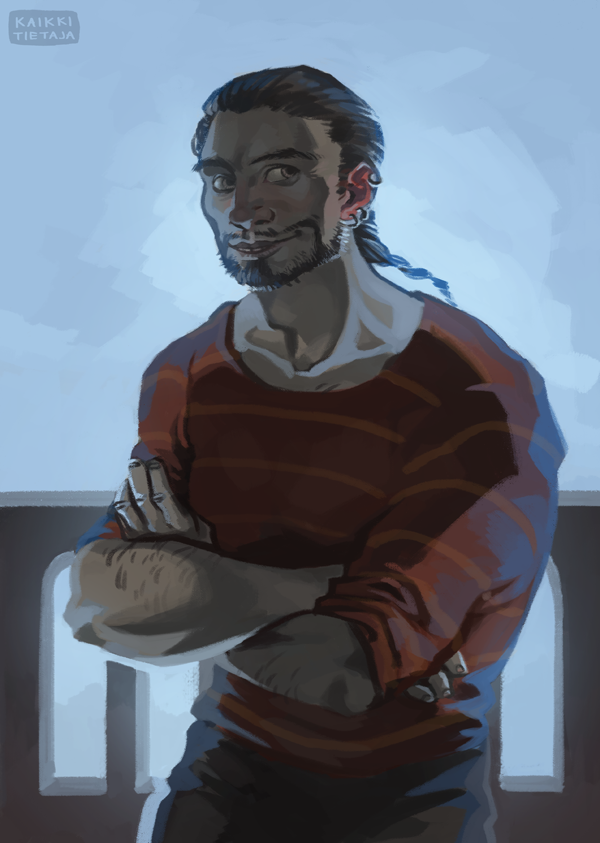
FitzChivalry Farseer by WhiteElzora
To be fair, it is a distinctive look.
FitzChivalry Farseer by WhiteElzora on DeviantArt, here, used for commentary

That night, Starling sings a song about Fitz’s martial exploits. Members of the caravan discuss it and its implications as Starling expounds on the history. An uneasy night passes for Fitz before the caravan continues, and the young woman whom Fitz had refused previously tumbles to the idea that Fitz is himself and pursued by Regal’s forces. Starling speaks with him after, intimating a desire to follow him on his path to Verity. He tries to set it aside and deflect her interest, to little avail.

A few more days pass before Regal’s forces come upon the caravan. One of the guards had been among Fitz’s tormentors. They do not recognize Fitz at first, but in the night, they seek to come upon him unawares. The Wit prevents it from happening, and, after an inspection that confirms his identity, Fitz tries unsuccessfully to flee.

Fitz wakes once again to pain, and his captors take him off. They soon begin to experience no small gastrointestinal trouble, results of Fitz’s surreptitious poisoning of them. The trouble worsens, and guards begin to die; none of them survive past the next midday. Fitz frees and resupplies himself, and he is bolstered by a faint touch of Nighteyes’s mind upon his through the Wit.

It is hard to be aghast at Fitz’s reactions in the chapter, although he does kill several people in a particularly unpleasant way. Still, they are taking him to be killed–again–in public agony, so it is difficult to feel sorry for his slain captors–even aside from the one who had worked upon Fitz in the previous novel. Hobb does point out through the last of the guards to die that some people simply get swept up in things there is no way they can recognize the overtones or implications of, but, particularly in the present climate, it must be recognized that simply going along and following orders does not absolve a person of responsibility for the aid and support of evil. Not all who are, to follow Arendt, banal in their evil are punished for their complicity as overtly as the unfortunate final captor in this chapter, but some are.

It is another reminder that more people need to heed than do. It is another reminder that evil needs to be opposed–and that what many think evil is not.

I could use your help to keep the lights on.

A Robin Hobb Rereading Series: Entry 70: Assassin’s Quest, Chapter 11

Read the previous entry in the series here.
Read the next entry in the series here.


The next chapter, “Shepherd,” opens with a brief note about Chade’s activities after the death of Shrewd and Regal’s removal to Tradeford. It moves thence to Fitz’s description of the convening caravan. He dreams that night of Molly, realizing she had left him to protect their child–a daughter whom she is delivering even then, aided by Burrich. Fitz almost leaves off what he is doing to go to them, only to be forestalled by the echoes of Verity’s Skill-driven command.

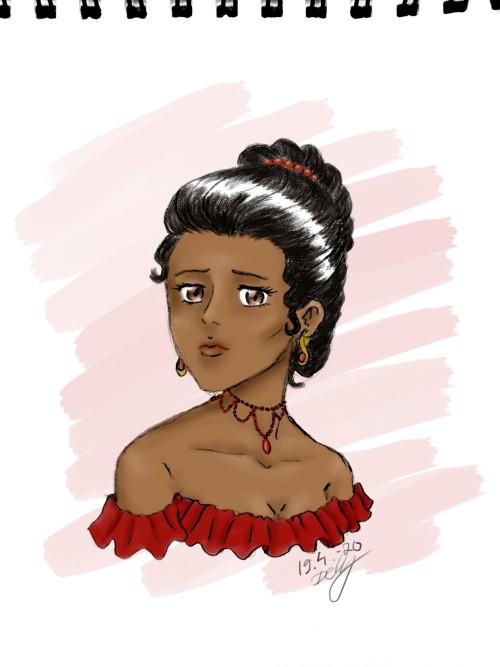
Starling Birdsong by Mimi-Evelyn on DeviantArt, here; image used for commentary

Fitz considers the command upon him even as he cannot resist it, and he spends the next few days in a daze, plodding along with the caravan and attending to his assigned tasks with it. A minstrel traveling with the caravan, Starling, sometimes seeks his company, and guards in local livery give Fitz pause, but the journey is long dull. Fitz considers the possibility of raising his daughter with Molly once his work for Verity is done.

The tedium is interrupted by the apprentice of one of the performers traveling with the caravan. Fitz makes to tend to an injury she has incurred, and she propositions him. He refuses her offer, knowing that it would be no comfort to him to accept it, and she grows angry, indeed.

I find myself reading affectively once again, particularly as I read Fitz’s consideration of being a father. Certainly, father-figures feature in the Farseer novels; Fitz is marked by separation from Chivalry, Chivalry is separated from his father by his own fatherhood, and the surrogates that come into Fitz’s life–Burrich and Chade–clearly love him but regard him other than as a son. That he would turn over the idea of fatherhood in his head would not be wondered at even were he a more “normal” son and father. The Six Duchies clearly expects that a child’s parents will be present and in a relationship with each other (something answering to the putatively prevailing expectations of Hobb’s presumed primary audience), and, being in such a situation myself, I note that I still have thoughts in that line–and my daughter was born in 2014.

And I share, perhaps, with Fitz (again, I know I am reading with affect, and I ought to know better, but still…) an eagerness to be part of my child’s life–though I doubt it is to the extent that a young man who grew up without a father would. Knowing what is coming–this is a reread–gives me pause as I consider it, and I am reminded that I am fortunate to have been with my child as much as I have been. I am also reminded that I need to give my kid a hug, telling her once again that I love her, next time I see her–and I am glad it won’t be too long…

My daughter’s birthday’s coming up; help me buy her a nicer gift?

A Robin Hobb Rereading Series: Entry 69: Assassin’s Quest, Chapter 10

Read the previous entry in the series here.
Read the next entry in the series here.


The next chapter, “Hiring Fair,” opens with a brief commentary on slavery in the Six Duchies before moving on to Fitz’s difficulties in setting out to reach Verity, as he has been commanded through the Skill. The geography of his expected path is glossed, and he begins to look for means to cross the intervening distance. He also considers his circumstances and the fact of his isolation.

I see the earring as something like this piece on Etsy, here; image used for commentary

As he makes his way onward and resupplies, Fitz is offered gold for the earring he had from Patience, that had been Burrich’s, as well as information about its earlier provenance. With difficulty, he refuses the offer, keeping the earring and looking for work that will take him in the direction he needs to go. He does not find it that day, but he does learn local gossip: Chade is being hunted as he is, with hefty rewards offered that would likely not be paid. And when Fitz sleeps, he dreams of Chade.

The next day sees him find some work and the promise of a caravan to accompany. He works throughout the day on odd tasks to see him through, and he muses on the kind of life he might otherwise have had as he considers how to answer Verity’s demand.

It is good to see the earring Fitz has deliberately retained come up again. Authors keeping their characters’ equipment in mind is always good to see; narratives do well to follow their own rules. Too, having the earring appear in the chapter both on Fitz’s person and in descriptions of him promulgated by Regal’s forces serves as a reminder of the dangers of sentimentality and nostalgia (and I am not unaware of the irony of my making such comments; I am more nostalgic than is good for me and more sentimental than is comfortable for most folks). Keeping too tight a hold on the past imperils the present and the future.

Fitz’s musing on his individual inadequacy early in the chapter is of some note. Many “heroic” narratives go to great lengths to identify their protagonists as sufficient to all the tasks that confront them–perhaps with struggle, perhaps with training, but still sufficient. (It is for such reasons that many who are themselves execrable look to “heroic” narratives for inspiration and seek to link themselves therewith; they imagine themselves as the protagonists, feeling adequate for once.) Fitz, although long since a subversion of “heroic” narrative tropes, is, by his own admission, not enough on his own; he cites the contributions of others to his skill and performance, confessing his insufficiency in their lack. It is something to which Donne speaks, of course, that all are interconnected, and others echo him.

More would do well to listen better and to heed what they hear.

Care to help fund my holiday gifts for my wife and child?

A Robin Hobb Rereading Series: Entry 68: Assassin’s Quest, Chapter 9

Read the previous entry in the series here.
Read the next entry in the series here.


A chapter titled “Assassin” follows, opening with a passage about the recent Skillmasters of the Six Duchies and the strange manner in which Galen, the last of those, formed a coterie. It moves thence to track Fitz’s reconnaissance of Regal’s palace. He is able to exploit gossip and the largesse of a few sympathetic people to gain entrance, and, when within and safely concealed, makes ready to carry out his assassin’s work.

FitzChivalry Farseer by vihmakivi on DeviantArt, here, gives some idea of how the haggard assassin looks; image used for commentary

Thinking himself ready, Fitz proceeds, noting the grandeur of the halls through which he creeps as he goes along. One of his former tormentors spots him but does not recognize him until after Fitz has killed him.

After disposing of the body as best he can, Fitz continues on his errand, still creeping and marveling. The efforts of Regal’s Skilled servants break upon him, and Verity steadies him through a hint of that magic; Fitz hides and forces himself to calm before proceeding and marveling yet further.

At length, Fitz finds Regal’s chambers and sets to work poisoning his possessions. Verity queries him through another touch of Skill, and Fitz responds in kind. But as Fitz is about that task, he is spotted by a guard; though he kills the guard, another of his tormentors, he realizes that Will had been using the guard’s senses–he has been found out. Fitz makes to flee, only to fall further into Will’s power, and he realizes that death is once again his only option. Verity then reaches out through the Skill in anger and power, binding Fitz to come to him and leaving him room to flee.

Fitz makes his escape, stealing a horse along the way, but he is recognized as himself as he does so. As he flees, he comes through the King’s Circle and is revolted by the depredations he knows transpire therein. He eventually gets clear of Tradeford, sending the stolen horse back to its stable with the Wit, and begins another journey–this time, to join Verity, wherever he may be.

The present chapter occasions a sharp change in the direction of the novel. Leading up to and into it, Fitz had had the goal of killing Regal–though he was often distracted from it by idle thoughts of the life he had once led and the possibility of leading other lives yet, whether among the Old Blood or among the more “normal” people of the Six Duchies. Leaving the chapter, however, he has the burning command imposed upon him, not just by the king he acknowledges as rightful, but by force of magic; it does not leave his mind as the desire to kill Regal appeared to have done on occasion.

I suppose, as I consider the chapter I have reread again, that the command inscribes another trauma onto Fitz, who has already suffered many (and who does not deal well with several of them–as is to be expected in a milieu that admits of no therapies for such). It is one that Verity himself has acknowledged is a thing wrongly done, even if done without intent. Again, my understanding of and training in trauma theory are sharply limited, so I would not venture to say much–but I will remark that it seems Fitz is being set up for yet more pain to come.

As is usual.

We’ve made it through one month; kick in to help me make it through more?

A Robin Hobb Rereading Series: Entry 67: Assassin’s Quest, Chapter 8

Read the previous entry in the series here.
Read the next entry in the series here.


A chapter titled “Tradeford” follows, opening with notes about the status of the continued fight against the Red-Ship Raiders–including the fall of Brawndy of Bearns. It moves to a disheveled Fitz making his disreputable-looking way into a nearby town. As he takes in the local gossip–and a meal provided through a local lord’s general largesse–he learns of the “King’s Circle” and the “King’s Justice,” gladiatorial trial-by-combat spectacles that have taken the popular imagination.

Jean-Léon Gérôme‘s Pollice Verso, hosted at the Phoenix Art Museum and, by report, public domain; image from Wikipedia (here) used for commentary

A pair of locals makes to challenge Fitz, and he almost rises to that challenge, but is stopped by a voice in his head–Verity’s or his own. Moving off, he finds an inn and avails himself of it. Bathing reveals to him the extent of his travels, and shaving shows him a face unfamiliar to him. But when he makes to sleep, he finds himself restless with worry about his task, and when he does sleep, he dreams of the fall of Brawndy of Bearns and the continued valor of his daughters, Faith and Celerity. Verity again rebukes him through the Skill, and Fitz awakes.

The next morning, Fitz again avails himself of elfbark and prepares to move on to Tradeford from the small town. The small effects of the drug and the depression that follows its use attract his attention, bespeaking his addiction. And as he leaves the town, he sees recently built–and still-occupied–devices of torment and execution, and he thinks of Chade.

Soon enough, Fitz comes to Tradeford and marvels at it. In a short time, he is able to get a bit of work, and he listens to gossip while he does the work, noting the lack of talk of the Red Ships and reference to Regal by his mother’s name of Mountwell. He also learns more about the King’s Circle and is disgusted by it. And he learns about Tradeford Hall, the now-royal palace, which he surveys, marveling again at the splendor on display. The disjunction between easy life inland and his own upbringing shocks him–and he realizes what will come if Buckkeep falls.

Two things come to mind most forcefully for me as I reread the present chapter. One is the trial-by-combat concept and its problems; Jacqueline Stuhmiller writes of such things in another area of inquiry, and even if Fitz himself accepts the utility of what might generously be called alternative forms of justice, the nature of trial-by-combat as spectacle is dangerous even in his mind. But the notion of such a thing looms large in the chapter, hence the selected illustration above, and I am once again hard-pressed not to comment on the novel’s intersection with current events (I write this in mid-January 2020).

The other is the final passage in the chapter, in which Fitz juxtaposes the grandeur of Tradeford with the sullen, obstinate strength of Buckkeep. There is a bit of jingoism to be found in the comment, even if it is accurate, and even if it is mollified by Fitz’s longing for the kinds of nice things he sees, his assertion that a ruler having such things for the people ennobles the people. As with many other things in the series, there’s a lot to unpack, more than the present task admits of handling; it may well be another thing to which I return someday…

Pay it forward; help me out!

A Robin Hobb Rereading Series: Entry 66: Assassin’s Quest, Chapter 7

Read the previous entry in the series here.
Read the next entry in the series here.


A chapter titled “Farrow” follows, opening with an extended rumination on Lady Patience and her assumption of power in Buckkeep. It moves to Fitz and Nighteyes’ progression towards Regal as Fitz considers Will’s interference and likely motivations. The two take stock of their condition and position as they enter the unfamiliar topography of the Inland Duchies.

Nighteyes by Myblack on DeviantArt, here; image used for commentary

Fitz reaches out to Molly through the Skill, seeing Burrich attending to her and attracting Verity’s own Skilled attention. Verity warns him away from such actions, and Fitz wakes to take from a dwindling supply of elfbark. Nighteyes chides him, and they sleep.

As they continue the next day, Fitz recounts his affection for Nighteyes, as well as an exchange in which he considers parity among animals. And an account of the intervening travel follows, glossing over weeks and miles passed by the pair as they move closer to where Regal has enthroned himself.

As they do, the holwing of nearby wolves compels Nighteyes, and he departs from Fitz for a time to pursue wolfly interests. Fitz is struck by the departure, and he watches from afar through the Wit as Nighteyes seeks out the pack–but he presses on, even so. And in the dreams that follow, he sees the continued depredations of the Red-Ship Raiders, considering how Verity and the late Shrewd must see and have seen the same things.

Fitz continues toward Regal, slowly adjusting to not having Nighteyes at his side. Through Sleet, he receives a message from Holly and Black Rolf. Regal has begun hunting Old Blood deliberately; Fitz begins to consider how he will carry out his self-appointed task of killing Regal.

Although the issue comes up in several other places in the series, the notion of posthumanism seems particularly prominent in the present chapter. Such thinkers as Ron Brooks might have more to say on the matter; again, I have stepped away from academe, and my own interests did not lie in such fields. But I do find the explicit rumination about the relative privileging of particular narratives based on species–and the repudiation of hierarchical relationships within those narratives–to be…worth thinking through. Given the propensity of speculative and fantastic fiction to work as metaphor or analogy, the applications of such rumination to dynamics of privileging race/ethnicity, gender, and the like emerge fairly plainly. My own inadequacy is such that I cannot sufficiently explicate the matter, not as it deserves, not in this medium (partly because my research apparatus is greatly diminished–along with the demand that I conduct research). But it is something to which I might return sometime.

Maybe.

I’ll have to do a lot more reading of a lot more things before I can do so, though.

Can I count on you to help me make it through?

A Robin Hobb Rereading Series: Entry 65: Assassin’s Quest, Chapter 6

Read the previous entry in the series here.
Read the next entry in the series here.


A chapter titled “The Wit and the Skill” follows. It opens with a musing on the place of minstrels in the Six Duchies. It then pivots to Fitz parting from the minstrel family after seeing them to an inn in a small town. After refusing another invitation to join them, Fitz heads off, reflexively noting the state of the town and the gossip to be heard in it. He also watches as a drunk is rebuked forcefully for speaking against the current regime.

Image result for black rolf robin hobb
A Redditor comments “Pretty much how I pictured Black Rolf.” I can’t much disagree.
Image used for commentary.

As Fitz makes to leave, he is approached by another through the Wit, and he offers help to the man–Black Rolf. Fitz and Nighteyes accompany the Witted man and his own bear companion–Hilda–to Rolf’s home, which he shares with another Witted one–Holly–and her hawk, Sleet. The Witted ones–who express a preference for the term “Old Blood”–welcome them hospitably. They do, however, express concern tending toward disgust at Fitz and Nighteyes, not for their bond but for their youth in building it, and with Fitz’s gaps in memory and prior bondings. They set it aside as done in ignorance and invite Fitz and Nighteyes to stay and learn from them. They also note the current state of affairs to Fitz, cautioning him in his work to kill Regal. And they press him to teach them how the Wit may be used against the Skilled.

Fitz refuses each offer, not to Rolf’s pleasure. Rolf notes that Fitz will return, and Fitz realizes the truth of it as Rolf and Holly speed him on his way.

I am once again struck by the desire to read the novel against current circumstances; it has been something of a refrain in my comments in this reading series, I know, and it is a legitimate area of inquiry to ask what an earlier work continues to say. I am also struck again by the idea of the Wit as a metaphor for homosexuality, as a number of others have been (see here for examples), though I maintain that the metaphor breaks down in later parts of the Elderlings corpus. (It might be argued that the metaphor instantiates the queerness it represents in refusing to remain stable as the narrative progresses, though that is perhaps more metacritical than is necessarily good for me to pursue. I am no longer in academe, after all.)

Strangely, I am struck perhaps most by the names in the chapter, particularly that of the bear, Hilda. Hobb is typically deliberate with naming in the Six Duchies, favoring emblematic names that speak to the character of those who bear them. “Hilda” seems such an oddity in that regard; the resonances that seem to associate with the name, except perhaps for being of a certain size and physical power (though “Bertha” and others work just as well for those), do not seem to line up well. I am perhaps paying too much attention to so minor a character, but, though I am not an academic, I still think as I was trained to, and the out-of-place detail nags at me. A bit.

Pennies for a poor scholar?

A Robin Hobb Rereading Series: Entry 64: Assassin’s Quest, Chapter 5

Read the previous entry in the series here.
Read the next entry in the series here.


A chapter titled “Confrontations” follows. It begins with a brief rumination on the reciprocal nature of the Wit before moving to Fitz describing fretful sleep and uncomfortable dreams. He wakes to an offer from one of the minstrels of intimate company, which he rejects; Fitz returns to sleep and dreams of being watched by Will, then of being the victim of Red-Ship raids in progress. Verity joins him in the dream and sends Fitz back to himself.

Not quite elfbark, but close.
Image from Wikipedia, here, and used for commentary

Fitz wakes in pain from his Skill exertions and sets about brewing elfbark tea to ease himself; the work occasions rebuke from the minstrels, who note its use in suppressing slaves in other countries. At length, the group heads out, failing to make the next town before nightfall. They make an uneasy camp that is soon relaxed as Fitz cannot help but betray some of his skill-set once again. The betrayal earns an invitation to join the group more permanently, which Fitz ineptly refuses.

The next day, the group sets out again. Through the Wit, Nighteyes warns Fitz of Forged Ones nearby. There is little time to brace for the attack that comes, and Fitz has trouble defending himself, as do his companions. Nighteyes takes injury, as do the minstrels, though the Forged Ones are defeated. In the wake of the battle, however, Fitz is rebuked for what appears to have been his cowardice, since he had moved off to engage Nighteyes’s opponent amid the fight.

Fitz sleeps and dreams again, and in those dreams, Will assails him through the Skill. Through the Wit, Nighteyes defends Fitz, and Fitz wakes in a sweat from what he explains as a nightmare. Through the Wit, Nighteyes signals his understanding that they must kill Regal and his inner circle, lest they be forever pursued.

I’ve not hidden that I work in addiction treatment at the moment (and am likely to do so for some time), although I am not a counselor. Inexpert though I am in such matters, and suspect as any diagnosis of a literary character must be, it does seem that Fitz is indeed addicted to elfbark; his swift recourse to that remedy is but one sign of it. The US NIH, among others, notes that fatigue and depression are observed aftereffects of certain illicit stimulants. While it is the case that elfbark is a fictional plant, it does bear some superficial similarities to the coca plant; it is not an exact analogue, but it is evocative. And it does have some explanatory power, offering another layer of verisimilitude to Hobb’s work; the fictional stimulant acts much like observed real ones, making it more believable for readers who do not have access to it. In a world that admits of magic, having a touchstone, even an unfortunate one, to the reader’s world is an aid to understanding and engagement, as Hobb herself notes.

I still continue to appreciate any support you can offer.


A Robin Hobb Rereading Series: Entry 63: Assassin’s Quest, Chapter 4

Read the previous entry in the series here.
Read the next entry in the series here.


The next chapter, “The River Road,” opens with a brief statement about the economic importance of the Buck River. It moves thence to Fitz waking from a drunken stupor at Nighteyes’s insistence. Hung over, he makes more preparations for departure; upon returning from getting water, he finds Forged Ones in the small hut where he had been staying.

harp
Something like this might be present; image from East Carolina University, here, used for commentary

Melee ensues as the Forged Ones attack Fitz–“Dreams too loud!” says one of him–and Fitz panics, fleeing as soon as he is able. The change from previous behavior gives Nighteyes concern, and Fitz mulls over the difference, trying to convince himself that he acted wisely and not from fear.

It is only much later, and coaxed by Nighteyes, that Fitz approaches the hut again. After nervously gathering–again–provisions, Fitz and Nighteyes set out. It becomes a pattern that they travel by night, resting by day, though the lingering effects of repeated trauma make Fitz less able to sleep than is ideal. And Fitz sorrows over the visible effects of the depredations the Six Duchies have suffered.

They come to a town, which Fitz investigates over Nighteyes’s objections. When assessing his available resources, Fitz, realizes he has lost the pin Shrewd had given him as a marker of his service; it was taken by a Forged One Fitz had killed as he fled. He resolves to keep the earring he had from Patience, that had been Burrich’s, and proceeds into the town. Therein, he finds food and news–the former better than the latter–and the company of a minstrel family that sympathizes with him over his evident ill-treatment. Reluctantly, Fitz agrees to fall in with them; he and Nighteyes both know that it is a bad thing for him to do.

The chapter is not the introduction of minstrels to the Farseer novels; they are mentioned before. But it is an early indication of the minstrels’ social function in the Six Duchies, not only as bearers of news (as in the medieval life Hobb’s Six Duchies evokes to some degree–with my usual caveat), but also as witnesses. As emerges later in the corpus, a minstrel’s sworn testimony is authoritative in Six Duchies legal proceedings. For Fitz to fall in with a group of them foreshadows their importance to come–and the Elderlings corpus as a whole makes much of predestination and glimpsing the future.

Also foreshadowed is that Fitz’s sloppiness will cause problems for him. He notes his errors with the minstrel group, and that much self-awareness might well help him as he proceeds. If he has already been so lackadaisical, though, the question has to arise of what else he has missed–and what others have seen. For it was noted to him that others watch, and even in the present chapter, it is remarked that there are informants about…

I continue to appreciate any support you can offer.