A Robin Hobb Rereading Series: Entry 62: Assassin’s Quest, Chapter 3

Read the previous entry in the series here.
Read the next entry in the series here.


The next chapter, “The Quest,” opens with a brief passage on the powers and perils of the Skill before moving into Burrich’s preparations to leave Fitz behind. Burrich leaves, and Fitz considers his next actions.

Post image
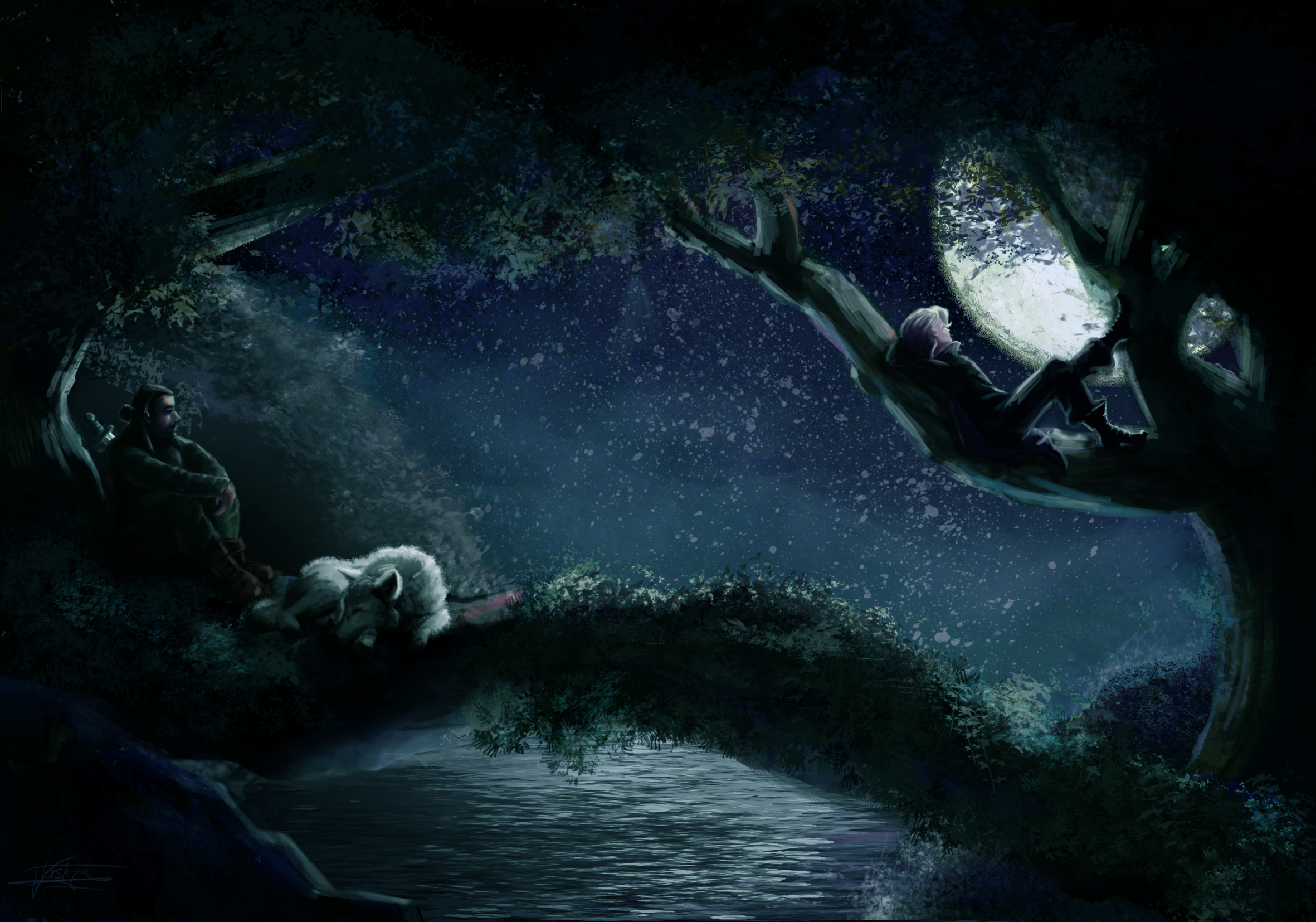
From Epic by anndr on DeviantArt, here, used for commentary

He confers with Nighteyes, who surveys the cabin where Fitz had been living with Burrich as he returned to humanity, and he considers the wolf. The wolf naps, and Fitz assesses his situation for the start of the journey. Over the following days, he makes preparations for his own departure, and the two linger near the cabin as Fitz convalesces a bit further amid his preparations.

After a traumatic dream, Fitz realizes that he has completely lost his sense of time; weeks have passed that he had thought days, and he understands the truth of Burrich’s fears for him. He does what he can to return from it and renews himself to his purpose against Regal, if with some misgivings as other ideas come to him. Considering some of them leads him to Skill to Verity; he makes contact and affirms that he will join Verity after he concludes an errand. In the wake of it, he reflects on the Six Duchies and his former life in the kingdom.

I am struck as I read the chapter again by how Fitz seems to waffle in his decision, realizing in part that the words Burrich and Chade had spoken to him had merit, realizing in part that he is bound to Verity through a kinship incompletely concluded but that is compelling, even so. He seems ever to vacillate between certainty and doubt, and I once again find myself reading with affect; I doubt myself often, possibly more than I do not, and I am not in nearly so straitened a set of circumstances as those in which Fitz finds himself. No, I have a regular job with regular duties and common expectations, things I have repeatedly addressed before–but I still doubt myself and my abilities. So I sympathize with a character who similarly doubts his strong intent.

I think also that the waffling humanizes Fitz, moving him away from being the kind of archetypal hero commonly perceived as being at work in fantasy literature (though I will note that Tolkien’s Aragorn expresses doubt, as does his Frodo; others can speak more to the matter than I, and more eloquently). For someone who has been uprooted–much less metaphorically than most who self-describe thus–it is only sensible that there would be doubt as to what to do now. Conversely, someone who focused utterly on the one thing would make for a more difficult read for many readers, or would come off to many readers as far less enfleshed a character than Hobb has given readers to expect. It might line up more neatly with best-selling popular novels, but I do not think it would make for as engaging a read. Certainly, it has not for me.

New year, new you; help me be a new me?


A Robin Hobb Rereading Series: Entry 61: Assassin’s Quest, Chapter 2

Read the previous entry in the series here.
Read the next entry in the series here.


The next chapter, “The Parting,” opens with a reasonably detailed overview of the Six Duchies’ political situation in the wake of Shrewd’s death. It moves to Fitz and Chade conversing, with Chade voicing his surprise that Fitz is as ready to leave things behind as he is. Chade pushes Fitz to Skill to Verity, but he cannot, and he flees.

image
A memetastic bit from Darling, Say It Backwards on Tumblr, here, and used for commentary

Along with Nighteyes, Fitz considers himself, his shame at having suffered as he did, and the course of action he feels he must take. He steels himself to it, and, over dinner that night, he excoriates Burrich in singularly harsh terms. Burrich leaves, and Chade presses Fitz, returning to the idea of Fitz’s long-simmering anger. Before matters can devolve, though, Chade departs.

Burrich returns in the night, speaking with Fitz about his own history. In the wake of it, Fitz turns to his resolution to kill Regal.

The present chapter makes much of the power of words; Fitz strikes with and in stricken by the words of others. (Not without justification on any side; Fitz’s return to life was far from pleasant, while Burrich’s sacrifices for him had been many, and Chade was not wrong in pointing out the ways in which Fitz had acted with far less deliberation than ought to have been the case.) That an author, whose work necessarily relies on the power of words, would present such a scenario is to be expected–and it is something of a theme in Hobb’s work, as I have motioned towards. Ill-considered words have the potential to cause great harm in Hobb’s milieu, as in life.

The present chapter is another part of the series I find it difficult not to read with affect. As might be thought, I’ve said a great many things in my life. As might be expected, a great many of those things have been hateful; I have not always been in a position to defend myself with fists and feet, but my tongue has always leapt free and quickly. It has not always been at those who have earned rebuke or scorn, either; too often, I have spoken to those I claim to love most unkindly. It has hurt them, I know, and in my better moments, I am astonished that they remain in my life after some of the things I have said to them. Some of them have been as harsh as what Fitz says to Burrich; some of them have been worse.

Far worse.

I am grateful that I have not been left, even if I have deserved it, and from many more people than have left me behind. I continue to work on improving, even if I never do so well as I hope to–and not even close to so well as those around me deserve.

Did you resolve to be more giving? Can I help you meet that goal?

A Robin Hobb Rereading Series: Entry 60: Assassin’s Quest, Chapter 1

Read the previous entry in the series here.
Read the next entry in the series here.


The first chapter in the novel, “Gravebirth,” opens with comments about slavery in the Six Duchies’ neighboring nation of Chalced and a reported story Fitz asserts Burrich latched onto as a way to save him from the dungeons. It moves into Fitz’s nascent return to humanity from the experiences of death and wolfhood. It is not an easy transition for him–or for Burrich, who is haltingly coaching his return.

Fitz Flees by ThereseOfTheNorth on DeviantArt; used for commentary

Amid the recovery, Fitz’s seizures continue. Chade checks in on him and Burrich from time to time, carrying news and occasional supplies. Burrich also goes out at odd times, returning with what Fitz identifies as a feminine smell. Old traumas continue to resurface for Fitz, and his account grows more focused and lucid as memories of his life before death reassert themselves. And amid some of Chade’s efforts to restore Fitz, Verity makes contact through the Skill, announcing that he yet lives. Fitz flees after delivering the message.

In the wake of the revelation, Fitz’s old personality and memories reassert themselves fully. He and Burrich confer about the events leading up to Fitz’s death and Regal’s usurpation of power. The various traumas continue to tell upon Fitz, as well, and Burrich grows restive in his inability to act effectively and in his enforced withdrawal from alcohol. Chade is overjoyed to see Fitz restored, though, even if Fitz is far from pleased at having been restored to life.

The shape of the chapter reminds me of the earlier parts of Daniel Keyes’s “Flowers for Algernon,” which I read in short story form and which has remained with me for years. The increasing lucidity and focus of Fitz’s narration as he rehearses his return from a semi-feral state to something near the sharp-minded young man he had been seems to me to work along the same lines as Charlie Gordon’s experience of enhancement before it begins to falter. Even knowing what comes, I find myself recalling that Hobb has no problems killing her protagonist (though, clearly, death does not necessarily stick in the Six Duchies), and I tremble at the thought that Fitz will also suffer again.

The final line of the chapter–“I was kind to the old man. I did not tell him that they had” done something worse to him than let him die–is telling. It seems to follow an earlier comment of mine, that Hobb subverts what would normally be an event worth celebrating. Chade is certainly happy to have Fitz back, and Burrich seems to be; both reactions seem to proceed from love or what might be described as love, even if, as I think on it now, they seem more selfish than that. It is only that they evidently believed Fitz to be alive as they had understood being alive–not in sharing a body with a bonded soul, which has to be a different thing, somehow–that it is not an utterly horrifying tragedy. If it is not.

I am not a clever enough theologian to untangle all the resonances that apply here, nor yet a literary scholar. Clearly. But I can at least see the knots in the tapestry, and I can wonder what picking at them would reveal.

Help me continue to indulge bad habits?

A Robin Hobb Rereading Series: Entry 59: Assassin’s Quest, Prologue

Read the previous entry in the series here.
Read the next entry in the series here.


The novel opens with a prologue titled “The Unremembered,” in which Fitz muses about the need for purpose and the purposes of his own writing–the framing device of the trilogy of Farseer novels. It serves both to document the history of the Six Duchies as a whole and to distract him from the pangs of lingering addiction, both to the Skill and to the chemicals used to combat the aftereffects of indulging in the Skill.

https://www.theplenty.net/wiki/images/b/b7/Us-aq-original-hc.jpg
Stephen Youll’s cover art for the novel, taken from ThePlenty.net, here, and used for commentary

Fitz moves on to relate, in brief, his recollections of the events at the end of the previous novel, those of his torture and death. They beset him in dreams and waking. So does the lack of connection to his former life; having died to the world, he cannot make contact again with those he had known before. This includes the Patience and Lacey who tended his corpse and, alone, mourned him.

Fitz also notes the strain of his regard for Burrich and Chade, who exhumed him and forced him to live again. They returned him to life and humanity, but they also returned him to the burdens of obligation; not even the end of his life occasioned the end of his service to the Six Duchies.

That last is a strange idea and a compelling one. Typically, debts and vows end with the death of the one who has incurred them or sworn them. This is the case with the student loan debt that plagues me and many, many others in the United States, and it is the case with marriage vows, as traditionally framed in US English. It is also true in Hobb’s fantasy antecedents; Pippin’s vow to Denethor in Lord of the Rings (about which my friend, Luke Shelton, could say more and more eloquently) stands out as perhaps the easiest example to find.

When they do not, when they pass beyond the end of a life, they usually devolve to the obligated’s next of kin. They do not, in such cases, return to the one who incurs the obligation; indeed, dying is usually considered to be the discharge of such, at least on the individual level. For Fitz, then, to be called back from a death he incurred in service to the Farseers, only to be put back to the service of those same Farseers, seems cruel. It seems cruel even for one such as he, whose work as an assassin would seem to invite disdain and opprobrium. And though I know how matters turn out–there’s a reason it’s a reread–I still find myself wondering how much worse it can get for Fitz.

There’s also something to be made of the connection between Skill and addiction, and I ought to be able to do more of that making, given where I work. I have the sensation, though, that doing it will take more space than I can give it here–and I am trying to leave academe further behind me…

Help me celebrate New Year’s Eve?

A Robin Hobb Rereading Series: Entry 58: Royal Assassin, Chapter 33 and Epilogue

Read the previous entry in the series here.
Read the next entry in the series here.


The final chapter, “Wolf Days,” opens with a comment on a centering exercise before moving into what Fitz recalls of his experiences as a wolf, inhabiting Nighteyes’s body beside him, as well as his musings about the life of a wolf, generally. He resists being summoned back to his body by Burrich, who has exhumed him and cradles the now-barely-living thing in his arms.

Stay With Me
A new take…
ArlenianChronicles’s Stay with Me on DeviantArt, used for commentary.

In the brief epilogue, Fitz rehearses his situation at that point. Only Burrich and Chade know he lives. What else would have been his life is in ruins. Regal is crowned and ascends to power, and Fitz purposes to head inland, following Verity and Kettricken even as he chafes against the structures of fealty that compel him so.

It is clear that the book sets up for a sequel, as should be no surprise; a person isn’t brought back from the dead for nothing, after all. In the specifics, though, Hobb takes what would normally be a joyous event and twists it to be the traditional ending of a trilogy’s second part; the protagonist is in a terrible position, one that could be argued is worse than being dead. Then again, such a position leaves much room for improvement of circumstances. Whether the next volume offers such resolution, though, remains to be seen–at least in the reread. The book’s been out for a while, and it makes for good reading…

Given the time of year, too, there is a bit of obvious symbolism here. Fitz is presented as being something like a messiah, but not quite one. The whole dying and coming back bit is one clear motion towards that point. The resurrection being associated with the chapter number, 33, does, too. So, too, does Patience’s claiming Fitz’s body, as related in the epilogue, which echoes the Biblical report of how Jesus’s corpse is treated after crucifixion. Like many other tropes, though, the messianic one is altered and nuanced as it applies to Fitz; he is not the product of a virgin birth, nor is he yet a shining exemplar of conduct, though he does seem to be persecuted. How effective a savior he is or can be can also be argued.

I look forward to seeing such, and maybe to moving into them as the reread progresses.

It’s not too late to give!

A Robin Hobb Rereading Series: Entry 57: Royal Assassin, Chapter 32

Read the previous entry in the series here.
Read the next entry in the series here.

This entry needs something of a content warning for torture and suicide. Consider it given.


The penultimate chapter, “Executions,” opens with something of an encyclopedia entry regarding Burrich. It moves to Fitz failing to understand Nighteyes’s call to join him.

Dungeons by ThereseOfTheNorth on DeviantArt, here;
image used for commentary

Understanding breaks upon Fitz as he wakes to pain. He tries to release himself from his own body and into Nighteyes’s, but he cannot. Guards seize him and drag him out before Regal, who watches with mild interest, drink in hand. Will urges Regal to allow him to work on Fitz, and Regal refuses; Fitz provokes Regal, and very nearly poisons him. The toxin takes Will instead, though, and, after more brutality, Fitz is returned to his cell. Rousing himself there, he takes the dose of poison Burrich had prepared for him and lets his consciousness enter the wolf while his body dies.

The chapter is a brief one, indeed, though the death of the narrating protagonist does call for the division. And Fitz does kill himself in the chapter, even if there is some…nuance to it. But it is still suicide, and it necessarily introduces the idea of when such is acceptable. Noting that the milieu is a fictional one, the mores of which differ from those prevailing around the circumstances of composition, it still seems a cold and pragmatic thing for Fitz to end himself as he does–and a mercy for Burrich to offer the specific means. The mercy fits him, though; euthanasia would be an expected duty of a stablemaster, and it is made abundantly clear that Burrich esteems the animals in his care. That he values Fitz at least so much…

Defeat is certain for Fitz in the situation. That he dies as he does, and not as Regal wills, is perhaps the only victory he can claim in the situation. It is hard to begrudge it him.

Any chance for a present?

A Robin Hobb Rereading Series: Entry 56: Royal Assassin, Chapter 31

Read the previous entry in the series here.
Read the next entry in the series here.

This entry needs something of a content warning for torture. Consider it given.


The next chapter, “Torture,” opens with an excerpt from a Six Duchies legend. It moves to Fitz contemplating his end in the Buckkeep dungeons. He reaches out to Nighteyes through the Wit, learning what the wolf can tell him of the events on the night of his capture. Fitz sends Nighteyes to Burrich and settles in to wait.

Related image
An image of the legend in question, from Jackie Morris, here, and used for commentary

After a time, Will pays Fitz a visit, working on him with the Skill. Fitz is able to resist the psychic assault, but he is left afraid in its wake, and he considers its implications. Later, after some fitful dozing, he is roused by Regal and his torturers, who begin their grim work upon him. Fitz ends up battered and with a broken nose in the initial session, but Regal does not get what he wants from him.

In the wake of the session, Burrich visits Fitz, seemingly drunk and angry. He reviles Fitz and spits upon him. After Burrich leaves, a hurting Fitz sees what came with the sputum: a gentle poison that Fitz takes. As he considers dying, he joins Nighteyes in the body of the wolf, speeding away over the snows.

A brief note before I go on: the legend of the Piebald Prince is something that comes up more than once in the main line of the Elderlings corpus, and it is treated at length in a novella titled The Wilful Princess and the Piebald Prince. It will feature in the rereading series, to be sure. But not yet.

As to the present chapter, though: Hobb does well to address the issue of torture in her work, and to address it in the way she does. (Another of her works, a story in an edited collection, addresses it differently. It, too, will get a reread series entry. Later.) Indeed, the present chapter serves as a common reference point for a fair bit of Hobb’s later work; Fitz is never fully free of his experience herein. Those more up on trauma theory than I might have more to say about the matter than I, though.

More, there is something to be noted in the fact that Regal uses the torture both as a bloody entertainment and a means to assess members of his guard; Fitz comments that he “became aware of another thing. Regal’s enjoyment. […] He watched his guard, too, noting, no doubt, which ones turned their eyes away from this sport. He used me to take their measure.” Regal’s sadism has been hinted at before; he certainly takes relish in Fitz’s earlier injuries, and he seems to delight in his late father’s pain earlier in the novel. To have it laid out, and to have it used as a rubric seems particularly depraved, and, once again, I find myself put to it not to read the chapter against the circumstances prevailing during this writing.

May I suggest making a holiday gift?


A Robin Hobb Rereading Series: Entry 55: Royal Assassin, Chapter 30

Read the previous entry in the series here.
Read the next entry in the series here.


The next chapter, “Dungeons,” opens with a traditional “corrective” for the Witted. It moves on to Fitz awakening in a dungeon and assessing his situation; it is not good.

Rosemary in bloom.JPG
Rosemary, from Wikipedia; image used for commentary

Patience visits Fitz early on and, when a guard is distracted, briefs Fitz on the current situation in Buckkeep; it is not good. After Patience is escorted out, Fitz is fed, and he considers his situation further, trying to make sense of events.

The arrival of Regal and the Coastal Dukes interrupts Fitz’s musings. Regal levies charges against Fitz that he has killed by the Wit; Fitz denies them, and the Dukes demand that legal proceedings be followed. After some dickering, Regal agrees, and Fitz realizes that Regal will see him dead in his cell, that the Dukes still do not regard Regal as they ought.

After the others leave, Fitz contemplates suicide. He sleeps badly and tries in vain to hear a message Chade speaks to him. When he drowses again, he dreams of Molly, and Verity visits him through the Skill. Fitz is shaken from their conference by the arrival of Regal and a “witness” to his transformation via Wit magic. Fitz realizes that Kettricken’s young servant, Rosemary, has been Regal’s spy all along, and he despairs.

I yet again find myself trying not to read a chapter from a decades-old book against current political circumstances…but that is not new. What is new to the current chapter is the revelation that Rosemary is one of Regal’s operatives, the source of Regal’s information about the plot Fitz has headed up. In her, I am once again struck by the use of emblematic names in the Six Duchies; while Rosemary might seem a common enough feminine name to Hobb’s presumably primarily English-language readership (though I note for reason a number of translation studies done on Hobb’s works), it does serve as a usefully descriptive name for the character.

To explain, there is the bit from WebMD, here, noting that, among others, rosemary has been attributed abortifacient properties (even if not necessarily accurately; the resonance would still carry through). Rosemary is the operative whose actions led to Kettricken’s feared miscarriage, making her, in the event, an ineffective abortifacient. Too, rosemary is reported as associated with improved memory–something not unlike the conveyance of information, if within the body–and with a number of cosmetic concerns–and Regal has been demonstrated repeatedly to be particularly vain about his appearance. Further, the herb is reported to interact badly with certain seizure-causing disorders, and the lingering effects of Fitz’s being poisoned late in Assassin’s Apprentice include a tendency towards seizures (which, admittedly, seem to taper off throughout Royal Assassin, but still…), so there is another point of correspondence to be found.

It is a small thing, to be sure, and relying on a single source to provide context is far from the soundest argumentative strategy. But this is also an informal treatment, enough to suggest that more might be done–and that more attention should be paid to such details, as they can reveal much with a bit of consideration.

I appreciate anything you can send my way.

A Robin Hobb Rereading Series: Entry 54: Royal Assassin, Chapter 29

Read the previous entry in the series here.
Read the next entry in the series here.


A chapter titled “Escapes and Captures” follows, opening with commentary about the historical basis for the tensions between the Coastal and Inland Duchies. It moves to gloss over the lead-up to the ceremony in which Regal is invested as King-in-Waiting. Rumors of ill portents surround the event and penetrate it as Regal crowns himself as the heir apparent to the Six Duchies’ throne.

In the wake of the formalities, Fitz realizes that the Coastal Dukes do not fear Regal as they ought to do. He makes as hasty an exit as he can from the following revelry and sets about the next phase of his plan, feeling the weight of his folly as he does so. Stealing into Shrewd’s chambers, he looks on as Kettricken, the Fool, Rosemary, and a hated attendant try to make a bit of cheer in the room without success. The attendant is dismissed, and Kettricken and Rosemary exit, leaving the Fool and Fitz to spirit Shrewd away. The old king refuses to go, however, and uses Fitz to Skill to Verity one last time.

The effort kills Shrewd, and Fitz learns that the other Skilled ones–Serene and Justin–had been leeching power from Shrewd. A clamor rises, and Fitz urges the arrived Chade to take the Fool and flee. Fitz then goes about foolish, burning revenge. While he kills Serene and Justin, he is taken in the following melee.

The present chapter refers back to comments made in previous chapters about Fitz’s self-destructive tendencies; Fitz himself asks “Did I taunt self-destruction, or did I desire it?” as he sets about his revenge for Shrewd. Given the references to Galen in the chapter and the demonstrated lingering effects of Galen’s work upon Fitz, I have to wonder if the self-destructive tendencies are themselves the ongoing work of Galen’s machinations, if they are the echoes of a Skill-suggestion or command that Fitz die. It is not the only explanation for them, of course; Fitz is an adolescent who has suffered repeated traumas and who has indulged in or been subjected to mood-altering chemicals on no few occasions, so a fair bit of recklessness is to be expected. But the idea that Galen has had a lingering effect on him fits with Fitz.

As I continue to work through the re-read–and I am surprised to realize I’ve got more than half a hundred entries in it so far, with a lot of reading left to do again–I find myself wondering about the fan communities whose edges I glimpse as I look for images to use to accompany my commentary. I wonder how much of what I see has been seen by others already and where such sayings are, if they are. I have tried to compile scholarly and related works on Hobb, of course, but I do not pretend that I have a comprehensive list, and I know better than to think that the scholarly world is the sum of insightful treatments of the Elderlings corpus. I am aware of my not-“fan” status and of the dangers fandom can present (as noted), and I wonder what I miss because of it.

I continue to thank you for your support.


A Robin Hobb Rereading Series: Entry 53: Royal Assassin, Chapter 28

Read the previous entry in the series here.
Read the next entry in the series here.


A chapter titled “Treasons and Traitors” follows, opening with a note regarding the children of Shrewd and Desire. It moves to follow Fitz’s continued plotting to spirit Shrewd and Kettricken from Buckkeep; he confers with Burrich, not entirely comfortably. He moves then to confer with Nighteyes; man and wolf both chide him for thanking them for what they perceive as their duty.

al-norton:“Be careful in a Buckkeep castle! They say, the witted basterd still walks the halls… ”
Be Careful in Buckkeep Castle from Realm of the Elderlings on Tumblr, here; image used for commentary

Fitz moves next to Kettricken, and, after she manages to achieve privacy for them, he relays what he can of what she is to do. After, he finds himself wandering in thought, and he arrives in Verity’s chambers. Reminiscing about the man, he inadvertently makes Skill contact with him, and they confer through that medium until Verity grows aware of an interloper and breaks off the connection. Fitz soon confronts said interloper, Justin, who is joined by Serene; they depart, and Fitz continues his errands.

Fitz is distracted from them by a summons from Duke Brawndy of Bearns. Answering it, he finds himself the focus of something of a plot. Brawndy, speaking for his counterparts in Shoaks and Rippon Duchies, purposes to put Fitz forward as a regent for the child Kettricken bears. Fitz steps slightly aside from that purpose, and Branwdy offers him his fealty. He also asks Fitz to accept Celerity’s betrothal, and Fitz nearly accepts, but demurs in favor of resolving the present conflict first.

Later, Chade presses Fitz for information about the plot, clearly in high dudgeon. He reminds his protege of their rightful place and backs away from earlier concerns about Regal’s kingship, then sets aside that line of conversation in favor of returning to their plot to spirit Shrewd and Kettricken away. It is an unhappy conversation, one without much hope.

The name of Shrewd’s second wife, Queen Desire, is not newly announced in the chapter, but as I reread it this time, I was struck by the comment being offered by way of her name. I’ve noted (here, here, here, and here), as have others, that the Six Duchies tends towards emblematic names, particularly among its royal and noble houses. Given that, Desire reads as being something of an allegory of her name, the more so with the reminder at the head of the chapter that she was routinely intoxicated, and not always on alcohol, and in conjunction with the earlier notes of Desire’s…amorousness (here, for example). She is clearly given to indulging her name, and was presumably able to instill her name in others–such as Shrewd. Given how matters fall out from that relationship–it seems not to have been happy, and the fruit of it, Regal, is hardly the most pleasant of fellows–it is possible to read into the Six Duchies’ monarchy the comment that succumbing to desire or putting the enactment of desire above other concerns is the unmaking of the shrewd, as well as much else.

It is a lesson many could still stand to learn.

The holidays continue their inexorable approach; can you help me out?