A Robin Hobb Rereading Series: Entry 42: Royal Assassin, Chapter 17

Read the previous entry in the series here.
Read the next entry in the series here.


The next chapter, “Interludes,” opens with a brief and enigmatic statement about the Elderlings before moving into Fitz responding to a summons from Shrewd. He notes his refusal to call on his king prior to the summons, despite the imprecations of the Fool and Verity. He also notes his coldness towards Shrewd as the latter presents him a scroll that Celerity had sent with a missive from her father. Shrewd also commands that Fitz will compose a reply to be sent back that afternoon.

Shrewd also takes the time to explain himself to Fitz, a strangely warm gesture from the aging king. He still intends to see Fitz wed Celerity, looking at it as a way to offer Fitz legitimacy and a more “normal” place. Shrewd also tacitly sets aside the idea that Fitz and Molly might wed. When Fitz pens the commanded reply letter, he does so with that idea in mind, and his thoughts turn to dark places as he delivers it back as he is bidden.

Later, after making contact with Nighteyes, Fitz heads into Buckkeep Town. He shadows Molly unobtrusively and “ambushes” her with an impromptu picnic that turns into another assignation. Narrating, Fitz glosses informing Molly of matters with Shrewd and Celerity, to which she responds as could be expected: with a solid understanding of what is to come, what the political circumstances will mean for them. Fitz does not share her maturity, and he grouses after they part.

Chade summons Fitz that evening, and they confer about Shrewd’s state of health–and Fitz’s impending betrothal. Chade tries to be sympathetic, but Fitz, enrwapped in adolescent passions, cannot accept it. Fitz apologizes for his outbursts, and Chade warns him that apologies will not always suffice before telling him the reason for the summons: Fitz will be hunting Forged Ones again. They commiserate over the work to come.

The bit about forgiveness late in the chapter seems to stick with me as I read again. I know that I have had something of a mouth on me for quite a while, and there were no few times in my childhood that my lip won a fist in return, suddenly applied. There were no few times, too, that my mouthiness hurt one or more people I really ought not to have hurt, and while some of them have forgiven me my faults, there are some I know never will. There are even a few of those to whom I have apologized, to no avail. (I am arrogant or evil enough to think that some of those I have mouthed off at have deserved whatever pain I have caused them.) I regret many of those words, even those that others seem to have forgotten or passed over–but the arrogant ass that I was in my youth would not believe in such regrets.

I am glad to be less of a fool now, though I am still very much a fool.

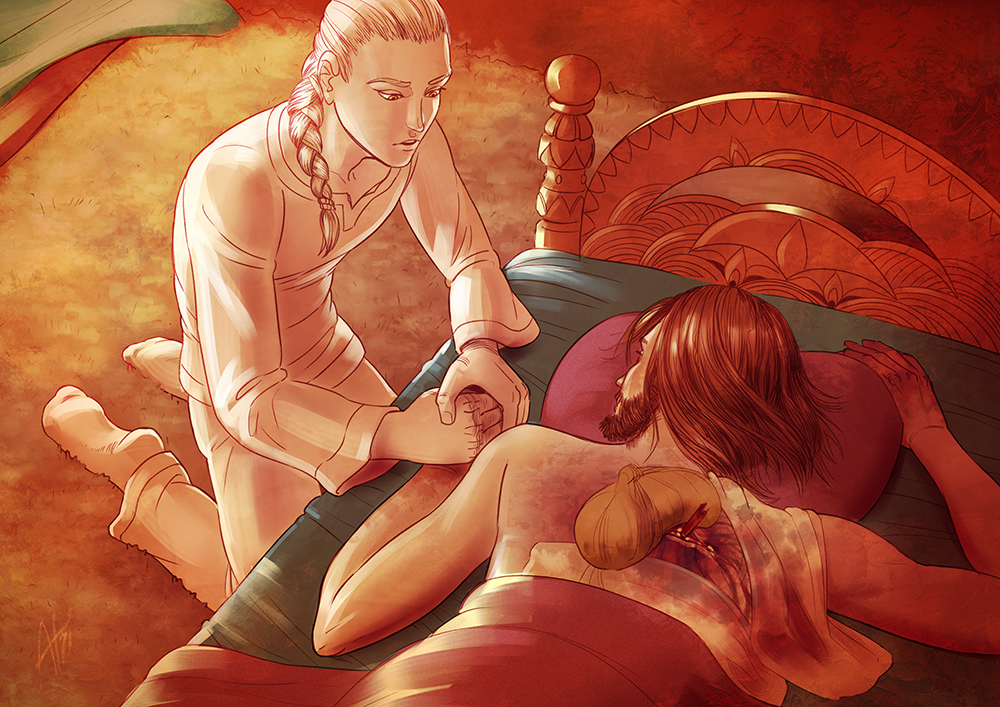
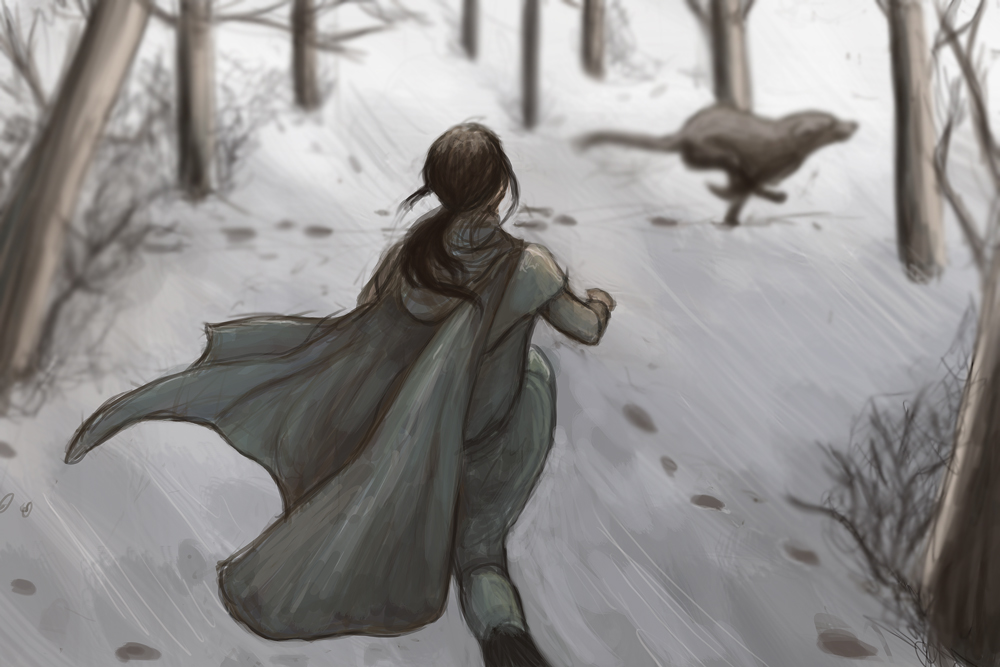
(In case the image caption doesn’t show, it’s fitz + molly from risoria’s Tumblr, here; the image is used for commentary.)

I’ll be at a football game tonight; pick up my Frito pie?

A Robin Hobb Rereading Series: Entry 41: Royal Assassin, Chapter 16

Read the previous entry in the series here.
Read the next entry in the series here.


Coming after, “Verity’s Ships” opens with a gloss of early military actions against the Red-Ship Raiders. It moves on to Fitz glossing the shape of his days for the rest of the season, which keep him quite busy. They also begin to include postings to the Rurisk, the first of Verity’s warships, where he learns seacraft and some of the language of the Outislanders.

Image result for longship
The ship’d be something like this image from Britannica.com, which is used for commentary.

At length, Fitz is able to find a private moment with Shrewd, during which he broaches the topic of marrying, thinking to wed Molly. Shrewd, however, has been approached by Celerity of Bearns and her father, Duke Brawndy, whom Fitz met earlier in the novel and seems to have impressed. Fitz attempts to speak out, but Shrewd harshly rebukes him, conflating him with his father for a moment.

Noting his heartsickness, Fitz continues relating the passage of the season, laying out the disposition of the Skilled with whom he had trained under Galen and their arrangement on the warships of the chapter’s title. It ranges to a training exercise that is ostensibly Skill-assisted, and that is interrupted by Skilled orders from Verity that direct the Rurisk to Antler Island, where a Red-Ship raid is in progress. The crew of the Rurisk joins the melee, and Fitz makes quite a showing for himself in a berserk rage that falls upon him. He does not comport himself as well in the wake of the battle as in the midst of it, and he has little time to rest; more fights follow in the succeeding days and weeks. During one such, Fitz glimpses a white-hulled ship that affects him oddly. It is not present after the battle, and others do not recall seeing it, but it remains disquieting.

Fitz continues to work the Skill with Verity, and he learns him in doing so. He also has something of a sour patch with Molly, and not because he relates Shrewd’s words to her; he does not. And when he calls on Kettricken, he finds he mulling over some thought to bring an end to the realm’s troubles.

I’ve argued before that there is a tendency, owing to Tolkien, to read fantasy novels as borrowing largely from the European medieval–particularly Celtic and Germanic Europe, and that tendency ranges to Hobb’s Elderlings novels. Such chapters as the present one help prompt reading Hobb as European medievalist fantasy, with the single-sailed clinker-built ships and some of the geographical descriptions, as well as other such tropes long present in the series.

It may be the case that the Realm of the Elderlings moves away from the European in the author’s mind as more work gets done on it. Hobb notes her own grounding in Tolkien, and Tolkien’s influence is…substantial, as many, including Luke Shelton, argue and attest. And it makes sense that earlier compositions will cleave more clearly to established patterns, both for the author’s own ease (deliberate or not) and for the audience’s. So there is some cause, even if other interpretations come out better as the series goes on.

Stand me a cup of coffee?

A Robin Hobb Rereading Series: Entry 40: Royal Assassin, Chapter 15

Read the previous entry in the series here.
Read the next entry in the series here.


The next chapter, “Secrets,” opens with the commissioning of the warships Verity has had built. It moves to Fitz’s minimally successful hunt with Nighteyes, after which Fitz finds himself confronted by the Fool. Fitz asks the Fool after his origins, and the Fool replies as plainly as he can, noting his prophetic powers and the system that allows them to flourish. As Fitz turns the ideas over in his mind, he is taken by the damage done by the poisoning at the end of the previous novel, and he collapses.

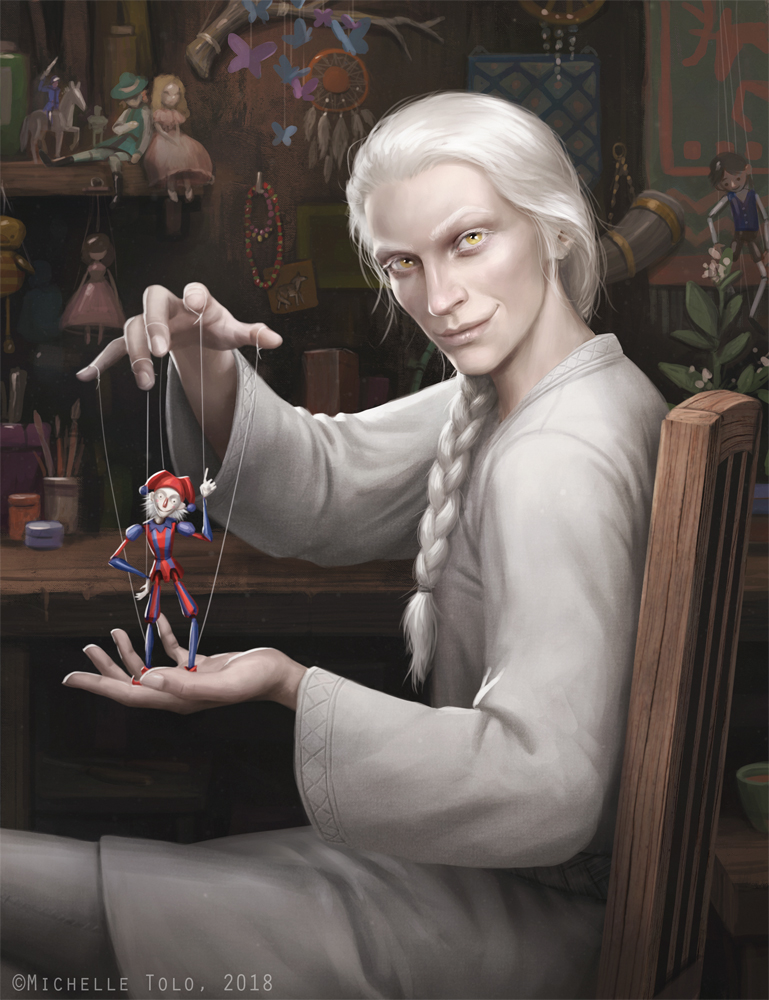
anaryawe:“I finally got my reserved library copy of the Fools Assassin, just in time for holiday reading! Here’s a festive Fool to celebrate. ”
I found this on ambersapricotbrandy’s Tumblr page, here. I’m not sure of any earlier sourcing, but I’m using it for commentary.

Amid his fit, Fitz wanders Buckkeep as if drunk or fevered. Patience manages to extricate him from a potentially awkward social moment, and, later, Chade quizzes him–as well as noting another source of Fitz’s malady. Chade also lays out assignments for Fitz to carry out before dismissing him back to his bed. Fitz enjoys an assignation with Molly, instead.

The next morning sees Burrich summon Fitz for more training. It does not go well to start, fatigue telling on Fitz. But at a point in it, something clicks for Fitz, and he seems to catch the knack of what it is he needs to do.

The (partial) revelation of the Fool’s origins in the present chapter has long-reaching ramifications in the Realm of the Elderlings novels as a whole, such as will receive comment in later installments of this rereading series. For now, though, a few points worth considering come up in the Fool’s explication of himself to Fitz:

  • The Fool openly acknowledging himself as a prophet confirms things that had been suggested earlier in the series. Positioning himself as such, with Fitz as the agent through which he will work change, reinforces the already-noted status of Fitz as the protagonist of the series–he can hardly not be, even without the Fool’s revelation–and puts the Fool in a seemingly similar position, if uncomfortably. It also introduces to the novel a stronger element of the fate/free will discussion that continues to pervade many, many systems of thought.
  • The comments about philosophy being necessary to everyday life are, perhaps, to be expected from someone who makes a living writing; writing and reading demand thinking, which is the source and substance of philosophy. But that there is some self-interest in an author commending reading and contemplation through the voice of a protagonistic character–which the Fool is, clearly–does not mean that the advice is not good. And it is always dangerous to assume authorial intent in characters’ speech, in any event; even if Hobb does not believe what her Fool says, it remains a good thing to note.
  • The comments about the value of the individual function similarly. Each of us is a part of a future recollection; each of us can affect what will come, and in ways we cannot necessarily foresee. That does not mean what we do is without value, and that is a hopeful thing to think upon.

Help me keep this going!

A Robin Hobb Rereading Series: Entry 39: Royal Assassin, Chapter 14

Read the previous entry in the series here.
Read the next entry in the series here.


The chapter that follows, “Winterfest,” opens with a description of how the holiday of the chapter’s title is marked at Buckkeep. It moves to Fitz’s continued work on the tasks assigned him and his ruminations on the current state of Skilled practice in the Six Duchies. He soon falls asleep, though, his exertions and the medication given him overtaking him.

Banquet menus consisted of many types of food
Certainly something worth attention…
Image from Medieval Recipes, used for commentary

Nighteyes’ announcement of Molly’s arrival wakes Fitz from sleep, though. She asks him after going to see Shrewd about their nuptials and broaches the topic of rumors about his recent actions in the field. Fitz turns the questions aside, and the two enjoy another night together.

Molly leaves in the early morning, and Fitz falls asleep again, only to be roused by Burrich summoning him to his training appointment in Verity’s tower. After Burrich stalks off, the Fool calls upon Fitz, offering an apology for his earlier misdirection. He also urges Fitz to call upon Shrewd again, floating the idea that they may be united in their opposition to Regal. They confer, and Fitz reports for training.

His progress in that training is sketched in, and, once it is done, Fitz attends to his many other duties. The first of them is to call on Shrewd, as he had intended. Verity accompanies him through the Skill, noting oddities in his father’s conduct as he does so. Fitz forces his way past a putative attendant and works to set Shrewd’s chambers to rights. The attendant fetches Regal, who interferes–to an extent, before Shrewd issues his orders. Fitz departs, his mind reeling at what he has seen.

I think Hobb does well, overall, at capturing the throes of teenage romance. Fitz’s conduct and thoughts in the present chapter–and several preceding it–bear it out; the propensity towards grandiosity and dramatic declarations rings true for me, as I think has been the case for many other people. (I am not entirely pleased with how I acted in my younger days. Those who know me can probably guess why. And I do not think I am alone in it.) Looking back, both on my teenage years and their “romances” and on a series of novels I have read before, I cannot help but cringe, knowing as I do that what is coming is. For while there are some adolescent loves that linger and deepen, most teenage amorousness leads to other ends than might be desired, and it is not the case that an assassin is like to have a happy ending…at least, not in the short term.

The passage of decades can change quite a bit, however.

Care to fund my holiday events?

A Robin Hobb Rereading Series: Entry 38: Royal Assassin, Chapter 13

Read the previous entry in the series here.
Read the next entry in the series here.


The chapter that follows, “Hunting,” opens with Fitz musing on the different teaching styles of the then-last two Skill Masters at Buckkeep. It turns then to the morning after Fitz’s assignation with Molly, when he reports to Verity. Verity gifts Fitz with a sword and reminds him that he, himself, is still but a servant, chiding Fitz for not warding his mind as he had been taught.

all senses keen by katya-h on DeviantArt, image used for commentary

Verity also tasks Fitz with refining further his control over the Skill, even as he works on exterminating the nearby Forged Ones. The exercise is something of a strain for Fitz, as he works to keep his mind focused on the needed tasks and not to dwell on other matters, particularly Molly and Nighteyes

While taken with his thoughts, Fitz hears a scream and moves to investigate. He finds Forged Ones fighting over a child they have taken, with one having begun to eat her before she dies in the hands of the others. Fitz falls into a rage and attacks, Nighteyes helping him. They prevail with difficulty, and Nighteyes departs moment before riders reach Fitz.

The riders try to make sense of events, and Burrich, who is among them, tends Fitz’s wounds–with clear questions that Fitz does not answer. As Fitz debriefs afterward, Verity ruminates on Fitz’s survival and tasks Burrich to teach him fighting with an axe. Burrich agrees, but he expresses reservations about sending Fitz to do more of the work he has been doing. Verity reminds Burrich that Fitz has little choice in the matter–that none of them do. Fitz surprises both by asserting his willingness to continue.

I’ve noted before that foresight is a dominant theme in the series, making foreshadowing a common device. Having read the books before, I note with some amusement the gesture towards such foreshadowing Hobb makes in Verity’s Skilled comments to Fitz about the child Verity’s mother had used to gather information. Without spoiling too much (insofar as a novel in print for decades as I write can be spoiled), I can note that something similar happens, and more than once, to Fitz–even as he, himself, was formerly positioned to be such an actor.

I’ve also noted that I tend to read Hobb affectively. The present chapter is not an exception to that. Having a daughter who is not much older than the child described…it was not an easy read this time around. (Not that it ever has been; I’ve long been more sentimental than it’s good for me to be, and it’s gotten me into trouble more than once.) I do not find fault with Hobb for refusing to indulge in what TV Tropes describes as “Improbable Infant Survival,” but that does not mean it was comfortable for me to read it. I’m not sure what all it says about me, and I’m not sure I’m eager to find out. I am, though, eager to read on.

Care to send something my way, support my still working on this?

A Robin Hobb Rereading Series: Entry 37: Royal Assassin, Chapter 12

Read the previous entry in the series here.
Read the next entry in the series here.


The next chapter, “Tasks,” opens with Fitz’s later musings on the winter and the state of the Six Duchies during it–not good, in the event. It moves to Fitz departing Verity’s chambers and reporting to Kettricken with Verity’s message for her to take the Queen’s Gardens. Kettricken leaps eagerly to the task, her ladies following her despite the cold, and Fitz muses on the quiet deception he is facilitating in the event.

Fitz and Molly by Mirre-Kala
Fitz and Molly by Mirre-Kala on DeviantArt,
used for commentary

After, Fitz takes a meal in strange solitude and goes out to Nighteyes. He proceeds thence to review the documents with which Verity had entrusted him, regarding them amid his chamber for a time in frustration before calling on Patience. There, he encounters Molly and makes something of a fool of himself to her–in front of Patience and Lacey. Patience chides him gently for the outburst after Molly makes her excuses and departs, and Fitz unburdens himself of some of his cares to her. He also conveys to her that she might go to Kettricken and help her with the Queen’s Garden.

Once he leaves Patience, he purposes to call upon Molly once again, doing so by climbing down to her window. She reluctantly admits him into her chambers as tells him that Regal has pressed upon her that a relationship would be ill-advised. In something of a rush, they consummate their love, and they part in the throes of teenaged romance the next morning.

I’m not sure, at this point, how to read the intimate interlude. Hobb does well to elide the more salacious details, certainly; a passage of erotica or outright pornography would seem out of place against the rest of the narrative. And it is the case that there has been motion throughout the series to have Fitz and Molly come together; it is not necessarily a sudden thing that they do. But Fitz does seem to force the issue a bit, which seems…squicky to my reading, anymore. (And, no, I did not always find the passage problematic. I am still not the person I should be, but I am better than I was, and I keep trying to be better, thanks.) Fitz is hardly an honorable character–being an assassin more or less precludes that, and I’ve discussed the topic at some length elsewhere–so a less-than-upright action may be in character, but I do not want to defend even a fictional offender. So there is that.

I suppose my…unease with the passage now is a sign of the ways in which I *have* changed, partly as a result of getting older, partly as a result of having had the exposures I had in graduate school and in life after. I’ll not deny there is a certain ironic orthodoxy that affected me (ironic in that it is predictably heterodoxical), but having the time to think about things that higher education offers did much to help make me more humane. Carrying that into the world outside the ivory tower is not always an easy thing, to be sure, but it does little enough good staying inside it–especially in the windowless basement rooms thereof that I shared with many, many others.

I continue to welcome your contributions.

A Robin Hobb Rereading Series: Entry 36: Royal Assassin, Chapter 11

Read the previous entry in the series here.
Read the next entry in the series here.


The next chapter, “Lone Wolves,” opens with a brief musing on the Fool before turning to a hunting scene, with Fitz guiding the wolf cub in a failed attempt to take a white rabbit in the snow. After, Fitz guides the cub to an abandoned shack that mice have taken over, purposing to leave him there. He attempts to do so, forcefully and with regret against which he tries to steel himself.

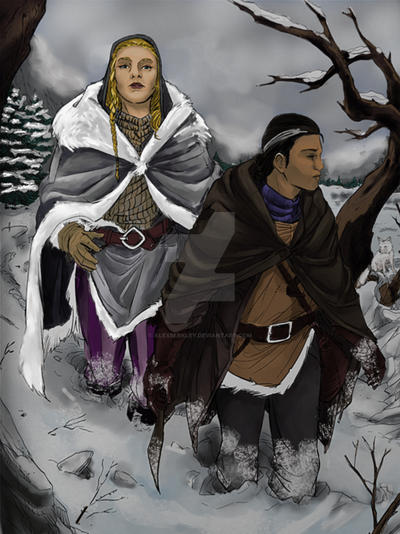
Drawing 2: Fitz and Fool Coloring Book by Alex Berkley on DeviantArt, used for commentary

Lost among his thoughts, Fitz is attacked by Forged Ones who purpose to eat him. He fights them, faring poorly until the wolf cub arrives and turns matters. When Fitz wakes from his exertions, the wolf cub reveals his name, Nighteyes, and their bond reasserts itself with greater intensity.

After, Fitz returns to Buckkeep and reports to Verity, whom he finds Skilling with greater intensity than is to his good. Verity, with some apology, directs Fitz to resume exterminating the arriving Forged Ones. The two also confer about Kettricken, and Verity notes the consuming passion for the Skill. Verity also asks about Fitz’s injuries before bidding him be careful. They eat together, and Fitz considers what is likely to come. They also confer about the Fool and the dearth of Skilled people who should be present but are not. Verity assigns Fitz a mapping task and bids him report early the next morning.

As I read the chapter again, I found myself annoyed by the continued treatment of Kettricken as a childish figure who has to be given tasks to distract her. The fight against the Forged Ones she led, among many others, should have served to Verity as an indication that she is a woman of her own volition and no mean leader, not some idle arm-ornament. And while some allowance might be made to Verity for the thought-disrupting effects of any addiction–and the Skill is repeatedly asserted to be addictive–it still rankles that he looks on the leader his wife is as in need of distraction.

Fitz, too, ought to know better. Indeed, in the chapter, he notes knowing Kettricken better than her husband does. Too, he has demonstrated in the text that he has no small degree of political acumen; his specific suggestion speaks to that acumen, in fact, as well as serving as a bit of revenge for wrongs done him in the previous novel. And while it may be the case that the power difference between him and Verity accounts for some of his behavior, Fitz has proven willing to talk back to power before; he seems to have forgotten things he has already learned, no less so than Verity. It’s something that vexes me as I read again, though I will concede it may be me reading with more affect than I ought to once again.

Fall is coming; help me lay in supplies for the rest of the year.

A Robin Hobb Rereading Series: Entry 35: Royal Assassin, Chapter 10

Read the previous entry in the series here.
Read the next entry in the series here.


The chapter that follows, “Fool’s Errand,” opens with a discussion of the state of Skill practice leading up to Verity’s time. It moves to Fitz recounting his Wit experiences with the wolf cub and his waning denial of their growing bond.

Canis lupus occidentalis.jpg
Standing Wolf by Ellie Attebery on Flickr, image used for commentary

Of a morning, Fitz is asked by some of the guards at Buckkeep to put to Verity an idea that they had had to form an independent guard unit for Kettricken. Fitz presses them for a bit before agreeing to carry the idea to the king- and queen-in-waiting. Fitz also rehearses his continued longings for Molly, as well as the state of affairs in Buckkeep following the funeral proceedings. As he makes to attend on Kettricken, he is greeted by the Fool, who poses to him questions about the dearth of Skilled in the Six Duchies. Fitz contemplates the matter, finding difficulty in interpreting the Fool’s words; the Fool presses on, making mockery of Fitz and leaving him much to consider as he reaches Kettricken’s chambers.

When Fitz reaches them, Regal greets and insults him, provoking him to a rage that morphs into impolitic delight at seeing Molly. She excuses herself, and Fitz enters Kettricken’s chambers, finding her centered and more at ease than he has seen her for long. She notes that she has returned to herself, offering philosophical discussion and meditation. Fitz realizes, with some astonishment, that Kettricken is possessed of the Wit, and the wolf cub through him connects to her, exulting in it. Fitz, however, is wary; knowing that his own Wit-work can be detected by others, he realizes that others’ might, as well.

The chapter offers a bit more to support the idea that the Wit, at least in the Farseer novels, is a metaphor for homosexuality. That Kettricken is possessed of it, marking her as even more Other to the mainstream Six Duchies than her ethnic identity already does, poses the same kind of threat that being a closeted member of a minority population in the United States in the mid-1990s did; the revelation, even then and there, could well be fatal, as is noted here, here, and elsewhere. And Fitz already knows he has enemies that would not scruple to use a perceived usurping outsider as an avenue of attack against him.

There is also an interesting bit about meditation in the chapter. The philosophical approach Kettricken voices is somewhat fatalistic, something of a “the world will happen as it happens, despite what you do,” and the machinations of fate do form a major motif in the series, filled as it is with prophecy and the like. But the meditative aspect of Kettricken’s approach to life, juxtaposed with Fitz’s inability to participate in it, seems it could be read as a comment about the accessibility of such practice. Fitz, while not exactly among the lower classes, is not among the elite; he has to work, and abundantly, while Kettricken sees herself as unoccupied in her role as queen-in-waiting. For her to meditate, when Fitz cannot, could be taken as a rebuke of the practice as something set aside from the working world. But that might be going further than can be sustained by the text as a whole; in the Mountain Kindgom, it is asserted, Kettricken would have had and did have much work to do. She is not depicted as having meditated there, though she seems to report it in the present chapter, so…

I shall still thank you for your support.

A Robin Hobb Rereading Series: Entry 34: Royal Assassin, Chapter 9

Read the previous entry in the series here.
Read the next entry in the series here.


The next chapter, “Guards and Bonds,” opens with a brief rumination on the differences between lived experience and careful study. It moves on to track the night after Fitz leaves Molly’s chamber and the following day, when he calls upon Patience once again. He is somewhat surprised to hear her warn him against court intrigues–and moved at her sincerity in doing so, when it is not to her advantage or even, seemingly, in her interest. Fitz is also shown a bit of his folly by Lacey, who pointedly demonstrates that she is not only a lady’s attendant.

image
Fitz and Cub (Nighteyes) Playing in the Snow from Royal Assassin, taken from facelessfrey’s Tumblr page, used for commentary

After he leaves Patience, Fitz calls on Kettricken. He finds that she is absent, and he goes in search of her. The search leads him out to the stables, where he is informed that Burrich is at work on a funeral pyre for his old hound, Vixen. He is also informed that Kettricken has left Buckkeep afoot, and Fitz moves to pursue her. When he overtakes her, she expresses a desire to attend on Verity and a dissatisfaction that he seems uninterested in her. She also marks the wolf cub that Fitz has been tending, though she does not connect it to him.

Fitz is able to persuade Kettricken to return to Buckkeep for the time, conversing through the Wit with the wolf cub along the way. Molly marks their return, and Fitz goes off to pay his respects to Vixen before gathering meat and bones to take to the cub. They play together for a time, and Fitz feels himself slipping into their bond. When he breaks the connection, it is only with regret, and he is reluctant as he returns to Buckkeep.

Much of the chapter focuses on depicting women, from Patience’s assertions about the historically strong Farseer queens to Patience and Lacey to Kettricken. To my mind, Hobb makes a point of subverting the kinds of typing that pervades Tolkienian-tradition fantasy literature in the depictions; none of the women seem to adhere to one trope or another, even if Patience lampshades her in-milieu presentation. Rather, they come off as having the kinds of contradictory motivations and behaviors that people, rather than caricatures, do. Patience is flighty, yes, but evidently more capable and aware than she is commonly credited. Lacey seems demure but is clearly a threat. Kettricken is strong and noble in many ways, although she is clearly affected by her interpersonal relationships. Given how many other novels, and more popular, have so much trouble depicting women, it is a pleasure to see one that does not. To see it come from twenty years ago (as of this writing), when so many pieces of contemporary fiction–and all too many people who are all too real–still cannot do better than they do…whether it should be read as praise for Hobb or a lamentation of the state of the world is not yet clear to me.

I shall thank you for your support.

A Robin Hobb Rereading Series: Entry 33: Royal Assassin, Chapter 8

Read the previous entry in the series here.
Read the next entry in the series here.


The next chapter, “The Queen Awakens,” opens with two stanzas from the in-milieu “The Vixen Queen’s Hunt” before moving to detail preparations at Buckkeep for a large hunt. Fitz reports to Verity of the events in the keep, and Verity dithers about how he will proceed and his own ineptitude. He does send Fitz to observe in his stead, keeping himself aloof, and Fitz rushes thence, delayed slightly by Regal.

Queen Awakes   “This is not a hunt. Let your hearts be solemn. We do not go to hunt, but to claim our casualties. We go to lay to rest those the Red Ships have stolen from us. Those we put down today are of the Six Duchies - our own”.-Kettricken,...
Queen Awakes by Jemina Malkki on the artist’s Tumblr page,
image used for commentary

Fitz arrives in time to see Kettricken dispel the festive atmosphere that has cropped up, reminding the hunters that they are riding to put their fellow Duchies-folk to rest rather than to garner any acclaim or claim any trophies. The hunters divest themselves of their joyful trappings, and they prepare to depart somberly. Regal is incensed by the whole affair, and Verity, who has descended to take stock of the situation, is strangely emboldened. Fitz moves off to help ensure that matters are made ready for Kettricken’s return.

When she does return, it is at the head of a funeral procession. Fitz assists in preparing the bodies for cremation and identifying the dead–they include one of his childhood friends. A solemn feast follows the funeral proceedings, with Shrewd unexpectedly presiding, and Fitz marks the unity promoted by the event.

Chade also remarks upon it when he summons Fitz to his hidden chambers that night. The old man waxes eloquent upon the unexpected asset Kettricken has become. Fitz is drawn into somewhat dangerous talk by the open mood, and Chade rebukes him for it before announcing that he is to be dispatched on a mission of his own. He does not share the details with Fitz, and Fitz is soon dismissed.

After leaving Chade, Fitz makes his way to Molly’s chambers, opening her door latch ineptly. There is a tense encounter between them, but it ends up with them admitting their love for one another and kissing.

In the chapter, as Verity dithers, Fitz remarks on the unsettling humanity of the man who seems poised to be the next King of the Six Duchies. He had remarked earlier on noticing some of the incapacities Verity displays, notably in his handling of people when he is surprised, and the narrative earlier notes Verity’s confession that he was not raised to rule, but to aid a ruler he trusts. So that much is not new.

What is new, though, is that Fitz seems taken aback by it. Whether the reader is to take this as a sign that Fitz is becoming disillusioned or as a comment against blind trust in a ruler is not clear–and it ultimately matters little, since both readings work. Fitz is growing, and growing stronger, as his interactions with Regal and Chade, in particular, show. Those who rule are themselves but people, subject to the same flaws and failings as any others, and while they may be trusted to a large extent, they will err, and it is likely that others will pay for the mistakes. It is a lesson that seems to need reiteration far more often than offers comfort.

Nothing witty this time, just a request for a bit of funding.