Sample Student’s Own Question/Researched Paper: Why Not Have a Rhetoric Requirement among UL Lafayette PhD Students in English?

What follows is a conference-length papers such as my students are asked to write for the SOQ assignment during the Spring 2016 instructional term at Oklahoma State University and the ResPpr assignment during the Spring 2016 instructional term at Northern Oklahoma College. As is expected of student work, it treats an issue of its writer’s curriculum. It also adheres to the length requirements expressed to students (they are asked for 3,100 to 3,400 words, exclusive of heading, title,  page numbers, and Works Cited entries; the sample below runs to 3,116 words, exclusive of its own end-of-text citations), although its formatting will necessarily differ from student submissions due to the differing medium. How the medium influences reading is something well worth considering as a classroom discussion, particularly for those students who are going into particularly writing- or design-intensive fields.

Note that the paper below follows from earlier activities at both the University and the College, serving generally as a later version of them, and so it will make free use of materials developed in response to those activities.

Among the many things of which I am proud is that I hold a doctorate in English from the University of Louisiana at Lafayette (ULL). Earning it required me to sit for no few hours of coursework past my Master of Arts degree and to complete a dissertation. It also obliged me to pass a series of comprehensive exams. Those exams are described by the ULL English department in its online “English Graduate Student Handbook” as consisting of four five-hour on-site tests taken in one or two semesters and spread across four of the following areas of inquiry: English literature to approximately 1500 CE, early modern English literature, Restoration and Eighteenth-Century English literature, Nineteenth-Century British literature, British literature from the twentieth century forward, American literature to approximately 1900 CE, American literature from approximately 1900 CE, literary theory, rhetoric, linguistics, and folklore; an option exists to sit for one exam in an open topic that must be proposed by the student and approved by the Department on a case-by-case basis. (My own were in early British literature, early modern English literature, early American literature, and contemporary fantasy literatures.) The exams reinforce the avowed generalist nature of the program, seeking to equip students to research and teach across a number of fields, but a problem arises when that theory encounters predominant practice. As Holly Hassel and Joanne Baird Giordano note in a 2013 CCC article, most of the teaching done at the collegiate level is by non-tenure-track faculty, reaffirming comments from Mike Palmquist and Sue Doe in a 2011 issue of College English. Also, as Brad Hammer notes in a 2012 CCC commentary, most of the teaching non-tenure-track faculty do is in first-year composition. If the curriculum, encapsulated by the comprehensive exams, is meant to equip its graduates to enter into the academic job market, then it would be sensible for it to require coursework in rhetoric and composition as it does for literature; per the “English Graduate Student Handbook,” all students must take at least two examinations in literature, regardless of their concentration or emphasis. The same is not true for rhetoric, however, and it defies sense to think there is no reason there is no rhetoric requirement among PhD students in English at ULL. The most likely primary reason–because there are doubtlessly many contributing factors–inheres in concerns of logistics.

It is, admittedly, tempting to try to ascribe the lack of a rhetoric requirement instead to perceived disciplinary status. There is a prevailing tendency among institutions of higher learning to regard rhetoric and composition as service disciplines. That is, rhetoric and composition are held not so much to have their own distinct identity, but to exist to enable other disciplines to do the work they do. Hammer makes the point, as do Hassel and Giordano; both pieces speak to the relegation of the experience most have with rhetoric and composition to lower hierarchical levels. This is reinforced by dominant teaching practices, which assign the common classes in rhetoric and composition–first-year composition classes–to the least experienced instructors–typically second-year graduate students, irrespective of their own concentrations within English studies. My own teaching at ULL was of such a kind; while I did teach first-year courses throughout my attendance at that institution, I began to do so after completing but one year of graduate school. I was hardly atypical in that (although I might have been so in coming into graduate work with some formal teaching experience already), and the collective experience argues that the teaching of rhetoric and composition is devalued. If it is devalued, then a lack of a rhetoric requirement in doctoral examinations makes sense; the exams emphasize areas of study, and the devalued does not generally receive emphasis.

While such a thing might be true in other English departments, however, it is not at all likely to be the case for the ULL English Department. Many of the faculty list “rhetoric” or some convenient variation thereof as a principal research and teaching interest; the list of graduate faculty in the “English Graduate Student Handbook” identifies four of the 25 members included thereupon as explicitly claiming to be rhetoricians, more than any single other identification (taking the specific variations of “creative writing” listed as each constituting its own area). The more general faculty webpage identifies another member of the graduate faculty, one who does not list “rhetoric” as an interest on the graduate faculty list, as the first-year writing director, which position necessarily carries a strong professional interest in rhetoric and composition. Further, the general faculty list identifies as interested in rhetoric and composition four other members of the teaching corps in the ULL English Department–in addition to several others whose research and teaching interests are not listed and who may well therefore be rhetoricians by training. (Several faculty have been added to the roster since I completed my studies at the institution, so I cannot speak to their interests.) Additionally, several of the English faculty are prominent in rhetoric and composition studies more broadly. Clancy Ratliff, for example, is highly placed in the National Council of Teachers of English, which body concerns itself greatly with rhetoric and composition, and James McDonald, a former head of the department, has contributed much to prevailing rhetorical study. It is not to be expected that such people will devalue rhetoric and composition as a field of study; it is not to be expected that disciplinary bias argues against requiring all PhD students in English at ULL to sit for a comprehensive exam in rhetoric.

Rather the opposite of disciplinary or departmental disfavor would seem to be in place, which demands another explanation entirely–and logistical concerns seem the most likely culprit for obliging members of the professoriate to set aside their own areas of interest. And they are substantial as regards comprehensive exams. For one thing, there are interdisciplinary standards and expectations that apply to the institution of the comprehensive exam as a whole. Surveys of comprehensive exam practices conducted by Robert E. Nolan; Nicole Ponder, Sharon E. Beatty, and William Foxx; and Joseph A. Schafer and Matthew J. Giblin, among others, note that a scant few forms of exams are found in practice; the surveys work across disciplinary boundaries, which makes all the more compelling the idea that the exams must happen, and that they must happen according to particular formulas. (Notably, however, Ponder, Beatty, and Foxx identify only one program that eschews the comprehensive exam altogether [233].)  The idea receives reinforcement by the notion that the comprehensive exam serves as rite of passage, a ritual that must be performed before participants can be recognized as peers in intellectual inquiry. Nolan speaks to the issue (39, 42); as do Ponder, Beatty, and Foxx (230); as well as Schafer and Giblin (277, 284). Both a 1987 piece in The American Sociologist by Cynthia Negrey and a 2015 piece in Arts & Humanities in Higher Education by Sara Scott Shields explicate the ritual aspects of the comprehensive exam in more detail, pointing to the enduring concept of the comprehensive exam as a thing that must be done in particular ways across disciplines to ensure the very identity of the intellectual as an intellectual. Such a concept tends towards making changes to forms difficult, which may account for some part of the non-adjustment of the ULL PhD comprehensive exams in English to account for current employment demands.

More concrete a reason for maintaining comprehensive exams, as well as one more frequently attested, is to allow students to demonstrate their mastery of the existing work done in a given field. Since the doctorate, particularly the PhD, is a research degree, one whose holders are expected to generate new knowledge, that it would oblige those who seek it to demonstrate such mastery is sensible. Again, scholars across disciplines speak to the issue (Nolan 41-42; Ponder, Beatty, and Foxx 227, 229-30; Schafer and Giblin 277, 284), situating it as one prevalent in the academy broadly. Changing the comprehensive exams therefore potentially registers as a possible lowering of standards for graduates, something that any academic unit will be chary of inviting; humanities departments such as the ULL English Department, which face a prevailing social onus (the jape of “I have a degree in English; would you like fries with that?” comes to mind, despite the many problems attendant on it), will be even more likely to look askance at any adjustment that might make them look less rigorous. This is not to say that including rhetoric as a required area of examination for ULL PhD students in English would be a lowering of standards–quite the opposite is likely to be true, as is noted below–but it is to say that it might appear to be so as looked at by those outside the field who exert unfortunately disproportionate influence on the allocation of resources to the Department and whose views must therefore be considered. (Indeed, recent problems with funding of Louisiana public universities highlight the immediacy of the problem. In February 2016, Louisiana announced that a funding program upon which students and the institutions that serve them rely would be suspended, as Brock Sues reports for WBRZ in New Orleans. Rebekah Allen, writing for The Advocate, reports that universities would be expected to absorb any costs incurred. Outside concerns about funding therefore loom large.) Any change, even one that would likely be for the better, thus must be approached with caution–if it can be safely approached at all.

As noted above, requiring students to take a comprehensive exam in rhetoric would, despite potential appearances, be an increase in their workload, as well as that of the faculty involved in the examination process. The additional area requirement would oblige many students to stretch their areas of study further than the generalist curriculum in place in the ULL PhD program in English already demands. I would not have been able to focus my area of endeavor even as much as I did were there a rhetoric exam requirement in place when I sat for exams, for example, and I often experience the sense of being insufficiently rigorously trained in my primary area of study (hence my eagerness to remain in practice through certain classroom activities, such as the riddle quizzes that have appeared in my teaching and that are discussed in an older set of teaching materials [“About”]). I was not atypical in seeking to align my exam areas or the areas of intellectual inquiry they represent. Since comprehensive exams purport to have students demonstrate mastery of the literature in a given field, asking for an additional area of examination that might well be markedly dissimilar from the areas students are already studying intently presents a formidable challenge to students who are already asked to do a substantial amount of work to earn their degrees. While it might well be argued–and with some justice–that those who seek doctorates should be able to handle many intellectual challenges, it is also true that an exam that covers one thousand years of literature in a minimum of three languages (Old English, Middle English, and Latin), or another that asks for several hundred years of material that could be in three other different languages (Spanish, French, and modern English), already presents a formidable challenge. Adding to it would doubtlessly occasion comment, and unfavorable comment, from the students who would have to face such an exam; given the work that is done by graduate students, helping faculty with their own research and teaching no few classes, there is some incentive to keep them content. Since imposing additional requirements would vitiate against that contentment, it suggests another type of logistical challenge to adding a required exam in rhetoric to what students in the ULL PhD program in English face.

One such additional requirement would be an added burden of coursework. Presently, PhD-seekers in the ULL English Department are obliged to take a gamut of courses to meet distribution requirements, per the “English Graduate Student Handbook,” courses that allow them to fulfill the generalist mission of the program. Implicit in the description of the coursework is that the courses lead up to and help prepare students for their comprehensive exams, the completion of which must precede the work to develop new knowledge conducted in the dissertation. For students to be able to successfully complete their dissertations, however, they must generally focus their attentions reasonably narrowly; again, my own exam spread is not atypical, as I am given to understand it. (I remain in contact with a number of people who have successfully completed the PhD program in English at ULL, and in focal areas other than mine. The discussions, informal in nature, corroborate my own experience reasonably well.) For many students, the addition of a rhetoric exam requirement would prove distracting from their intended foci, potentially hampering their ability to conduct the sustained research and investigation that a dissertation in the humanities demands–for while many might argue that poring over texts is easy, poring over hundreds of years of texts or the thousands of years that rhetorical study would seem to oblige quickly becomes quite the demand. Again, then, the added burden is one likely to occasion unfavorable comment, making it something that must be approached carefully if at all. It becomes something of a logistical concern therefore, one not necessarily easily treated and so one that suggests being set aside in favor of more immediate concerns.

Another such concern suggests itself, although one for the faculty more than for the students. As noted above, there is a strong implicit expectation that students who will examine in an area of inquiry will take courses in that area, taking the time not spent in meeting distribution requirements to cement their knowledge and understanding of those sub-fields in advance of demonstrating that knowledge and understanding. Obliging a rhetoric exam would therefore prompt more students to take courses in rhetoric and composition–wherein lies some difficulty. Graduate courses, because they are more intense due to the higher level of study and the increased depth of inquiry prompted thereby, demand more faculty involvement than almost any undergraduate class. (Directed independent studies at the undergraduate level, as well as undergraduate thesis work, are the exceptions.) This means that they must necessarily enroll fewer students–a need more emphatic for rhetoric classes, whose very subject matter is argumentation, such that they will demand more display of argumentative technique, demanding more time and effort to assess than many other classes might. That is, while a literature class might well ask for two papers (conference- and seminar-length, or 10- and 20-page pieces), supplemented by discussion and perhaps an exam (although the last is not necessarily common, in my experience), a class in rhetoric will be likely to demand persistent writing–and so persistent assessment from faculty. If a graduate seminar has a maximum enrollment of, say 15 students (which number seems a bit high), then a literature seminar can expect to see the professor review some 30 pages per student, or some 450 for the class–and the professor is likely to read graduate work with greater intensity and higher expectations than undergraduate work will receive. A rhetoric seminar might well expect twice that–and professors rarely teach but one graduate seminar in a term.

Even if faculty are willing to bear the brunt of student ire–and they may well be, particularly since an exam and concomitant coursework in rhetoric would be helpful for those going into the dominant academic job market–they may well not be willing to take on yet more burdens than they already carry with their current teaching loads, service obligations, and the calling to research which many feel. Increasing class sizes will not work for the reasons noted above, and keeping matters as they are in terms of enrollment would also be ineffective; class size caps would ensure that students are delayed in completing their degrees, which has deleterious effects on individual students (Nolan speaks thereto), as well as on programs, as completion rates and times factor into how programs are assessed and valued. The simple solution to the issue of workload and increased enrollment–bringing in additional faculty–runs afoul of the budgetary concerns that are always present but particularly prominent at public universities in Louisiana in 2016. It might well also begin to introduce difficulties at higher administrative levels; the PhD program in English at ULL is explicitly generalist, and bringing in several additional rhetoric and composition faculty at the level they would need to be introduced–graduate faculty designation is a separate thing, markedly subject to administrative shenanigans, as my experience has shown me–would begin to argue that the program is adopting a rhetorical focus. Such adoption might lead to the perception that the program is duplicating other institutions’ works–even if ULL is the only institution in the University of Louisiana system that offers a doctorate in English (Elliott, “Sample”), there are other public school systems in the state and other institutions available. Access to such a thing through other venues might well suggest that the ULL program is redundant and can be eliminated therefore. It is not something that would be good to see for the faculty, understandably, nor yet for those who have yet to complete their courses of study or who have already done so. Another systemic concern that argues against requiring an exam in rhetoric, useful though it would be, thus presents itself.

The kinds of logistical challenges that attend on requiring PhD students in English at ULL to sit for a comprehensive exam in rhetoric are formidable, certainly, and facing them will take no small degree of political will at the institutional level and above. As the only member of the University of Louisiana system to grant a doctorate in English and one of only three in its athletic conference to do so (Elliott, “Sample”), it does not face much competition, and so it may not have much immediate reason to change. But it does have long-term reasons to adjust how it prepares its students. The more of its graduates who can successfully enter the academic workforce, or who can successfully pivot into the kinds of professional writing demands of the emergent workplace, the more attractive ULL and its English Department will both be, which cannot help but conduce to the long-term health of the organizations. Obliging PhD students in English to sit for an examination in rhetoric–and to take the courses that such an examination effectively demands–will help in both cases, suggesting that the change, although difficult, is one well worth making.

Works Cited

  • Allen, Rebekah. “Gov. John Bel Edwards on Radio Show: ‘I can’t guarantee TOPS will be fully funded next year.'” The Advocate. Capital City Press, 12 February 2016. Web. 5 April 2016.
  • Elliott, Geoffrey B. “About Riddles.” Geoffrey B. Elliott’s Teaching Blog. Geoffrey B. Elliott, 11 October 2012. Web. 5 April 2016.
  • —.”Sample Infographic Portfolio Assignment: Context to Answer a Question about the Comprehensive Exams for UL Lafayette PhD Students in English.” ElliottRWI. Geoffrey B. Elliott, 1 March 2016. Web. 1 April 2016.
  • Hammer, Brad. “The ‘Service’ of Contingency: Outsiderness and the Commodification of Teaching.” CCC 64.1 (September 2012): A3-A7. Print.
  • Hassel, Holly, and Joanne Baird Giordano. “Occupy Writing Studies: Rethinking College Composition for the Needs of the Teaching Majority.” CCC 65.1 (September 2013): 117-39. Print.
  • Negrey, Cynthia. “How I Demystified Academe and Got a PhD.” The American Sociologist 18.1 (Spring 1987): 58-62. PDF file.
  • Nolan, Robert E. “How Graduate Students of Adult and Continuing Education Are Assessed at the Doctoral Level.” Journal of Continuing Higher Education 50.3 (Fall 2002): 38-43. PDF file.
  • Palmquist, Mike, and Sue Doe. “Contingent Faculty: Introduction.” College English 73.4 (March 2011): 353-55. Print.
  • Ponder, Nicole, Sharon E. Beatty, and William Foxx. “Doctoral Comprehensive Exams in Marketing: Current Practices and Emerging Perspectives.” Journal of Marketing Education 26.3 (December 2004): 226-35. PDF file.
  • Schafer, Joseph A., and Matthew J. Giblin. “Doctoral Comprehensive Exams: Standardization, Customization, and Everywhere in Between.” Journal of Criminal Justice Education 19.2 (July 2008): 275-89. PDF file.
  • Scott Shields, Sara. “Like Climbing Jacob’s Ladder: An Art-Based Exploration of the Comprehensive Exam Process.” Arts & Humanities in Higher Education 14.2 (April 2015): 206-27. PDF file.
  • Sues, Brock. “Budget Concerns Cause State to Temporarily Suspend TOPS Payments.” WBRZ.com. WBRZ, 11 February 2016. Web. 5 April 2016.
  • U of Louisiana at Lafayette Department of English. “Current Faculty and Staff.” U of Louisiana at Lafayette Department of English. U of Louisiana at Lafayette, 8 December 2015. Web. 1 April 2016.
  • —.”English Graduate Student Handbook.” U of Louisiana at Lafayette Department of English. U of Louisiana at Lafayette, 23 September 2015. Web. 5 April 2016.

Class Report: ENGL 1213 at NOC, 4 April 2016

After addressing questions from previous classes, discussion noted the availability of a survey informing the FinEx; information is below. It also asked after student progress on the ResPpr and treated the assigned readings.

The FinEx survey can be found here: http://goo.gl/forms/GPCQDOABFx. Students who complete it before the end of office hours on Friday, 8 April 2016, will receive an A+ quiz grade.

Students are advised that office hours on Friday, 8 April 2016, will be truncated, as they will have to start later than usual due to instructor participation in a local linguistics study. Eligible students are encouraged to participate, as well.

Students are reminded of the following due dates:

  • ResPpr RV (due online before class begins on 13 April 2016)
  • ResPpr FV (due online before class begins on 20 April 2016)
  • FinPort (due online before class begins on 27 April 2016; information is forthcoming as of this writing)

The section met as scheduled, at 1300 in North Classroom Building Room 311. The roster listed seven students enrolled, unchanged since the previous class meeting. Five attended, verified informally. Student participation was good.

No students attended office hours since the previous class meeting.

About a Local Linguistics Study

Because collegiality matters, I pass on the following information from Sara Loss, Visiting Assistant Professor of English at Oklahoma State University. She is requesting participants for a linguistics study; details are below:

What: First – tell me if you could or couldn’t say some sentences
Then – give judgments on a computer about what different sentences mean. (A device on the computer will track where your eyes are looking!)

How long: About half an hour.

When: We’ll arrange a time. Send me a few times that work for you.

Where: Morrill 112, The Linguistics Lab

Sorry, no compensation.

Please email me at saraloss@okstate.edu for more information or to set up a time.

The accompanying flier appears here: Personal Datives Flier.

I am trying to participate in the study; I encourage you to do the same. Help us make new knowledge!

Class Report: ENGL 1213 at NOC, 30 March 2016

After addressing questions from previous classes, discussion inquired after student impressions of the AnnBib, of which the FV was due before class began. Readings assigned for the day and further ideas of the ResPpr also received attention.

Students are reminded of the following due dates:

  • ResPpr RV (due online before class begins on 13 April 2016)
  • ResPpr FV (due online before class begins on 20 April 2016)
  • FinPort (due online before class begins on 27 April 2016; information is forthcoming as of this writing)

The section met as scheduled, at 1300 in North Classroom Building Room 311. The roster listed seven students enrolled, unchanged since the previous class meeting. Six attended, verified informally. Student participation was good, if somewhat distracted.

No students attended office hours since the previous class meeting.

Class Report: ENGL 1213 at NOC, 28 March 2016

After addressing questions from previous classes, discussion treated additional concerns of the AnnBib before discussing the assigned reading for the day and refining discussion of the ResPpr.

Students are reminded of the following due dates:

  • AnnBib FV (due online before class begins on 30 March 2016)
  • ResPpr RV (due online before class begins on 13 April 2016)
  • ResPpr FV (due online before class begins on 20 April 2016)

The section met as scheduled, at 1300 in North Classroom Building Room 311. The roster listed seven students enrolled, unchanged since the previous class meeting. Five attended, verified informally. Student participation was good.

One student attended office hours since the previous class meeting.

Class Report: ENGL 1213 at NOC, 23 March 2016

After addressing questions from previous classes, discussion asked after impressions of the AnnBib RV, which was to have been submitted before class began. Comments about assigned readings were voiced, and information regarding the ResPpr was presented.

Students are reminded of the following due dates:

  • AnnBib FV (due online before class begins on 30 March 2016)
  • ResPpr RV (due online before class begins on 13 April 2016)
  • ResPpr FV (due online before class begins on 20 April 2016)

Students are informed also that the College final exam schedule for the current term lists the appointed exam time as 1400-1550 on 2 May 2016. Students should expect to meet in the regular classroom for it.

The section met as scheduled, at 1300 in North Classroom Building Room 311. The roster listed seven students enrolled, unchanged since the previous class meeting. All attended, verified informally. Student participation was good.

No students attended office hours since the previous class meeting.

Class Report: ENGL 1213 at NOC, 21 March 2016

After addressing questions from previous classes and addressing formatting concerns, discussion focused on matters of assigned readings, long neglected in favor of assignment discussions and instructor illness on 9 March 2016.

Students are reminded of the following due dates:

  • AnnBib RV (due online before class begins on 23 March 2016)
  • AnnBib FV (due online before class begins on 30 March 2016)
  • ResPpr RV (due online before class begins on 13 April 2016; note that materials for the assignment are not yet developed as of this writing)

The section met as scheduled, at 1300 in North Classroom Building Room 311. The roster listed seven students enrolled, unchanged since the previous class meeting. Six attended, verified informally. Student participation was reasonably good.

No students attended office hours since the previous class meeting.

For 9 March 2016

As it happens, I do occasionally get ill such that I cannot take the risk of coming in to work. Such a thing has happened to me today; I know what it is, and I am getting it taken care of, so I should be able to be back to work when I am next scheduled to be. In the meantime, however, there are some things that need to be discussed for my students at Oklahoma State University and Northern Oklahoma College. They should appear below.

Oklahoma State University

Students of mine at Oklahoma State University should be working on their Infog, of which the RV is due before the beginning of class time on 11 March 2016. That RV is supposed to consist of a statement of goals and purposes, a raw-form infographic, and a digital-original form of the infographic, all in a single Word document. Compiling the document will require students to insert graphics, and legibility of the graphic may require resizing pages. I had meant to cover one method of doing so in a single document with my students today; since I am not in the classroom, that will not be possible, so I am putting together this commentary to help with that task.

Please note that the directions below are written from the perspective of a PC user; commands for Mac and other platforms will be different. Please note also that the directions below work from previously existing materials, the sample infographic provided for students, here.

Drafting the statement of goals and purposes should work much as previous assignments for the class have; the text should be left-aligned in double-spaced 12-point Garamond, Georgia, or Times New Roman type, with paragraphs indented half an inch from the margin and headings, title, and page numbers in place as normal. It should look something like this:G. Elliott Spring 2016 ENGL 1213 Infog Example Img. 1

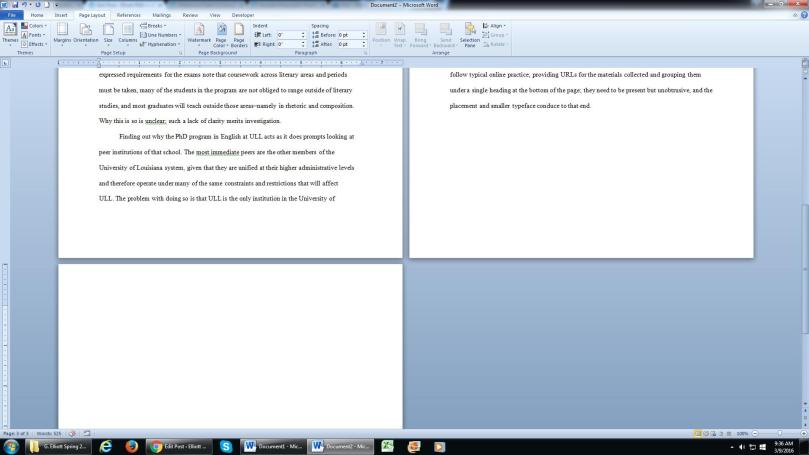
After completing the text of the statement, hit the enter key once to move the cursor to a new line. Then start a new section of the paper. To do so, go to the “Page Layout” tab at the top of the screen and select it. Next, select “Breaks,” which should offer a drop-down menu. On that menu, under the heading “Section Breaks,” select the “Next Page” option, which will move the document to a new page, with that new page being a new section of the document able to be adjusted independently of the other parts of the text. The selection should look something like this:G. Elliott Spring 2016 ENGL 1213 Infog Example Img. 2

Once the selection is made, the screen should look something like this:G. Elliott Spring 2016 ENGL 1213 Infog Example Img. 3

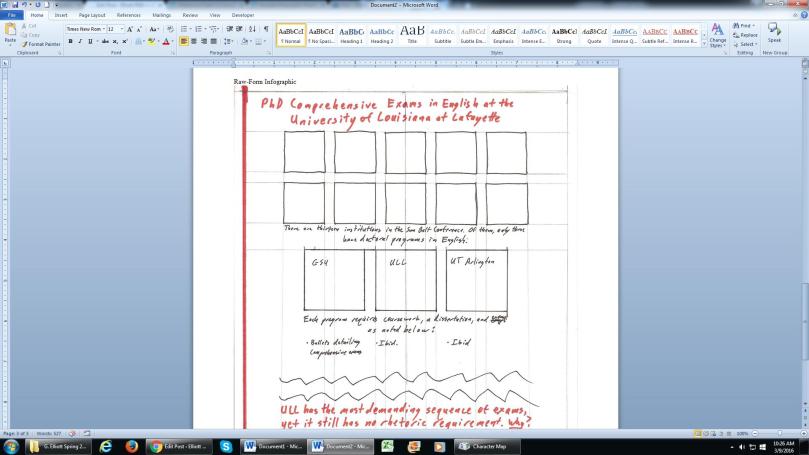
Page numbers will need to be inserted into the new section; the document is continuous, and the pagination needs to reflect it. And it will be helpful to have a subject heading that indicates what content will be in the new section; my sample post on the blog called it “Raw-Form Infographic,” which seems a useful label. I put it into my document, changing the spacing on that line to “Single” to facilitate image placement. (It is a variation from “normal” formatting, admittedly. Visuals introduce changes.) A problem arises, however, in that my hand-drawn raw-form infographic is on letter-size paper, as are many done by students. Inserting that image into another letter-size page will shrink it, making it more difficult to read than it needs to be.

To allow the image to show up at full-size, then, the page into which it is inserted must be made larger. (Keep in mind that it has to fit onto the page along with its label.) Margins will do well to remain at one inch, so the page will need to be two inches wider than letter-size: 10½ inches. Height will need to accommodate the label; an inch in addition to the two added for margins should suffice, making the overall page height some 14 inches.

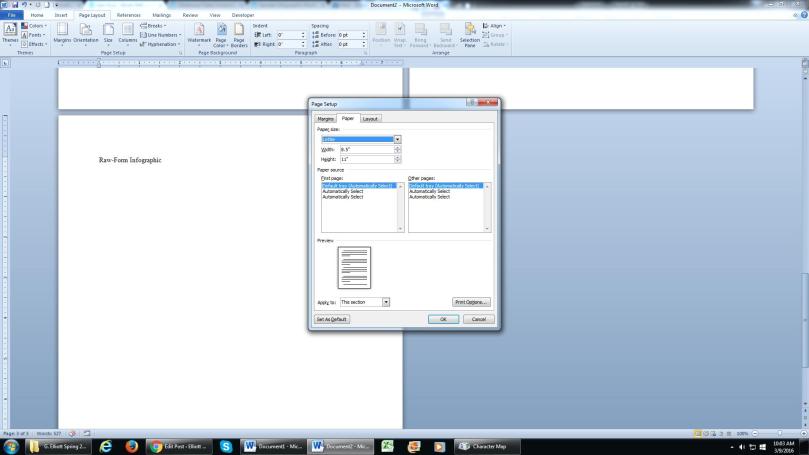
Making the adjustment necessitates returning to the “Page Layout” tab at the top of the screen, selecting it, and selecting the “Size” button thereupon. Doing so will produce a drop-down menu, at the bottom of which is “More Paper Sizes,” which is the appropriate choice. Selecting it brings up something like this:G. Elliott Spring 2016 ENGL 1213 Infog Example Img. 4

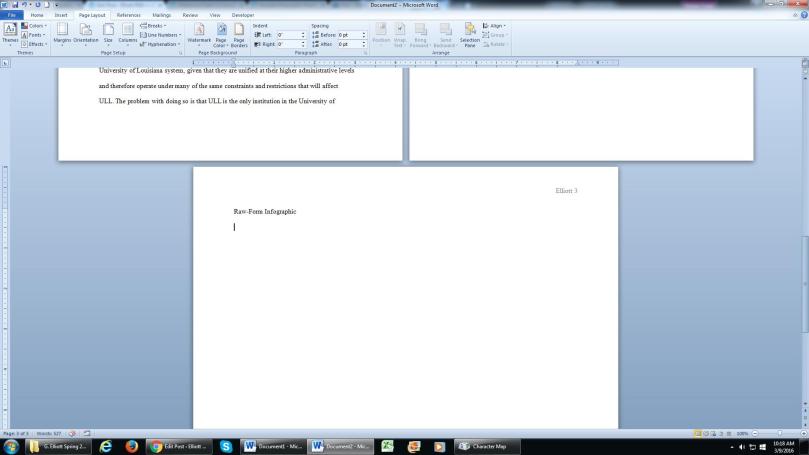
The “Height” and “Width” boxes can be adjusted by selecting them and putting in new values. For mine, they are the 14 inch height and 10½ width noted earlier. Also, in the “Apply to” box, I selected “This section,” which I recommend to others. Upon making the adjustments and selecting “OK,” I received a message about the printable area, which I opted to ignore for the present purpose. That done, my document came to look like this:G. Elliott Spring 2016 ENGL 1213 Infog Example Img. 5

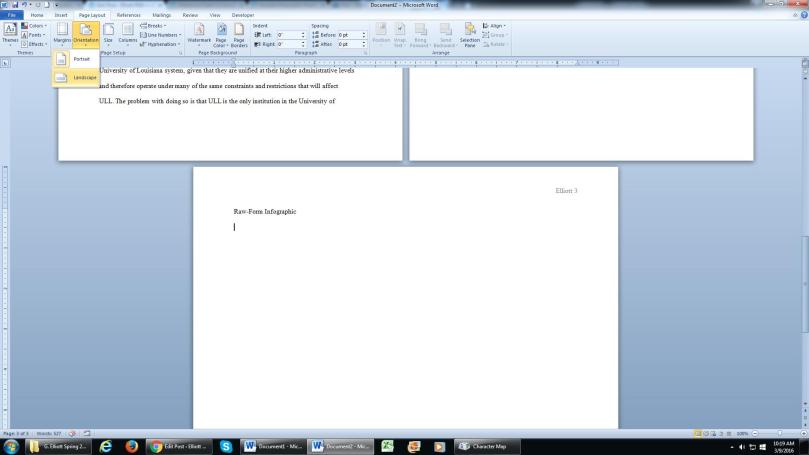
Students whose raw-form infographics are oriented horizontally rather than vertically will also need to adjust their page layout to suit. This is done by going to the “Page Layout” tab once again, this time selecting it and selecting the “Orientation” option appearing thereupon. Normally, documents will be in the “Portrait” orientation; a horizontal layout will need to be adjusted to the “Landscape” orientation, done by making the appropriate selection. (Keep in mind that room still needs to be accorded to the label on the page; the page will need to be 11½ inches high and 13 inches wide to accommodate.) Something like the following should appear:G. Elliott Spring 2016 ENGL 1213 Infog Example Img. 5.1

With my page set up appropriately to accommodate the raw-form image, the time came to insert the image into the document. To do so, I placed my cursor where I need the image to appear: the next line of text after the label. That done, I selected the “Insert” tab at the top of the page, clicking on the “Picture” button beneath it; the following appeared as I did so:G. Elliott Spring 2016 ENGL 1213 Infog Example Img. 6

A file-selection menu appeared, and I selected the raw-form infographic I had drafted and scanned in. (I used my home scanner; scanners are available to students in the Edmon Low Library, and their use is intuitive. I do recommend saving images as .jpg files, however.) Doing so placed the raw-form infographic in the document where I wanted it to be, as shown below:G. Elliott Spring 2016 ENGL 1213 Infog Example Img. 7

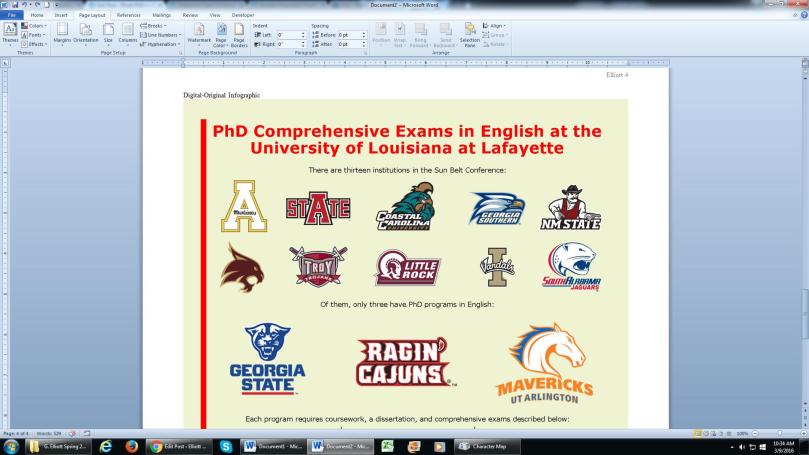
That done, I went to the end of the document (hold “Ctrl” and press “End” on the keyboard) and repeated my earlier process of starting a new section of the document to facilitate insertion of the digital-original form of the infographic. I also repeated my earlier process of adjusting the page size to suit the digital document. Because I formatted the digital-original version as a tabloid-sized document (11 inches wide, 17 inches high), and I still needed a label (“Digital-Original Infographic,” after the online version), I set my page size to 13 inches wide and 20 inches high. Afterwards, I inserted the label and the image, with the following result:G. Elliott Spring 2016 ENGL 1213 Infog Example Img. 8

The resulting document appears here: G. Elliott Spring 2016 ENGL 1213 Infog Formatting Walkthrough Result.

Return to top.

Northern Oklahoma College

I had intended to discuss more citation styles with my students at Northern Oklahoma College today; my absence will prevent that from taking place. That said, I can point them again to the Purdue OWL discussion of MLA standards, here. I can also offer them some questions to ask about sources when determining whether or not they are likely to be valid for the AnnBib on which they are to be working.

I have noted before that information is not neutral; the selection of what information is to be presented is a deliberate choice, one stemming ideally from considered judgment and therefore interpretive decisions. Concerns of ethos attach themselves to such interpretations; knowing what types of information the expected audience is likely to consider reliable and presenting those types helps writers to present themselves to their audiences as being reliable and worth attention. Academic audiences are likely to consider primary source materials reliable (although there may be quibbling over which edition of a given primary text is the best to use); one cannot discuss a thing without reference to that thing. That primary materials are so necessary, however, means that they are not appropriate for inclusion in an annotated bibliography in most circumstances. Secondary and tertiary/critical sources, however, are–provided they are of sufficient quality.

Determining whether they are happens through developing answers to a series of questions, of which a selection appear below. Each source will need to prompt some questions of its own, so there is no way to account for all of them that might do well to be asked. Also, there is no guarantee of reliability, as it is possible for error to persist despite the best and most sincere efforts of those producing work–whether because new data is uncovered later or elsewhere or because, as the adage has it, “Even Homer nods.”

Keep in mind that there are multiple people involved in the dissemination of information. For most reliable secondary and tertiary/critical sources, there will be an author, an editor or editors, and a publisher or publishers. Similar questions will apply to each, with one or two others worth asking, as well; the first of them is “Is the author/editor/publisher identified?” While there are circumstances in which anonymity is desirable or even necessary, people are generally less willing to associate their names with what they know is wrong; having those involved in the production of a source identified is therefore an easy, early indicator of whether the source can be a quality source. (Admittedly, many hold sincerely to cockamamie ideas. Again, answers to such questions move towards reliability; they do not guarantee it.)

Related to that question is that of “What background does the author/editor/publisher have with the subject being described?” While past performance is not an absolute predictor of current or future performance, it is the case that someone who repeatedly does well with a thing is likely to continue to do well with that thing. The reverse is also true.

Also related, and of perhaps greater importance, is “What does the author/editor/publisher gain from others?” This can be rephrased in part as “Who pays?” It can also be “How does the author/editor/publisher benefit?” While admittedly cynical, the idea that people will work to suit their interests and act in ways that benefit them–whether those ways are generally ethical or not–is one that needs to be considered, as it skews perspectives as much as if not more than any other concern.

Less cynically, having identification of the author/editor/publisher allows for the question of “Who/what else works with what the author/editor/publisher produces?” If materials known to be good use the current piece or others produced by the same agency, and they do so favorably, the materials under review are more likely to be good, as well. Conversely, if good materials disparage the work done by the agency responsible for the reviewed material, that material is likely to be less helpful. Again, the reverse is also true.

A similar question, albeit one oriented towards the past, is “From what does the author/editor/publisher work?” If the material being reviewed uses good materials and commends them, it is more likely to be good. If it disparages them, it may still be good; one of the things that scholars accept is that their work may be supplanted by further study and the revelation of new information. Sometimes, advancing that new information requires the outright rejection of the old.

Two other questions present themselves for particular attention. One of them is “What is the medium of presentation?” Marshall McLuhan famously quips that “The medium is the message” in Understanding Media: The Extensions of Man, and he is, in large part, correct. The manner in which information is presented influences how it is received, and, as dominant communicative theories hold, the reception determines what information is actually transferred–not only in terms of the explicit data, but also in parallel concerns that do much to influence perceptions of reliability and applicability of the information to other venues. The degree of adherence to the conventions of a particular medium deployed in a given source help speak to its credibility and reliability (although, again, they do not guarantee it)–particularly in the case of scholarly literature, which is conventionally peer-reviewed (i.e., the materials are blind-assessed by experts in the field, and usually substantially adjusted based on those assessments, before being allowed to proceed to publication).

The other is “How timely is the source?” Timeliness does not necessarily equal recency, although a more recent source will generally be more helpful than an older one, as it allows for more information to have been uncovered. That said, enough time for fact-checking needs to be allowed to avoid things happening like the CERN neutrino kerfluffle in 2011 and 2012. Also, projects that track historical progressions (and many will need to do so, if only to provide adequate surveys of prior treatments of the material) will necessarily need to examine earlier sources.

There are, as noted above, other questions that can be asked–and that should be asked. Those noted above, however, should offer a useful beginning from which students can work on the AnnBib and other projects, both in my class and in their writings yet to come.

Return to top.

Updated 1 April 2016 to adjust grouping.

Class Report: ENGL 1213 at NOC, 7 March 2016

After addressing questions from previous classes, discussion focused on concerns of citation. The Purdue Online Writing Lab discussion of MLA format and style, here, informed much of the talk.

Students are reminded of the following due dates:

  • AnnBib RV (due online before class begins on 23 March 2016)
  • AnnBib FV (due online before class begins on 30 March 2016)
  • ResPpr RV (due online before class begins on 13 April 2016; note that materials for the assignment are not yet developed as of this writing)

The section met as scheduled, at 1300 in North Classroom Building Room 311. The roster listed seven students enrolled, unchanged since the previous class meeting. All attended, verified informally. Student participation was good.

One student attended office hours since the previous class meeting.

Sample Annotated Bibliography: Why Not Have a Rhetoric Requirement among UL Lafayette PhD Students in English?

What follows is an annotated bibliography such as my students are asked to write for the AnnBib assignment during the Spring 2016 instructional term at Northern Oklahoma College. As is expected of student work, it treats an issue of its writer’s curriculum. It also adheres to the length requirements expressed to students (they are asked for a two-paragraph introduction that contextualizes the project and outlines the methods for selecting materials, as well as six annotative entries, exclusive of heading, title, and page numbers; the sample below provides them), although its formatting will necessarily differ from student submissions due to the differing medium. How the medium influences reading is something well worth considering as a classroom discussion, particularly for those students who are going into particularly writing- or design-intensive fields.

Please note that the bibliography below treats the same topic addressed in earlier sample assignments written throughout the Spring 2016 instructional term; it is, in effect, an expanded version of the T&S assignment required of students at Oklahoma State University, for which a sample assignment has been provided (here). Some materials will be duplicated from the earlier version.

I hold a doctorate in English from the University of Louisiana at Lafayette (ULL). Earning it obliged me to take many hours of coursework, draft and defend a dissertation, and sit for a battery of comprehensive exams. Those exams are described by the ULL English Department as helping to prepare students for teaching and research–but most of the teaching that I have done since leaving ULL has been in rhetoric and composition, and the training the exams promote and assess did not require me to make much if any formal study of that area of English studies. That a combination of logistical and disciplinary factors contribute to the lack of a rhetoric requirement in a battery of generalist English exams seems likely, but more investigation is needed to ascertain whether or not it is.

Conducting such an investigation suggests looking at discussions of comprehensive exams, generally, as well as of the disciplines in which the specific exams being discussed might exist. Those discussions are easily found in a number of disciplinary-education journals, such as are available through the Oklahoma State University library and through subscriptions to publications of organizations invested in English education, such as the National Council of Teachers of English. A few prominent results of searches through such materials are related below; they, and other sources yet, argue for a dominant format of comprehensive exams and a view of the field into which graduates of the ULL English PhD program will enter, highlighting some of the disconnections between how the program prepares its students for their likely career paths.


Hassel, Holly, and Joanne Baird Giordano. “Occupy Writing Studies: Rethinking College Composition for the Needs of the Teaching Majority.” CCC 65.1 (September 2013): 117-39. Print.

The article argues against perceptions among writing scholars that devalue the work done by most writing teachers, who work in two-year and open-admission institutions. After defining a number of its terms, the authors note that studies of such teachers are not proportionate to the work they do. They continue with discussions of the two-year teaching environment, the focus of writing scholarship on four-year and elite institutions and the concomitant problems associated with community colleges, and what benefits would accrue to teachers and scholars from a reconsideration of such positions as they outline. The article concludes with a few recommendations of how to proceed, namely the support of research by and about two-year and open-admission institutions.

Of particular importance in the article is a quotation from a  Chronicle of Higher Education article by Schmidt, one noting that non-tenure-track faculty account for more than three quarters of teaching positions (119). While it does not discuss the comprehensive exam as an item, it does point towards the ubiquity of writing instruction by those with graduate degrees in English, irrespective of their specialization; it is a point the article reiterates. As such, it helps provide context and support for the need for graduate students in English to take exams and concomitant training in rhetoric, since it is from rhetoric that the practice of teaching writing emerges.


Nolan, Robert E. “How Graduate Students of Adult and Continuing Education Are Assessed at the Doctoral Level.” Journal of Continuing Higher Education 50.3 (Fall 2002): 38-43. PDF file.

The article encourages discussion of the forms comprehensive examinations in doctoral coursework should take to increase completion rates and more accurately reflect the expectations placed on those who pursue advanced graduate study. After explicating then-current demographic data among graduate students, the piece lays out its purpose and summarizes previous studies of the topic. It then lays out its methods–noting the group surveyed and describing the survey used. Findings follow, identifying major trends about the timing, format, and intentions of comprehensive exams. The article concludes with notes that indicate no consensus among programs about how to hold comprehensive exams and what they ought to do.

The article may suffer somewhat from concerns of age, and repeated mentions of what various things “presumably” do weaken some of the rhetorical force of the piece. The brevity of the piece may also be of some concern. The article does, however, provide a useful summary of tendencies in how examinations have been conducted at the doctoral level across disciplines. In that regard, the article offers a useful starting point for discussion of any topic treating comprehensive exams at the doctoral level. As background material for framing investigation of the comprehensive exam, then, it is worth reading.


Palmquist, Mike, and Sue Doe. “Contingent Faculty: Introduction.” College English 73.4 (March 2011): 353-55. Print.

Introducing a special issue of College English they edit, Palmquist and Doe note the centennial of the National Council of Teachers of English, the quarter-century anniversary of the Wyoming Resolution (one of the major statements regarding contingent those members of college and university faculties with the least protection), and the many statements made by scholarly societies calling for improvements to the working conditions contingent faculty face. They then lay out the contents of the special issue of the journal, summarizing three articles and three discussion forums that occupy the following pages.

Of particular note in the piece are cited comments from the American Association of University Professors and a committee of the Modern Language Association of America. Combined, the comments speak to the prevailing conditions faced by those who will teach English. Most postsecondary teaching positions are contingent, and most composition teaching is done by contingent faculty. The chance that a graduate of any English PhD program will teach composition off of the tenure track is therefore substantial, making preparation for that work all the more important–and its lack all the more curious.


Ponder, Nicole, Sharon E. Beatty, and William Foxx. “Doctoral Comprehensive Exams in Marketing: Current Practices and Emerging Perspectives.” Journal of Marketing Education 26.3 (December 2004): 226-35. PDF file.

The authors identify and explain then-current and -emerging practices regarding doctoral comprehensive exams in United States marketing programs. After offering a general introduction to the topic, the authors review available literature on the topic, focusing largely on Bloom’s taxonomy. Methodology follows, with a survey described and the process of its dissemination, completion, and interpretation articulated. Results detailing the perceived purposes of doctoral comprehensive exams, structures of those exams, and changes to the latter are presented, and less traditional emergent structures–an “original papers” approach, an “extended take-home,” a “specialist,” and a “no exam–no paper” approach–are explicated. Results are discussed, and a conclusion suggesting that the traditional closed-book format of comprehensive exams will be less common in marketing schools finishes the article.

Although Ponder, Beatty, and Foxx discuss marketing, specifically, many of their assertions are likely applicable to other fields. Despite common perceptions of advanced education as liberal and socially deconstructive, academia tends to remain wedded to older structures, so the “traditional” examination structures discussed in the article are likely to be represented in other fields and programs entirely. If such points of correspondence are in place, then others may also be, making the conclusions reached by the article at least provisionally applicable to other areas of advanced education. Also notable in the article is the concern voiced by some faculty that changes to traditional exam structures “are depriving students of the opportunity to integrate a broad range of knowledge at a deeper level than they will ever have an opportunity to achieve again” (234), offering an unusual perspective on the comprehensive exam that may well bear examination.


Schafer, Joseph A., and Matthew J. Giblin. “Doctoral Comprehensive Exams: Standardization, Customization, and Everywhere in Between.” Journal of Criminal Justice Education 19.2 (July 2008): 275-89. PDF file.

The authors describe general tendencies regarding treatment of comprehensive exams by programs awarding doctoral degrees in criminal justice. The need for systematic study of criminal justice programs is articulated before the doctoral comprehensive exam is contextualized. Exam procedures are described and historicized. Study methods–largely focused on conducting surveys and interviews–are described and findings articulated, the latter focusing largely on the forms the exams take. Findings are subsequently discussed, identifying and commenting on the patterns that emerge from the study and treating relative merits of several exam formats. The article concludes with questions about the ongoing utility of curricular standards to both the discipline and the broader community the discipline serves.

Although Schafer and Giblin treat the discipline of criminal justice, specifically, they ground their article in information deriving from studies of other fields–notably including rhetoric–and assert that their own discipline largely follows the structures of others. The conclusions they reach about their own field therefore present themselves as able to be generalized back to those other fields, so that what they say about comprehensive exams can be applied to other areas than their own. Additionally, their relatively recent (to this writing) article allows their conclusions to be taken as more timely, and their relatively extensive bibliography offers useful insights as to further reading.


Scott Shields, Sara. “Like Climbing Jacob’s Ladder: An Art-Based Exploration of the Comprehensive Exam Process.” Arts & Humanities in Higher Education 14.2 (April 2015): 206-27. PDF file.

Following an epigraph taken from Scripture, Scott Shields explains that her piece is a reflection on the experience of doctoral comprehensive exams. The reflection is framed in terms of the general shape and purpose of the doctoral exam, described as having ritual aspects that are not clear to graduate students who will soon take such tests; the author notes desiring to explicate the ritual through narration in reflection. Excerpts of exam questions and answers, as well as visual and verbal materials taken from personal journal entries relating to the exam experience follow; reflections on individual exam components accompany each set of materials. Ultimately, the author arrives at the notion that the value of the comprehensive exam is in its facilitation of individual focus on personal growth leading to shared experiences.

While the piece is unconventional, it is of value in that it offers an inside perspective on comprehensive exams; most treatments of the subject look at them from the perspective of having long completed them. The anecdotal and idiosyncratic nature of the article may read to some as lessening the effectiveness of the piece as a whole, but that same individualistic narration does much to remind readers of the deeply personal nature of the comprehensive exam. It bespeaks the overall engagement with subject matter inherent in the comprehensive exam, making it all the more important that the exercise is directed to good effect.