The paper that follows is the full text of what I drafted to present as part of a roundtable session at the 2026 International Congress on Medieval Studies, hosted at Western Michigan University in Kalamazoo, Michigan. Adjustments have been made for formatting and for expectations of the medium.
In a paper presented at the 2025 International Congress on Medieval Studies,[1] I began a discussion of how Free League’s The Lord of the Rings Roleplaying–a tabletop roleplaying game (TTRPG) set in Tolkien’s Middle-earth in the period between the events of The Hobbit and The Lord of the Rings, and with rules compatible with the fifth edition of Dungeons & Dragons–adapts Tolkien, his sources, and his methods principally to facilitate play and in ways that themselves reflect medievalist and neomedievalist practices. That is, the TTRPG does with Tolkien and the medieval much the same kind of thing that Tolkien himself does with the medieval, which serves among others as an indication of how popular audiences continue to construct, use, and misuse the medieval. In that paper, I noted that there is more to be done in that line of inquiry, partly in looking at other TTRPG materials. One such piece of material, Free League’s supplement The Lord of the Rings Roleplaying: Tales from Eriador,[2] offers some materials to further that discussion.
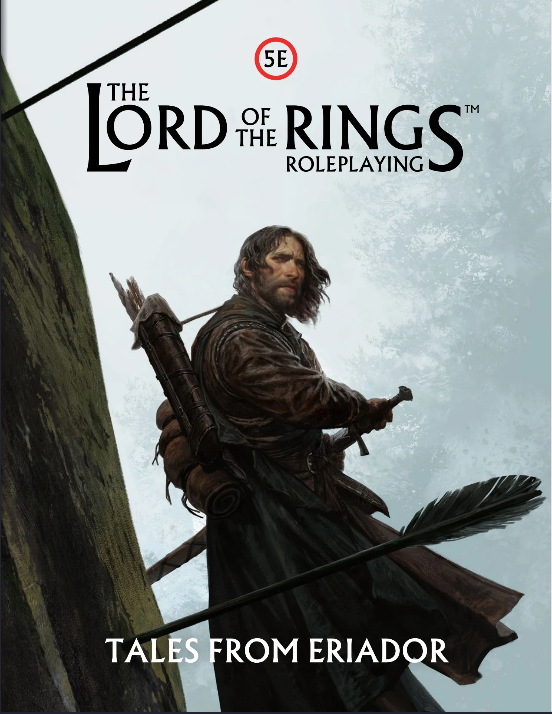
Image from the product itself, available here: https://freeleaguepublishing.com/shop/the-lord-of-the-rings/tales-from-eriador/
The supplement itself offers what might well be regarded as a campaign setting–that is, a series of interlinked but independently playable narrative adventures–within the broader Legendarium that features in a period not amply attested in Tolkien’s own works; it also focuses on locations that are not, themselves, amply attested. In doing so, the supplement continues what the main TTRPG does, expanding on Tolkien’s works in ways that are, to be fair, reasonably consistent with what is canonical to the Legendarium (or at least do not contradict it) while still permitting players to portray characters acting in such capacities as not to be overshadowed by the canonical events of Tolkien’s writing.
Tales from Eriador, like the broader game to which it is a supplement, makes much of being Tolkienian. Of note is the introduction to the first of the interlinked narrative adventures it presents, which begins
In a hole in the ground there lives a Troll.
Not a nice cosy Hobbit-hole, full of comforts and a well-stocked pantry. No, this is a Troll-hole, awash in noisome things and bones crunching underfoot wherever you step. If there is a pantry in this Troll-hole, it is a prison cell.[3]
As a mimickry of the opening of The Hobbit, the supplement offers a small bit of humor, playing with expectations and tropes, as well as situating itself as the product of people familiar with the Legendarium. That is, it renders itself usefully authentic to its antecedents, which gives it greater adherence to the “inner consistency of reality” Tolkien asserts is necessary for effective fiction,[4] if with some nuancing of “reality.”
The supplement also introduces into the broader game the idea of “the Heir,” the assignment in game terms of “a possible heroic lineage, an ancestry harkening back to a line of heroes and champions.”[5] The Heir, in the supplement, is a focal character for the overall narrative arc, and the presence of that character as a focus does tend to bring the supplement more closely in line with its medieval and medievalist antecedents; there is a tendency, of course, to focus on one character, or one character at a time, in narrative works, and not without cause. Aragorn is Aragorn in large part because of his ancestry, and much is made of it; Frodo is Frodo in large part because he is kin to Bilbo; and much of the distinction between Boromir and Faramir comes from who inherits what from which of their forebears.
Although so much is the case, the heirship frustrates concerns of play. TTRPGs are, by their nature, collaborative narrative constructions,[6] so making one character, by rule, more important than the others is a concern. To be fair, the supplement does address the issue, and directly, not least by evoking “Hobbitish” practice,[7] but the fact of the inclusion and narrative privileging of heirship introduces the possibility for intra-party conflict at a systemic level. That is, the existence of the rule creates an area of potential conflict between players, themselves at once the narrators and the audience for the game, rather than between their characters. It is an instance of greater adherence to source materials proving an impediment to play, pointing to concerns of necessary adjustments for medium as well as towards some pragmatic limits as to authenticity, however desirable authenticity may generally be.[8] Even aside from the ultimate inability to fully reconstruct antecedent conditions, it is not always good to attempt it.
Not to conclude, but to wrap up for the present: there remains, as before, still more to do. Free League has produced a number of supplements for The Lord of the Rings Roleplaying, and its line is not the only line of TTRPG products that has taken up the Legendarium as its subject matter. It is even less the only one to have taken up the Legendarium’s own antecedents, and it remains the case that how such things are used points towards the users’ understandings of themselves and their pasts.
[1] https://elliottrwi.com/2025/05/16/dice-of-the-rings-reflections-on-a-particular-tabletop-roleplaying-game-set-amid-tolkiens-legendarium/
[2] Gareth Hanrahan et al., The Lord of the Rings Roleplaying: Tales from Eriador (Free League, 2023). Note, too, the particular medieval resonances of the principal author’s name: Gareth was one of Arthur’s nephews in Malory and elsewhere, known as Beaumains, and his death leads to much of the calamity at the end of Le Morte d’Arthur.
[3] Hanrahan et al., 10.
[4] JRR Tolkien, “On Fairy-stories,” in “The Monsters and the Critics” and Other Essays, ed. Christopher Tolkien (HarperCollins, 2006).
[5] Hanrahan et al., 6.
[6] Daniel Mackay, The Fantasy Role-Playing Game: A New Performing Art (McFarland & Company, 2001).
[7] Hanrahan et al., 6.
[8] See, for example, Helen Young’s “Who Cares About Historical Authenticity? I Do,” Tales after Tolkien: Travels in Genre and Medievalism, 16 June 2014, https://talesaftertolkien.blogspot.com/2014/06/who-cares-about-historical-authenticity.html.
It turns out I still do conference work, which means I’m able to help you with yours, and in a variety of genres! Fill out the form below to begin your piece with me!


[…] † I follow Daniel Mackay’s The Fantasy Role-playing Game: A New Performing Art for this. I’ve referenced him more than once before, as witness this, this, this, this, and this. […]
LikeLike