The paper that follows is the full text of what I drafted to present on a paper session at the 2026 International Congress on Medieval Studies, hosted at Western Michigan University in Kalamazoo, Michigan. Adjustments have been made for formatting and for expectations of the medium.
The[1] present paper is the continuation of a project begun alongside the Tales after Tolkien Society, details of which beginning are presented in “An Update to ‘Moving Beyond Tolkien’s Medievalism,'” presented at the 2024 International Congress on Medieval Studies.[2] The original project moved from an initial explication of how Robin Hobb’s Farseer trilogy works with and adapts the setting of the typical Tolkienian-tradition fantasy work to how that trilogy and the succeeding Tawny Man trilogy move away from the Tolkienian tradition to present a fantasy setting more akin to North America, particularly the Pacific Northwest, than to an ambiguously feudal Northern and Western European setting.[3] The 2024 paper takes in two other series set in the same narrative continuum, the Liveship Traders and Rain Wilds Chronicles novels, furthering explication of the North-American-ness of the Realm of the Elderlings corpus in which Hobb has written most of her work. The present paper turns to what is currently the final component of the Realm of the Elderlings corpus, the Fitz and the Fool novels, identifying how Hobb continues the work of her previous series to assert and operate within a setting separated from the Tolkienian tradition, even if clearly still conversant with it.

Photo by Ken Jacobsen on Pexels.com
The Already Ongoing Conversation
That Hobb has been and remains in conversation with Tolkien is clear. Earlier portions of the project this paper continues acknowledge as much, identifying areas of correspondence (particularly in the earlier-published and, presumably, -written) between parts of the Realm of the Elderlings corpus and Tolkien’s Legendarium. There are commonalities, not least in the social structures described as at play in the Six Duchies and the seemingly evident borrowings from early English and Norse languages and cultures showing up in the Outislands–two of the major political powers described in the Realm of the Elderlings corpus.[4] Kelsingra and its surroundings also evoke The Professor at some length, if with nuance.[5] And Hobb herself notes being steeped in Tolkien,[6] aside from working in a genre Tolkien effectively defines for modern readers, so that it is to be expected she would echo him in some ways.

Photo by Jay Brand on Pexels.com
Because substantial portions of the Fitz and the Fool novels take place in areas familiar from earlier series–notably the Six Duchies, Kelsingra, and the Cursed Shores–patterns of correspondence to and divergence from the tropes of the Tolkienian fantasy tradition identified as at work in those areas remain in place. For but one example, as frequent narrator FitzChivalry Farseer (“Fitz”) operates necessarily clandestinely in Buckkeep, a crow makes ominous noises in ways reminiscent of Nordic myth, particularly as coupled with Fitz’s long lupine association,[7] which brings his characterization back towards the underpinnings of Tolkien’s major literary milieu. Some time afterward, Fitz finds himself subjected, without much advance warning if any, to a ceremony that, while clearly grounded in the medieval(ist) from which Tolkien works, also shows details that might well emerge from more North American sources.[8]
Meanwhile, or close to it, as Fitz’s daughter Bee is taken by her captors towards Clerres, included in-milieu commentary remarks upon tattooing practices, following fairly explicitly on comments made in earlier entries in the Realm of the Elderlings corpus,[9] as well as tying into tropes associated with indigenous populations that, while not necessarily limited to North American indigenous groups, are certainly associated with them. It also ties into racial tropes that work from Manichean allegory, as similar comments following soon after suggest,[10] which has some more unfortunate implications regarding particular Tolkienian resonances and the audiences attuned thereto, as a number of scholars point out.[11]
In a yet later example, Bee travels up the Rain Wild River, noting animals and plants that seem to line up with North American flora and fauna.[12] This parallels an earlier example in which Fitz travels from Kelsingra down the Rain Wild River, he remarks upon a litany of creatures that reflect more of the Pacific Northwest than Europe, as well as motioning towards some more concrete chronology than is typical for the Realm of the Elderlings novels.[13] The travel and remarks Hobb’s milieu–and, by default, the characters in it–away from Tolkien’s work in their presentation of natural geography, even as they start (but only start) to build towards the kind of calendar-work notable in the Appendices to The Lord of the Rings. The tension, then, between adherence to and divergence from Tolkien’s work remains in place as Hobb’s continues.
Although it is the case that the milieu changes with the passage of time (such change itself a defiance of the temporal stasis perceivedly at work in much Tolkienian-tradition literature and even in the Legendarium itself[14]), it does not change so much as to be unrecognizable.[15] Many of the characters introduced in even the earliest parts of the Realm of the Elderlings corpus–Chade Fallstar and Kettricken are perhaps the most prominent examples other than Fitz and the Fool–remain present and active in the Fitz and the Fool novels; their attitudes remain largely as they had been, or at least change only so much as it might be expected that a person’s attitudes and perspectives change with the passage of decades. At root, the conversation that had been going on prior to the Fitz and the Fool novels continues in them, referring back to things said before and, it must be noted, occasionally repeating them.
Adding to the Conversation
Expanding from the earlier series and treatments of the same, substantial portions of the Fitz and the Fool novels–chiefly, though not exclusively, in the final novel–take place under the control of another major, substantially antagonistic, political power in the milieu: Clerres. To be sure, there is some correspondence to be found between Clerres and Western Europe, so that there continue to be invocations of the Tolkienian fantasy literature tradition at work in the Fitz and the Fool novels. In another earlier paper presented at the International Congress on Medieval Studies,[16] I make the point that Clerres
rings of medievalist depictions of capital cities. It is described at one point as “a very beautiful city on a bay on a large island named Kells in the old tongue,”27 and Kells is itself an invocation of the medieval through the famous illuminated manuscript. It is also framed in terms reminiscent of medieval descriptions of Mont-Saint-Michel, particularly in the emphasis on its fortifications and its accessibility principally via a tidal causeway.28
In the same paper, I add[17]
the prophecies they [in Clerres] make available to petitioners–for fees that range in scope from the modest to the exorbitant and well beyond it–are not the core of their work. They are instead pieces bartered for support of their own, often abusive lifestyles,33 and for the organization’s work towards enacting one particular vision of the future it sees…it might be argued that such practice does align to medieval western European religious practice–the sale of indulgences criticized by Reformation theologians comes to mind as one example, the satire in Chaucer’s Pardoner another–the lack of organized and stratified observance, the lack of proselytizing, and the efficacy of practice that can only happen in a fantasy milieu all serve to make the religion centered around the White Prophets decidedly distinct from potential antecedents.
Again, then, Clerres does and does not partake of the documented and attested medieval; it remains conversant with but not necessarily aligned to the Tolkienian fantasy literature tradition.

Photo by Bingqian Li on Pexels.com
Part of that conversation does take the form of frustrating some already-asserted alignments with what some perceive as Tolkienian tradition. In one instance, an enduring figure from the novels, Prilkop, is explicitly celebrated as being the seniormost and most accomplished of those prophets trained in Clerres, his ancientry indicated in no small part by the exceptional darkness of his skin.[18] Much later, he emerges as the leader of the remnants of Clerres, taking charge of those like him who survive its destruction.[19] That he is able to do so makes some sense; he is the eldest and most experienced of those who had inhabited Clerres, presumably the one left who knows most, and so should step into leadership. And there is some alignment with Tolkienian tropes in his doing so; Prilkop is immensely old in the novels, effectively immortal and definitely both of enhanced perceptive abilities and some distance from the shorter-lived around him, all of which evokes Tolkien’s Eldar.
Yet the fact of Prilkop’s skin-color remains, almost an inversion of Tolkien’s usual presentation in which the mightiest and noblest of Elves are the Fair or are, in most cases, descended from them.[20] And there is the issue, too, that Prilkop enacts, at least in some ways, some of the more problematic racial tropes on display in the United States. Prior to taking up leadership, Prilkop aligns himself with one of the other survivors of the ruin of Clerres: Capra. He does so in a way that comes off as fawningly subservient to her,[21] and that despite her outright administration of no few of the policies and actions that make Clerres not only antagonistic, but outright evil. (Clerres knowingly attempts genocide,[22] and it is overtly eugenicist.[23] It also makes little of torture, using it often, although less as a flawed interrogation method than for entertainment.[24] None of the aforementioned bespeaks a particularly good moral stance.) And it is despite his own abuses at her direction if not her hands. No Wormtongue, Prilkop; no final straw leads him to end his oppressor. No neat parallel of Tolkien, he, although certainly far more of a repetition of a pernicious United States trope than is comfortable to read.
The frustration of the color-trope is, admittedly, not new to events in Clerres, although it does seem to center on the White Prophets who traditionally emerged from it. (That Bee, herself a White Prophet, appears other than under control of Clerres is a frustration to that polity’s plans; her kidnapping from the Six Duchies is an attempt to manipulate futures,[25] one ultimately unsuccessful and ruinous.[26]) Throughout the Realm of the Elderlings corpus, the idea emerges that the more successful a White Prophet is in accomplishing his or her goals, the more fully the Prophet causes the prophecies to come true, the less white the Prophet becomes; the reverse is also true, as when Bee is pulled away from her envisioned future, she grows paler.[27] This is at odds with such depictions in Tolkien as the Istari, where the primacy of a given wizard is associated with whiteness and the lapse thereof as the loss of the same.[28]
Indeed, it is possible to read the top-level governance of Clerres as a near-inversion of the Five Wizards. In Tolkien, the white wizard is, as noted, paramount; in Clerres, the White Prophet of whom those at Clerres are ostensibly servants (so much so that they are called Servants), is in fact chosen by the leading Servants, the Four.[29] That is, in essence, the White Prophet is subordinate to the others, having been cultivated, trained, and selected by them to conduce to their own ends and enrichment.[30] Additionally, the Four are color-coded: one each is dressed in blue, red, green, and yellow.[31] The color-palette is more simplistic than Tolkien’s, to be sure, receiving comment in the narrative and calling to mind the packages of crayons often given young children at restaurants. That palette marks its wearers as self-constructed artifice, as opposed to the charged and commissioned nature of the Istari (although it may be that their very colorfulness is, itself, a nod to Saruman, multicolored once fallen). In them, then, as in other things, Hobb presents Clerres as both working recognizably within the Tolkienian tradition and moving away from it in decided ways.
One other way in which Hobb uses Clerres to frustrate the Realm of the Elderlings as a participant in the Tolkienian tradition of fantasy literature is in its interactions with Christian tropes. That Tolkien writes within a Christian, specifically Roman Catholic, worldview is abundantly attested, needing little if any rehearsal at this point to assert that, although the Legendarium does not do much with overt religious practice, it reflects particular theological and doctrinal stances throughout. Clerres, of course, deviates from this, making the ostensible religion of which it is the center a system of control and resource extraction, preying upon sincere belief (that is bolstered by overt demonstration across many volumes of the Realm of the Elderlings corpus) as a means of enrichment; it is not a faith unless it is a faith in the rightness of the Servants and their own worthiness to guide the world as they see fit.[32] Rather than a background from which narrative emerges, the “faith” at work in Clerres is a centered, centralized regime, and if there is not much depicted of formal observance,[33] there is still clear organization and explicit conformity of doctrine at work.
More focused an example is a reported part of the captivity of another White Prophet, the titular Fool of the Fitz and the Fool novels. Having once escaped from Clerres in the pursuit of enacting his own prophecies, he had returned with Prilkop to Clerres in the hopes of effecting changes to its practices and predilections. Initially, the pair had been welcomed back warmly, the Servants tending to them and attending to them, seeking wisdom in the visions that they could report. Soon enough, however, the pair began to recognize themselves as having been captured again, and while Prilkop was confined relatively gently, the Fool was taken into far harsher conditions, pressed for information regarding the death of an erstwhile White Prophet, Ilistore.[34] The Fool reports that there were some among the Servants who attempted to help him now and again; after some time, the attempts stopped, and he began to notice parts of bodies in the food he was given in his captivity, parts he recognized as belonging to those who attempted to aid him, although not until after he had eaten.[35]
Now, the Fool is something of a messianic figure, being a prophet come with a message of a better world, at ease with diverse populations, and having died and come back to life.[36] Here, rather than giving of his flesh and blood, willingly, for those whom he would serve, he unwittingly eats of the flesh and blood of those who had sought to serve him; instead of being a sacrifice for others, he receives the sacrifice of others, and instead of pointing toward a liberation and exaltation, he is made all the more imprisoned and is debased. For him to be constrained into something legible as an anti-Communion, in addition to being an example of evil written in bold letters,[37] is a striking deviation from the Tolkienian tradition, an abuse that stands out not only from the relatively genteel writing of the Professor, but also from even much of the “grittier” work that comprises much mainstream fantasy literature. It is not the final word in the conversation between Hobb’s work and Tolkien’s, certainly, but it does ring out as an obscenity within it.
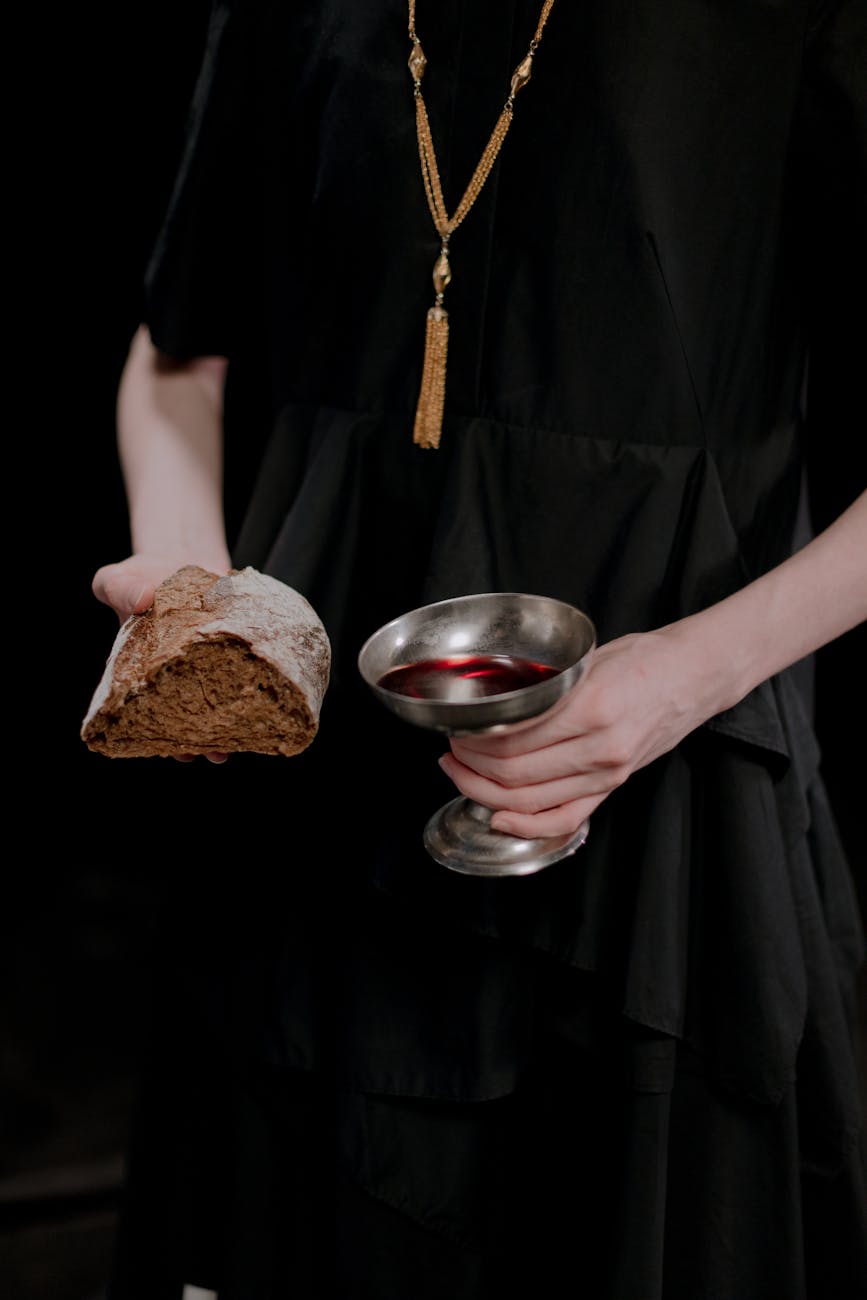
Photo by cottonbro studio on Pexels.com
That the Fitz and the Fool novels continue to present the tension between adherence to and divergence from the Tolkienian fantasy tradition begun in the earlier Realm of the Elderlings novels is clear. That they recapitulate the invocation and exploitation of North-American-ness at work in the Farseer, Liveship Traders, Tawny Man, and Rain Wilds Chronicles novels is evident. That they go further, in some ways more directly rebutting the Legendarium than their predecessors, emerges upon reading. In doing so, the novels yet further expand possibility for the genre in which they participate, making more space for more to emerge, hopefully to readers’ delight.
Future Conversations?
It is at this point not likely that more novels will be added to the Realm of the Elderlings corpus; their author grows older and, in a number of social media posts, has remarked upon the effects of her aging on her writing ability.[38] There are some other works already extant in it that the project this paper extends has not treated–a novella or two, several short stories in various collections, that sort of thing–so that a further extension of the project this paper informs might well offer some few additional notes, but anything more substantial is, unfortunately, not to be expected.
What might be of more substance would be a reading of Hobb’s other major narrative milieu, that of the Soldier Son novels, in a manner similar to that of the Realm of the Elderlings novels. That milieu is even further removed from the Tolkienian tradition than is that of the Realm of the Elderlings, although it does retain some correspondences to it; there is also less extant scholarly work on the series,[39] owing in part to its later start and shorter duration.
Whatever the case for future work may be, Hobb’s nuancing of the Tolkienian tradition of fantasy literature does serve to show that writing within it can be sufficiently grounded in it to be recognizable as belonging to it and with it while still moving away from its tropes and trends in ways that invite in more readers. As has been noted on more than one occasion by more than one commenter, representation matters; Hobb’s novels show more figures and different than is still typical of Tolkienian-tradition literature, reminding readers recreational and scholarly that there is still plenty of room for them. It behooves us to take a look around and see what can be found therein.

Photo by Regan Dsouza on Pexels.com
[1] Given that the present paper is written for oral delivery and will likely only see publication online, most citation will be informal in nature. Those things not readily available or able to be referenced via hyperlink will receive more formal attestation, but if it can be linked, it will be.
[2] https://elliottrwi.com/2024/05/15/an-update-to-moving-beyond-tolkiens-medievalism/
[3] ttps://elliottrwi.com/research/hobb-bibliography/#Elliott-Moving
[4] What those earlier portions of the project do not detail are correspondences between another of the major political blocs, the Chyurda / Mountain Kingdom, and Tolkien’s Elves. Another scholarly someday presents itself.
[5] https://elliottrwi.com/2021/05/19/sites-of-memory-in-robin-hobbs-realm-of-the-elderlings/
[6] Robin Hobb, “A Bar and a Quest,” in Meditations on Middle-earth, ed. Karen Harber (New York: St. Martin’s P, 2001), 85-100.
[7] https://elliottrwi.com/2024/12/23/a-robin-hobb-rereading-series-entry-429-fools-quest-chapter-7/
[8] https://elliottrwi.com/2025/03/19/a-robin-hobb-rereading-series-entry-441-fools-quest-chapter-19/
[9] https://elliottrwi.com/2022/05/20/a-robin-hobb-rereading-series-entry-303-fools-fate-chapter-26/
[10] https://elliottrwi.com/2025/05/12/a-robin-hobb-rereading-series-entry-449-fools-quest-chapter-27/
[11] See, for example, my comments at https://elliottrwi.com/2024/08/28/in-response-to-robert-t-tally-jr/, in which I remark upon a number of such scholars’ pointings-out.
[12] https://elliottrwi.com/2026/04/20/a-robin-hobb-rereading-series-entry-503-assassins-fate-chapter-44/
[13] https://elliottrwi.com/2025/09/22/a-robin-hobb-rereading-series-entry-468-assassins-fate-chapter-9/
[14] See, for example, Thomas Honegger’s “(Heroic) Fantasy and the Middle Ages – Strange Bedfellows or an Ideal Cast?” https://doi.org/10.4000/itineraires.1817; Joseph Rex Young’s Secondary Worlds in Pre-Tolkienian Fantasy Fiction, https://hdl.handle.net/10523/1718; and the TVTropes page “Medieval Stasis,” https://tvtropes.org/pmwiki/pmwiki.php/Main/MedievalStasis. Note, however, the active decline at work in the Legendarium, attested by Vieira (https://www.academia.edu/11930074/The_theme_of_decline_Its_instances_and_origins_in_Tolkiens_legendarium) and many others.
[15] See, for example, https://elliottrwi.com/2026/04/27/a-robin-hobb-rereading-series-entry-505-assassins-fate-chapter-46/
[16] Quotation from https://elliottrwi.com/2020/04/15/manifestations-of-medieval-religion-in-robin-hobbs-elderlings-corpus/; internal references are to Assassins Fate, chapter 6, https://elliottrwi.com/2025/09/05/a-robin-hobb-rereading-series-entry-465-assassins-fate-chapter-6/.
[17] Internal reference here is to Fool’s Quest, chapter 5, https://elliottrwi.com/2024/12/09/a-robin-hobb-rereading-series-entry-427-fools-quest-chapter-5/.
[18] https://elliottrwi.com/2025/09/05/a-robin-hobb-rereading-series-entry-465-assassins-fate-chapter-6/
[19] https://elliottrwi.com/2026/04/13/a-robin-hobb-rereading-series-entry-501-assassins-fate-chapter-42/
[20] Consider Tolkien’s Vanyar, who removed entirely to the Blessed Realm and whose head is considered the leader of the entire race (The Silmarillion, ch. 3). Consider, too, Fingolfin and Finarfin, themselves sons of Indis of the Vanyar, and their exploits; they “were great and glorious, and their children also; and if they had not lived the history of the Eldar would have been diminished” (The Silmarillion, ch. 6). Golden hair and pale skin are typical descriptors.
[21] https://elliottrwi.com/2026/04/06/a-robin-hobb-rereading-series-entry-499-assassins-fate-chapter-40/
[22] https://elliottrwi.com/2026/04/13/a-robin-hobb-rereading-series-entry-501-assassins-fate-chapter-42/
[23] Note https://elliottrwi.com/2024/12/09/a-robin-hobb-rereading-series-entry-427-fools-quest-chapter-5/, https://elliottrwi.com/2025/10/06/a-robin-hobb-rereading-series-entry-470-assassins-fate-chapter-11/, and https://elliottrwi.com/2025/12/01/a-robin-hobb-rereading-series-entry-478-assassins-fate-chapter-19/.
[24] Witness, among many others, https://elliottrwi.com/2024/10/28/a-robin-hobb-rereading-series-entry-421-fools-assassin-chapter-31/, https://elliottrwi.com/2024/12/23/a-robin-hobb-rereading-series-entry-429-fools-quest-chapter-7/, https://elliottrwi.com/2025/12/22/a-robin-hobb-rereading-series-entry-482-assassins-fate-chapter-23/, https://elliottrwi.com/2026/01/12/a-robin-hobb-rereading-series-entry-485-assassins-fate-chapter-26/, and https://elliottrwi.com/2026/03/09/a-robin-hobb-rereading-series-entry-493-assassins-fate-chapter-34/. Note, too, that torture is something of a theme in Hobb’s works, not only in the Realm of the Elderlings novels.
[25] https://elliottrwi.com/2024/11/04/a-robin-hobb-rereading-series-entry-422-fools-assassin-chapter-32-and-epilogue/
[26] See https://elliottrwi.com/2026/01/21/a-robin-hobb-rereading-series-entry-486-assassins-fate-chapter-27/ and https://elliottrwi.com/2026/03/16/a-robin-hobb-rereading-series-entry-494-assassins-fate-chapter-35/
[27] https://elliottrwi.com/2025/11/17/a-robin-hobb-rereading-series-entry-476-assassins-fate-chapter-17/
[28] See Fellowship of the Ring, book 2, ch. 2.
[29] https://elliottrwi.com/2025/01/27/a-robin-hobb-rereading-series-entry-434-fools-quest-chapter-12/
[30] https://elliottrwi.com/2025/06/16/a-robin-hobb-rereading-series-entry-454-fools-quest-chapter-32/
[31] https://elliottrwi.com/2025/12/22/a-robin-hobb-rereading-series-entry-482-assassins-fate-chapter-23/
[32] As noted in many of my rereading commentaries, there are parallels to various capitalist / colonialist / nationalist endeavors to be found herein. A conference paper does not admit of addressing them alongside the main argument, however.
[33] NB https://elliottrwi.com/research/abstracts/#Unchurched
[34] https://elliottrwi.com/2025/12/22/a-robin-hobb-rereading-series-entry-482-assassins-fate-chapter-23/
[35] https://elliottrwi.com/2026/01/12/a-robin-hobb-rereading-series-entry-485-assassins-fate-chapter-26/
[36] https://elliottrwi.com/2022/06/03/a-robin-hobb-rereading-series-entry-306-fools-fate-chapter-29/
[37] In comments regarding my rereading, I remark on Hobb’s motion towards overt evils in her later Realm of the Elderlings works, far more than the pettinesses and brokenness at work in the Farseer and Liveship Traders novels.
[38] https://www.facebook.com/robin.hobb
[39] At the time of this writing, I am aware only of a handful of formal papers on the series: Siobhan Carroll’s “Honor-bound: Self and Other in the Honor Culture of Robin Hobb’s Soldier Son Series,” Anna Metsäpelto’s Attitudes to Fat Characters in Fantasy Literature—Cases from The Soldier Son by Robin Hobb and A Song of Ice and Fire by George R.R. Martin, and Helen Young’s “Critiques of Colonialism in Robin Hobb’s Soldier Son Trilogy.” I’ve also given a conference paper on the matter, one I do mean to revisit. Work on my Hobb bibliography (at https://elliottrwi.com/research/hobb-bibliography/) goes on, if slowly, so I might run into more, and I hope so, but I haven’t seen it yet.
It turns out I do still do conference work, which means I’m able to help you with yours! Fill out the form below to begin.


[…] noted, I am aware at this point of only a few pieces of criticism that treat the Soldier Son series. From […]
LikeLike
[…] be noted that the inclusion of tobacco as a significant trade good also does come up in Tolkien; again, Hobb does have cause to stay close to the Tolkienian fantasy tradition even as she moves away from […]
LikeLike