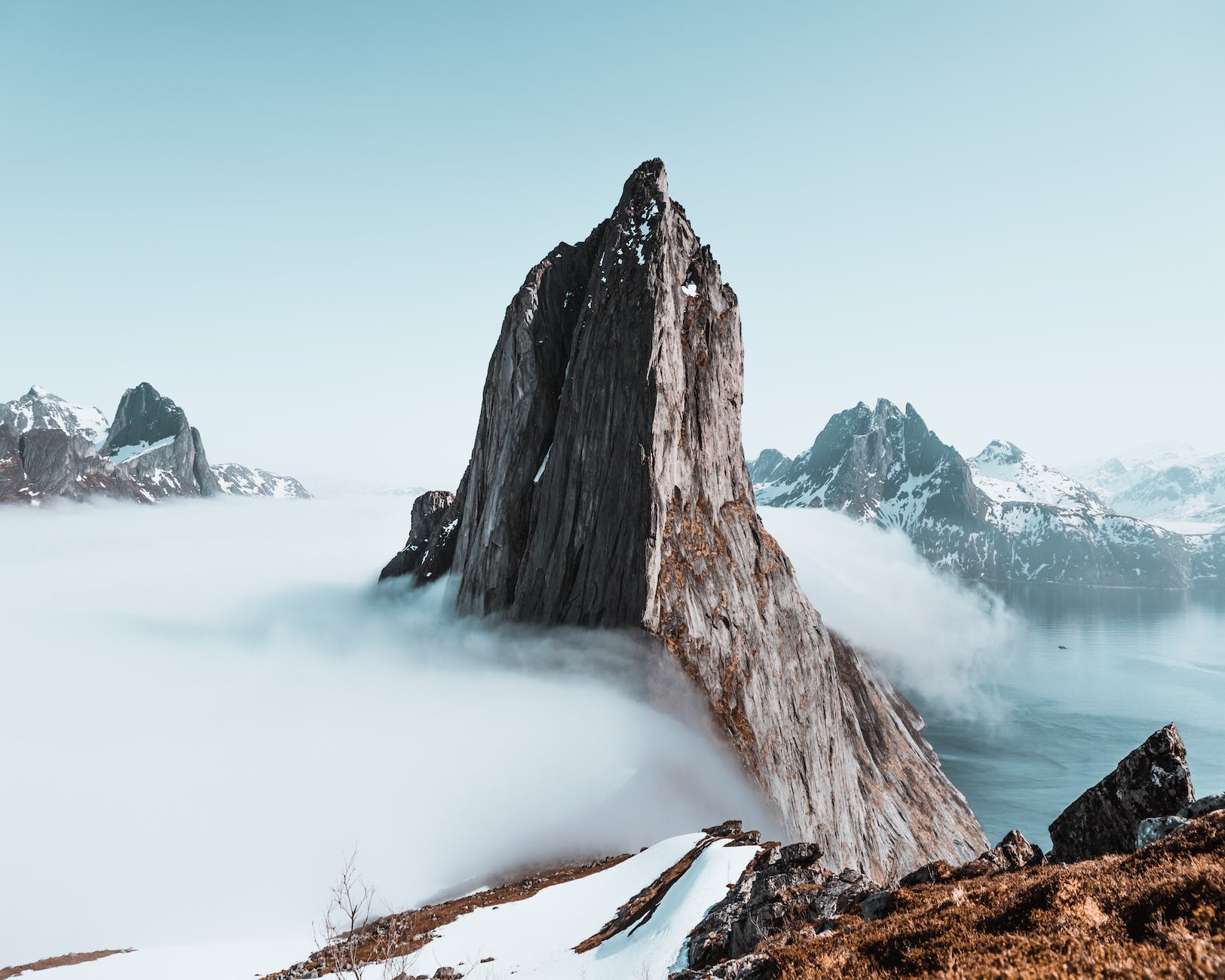
Not as Dextrous as They Might Like to Be

Because they fear what they do not control
Because they fear what they do control
Because they know what bows to them today
May stand taller than they tomorrow
And they fear to be looked down upon for more reasons than
Shame at growing bald
Because they know what kneels before them tonight
Might suddenly bite down
Take a small mouthful away instead of
A tablespoon of lukewarm soup
Because they know that they do not know
And they do not want others to know as much
Because they know that they are not enough
They do as they do
Reaching out one hand to grip a bar they think was
Planted long before and not realizing that
It has never stood as straight as they see it, that
It is bent and curved and knurled
As any can find who bestir themselves to seek
And go a bit from where they began

Some need no cutting down to size…
Photo by Nishant Aneja on Pexels.com

They do not want to be so moved
Clearly
And so they keep their hands upon that bar
Clinging to it as the world will move them up and down
Their palms sliding
As they must
Which would not be so bad if they did not force so many
Not only to observe
But to take part in their little shows

I’m happy to write to order for you, from Jeremiads to assessment text, from haiku to sonnets to semi-alliterative tetrameter, from essays to ad copy. Just fill out the form below to tell me what you need, and we can work on it!

← Back

Thank you for your response. ✨

Or extend patronage, and enjoy the benefits!

A Robin Hobb Rereading Series: Entry 347: Dragon Haven, Chapter 17

Read the previous entry in the series here.
Read the next entry in the series here.


Another message in the ongoing exchange between Detozi and Erek sent along with official business between Traders’ Councils precedes “Changes.” As the chapter begins, Sedric paddles and considers the changes going on in him, on which Carson remarked the night before. Their conversation about those changes is rehearsed, and Sedric mulls over the need to keep parts of himself hidden from his lover. Relpda intrudes upon his reverie, noting the coming of changes.

It’s a good look.
Firehorse Glass‘s Sintara via Coffee and Captured Moments, used for commentary

Sintara muses over her current situation and that of the other dragons with her. The changes going on in her own body please her. The changes going on among the keepers do not, and she looks on as Mercor and Kalo summon the keepers to attend. The dragons’ actions provoke ire from Leftrin at the treatment of the Tarman, and Kalo demands a keeper to replace Greft. A scuffle among the dragons breaks out, which Mercor swiftly subdues. Discussion proceeds, more calmly but not without tension, and Carson’s nephew, Davvie, volunteers to the task of keeping Kalo, and Carson finds himself conscripted to aid the belligerent Spit. Sintara considers the changes occurring in Thymara, finding herself startled at some of the particulars, and determines to guide their further course. The dragons set out, compelling the rest to follow.

The dragons are long noted in the Elderlings novels as being mirrors to humans, the Fool making the parallel explicit more than once. If that is the case, and if, in a more “literary critical” sense, the dragons are metaphors for (certain) people, then I have to wonder what comment is being made with the casual assumption of authority over humans on the dragons’ part. Admittedly, it is persistent throughout the Rain Wilds Chronicles–and in earlier Elderlings novels–but it seems more prominent at present than elsewhere, with the offhanded consideration of eating Greft and the assertion that new keepers will make themselves available to the dragons. There are reasons for the new keepers to agree, of course; desire and fear are powerful motivators, as no shortage of advertising demonstrated. But even so, there is an arrogance in the dragons that…I wish I could say I see it rarely in the world around me and the people in it.

My wishes are many. Not many are granted.

It will, of course, be the case that some will complain of striving toward such a reading. “It’s just a story,” some will say. “Why do you have to make it political?” or some other purportedly objectionable thing. The thing is, though, that I’m not making it any way. The words are on the page, whoever reads them. All of us who do read, though, approach the text from the perspective/s we inhabit, and those perspectives emerge from our own orientation. When I had students, I explained it to them as a combination of where we’re from, when we’re from, and who we’re from. Even if we place ourselves into the positions of other, we do so only to the extent that we are able to imagine those positions, and those imaginings are themselves constrained as we are. And, all of those constraints reflect the circumstances in which we have lived; they are all necessarily already political, whether in terms of party alignments, demographics, ideological orientations, or other factors.

Reading is always a communal act. Any community will necessarily have “politics.” The questions become whose are reflected and in what ways.

Like how I write? Want me to write for you? Fill out the form below!

← Back

Thank you for your response. ✨

Or maybe send me some support?

A Rumination on Good Friday

Around this time last year, I posted a translation I did of The Dream of the Rood. It’s been on my mind again in recent weeks, partly because it is the time of year that it is, and partly because of some other things going on about which I might comment at some point or another; I am not yet certain. Today, I have some leisure to attend to it, having been given an unexpected day off from my regular job, something for which I am grateful; I rather enjoy writing, however good or otherwise I might be at the task, and the thinking that undergirds it has its charms, so that the opportunity to engage in both is a welcome thing.

From about this time last year…
The Ruthwell Cross by JThomas is licensed under CC-BY-SA 2.0

For many, especially in this part of the world, the day serves as a reminder of sacrifice and the necessary costs of salvation, prepaid for those who, like the dreamer in the poem, are aftercomers “stained with sins, / badly wounded with sins.” (I think I could polish the translation more, but that is another project for another time, one of many that might be imagined.) Much is made of the magnitude of the sacrifice, of the agony that was endured by those crucified in the Roman style, and better theologians and historians than I can speak more eloquently and accurately to the same.

For my own part, as often, I find myself coming up with questions that I expect would be heterodoxies to voice–if not more. Ideas about their answers abound for me, offering other projects that might be undertaken; there is never a shortage of them, although there are shortages of my time and talents to attend to them all. (I would seem to have internalized humilitas to some extent, both sincerely and otherwise.) But if I were to voice one idea, one that might not be so divergent as all that: the story so widely celebrated today, the self-sacrificial sin-taking for others’ redemption, speaks to many to say that there is some hope, and that even amid those who would abuse laws to persecute those whom they perceive as threats to their power, there is some sympathy to be found.

I am not sure, certainly, how far to follow that idea, how far it can be followed. That there are limits to any such thing, I am well aware; indeed, one of the standard questions I pose in the lesson plans I still write is to find the point of failure and interrogate it. But I am no longer at the front of the classroom, so it is not for me to push others to such contemplations. It is for me, however, to conduct them myself, and a solemn observance–even in advance of a joyous occasion–offers opportunity for such things.

I remain grateful for such things.

Like what I write? I’m happy to write for you; do me a favor, take a minute, and fill out the form below. See what I can do for you!

← Back

Thank you for your response. ✨

Or just send your support along!

A Weekend Wondering

Something about sitting under a springtime sun
Staring into the open blue sky
In advance of the evening’s enjoyment
Prompts pondering on what has passed to this point
How many such days
Or sultry summer afternoons and their languid evenings
Or autumn nights warmed by flickering flames and fragrant smoke
Or winter mornings spent snuggled beneath blankets
Have been lost to labor for others’ gain
For no better reasons than another’s profit,
And the scraps from their table
Copper crumbs falling from crackling lips
That grimace as any other’s gain

Like the work I do? Want some done for you? Reach out through the form below!

← Back

Thank you for your response. ✨

Or simply send support along!

I Could Have

Gone out and partied instead of
Staying in and studying
Slacked off and coasted instead of
Showing up and working hard
Made friends and talked to people instead of
Sitting alone in the room with books
Played outside or lounged about instead of
Taking the job and
Showing up for every holiday

…and never was.
Photo by cottonbro studio on Pexels.com

But I did not
They told me not to
Said doing as I did would lead to success
And it might be called success to be
Working in a field for which I never trained
Working to pay off the debts that cluster in my name
Working so that others may profit all the more
Working day and night each day and night
But if this is success
What must failure be?

Like what I write? Want some done for you? Fill out the form below, and we’ll see what we can do!

← Back

Thank you for your response. ✨

Or just send your support along!

Deverdie

The jewels upon her dress are losing their luster
And the dyes of its fabric begin to fade
Its warp and weave fraying and growing ragged
On her chalk-like rolling swellings as
He lays his castings out longer and harder daily

Picture not related
Photo by Alex Conchillos on Pexels.com

Worse
Of course
Are the clinging things
Bloating up with blood on which they feast
Clamoring for more
And turning away from the sight of the sky as they beset her

Still
She is beloved
Deeply and by many
And the thought of leaving her
Though such parting might be needed
Is no easy thing

If you like the work I do, fill out the form below and see what I can do for you!

← Back

Thank you for your response. ✨

Or just send support along!

A Robin Hobb Rereading Series: Entry 348: Dragon Haven, Chapter 16

Read the previous entry in the series here.
Read the next entry in the series here.


A trio of missives coming in rapid succession note the concerns and lack thereof of Trader families in Bingtown for Alise and Sedric; they are accompanied by continued messages from the bird-keeper Erek to Detozi. They precede “Reeds,” which opens with Leftrin surveying the continues progress of the Tarman upstream as night begins to fall upon the expedition to Kelsingra. The local flora and fauna receive no small consideration, and Leftrin notes the acceptance of Alise by the liveship he commands. Leftrin’s thoughts turn to his continued affair with her before his reverie is halted by her questions about their course along the river. After some discussion, they note the presence of clearly artificial elements in their surroundings.

Something like this, perhaps?
Photo by Mabel Amber on Pexels.com

Discussion and investigation follow, with Alise charging ahead despite objections from Sedric and Leftrin’s concern. She finds structures not far under the surface of the water, and the dragons move to investigate further. Mercor pulls on something beneath the surface, triggering a reaction that startles Alise, and as she is pulled back aboard a boat from the Tarman, the dragons move to avail themselves of what Sedric explains they have found: guest accommodations for dragons, built by Elderlings before. Alise and Leftrin both purpose to record findings, and despite their intent, the decision is made to press ahead the next day.

Later, Thymara breaks off a budding assignation with Tats, citing concerns about pregnancy. Tats reacts poorly to the decision, for which Thymara upbraids him. They fall into an argument that is interrupted by loud upset from the dragons, Kalo raging against Greft. Greft falls into the water and is retrieved, brought aboard the Tarman, and restored to consciousness. Leftrin questions him, harshly, and learns that Greft had asked Kalo for blood and to be made into an Elderling, but had been refused vehemently. Sylvie reports that Kalo had suspected Greft of wanting to take blood to sell, which Greft admits before noting that many in the expedition had been put to that purpose to secure an alliance with Chalced. Violence erupts, and secrets come out. Greft confesses the changes working ill upon him, changing him in ways that will kill him, and Leftrin notes the extent of his complicity in the matter.

The present chapter is another place where I find myself reading with affect and the recollection of my decades-gone adolescence. The argument between Thymara and Tats is all too close to more than one I recall having in the long-ago days before I met the woman who is now my wife. I am not proud of it, that I acted such, but I doubt very much that I am alone in having done it. So much does not excuse the behavior, and I have worked to be better since. How I will address such things with my daughter–because I do not doubt that she will have the experience of similar arguments, and I can hope she will be as certain of herself as Thymara is, although I will hope she is better informed–is a matter of increasing concern for me as she gets older. But I do not think I am alone in being concerned for a growing child. I know I am not alone in worry for Ms. 8.

(Again, I must note that I do not approve of Tats’s behavior. I understand it, I sympathize with it, but I also recognize it as wrong. That the pot has been patinaed does not mean it errs to note the kettle’s hue.)

In terms of narrative structure, the present chapter seems to be something of a Freytagian (is that the word?) climax. Part of this are the positions in the book of the chapter and in the series of the book; the Rain Wilds Chronicles is a tetralogy, and the present chapter is near the end of the second book. Being nearly the middle of the overall narrative arc, the present chapter is a good place to move into climax. Moreover, the revelation of secrets and explication of tensions, bringing them to the forefront so that they must be acted upon, is, if not itself a turning point, a clear set-up for one. Things that are allowed to remain secret can be ignored, and keeping things secret can itself be a useful plot, an early act setting up for a new one. The reinforcement of a time-limit upon the characters, both in Mercor’s note about the advancing seasons and in Greft’s openness about the physical changes befalling him, also serve to provide motivating factors for continued action.

And I am led to another thought. I’ve remarked before that some of the magics at work in the Elderlings novels can be read as commentaries on social issues, even if those readings do end up breaking down later (I find it hard to accept something as a stand-in for a thing that presents itself openly in the corpus, but that may just be my own limitations at work). If the Wit can be read as queerness (for admittedly variable types of queerness), as what can the Skill be read? Or the work of the Rain Wilds and the dragons in the world? I do not have ready answers at this point, not being the scholar I once was anymore (and not having improved, really; quite the opposite from my expatriation or expectoration). But I think there is something there to consider, and I would welcome seeing how others address that topic (perhaps again; I forget too many things anymore).

Like what I do? Want me to do it for you? Fill out the form below!

← Back

Thank you for your response. ✨

Or simply send support!

Briefly, Not on Writer’s Block

A few days ago, I remember having had an idea about a story I thought might be worth writing down. As it happened, the thought occurred to me while I was driving along US 290 west of Dripping Springs, and that is not a good place to pull off to the side of the road to take notes. By the time I got to where I could pull off, the idea was gone, a squirrel scampering across the highway and into the surrounding brush.

You know what you did…
Photo by Joseph Yu on Pexels.com

It’s not the first time such a thing has happened to me, of course; it is a frustratingly frequent occurrence, in fact. The opposite of writer’s block, it is instead too free a flow of ideas; there needs to be a dam across the irregular stream, something to catch at and slow the spurts that gush out from time to time. But I am not built so well as to have such a thing in me, clearly.

I imagine the issue is related in some way to the Asimovian Eureka phenomenon, explicated in an essay of the same name. Ideas upon which the subconscious mind has worked emerge into conscious thought amid relaxation or distraction–and it is the case that driving through the Hill Country during wildflower season provides distractions in plenty, not only squirrels darting across the highway and deer, or the occasional armadillo looking to pose with a beer can, nor yet only a possum snooping around the inside of a mobile home. They may not be relaxing, as such, but they still divert conscious attention from other matters, allowing the subconscious mind to work on other things and vomit them up, undigested cud, to be gnawed upon and fermented further–or else spewed out all of a sudden and flushed away.

The handle on my toilet gets a lot of use.

If you like how I write, why not have me write for you! Custom work without the worries of AI foul-ups! Fill out the form below for details!

← Back

Thank you for your response. ✨

Or do the human thing, and send some support along!

A Thought on Wildflowers

They show up in patches on the roadside
Stains upon the carpet stretching wide
Spilled by passers-by and thickest nearest traffic
Crowding where the sludge and slime run off
Color springing from the filth

Pretty.
Photo by Irina Iriser on Pexels.com

There is hope in such
Because it is not only the roadsides
That bathe in such waters

I remain available to write to order; let me know below what you need!

← Back

Thank you for your response. ✨

Or simply send your support along!

A Robin Hobb Rereading Series: Entry 347: Dragon Haven, Chapter 15

Read the previous entry in the series here.
Read the next entry in the series here.


Following more of the ongoing exchange among the bird-keepers (with complaints about public spending priorities), “Tarman” begins with Thymara bringing food to Sintara, to the Dragon’s begrudging approval. Thymara inquires about Sintara’s effects upon her, and Sintara answers somewhat cryptically. Mercor puts into the conversation and rebukes Sintara for her lackadaisical attitude toward her keeper. Sintara responds to the rebuke with anger, provoking upset among the dragons that is only narrowly stopped from becoming violent. Sintara stalks off, nursing her embarrassment.

Not the friendliest, no.
PunkerLazar’s Black Dragon (3) on DeviantArt, used for commentary

Leftrin and Skelly confer about the ongoing reluctance of the Tarman to get back underway. Annoyance with the ship’s resistance to efforts to resume travel is noted, and the motivations of the ship are theorized. Leftrin puzzles over the matter for a time before recalling that the liveship is made of the stuff of dragons. The Tarman seems pleased with the recognition and shifts to realign the course to be taken; Leftrin delights in his ship’s renewed compliance, even as Greft questions him aspersively.

Thymara and Sintara, returning from where the former has tended to the latter, see the liveship’s reorientation. They confer with Sedric and the other dragons about the same, and the dragons begin to talk together about the liveship and the nature thereof. Another argument ensues among the dragons, threatening violence until it is stopped by Kalo. Kalo recalls having been Kelaro, a follower of Maulkin who became Mercor. Kalo calls for forbearance with the Tarman, and Thymara sees the modifications that were made to the ship. The dragons and the Tarman depart, heading upstream on the correct course and leaving the keepers scrambling to follow.

Sedric finds himself conducted along by Thymara and Sylvie, assessing the condition of the waterway as they go and noting the differences from the main flow of the Rain Wild River. Sedric’s thoughts turn to Carson and warm him. At length, Sedric offers to spell one of the keepers at the oars, and Thymara notes willingness to accept the offer, surprisingly, but citing a back injury. Discussion turns to the changes befalling each of them, as well as their sources in the dragons. Conversation lapses thereafter into uncomfortable silence.

There are interesting parallels between Sintara and Thymara in evidence; the one brought to attention by the present chapter is their vexation with being the focus of others’ reproductive desires. It is an understandable thing, if one I’ve commented on with any number of other chapters–at least insofar as it relates to Thymara. For Sintara to show similar attitudes is of interest, however–although this is far from the first time Hobb shows such things among thinking members of different species.

Of more moment is Sylvie’s comment that “Elderlings were a form of art for the dragons of that time. They found humans they thought had potential and developed them. That was why they cherished them. Everyone cherishes what they create. Even dragons” (392). It is a chilling thought, the idea of being made an artwork for some other thing; for some reason, I am thinking of Hellraiser and the less savory parts of Berserk…Given the implications of the chapter, that many of the dragons who are “developing” Elderlings do not really know what they are doing…body horror comes to mind. Even with “beneficial” changes, it’s chilling, to indulge litotes.

I’m available to write to order; fill out the form below for details!

← Back

Thank you for your response. ✨

Or just send your support along!