As it happens, I do occasionally get ill such that I cannot take the risk of coming in to work. Such a thing has happened to me today; I know what it is, and I am getting it taken care of, so I should be able to be back to work when I am next scheduled to be. In the meantime, however, there are some things that need to be discussed for my students at Oklahoma State University and Northern Oklahoma College. They should appear below.
Oklahoma State University
Students of mine at Oklahoma State University should be working on their Infog, of which the RV is due before the beginning of class time on 11 March 2016. That RV is supposed to consist of a statement of goals and purposes, a raw-form infographic, and a digital-original form of the infographic, all in a single Word document. Compiling the document will require students to insert graphics, and legibility of the graphic may require resizing pages. I had meant to cover one method of doing so in a single document with my students today; since I am not in the classroom, that will not be possible, so I am putting together this commentary to help with that task.
Please note that the directions below are written from the perspective of a PC user; commands for Mac and other platforms will be different. Please note also that the directions below work from previously existing materials, the sample infographic provided for students, here.
Drafting the statement of goals and purposes should work much as previous assignments for the class have; the text should be left-aligned in double-spaced 12-point Garamond, Georgia, or Times New Roman type, with paragraphs indented half an inch from the margin and headings, title, and page numbers in place as normal. It should look something like this:
After completing the text of the statement, hit the enter key once to move the cursor to a new line. Then start a new section of the paper. To do so, go to the “Page Layout” tab at the top of the screen and select it. Next, select “Breaks,” which should offer a drop-down menu. On that menu, under the heading “Section Breaks,” select the “Next Page” option, which will move the document to a new page, with that new page being a new section of the document able to be adjusted independently of the other parts of the text. The selection should look something like this:
Once the selection is made, the screen should look something like this: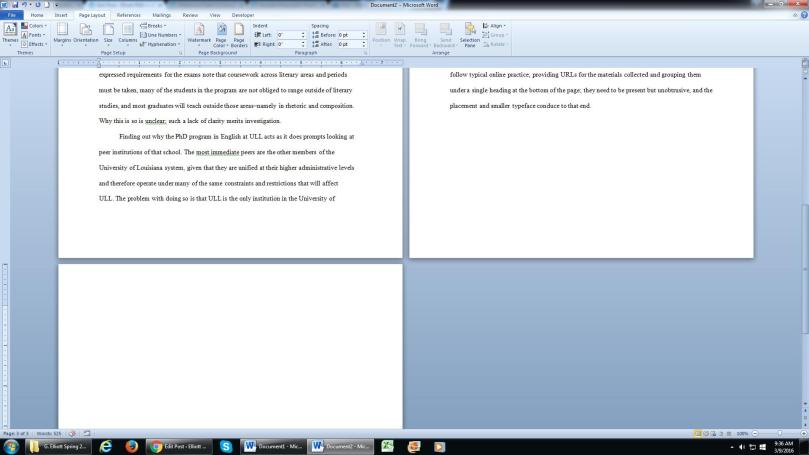
Page numbers will need to be inserted into the new section; the document is continuous, and the pagination needs to reflect it. And it will be helpful to have a subject heading that indicates what content will be in the new section; my sample post on the blog called it “Raw-Form Infographic,” which seems a useful label. I put it into my document, changing the spacing on that line to “Single” to facilitate image placement. (It is a variation from “normal” formatting, admittedly. Visuals introduce changes.) A problem arises, however, in that my hand-drawn raw-form infographic is on letter-size paper, as are many done by students. Inserting that image into another letter-size page will shrink it, making it more difficult to read than it needs to be.
To allow the image to show up at full-size, then, the page into which it is inserted must be made larger. (Keep in mind that it has to fit onto the page along with its label.) Margins will do well to remain at one inch, so the page will need to be two inches wider than letter-size: 10½ inches. Height will need to accommodate the label; an inch in addition to the two added for margins should suffice, making the overall page height some 14 inches.
Making the adjustment necessitates returning to the “Page Layout” tab at the top of the screen, selecting it, and selecting the “Size” button thereupon. Doing so will produce a drop-down menu, at the bottom of which is “More Paper Sizes,” which is the appropriate choice. Selecting it brings up something like this: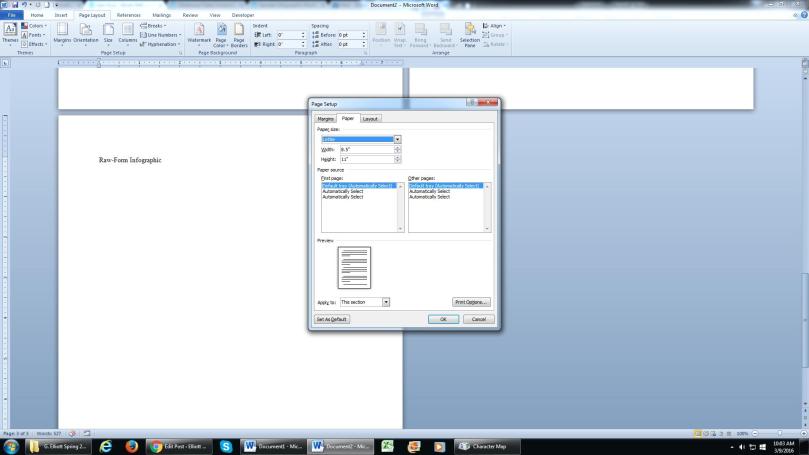
The “Height” and “Width” boxes can be adjusted by selecting them and putting in new values. For mine, they are the 14 inch height and 10½ width noted earlier. Also, in the “Apply to” box, I selected “This section,” which I recommend to others. Upon making the adjustments and selecting “OK,” I received a message about the printable area, which I opted to ignore for the present purpose. That done, my document came to look like this: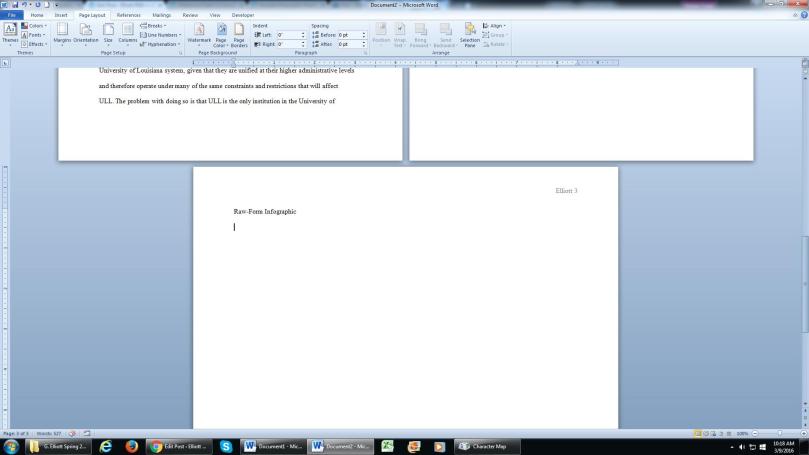
Students whose raw-form infographics are oriented horizontally rather than vertically will also need to adjust their page layout to suit. This is done by going to the “Page Layout” tab once again, this time selecting it and selecting the “Orientation” option appearing thereupon. Normally, documents will be in the “Portrait” orientation; a horizontal layout will need to be adjusted to the “Landscape” orientation, done by making the appropriate selection. (Keep in mind that room still needs to be accorded to the label on the page; the page will need to be 11½ inches high and 13 inches wide to accommodate.) Something like the following should appear: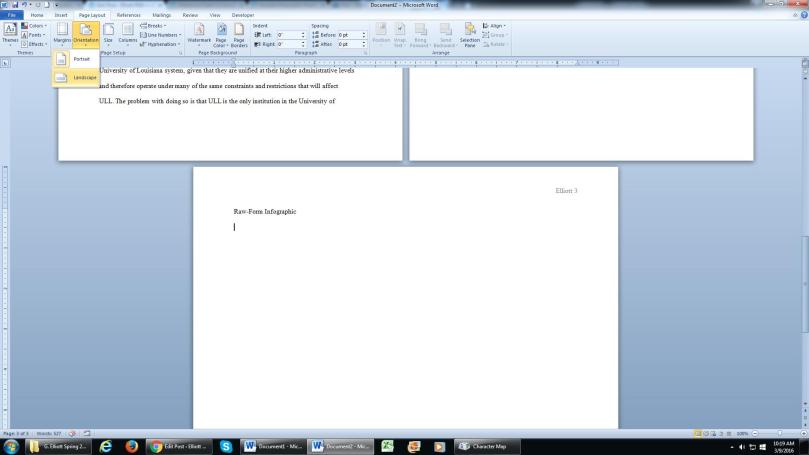
With my page set up appropriately to accommodate the raw-form image, the time came to insert the image into the document. To do so, I placed my cursor where I need the image to appear: the next line of text after the label. That done, I selected the “Insert” tab at the top of the page, clicking on the “Picture” button beneath it; the following appeared as I did so:
A file-selection menu appeared, and I selected the raw-form infographic I had drafted and scanned in. (I used my home scanner; scanners are available to students in the Edmon Low Library, and their use is intuitive. I do recommend saving images as .jpg files, however.) Doing so placed the raw-form infographic in the document where I wanted it to be, as shown below: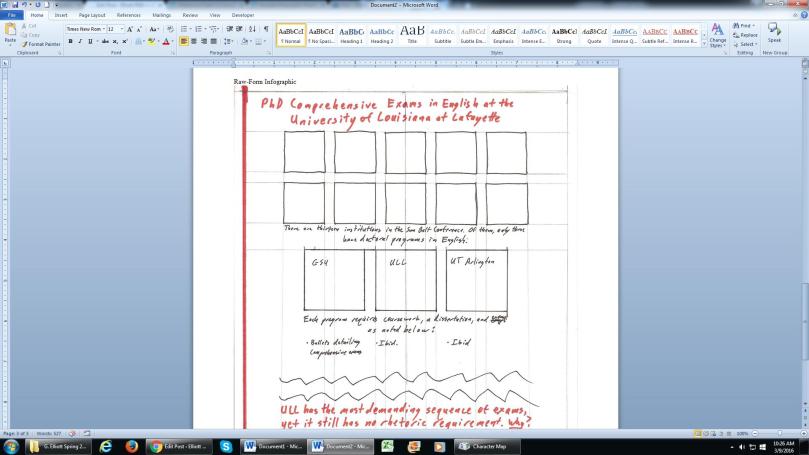
That done, I went to the end of the document (hold “Ctrl” and press “End” on the keyboard) and repeated my earlier process of starting a new section of the document to facilitate insertion of the digital-original form of the infographic. I also repeated my earlier process of adjusting the page size to suit the digital document. Because I formatted the digital-original version as a tabloid-sized document (11 inches wide, 17 inches high), and I still needed a label (“Digital-Original Infographic,” after the online version), I set my page size to 13 inches wide and 20 inches high. Afterwards, I inserted the label and the image, with the following result: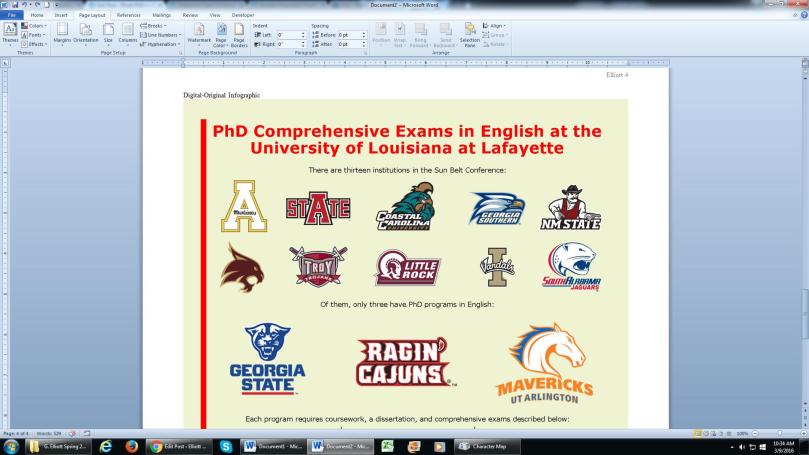
The resulting document appears here: G. Elliott Spring 2016 ENGL 1213 Infog Formatting Walkthrough Result.
Return to top.
Northern Oklahoma College
I had intended to discuss more citation styles with my students at Northern Oklahoma College today; my absence will prevent that from taking place. That said, I can point them again to the Purdue OWL discussion of MLA standards, here. I can also offer them some questions to ask about sources when determining whether or not they are likely to be valid for the AnnBib on which they are to be working.
I have noted before that information is not neutral; the selection of what information is to be presented is a deliberate choice, one stemming ideally from considered judgment and therefore interpretive decisions. Concerns of ethos attach themselves to such interpretations; knowing what types of information the expected audience is likely to consider reliable and presenting those types helps writers to present themselves to their audiences as being reliable and worth attention. Academic audiences are likely to consider primary source materials reliable (although there may be quibbling over which edition of a given primary text is the best to use); one cannot discuss a thing without reference to that thing. That primary materials are so necessary, however, means that they are not appropriate for inclusion in an annotated bibliography in most circumstances. Secondary and tertiary/critical sources, however, are–provided they are of sufficient quality.
Determining whether they are happens through developing answers to a series of questions, of which a selection appear below. Each source will need to prompt some questions of its own, so there is no way to account for all of them that might do well to be asked. Also, there is no guarantee of reliability, as it is possible for error to persist despite the best and most sincere efforts of those producing work–whether because new data is uncovered later or elsewhere or because, as the adage has it, “Even Homer nods.”
Keep in mind that there are multiple people involved in the dissemination of information. For most reliable secondary and tertiary/critical sources, there will be an author, an editor or editors, and a publisher or publishers. Similar questions will apply to each, with one or two others worth asking, as well; the first of them is “Is the author/editor/publisher identified?” While there are circumstances in which anonymity is desirable or even necessary, people are generally less willing to associate their names with what they know is wrong; having those involved in the production of a source identified is therefore an easy, early indicator of whether the source can be a quality source. (Admittedly, many hold sincerely to cockamamie ideas. Again, answers to such questions move towards reliability; they do not guarantee it.)
Related to that question is that of “What background does the author/editor/publisher have with the subject being described?” While past performance is not an absolute predictor of current or future performance, it is the case that someone who repeatedly does well with a thing is likely to continue to do well with that thing. The reverse is also true.
Also related, and of perhaps greater importance, is “What does the author/editor/publisher gain from others?” This can be rephrased in part as “Who pays?” It can also be “How does the author/editor/publisher benefit?” While admittedly cynical, the idea that people will work to suit their interests and act in ways that benefit them–whether those ways are generally ethical or not–is one that needs to be considered, as it skews perspectives as much as if not more than any other concern.
Less cynically, having identification of the author/editor/publisher allows for the question of “Who/what else works with what the author/editor/publisher produces?” If materials known to be good use the current piece or others produced by the same agency, and they do so favorably, the materials under review are more likely to be good, as well. Conversely, if good materials disparage the work done by the agency responsible for the reviewed material, that material is likely to be less helpful. Again, the reverse is also true.
A similar question, albeit one oriented towards the past, is “From what does the author/editor/publisher work?” If the material being reviewed uses good materials and commends them, it is more likely to be good. If it disparages them, it may still be good; one of the things that scholars accept is that their work may be supplanted by further study and the revelation of new information. Sometimes, advancing that new information requires the outright rejection of the old.
Two other questions present themselves for particular attention. One of them is “What is the medium of presentation?” Marshall McLuhan famously quips that “The medium is the message” in Understanding Media: The Extensions of Man, and he is, in large part, correct. The manner in which information is presented influences how it is received, and, as dominant communicative theories hold, the reception determines what information is actually transferred–not only in terms of the explicit data, but also in parallel concerns that do much to influence perceptions of reliability and applicability of the information to other venues. The degree of adherence to the conventions of a particular medium deployed in a given source help speak to its credibility and reliability (although, again, they do not guarantee it)–particularly in the case of scholarly literature, which is conventionally peer-reviewed (i.e., the materials are blind-assessed by experts in the field, and usually substantially adjusted based on those assessments, before being allowed to proceed to publication).
The other is “How timely is the source?” Timeliness does not necessarily equal recency, although a more recent source will generally be more helpful than an older one, as it allows for more information to have been uncovered. That said, enough time for fact-checking needs to be allowed to avoid things happening like the CERN neutrino kerfluffle in 2011 and 2012. Also, projects that track historical progressions (and many will need to do so, if only to provide adequate surveys of prior treatments of the material) will necessarily need to examine earlier sources.
There are, as noted above, other questions that can be asked–and that should be asked. Those noted above, however, should offer a useful beginning from which students can work on the AnnBib and other projects, both in my class and in their writings yet to come.
Return to top.
Updated 1 April 2016 to adjust grouping.
 Elliott RWI