Reflective Comments for the July 2018 Session at DeVry University in San Antonio

Continuing a practice I most recently iterated at the end of the May 2018 session at DeVry University in San Antonio, and following closely the patterns established in previous practice, comments below offer impressions of class performance among students enrolled in ENGL 062: Introduction to Reading and Writing during the July 2018 session at that institution. After a brief outline of the course and selected statistics about it, impressions and implications for further teaching are discussed.

Students enrolled in ENGL 062: Introduction to Reading and Writing during the July 2018 session were asked to complete a number of assignments in quick succession. Many, and the weightiest, related to the overall course project; others were homework meant to practice skills used in the workplace and in later stages of the course project. Those assignments and their prescribed point-values are below, with relative weights shown in the figure below:
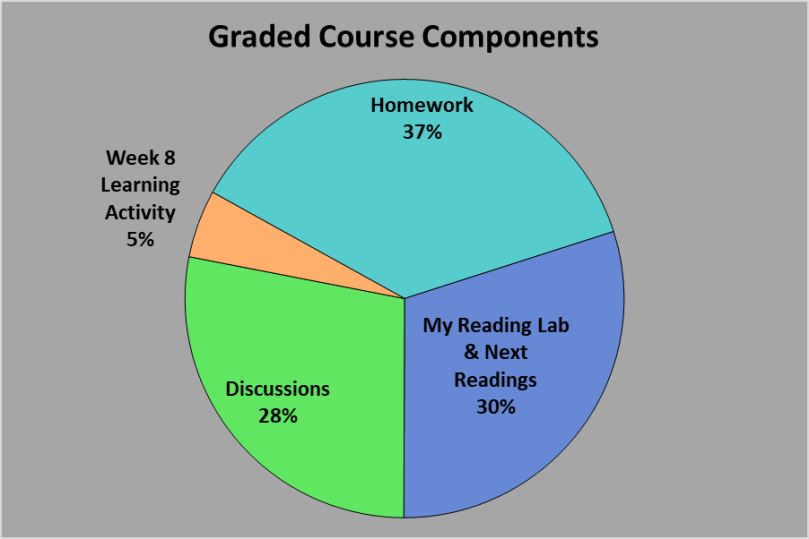
ENGL 062 Grade Breakdown July 2018

  • Homework (a developed paragraph, a summary and response, and two essays in two versions each)- 370/1,000 points
  • My Reading Lab (reading skills and reading level assessments)- 300/1,000 points
  • Discussion Posts (three posts in each of two graded discussion threads weekly)- 280/1,000 points
  • Reflection on Progress and Plan for Improvement- 50/1,000 points

As before, most assignments were assessed by means of rubrics provided by the institution. Some few were assessed on a percentile basis from standardized testing conducted as part of University-wide course requirements.

The section met on Thursdays from 1800-2150 in Room 107 of the San Antonio campus of DeVry University. Enrollment was low–only two students as the class began, dropping to one before the class ended–so presentation of students’ statistics is inappropriate; there are insufficient numbers to allow either anonymity or the extraction of useful data.

Teaching so small a class had its benefits, certainly. I’ve got a fair amount of experience as a tutor, so I was able to operate the class as a sort of extended tutorial, though my tutorials are usually more responsive and flexible than a prescribed assignment sequence allows. I do have to note that the relatively low workload made for an easier time of things for me, and I am not ungrateful–particularly given that the next session looks like it will ask quite a bit of me (I’m only teaching one class, but it has 28 students in it as I write this–and it’s a wholly online composition course). In all, it catered to my strengths, and I feel I did a good job of it this time around.

I still appreciate having had the chance to teach again, and I once again look forward to having others in the new session and in sessions yet to come.

Class Report: ENGL 062, 30 August 2018

Discussion was meant to address questions from the previous week and earlier before turning to summative thoughts about the course. Time to complete the assignment for the concluding week of the course was to have been offered.

Class is reminded of the upcoming assignment:

  • Homework: Reflective and Planning Postscript, due online as a Word document in APA format before the end of 1 September 2018

The session closes at the end of the day on Saturday, so all work must be submitted by then to be counted.

The class roster listed one student enrolled, unchanged from last week. None attended, assessed informally. No student attended the most recent office hour.

Class Report: ENGL 062, 23 August 2018

After addressing questions from the previous week and earlier, class turned to workshopping student work in advance of the second draft of the final essay being due. Student questions were addressed as they arose.

Students are reminded of upcoming assignments:

  • Discussions (three posts per graded thread), due online before 0059 on 27 August 2018
  • Homework: Essay 2, Graded Draft, due online as a Word document in APA format before 0059 on 27 August 2018
  • My Reading Lab: Reading Textbooks Topic and Post-Test, due online before 0059 on 20 August 2018
  • One selection from My Reading Lab: Next Reading (in the Reading Level part of My Reading Lab; requires the Lexile Locator [which will be unscored]), due online before 0059 on 20 August 2018

The class roster listed but one student enrolled, a decline of one from last week. The student attended and participated well. No student attended the most recent office hour.

Initial Comments for the September 2018 Session at DeVry University in San Antonio

I have been offered a section of ENGL 135: Advanced Composition for the September 2018 session at DeVry University in San Antonio–and I’ve signed my contract for it. The course will run from 2 September through 27 October 2018, and it will meet wholly online. I admit to preferring hybrid or on-site courses to fully online work, but I also admit to preferring having income to not, so I was pleased to accept the course.

Ah, to see such a thing…
The image comes from DeVry University. It seems to fit, given the topic here.

I note, also, that there have been some adjustments to the assignment sequence in the course. As such, I’ll need to adjust my teaching materials somewhat from those I’ve been using for the past couple of years. It’s not a bad thing; updates need to happen as more research is done into what best practices are (even if that research tends to focus on traditional undergraduates, who are not the students DeVry tends to teach), and there were things in the previous assignment sequences that flatly did not work well.

Whether or not I assign a topic for consideration is still undetermined. I did not have great success with it the last time I did so, as I believe I noted. My concerns about it remain in place–the more so with a wholly online class, where students are typically even more pressured to cleave to assignments as prescribed and less inclined to range out from their expectations. (It’s not my first wholly online course, and my own mother completed a wholly online degree. I’ll admit my experience is limited, but it is still what I have to work with.) If I do, I do not think I will restrict myself to the previously assigned topic; again, few of the students I taught felt as if they could meaningfully address it. (I wonder if it derives from their having been underserved by their previous academic experiences.) Perhaps if I prescribe a topic, I will work with humor once again–although the circumstances of the class are not such as admit of jocularity easily.

In any event, I have it to do one more time, at least. Even if I do confine myself to the “standard” offerings this time around–and I might, that I might better negotiate the changes to the course sequence since the last time I taught it–I will be glad to have the opportunity to work with students yet again, hopefully to help them move beyond the idea of research as compiling and reporting information only and into the notion of research being the revelation or creation of new knowledge. Students in first-year writing classes do not necessarily often make such breakthroughs, but when they do, it is quite a joy to see; every time I am able to help it happen, I am pleased with myself.

Every time it happens, whether I am responsible for it or not, the world is that much better off than it was before. And more of that needs to happen.

Class Report: ENGL 062, 16 August 2018

Class was intended to address questions from the previous class meeting and before and turn to organizational patterns before briefly treating some concerns of paratext. Instructor absence prevented that, however. Instructional materials, including an attendance-equivalent, were sent to students.

Students are reminded of upcoming assignments:

  • Discussions (three posts per graded thread), due online before 0059 on 20 August 2018
  • Homework: Essay 2, First Draft, due online as a Word document in APA format before 0059 on 20 August 2018
  • My Reading Lab: Patterns of Organization and Inference Topics and Post-Tests, both due online before 0059 on 20 August 2018
  • One selection from My Reading Lab: Next Reading (in the Reading Level part of My Reading Lab; requires the Lexile Locator [which will be unscored]), due online before 0059 on 20 August 2018

The class roster listed two students enrolled, unchanged from last week. No students attended the most recent office hour.

Class Report: ENGL 062, 9 August 2018

After addressing questions from the previous class meeting and before, discussion turned to paraphrase and summary before responding to student questions about orthography. In-class practice was offered, and time was allotted for student work.

Students are reminded of upcoming assignments:

  • Discussions (three posts per graded thread), due online before 0059 on 13 August 2018
  • Homework: Summary and Response, due online as a Word document in APA format before 0059 on 13 August 2018
  • My Reading Lab: Paraphrasing and Summarizing Topic and Post-Test, due online before 0059 on 13 August 2018
  • One selection from My Reading Lab: Next Reading (in the Reading Level part of My Reading Lab; requires the Lexile Locator [which will be unscored]), due online before 0059 on 13 August 2018

Class met as scheduled, at 1800 in Room 107 of the San Antonio campus. The class roster listed two students enrolled, unchanged from last week; one attended, assessed informally. Student participation was good. No students attended the most recent office hour.

A Rumination on Commas

Standout Comma
I recently came across Chris Stokel-Walker’s 23 July 2018 BBC.com piece, “The Commas That Cost Companies Millions.” In the piece, Stokel-Walker details several legal cases where the presence and placement of commas matters, whether to the tune of millions of dollars (as in the Oakhurst Dairy case), in a Texas Supreme Court insurance case, an old tariff law, or a vendor contract, or in a capital case, as in 1916. Stokel-Walker along the way also reports on the need for linguistic ambiguity in some diplomatic contexts, and the article closes with a commendation to review documents carefully and hash out their meaning–adjusting the affecting punctuation–before agreeing to them.

As someone who remains involved in teaching writing, and doing so in accord with particular style guides (which have stated opinions about comma use), I am engaged in issues Stokel-Walker addresses in the article. Indeed, as was true of the Oakhurst Dairy case before, Stokel-Walker’s piece is a boon for those in my position. No few students have, in my experience, bemoaned attention to small details such as comma use (and commas are frequently an issue demanding attention in their writing); having a piece ready to hand that notes ways in which different punctuation results in different meanings–some of them quite costly–helps to make the real-world connections that are not always evident to those enrolled in required writing classes. And even if the use of particular style manuals can be problematic–as I acknowledge they can well be–they do speak to audience expectations, which must be addressed in any writing that would succeed at reaching any particular group of people.

That younger students I’ve taught, both at the secondary and undergraduate levels, would balk at having to pay such detailed attention is not a surprise. Being young, they tend to act as youths, and youth is not much associated with patience. Too, being young, they are newer to having to do anything, including to attend to details; they will necessarily be less practiced at it, and will therefore likely do less well at it–and I know of few who enjoy having it pointed out to them that they do not do a thing well. (They may appreciate knowing where they need to improve, but that is not the same thing as enjoying it, to be sure.) But I am surprised that the same attitude prevails among the older students I currently teach–people who, having been in the workforce and, in many cases, the military, are acquainted with the idea that small details matter. And I am surprised that those enrolled in the business- and technology-heavy programs offered where I continue to teach balk at such things, given the damage done by a misplaced decimal point on an accounting spreadsheet or by a single mis-typed character in a long string of code.

I suppose the matter is one of looking at standardized spelling and punctuation–whatever standard is applied–reads as a matter of being persnickety, as one that doesn’t affect anything “real.” Some of that, I’m sure, is an attitude held over from bad earlier teaching (not that I necessarily teach well; I’ve read the comments students have written of me, and they are not always compliments). That is, part comes from an issue I address in another essay, and part comes from teachers using “grammar” as a “gotcha” mechanism. Some, too, is the same unfamiliarity present among younger students; those I teach now have generally been away from formal schooling for a while, and the lack of exposure is not always helpful. But whatever the reason, I think it will be helpful to add Stokel-Walker’s recent piece to my teaching materials; while the details can differ, they do matter, and students–indeed, all of us–benefit from attending to them.

Care to help me fund my further comma use?

Another Rumination on an Online Course

A week ago, I commented on a training course I took to help myself and my major employer against disaster-readiness requirements, in which comments I made a note about my old study habits:

I looked at relevant texts–in this case, printed transcripts of the lessons [associated with the training course]–and annotated them before sitting for the actual lessons, and I followed along with the lessons as I could with the annotated texts in hand, making adjustments to my own notes along the way. Consequently, I had little difficulty in passing off the in-lesson assessments, and, when it came time to sit for the exam that would solemnize my completion of the course (and offer me continuing education units, which offer was not unwelcome), I passed it off with little difficulty.

Aside from coming off as more than a little arrogant–which I know it does, thank you–it suggested itself to me as a point of departure for more discussion. Indeed, I note that my study habits “might become [what I want to make a point of] in another blog post”–and so I offer this one.

First, I know that the methods I use may not be useful for every student in every subject. I’m trained as a reader and annotator, and I know not everybody is–and not all areas of inquiry and practice admit of annotation. The martial arts I have studied at times in the past are such disciplines; while judo may admit to it to some degree, what with certifications involved in refereeing and serving as a technical official, the performance of the art is a thing that must be done to be understood–and Aikikai aikido even more so. I hardly hold such practices in disdain–and many of the folks I esteem greatly are not “readers,” as such.

Second, I’m trained as a reader. Seriously. I’ve been damned lucky in being able to access and undertake such training, as I know many are not and have not. And I’m luckier in that I have a main job that still allows me to keep a toe in academe and run side-hustles that let me use that training to advantage. It’s a position of privilege I occupy, and I do not discount that. But neither this point nor the previous mean that what I do cannot be of some help to others, which is why I make a point of it now.

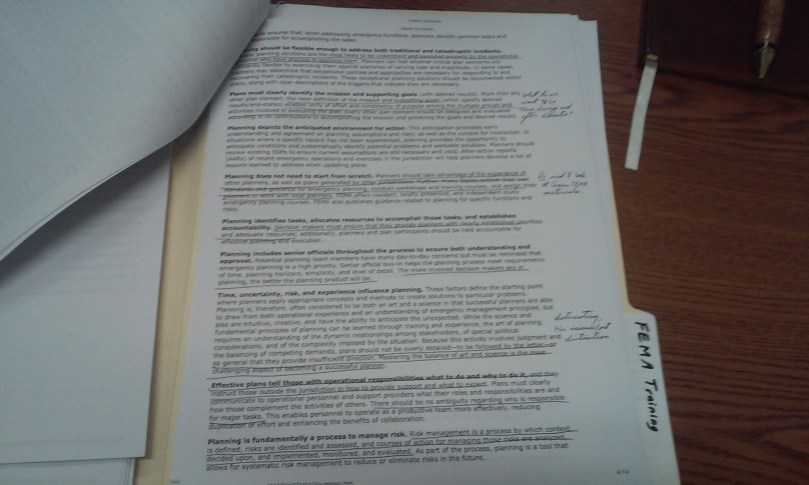
So, as I note above, I tend to print texts out (or buy them, when I have the money and I must or can) in large part because I find the physical media easier to use. I can page through books faster than I can scroll through screens, and while I can use a search function faster than that, I cannot always remember the best search terms–but I can glance across pages and remember what it was that I was supposed to be looking for. And I make marks on the physical pages for my convenience, in part to make later references easier–the marks stand out, being different from the printing on the pages–and in part to keep my notes about things with the things they are about. The things themselves need annotation, or I need them to have it, else I’d not make it–but the notes make no sense without reference to what they are notes about. I have a box full of notes taken on legal pads and other assorted papers, and when I look through them, I have no idea anymore what’s going on with them–but where I’ve marked my texts themselves, I’ve had no such problems at all, even a decade or more after the fact.

20180726_095727
One page of many.
The picture is mine. So is the handwriting.

To be sure, it’s no miracle method I use, nor is it anything necessarily special. For me, it works. I can hope it will for others, too.

Care to help me find and discuss yet better ways?

Class Report: ENGL 062, 2 August 2018

After a note about the abortive class meeting of the previous week, discussion turned towards the needs of introductions and conclusions before moving on to revision strategies. In-class practice with selected revision techniques was offered, and time was allotted for student work.

Students are reminded of upcoming assignments:

  • Discussions (three posts per graded thread), due online before 0059 on 6 August 2018
  • Homework: Essay 1, Final Draft, due online as a Word document in APA format before 0059 on 6 August 2018
  • My Reading Lab: Implied Main Ideas Topic and Post-Test, due online before 0059 on 6 August 2018
  • One selection from My Reading Lab: Next Reading (in the Reading Level part of My Reading Lab; requires the Lexile Locator [which will be unscored]), due online before 0059 on 6 August 2018

Class met as scheduled, at 1800 in Room 107 of the San Antonio campus. The class roster listed two students enrolled, unchanged from last week; one attended, assessed informally. Student participation was good. The most recent office hour was canceled due to another obligation on the instructor’s part.

Class Report: ENGL 062, 26 July 2018

Class was to open with treating questions from the previous class meeting before turning to concerns of writing as a process and of essay structures. Some time would have been allotted to work on student assignments. However, neither of the students enrolled attended.

Students are reminded of upcoming assignments:

  • Discussions (three posts per graded thread), due online before 0059 on 30 July 2018
  • Homework: Essay 1, Review Draft, due online as a Word document in APA format before 0059 on 30 July 2018
  • My Reading Lab: Outlining and Mapping Topic and Post-Test, due online before 0059 on 30 July 2018
  • My Reading Lab: My Reading Lab: Outlining and Mapping Topic and Post-Test Topic and Post-Test, due online before 0059 on 30 July 2018
  • One selection from My Reading Lab: Next Reading (in the Reading Level part of My Reading Lab; requires the Lexile Locator [which will be unscored]), due online before 0059 on 30 July 2018

Students, please keep in mind that the post-tests provide the grades for My Reading Lab assignments.