Read the previous entry in the series here. Read the next entry in the series here.
The next chapter, “Candletown,” opens with Althea reflecting on the titular port town and her life on the Vivacia as the Reaper sits in her slip. Brashen confers with her briefly before sending her on to meet with the ship’s captain, who has summoned her.
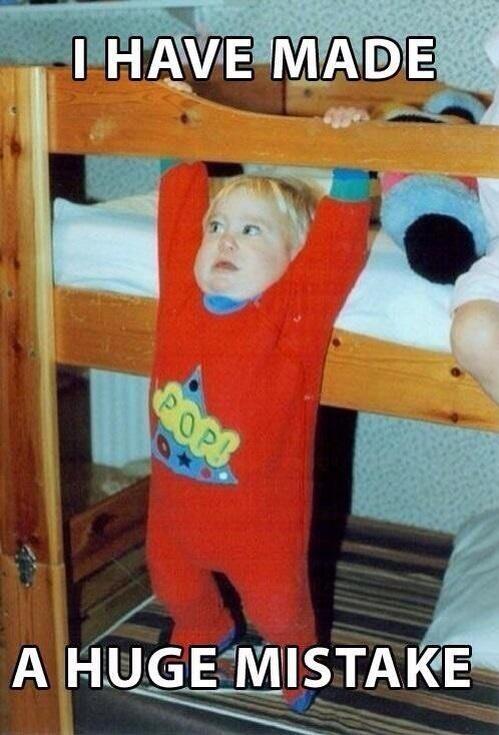
Memes to the rescue; image from QuickMeme.com, used for commentary
When she reports to the captain, Althea muses briefly on his sloppy quarters before standing for what begins as a fine review. The captain offers to hire Althea on for another cruise, but Althea demurs, requesting her ship’s ticket so she can force Kyle to surrender the Vivacia to her; the captain vociferously, vehemently refuses, and has her put off the ship with prejudice.
Meanwhile, Brashen finds himself a room in a pointedly tidy inn ashore and considers his situation. He waits for Althea, who takes her time finding her way about the town. At length, she finds him, and the two confer again; Brashen has made himself unwelcome aboard the Reaper, as well, and the rest of the conversation is unhappy. They part less than amicably, and Brashen returns to his inn to find himself turned out of it, too.
The patriarchal superstitious fear of menstruation attracting misfortune emerges again in the chapter, as should be no surprise. Transphobia does, as well, which is unfortunately not surprising, either. Given Hobb’s stated affection for sailors–she married one, after all, and in several commentaries she makes happy reference to some of them–it is not to be wondered at that she would focus her attention on them, but it would be something of a surprise for her to go out of her way to depict them unflatteringly, as in the case of the Reaper‘s captain–or of Kyle Haven. Perhaps it is best to read the character as a motion towards Hobb’s efforts at verisimilitude; the profession is not romanticized, nor are most of its people, but presented as flawed, sometimes substantially so, amid the good things they are and do.
Read the previous entry in the series here. Read the next entry in the series here.
The following chapter, “Rain Wild Traders,” opens with Ronica in a foul mood and Keffria attempting to negotiate it as Malta looks on and plots her own affairs, rehearsing what she knows of upcoming events. A major Trader social function is in the offering, and Malta seeks to impress at it; her family’s situation hinders her prospects of doing so.
The three ride to the event with Davad Restart, who muses on the benefits of slavery as they ride along together. Malta notes mentally and with some aspersion Ronica’s handling of the conversation, and she acts something of an ass as the Vestrits enter the darkened venue for the event. Malta muses on the reasons for the darkening as she, Keffria, and Ronica make to enter. While they wait to be announced, Malta is introduced to the Rain Wild Trader Jani Khuprus. She makes a slight faux pas with her, though the older woman takes it in stride.
When the Vestrits are seated, Malta continues to muse aspersively on their surroundings and the event as it gets underway. It is something of a legal convocation, and Trader Khuprus addresses the assembled Bingtown Traders on behalf of the Rain Wild group, calling for their intercession with the Satrap in Jamaillia, to whom they owe nominal allegiance and from whom they claim exclusive legal privileges that are being infringed upon.
A tumult arises in the wake of Khuprus’s plea, the Traders present growing fractious and argumentative. Khuprus calls for unity, and discussion continues as Malta excuses herself. Along the way, she encounters another Rain Wild Trader, with whom she converses for some minutes before realizing that he is not what he seems and that there is potential for scandal. She gives him her name before she makes her way back to her family.
Elsewhere, a group of serpents proceeds northward, if uncertainly. They press forward, striving towards something of which they are unsure.
I forget if I have noted another one of Hobb’s meaningful names: Davad Restart. The surname seems a fairly obvious bit of foreshadowing, promising to be the source of a renewal in the book–and it can be argued that he does, in his approval of chattel slavery and alliance with the New Traders whose landed presence violates the promises of Bingtown’s founding, look towards a new beginning for his home. That does not mean it is a pleasant or desirable one, however, for many or most who would be affected by it.
I note also that the focus on Malta offers insight into her still-childish character, and it is also not a pleasant or desirable one. Frankly, the girl is spoiled. She has been allowed to be, which is not her fault, but not all of her unpleasantness is a result of easy circumstances. There is this to consider, however; her character is not alone in being thus unpleasant, and there is room for her to grow from where she is in the present chapter…
I believe I’ve mentioned before that I live outside of town in the beautiful Texas Hill Country, a place where we occasionally get to critters of one kind or another up close and personal. Often times, there’s one cat or another sitting like a loaf of bread under the spreading oak tree that shades a good portion or the yard or curled up and sleeping under the rickety wooden steps that lead up to the kitchen door where my wife and daughter and I go into and come out of the place where we live. There’s been a possum in the house or on the porch, too, despite the presence and best efforts of our own cat and dog. And, of course, there are any number of bugs that find their way in, none of which are welcome–and bugs attract other little visitors from time to time.
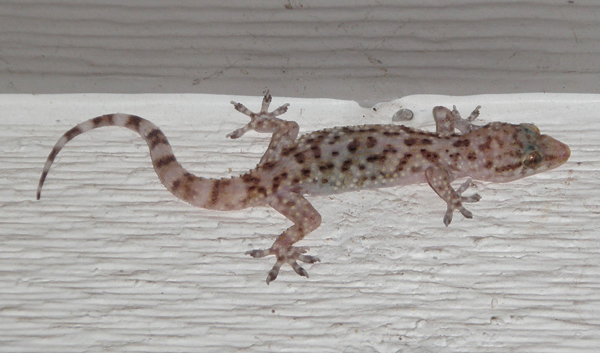
Now, like I’ve noted, I’ve lived in the Hill Country more years than not since 1988, and I’ve gotten more or less used to living here again after more than a decade away from it. I’ve seen no few lizards and even tried to keep one or two as pets. (The attempts did not last long.) So when my daughter started yelling as she went to get into her shower one recent morning, and I saw a little lizard–a couple of inches long, at most, and spotted pink–in the bathtub, I thought nothing of it except some annoyance that I got called away from making breakfast to redirect the critter outside. Nor yet did I think much of it when another such–or maybe the same one; I didn’t look close enough to be able to tell–appeared in the kitchen as I was putting dishes away a day or two later.
A little bit of looking since has told me that the kind of lizard I dealt with is most likely an invasive species, the Mediterranean house gecko, and I understand that there’re some problems with that. Then again, I’m an invasive species by some reckonings–I wasn’t born in Texas, after all, and I’ve taken up a lot of attitudes and beliefs that are at odds with where I live–and even a transplanted gecko eats a damned lot of the bugs that I’d prefer not to have about the house. So when I went to corral it with an empty sour cream container, I did so thinking to redirect it back outside. I did not mean to bring the lip of the container down on its little neck, not at all.
Whether I meant to do it or not, though, I did it. Intention’s not much against effect, really, though I still feel badly about blundering and bumbling the way I did. I’m not going to flagellate myself or anything, but I do have to wonder, if I screwed up trying to do something decent, what’s going to happen when I’m not trying to be nice?
Read the previous entry in the series here. Read the next entry in the series here.
The next chapter is titled “Jamaillia Slavers,” and it begins with Wintrow exulting in his freedom from the ship and service, walking along the streets of Jamaillia City. He considers his present circumstances, how to return to his monastery, and the ship he has left, and it nags at him no less than the clear signs of corruption in the city that is supposed to be the heart of civilization.
Quite a mouthful. Image taken from @katrindraws on PictoSee, used for commentary
The Vivacia stands sullenly as her officers query her about Wintrow’s departure. At length, she rebukes them openly and violently, striking Kyle and damning him. Gantry persuades Kyle to go out and look for the boy and to put out word of a reward for his safe return. Gantry tries to ease the ship, showing respect to her, but she stiffly rebuffs him, weeping at her current circumstances.
Elsewhere, Kennit and Sorcor make ready to take another slaver. Sorcor tries to spare Etta the sight of it, but she refuses, and the plan to take the slaver begins. Kennit makes to lead the boarding party, and as the Marietta draws close to the slaver, the slaver begins tossing slaves overboard, threatening to send more screaming into the sea if they are accosted. Kennit presses the attack anyway, and into the fracas presses a serpent that had been following the slaver and feeding upon the dead. The serpent takes Kennit’s leg, even as Etta saves his life.
Wintrow finds himself among the slave markets in Jamaillia City, stunned by the squalor and suffering he finds there. He responds to one of the enslaved who asks for pity and mercy–not for himself, but for a woman suffering from a botched abortion. Wintrow initially seeks to find an ordained priest to help, but the idea is laughed at; with some reluctance, he offers a terminal last rite to the woman. The slavemonger takes exception to the mercy, however, and challenges Wintrow for the lost revenue. When he cannot tender it, he is taken, himself.
As I read the chapter again, I find the juxtaposition of events curious. I am aware that yoking them together is supposed to tell readers that they are roughly contemporaneous, and that comes across fairly clearly, but I also know that the events are under their author’s control; they are made to be contemporaneous. And so readers are led to understand them as somehow linked other than by time–fallaciously, perhaps, but readers who will seek such fantasy as Hobb writes are not necessarily reading to make a predominantly logical argument.
I’m not sure where else I can go with that line of thought, though. Perhaps it is simply me reading badly once again. I tend to think not, though; I’m supposed to be trained to read analytically and critically, and if there is such a yoking in place, such a construction of a contemporaneity of events, there has to be something going on in it, right?
Read the previous entry in the series here. Read the next entry in the series here.
A chapter titled “Plots and Perils” follows, opening with Kennit fuming at a failure to take a liveship he pursued. The wizardwood charm he wears chides him in advance of Etta approaching; the changes in her carriage and clothing are noted as she offers an idea of how to capture such a ship. Outwardly, he rejects the idea and reasserts his mastery.
Somehow, reading the first passage, I can’t help but see something like this… It’s the cover of In the Arms of a Pirate, as shown on Amazon.com, used for commentary
Just outside Bingtown, Mingsley brings another prospective buyer to survey the Paragon. The ship warns the buyer about Mingsley’s machinations even as the broker notes that a liveship is needed to sail the destructive waters of the Rain Wild River–the source of Bingtown’s riches. The Paragon rages futilely against the idea.
Aboard the Reaper, Althea sights a serpent, musing about Brashen and about serpents as the beast attacks halfheartedly. As her watch ends, she continues fretting and finds herself talking with Brashen again until the attack is rejoined with greater vigor. The ship’s captain opts against a more dedicated pursuit, deciding to flee back to home port with the full cargo rather than take the risk; the Reaper escapes, but only at cost.
In Jamaillia, Wintrow approaches the Vivacia and tells the ship his intention to depart. The ship quails, but he does not relent, and she mourns his flight as she hopes for his return.
In the morning after, Etta revels in Kennit’s attention, and the wizardwood charm smiles.
As I note in captioning this entry’s image, I am put in mind of trashy romance novels by the first passage in the chapter, the kind of thing I remember my grandmother reading in those long-ago days when I could spend my summers with my nose in a new book every day, and she was the only one who read as much as I did. My own reading was just as trashy, I know; a lot of popular science fiction and fantasy novels are, and they were most of what I read, then. Anymore, I do not read nearly as much or as broadly as I ought to do, particularly since I have a small person watching me not read so much when I ask her to read more than she currently does. It is a thing I must correct.
I’ve only skimmed such books, and that, not often; what I recall from them is far afield from what it seems to me Hobb does in her work. I have to wonder if there is some sort of backhanded joke at work with it; I do tend to look for such things, and not always in expected places, so it should not be a surprise that I have such a thought, though I will admit that I may be apt to see such where none exist. It’s not the only thing I find when I make to look, after all…
I have never been in what most folks would consider “good shape.” Yes, while I was in graduate school, I did judo–competitively. Yes, while I lived in New York City, I studied aikido at the New York Aikikai. Yes, I did reasonably well in both. Yes, I miss them both. But, yes, I had a flabby belly the whole while, and, yes, it has been some time since I did either of those things. I stopped judo in 2009, and I stopped aikido in 2013, and I have spent a damned lot of time sitting on my ass since.
No, I don’t make it look this good. Image taken from Giphy.com, used for commentary.
I’ll not go into the litany of health and related issues my not exercising has promoted in me. Instead, I’ll note that I recently saw an advertisement at the dance school my daughter attends (yes, she’s still going, and she’s doing well, so far as I understand it), one promising low-cost exercise classes. I figured that the school’s head wouldn’t allow the ad to be posted if the class weren’t worth the time, so I told my wife about it, and we started attending; we’re still going.
I’ll not pretend it’s been easy. As I noted, I’ve been largely sedentary since 2013; I made a few attempts at getting to the gym and classes while I was teaching at Oklahoma State University, but trying to recover from the financial shock of the move, addressing the culture shock of moving from New York City to Stillwater, and becoming a father combined to quash those efforts entirely. (Not that I was particularly earnest in the attempts, admittedly.) Years of not moving nearly as much as I ought to have been left me rusty, and I can’t exactly put WD-40 into my elbows and knees.
Too, the class does a lot of dance–not ballroom dancing, with which I have some small experience, but the kind featured in no small number of exercise videos. I feel, well, silly when I attempt many of the moves the instructor–who is good, really, and who does a lot to work with those of us in the class who are inexpert in such things–has the class do. Many of them ask me to move in ways I find difficult to do, to exhibit flexibility that I do not have and have not trained. No few are suggestive, and I am generally the only man in the class; there is a fine line between paying attention to the instructor and my surroundings and not coming across as a leering creep. That I attend the class with my wife helps with that a bit, but I am still aware of being in a predominantly feminine space, and I try to be respectful, though I worry I am not successful.
For all that, though, I feel like I am getting something out of it. The exercises are becoming easier for me to do, and some of the complaints I have had about my body are less emphatic. (I’m not getting rid of sciatica anytime soon, but it does bother me less, for example.) Too, even though I flail about ineptly through the classes, I enjoy them; I appreciate being able to do them, not least because I do so with my wife and it makes her happy. That alone is worth the price of admission.
Read the previous entry in the series here. Read the next entry in the series here.
The succeeding chapter, “Visitors,” begins with Ronica receiving Cerwin and Delo Trell, with the former thinking to call on Malta. Ronica sends for Keffria amid the faux pas; her daughter meets her en route. When they greet their guests, Keffria seeks to stifle Cerwin’s interest in Malta with subtlety and tact, Malta’s entrance spoiling the effort to some extent. Keffria presses on for control of the situation, however, handling it adroitly, and Ronica reassesses her grandchildren in the light of the changes she marks in Malta.
She moves on to mull over changes in Bingtown, generally, including the increasing divide between servant and served, spurred by increasing acceptance of slavery in the area. After Keffria, Malta, and her guests depart, Ronica confers with Rache about Malta and what has happened leading up to the day.
Elsewhere, the Vivacia approaches port in Jamailla, and the ship wakes Wintrow to show him the city they approach. The overall geography and some of the history of the city are glossed, and Wintrow finds himself bitter. He and the ship confer about ponerology, and the Vivacia warns him to caution. He is smitten by her, and he cannot place why, though he moves towards philosophical acceptance. The results of the affair with the bear are also noted. And when Wintrow is called away to work, the ship considers what she knows of the city and its lurking foulnesses.
Back in Bingtown, Ronica and Keffria confer. Keffria lays bare that she has ever felt neglected by Ronica in favor of Althea. Ronica accepts the rebuke, as well as Keffria’s insistence upon taking back her authority over her daughter and her inheritance. Ronica does note the arrangement with the Festrews, however, and Malta’s possible liability for paying the family’s debt as soon as she is formally recognized as a woman grown.
I delight, of course, in the opportunity to use the word ponerology (I clearly like words, else I’d not’ve sought and earned three degrees in English). It’s not something I often get, so I take the chance when I can, even if the philosophical motions are not as deft as might be hoped. Then again, there is something to be said about the faith Wintrow follows, and it may also be that there is some more commentary to be made. For Jamaillia is something of a shining city on a hill, one evoking London in being rebuilt in stone after a fire in centuries past, as well as one evoking Rome in being made the center of a theocracy. But the Realm of the Elderlings is far more the New World than the old, and it is hard to ignore in such days as these that, however glimmering the promise of the United States may be, there is an awful lot of corruption and filth at its roots, and hungry serpents nurtured on the lives of the enslaved waiting to take another meal.
Read the previous entry in the series here. Read the next entry in the series here.
The following chapter, “Crimpers,” begins with Althea aboard the Reaper on her return journey from her hunting expedition, laden with cargo. A brief resupply stop has the crew on a night’s liberty, and Brashen watches over the fortunate “Athel.” He approves silently of her conduct and her comportment on the voyage and ashore as he nurses a dose of cindin. He muses on it, finding himself feeling strangely and making to excuse himself from the tavern where he and many of his crewmates have been drinking and dicing. One of the servers suggests he overnight in her bed, and he moves to accept the offer.
Might be something like this… Julius Caesar Ibbetson’s Sailors Carousing at the National Maritime Museum, used for commentary
Meanwhile, “Athel” and some crewmates make to wrap up their night of drinking. One of them mentions that another ship in port has lost crew to disease and is starting to press-gang sailors found alone. The crewmates make for the ship, and “Athel” goes looking for Brashen, finding him just as an attack comes. “Athel” yells a warning and is struck down.
When the ship’s “boy” wakes, “Athel” finds “himself” under some scrutiny. There is disbelief that the tavernkeeper and server are complicit with the press-gang, but there is another other disruption that “Athel” is able to collect Brashen and get him back to the Reaper. As they hobble along, Brashen suggests that Althea head for the Six Duchies; she refuses, citing the barbarism of the people there.
Later, Brashen summons the ship’s “boy” for medical treatment; blows to the head do demand some consideration, after all. They confer about their narrow escape from kidnapping, and he doses her with cindin in the absence of more appropriate medicines as he stitches her scalp. The drug and the danger and the damage to their heads combines to push them to have sex. In the wake of it, Brashen comments on the prophylactic wizardwood charm in her belly button; Althea relates the story behind it. And, despite their better judgment, they have sex again.
As I reread the chapter, I find myself thinking that it introduces cindin–something of an analogue of chewing tobacco, and not the first appearance of addictive stimulants in the Realm of the Elderlings novels (as witness here, here, and here, in addition to the noted addictive qualities of the Skill in the Six Duchies). Brashen’s musing on the substance and his old captain’s insistence against it rings true to me; I work in substance abuse treatment at present, and there are no few employers in my area who will fire employees on suspicion of drug use–unfairly, to be sure, but it is an at-will state, to its misfortune–or who will send them to my agency for drug testing. (If they are fired after that, it is not quite so unfair, I think.) And I know many, many people who got into trouble with substance use through something like Brashen describes: a need to take an edge off of sensation and dull pain just a little bit so that they can relax. It is certainly the case that may substances will harm the body; it is also certainly the case that overwork and excessive stress will, as well. So there is that to consider.
Also worth considering is the disregard in which Althea holds the Six Duchies. She remarks aspersively upon their lack of sophistication, comments that seem excessively colonialist, even if the Bingtown Traders from which she hails are not colonizers in the sense of pushing out indigenous peoples. Still, it is a haughty and imperialist perspective, and one that reveals a surprisingly lingering blindness to the level of privilege with which Althea grew up; the conditions that she deplores in the Six Duchies are doubtlessly current among the other-than-Trader families in Bingtown. They are all too current even now in supposedly affluent places; how much more must they be so in a parallel of the Golden Age of Sail?
I continue to play roleplaying games, as might be expected from such a nerd as I am, doing so almost exclusively through online platforms even before COVID-19 prompted many people to retreat from public spaces, ushering in an Age of the Introvert likely to be brief. Most of them have been campaigns following a predictable power curve, with most of the advancement a returning character achieves happening between games and only moderate advancement occurring “in-game.” It makes sense on the surface of it, although it is sometimes a bit of a drag.
Yes, it’s on my shelf. Image from Texas-based Steve Jackson Games, its publisher; support the Texas economy!
Other games, though, do more with advancement. One I recently played in offered more benefits in game than usual, a few more points to put towards character purchases, but nothing exorbitant. Indeed, there’s a lot about that game, Heavenfall, that I think I will use if and when I go in for running a campaign of my own; Canary (Birb), Bakuriel (Underbirb), and Tyrus did a hell of a job, I feel. Another, ongoing now, goes even further, running right into powergaming–and that, dear reader, is what I mean to ruminate on this time.
Tabletop roleplaying games are, by their nature, escapist. I’m not about to go through the “scholarly” part of my undergraduate honors thesis in full–nobody wants to read that–but I will note that the history of the genre speaks to it, as do most of the settings. Few play in “the real world,” and most do not play in something too close to it; even those games that focus on milieux akin to the “real world” bring in and make use of concepts foreign to it (magic and extradimensional horror are the usual examples). It is not to be wondered at, then, that play would exaggerate things, sometimes greatly, and ostensibly for the entertainment value of it.
When done well, the exaggeration adds to the enjoyment of the group–because, for all its association with introverted, nerdy types, the tabletop roleplaying game is a social endeavor, and group cohesion matters a great deal in it–either by making things funny or by making them larger than life, such that players can feel like they participated in something that matters, something epic (as the literary genre more than as the intensifier). Some of Tolkien’s comments in “On Fairy-Stories” come to mind–the ones about not blaming the person who feels imprisoned for a longing to escape; many look at modern life as stultifying, ossifying, and while I am still medievalist enough to know that earlier times were not necessarily better about that, I am not immune to scraping myself on the walls of my life’s many ruts.
The “When done well” is telling, however. It is not always done well, not always done with the intent of being done well (and there is a difference between trying something that does not work and not even trying it). Oh, no, sometimes it is done for the aggrandizement of a single player, and it inevitably happens when such cases are indulged that the one player does well at the expense of the others at the table, for whom the game is also supposed to be enjoyable. It is not that the one player–usually referred to as a powergamer–gets a chance to shine; it is that the powergaming precludes others from getting their own chances to do so. Powergaming as anti-polish, as it were, occluding rather than enhancing.
The game now going does seem to move towards powergaming; each of the characters is able to do quite a bit, especially so for the normally-assumed level of capability at the event around which the game centers. I feel myself looking for ways to display my character’s power–and, given how the game is set up, there’s a damned lot of that to go around, even if other characters have as much or more. And there’s the offsetting factor; my character, powerful as she is, is but one of many; to mix a metaphor slightly, she is not Supergirl among humans, but Supergirl among other superheroes.
Even so, some of the online discussion of the game–because such games attract nerds, and nerds gonna nerd–turned quickly to ways to “get over” on the system and on other players in the game, and there was more to say about such things than usual due to the power-curve. I soon found myself checking out of the talk; I know I need to look at it because it is going to be used in the game, but I do not play quite so intently as I used to do. I used to be a fan, remember. And I probably ought to think more deeply on a game that obliges me to be wary about what will be used against me, even if I have enjoyed playing thus far.
My character’s story does try to bring in others. That’s about as much as I can do to counter the powergaming. I try not to let others’ shenanigans keep me from enjoying my play. Sometimes, I even succeed.
Read the previous entry in the series here. Read the next entry in the series here.
The next chapter, “Testimony,” starts with the Vivacia hurting from the bond with Wintrow. Despite the correctness of his earlier actions, he still suffers the onus of the crew’s disdain–and his father’s–and the ship aches with Wintrow. His progress is rehearsed, as is an accident that has left him significantly injured and the relationship between boy and ship that is strained as a result of it. She ponders his ponderings until he voices the certainty that he will have to have a finger amputated.
Wintrow muses to the ship about his injury and the work he has done caring for others’ wounds. He rails again at being ripped from the monastery to take up a life at sea that he does not want; the Vivacia offers him strange comfort. Emboldened by it, Wintrow calls upon his captain to attend to the injury, displaying its worsening condition to affirm his decision and persuading the captain to have the amputation up on the foredeck where the ship can observe best. The captain refuses to do the work himself, however, assigning it to the first mate.
The mate agrees, at least, that the finger needs to be removed and issues a rare rebuke for it not being seen to sooner. The ship overrules the captain’s objections and demands his presence. The crew assembles to watch as the mate begins the surgery, guided by Wintrow, who steadies himself in prayerful discipline. The amputation is successful, and Wintrow’s blood soaks into the planking of the Vivacia‘s deck.
Wintrow challenges the captain with his finger; the captain turns away, knowing he will not master Wintrow now. The mate issues orders to see to Wintrow’s healing and the ship’s operations, relocating Wintrow’s berth to the fo’c’sle with the rest of the crew and ordering a low dose of laudanum for him. The ship takes the discarded finger and considers it closely before eating it.
Near Bingtown, the Paragon sits in the wintry rain, vaguely annoyed by it, until he is intruded upon by Amber and a broker. Amber had been interested in working with the ship’s wizardwood, believing the report that the ship is dead, but the evidence that the Paragon remains thinking deters her; she stalks off. She later returns, however, to converse with the ship; they swiftly forge a connection, and he invites her into himself.
The chapter seems almost to eroticize Wintrow’s injury and the removal of the injured digit from him, spending time considering it from multiple gazes and perspectives and going into substantial detail regarding the process of removal itself. That the Vivacia takes the appendage into herself, even as she takes Wintrow into herself, reinforces the impression. It is, for me, a strange realization, although I have spent enough time on the internet to know that some people are very much into such things…I do not judge such, but I do not quite share the fascination.
There is something of the erotic, too, in the interaction between Amber and the Paragon. It is made more overt, in fact, with the comment that “the warmth of her shot through him the way the heat of a woman’s hand on a man’s thigh can inflame his whole body.” Leaving aside the heteronormativity of the description–problematic as indicated by the work of several scholars, as noted here–the sexual overtones of the connection between woodcarver and ship are clear. Again, I do not judge such, though I do not share the fascination that I know is out there. It is something that comes to bear later on, however, and so bears attention in the present chapter, where it appears to begin.