A Robin Hobb Rereading Series: Entry 37: Royal Assassin, Chapter 12

Read the previous entry in the series here.
Read the next entry in the series here.


The next chapter, “Tasks,” opens with Fitz’s later musings on the winter and the state of the Six Duchies during it–not good, in the event. It moves to Fitz departing Verity’s chambers and reporting to Kettricken with Verity’s message for her to take the Queen’s Gardens. Kettricken leaps eagerly to the task, her ladies following her despite the cold, and Fitz muses on the quiet deception he is facilitating in the event.

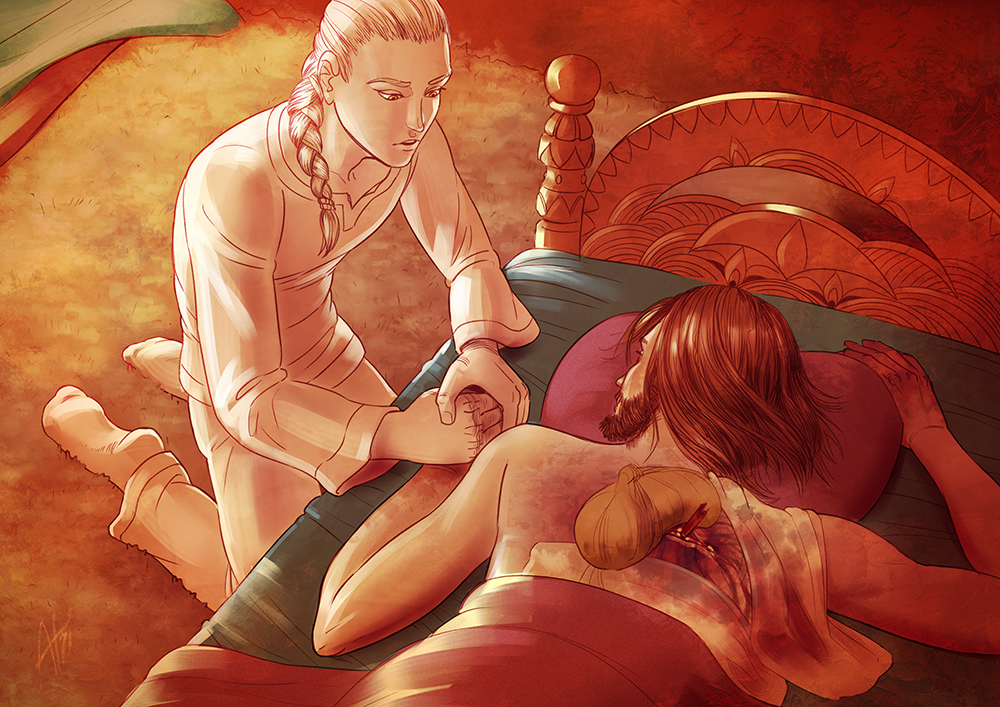
Fitz and Molly by Mirre-Kala
Fitz and Molly by Mirre-Kala on DeviantArt,
used for commentary

After, Fitz takes a meal in strange solitude and goes out to Nighteyes. He proceeds thence to review the documents with which Verity had entrusted him, regarding them amid his chamber for a time in frustration before calling on Patience. There, he encounters Molly and makes something of a fool of himself to her–in front of Patience and Lacey. Patience chides him gently for the outburst after Molly makes her excuses and departs, and Fitz unburdens himself of some of his cares to her. He also conveys to her that she might go to Kettricken and help her with the Queen’s Garden.

Once he leaves Patience, he purposes to call upon Molly once again, doing so by climbing down to her window. She reluctantly admits him into her chambers as tells him that Regal has pressed upon her that a relationship would be ill-advised. In something of a rush, they consummate their love, and they part in the throes of teenaged romance the next morning.

I’m not sure, at this point, how to read the intimate interlude. Hobb does well to elide the more salacious details, certainly; a passage of erotica or outright pornography would seem out of place against the rest of the narrative. And it is the case that there has been motion throughout the series to have Fitz and Molly come together; it is not necessarily a sudden thing that they do. But Fitz does seem to force the issue a bit, which seems…squicky to my reading, anymore. (And, no, I did not always find the passage problematic. I am still not the person I should be, but I am better than I was, and I keep trying to be better, thanks.) Fitz is hardly an honorable character–being an assassin more or less precludes that, and I’ve discussed the topic at some length elsewhere–so a less-than-upright action may be in character, but I do not want to defend even a fictional offender. So there is that.

I suppose my…unease with the passage now is a sign of the ways in which I *have* changed, partly as a result of getting older, partly as a result of having had the exposures I had in graduate school and in life after. I’ll not deny there is a certain ironic orthodoxy that affected me (ironic in that it is predictably heterodoxical), but having the time to think about things that higher education offers did much to help make me more humane. Carrying that into the world outside the ivory tower is not always an easy thing, to be sure, but it does little enough good staying inside it–especially in the windowless basement rooms thereof that I shared with many, many others.

I continue to welcome your contributions.

A Robin Hobb Rereading Series: Entry 36: Royal Assassin, Chapter 11

Read the previous entry in the series here.
Read the next entry in the series here.


The next chapter, “Lone Wolves,” opens with a brief musing on the Fool before turning to a hunting scene, with Fitz guiding the wolf cub in a failed attempt to take a white rabbit in the snow. After, Fitz guides the cub to an abandoned shack that mice have taken over, purposing to leave him there. He attempts to do so, forcefully and with regret against which he tries to steel himself.

Drawing 2: Fitz and Fool Coloring Book by Alex Berkley on DeviantArt, used for commentary

Lost among his thoughts, Fitz is attacked by Forged Ones who purpose to eat him. He fights them, faring poorly until the wolf cub arrives and turns matters. When Fitz wakes from his exertions, the wolf cub reveals his name, Nighteyes, and their bond reasserts itself with greater intensity.

After, Fitz returns to Buckkeep and reports to Verity, whom he finds Skilling with greater intensity than is to his good. Verity, with some apology, directs Fitz to resume exterminating the arriving Forged Ones. The two also confer about Kettricken, and Verity notes the consuming passion for the Skill. Verity also asks about Fitz’s injuries before bidding him be careful. They eat together, and Fitz considers what is likely to come. They also confer about the Fool and the dearth of Skilled people who should be present but are not. Verity assigns Fitz a mapping task and bids him report early the next morning.

As I read the chapter again, I found myself annoyed by the continued treatment of Kettricken as a childish figure who has to be given tasks to distract her. The fight against the Forged Ones she led, among many others, should have served to Verity as an indication that she is a woman of her own volition and no mean leader, not some idle arm-ornament. And while some allowance might be made to Verity for the thought-disrupting effects of any addiction–and the Skill is repeatedly asserted to be addictive–it still rankles that he looks on the leader his wife is as in need of distraction.

Fitz, too, ought to know better. Indeed, in the chapter, he notes knowing Kettricken better than her husband does. Too, he has demonstrated in the text that he has no small degree of political acumen; his specific suggestion speaks to that acumen, in fact, as well as serving as a bit of revenge for wrongs done him in the previous novel. And while it may be the case that the power difference between him and Verity accounts for some of his behavior, Fitz has proven willing to talk back to power before; he seems to have forgotten things he has already learned, no less so than Verity. It’s something that vexes me as I read again, though I will concede it may be me reading with more affect than I ought to once again.

Fall is coming; help me lay in supplies for the rest of the year.

A Rumination on Writing Series

It should not be a secret at this point that I do a fair bit of work that emerges from earlier work I’ve done or that calls back to it. The Robin Hobb Reread on which I’m working now is perhaps the most put-together example, but it’s not the only one, even in this webspace; the abortive Pronghorn Project and Points of Departure are others, as are the several responses to Erin Bartram I’ve made here, as well as the many sample assignments I’ve posted. This is not to say that I always think of things as being series when I start them, but even when I do not set out to put together some kind of continuous narrative or set of essays, I do often look back at what I have already done to find something else to do.

 how writing seor assignment GIF
Image from Giphy.com

That I am often able to do so, though, does not mean I am always able to do so. There are many occasions that see me finding some idea I’ve had in passing, often made in some footnote, that I’ve pursued further; I’ve gotten several conference papers out of doing that very thing, and I tend to write with a lot of footnotes when I do my academic writing. (One professor commented that I tend to make my better points in my footnotes. I’m still not sure what I should think of that.) But I write less academic stuff at this point than I used to (sensibly, given that I am much less involved in academe than I used to be–which is likely to my benefit and others’), so I have far fewer footnotes from which to work.

Between that and being between teaching sessions at the moment–I expect to have a class in each of the next two upcoming sessions, which will be good, but I don’t have access to course materials to work on sample assignments and the like–I find that I have been struggling for things to write between the entries in the current writing series, and I am not able to work on that series enough at any one time to get away with making three or more entries into it each week. I would love to, of course, but there are enough other things going on that I have not been able to make the time for it.

Even with the challenges to composition, though, I am glad to have the writing series to work on. I do better having direction than not, and working on series gives me that direction or some semblance of it. I could wish to have such direction in other ways, as well, but I am no longer in a place where I’ve got a lot of people telling me what I need to do to be able to get what I want–nor yet any such clear idea of what I want as I have had at points in the past.

Any support would still be appreciated.

A Robin Hobb Rereading Series: Entry 35: Royal Assassin, Chapter 10

Read the previous entry in the series here.
Read the next entry in the series here.


The chapter that follows, “Fool’s Errand,” opens with a discussion of the state of Skill practice leading up to Verity’s time. It moves to Fitz recounting his Wit experiences with the wolf cub and his waning denial of their growing bond.

Canis lupus occidentalis.jpg
Standing Wolf by Ellie Attebery on Flickr, image used for commentary

Of a morning, Fitz is asked by some of the guards at Buckkeep to put to Verity an idea that they had had to form an independent guard unit for Kettricken. Fitz presses them for a bit before agreeing to carry the idea to the king- and queen-in-waiting. Fitz also rehearses his continued longings for Molly, as well as the state of affairs in Buckkeep following the funeral proceedings. As he makes to attend on Kettricken, he is greeted by the Fool, who poses to him questions about the dearth of Skilled in the Six Duchies. Fitz contemplates the matter, finding difficulty in interpreting the Fool’s words; the Fool presses on, making mockery of Fitz and leaving him much to consider as he reaches Kettricken’s chambers.

When Fitz reaches them, Regal greets and insults him, provoking him to a rage that morphs into impolitic delight at seeing Molly. She excuses herself, and Fitz enters Kettricken’s chambers, finding her centered and more at ease than he has seen her for long. She notes that she has returned to herself, offering philosophical discussion and meditation. Fitz realizes, with some astonishment, that Kettricken is possessed of the Wit, and the wolf cub through him connects to her, exulting in it. Fitz, however, is wary; knowing that his own Wit-work can be detected by others, he realizes that others’ might, as well.

The chapter offers a bit more to support the idea that the Wit, at least in the Farseer novels, is a metaphor for homosexuality. That Kettricken is possessed of it, marking her as even more Other to the mainstream Six Duchies than her ethnic identity already does, poses the same kind of threat that being a closeted member of a minority population in the United States in the mid-1990s did; the revelation, even then and there, could well be fatal, as is noted here, here, and elsewhere. And Fitz already knows he has enemies that would not scruple to use a perceived usurping outsider as an avenue of attack against him.

There is also an interesting bit about meditation in the chapter. The philosophical approach Kettricken voices is somewhat fatalistic, something of a “the world will happen as it happens, despite what you do,” and the machinations of fate do form a major motif in the series, filled as it is with prophecy and the like. But the meditative aspect of Kettricken’s approach to life, juxtaposed with Fitz’s inability to participate in it, seems it could be read as a comment about the accessibility of such practice. Fitz, while not exactly among the lower classes, is not among the elite; he has to work, and abundantly, while Kettricken sees herself as unoccupied in her role as queen-in-waiting. For her to meditate, when Fitz cannot, could be taken as a rebuke of the practice as something set aside from the working world. But that might be going further than can be sustained by the text as a whole; in the Mountain Kindgom, it is asserted, Kettricken would have had and did have much work to do. She is not depicted as having meditated there, though she seems to report it in the present chapter, so…

I shall still thank you for your support.

A Robin Hobb Rereading Series: Entry 34: Royal Assassin, Chapter 9

Read the previous entry in the series here.
Read the next entry in the series here.


The next chapter, “Guards and Bonds,” opens with a brief rumination on the differences between lived experience and careful study. It moves on to track the night after Fitz leaves Molly’s chamber and the following day, when he calls upon Patience once again. He is somewhat surprised to hear her warn him against court intrigues–and moved at her sincerity in doing so, when it is not to her advantage or even, seemingly, in her interest. Fitz is also shown a bit of his folly by Lacey, who pointedly demonstrates that she is not only a lady’s attendant.

image
Fitz and Cub (Nighteyes) Playing in the Snow from Royal Assassin, taken from facelessfrey’s Tumblr page, used for commentary

After he leaves Patience, Fitz calls on Kettricken. He finds that she is absent, and he goes in search of her. The search leads him out to the stables, where he is informed that Burrich is at work on a funeral pyre for his old hound, Vixen. He is also informed that Kettricken has left Buckkeep afoot, and Fitz moves to pursue her. When he overtakes her, she expresses a desire to attend on Verity and a dissatisfaction that he seems uninterested in her. She also marks the wolf cub that Fitz has been tending, though she does not connect it to him.

Fitz is able to persuade Kettricken to return to Buckkeep for the time, conversing through the Wit with the wolf cub along the way. Molly marks their return, and Fitz goes off to pay his respects to Vixen before gathering meat and bones to take to the cub. They play together for a time, and Fitz feels himself slipping into their bond. When he breaks the connection, it is only with regret, and he is reluctant as he returns to Buckkeep.

Much of the chapter focuses on depicting women, from Patience’s assertions about the historically strong Farseer queens to Patience and Lacey to Kettricken. To my mind, Hobb makes a point of subverting the kinds of typing that pervades Tolkienian-tradition fantasy literature in the depictions; none of the women seem to adhere to one trope or another, even if Patience lampshades her in-milieu presentation. Rather, they come off as having the kinds of contradictory motivations and behaviors that people, rather than caricatures, do. Patience is flighty, yes, but evidently more capable and aware than she is commonly credited. Lacey seems demure but is clearly a threat. Kettricken is strong and noble in many ways, although she is clearly affected by her interpersonal relationships. Given how many other novels, and more popular, have so much trouble depicting women, it is a pleasure to see one that does not. To see it come from twenty years ago (as of this writing), when so many pieces of contemporary fiction–and all too many people who are all too real–still cannot do better than they do…whether it should be read as praise for Hobb or a lamentation of the state of the world is not yet clear to me.

I shall thank you for your support.

A Rumination on Jury Service

photo by john n. lavender
The Kerr County Courthouse,
Image by Constable John N. Lavender on the Kerr County website,
used for commentary

I was recently called up for jury duty, and not for the first time; I seem to attract jury summonses, having gotten at least one in each place I’ve lived since I got married–and two since moving back to the Texas Hill Country. I don’t mind showing up for it, not least because the alternatives available to me aren’t good ones (I can’t afford a $1,000 fine, for example). Also, I don’t want to be in the position of having to rely on people who don’t want to be there if I am ever in front of a jury, so I try to model the behavior I hope to see. How much it might matter is unclear, but it cannot hurt.

As I sat in the benches waiting to find out whether I would be empaneled, waiting once I was empaneled to find out whether or not I would be selected (I was not), I was reminded of one of the standbys of humanisitic education, that study of the academic humanities helps suit people to such acts of engaged citizenship as jury service. I am minded in particular of Amy Wan’s 2011 College English piece, “In the Name of Citizenship: The Writing Classroom and the Promise of Citizenship,” which I read in those heady times when I thought I might be teaching college English as a full-time, continuing thing–which is not the case, obviously, but I had hopes, then. While definitions of citizenship and duty can certainly be argued, and unfortunately often disingenuously and/or with an eye to removing the one from and enforcing the other upon those who can least endure the changes, the basic idea seems a sound one from my experience of the classroom and the courtroom: humanistic education has particular valence in jury service.

For one thing, I did note what might be called rhetorical effects of the setting. The courtroom I reported to does much to focus attention on the judge’s bench while removing its occupant from common access; the judge (whom I will note I found personally pleasant) is the representative of law, present and commanding but remote, or so those called into the courtroom are pushed to believe. Standing upon the judge’s entrance reinforces that those in the courtroom are at the judge’s whim, enforced by armed bailiffs–at least one of whom made a point of calling out people dressed “inappropriately” for the occasion and loudly chastising a very junior staffer with a promise to “tell [her] boss about it, too.” Even though much was made through jingoistic, propagandistic statements about jury service being something “that can only be done by a free people,” and even though the judge commanded those in the court to rise for the entrance and exit of the jury panel, the disparity of power in the room was clear, with particular speech acts compelled under threat of force. (The bailiffs’ hands rested on the handles of their sidearms an awful lot, to my eye.) Would I have noticed it had I not the training and experience I do? Would I perhaps have read it as comfort in a system that stands above people, rather than as a show that may or may not have any substance to it–because law and justice are far from being the same thing–had I not? I could not say; I do not know who I would be without. As it is, I scarcely know who I am with it.

More importantly to me, I think, having been trained in the academic humanities helped me understand better the process of voir dire, when the prosecuting and defending attorneys pressed the members of the jury panel for information to facilitate their selection of a trial jury. I recognized from one attorney many of the same tactics I had seen deployed by professors I have had–and which I have, in turn, deployed–to lead students along to a conclusion the professors desired. I know that the attorney’s job is, in fact, to persuade the jury to the argument s/he makes, that the defendant is or is not guilty of the charge/s pressed, but I do not know that many or most of the others on the jury panel with me were aware that the attorneys were doing their work even at that point, prior to the presentation of any evidence or testimony to bolster their cases. The ability to identify my own biases came up, as well, though I hesitate to state more explicitly, both out of professional concerns and out of a desire to keep the specific case relatively anonymous. And the ability to recognize others’ biases made me a bit sad; I was not the only one with pre-existing opinions that touched upon the kinds of things the case appeared ready to treat, but not as many voiced their concerns or took them into account as perhaps ought to have for the sake of giving the defendant as close to fair a trial as could be.

As I note above, I was not selected to sit on the jury. Evidently, my case for my own biases and their potential negative impact on proceedings was convincing to the attorneys and the presiding judge. Had I been, though, the obvious things would have come to bear for me: the ability to understand dense, often arcane wording and the principles it articulates, and the ability to apply that understanding to evidence presented and the explanations of that evidence offered to the court in the hopes of reaching a true and accurate determination of guilt or innocence of the charges pressed. Such things, absent the guilt or innocence issue, are the core of what study of the academic humanities does–but that’s an old assertion and one that seems not to be nearly so important as might be hoped.

If ever I am on trial, give me a jury of English majors.

Jury duty doesn’t pay much here; care to help offset some of it?

A Robin Hobb Rereading Series: Entry 33: Royal Assassin, Chapter 8

Read the previous entry in the series here.
Read the next entry in the series here.


The next chapter, “The Queen Awakens,” opens with two stanzas from the in-milieu “The Vixen Queen’s Hunt” before moving to detail preparations at Buckkeep for a large hunt. Fitz reports to Verity of the events in the keep, and Verity dithers about how he will proceed and his own ineptitude. He does send Fitz to observe in his stead, keeping himself aloof, and Fitz rushes thence, delayed slightly by Regal.

Queen Awakes   “This is not a hunt. Let your hearts be solemn. We do not go to hunt, but to claim our casualties. We go to lay to rest those the Red Ships have stolen from us. Those we put down today are of the Six Duchies - our own”.-Kettricken,...
Queen Awakes by Jemina Malkki on the artist’s Tumblr page,
image used for commentary

Fitz arrives in time to see Kettricken dispel the festive atmosphere that has cropped up, reminding the hunters that they are riding to put their fellow Duchies-folk to rest rather than to garner any acclaim or claim any trophies. The hunters divest themselves of their joyful trappings, and they prepare to depart somberly. Regal is incensed by the whole affair, and Verity, who has descended to take stock of the situation, is strangely emboldened. Fitz moves off to help ensure that matters are made ready for Kettricken’s return.

When she does return, it is at the head of a funeral procession. Fitz assists in preparing the bodies for cremation and identifying the dead–they include one of his childhood friends. A solemn feast follows the funeral proceedings, with Shrewd unexpectedly presiding, and Fitz marks the unity promoted by the event.

Chade also remarks upon it when he summons Fitz to his hidden chambers that night. The old man waxes eloquent upon the unexpected asset Kettricken has become. Fitz is drawn into somewhat dangerous talk by the open mood, and Chade rebukes him for it before announcing that he is to be dispatched on a mission of his own. He does not share the details with Fitz, and Fitz is soon dismissed.

After leaving Chade, Fitz makes his way to Molly’s chambers, opening her door latch ineptly. There is a tense encounter between them, but it ends up with them admitting their love for one another and kissing.

In the chapter, as Verity dithers, Fitz remarks on the unsettling humanity of the man who seems poised to be the next King of the Six Duchies. He had remarked earlier on noticing some of the incapacities Verity displays, notably in his handling of people when he is surprised, and the narrative earlier notes Verity’s confession that he was not raised to rule, but to aid a ruler he trusts. So that much is not new.

What is new, though, is that Fitz seems taken aback by it. Whether the reader is to take this as a sign that Fitz is becoming disillusioned or as a comment against blind trust in a ruler is not clear–and it ultimately matters little, since both readings work. Fitz is growing, and growing stronger, as his interactions with Regal and Chade, in particular, show. Those who rule are themselves but people, subject to the same flaws and failings as any others, and while they may be trusted to a large extent, they will err, and it is likely that others will pay for the mistakes. It is a lesson that seems to need reiteration far more often than offers comfort.

Nothing witty this time, just a request for a bit of funding.

A Robin Hobb Rereading Series: Entry 32: Royal Assassin, Chapter 7

Read the previous entry in the series here.
Read the next entry in the series here.


The following chapter, “Encounters,” opens with a brief rumination of Kettricken’s unusual isolation when she arrived at court in Buckkeep. It moves thence to Fitz confronting his growing and deepening connection to the wolf he had rescued.

 Fir Snow Winter Evening - Free Stock Photo, Image, Wallpaper
Pretty as it is, this is the kind of thing that can lead to trouble, as Kettricken finds.
Fir Snow Winter Evening from Red Wallpapers, image used for commentary

After, Fitz calls on Patience, having an awkward encounter with Molly along the way. There, he surreptitiously leaves a gift for Molly, and he plies his father’s widow and her maidservant for gossip. The gossip depicts Shrewd as an invalid under the care of Wallace, and Fitz makes to report to his king. When he does, the aforementioned Wallace attempts to interdict him; Fitz finds himself suddenly and unexpectedly supported by the Fool, and the latter manages to provoke an appropriate reaction from Shrewd.

Shrewd takes Fitz’s report, but he repeats himself oddly as he does so, causing Fitz some concern. The Fool confers with him briefly about it, and Fitz goes about his duties in the Keep and outside it during the next few days.

Fitz is about such duties on a later day when he finds Kettricken out riding, beset by Forged Ones. He rushes to her aid, and they manage to fight their way free. In the wake of it, they confer about the situation, and Fitz realizes that it had been contrived by Regal–though there is no way he can prove it to any others.

Then encounter a search party led by Verity not much later, and though the party members are reverent of Kettricken, Verity is not, and openly, publicly rebukes her. He takes her back to Buckkeep, leaving Fitz and the search party to follow–and there is something approaching grumbling from them. There is something similar from Burrich after the horses that had been taken are returned to his stables, though it ranges to include Regal, as well.

That night, Verity summons Fitz to him; Fitz’s talents with the Skill have left Verity with some particularly detailed dreams, to his vexation, Their conversation turns to Kettricken and the situation with the Forged Ones in the area of Buckkeep, and Verity dismisses Fitz back to his own bed.

Verity’s muddling and uncomfortable attitude toward Kettricken noted in the previous chapter carry forward into the present one. Fitz comments upon it, though not openly, and it cannot but be assumed that others in the milieu make similar remarks. Similarly, the issue of unfitness for rule emerges in the present chapter; Shrewd appears to be having mental difficulties, though whether those are inherent to him or a result of the herbs with which Wallace doses him is not clear. Most likely, it is a combination of the two, which has unfortunate implications for the Six Duchies and their stability as matters move forward–and which reaffirms some of the assertions that Hobb’s background and her presumed primary audience’s might well have, that the ruler is much less to be trusted and served than the realm.

I’d still love to say I have your support. Care to send a little help my way?

Another Rumination on Leaving Academe

There is something of a firestorm going on in part of academe really close to that into which I once sought admission–close enough that I would have been expected to teach in it had I been able to secure the kind of tenure-line job I ultimately unsuccessfully tried to secure. I’ll not comment on specifics here; I do not need to, as the discussion is going on publicly and at great length online (and it might well be ended by the time this reaches public view). It will suffice that I acknowledge the “rebel” forces are correct and that the “traditional” parts of the “old guard” are wrong, though those in the right do not need my acknowledgement to know they are right and those in the wrong will likely look down upon me as a lapsed or apostate member of such church as they purport to be priests of.

Graduation Gown With Mortarboard On Retaining Wall : Stock Photo
It’s as good a place for a robe as any.
Graduation Gown with Mortarboard on Retaining Wall by Danial Najmi / EyeEm,
used for commentary

The issues on which the fracas touches and into which it delves are well worth considering, well worth applying to the world outside the ivory tower, and I have been working to consider my own complicity in the problems cited, both in my lingering academic work and in the work I do to lead a small nonprofit agency to help people who struggle against substance abuse issues. But the fracas itself lays bare some of the problems of academe to audiences that might not previously have seen them, which is a good thing in itself, and it serves as a reminder that I am better off for not having to be embroiled in them at this point. Because I am not seeking full-time, continuing employment in academe, I am not facing the kinds of struggles that others are and that are being posed against them unfairly and unjustly. And because I have some distance from the pursuit of that kind of job now, I can acknowledge that I did not “deserve” the jobs I did not get. It may not be the case that they went in all or even most cases to people who do deserve to have them–if “deserving” has anything to do with it, really–but I know I damned well ought not to have gotten them. The folks who have them and are struggling as they are–again, unfairly and unjustly–are far better at the work of academe than I. Those who array against them are lucky and privileged and do poorly in acknowledging neither; they do less well to stand in opposition as they do.

It is not an easy thing to admit to being wrong, certainly, the more so when so much of the work that gets done and the idea of self that gets bound up in doing that work depends upon being right. I well understand the impulse to resist it. But that I understand it does not mean I condone it; the opposite is true. Those invested in being right need to be right, not to assert that they are right. That they refuse to do so (again, as I write this; it might have changed by the time this gets seen) is a disservice to all, and I am glad to have as little part in it as I still have.

But I have to confess to lingering complicity. I still accept teaching assignments, and I still work within predetermined curricula that continue to transmit ideas that are problematic. I do so because I still feel the need to bring in the money, and I do still manage to make some small connections to people who would otherwise not have any access to the ennobling parts of continued study. They are still there, and they may be worth preserving, but there’s a damned lot that isn’t, and I’m glad I’m more or less quit of it.

Any support would be appreciated.

A Robin Hobb Rereading Series: Entry 31: Royal Assassin, Chapter 6

Read the previous entry in the series here.
Read the next entry in the series here.


The next chapter, “Forged Ones,” opens with a brief rumination on Shrewd’s three sons, the close relationship between Chivalry and Verity, and the special status accorded to Regal. It pivots to Fitz’s return to Buckkeep and his shock at seeing Regal riding with Kettricken. He has opportunity to ask Burrich about it briefly before answering a Skill-summons from Verity.

Kettricken by Ptolemie
Kettricken by Ptolemie on DeviantArt,
image used for commentary

When Fitz attends upon Verity, he is bidden eat while he is informed of the presence of Forged Ones in the area of Buckkeep. The two confer about the problem, and Fitz realizes that the Forged Ones appear to be converging on Buckkeep. Verity tasks Fitz with learning more about the converging Forged Ones and to put down those he can eliminate quietly. And Fitz broaches the issue of Regal’s attentions toward Kettricken with Verity, which Verity acknowledges but sets aside in favor of his own concerns before Fitz offers him a strange sort of comfort.

The chapter is brief, fewer than ten pages in the edition of the book I’ve long used for pleasure reading and for scholarly work. (I look forward to the illustrated anniversary editions of the Farseer books that appear to be forthcoming and have pre-ordered a copy of the first one.) That does not mean there is not material upon which to comment, however; it might be noted that Verity, for all the virtues he has as a character in the series, comes across as something of an ass in his attitude toward Kettricken, for example. While it may not be the case that an arranged marriage would be expected to be a happy one, and while a ruler-to-be could reasonably expect subjects to be of service to them, Verity does appear to view Kettricken as supposed to be what Fitz calls in his own father’s marriage to Patience “an escape,” rather than as a person in her own right who views herself as in service to the nation rather than to its leader.

It is something of a tension in the series as a whole, though, between service to the realm and service to its ruler. Some traditional theories of kingship, particularly medieval models that the Farseer novels might be thought to use because of their seeming medievalism (though, as I’ve asserted, it’s not the best reading), hold that the two, ruler and realm, are as one. Service to one is therefore service to the other. At the same time, it is also clear that at least one of the potential rulers of the Six Duchies is not suited to rule; Verity seems to muddle about, though with the thought of preserving the nation foremost in his mind, while Regal seems focused on himself. The theory clearly does not hold when it is clear that the ruler might well be bad for the realm–but that shows as much its writer’s background and presumed primary audience as much as anything else.

Support for the Series, please?