A Robin Hobb Rereading Series: Entry 151: Mad Ship, Chapter 13

Read the previous entry in the series here.
Read the next entry in the series here.


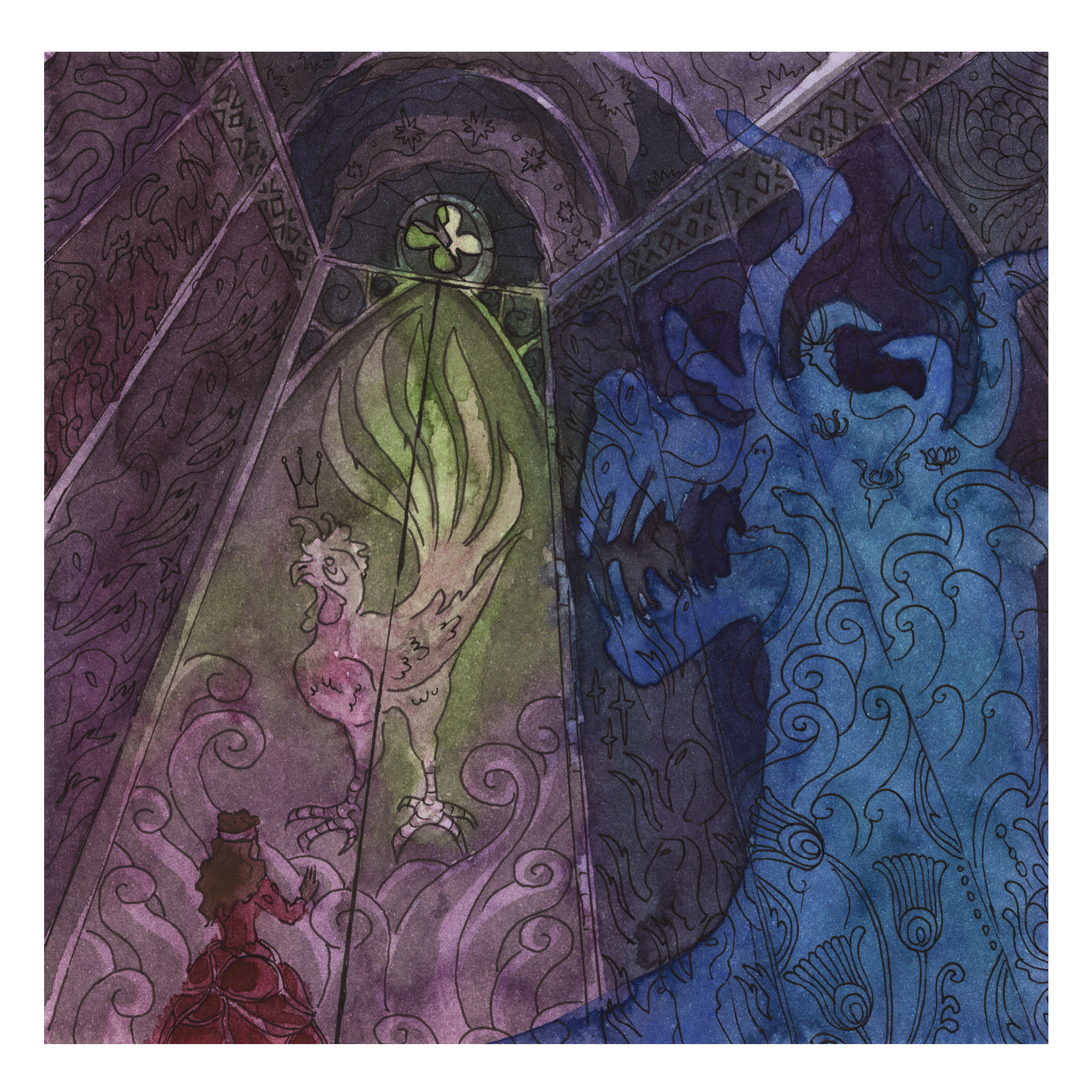
The following chapter, “Interlude,” begins with the serpent Shreever musing on the status of Mauklin’s group. She, Mauklin, and Sessurea alone remain of their original gathering; they are joined by other serpents gone feral as they press northward. Maulkin weakens and grows depressed. One of the feral serpents rises above the water and sings, and Maulklin suddenly grapples therewith, finding that a core of consciousness remains within.

Sea Serpent 2
Perhaps something more like this?
Sea Serpent 2 by verreaux on DeviantArt, used for commentary.

Through more struggle, the three are able to reawaken that consciousness; the serpent recalls his name, Tellur. Slowly, the other feral serpents also return to consciousness, naming themselves–Kelaro and Sylic. After orienting themselves, they agree to align themselves to Maulkin and to press on in search of a serpent who actually remembers what it is they are supposed to do to do more than simply survive in the flesh.

The chapters that focus on the serpents tend to be shorter than those that focus on more human characters. There is sense in this; the minds of non-human sentients would necessarily be less accessible, their actions less understandable, than those of humans to human readers. At the same time, the non-human intelligences are at work in Hobb’s literary world, and it is not good to disregard them. Showing their workings in brief serves to remind readers that there is more going on than the social upheavals clearly at work in Bingtown, in Jamaillia, and between them, while not going so far afield from them that readers lose a sense of narrative and understanding.

More people would do well to recognize that other minds are at work in the world.

It’s only a few weeks until Christmas; send me a present?

A Rumination on Being a Bit Humbler

I confess to no small amount of vanity about my intellect. It is a thing for which I was roundly and repeatedly praised in my childhood and adolescence, and it is something I had thought to use to make my way in the world as an adult. Even now, when they matters a damned sight less than I had thought they would or that one or two of my erstwhile careers would have made them, my brains remain a point of pride for me, as does the cluster of letters at the end of my name that I flatter myself my smarts got for me and that serve as proof of the same.

Carcinisation - Wikipedia
End of the road…
Image is J. Antonio Baeza’s on
Wikipedia, used for commentary.

As part of flexing that intellect, I do a fair bit of writing, as should be obvious. Some of that writing, as I’ve demonstrated here and in other places, takes the form of poetry (of admittedly varying quality). In that, I am often lewd or outright vulgar, to be sure, but I also do not seldom play with fancy words for the sake of delighting in them. It’s perhaps a bad habit carried over from more formal academic writing and growing up as a nerd who spent much of his time with his nose in a book. (Too much, I’ve been told; the problem was really “not enough on other things.”) There is something useful in verse in using one word that will do for five, even if it sends a person to a dictionary now and again.

In my arrogance about such things, I accepted a challenge that was not given to compose a poem involving a word for the process of evolving towards a crab-like form. Without bothering to check up on a word with which I was unfamiliar, I hammered out a brief bit of free verse, an amended version of which is

They age
Enduring without youth
But do not follow Tithonus too closely
Opting rather to snap and scuttle
Than chirp their hopping evening tunes
Carcinization overtaking them
As they drag too much of the rest sideways with them

Of course, that I note it is an “amended” version should be something of a giveaway. I didn’t have it right the first time I let others see it. And I was informed of that–politely and kindly, yes, but no such notice is an easy one to receive, and I found myself hurting from the shame of having erred in such a way.

It has been a few days since it happened as I write this, and the pain has eased, even if I can feel my face flushing red from the recollection. I take the lesson that I need to check things before I move ahead in such ways. And I recall something from my teaching days: when I would discuss sourcing with my students, I would note to them that there is never 100% certainty in a scholarly source, explaining by analogy to sports figures. Whoever the greatest basketball player may be or have been, s/he missed a damned lot of shots; whoever the greatest baseball player may be or have been, s/he struck out an awful lot. I am far from the greatest–even I am not so arrogant as to think otherwise–so it follows that I will miss far more often.

It’s not a reason not to play, though.

Your kind support remains greatly appreciated.

A Robin Hobb Rereading Series: Entry 150: Mad Ship, Chapter 12

Read the previous entry in the series here.
Read the next entry in the series here.


The next chapter, “Portrait of Vivacia,” begins with Brashen looking on as his captain dickers with Sincure Faldin away from Divvytown. As he does, he muses on a recent incident of violence he had had to enact against a crewman who was stealing from the ship. He also reflects on his captain’s bargaining tactics and the strangeness of putting in along the Cursed Shores, noting mentally the ways in which they live up to the name.

https://i.pinimg.com/564x/ec/ec/76/ecec761686c6dbd27a9097e21d9f80b0.jpg
Probably not the portrait in question, but compelling.
Image by Gilles Francescano, used for commentary.

As the dickering continues, Brashen considers the charts he has been making in secret and the knowledge of the waters his captain has as his own security. He also reflects on the tales he had been told of pirate settlements, seeing them now in truth when he had doubted them before. Too, he recognizes among the offerings a portrait of the liveship Vivacia that had once hung in Althea’s cabin aboard the ship. His interest in the painting and the memories it evokes in him attracts attention, and Brashen deflects adeptly, finding himself getting a report about Kennit and his activities in the Pirate Isles. Faldin invites Brashen’s captain to his warehouse in Divvytown, noting that Kennit is like to put in there soon, and the captain tentatively accepts.

Elsewhere, Wintrow marvels at the speed and skill with which the Vivacia is being restored after her struggles. Sorcor and Etta are commanding, intimidating presences aboard the ship as she is repairs. Wintrow muses on them briefly before taking food to and conversing with his father, who rebukes and upbraids him. Wintrow withdraws, somewhat shaken, and is soon after confronted by Sa’Adar. The priest attempts to persuade Wintrow to his cause once again; Wintrow refuses, violently.

Kennit regards himself and his situation as he continues to convalesce. The slow recovery annoys him, and the ship steadies him as Wintrow comes to call. Kennit is eased by his presence and asks after his tattoos. Wintrow’s answers reveal much before he makes to treat Kennit’s amputation. In the continuing conversation, Kennit finds a strangely revelatory scrap of wisdom and seems to return to himself. He orders Wintrow to help him make himself ready, and Wintrow obeys. So does Etta when she, summoned, arrives.

Brashen and the ship on which he is mate arrive in Divvytown. He recognizes the Vivacia at anchor there, and he tries to persuade his captain to travel to Bingtown after; the captain demurs. He also thinks he sees Althea aboard the ship, but that is soon and decisively belied.

There is quite a bit going on in the chapter. The mention that the Vivacia is not the first liveship to be turned pirate is something portentous, certainly, as is the confirmation to Brashen of the Vivacia‘s situation. So, too, is the tension with both Wintrow’s father and Sa’Adar; both have presented themselves as needing removal, and it might be noted that both, in displaying what appear to be symptoms of mental illness (although it is, of course, always fraught to diagnose characters in novels from what the narrator depicts of them), and both retreating under some compulsion into isolation, offer a comment on the treatment of those with mental health conditions. Working in a closely parallel field–substance use disorder treatment is classes as behavioral health, as distinct from but often related to and funded alongside mental health–I am aware that, even now, treatment is other than optimal, not least because of stigma. Whether the present chapter reinforces or speaks against the stigma is an open question, one that might well be worth discussing.

Help me make it to the end of the year?

A Rumination on Black Friday

Once again, I find myself with a post coming up on one kind of observance or another. Today’s is less happy than most, the expected but informal commemoration of consumerist capitalistic excess that is Black Friday. It is a paroxysm of purchasing panic, a recklessly ragged rush to seek out the sales that set up holiday happiness–hardly the thing I am most wont to endorse.

DCUSA.Gallery11.BB&BBlackFriday.Wikipedia.jpg
Seems light traffic for years gone by.
Image is Gridprop’s on Wikipedia and is used for commentary.

Yes, of course, I buy things; I am not able to supply myself and my family with all of what we need without doing so, and I can certainly not meet what all we want. So, yes, I am aware of the disconnection between bewailing buying and doing it myself. And I am aware of the tension between supporting workers whose paychecks come from purchases made on this day and reducing the suffering and stress they undergo at this time of year; I have been such a worker, although my retail and foodservice experience are some time in my past as I write this.

Much as I might be annoyed by what happens today, much as I may try to absent myself from it, I know it does no good. I am but one voice, and even if I can be loud, indeed–heard clearly at a quarter-mile and more on occasion–the many voices of others exclaiming how good a deal they got drowns me out. It is not the only thing for which such is true, either, and the anger that I all too often feel at the state of the world flatly does not matter; no amount of raging I do in my heart or on the page changes a damned thing, nor yet am I in a position to effect any alteration.

I recognize it, obviously, but I am not able to set it aside, even as I know I would be better off to do so. I do not know how not to be angry; I do not know how to be okay with the things I see as wrong and in which I am constrained still to participate. And the only why I should be that I know is far more selfish than I am comfortable with being. As is taking part in today’s “festivities” more than I must.

Help fund my Small Business Saturday?

Some More about Why I Am Still Doing This

A couple of months ago, I wrote a bit about my reasoning for maintaining this and other webspaces, as well as keeping a journal and doing the other writing that I do. I note in it that I had not at that time poured a slab for any kind of concrete answer to why I do this kind of thing. I suppose that, in making the comment, I dug a bit of a hole, opening space into which I could lay a foundation.

Maybe I’m taking the metaphor too far?
Photo by Rodolfo Quiru00f3s on Pexels.com

As I think on it, I am reminded of such questions from my teaching days. (I am, perhaps, stretching a point to speak of that work as quite so far gone, but 2020 has seemed to extend interminably.) I would not seldom get the question of why I studied what I studied; I usually replied with “the jokes,” and it is the case that there is a lot of humor–some overt, some more subtle, some quite vulgar–in the works written in older Englishes. (Yes, plural.) But that is not the whole of it; the jokes themselves are not enough, or there is more going on than wry comments and ribaldry, much as I enjoy both.

I have long enjoyed puzzling out what’s going on in what I read. For me, tracing the references and exploring their meanings is satisfying. (I was going to type “fun,” but the connotations of that aren’t really applicable; “fun” employs greater physical activity and less restraint.) It is enjoyable in the same way that building something is enjoyable, at least for me; it is not play and would not be mistaken for such, but it is an accomplished thing, and, when traced out as an essay in one medium or another, it is something that can be pointed to as having been done, some record of the actions undertaken.

Leaving such a record here and elsewhere and undertaking the actions that support my doing so seems as good an answer as any to “Why do I keep doing this?” (So is the “for you” I gave when I announced the earlier piece online.) I enjoy doing this stuff, in the main; I enjoy reading and discussing what I have read and what I find in what I read, and I enjoy laying out something like my thoughts where others can see them, as doing so helps me to form them more fully for myself. And I am vain enough to be flattered when I see that others are viewing what I put out into the world, to think that they might be of some help to somebody, somewhere, sometimes. (I have direct attestation that something I’ve done was helpful, which was nice.)

I cannot speak to the walls that will rise. But I think they’ll have something to rest upon, at least.

The holidays are coming; help me make it through them?

A Robin Hobb Rereading Series: Entry 149: Mad Ship, Chapter 11

Read the previous entry in the series here.
Read the next entry in the series here.


The succeeding chapter, “Judgment,” begins with Keffria fuming to Ronica about Althea’s conduct, Malta looking on. The girl pipes up, complaining of the quiet in the wake of the Rain Wild Traders’ departure and of Ronica’s quiet rebukes. She complains of Reyn’s assertions, and, after a few more quips, the three lapse into silence.

Gavel image - vector clip art online, royalty free  public domain
This is the kind of thing that comes to mind.
Image from Clipart Library, used for commentary

Elsewhere in town, Althea eats with Amber and continues to relate her tale. She lays out her greater purposes–ending slavery, effecting Bingtown’s independence–and presses Althea for more information. They drink together, heavily, and talk turns to Althea’s intimate liaisons, then to the Paragon, liveships, and the Rain Wilds.

After a bit of tension, Amber goes on to explicate the situation of the Satrap. Something lodges in Althea’s mind, and she excuses herself back to her family home–where Malta indulges fantasies of being fought over as she waits with Keffria and Ronica for her return. Said return startles the three, and bickering ensues until Ronica quashes it with an overt explication of the Vestrits’ financial situation. After, however, discord reemerges. Ronica brokers peace again, and Malta seethes at her perceived exclusion and the seeming threat to her father.

Despite the sneering, conniving tone Malta’s perspective takes, she is not wrong in noting that Althea seems to be self-serving. Nor yet is Keffria wrong to note the dismissal of her husband by her family. Nor still is Ronica wrong in working to secure and stabilize her family. Nor, indeed, is Althea wrong to assert herself and seek to hold others to their sworn word.

But neither are they all in the right–which makes for no small part of the fun of reading. Malta approaches her situation as a game, trusting that her father will make things right for her even as he would likely readily agree to marry her off for the wealth of the Rain Wilds. Keffria fails to recognize her husband’s failures and shortcomings, as well as to assert herself and take up her rightful place. Althea is more concerned with herself than with the greater good of the family. And Ronica erred in not teaching her daughters better earlier.

One of the things that Hobb does well is to move away from the stereotypical depiction of characters; hers are nuanced, flawed, humane (even when they are not necessarily human), and that makes them more “real” than many. I would venture to say more so than in her lauded-as-realistic contemporaries, although I might be expected to be biased in such matters due to my own academic history. Still, it is the nuance and integration of things that allows for so much to take place in the novels, giving those who would carry out interpretive work more to do, and I appreciate it greatly.

Holidays are coming; help me face them?

A Robin Hobb Rereading Series: Entry 148: Mad Ship, Chapter 10

Read the previous entry in the series here.
Read the next entry in the series here.


The next chapter, “Homecoming,” opens with Althea making her way back to the Vestrit estate in Bingtown. She considers her surroundings and the changes in herself as she proceeds, noting the evidence of neglect of the grounds and its disjunction from the in-progress celebration denoted by noise and carriages. As she remains in disguise as Athel, she is greeted politely but coolly as she enters at the back of the house, and she observes the preparatory goings-on as she eats under that disguise and pieces together some picture of events.

Tivy homecoming mum | Homecoming mums, Homecoming, Style
Unfortunately, mum’s not the word this time.
Image taken from Pinterest, used for commentary.

At length, the celebration having ended, Althea is taken to Ronica. The older woman recognizes her daughter instantly and initially upbraids her for having worried her before embracing her tearfully. She briefs Althea on events that have transpired since her abrupt departure. Althea notes her objections and delivers the message she carries from the Teniras. Ronica notes her own objections, and Althea makes to return with her reply to the Teniras.

As she makes her way back to the docks, noting the changes and increased apprehensiveness in Bingtown, she encounters Amber, who enlists her aid in carrying as a cover for conversation. Each notes to the other the need to confer in greater detail than present haste allows. Amber disguises herself as a diseased slave to accompany Althea down to the docks as she listens to Althea’s tale; Althea hopes the woodcarver can help repair the Ophelia, but she will need to clear the idea with the ship’s captain.

When they arrive at the ship, Amber presents herself with celerity. The Tenira’s leap at the chance to see their ship repaired, and the Ophelia herself delights in the opportunity. There is some exchange between Amber and the Teniras as she begins working on the ship, and Althea is asked for her report; delivering it, she notes her own sadness at how events have progressed, as do her interlocutors.

The present chapter notes and discusses the omnipresence of servants in the households of the wealthy and remarks upon how it might be leveraged. It is a point of correspondence with real life, of course; even for those unable to afford servants, as such, service industry workers are everywhere, and my own experience as such a person reminds me that, yes, they listen to damned near everything. The pizza delivery person notes what’s on the television when you open your door; the package handler sees where the parcel’s from and where it’s going. It is a peculiar source of power, one that can be employed to no small effect, and one that offers the potential for significant upset–another point made in the more politically charged novels of the Liveship Traders series.

More and more, as I reread the series, I am struck by how fertile a field it is for cultivating theory-informed readings. There’s a lot to do–but that is one of the marks of better writing, that it offers and sustains multiple interpretations.

Care to send some support?

Driving

It was a finely tuned machine
Built in a union factory from Midwestern parts
Serviced regularly and maintained well
Enhanced by the careful attentions of master mechanics
Filled with the highest-octane fuels
And driven hard but with care and attention
Racing down the roads well paved
And venturing off of them into parts hitherto unknown
Marking off a trail that others could follow at greater leisure and
Not having to navigate
They might look at the surrounding scenery
And see something small and beautiful
Somewhere, though, it hit a rock
Larger than had been expected or understood
Perhaps placed there by someone who didn’t want to see the sights
But more likely unhappy happenstance
A stone in the street that might come to be
And it did something to the drive
Threw the wheels out of alignment
Messed up the timing
Damaged the transmission
So that it handles sluggishly
Accelerates slowly and not to as high a speed
And seems to hiccup as it goes along
I have no other car
And I cannot trade this one in
There is no dealer that would take it
But I miss driving what it was
So much

It’s not quite this bad.
Image from
Wikimedia Commons, used for commentary

I could still use your support, particularly as another holiday approaches.

A Robin Hobb Rereading Series: Entry 147: Mad Ship, Chapter 9

Read the previous entry in the series here.
Read the next entry in the series here.


The following chapter, “Bingtown,” opens with the Paragon considering the sleeping form of Amber and the circumstances leading up to her sleeping aboard. The relationship between the two retains some tension, although they do seem to be growing closer together. And the ship wakes her from a dream she reports having repeatedly and explicates to the Paragon. When she notes dragons, and having seen dragons in the Six Duchies, the ship rebukes her, denying that what she saw were dragons. The following conversation grows heated, and Amber uncovers information in the ship’s ranting.

Ophelia's Mischief
You know where this is going.
Ophelia’s Mischief by Delfin-a on DeviantArt, used for commentary

Elsewhere, the Ophelia approaches Bingtown, and Althea finds herself unable to sleep. She confers with the liveship, interrupted by the approach of Grag Tenira and the ship’s captain. The last lays out his suspicions and concerns about affairs in Bingtown; he anticipates trouble from the encounter with Chalcedean mercenaries, and he arranges to have Althea in a position to get away from the ship if Bingtown authorities attempt to seize her.

After, Grag asks Althea about their earlier conversation. Her replies are frank and honest, not unkind but not comfortable. After an interlude, however, she agrees to consider his suit for her hand.

When the Ophelia makes port in Bingtown, Althea has resumed her guise as Athel and muses amid the work about the home port and returning to it. She marks the presence of a Chalcedean galley in the harbor and looks on as the captain badgers the tax officials. Dispute over patrols and surcharges ensues, and Althea, directed, reports as much to Grag. The captain tells her to take the tale to the town and to set aside her personal strife in the interest of Bingtown unity. After a moment, she agrees.

The conversation between Althea and Grag reinforces one of the issues brought up earlier in the Liveship Traders novels: marriage as economic contract. Unlike the earlier example, the principals in the potential union approach the topic with relatively level heads, both understanding the issues involved not only for themselves, but for their families. It is a much more sober thing than what goes on between Malta and Reyn, certainly, and it highlights another point of concern: heteronormative assumptions at play. The topic of who will leave their family’s liveship in favor of the other’s is broached, and though no resolution is expected or offered, it is clear that Tenira had never considered that he would be the one to leave his family’s ship. He assumes Althea will leave hers, joining him, rather than the other way around–and even if such an arrangement did occur, it seems to defy equal partnership that there was an initial assumption at all.

“It’s always been this way” is not, in itself, a reason to keep doing something, after all.

Care to help keep me going?

A Robin Hobb Rereading Series: Entry 146: Mad Ship, Chapter 8

Read the previous entry in the series here.
Read the next entry in the series here.


The next chapter, “Immersions,” starts with the Vivacia and Wintrow realizing Kennit has died. The pirate’s own self-awareness begins to fade and fray out, but the ship somehow reaches out to him and holds him together, bringing Wintrow to him in a psychic space and guiding the boy to put the pirate’s consciousness back into his body. They share much of their experiences with one another in the efforts, and Kennit returns to his body to find Wintrow slumped over it and Etta weeping in joy at his return. Kennit directs her to be kind to Wintrow, who has passed out on the floor of the cabin.

Shining light on 'near-death' experiences - Chicago Tribune
This is something Wintrow’d like to stop.
Image from the Chicago Tribune, used for commentary

Wintrow returns to consciousness with some difficulty, finding Kennit asleep and Etta at work on sewing. He is taken somewhat aback by her changed attitude toward him, and he asks her after her past. Her frank answer forces him to reconsider his notions, and her subsequent questions to him silence him for a time. Wintrow attempts to make amends, and their conversation turns strangely philosophical.

Etta rehearses to an increasingly uncomfortable Wintrow the beginnings of her liaison with Kennit. Wintrow’s regard for both Kennit and Etta changes as a result, and he excuses himself to attend to himself and the tasks that face him. One of them is conferring with the ship; there is some bitterness in the discussion, and some communion.

Later, the Marietta makes rendezvous with the Vivacia. Wintrow marks the state of the ship and her crew until he is summoned to tend to an angrily convalescing Kennit. Tensions grow between the two until Etta proposes a solution that pleases Kennit, and matters proceed thence.

It is perhaps a small thing in the chapter, although it seems to be important in the broader discussion of the Liveship novels, that Etta appears to have taken ownership of herself as a prostitute. Wintrow, a child who had spent most of the past few years in a monastery, might well be expected to have an uninformed view of sex and sexuality such as he displays in his thoughts during his conversation with Etta and later. That he is struck by Etta’s reappropriation or reclamation of her sexuality seems in line with that, while the reclamation itself speaks, if quietly and briefly, to the feminist critique that pervades the Liveship Traders works. It is a sometimes fraught discussion, but sex work is work, as others discuss in far greater detail and far more eloquently than is given to me to do; Kate Lister is one such person. Etta’s assertion of power through that avenue would seem to bear more investigation.

Your continued support is still kindly appreciated.