Read the previous entry in the series here.
Read the next entry in the series here.
The seventh chapter of Shaman’s Crossing, “Journey,” opens with musings on Keft’s military education, contrasting it with the expected course of the same for Nevare, and a gloss of the history that led up to the establishment of the King’s Cavalla Academy that Nevare expects to attend. Preparations for said attendance receive substantial attention, and a farewell party is held in his honor.

Image is from Cridgway on Wikipedia, here, under CC BY-SA 3.0, and used for commentary.
Details of the party follow, noting its setting and the extent of its guest-list. Concerns of social class are reported, with Keft inviting nearby landholders regardless of rank and Selethe inviting peers regardless of distance. Nevare finds himself hoping to be well regarded by Carsina, reviewing the progress of their relationship since his coming of age and the announcement of their expected betrothal. The party progresses, Nevare doing what he can to discharge his duties as the guest of honor as well as an older brother, the latter when he follows Carsina and Yaril outside and moves to intercede as Kase Remwar emerges into their company. A tense exchange between Nevare and Kase follows, and Yaril feigns having lost an earring to defuse the situation and allow Nevare time alone with Carsina.
Carsina makes flirtatious gestures towards Nevare, to which he responds, and the two talk together of upcoming events. Carsina expresses concerns for Nevare that he sets aside, and the two kiss briefly until Yaril returns with a feigned rebuke. Kase also returns, noting to Nevare that his own father is conferring with Keft about the possibility that he and Yaril will be engaged. As Kase returns to the party, Nevare muses on Carsina and finds her gardenia-scented handkerchief surreptitiously tucked into his jacket. He is somewhat distracted as the party winds to its conclusion.
The next morning sees Nevare set out for the Academy, his father and Duril accompanying him; he takes with him the stone removed from his body after his experience with Dewara, citing it as a reminder of the imminence of death. Selethe bids her son farewell, and the three men head out. Duril helps situate the Burvelles on a barge going downstream and leaves them to their travels. Keft notes the presence of Plainspeople working the deck and complains to Nevare about it as the journey gets off to an easy start, the barge, its captain (Rhosher), and other passengers described.
Nevare reflects on earlier trips to the capital, focusing his recollections on a visit to the estate of his uncle and the break in family tradition that had accompanied Keft’s elevation. Trophies of wars and hunts are described, and Nevare muses on social shifts and family tensions caused by the ennobling of a number of military officers. He also considers his familial obligations, and he looks with some trepidation towards the next stage of his life. Keft reminds Nevare of the coming demands upon him, trying to focus his attention and to give him something of a head start on his studies as the journey downriver passes with little incident.
One incident that does occur centers on a wind wizard Nevare sees sailing upstream. Rhosher comments on the increasing rarity of such practice, and Nevare watches aghast as one of the other passengers on the barge shoots at the wizard, laughing at the disruption of the magic being practiced. One of the Plainspeople working the deck assails the shooting passenger, tossing his gun overboard, and Keft removes Nevare from the deck, trying to ease Nevare’s concerns and reminding him that Rhosher is the law on his vessel. Soon after, the other passengers and the working Plainspeople are put off the barge, new hands are hired, and Nevare and Keft remain the only passengers aboard.
Nevare and Keft intend to leave the barge in Canby, the town and their intended journey onward from there described. As they approach Canby, however, Nevare finds himself wakened by his awareness of a nearby forest. Rushing to the deck, he looks out upon it and finds himself strangely stirred to a religious experience: “this was one of the old gods, this was Forest himself, and I almost went to my knees before his glory” (177). His reverie is disturbed by his father’s approach, and the latter opines about the forest being the former border of Gernia. Keft departs, and Nevare attempts to reclaim his communion with the woods to no avail.
At breakfast that day, Nevare becomes aware of a foul odor that Rhosher notes is the timber-harvest going on at Loggers. When Nevare goes on deck to look out, he is aghast at the clear-cutting he sees, sickened by it and the rapacious greed it bespeaks. Rhosher comments wryly on it, noting the interference with his work that the lumber work occasions.
To address the chapter-length issue: the present chapter, in the edition of the novel I’m rereading, runs 32 pages in length, approximately 5.42% of the novel. The joke might well be made that “The Journey” covers a lot of ground, relatively speaking. If it is the case, as I’ve suggested is possible, that the first few chapters of the novel can be read as something of a stand-alone work, then the present chapter serves as explication for the “next” part; its length, then, makes sense.
Also, for indexing purposes, the following: Arms Institute, Battle lord, Bison, Calabash boat, Canby, Captain Rhosher, Carsina Grenalter, Carson Helsey, Cavalla, Cecile Poronte, Colonel Haddon, Colonel Kempson, Council of Lords, Cuerts, Daraleen Burvelle, Dewara, Ecclesiastical School of Saint Orton, Elephant, Elisi Burvelle, Forest, Gardenia, Gernia, Handkerchief, Helsied Cannon, Humpdeer, Ister River, Jankship, Kase Remwar, Keft Burvelle, King Troven, King’s Cavalla Academy, Lady Currens, Lady Grenalter, Lady Remwar, Landsing, Loggers, Long Wall, Lord Grenalter, Lord Keesing, Lord Remwar, Major Tanrine, Mrs. Grazel, Muskets, Nevare Burvelle, Old Thares, Plainspeple, Roger Holdthrow, Rosse Burvelle, Sara Mallor, Sefert Burvelle, Sergeant Erib Duril, Sirlofty, Soudana River, Spond tree, Steelshanks, Tefa River, Tobacco, Vanze Burvelle, Widevale, Wind wizard, Writ, Yaril Burvelle. It might be expected that a longer chapter would include more items of note. The sheer volume of material present, however, serves to obfuscate what will be important later (which frustrates Chekhov’s gun) while at the same time fostering verisimilitude (which is of importance to Hobb); in Nevare’s travels as in life, there is more than can be explored in detail but that is nonetheless present. Indeed, there is something of the Tolkienian tradition at play in the present chapter, glimpses of such islands and cities and vistas as in Tolkien’s Letter 151–but then, Hobb does situate herself in the Tolkienian tradition even when she moves away from it.
There is another Tolkienian correspondence in the present chapter in Nevare’s reactions to the clear-cutting going on near Loggers (another example of Hobb’s emblematic naming, not so prevalent in the Soldier Son as in the Realm of the Elderlings). As noted, Nevare’s vision of the forest he passes aboard Rhosher’s barge is a religious experience for him, one that offers an entirely different life than he has been raised to lead and to want to lead; it prompts him to reconsider himself, his place in the world, and the world itself, if only briefly. Called to mind are the regard for Lothlórien and the regard for Fangorn Forest remarked upon by a number of characters in Lord of the Rings. Similarly called to mind is the revulsion with which Fangorn and the other Ents regard the desolation occasioned by Isengard; given the timing of the novel, scenes from the Jackson films come to mind as informing the description Hobb presents in the novel. And there is a similarly ecocritical strain in the surrounding discussion between Nevare and Rhosher about the rapacious deforestation going on, although it is clear that Nevare perceives the problem more fully than does Rhosher.
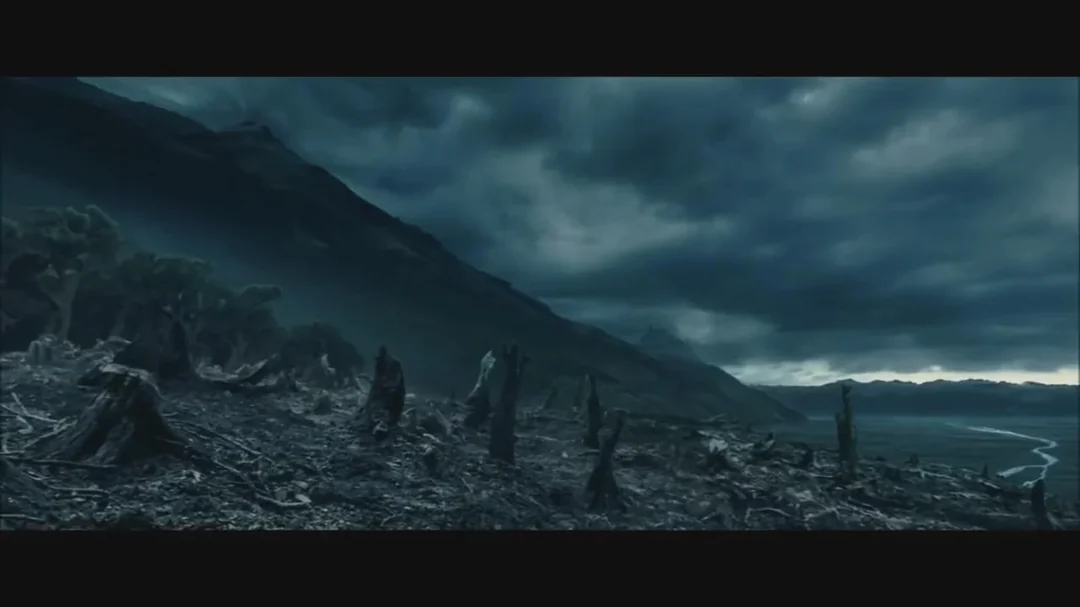
Image is a screenshot from Jackson’s The Two Towers, used for commentary.
Related, I notice in Nevare’s list of trophies in Sefert’s estate an interesting variety of items, including “bison pelts and elephant feet and even a wide rack of barbed antlers from a humpdeer [Keft] had sent back to his ancestral home” (167). The second of those serves to frustrate some of the earlier-identified association between Gernia and the United States, although the bison pelts definitely reinforce the association and the humpdeer might; such descriptions as are present call to mind moose, although the geography does not generally suit the species so well as it does mule deer or white-tailed deer, and it’s not necessarily the case that each species has a one-to-one correspondence with a real-world animal, just as it need not be the case that there is a one-to-one correspondence between fictional nation-states and real ones despite strong parallels identifiable between them. Still, the spread of animals whose remains are on display suggests that the continent on which Gernia exists is a large one–again, Tolkienian distant horizons can be seen.
Unrelated but of note is Nevare’s attention to Carsina’s breasts. The narrative is from Nevare’s perspective in retrospection, so it can be taken to reflect his attitudes; he is still a teenager in the events of the present chapter, and he gives every indication of being heterosexual. I am some years past being eighteen as I write this, but I am not so far past it now and was certainly not so far past it when then novel hit shelves (I was 22 at the time and had not long before started graduate school) that I do not recall how much of my attention was given to such things at that point in my life. (Too much, in the event, which is not the fault of those at whom I looked and about whom I thought.) Although earlier chapters do point out ways in which Nevare is…more docile than might be expected of a boy or young man of his age, that he does pay attention where he does, even if not necessarily flattering, is humanizing. I suppose it points towards at least portions of Hobb’s anticipated audience.
As something of an aside, I note that the present chapter calls attention to Nevare’s hair–namely, its removal. Keft gives Nevare a close, close haircut: “My entire head was now almost as bald as my scar….The stubble of blond hair was almost invisible against my naked pink scalp” (155). It’s certainly an appropriate enough thing; Nevare is on his way to formally enter military service, and such haircuts are hallmarks of such entries, as I’ve noted and as most any man who has processed into basic training in the United States can attest. But it’s also evocative of Hobb’s other work; coming to Soldier Son from Realm of the Elderlings, I am in mind of haircuts as signs of grief in the Six Duchies, examples of which are here, here, and here, among others. And I note with some interest that both major narrating protagonists, Nevare and Fitz, receive such haircuts in Chapters 7, as witness this. Although the chapter-number parallel is likely coincidental, it still attracts attention, making the idea of reading the characters against each other more attractive a prospect. While I’ve already gestured towards that scholarly someday, it may need to move up the list.
Have me write for you; fill out the form below to begin!


[…] Read the previous entry in the series here.Read the next entry in the series here. […]
LikeLike
[…] the previous entry in the series here.Read the next entry in the series […]
LikeLike
[…] the previous entry in the series here.Read the next entry in the series […]
LikeLike
[…] not the only blemish that attracted my attention. Earlier in the novel, the remark is made that Nevare expects to study at the Academy for four years (164), yet the […]
LikeLike
[…] he had been trained all his life to be placed into a position of command (if with some caveats and concerns) is one familiar in form to me, if not in specifics. I’ve had to leave off things I had […]
LikeLike
[…] intended. His epistolary practice towards her is remarked upon, and Nevare finds himself comparing his retained token of Carsina’s affection to his comrades’ similar items. When he receives a letter that carries a scent of gardenia, […]
LikeLike
[…] it is inexact, and some ideas are in tension with one another, but I’ve remarked before (here, here, and here, most relevantly) that a one-to-one correspondence is not necessary for a literary […]
LikeLike
[…] out some comparisons between Nevare and Fitz. For examples, see “Magic and Iron,” and “Journey,” as well as “Crossing the Bridge,” “Sword and Pen,” and […]
LikeLike
[…] commonplaces. Nevare reflects on the passing of the Plainsfolk’s ways of life, recalling events along his initial trip to Old Thares. The use of iron against magic is noted again, and Nevare muses on what has been gained for all the […]
LikeLike
[…] See Shaman’s Crossing, “Journey” and “Old […]
LikeLike