Read the previous entry in the series here.
Read the next entry in the series here.
The sixth chapter of Shaman’s Crossing, “Sword and Pen,” starts with Nevare ruminating on his interactions with trauma victims and comparing their testimonies to his own experiences with Dewara. Much of his rumination focuses on the attempt to drive uncomfortable ideas–the experience on the bridges, notions of his father’s doubts of him–from his mind, and Nevare rededicates himself to his training and development. Months pass, and Nevare’s siblings grow around him as he, himself, undergoes a growth spurt.
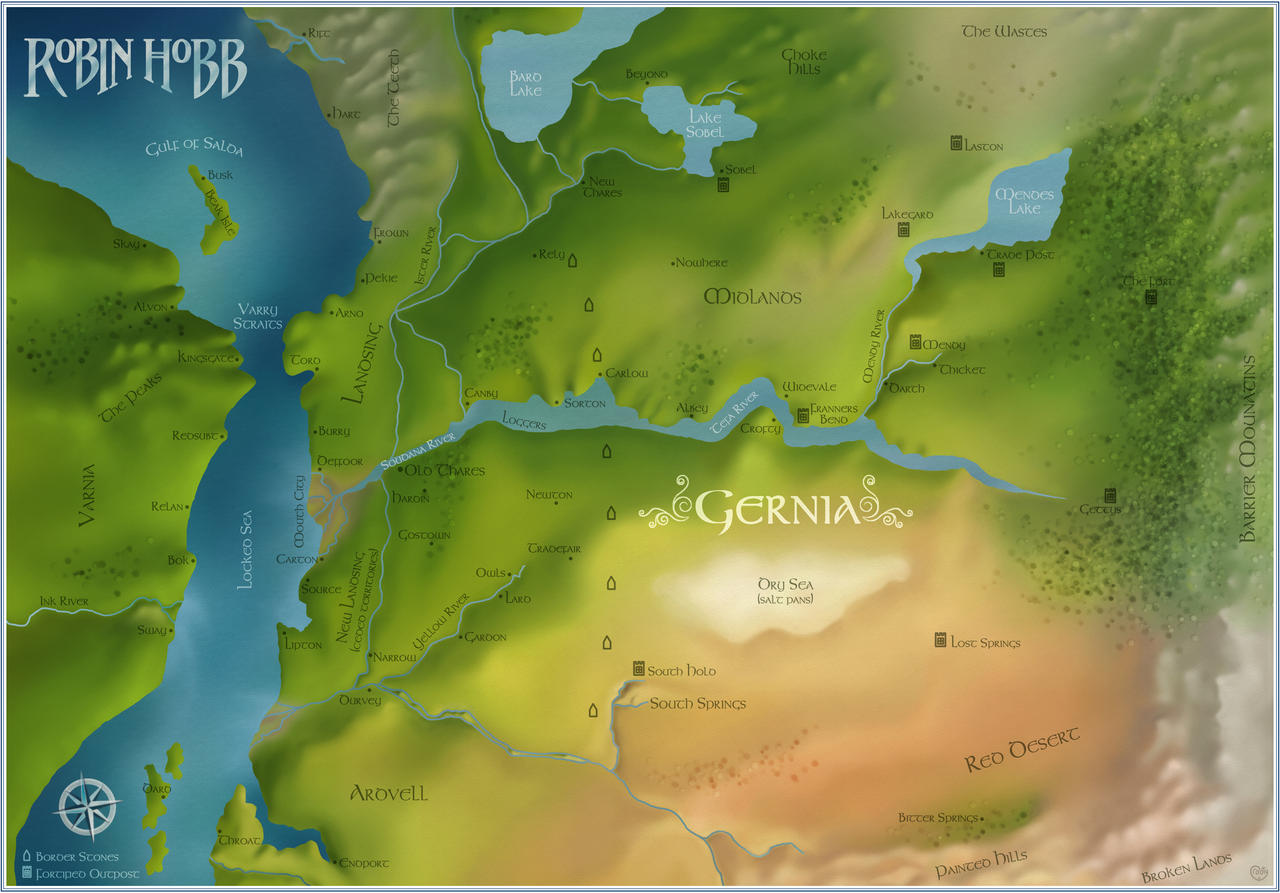
Image is Crooty’s Robin Hobb Map: Gernia on DeviantArt, used here for commentary
News of the outside world reaches Nevare through his father and older brother. Political unrest in the capital, centering on the tension between eastward expansion and westward reconquest, receives attention, as does the increasing spread of plague. Members of the local staff see their families affected by the latter, and Nevare remarks upon seeing both troops heading east and funeral processions heading west. Information about the effects of the plague, both in direct mortality and in lingering effects, are noted.
Also noted are the Burvelle midwinter celebrations. The common celebration, Dark Evening, receives some attention, notably in the family’s minimal observance of the winter solstice. The local, Nevare’s birthday, receives more, particularly as he reaches majority at eighteen. The family gathers, Vanze reading from Writ of the duties of the second son as Nevare is presented with his sword and his first formal journal. The importance of the journal is attested, and the physical object described. Nevare reflects on his family and his place within it, as well as what he knows of how he came to hold it; his father’s history receives some attention.
Celebration continues as Nevare’s father announces wedding arrangements, pending certain conditions, made between him and the neighboring Carsina Grenalter by their respective families. The existing relationships involved are described, and Nevare acknowledges with gratitude the honor being done him.
With that done, Nevare enters a manhood of increased discipline and austerity, accompanying his father and brother on surveys of their holdings and people, noting their ways and their efforts to work the land where they dwell. He thinks towards his expected future, serving in uniform until unable to do so, and then serving the family, and he continues to train in academics and martial arts, setting aside the pursuits of his childhood now ended. Duril continues to train him, growing closer as he passes what he can of hard-won practical wisdom to Nevare. Nevare also learns Duril’s curious personal history, as well as about the recent changes in Gernia’s fortunes under Troven. Resistance thereto and the ensuing conflicts are noted, and details of the Plainspeople and their social structures are presented.
Duril waxes eloquent about the Plainspeople and their groups that he had fought. Difficulties in fighting the Plainspeople are noted, and Duril reports the subjugation of the local Ternu indigenous people. The genocide of the Portrens is also reported, Duril commenting darkly thereupon. He continues, noting the passage of peoples and times and looking towards what he regards as an in-progress war with the Specks. Duril offers Nevare his commendation as the chapter concludes.
To address the chapter-length issue: the present chapter, in the edition of the novel I’m rereading, runs 23 pages in length, approximately 3.90% of the novel. As with an earlier chapter of similar length, however, the shorter page-span felt a longer read. Some of that is addressed by the indexing noted below; there was a lot of information presented, which frustrates the idea that “explication” part of the novel is over at this point but does lend itself to the idea of reading the first five chapters as something of an independent work and the present chapter as the beginning of another. In such a reading, the heavy explication makes sense, structurally; it’s a new story beginning (sensibly enough for a stated and ceremony-solemnized entry into adulthood), and so it needs its own set of explication.
Also, for indexing purposes, the following: Barrier Mountains, Battle of Bitter Creek, Bitter Creek, Captain Herken, Carsina Grenalter, Cavalla, Corporal Curf, Council of Lords, Dark Evening, Dark Woman’s Night, Dewara, Elisi Burvelle, Far Sea, Fort Renalx, Journal, Keft Burvelle, Keslan, Kidona, Kifer, King Darwell, King Troven, Lady Grenalter, Landsing, Landsingers, Locked Sea, Long War, Lord Egery, Lord Grenalter, Nevare Burvelle, Nobles’ Revolt, Old Thares, Percy, Plague, Plains War, Plainspeople, Portrens, Ratmen, Rawly, Rosse Burvelle, Sefert Burvelle, Selethe Burvelle, Selethe Rode, Sergeant Erib Duril, Sergeant Jeffrey, Sergeant Refdom, Shir, Sirlofty, Sirlofty, Specks, Spond tree, Stonecreek Mansion, Ternu, Tree woman, Vanze Burvelle, Widevale, Widevale Mansion, Writ, Yaril Burvelle. As noted, there’s a lot of information presented.
While the novel, dating to 2005, long predates COVID-19, rereading it after the panic of 2020 and ongoing concerns of pandemics has some…effects. It is the case, of course, that pandemics long predate COVID-19, and even as composition of the present novel and preparations for its publication were underway, SARS might well have been in mind, given its timing and spread, per report. And it is not as if pandemics did not occur in the nineteenth-century United States the novel evokes, such as a yellow fever epidemic in 1878 and the various waves of cholera that swept across cities, states, and territories. Some of the description of the effects of the plague in the present chapter call to mind tuberculosis, which was certainly prevalent enough in the novel’s historical antecedents, although the usual care–sanatoria and removal to arid areas–seems not to do much for what the Dappled People are doing to their enemies. (Of course, the milieu admits of various competing magics, so it is not necessary there be a “real world” diagnosis applicable.) Still, the plague is certainly in keeping with the verisimilitude Hobb notes prizing, and it is something resonant perhaps with later readers more than Hobb’s initial readership–something that does not happen often.
Parallels to the United States are both frustrated and increased in the present chapter. As to the former, there is an inversion of expansionist drive, as well as a reminder that the United States’ narrative of being undefeated is very much not in place in Gernia. Gernia is growing east rather than the United States’ west. Too, while the United States likes to assert that it has never lost a war and never ceded territory, Gernia openly acknowledges that it was defeated by Landsing and some of its territories–“our coastal lands and our best coal-mining region” (143)–taken; so much is mentioned in earlier chapters and explicated in greater detail in the present. Along with the explicit hereditary nobility and kingship, it’s a decided motion away from historical antecedent, but that is not necessarily a bad thing for the reading. There are reasons to retain some trappings of mainstream fantasy literature, as I’ve noted on more than one occasion, and it is generally a good thing not to recapitulate tropes and antecedent flatly. After all, if all that’s happening in the text is a repetition of other things, there’s no need for the text.
As to the increased or enhanced parallels between the United States and Gernia, the present chapter notes the age of majority as eighteen, something of a commonplace in the US but not necessarily or even often the case in other works of fantasy fiction. Tolkien’s hobbits famously come of age at 33, for example, and even Hobb’s Six Duchies admit of adult responsibility and position at sixteen or so. Too, Gernia does look towards an expansion past mountains to another sea, something about which I’ve commented before. (I really do need to revise that old paper; perhaps it will happen after I finish my reread of the present volume. It would be a good time.) As such, even though there are decided motions away from both the dominant tropes of fantasy literature and historical antecedent in the text, there is enough (of the latter, at least, although certainly also of the former) to keep readers grounded and oriented. Such grounding and orientation work to maintain verisimilitude and a Tolkienian “inner consistency of reality” such that Coleridge’s “willing suspension of disbelief” can take place.
Of some note, given the long indexing list, is the divergence of naming, particularly as applies to indigenous populations. Certain components of the Plainspeople–the Kidona, the Portrens, the Ternu–are accorded more or less proper demonyms; others, such as the Ratmen, as well as the Specks, are given only pejorative descriptors that do not seem to be what they call themselves or even close thereto. Some of the division seems to be based on martial prowess. The Kidona had been described as difficult foes, while the Portrens were willing to die to a person rather than to accept defeat, and the Ternu obliged the eradication of their entire fighting population for their own subjugation; the Gernians, or at least those who receive sustained narrative attention, seem to respect that. The putative Ratmen receive scorn, and the Speck, whether due to the current conflict or the way in which it is being conducted, also garner no popular acclaim. Such is not something to be sought, of course; it matters little what an oppressor says of the oppressed. But it is something telling, at least to my current rereading.
Of particular note in the chapter is the emphasis on the journal. Much is made of the volume, itself, as it is presented to Nevare; much, too, is made of the importance of filling it and its successors. I’ve noted before (here, here, and here, if not also elsewhere) that Hobb remarks upon the importance of writing–fittingly enough for someone who makes a living writing. That the act is emphasized as important in the present chapter is therefore not to be wondered at; that it attracts attention, not only from the amount of page-space given to it but also from readerly engagement, is also not to be wondered at. There’s much overlap between those who read and those who write; both are likely to value writing, and both are therefore likely to respond well to positive depictions of writing. And I’ll note that even my practice of journaling is influenced by the present chapter’s depiction, something I noted in my journals recently as being the case (among others; I have been much influenced by the reading I’ve done over decades); while getting words onto the page is important, it is nice to have fancy pages onto which to put the words.
Get yourself some writing done; fill out the form below to begin!


[…] Read the previous entry in the series here.Read the next entry in the series here. […]
LikeLike
[…] the previous entry in the series here.Read the next entry in the series […]
LikeLike
[…] to be found, that Gernia is a literate culture (established previously and reasserted emphatically here), but the identification of specific works of note within it, both highbrow and lowbrow in culture. […]
LikeLike
[…] Strategy in Uneven Terrain.” I’ve commented before in rereading the present novel (here and here, as well as in the immediately previous chapter) on the importance of writing within the […]
LikeLike
[…] is as discrete a story as the first five chapters of the novel offer (or that “Sword and Pen” through “Classmates” comprises one), but with Tiber having “walked away […]
LikeLike
[…] starts with deepening winter and the approach of Dark Evening. Nevare reflects upon his family’s observance thereof and contrasts it with what his cohort reports of their own histories with the event. Nevare finds […]
LikeLike
[…] See, for example, “Sword and Pen,” as well as “Letters from Home,” linked […]
LikeLike
[…] seems akin to typhoid or something similar (such as cholera, previously mentioned in regards to “Sword and Pen”).* The symptoms presented, as well as the rapid spread and the vector of infection–the dust […]
LikeLike
[…] they were born–notably Duril, whom he esteems (see Shaman’s Crossing‘s “Sword and Pen“); whether the distaste comes from the persons involved or from a perception of some decline […]
LikeLike
[…] * See my remarks on Shaman’s Crossing‘s “Sword and Pen.” […]
LikeLike
[…] there is some mention of a gift of money in the eastern Burvelle home of a Dark Evening (see Shaman’s Crossing‘s “Sword and Pen”), and Nevare remarks on his supply of hectors as he returns home from the King’s Cavalla […]
LikeLike