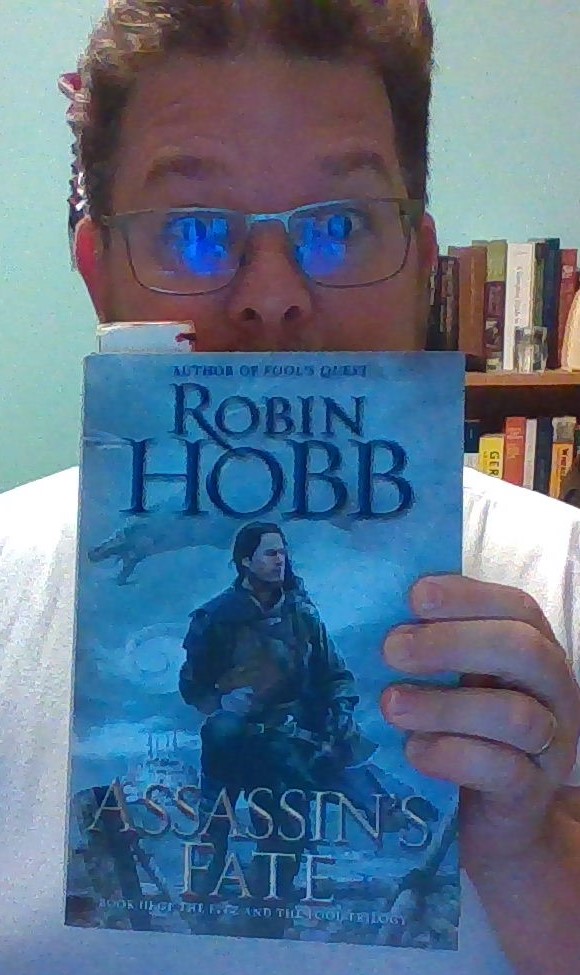
A Robin Hobb Rereading Series, Entry 459: Assassin’s Fate, Prologue

Read the previous entry in the series here.
Read the next entry in the series
here.


An extended excerpt from Bee’s dream journals serves as a prologue for the novel. It speaks of children playing and singing while one, blindfolded, rages in snippets. Wind rises, bursting from the blindfolded child and scattering all. The blindfold remains, its painted eyes staring.

Because I remain a nerd…and I am not a photographer.
Image is mine, as you might expect.

This is it, the beginning of the end…of the Fitz and the Fool trilogy. Fifty chapters remain to reread for this part of the Robin Hobb rereading series…which I seem not to have reviewed or commented on as I had earlier volumes of the Realm of the Elderlings corpus. It’s strange that such is the case, although I will note that I had some…things…going on when the novel emerged into the world and I read it. But not having gone on about the book before, I have the opportunity to approach it more nearly afresh now, and I’m grateful for that opportunity.

More firmly about the text: it is clear that one of the primary narrative foci throughout the Realm of the Elderlings corpus is foreshadowing. Beloved, in whatever guise, is easily the protagonist of the sixteen novel series culminating in the present volume, and Beloved’s core identity is as a prophet who must work to ensure that their prophecies come to pass; foreshadowing could hardly not be a focus in such a case. What is foreshadowed in the present passage, in Bee’s dark dreaming, I recall in broad strokes from my few earlier readings of the text. (What can I say other than that I’ve been busy?) Even without that recall, however, it’s clear that much is set to happen, and most of it will be unpleasant for those involved–but that’s Hobb, whose work I’ve loved across decades.

So, moving ahead…

I am still always happy to write for you; fill out the form below to start the process!

← Back

Thank you for your response. ✨

Or you can send your support along directly!

A Robin Hobb Rereading Series, Entry 458: Fool’s Quest, Chapter 38

Read the previous entry in the series here.
Read the next entry in the series
here.


The final chapter of the novel, “Emergence,” is prefaced by an excerpt from Bee’s journals. It opens with Bee emerging uncertainly back into existence. She hears the voice of Wolf-Father urging her to rise, and she struggles to do so, assessing herself and her surroundings. Some who made passage through the Skill-pillar with her had not survived; others are stripped utterly of sentience. Dwalia, however, retains herself. As Wolf-Father bids Bee flee toward “one here who will help us if I can wake him” (754), and Bee complies with a remark on the changing season, Dwalia commands her pursuit.

Here, again, is Verity-as-Dragon by John Howe, from The Plentyhere, and still used for commentary

The present chapter is, as is often the case with Bee-centered chapters, brief; in the edition of the text I have, it’s pages 752-54, and it empties onto a brief author-blurb. As such a brief thing, and at the very end of the novel, it functions much as a mid-credit or after-credit scene in a movie, gesturing towards the sequel that the audience knows to expect; I want to think it’s a reaction to the prevalence of such devices in movies, although whether on the part of the author, the editor, or the publisher is not clear to me. The argument could be made that, to keep like with like, the chapter could feature early in the third volume of the trilogy…but I also think that the trilogy structure itself rather demands that Bee’s reappearance (which links back to earlier notes that travel through Skill-pillars can occasion displacement in time and that there are agents in the Skill-stream that take some interest in others, such as this) in the present chapter. The confirmation for readers of something they might well expect–Bee received a lot of narrative attention to be discarded–does occasion some shift in tone for the reader; there is hope yet, and for more than just vengeance by Fitz and what might be something like justice for the Fool.

When I next pick up this series, it will be with what is (presently) its final volume: Assassin’s Fate. After going through that novel, there are several directions I can take. There are a number of other Realm of the Elderlings pieces, including The Willful Princess and the Piebald Prince and Words like Coins, as well as some few short stories. There is also the Soldier Son trilogy, which presents a different take on things; I’ve done some work on that series before, and I have had thoughts about returning to that work off and on across time. Further, there are some decidedly different pieces by Hobb of which I happen to own copies, and I’m sure there is other work that I don’t have ready access to–which is all to say that there’s a lot of rereading left for me to do.

I appreciate you sticking around for it.

I am always happy to write for you; fill out the form below to start the process!

← Back

Thank you for your response. ✨

Or you can send your support along directly!

A Robin Hobb Rereading Series, Entry 457: Fool’s Quest, Chapter 37

Read the previous entry in the series here.
Read the next entry in the series
here.


Commentary from Chade regarding his scrying precedes “Heroes and Thieves,” which begins with Fitz waking in darkness, coming up from the effects of the sleeping draught he had been given. Fitz assesses his experience and surroundings, finding the Fool sleeping next to him. After Fitz rises and dresses, he and the Fool confer about the previous evening, about the Fool’s own shifting personal presentation, and about their long and tumultuous friendship.

Yeah, that’ll attract attention.
Photo by Tara Winstead on Pexels.com

Further talk is interrupted by the arrival of Spark, who attends to the Fool-as-Amber, and then breakfast. Over the meal, Spark notes the high regard in which Fitz is held in Kelsingra, and afterwards, they are conducted to meet with Reyn, Malta, and a number of Elderling families whose children are in need of attention. Rapskal confronts them before their meeting, accusing them and approaching taking them into custody when Reyn intervenes.

Fitz, the Fool, and Spark are joined by Lant and Perseverance at the meeting, and proceedings begin. Rapskal, present, does speak against Fitz and his party, to general disapproval. Fitz bows to the pleas of the parents around them, channeling the Skill to amend and ease the changes wrought by dragons upon the children of Kelsingra–including the child of Thymara and Tats, on whom the narrative dwells for a bit. Other healings ensue, and Amber cries out to have Fitz stopped before he expends himself utterly. The surrounding Elderlings plead for more aid, and Lant doses Fitz with elfbark while Amber puts a Silvered hand to him. And at the last, Rapskal cries aloud for their arrest for theft of Silver.

As is not unusual, the prefatory materials on the chapter attract attention. That Chade is able to scry is long established in the Realm of the Elderlings novels; I recall Fitz making mention of Chade trying him on the art, if without success. I also recall that not terribly much is made of it in terms of providing details of scrying’s workings, certainly not to the same degree as other magics at work in the series, whether or not Fitz possesses them–but I will admit that I did not pay particular attention to that aspect of the works. I suppose it becomes another scholarly someday to pore over the works and see how Hobb depicts scrying, at the beginning of the present chapter and elsewhere, and to compare that depiction to others in fantasy literature (Katharine Kerr’s Deverry novels come to mind) and in “real-world” precedents. (If someone’s already done it, please let me know; I’d love to add it to the Fedwren Project, on which I need to do more.)

In the main line of the chapter, I am again put in mind of Fitz as acting something of a Christ-figure. In my remarks on the previous chapter, I noted that healing Phron was not entirely voluntary on Fitz’s part, which, on further reflection, echoes Matthew 9:20-22, Mark 5:30, and Luke 8:45-46 (possibly something I should have included in my 2019 comments about medievalist religion in the Realm of the Elderlings corpus). In the present chapter, Fitz is beset by a group of whom he notes “Some pushed toward me out of hunger and need. Some strove to be first, others only to see what wonder I would next work, and some pushed to try and break through the wall of people in front of them so that they might have a chance to beg a boon of their own” (749-50), even as he continues to heal them. To my mind, as I read again, the scene rings of Luke 6:17-19 (also something I might ought to have included in my 2019 comments). I’m not sure why such passages are on my mind at the moment, though, and I’m not sufficiently skilled a theologian to unpack it further at the moment. But I do think that looking at how Hobb applies the Christ-figure here is something else worth doing–and, again, I’d love to know if someone’s already done that work.

I am ever happy to write for you; fill out the form below to start the process!

← Back

Thank you for your response. ✨

Or you can send your support along directly!

A Robin Hobb Rereading Series, Entry 456: Fool’s Quest, Chapter 36

Read the previous entry in the series here.
Read the next entry in the series
here.


After in-milieu commentary about selecting Skill-couriers and their practices, “An Elderling Welcome” begins with Fitz making a decent show of diplomacy and learning that he is, indeed, confronted by Rapskal. Rapskal introduces himself brusquely as the local military leader and begrudgingly agrees to conduct Fitz, Lant, and Perseverance to Kelsingra’s rulership. Fitz finds himself somewhat affected by the prevalence of Skill-stone in the construction of Kelsingra, and he contrasts what he sees in his present situation with what he had seen in the city previously, as well as what he knows of Dutiful’s impressions of Kelsingra.

Surely, such a thing can do much good…
Photo by Nihat on Pexels.com

At length, Rapskal leaves Fitz, Lant, and Perseverance to confer with his leaders, assigning a subordinate to see to them. Fitz presents himself diplomatically once again, and he and his companions are provided refreshment. After they attend to themselves, Fitz and his companions confer about next steps to take, and Fitz soon falls asleep.

Rest is interrupted by the arrival of Reyn Khuprus, who greets Fitz warmly and receives introductions as he has Fitz, Lant, and Perseverance follow him to a kinder reception than Rapskal had given them. Malta joins them there, apologizing for Rapskal’s behavior and welcoming them. She introduces Amber, attended by Spark, and Fitz finds himself taken up into the Fool’s performance as Reyn and Malta invite the rest to sit and eat with them. Fitz finds himself somewhat taken aback by the frank discussion of social structures at work in Kelsingra. Questions about Phron and their answers elicit sympathy from Fitz, and as Amber continues the conversation, Fitz is able to fill in more of his knowledge of his old friend.

After dinner, Phron joins his parents and their guests, and introductions are made. When Fitz offers to shake his hand, he is taken by the Wit and the Skill, and something like a Skill-healing is effected, although without intent. Phron is greatly eased, and Malta marvels at what has occurred. Fitz is shaken by the event, but he manages to explain at least some of the changes his magic has effected in Phron.

Amber redirects conversation, relating a version of her exploits since departing Bingtown and its environs. Malta asks for healing for the other Elderling children whose changes are proving difficult or dangerous, and Amber attempts to deflect conversation again by glossing the depredations Ellik and his followers wrought on Fitz’s home, eliciting a strong response. Talk returns to the Elderling children, and Fitz, noting caveats, agrees to assist them.

With gratitude, Reyn, Malta, and Phron retire, leaving Fitz, the Fool, Lant, Spark, and Perseverance to confer. Arrangements are made for the evening, and Fitz is convinced to accept a sleeping draught for which the Fool vouches.

There are several things that attract attention in the present chapter. That the Fool would present as Amber in a company composed of Traders is not to be wondered at, perhaps, nor is the ease with which Fitz fits himself to the presentation (including shifting his pronoun references to the Fool as Amber); he has had practice at it, after all. That Lant and even Perseverance adapt so readily is more noteworthy, although Fitz notes “There was something of Chade in Lant after all” (714), which comes off to my eyes as begrudgingly respectful of the younger man. In all, it is relatively impressive that the Fool’s presentation, and Amber’s narrative, would carry off so well as they do in the chapter. The writer being Hobb, however, good fortune for the protagonist is not to be trusted, especially with what the second volume of a trilogy is typically supposed to do: put the protagonist/s in a bad situation, from which they emerge in the final volume.

Comments about the social structures at work in Kelsingra also attract attention. Reyn comments to his guests that “Even after years of it, king and queen sit a bit oddly with us” [emphasis in original], adding that “After years of the Satrapy extorting money from the Bingtown Traders, we who were raised as Traders still wonder why anyone would think we preferred a monarchy. But it’s a convenient way for the outside world to see us” (714-15). I have opined, and at some length, about the social structure of the Traders, seeing in them echoes of the nascent United States (if with better reactions to some pernicious social problems), which Reyn’s commentary supports. There does still seem to be something of hereditary rule in force in Kelsingra, however; it must be recalled that the Khuprus Traders are outrageously wealthy (note this, this, and this, among others), and that wealth is, by the time of Reyn and Malta, largely inherited. While Reyn and Malta are both capable people, they had the luxury–Reyn more than Malta, admittedly–of developing their capabilities free from the brute-force concerns of “Do I have enough to eat not to die today?” that typify the lives of many of the other residents of Kelsingra before their emigration. That is to say, they began their lives with advantages that they have parlayed into prominence in Kelsingra; they had the opportunities to be first with dragons because their preexisting socioeconomic status afforded them as much. It is not entirely meritocracy at work–although, Traders being Traders, it is conceivable that the Khupruses would be shunted aside in favor of “better” merchants. It bears thought, another scholarly someday.

I note, too, the particularly Tolkienian resonance (yes, I know) of Fitz’s not-entirely-voluntary healing of Phron. I have written before (here) about the ways in which Fitz enacts the warrior-hero trope common to fantasy literature; he moves away from, but is still substantially grounded in, the Tolkienian iteration of the trope, or I understood him as being so at that point in his existence and in my own. (We ought to revise ideas and opinions as more information becomes available. It’s something with which many people struggle, clearly and unhelpfully.) Even with what I have come to believe since, I acknowledge that there is still enough to sustain such a reading, to look at Hobb as existing within the Tolkienian literary tradition although she is clearly drawing from other sources than Tolkien–or than just Tolkien, especially since she acknowledges her debt to him. In the present chapter, in addition to the martial and diplomatic aspects of the warrior-hero Fitz does not seldom deploy, there is something of “The hands of the king are the hands of a healer” (LotR V, ch. 8) about his interaction with Phron. While it is the case that Fitz has participated in Skill-healing previously, and to miraculous effect (something that edges towards Christ-referencing, as I think on it again), the present chapter, where the healing happens, and not entirely with Fitz’s approval, seems more…otherworldly than most of the examples in the Realm of the Elderlings corpus. It’s yet another thing that bears some thought and consideration, yet another scholarly someday I hope I live long enough to address.

I am still happy to write for you; fill out the form below to get yourself a piece begun!

← Back

Thank you for your response. ✨

Or you can send your support along directly!

A Robin Hobb Rereading Series, Entry 457: Fool’s Quest, Chapter 35

Read the previous entry in the series here.
Read the next entry in the series
here.


A brief excerpt from Bee’s dream journal precedes “Kelsingra.” The chapter opens with Fitz and the rest taking such sleep as they can. When Fitz is woken by Perseverance coming off of watch, his Wit-sense responds to the presence of a larger predator that, upon investigation, proves to be a large bear showing the initial decrepitude of age. Fitz directs his companions to minimize the danger to them and reaches out to the bear through the Wit, but the bear attacks. The Fool and Spark flee through a Skill-pillar, while the rest scramble up trees and look on in anguish as the animal destroys their provisions.

An image of an armored lone figure holding a single-edged sword and staring out at a frozen city, predominantly in shades of purple
You knew it had to be…
Frozen History by MeetV on DeviantArt, here, and used again for commentary.

After the bear leaves, Fitz, Lant, and Perseverance take stock of what remains and reestablish their camp as best they can. That done, they prepare to follow the Fool and Spark, Fitz speaking plainly of what might befall them. Steeling themselves, they plunge through the Skill-pillar, emerging to find the Fool and Spark before them and angry dragons in evidence. As Fitz directs Lant and Perseverance to take what little shelter there is, the dragons speak to him. As Elderlings approach, Fitz presents himself formally, beginning to defuse the situation as the arrival of additional forces makes violence an unpleasant option. Arrangements are made to conduct Fitz and his group to Kelsingra’s leadership.

The present chapter is not the first part of the Realm of the Elderlings corpus to bear the name; it follows the fourth chapter of City of Dragons in that. Correspondences between the two chapters are limited, although there are some to be found. I’m not sure that there is enough to make any claims about parallel functions; I rather doubt that there is, although I’ve not done the kind of close reading of the two texts against each other that would reveal whether or not there is in any real sense. It’s another scholarly someday, I suppose, if perhaps a winter day due to the brevity I would expect from such a thing.

There are a couple of other things of interest to me as I reread the chapter. One of them is the reinforcement of the idea, going back to the Tawny Man novels, that the dragons communicate with each other and with their Elderlings through the Skill. The implication that the Skill is some lingering trace of Elderling heritage seems clear to me, although I tend to think that it is something that has grown up as the Realm of the Elderlings corpus has extended rather than something that was planned at the outset–but I’ve made comments about that kind of thing before. And it’s not something with which I find fault; people change, and so the work that they do will also change. Nor yet is it necessary for something to be perfect before it gets going.

The other that stood out was the dragons’ inability to find the Fool, the Elderling blanket serving to conceal him from their sight (although not their sense of smell). The implications of that that emerge for me are significant. That there is a limit to the dragons’ abilities is of import; they are often shown as being super-predators and, while some fight against them seems possible, odds are never good for those who oppose them. That the Elderlings of old seem to have produced materials that thwart draconic senses is also suggestive, prompting questions of factionalism and rebellion among them. There’s not enough in the text, certainly at this point, to do more than make a vague suggestion, and I don’t expect that there is some sort of parallel to The Silmarillion waiting in Hobb’s notes for some future editor or scholar to find that would elaborate on it, but what is fantasy for if not for prompting the imagination?

I remain happy to write for you; fill out the form below to get yourself a piece begun!

← Back

Thank you for your response. ✨

Or you can send your support along directly!

A Robin Hobb Rereading Series, Entry 456: Fool’s Quest, Chapter 34

Read the previous entry in the series here.
Read the next entry in the series
here.


After a letter from Malta and Reyn that politely but tersely addresses what appear to be ongoing concerns between Kelsingra and the Six Duchies, “Dragons” begins with Fitz quizzing Lant and Perseverance about the passage of the Fool and Spark. They have no further answers for him, so they eat, and Fitz notes the improvements to the campsite the pair have made in his absence.

Shining brightly amid the darkness…
Photo by Magda Ehlers on Pexels.com

Perseverance sits awake with Fitz for the first watch of the night and asks about the way the Fool and Spark are dressed, meeting Fitz’s answers sullenly. Later, after watches are traded, Fitz finds himself wakeful and joins Lant at watch. Lant asks his own questions of Fitz and is answered, although he is less sullen than he is whining in his receipt of those answers.

Further conversation is interrupted by the return of the Fool and Spark through the Skill-pillar. Spark is badly affected, and the Fool sports Silvered skin. Fitz directs Lant and Perseverance to attend to Spark and directs his attentions to the Fool. Managing to secure a glove over the Fool’s Skilled hand, Fitz guides his friend to where Perseverance and Lant attend Spark, and there asks for a report of events. The Fool lays out his reasoning and proceedings, and Fitz notes the uncertainty of Spark’s recovery.

At the Fool’s suggestion, Fitz looks for the camping equipment they had had together in that place after the Fool had died. With assistance from Lant, he finds it, and camp is reassembled. With that done, the Fool resumes his narrative, if with some prompting. Fitz learns that the Fool had gone to Kelsingra, navigating from echoes of draconic memories he had imbibed, finding the Skill well and touching what of the Silver he could. Doing so provoked the wrath of the Elderlings and the dragons, and the Fool and Spark fled to a ruined chamber, escaping from it only narrowly and returning to where they now sit.

The early portion of the present chapter puts Perseverance in a position not unlike that Fitz occupies with the Fool years before. Indeed, some of the boy’s phrasing in the current moment echoes that of the earlier man quite closely, and I am reminded again both of the fraughtness of gender performativity in the Realm of the Elderlings and of the need to update the Fedwren Project more than I have done. There are several scholars’ works already noted in it that speak to the issue; I have to wonder, I have to hope, that there is more current work that takes in the more recent entries in the Realm of the Elderlings corpus. It certainly presents itself plainly enough, not through what may or may not be a metaphorical treatment as some other things might or might not have been–but, as with several things, I am not the person to carry out a treatment of the matter, having neither the situated nor the invented ethos to address it.

Not entirely related: I appreciate the references to Rapskal and Heeby made in the Fool’s narrative. They are not named, and sensibly; despite who the Fool does know under the guise of Lady Amber, he would not have any reason to know, or even to know of, Rapskal and the dragon he serves. But it is entirely in keeping with their characters that they would jealously guard the Silver and move to violence before any other concern, and it is suggestive that some uses of the Skill-stone still seem to elude the Elderlings of Kelsingra at this point in the overall narrative. I find myself wondering if and how that will develop if and as Hobb presses ahead with her series (or if there is a Brian to Hobb’s Frank waiting somewhere, although a Christopher to her JRR might well be preferable).

I am somewhat struck with Fitz’s handling of matters in the present chapter. He seems to have a fairly decent handle on himself, which is…uncommon for him, even with his years and experience. So much said, it’s a good thing to see; how long it will last, though, I don’t recall. I guess I need to do more rereading…

I’m still happy to write for you; fill out the form below to get yourself a piece begun!

← Back

Thank you for your response. ✨

Or you can send your support along directly!

A Robin Hobb Rereading Series, Entry 455: Fool’s Quest, Chapter 33

Read the previous entry in the series here.
Read the next entry in the series
here.


After an entry from Bee’s dream journal, “Departure” begins with a gloss of Fitz’s ongoing preparations to leave Buckkeep in pursuit of the Servants at Clerres. How he equips himself and plans to proceed are described, as is how he is sent off by his family and the assembled court of Buckkeep. Fitz notes some unease and sets it aside as the formal farewell proceeds and Fitz sets out with a party suitable to his station towards the Skill-pillar that was Bee’s last known location. Arriving there, Fitz gives a few final instructions, steels himself, and proceeds through the pillar.

…sometimes you don’t.
Photo by Pixabay on Pexels.com

Fitz is surprised to find that Lant goes with him, and he is more surprised that Perseverance accompanies them. To their questions, he makes harsh answer, and then he directs them to set up camp as best they can, given their situation. Matters proceed as well as can be expected, and the three take stock of their supplies, making clear that neither Lant nor Perseverance had thought through their actions. Fitz manages to calm himself and assess matters more rationally, although he is still displeased, and he sends through the Skill to Nettle and Dutiful, updating them.

The night passes uneventfully for the three, and the next day sees Fitz go out to hunt, setting Lant and Perseverance to tasks while he purposes to do so. As the pair address them, Fitz makes his way to the old stone-garden, visiting once again Verity-as-Dragon, tending to his lost king and confessing himself thereto. The man within responds to his nephew, easing him into sleep.

Returning to Lant and Per, Fitz makes a kill of a rabbit and learns that the Fool and Spark have been by, using the Skill-stones to travel. Fitz is incredulous as he receives report of their actions.

I‘m minded as I work through this that one of my scholarly somedays–and there are many, as I’m sure those of you whose continued reading I appreciate will have noted–is correction and updating of the work in this webspace. More than one of the prior pieces of writing I’ve referenced in putting together this commentary has needed some adjustment, and I cannot think that those I’ve noticed this time around are the only ones that are in such need. While it’s good to have something to do, it’s an annoyance to have made easily avoidable mistakes in my work; I really should be doing better than that. For such things, I can but apologize, work to proofread what needs it, and try to do better as I move forward.

It might also well be written that the present chapter seems to make some use of deus ex machina, an old device about which I’ve made some comment. There’s setup for such things as might appear so, though; Verity-as-Dragon is hardly new to the Realm of the Elderlings, after all, and the capriciousness of travel through the Skill-stones has been amply and repeatedly attested, in the present volume and others in the Realm of the Elderlings corpus. Verity’s response to Fitz might be a bit of a stretch, although it has been noted that the extent of Skill-knowledge that was available exceeds what is available; the recovery of what Regal had sent off to the Pale Woman was incomplete, and much of what was recovered was described either as damaged or at the leading end of substantial language change, such that it was unintelligible to modern-to-the-narrative-milieu readers. Verity, in isolation and seemingly interpenetrated with what might well be called a physical manifestation of Skill and which is used expressly to store and make available for consultation memories, has had time in which to plumb the mysteries of his magic. So perhaps it’s not quite so much deus ex machina, after all, but some variation on Chekhov…

I’m happy to write for you; fill out the form below to get yourself a piece begun!

← Back

Thank you for your response. ✨

Or you can send your support along directly!

A Robin Hobb Rereading Series, Entry 454: Fool’s Quest, Chapter 32

Read the previous entry in the series here.
Read the next entry in the series
here.

Do note that the present chapter discusses torture in some detail.


After commentary regarding proper installation of Skill-pillars, “Travelers” starts with Fitz announcing his decision to leave Withywoods to the household staff, who accept the news easily. Matters are arranged to facilitate that departure with relative ease, and Fitz returns to Buckkeep, learning along the way that the Fool has been found where Fitz had suggested seeking him.

Maybe something like this?
Photo by Jaxson Bryden on Pexels.com

After arriving back at Buckkeep, Fitz confers with the Fool about his doings, learning that the Fool had gotten lost in the warren of secret passages that permeates Buckkeep. He had gotten lost while seeking more dragon’s blood, thinking to use it to restore more of his body and memories of a Skill-river and the effect of Silver (though not by that name) on dragons. Fitz rebukes his friend, and the two confer about how they will proceed to Clerres, the Fool laying out details he had not previously revealed to Fitz about his return thence and the social structure in place there, the machinations of those in charge of it. Some of the Fool’s sufferings are rehearsed, as well, and Fitz’s resolve against the Servants hardens.

Afterward, Fitz calls on Chade, finding him alone and lucid. Chade notes the effects of his age, not all of which are feigned, and he commends Fitz. He also notes Lant’s desire to accompany Fitz and urges him to allow it; Fitz holds his tongue on the matter. Chade also notes his distrust of Rosemary and her unraveling of his information network, but he still urges Fitz to press on with his own work. To that end, he presents Fitz a pair of exceptionally detailed maps on which he had worked for years.

Fitz returns to his chambers and secrets his gifts therein before responding to a Skill-summons from Nettle and Dutiful. Having made himself presentable, Fitz presents himself, finding the Farseers aside from Chade awaiting him. Arrangements are made for how the prince Fitz is will proceed, and a cover-story is introduced–along with comments about the residents of Kelsingra. The Fool is also discussed, and Fitz calls upon him to announce his intention to proceed to Clerres alone, to the latter’s exceptional upset.

The next days pass with Fitz making final preparations for departure. Kettricken gifts him yet another map, noting quietly her knowledge of how Dutiful came to be. A farewell feast is given, and private farewells are said–some of them brusque, indeed.

The present chapter is a long one, some thirty pages in the printing I’m reading. I am reminded once again that I need to find a cohesive print-run of the Realm of the Elderlings novels to get page-counts for the chapters; I remain convinced that there is something to be found in the relative lengths. O, to have the resources to undertake such a project!

The present chapter also offers more than a few things I like to see in a continuing work. One of them is a reference back to earlier parts of the body of work–in this case, Fitz’s first receipt of prophecy from the Fool. (It is also of interest that it’s just after six years since I treated that part of the corpus; how time flies!) There is a delight in seeing efforts made to maintain continuity across a body of work, to see attention to detail and long reading rewarded in text. I look for such delights, which the present chapter provides at several points.

I also look for the kind of commentary that can be found in the present chapter as the Fool describes the generational machinations of the Servants–“They are tremendously wealthy. They have been corrupt for generations, and they use the prophecies to make themselves ever wealthier. They know what to buy to sell later at a much higher price. They manipulate the future, not to make the world a better place but only to add to their wealth” (627). It may well be an affective reading, but I do find myself in mind of various oligarchies, established and aspiring, I see at work in the world. I am probably not the only one, either, and I think an examination of such commentaries in Hobb may be an addition to my list of scholarly somedays.

My medievalist self takes some interest in the description of Clerres as akin to Mont St. Michel–although I’ve discussed that much previously. Still, that I managed not to miss all of the details in my earlier readings is a comfort, and the partial correspondence remains in place. I wonder, though, if there is another scholarly someday in tracing Arthurian parallels, here; does Fitz castrate some giant, if only obliquely? I’ll have to consider it further as I reread more; it’s been a while.

So much said, the present chapter does a lot of explicatory work. As it is near the end of the novel, I have to read that work as being done to set up the third volume of the trilogy, Assassin’s Fate; I’ll proceed to that text soon, although not as soon as I might like–as I reread, again, I feel again the hunger for the reading that I recall feeling in earlier readings, spanning nearly ten years with Fool’s Quest and longer with other parts of the Realm of the Elderlings novels, that has led me to linger in place for hours, moving nothing other than my eyes except to turn the pages, and to stay awake far longer than the next day’s working demands suggest, taking in the text at once.

It is good to have such feelings.

I’m happy to write for you; fill out the form below to get yourself a piece begun!

← Back

Thank you for your response. ✨

Or you can send your support along directly!

A Robin Hobb Rereading Series, Entry 453: Fool’s Quest, Chapter 31

Read the previous entry in the series here.
Read the next entry in the series
here.


Following an excerpt from Bee’s dream journal, “Loose Ends” opens with Fitz leafing through the same in a sleepless night, rehearsing some of his earlier follies (notably this and perhaps this) and resolving to proceed, but with more deliberation. That deliberation pushes him to return to Withywoods to settle matters there, something to which the Fool objects angrily.

It beckons…
Photo by Micah Boerma on Pexels.com

Fitz takes Perseverance with him when he goes, and the guard company commanded by Foxglove accompanies the pair. Their progress towards Withywoods is glossed and uneventful, and Fitz is welcomed back with reports of events there since his last visit. He secures what had been Bee’s room and directs that Shine’s and Lant’s belongings be forwarded to Buckkeep. And in the evening, he considers his course of action, finding himself unexpectedly in communion with Nettle through the Skill.

The next morning sees Fitz begin to learn from the household staff more of how events had fallen out since he was last on site. He learns also, to his surprise, that his treatment of Ellik and other Chalcedean raiders has been made known to the folk of Withywoods by way of Perseverance, who reports sadly on the state of his own mother. Foxglove is also apprised of matters and apologizes for her earlier cool treatment of Fitz.

Fitz spends more time putting things in order, his efforts glossed until he comes to sorting his personal effects. Those receive more detail, few as they are, as he arranges some and seeks out others that he knows Bee had secreted away. As he goes about that work, Fitz is overwhelmed by grief, prompting another Skill-sending from Nettle. As they confer, she notes that the Fool has gone missing, and Fitz offers some recommendation of where he might be found. Too, the two commiserate, after which Fitz outfits himself for the work he means to do.

Outfitted, Fitz reads Bee’s writings, finding himself often moved to tears by them. The next morning, Fitz takes a few things to Bee’s hiding place and locks it before taking his leave.

My background of media consumption shows itself, certainly, in one reaction I had to rereading the chapter. As Fitz equips himself for his trip to Clerres, I was reminded of nothing so much as Batman. The belt full of pouches of weapons and other accoutrements, weapons secreted in other places on his person, and the like all seem very much in the line of Bruce Wayne and his clandestine exploits–although, of course, Fitz is not so skilled as the Dark Knight, and he has little compunction about killing even on a good day.

That little bit of old nerdery aside, it is good to see that Fitz can, occasionally, learn from his mistakes. Although he certainly has the impulse to charge ahead (and, as I read affectively, I find it understandable; I think I would want to charge off after someone who took my daughter, and I am, well, me), he manages to restrain it in favor of making more careful preparations and undertaking careful pursuit. Admittedly, the lesson comes late for him; he reflects on earlier follies, and the fact that they are plural is an indication that he is not always the best of students. His more recent expedition, even in the present volume, suggests as much more forcefully. But the lesson seems, at last, to have taken, and that is good to see.

I don’t know that the present chapter offers a whole lot in terms of scholarly interest; it seems a narrative need, an accounting-for of some of the titular loose ends rather than any thing unto itself. There are a few offhanded comments about religion to be found, and those might be of some interest if there is some revisitation of an earlier project of mine. I’m not averse to doing such a thing, as might well be noted, and I’ve as much as declared my intent to extend at least one earlier project already; I might as well do another one, too, adding to my scholarly somedays. Too, there might be something to do regarding torture–which the present chapter references without presenting directly–as that is a recurring theme in Hobb’s work (not only in the Realm of the Elderlings novels; the Soldier Son series, which I will address at some point, has its share of such, as do some of the “peripheral” works under Hobb’s name). I’m not sure if and how I might address that, though, but there may well be time for me to consider it…and if I don’t, I’m sure someone else will.

If you like reading what I write, have me write for you, you well might!

← Back

Thank you for your response. ✨

Or you can send your support along directly!

A Robin Hobb Rereading Series, Entry 452: Fool’s Quest, Chapter 30

Read the previous entry in the series here.
Read the next entry in the series
here.


A commentary on how Nettle revitalized the corps of Skill-users in the Six Duchies precedes “Prince FitzChivalry.” The chapter, proper, begins with Fitz returning to his chambers briefly before making himself presentable for an audience with King Dutiful. As he does so and awaits the audience, Fitz muses on the presence of servants and their ministrations.

You know there’s a joke here…
Photo by Flip Side on Pexels.com

Fitz is admitted to the king’s presence, the chamber described as he enters it. Dutiful first thanks Fitz for recovering Shine. He then reminds Fitz that he occupies a place in the government of the Six Duchies, one that requires the king be able to trust him to act as a prince of the realm, and he bids him report, in full, his actions. Fitz does so “and left out no detail” (576). In response, Dutiful relives Fitz of his assassin’s duties, which takes Fitz aback.

Being dismissed from his audience with the king, Fitz stalks out without clear purpose, only to be found by Spark and informed that he has been assigned new quarters, the Heliotrope apartments where Patience had formerly dwelt with Lacey. Spark adds that she and the Fool have also been re-quartered, the Fool returning to the rooms he had had as Lord Golden.

From that meeting, Fitz calls upon Chade, finding him in his own chambers and attended by Shine. Fitz is again taken aback, seeing the decline that has afflicted Chade in seeming haste. Conversation between Shine and Fitz is tense, but it soon turns to Shine’s latent talent with the Skill. Chade unlocks that talent, prompting outside intrusion, Nettle soon arriving to take matters in hand and sending Fitz on his way.

Reluctantly acceding to the Skillmistress’s command, Fitz leaves Chade’s rooms and seeks out his own new ones, inspecting them thoroughly and carefully. Finding little to keep him there, Fitz seeks out the Fool, who is upset about the relocation and the interference from Rosemary. Fitz is able to offer the Fool some comfort, and he makes some recommendations for how the Fool might proceed. Beginning to do so, Fitz recalls some of Patience’s wisdom, although he is jarred by how he is enacting it.

Time passes, and Fitz begins to plan how he will proceed, and he takes steps to enact his plans. Most of them take the form of separating himself from his attachments, ensuring that he is not needed where he is so that he can go to where he is needed. How the others in Buckkeep fare is noted, and plans are made to question Shine further about events. Nettle and a reluctant Kettricken assist with the questioning, and useful information is uncovered. Lant is less helpful, but Riddle manages to be of help with him.

At length, Fitz begins to recover his Skill, training it back up as he continues to retrain his body. More of his affairs are settled and those in his care committed to other caretakers. The Fool adopts another new guise, Mage Gray from Satine. Dutiful takes some pleasure in Fitz’s evident integration into the life of the nobility, and, over a conversation between them and Chade, the latter reveals some unexpected insights.

The present chapter prompts another of my many affective readings. Dutiful’s decree removing Fitz from assassin’s work–not only reassigning him, but forbidding him from them–is a career-adjustment that is not unfamiliar to me. I’ve written about it a few times, I think (this is an easy example; it links back to others, as well). There is quite a bit of unease involved in leaving behind a career for which one has trained for decades, even when that career has not been entirely or even largely fulfilling; there’s a lot of identity constructed in such training and execution (yes, the pun is intentional), and so there is a lot of existential uncertainty involved in leaving it behind. There’s more in being forced out of it, and it remains an uneasy adjustment even years later, because it’s not always if ever possible to leave such a background behind entirely (as I’ve noted, too, here and likely elsewhere). Once again, then, I find myself feeling for Fitz, which I still know is unacceptably sentimental but which I persist in doing, regardless.

The present chapter also offers an interesting little bit of humor, the backhanded kind of thing I’ve commented on before and continue to enjoy finding (again? I hope so). The chambers Fitz is given, the ones formerly inhabited by Patience when she had come to Buckkeep after Chivalry’s death, carry the name of a plant that seems to have originated in the Americas (per Luebert, Hilger, and Weigend, here; I do still try to work from good information, you know) and that is toxic to people and animals (per NC State University, here), with the addition of being more dangerous when not in blue than when in it (per New South Wales, here, despite comments about nativeness). Even if it is a weak support, it remains a support for some ideas that I have had. Too, Fitz has not always been healthy to be around, although he seems to be deadlier when he is not wearing Buck blue than when he is. Again, it’s a backhanded thing, but that there is something there to look at is a pleasure.

On the topic of naming: I remarked some years back that Fitz’s very name indicates fundamental failures in the chivalric ideal. In some ways, the present chapter motions towards Dutiful’s recognition of such; he comments, among other things, that the Farseers have failed Fitz in assigning him to the assassin’s duties in which he had been trained by royal command. (To his credit, he also includes Chade among those who have been wronged.) But even that is a failure on Dutiful’s part and a gesture towards the failures of chivalry; for one, the king does not deny the need for such services, glossing over the fact of his retention of Rosemary in the assassin’s role, and, for another, the litany of services that Dutiful recites to Fitz as things for which he is grateful are only possible because Fitz was trained as he was and had his familial connections. It is a peculiar myopia, and while it may well be in keeping with Dutiful’s own name that he feels and acts out of an obligation to his older cousin, it is perhaps not so much in it that he would remove from particular activity someone who has been a resource in that particular activity. To my eye, Fitz continues to be an emblem of the failures of the chivalric ideal, and I think a fuller explication of that will be another scholarly someday for me.

If you like how I write, why not hire me to write for you? Fill out the form below for details!

← Back

Thank you for your response. ✨

Or you can send your support along directly!